

You can seem confident and still feel as if your value disappears when you fail. You can receive praise and still worry that one mistake will prove you are not enough. This is why the difference between self-esteem and self-worth matters. They are related, but they are not the same thing.
Self-esteem is often tied to how positively you evaluate yourself. It can rise when you perform well, feel capable, receive approval, or like what you see in yourself. Self-worth goes deeper. It is the belief that you still have value as a person even when your performance, appearance, popularity, or productivity changes.
This article is not about becoming endlessly confident, forcing positive affirmations, or pretending criticism does not hurt. It is about separating two questions that often get fused together: “How am I doing?” and “Do I still matter?” When those questions become one question, every setback can start to feel like a verdict on your existence.
Quick Answer
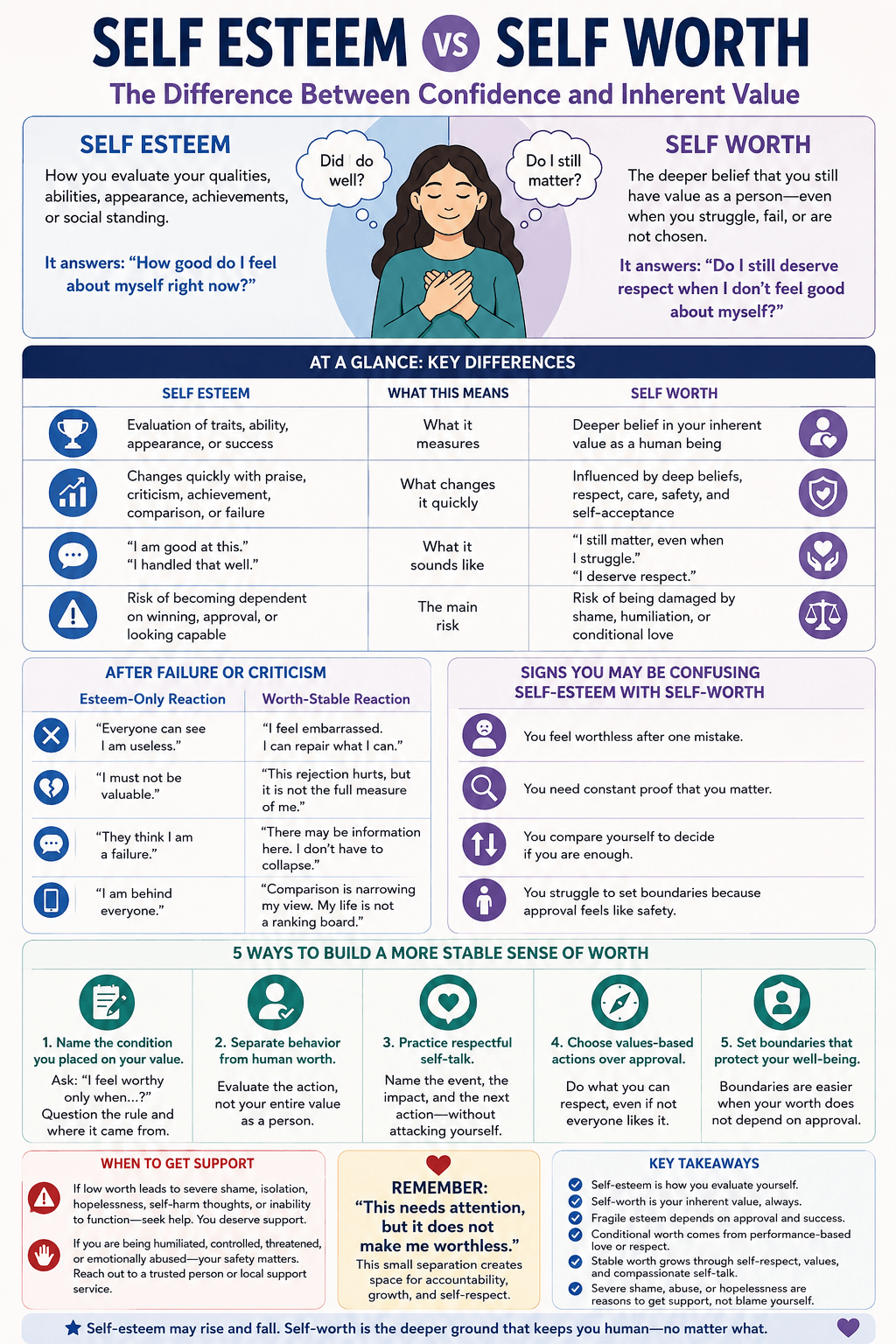
The simplest difference between self-esteem and self-worth
Self-esteem is how you evaluate your qualities, abilities, appearance, achievements, or social standing. Self-worth is the deeper sense that you are a valuable human being who deserves basic respect and care. Self-esteem can fluctuate with feedback and performance. Self-worth is healthier when it remains more stable, even during failure, rejection, embarrassment, or criticism. This distinction is part of self-awareness because it helps you notice what your sense of value is attached to. Some people feel steady until criticism, rejection, comparison, or failure touches the part of them that still feels conditional.
Why the difference matters in everyday life
If self-esteem and self-worth are fused together, normal setbacks feel much larger than they are. A bad presentation can feel like personal failure. A breakup can feel like proof you are unlovable. A critical comment can feel like a collapse of identity. Separating esteem from worth helps you learn from feedback without treating pain as proof that your value is gone.
What Self-Esteem Means

Self-esteem as evaluation of ability, traits, or performance
The APA Dictionary of Psychology defines self-esteem as the degree to which qualities and characteristics in a person’s self-concept are seen as positive. In plain English, self-esteem is the evaluation layer of the self. It asks questions like: Am I capable? Am I attractive? Am I successful? Am I liked? Am I competent? Am I doing well compared with my standards?
That evaluation is not automatically bad. It helps you notice progress, build confidence, and recognize strengths. A person with healthy self-esteem can say, “I am good at this,” “I handled that well,” or “I have qualities I like.” The problem begins when self-esteem becomes the only source of value.
Why self-esteem can rise and fall
Self-esteem often responds to evidence. You may feel better about yourself after solving a problem, receiving praise, finishing a difficult task, improving a skill, or feeling attractive. You may feel worse after rejection, failure, embarrassment, comparison, criticism, or being ignored. Low self-worth can also feed self-sabotage when a person avoids trying, delays decisions, or rejects support before anyone else can reject them.
Some fluctuation is normal because humans are responsive to social feedback and personal goals. The goal is not to make self-esteem perfectly steady. The goal is to keep a lower self-esteem moment from becoming a worth crisis. “I did not do well today” is different from “I am worthless.”
Healthy self-esteem vs fragile self-esteem
Healthy self-esteem gives you confidence without needing constant proof. You can appreciate your strengths and still admit mistakes. You can enjoy praise without becoming dependent on it. You can feel proud without needing to rank above everyone else. When self-worth feels conditional, the inner critic often becomes louder after mistakes. Instead of naming one behavior to repair, it turns the moment into a verdict on who you are.
Fragile self-esteem looks strong from the outside but needs protection all the time. It may depend on being admired, being right, being useful, looking successful, never disappointing people, or avoiding anything that could expose uncertainty. When fragile self-esteem is threatened, a person may become defensive, ashamed, perfectionistic, dismissive, or desperate for reassurance.
| Healthy self-esteem | Fragile self-esteem |
|---|---|
| Can accept both strengths and limits | Needs to hide or deny limits |
| Uses feedback to adjust behavior | Experiences feedback as humiliation |
| Allows other people to succeed too | Feels smaller when others succeed |
| Can recover after mistakes | Treats mistakes as proof of being defective |
What Self-Worth Means

Self-worth as basic value that is not earned through performance
The APA Dictionary of Psychology defines self-worth as a person’s evaluation of themself as valuable, capable, and deserving of respect and consideration. This is close to the phrase “basic human value.” It does not mean you believe you are perfect. It means you do not believe your humanity has to be earned every day.
Self-worth is the part of you that says: “I made a mistake, and I still deserve respect.” “Someone rejected me, and I still have value.” “I am struggling, and I am still not disposable.” That belief can be quiet. It does not have to feel dramatic or inspirational. Often, stable worth feels like a steady refusal to treat yourself as trash when life hurts.
Why self-worth is not the same as arrogance
Some people worry that building self-worth will make them selfish, entitled, or arrogant. Stable self-worth is not the belief that you are better than others. It is the belief that you are not beneath others either. Arrogance usually needs comparison. Self-worth does not.
A person with stable worth can take responsibility without collapsing. They can apologize without begging for permission to exist. They can receive love without feeling they must repay it through overfunctioning. They can set limits without treating other people as enemies.
How self-worth supports boundaries and resilience
Self-worth helps boundaries feel less like danger. If approval is the only proof that you matter, saying no can feel terrifying. You may tolerate disrespect, overexplain your choices, or accept situations that drain you because disapproval feels like abandonment.
Worth also supports resilience because it creates a place to stand after disappointment. You still feel pain, but pain does not become a total identity. You can say, “This hurts, and it matters, but it does not get to define my entire value.”
Self Esteem vs Self Worth: A Clear Comparison

Performance-based confidence vs unconditional human value
The simplest comparison is this: self-esteem often answers, “How good do I feel about myself right now?” Self-worth answers, “Do I still deserve respect when I do not feel good about myself?”
| Question | Self-esteem | Self-worth |
|---|---|---|
| What does it measure? | Your positive evaluation of traits, ability, appearance, or success | Your deeper belief that you have value as a person |
| What changes it quickly? | Praise, criticism, achievement, comparison, failure | Deep beliefs, repeated experiences, respect, care, safety, self-acceptance |
| What does it sound like? | “I am good at this” | “I still matter even when I struggle” |
| What is the risk? | Becoming dependent on winning, approval, or looking capable | Becoming damaged by shame, humiliation, or conditional love |
External approval vs internal respect
Self-esteem often gets strengthened by external approval. That is not wrong. Humans need encouragement, recognition, and belonging. But when approval becomes your only mirror, your self-view can swing wildly based on who is praising or criticizing you.
Self-worth includes internal respect. Internal respect sounds like, “I can listen to feedback without abandoning myself.” It also sounds like, “I do not need to make everyone comfortable with my boundaries before I am allowed to have them.” This is related to self-respect, the ability to regard yourself as a worthwhile person who deserves consideration.
Temporary feelings vs deeper belief
Self-esteem often shows up as a feeling. You feel proud, embarrassed, confident, exposed, capable, or inadequate. Self-worth is more like a deeper rule your mind follows under pressure. When the rule is stable, painful feelings still happen, but they do not automatically become a sentence about your value.
For example, after criticism, self-esteem might say, “I feel bad about how I performed.” Self-worth says, “I can look at this honestly without treating myself as worthless.” The difference is subtle, but it changes how you respond.
How each shows up after failure or criticism
After failure, self-esteem may dip because your evaluation of your ability has been challenged. That dip can be useful if it helps you learn. Self-worth becomes important when shame tries to turn the event into a total identity.
Here is the difference in real life:
| Situation | Esteem-only reaction | Worth-stable reaction |
|---|---|---|
| You make a visible mistake | “Everyone can see I am useless.” | “I feel embarrassed. I can repair what I can.” |
| Someone does not choose you | “I must not be valuable.” | “This rejection hurts, but it is not the full measure of me.” |
| You receive criticism | “They think I am a failure.” | “There may be information here. I do not have to collapse.” |
| You compare yourself online | “I am behind everyone.” | “Comparison is narrowing my view. My life is not a ranking board.” |
Signs You May Be Confusing Self-Esteem With Self-Worth

You feel worthless after one mistake
A mistake may deserve attention, repair, or a new plan. It does not deserve to become proof that you are worthless. When one event has the power to erase your whole sense of value, self-esteem and self-worth have probably become fused.
A useful sentence is: “This mistake tells me something about my action, preparation, or choice. It does not tell me that I have no value.” This is not avoiding responsibility. It is keeping responsibility specific enough to be useful.
You need constant proof that you matter
Reassurance is not wrong. Everyone needs reminders of love, belonging, and appreciation. But if your worth feels real only while someone is actively proving it, you may feel trapped in a cycle of checking, asking, pleasing, performing, or comparing.
The painful part is that reassurance may calm you briefly without changing the deeper rule. The rule says, “I matter only when someone confirms it.” Building self-worth means slowly creating another rule: “I can enjoy reassurance, but I do not disappear without it.”
You compare yourself to decide if you are enough
Comparison can give information, but it is a poor judge of worth. There will almost always be someone more admired, more attractive, more successful, more disciplined, more socially skilled, or more praised in a visible area. If comparison is your worth calculator, peace becomes almost impossible.
Try noticing the hidden question underneath the comparison. Is it “Can I improve?” or is it “Do I have permission to respect myself?” The first question can be helpful. The second question gives too much power to a moving target.
You struggle to set boundaries because approval feels like safety
When worth depends on approval, boundaries feel risky. You may worry that saying no makes you selfish, difficult, cold, ungrateful, or unlovable. You might agree quickly, then resent the agreement later.
Stable worth does not make boundaries effortless. It makes them thinkable. You can care about another person’s feelings without letting their disappointment decide whether you are allowed to protect your time, body, energy, attention, or values.
How Conditional Worth Develops
Achievement-based praise
Achievement-based praise can be motivating, but it can also teach a narrow lesson if it is the main way a person receives warmth. If love, attention, or pride arrives mostly when you perform, win, behave perfectly, or make others look good, you may begin to associate value with output.
The message may not be spoken directly. It may sound like, “We are proud of you when you succeed,” while silence follows ordinary effort, rest, sadness, or failure. Over time, the nervous system learns to treat achievement as safety.
Criticism, rejection, and shame
Repeated criticism can make worth feel conditional, especially when criticism attacks the person instead of the behavior. “That choice hurt me” is different from “You are a disappointment.” “This needs improvement” is different from “You never do anything right.”
Shame becomes more powerful when it is attached to identity labels. Lazy. Too much. Not enough. Weak. Difficult. Unwanted. Those labels can stay in memory long after the original situation has passed, especially if they came from people whose approval mattered.
Family or cultural messages about being good enough
Some people grow up with clear rules about what makes a person worthy: success, sacrifice, toughness, obedience, attractiveness, status, productivity, emotional control, loyalty, or being useful. These rules may be connected to family history, culture, survival, religion, migration, social pressure, or economic stress.
It is possible to honor where a message came from while still questioning whether it should govern your whole life. A rule may have helped your family survive and still be too heavy for your mental health now.
Social comparison and perfectionism
Social comparison can turn self-worth into a public scoreboard. Perfectionism often joins the cycle by promising safety: if you never fail, no one can judge you. But perfectionism usually increases the fear of being seen, because every task becomes a test of value.
A perfectionistic mind often says, “Once I do enough, I will finally feel worthy.” The problem is that “enough” keeps moving. Stable worth begins when you stop asking achievement to answer a question it cannot answer permanently.
How to Build a More Stable Sense of Worth

Name the condition you placed on your value
Start by finishing this sentence: “I feel worthy only when…” Common answers include when I am productive, attractive, chosen, needed, praised, thin enough, calm enough, successful, useful, perfect, easy to love, or not disappointing anyone.
Then ask a second question: “Who taught me that condition, and what did it help me avoid?” This is not about blaming one person for everything. It is about seeing the rule clearly enough that you can decide whether it still deserves authority.
Separate behavior from human worth
Separating behavior from worth is one of the most practical shifts. You can evaluate behavior without attacking the person. This applies to yourself too. “I handled that badly” gives you something to repair. “I am bad” gives you shame with no direction.
The Mayo Clinic offers practical education on self-esteem and notes that thoughts and beliefs can affect how people feel about themselves, with strategies drawn from cognitive behavioral approaches. Its guide on taking steps to improve self-esteem is a useful reminder that changing self-talk is not about pretending everything is fine. It is about examining the beliefs that keep turning pain into identity.
Practice respectful self-talk after mistakes
Respectful self-talk is not fake positivity. It is self-talk that keeps you accountable without degrading you. After a mistake, try moving through three parts: name the event, name the impact, name the next action.
| Harsh self-talk | Respectful replacement |
|---|---|
| “I am useless.” | “I missed something important. I need to correct it.” |
| “No one should trust me.” | “Trust may need repair. I can take one responsible step.” |
| “I always ruin things.” | “This situation went badly. I need to understand why.” |
| “I am impossible to love.” | “I am hurting. This feeling is not a final fact about me.” |
Choose values-based actions over approval-based actions
Approval-based action asks, “What will make me look good, keep people pleased, or protect me from criticism?” Values-based action asks, “What choice can I respect, even if not everyone likes it?”
Values-based action is not always dramatic. It may mean telling the truth gently, resting before resentment builds, asking a direct question, keeping a promise to yourself, apologizing without self-erasure, or saying no before you become bitter. Small values-based actions teach the mind that your worth is not only maintained by performance or pleasing.
How Self-Worth Connects to the Way You See Yourself
How self-concept shapes what you believe you deserve
Your self-concept influences what treatment feels familiar. If your self-concept says you are difficult, behind, replaceable, or only valuable when useful, you may accept less respect than you would recommend to someone else. Self-worth work often begins by noticing the self-labels that quietly lower your expectations. Your self-concept can quietly influence what kind of treatment feels normal. If you see yourself as difficult, replaceable, or only valuable when useful, lower standards may start to feel familiar.
This is where self-concept and self-worth meet. Self-concept says, “This is who I think I am.” Self-worth says, “This is what I believe someone like me deserves.” If either one is built on shame, choices can shrink.
How self-perception can make worth feel unstable
Self-perception is shaped by what you notice about yourself. If you pay attention only to mistakes, awkward moments, flaws, rejection, or comparison, your mind gathers evidence for low worth. The evidence may feel objective because you have been collecting only one type of data. Self-perception also matters because the mind may collect evidence selectively. If you only notice flaws, awkward moments, or rejection, your view of your worth can become narrower than reality.
A fairer self-perception does not ignore weakness. It widens the frame. It asks: What else is true? Where have I shown care, effort, honesty, persistence, or growth? Where am I judging my entire value from a narrow sample?
How the inner critic attacks worth through harsh labels
The inner critic often attacks worth with labels rather than useful feedback. It says, “You are pathetic,” “You are not enough,” “No one will stay,” or “You should be embarrassed.” Labels feel powerful because they sound final. They shut down curiosity.
A more useful response is not to argue with every insult for an hour. It is to translate the label into a specific concern. “You are pathetic” might become “I feel ashamed that I struggled today.” Once the concern is specific, you can respond with care and action instead of surrendering to the label.
When to Get Support
When low worth creates severe shame, isolation, or hopelessness
Low self-worth deserves extra support when it leads to persistent hopelessness, isolation, panic, inability to function, self-harm thoughts, or feeling that life is not worth living. These experiences are more than ordinary self-doubt. The National Institute of Mental Health explains depression as involving symptoms that can affect how a person feels, thinks, sleeps, eats, works, and handles daily activities.
If you are in immediate danger or might harm yourself, contact local emergency services or a crisis support line now. You do not have to prove that your pain is severe enough before seeking help.
When worth is being attacked through humiliation, coercion, or emotional abuse
If another person repeatedly humiliates you, threatens you, controls your choices, isolates you, mocks your needs, or makes you afraid to disagree, the priority is safety and outside support. Do not treat coercion as a self-esteem problem you need to solve alone.
The National Domestic Violence Hotline explains that emotional abuse can include nonphysical behaviors that demean, control, or make someone feel trapped. If this is part of your situation, communication tips may not be enough. Consider speaking with a trusted person, counselor, advocate, or local support service, especially if you fear retaliation.
FAQ About Self Esteem vs Self Worth
Can you have high self-esteem but low self-worth?
Yes. A person may feel confident in specific areas and still feel deeply unworthy when they fail, are rejected, or are no longer admired. For example, someone may have high self-esteem about their work skills but low self-worth in relationships. They may believe they are impressive, but not truly lovable unless they keep performing.
Is self-worth the same as self-love?
Not exactly. Self-worth is the belief that you have value and deserve basic respect. Self-love often includes warmth, care, acceptance, and active support toward yourself. You do not have to feel full self-love before practicing self-worth. Sometimes the first step is simply refusing to treat yourself as worthless when you are hurting.
Why does my worth feel tied to achievement?
Your worth may feel tied to achievement if praise, attention, safety, or belonging were strongly connected to performance. This can also happen in competitive environments where being productive, attractive, successful, or exceptional becomes the main way people receive recognition. The link can soften when you practice valuing behavior and effort without making achievement the price of being acceptable.
How do I stop feeling worthless after criticism?
Start by separating the criticism into three parts: what was said, what may be useful, and what your shame added to it. Then choose one specific action if repair or improvement is needed. If the criticism was cruel, vague, humiliating, or controlling, you may need protection and perspective, not more self-blame. Criticism should not get unlimited power to define your worth.
Can self-worth improve over time?
Yes, self-worth can become more stable over time through repeated experiences of respect, safer relationships, honest self-reflection, professional support when needed, and behavior that aligns with your values. Research on self-esteem and self-compassion suggests these self-related constructs are connected but not identical, and a PubMed Central narrative review discusses their complementary roles in well-being and mental health. Change usually comes through repeated practice, not one perfect insight.
Key Takeaways
- Self-esteem is often about how positively you evaluate your qualities, abilities, performance, appearance, or social standing.
- Self-worth is the deeper belief that you still have value and deserve respect even when you struggle, fail, or are not chosen.
- Fragile self-esteem can look confident but depend heavily on approval, comparison, achievement, or never making mistakes.
- Conditional worth often develops when love, attention, safety, or respect feel tied to performance, obedience, usefulness, or perfection.
- Stable worth grows when you separate behavior from human value, practice respectful self-talk, and choose values-based actions over approval-based actions.
- Severe shame, hopelessness, self-harm thoughts, coercion, humiliation, or fear are reasons to seek outside support, not reasons to blame yourself harder.
Final Thoughts
The difference between self-esteem and self-worth is not just a vocabulary detail. It changes how you live after disappointment. Self-esteem may rise and fall because life gives feedback, comparison, success, and failure. Self-worth is the deeper ground that helps you stay human toward yourself while that happens.
A practical next step is to notice one condition you have placed on your value. Then practice one sentence that separates behavior from worth: “This needs attention, but it does not make me worthless.” That small separation can make room for accountability, growth, boundaries, and self-respect without turning every hard moment into a trial of your entire value.

Michael Reed is the Founder and Lead Writer at Psychology Exposed. He writes about human behavior, relationships, emotional patterns, self-awareness, and practical psychology topics using research-informed, easy-to-understand content.
Read More About Michael Reed: https://psychologyexposed.com/michael-reed/