
Criticism at work can feel much bigger than a comment about your behavior. A manager says your report missed context, and suddenly you wonder whether they trust your judgment. A coworker questions your decision in a meeting, and your body reacts as if your reputation is on the line. A client points out a mistake, and the rest of the day turns into replay, shame, and self-correction.
The same feedback can feel very different in different teams. When mistakes are treated as learning, people are more likely to stay present instead of shutting down.
Feedback can turn into conflict when the person hears blame, disrespect, or threat instead of useful information. Slowing the conversation down can prevent the first reaction from becoming the whole conversation.
Learning how to deal with criticism at work does not mean accepting every comment as true. It also does not mean pretending feedback never hurts. A steadier response starts with separating three things: what was said, what it meant for the work, and what your mind made it mean about you. That separation gives you room to listen, ask for specifics, protect your boundaries, and decide what deserves action.
The most useful place to begin is the moment criticism lands: the first reaction, the words you can use, the questions that create clarity, and the difference between useful feedback and unfair treatment. This is different from solving every workplace conflict or treating clinical anxiety. If criticism includes threats, humiliation, harassment, discrimination, retaliation, or coercion, the priority is support and documentation, not simply becoming a better listener.

Quick Answer
The first goal is clarity, not instant agreement
When you receive criticism at work, your first goal is not to agree, defend, or apologize immediately. Your first goal is to understand the specific behavior, the impact, the expected change, and whether the feedback is fair. You can take criticism seriously without turning it into a verdict on your worth.
Why criticism feels personal even when it is about behavior
Criticism often feels personal because work is tied to identity, status, competence, and security. Even behavior-focused feedback can sound like “you are not good enough” when it touches reputation or past shame. A grounded response helps you hear the useful information without letting one comment define your whole professional self.
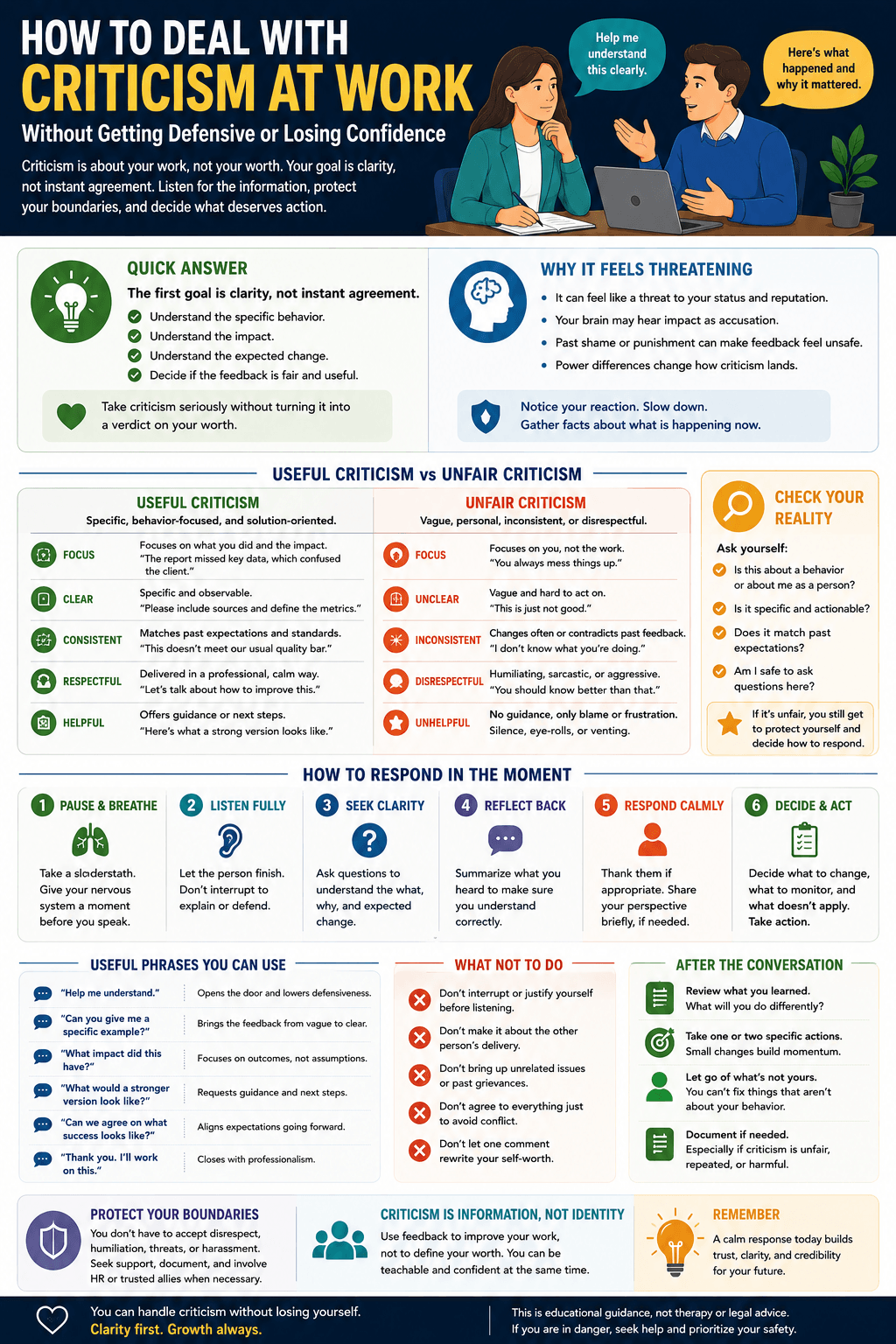
Why Criticism at Work Feels Threatening

Feedback is supposed to help people improve, but the experience of receiving it is rarely neutral. Your nervous system may react before your reasoning catches up. You might feel heat in your face, a tight chest, a sudden need to explain, or a blank mind. That does not mean you are immature. It means the moment has social risk.
Feedback can trigger status threat
Workplaces have visible and invisible status signals: who gets trusted, who is corrected publicly, who is invited into decisions, who receives praise, and who is seen as reliable. Criticism can feel threatening because it may seem to lower your standing in the eyes of a manager, coworker, client, or team.
Status threat often makes people respond too quickly. You may defend the intention behind your action before understanding the impact. You may try to prove you are competent before learning what needs to change. The useful question is: “What specific work outcome is at stake here?” That question moves the conversation away from image protection and toward improvement.
The brain hears impact as accusation
Many feedback conversations include impact language: “This created confusion,” “The client felt rushed,” “The team did not have enough context,” or “The deadline slipped.” The person giving feedback may be describing what happened, but the person receiving it may hear a character judgment: “You are careless,” “You are difficult,” or “You failed.”
That jump from impact to identity is where defensiveness often begins. The APA Dictionary of Psychology describes defensiveness as sensitivity to criticism and a tendency to counter or deny it. In real work conversations, that may look like explaining too much, correcting small details, changing the subject, or focusing only on the other person’s delivery.
Past shame or punishment can make feedback feel unsafe
If you have worked under harsh managers, unpredictable criticism, public embarrassment, or punishment for mistakes, feedback may not feel like information. It may feel like danger. You may enter the conversation already preparing to protect yourself from blame.
This matters because your current manager may be giving ordinary feedback, while your body is reacting to older patterns. It also matters because some current workplaces really do use criticism in harmful ways. The skill is not to ignore your reaction. The skill is to notice it, slow down, and gather enough detail to decide what is actually happening now.
Power differences change how criticism lands
Criticism from a peer may feel annoying. Criticism from a manager can feel career-defining. Criticism from a senior stakeholder can feel risky because they may influence opportunities, evaluations, workload, or reputation. The same sentence lands differently depending on power.
Because power changes the emotional weight of feedback, you may need more time to respond. A calm phrase like “I want to understand this clearly before I respond” can protect you from either collapsing into apology or reacting in a way that hurts you later.
Useful Criticism vs Unfair Criticism

Not all criticism deserves the same response. Some criticism gives you useful information, even if it is uncomfortable. Some criticism is vague, personal, inconsistent, or humiliating. The challenge is that both types can hurt, and both may come from someone with authority.
Useful criticism is specific and behavior-focused
Useful criticism points to something observable. It explains what happened, why it mattered, and what needs to change. It does not require you to guess what the person means.
| Useful criticism usually includes | Example | Why it helps |
|---|---|---|
| A specific behavior | “The summary did not include the client’s budget constraint.” | You know what to correct. |
| A clear impact | “That made the recommendation harder to evaluate.” | You understand why it mattered. |
| An expected change | “Add a context section before the final recommendation next time.” | You know what improvement looks like. |
| Room for clarification | “Tell me if you saw it differently.” | The conversation allows learning, not only blame. |
Unfair criticism is vague, personal, inconsistent, or humiliating
Unfair criticism may sound like “You always mess this up,” “You are not strategic,” “Everyone is frustrated with you,” or “I should not have to explain this.” It may attack identity instead of behavior. It may shift standards after the fact. It may happen in front of others when a private conversation would be reasonable.
Unfair criticism does not mean every part of the message is false. It means the delivery or framing makes it harder to learn and may require a boundary. You can ask for specifics without accepting labels.
Why both still require a grounded response
Useful criticism requires enough openness to learn. Unfair criticism requires enough steadiness to avoid giving the other person more material to use against you. In both cases, the first move is similar: slow the moment, ask for examples, clarify expectations, and decide what needs follow-up.
A grounded response is not passive. It is controlled. It protects your ability to think.
What Happens When You Get Defensive
Defensiveness is understandable, but it often creates the outcome you were trying to avoid. You may want to show that you are responsible, yet the other person hears resistance. You may want to correct an unfair detail, yet the larger issue gets lost. You may want to protect your confidence, yet the conversation leaves you feeling more exposed.
You protect identity before understanding impact
The defensive mind hears criticism as identity danger. Instead of asking, “What happened?” it asks, “What does this say about me?” That shift makes it hard to hear useful information.
Try this internal sentence: “This is feedback about a behavior, decision, or impact. I do not have to decide what it means about me right now.” The sentence is not magic, but it creates a small gap between the criticism and your self-worth.
You argue details before finding the real point
Sometimes you are right about the details. The deadline changed. The client added new requirements. Someone else gave you incomplete information. But if you start with corrections, the other person may think you are avoiding responsibility.
A better sequence is: acknowledge the concern, ask for the core issue, then add context if needed. For example: “I understand the concern is that the team did not have the final numbers in time. I can share the timeline, but first I want to make sure I understand what impact you want me to address.”
You miss useful information because the delivery felt wrong
Feedback can be poorly delivered and still contain useful information. It can also be confidently delivered and still be unfair. Try not to make the delivery the only data point. Ask: “Is there a specific behavior here that I need to understand?” and “Is the expected change reasonable?”
That does not excuse rude delivery. It simply stops the delivery from controlling your entire reaction.
A Simple Response Framework

When criticism hits hard, complicated advice is hard to use. A practical framework should be short enough to remember while your body is reacting. Use this five-part sequence: pause, specify, reflect, clarify, decide.
Pause before explaining
A pause gives your brain time to catch up with your body. You do not need a dramatic silence. One breath and one sentence can be enough.
Try: “I hear you. I want to understand the concern clearly before I respond.” This sentence shows you are not ignoring the feedback, but it also prevents a rushed defense.
Ask for the specific behavior or example
Specifics turn criticism into information. Without an example, you may end up defending your whole personality instead of discussing one situation.
Ask: “Can you point to the moment where that showed up?” or “Which part of the project are you referring to?” If the other person cannot give an example, you can say, “I want to work on it, but I need a specific behavior so I do not guess wrong.”
Reflect the impact without accepting unfair blame
Reflecting impact means showing that you understand what the other person says happened. It does not mean accepting every accusation. This distinction is important.
You can say: “I understand that the late update made planning harder for the team.” That is different from saying, “This is all my fault.” Reflection keeps the conversation mature while leaving room for context.
Clarify the expected change
Feedback is incomplete if it does not tell you what better looks like. Ask for the next standard. “What would you like to see from me next time?” “What level of detail would be enough?” “What would make this more useful for the team?”
In workplace feedback research, the quality of the conversation matters. One open-access paper on motivating performance improvement through feedback conversations highlights that feedback is meant to guide positive behavior change, not simply deliver judgment.
Decide what you agree with, what you question, and what needs follow-up
You do not have to finish the entire feedback conversation in one moment. After listening, sort the message into three categories: what seems fair, what needs more detail, and what may be inaccurate or inappropriate.
| Category | Question to ask yourself | Possible next step |
|---|---|---|
| Agree | What part is accurate and useful? | Name the change you will make. |
| Clarify | What is still vague or confusing? | Ask for an example or standard. |
| Question | What feels inaccurate, unfair, or incomplete? | Share context calmly or request a follow-up. |
| Boundary | Was the delivery humiliating or unsafe? | Document and seek support if needed. |
Scripts for Responding to Criticism at Work
Scripts are useful when your mind goes blank. Use them as starting points, not as perfect lines. The best script sounds like you, fits your role, and keeps the conversation focused on behavior and next steps.
When the criticism is fair but uncomfortable
“I see what you mean about the missing context. I should have included that earlier. I will add it to this version and use that structure next time.”
“That is hard to hear, but I understand the impact. I want to correct the issue rather than defend it.”
When the criticism is vague
“I want to improve this, but I need a specific example. When did you notice it?”
“When you say the work needs to be more strategic, what would that look like in the next draft?”
When the criticism feels unfair
“I understand the concern. I also want to add context because the timeline changed after the first review. Can we look at what was agreed and what changed?”
“I am open to feedback on the work. I do not think the label fits, so I would like to focus on the specific behavior you want changed.”
When criticism happens in front of others
“I want to address this properly. Can we take the detailed feedback offline after the meeting?”
“I hear the concern. For the group, I can clarify the next step now. For the detailed feedback, I would rather discuss it one-on-one.”
When you need time to process before responding
“I want to think about this instead of reacting too quickly. Can I come back with a response later today?”
“I understand the main concern. I would like to review the details and follow up with a clear plan.”
Criticism vs Conflict at Work
Criticism is feedback about behavior or impact
Criticism is usually directed at something you did, did not do, delivered, missed, said, or decided. It may be formal, like performance feedback, or informal, like a coworker saying your handoff was confusing. The central question is: “What behavior or outcome is being evaluated?”
Conflict is a broader disagreement or tension pattern
Conflict at work is wider. It can include competing priorities, role confusion, personality friction, resource disputes, decision disagreements, or repeated tension. Criticism can become part of conflict, but not all criticism is conflict.
Why criticism can become conflict when identity feels attacked
Criticism becomes conflict when the conversation shifts from “what happened” to “who is right,” “who is respected,” or “who is to blame.” If you feel your identity is being attacked, you may counterattack. If the other person feels ignored, they may escalate. Bringing the conversation back to behavior, impact, and next step can prevent a feedback moment from becoming a larger workplace fight.
Criticism vs Imposter Syndrome
Feedback is information; imposter fear turns it into identity proof
Imposter feelings can make one piece of criticism feel like evidence that you never belonged in the role. The mind moves from “this part needs improvement” to “they finally discovered I am not good enough.” That leap is emotionally powerful, but it is not always accurate.
The APA Dictionary of Psychology defines self-esteem in terms of how positively someone perceives qualities within their self-concept. Criticism can hit self-esteem when you confuse one behavior with your whole professional identity.
How to separate one mistake from your whole competence
Use a narrow sentence: “This feedback is about one deliverable, one behavior, one meeting, or one decision.” Then name three pieces of evidence that are also true: work you have completed, skills you have built, or feedback you have received before. You are not trying to inflate your confidence. You are correcting the mental habit of turning one criticism into a total verdict.
Why evidence tracking helps without becoming perfectionism
Keep a simple work evidence file: wins, solved problems, positive feedback, lessons learned, and skills developed. Use it when criticism makes your memory selective. The point is not to prove you are flawless. The point is to keep your mind from deleting every piece of evidence except the painful one.
How to Learn From Criticism Without Overcorrecting

Some people ignore criticism. Others absorb it too deeply and overcorrect. They change their style after one comment, apologize for everything, rewrite work excessively, or seek reassurance before every decision. Learning from criticism should make you more effective, not smaller.
Look for the pattern across feedback sources
One comment is data. Repeated comments from different credible sources may be a pattern. If one manager says you need more context, one client says the same, and one coworker says your handoffs are hard to follow, you likely have a specific improvement area. If one person criticizes you in vague, shifting, or personal ways while others do not, the issue may require caution.
Choose one behavior change at a time
Do not turn feedback into a total personality renovation. Pick one behavior. Add a context paragraph to reports. Send meeting notes within 24 hours. Ask clarifying questions before committing to a deadline. Confirm expectations before starting a draft.
Behavior change works best when it is visible and measurable. “Be better at communication” is too broad. “Send a two-line status update every Tuesday” is workable.
Request a follow-up checkpoint
A follow-up checkpoint prevents you from guessing forever. Ask: “Can we revisit this in two weeks so I know whether the change is working?” or “Would it be useful if I send one example before I use this format across the project?”
Feedback acceptance can be shaped by whether people experience fairness and respect in the process. Research on performance feedback acceptance and relational justice points to the role of perceived fairness in how feedback is received.
Protect confidence by measuring behavior, not self-worth
If you measure self-worth, every criticism becomes dangerous. If you measure behavior, criticism becomes more usable. Ask, “What behavior can I adjust?” not “What does this prove about me?”
This does not remove discomfort. It changes what the discomfort is allowed to decide.
When Criticism Is Part of a Toxic Pattern
Some criticism is not a growth opportunity. It is a pattern of control, humiliation, or moving standards. In those cases, advice about staying open to feedback can become harmful if it teaches you to tolerate mistreatment.
Repeated humiliation, moving standards, or retaliation
Be cautious when criticism is public by design, standards keep changing after you meet them, mistakes are exaggerated, or honest questions lead to punishment. Also pay attention if praise is private but criticism is public, or if feedback is used to isolate you from coworkers.
Criticism used to control, shame, or isolate
Control-focused criticism often sounds less like coaching and more like personal attack. It may include insults, threats, mockery, discriminatory comments, pressure to hide information, or warnings not to speak to others. In that situation, the issue is no longer only how you receive feedback.
For concerns about harassment in employment settings, the U.S. Equal Employment Opportunity Commission explains workplace harassment and gives examples of conduct that may create a hostile work environment under U.S. law. This information is educational and not legal advice.
When to document and seek support
Documentation can help when criticism becomes repeated, shifting, humiliating, discriminatory, or retaliatory. Save dates, what was said, who was present, what standard was given, and what follow-up happened. Depending on your workplace and location, support may include a trusted manager, HR, employee assistance program, union representative, legal resource, or external professional support.
What Shapes How Criticism Lands at Work
Why psychological safety changes feedback conversations
Feedback lands differently when people believe questions, mistakes, and respectful disagreement will not be punished. In a psychologically safer team, criticism is more likely to become learning. In a fear-based team, even mild feedback can create silence, self-protection, or resentment.
Research on psychological safety and team performance describes psychological safety as a shared belief that the team is safe for interpersonal risk taking. That idea matters because receiving criticism is often an interpersonal risk.
How criticism can affect motivation
Criticism can increase motivation when it is specific, fair, and tied to a believable next step. It can lower motivation when it feels vague, humiliating, impossible to satisfy, or disconnected from support. If you leave feedback conversations thinking, “I know exactly what to do next,” motivation has a path. If you leave thinking, “Nothing I do will be enough,” motivation often drops.
How burnout lowers your ability to process feedback
Burnout can make criticism feel heavier because your emotional margin is already thin. When you are depleted, feedback that might normally sting for ten minutes may follow you for days. This does not mean the feedback is wrong. It means your capacity to process it may be reduced, and recovery may need attention alongside performance changes.
When to Get Support
If criticism triggers severe anxiety, panic, sleep loss, or persistent distress
If feedback repeatedly triggers severe anxiety, panic symptoms, sleep disruption, constant rumination, or avoidance that interferes with your daily functioning, consider professional support. The National Institute of Mental Health explains anxiety disorders as conditions that can interfere with work, school, and relationships when symptoms become significant. You do not need to diagnose yourself to take distress seriously.
If feedback includes threats, humiliation, harassment, discrimination, retaliation, or coercion
If criticism includes threats, humiliation, harassment, discrimination, retaliation, coercion, stalking, or fear of punishment for speaking up, do not rely only on conversation techniques. Prioritize support, documentation, and safety. A calm response can be useful, but it should not be used to normalize mistreatment.
FAQ About Dealing With Criticism at Work
What should I say first when my boss criticizes me?
Start with a sentence that shows you are listening without surrendering your judgment. For example: “I hear the concern, and I want to understand the specific example before I respond.” This keeps you from reacting too fast and gives your boss a chance to make the feedback concrete.
How do I stop getting defensive at work?
Do not try to erase the defensive feeling. Try to delay the defensive behavior. Pause, ask for the specific example, reflect the impact, and save your context until you understand the main concern. Defensiveness often becomes less intense when the criticism is narrowed from a global judgment to a specific behavior.
What if the criticism is unfair?
Ask for specifics and separate the useful part from the unfair part. You might say, “I am open to feedback on the work, but I do not agree with that label. Can we focus on the specific behavior you want changed?” If the criticism is repeated, humiliating, discriminatory, or retaliatory, document it and seek appropriate support.
Should I apologize immediately after criticism?
Apologize quickly if you clearly understand the mistake and the impact. If the feedback is vague or you feel pressured to accept blame before understanding the facts, it is reasonable to ask clarifying questions first. A good apology is specific. A rushed apology can create confusion or make you accept responsibility for something unclear.
How do I take criticism without feeling like a failure?
Narrow the meaning of the criticism. Identify the behavior, the impact, and the next step. Then remind yourself what else is true about your work: skills you have built, results you have produced, and areas where feedback has helped before. One criticism can be important without becoming your whole identity.
Key Takeaways
- The first goal when receiving criticism at work is clarity, not instant agreement or instant defense.
- Useful criticism is specific, behavior-focused, impact-aware, and connected to an expected change.
- Unfair criticism may be vague, personal, inconsistent, humiliating, or tied to moving standards.
- A grounded response follows a simple sequence: pause, ask for specifics, reflect impact, clarify expectations, and decide what needs follow-up.
- Criticism becomes harder to process when it triggers imposter fear, status threat, burnout, or low psychological safety.
- If criticism involves threats, harassment, discrimination, retaliation, coercion, or repeated humiliation, prioritize support and documentation over communication technique.
Criticism at work is easier to handle when you do not treat it as a final judgment. Listen for the behavior. Ask for the example. Clarify the next standard. Keep the useful information, question what is unfair, and protect your self-respect while you decide what to do next.

Michael Reed is the Founder and Lead Writer at Psychology Exposed. He writes about human behavior, relationships, emotional patterns, self-awareness, and practical psychology topics using research-informed, easy-to-understand content.
Read More About Michael Reed: https://psychologyexposed.com/michael-reed/