
Workplace burnout can feel confusing because it often starts quietly. You may still answer emails, attend meetings, finish tasks, and appear responsible from the outside. Inside, work may begin to feel heavier, flatter, and harder to care about. The job has not always changed overnight, but your emotional relationship with it has.
Burnout may be intensified by a harmful culture. Constant blame, fear of retaliation, humiliation, or impossible expectations can make recovery much harder.
That shift is not the same as laziness. Burnout is usually better understood as a chronic work stress pattern where demand keeps exceeding recovery, control, support, reward, or meaning. A person can be highly responsible, skilled, and motivated for years, then slowly reach a point where the same effort no longer feels possible.
This matters because the wrong explanation can lead to the wrong solution. If you call burnout a motivation problem, you may push harder. If you call it a personal weakness, you may feel ashamed. If you call every hard job toxic, you may miss the specific pressures that need to change. The psychology of burnout helps you look at the match between work demands, human limits, and the environment that shapes both.
This is educational guidance, not a diagnosis or a substitute for medical or mental health care. If exhaustion, sleep changes, anxiety, depression like symptoms, panic, substance use, or thoughts of self harm are present, professional support matters. If your workplace includes threats, humiliation, harassment, coercion, retaliation, or fear for your safety, prioritize support and protection over communication tips.

Quick Answer
Burnout in one simple sentence
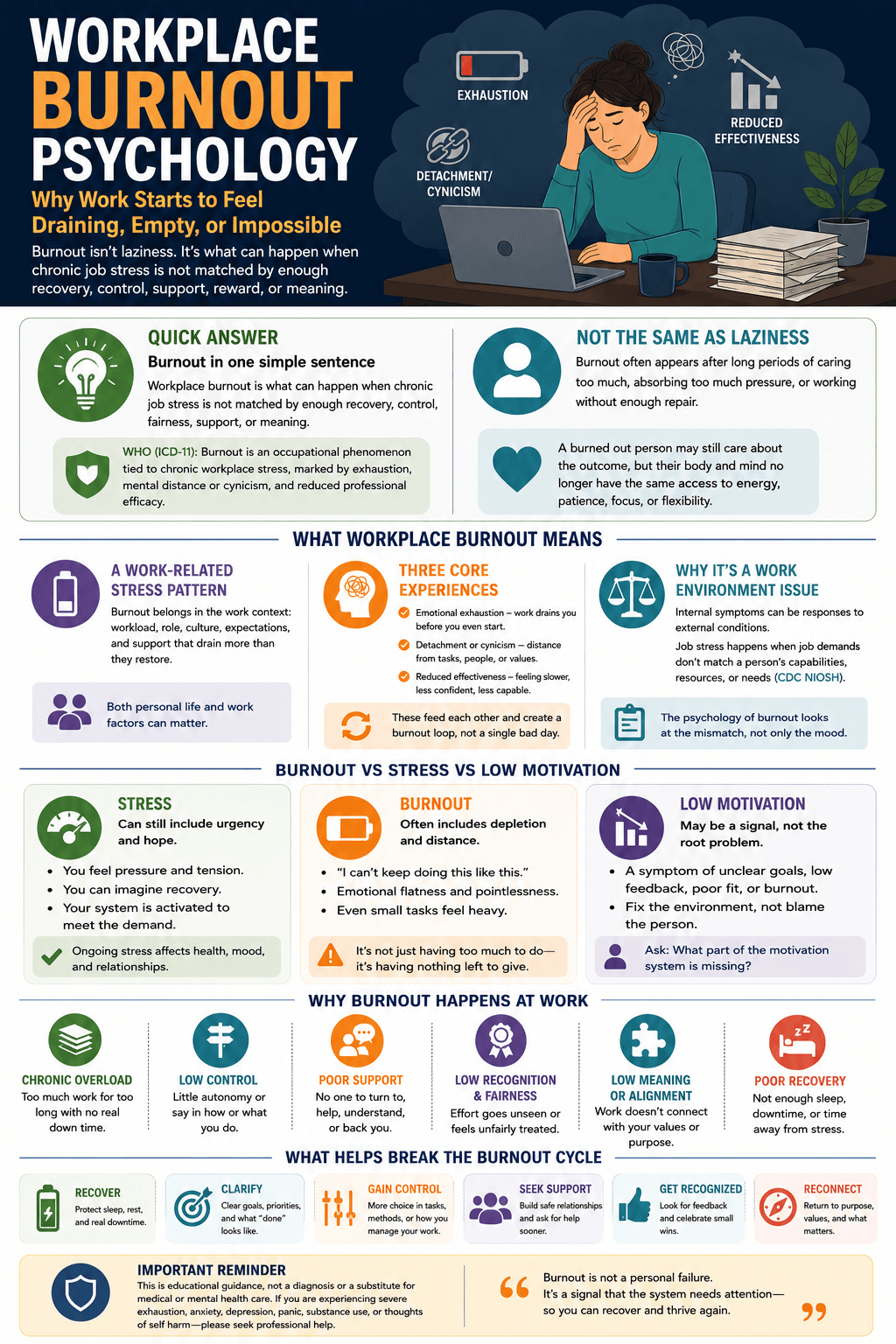
Workplace burnout is what can happen when chronic job stress is not matched by enough recovery, control, fairness, support, or meaning. The World Health Organization describes burnout as an occupational phenomenon tied to chronic workplace stress, marked by exhaustion, mental distance or cynicism, and reduced professional efficacy in its ICD-11 context.
Why burnout is not the same as being lazy
Laziness usually implies that someone could reasonably do the work but simply does not want to. Burnout is different. It often appears after long periods of caring too much, absorbing too much pressure, or working without enough repair. A burned out person may still care about the outcome, but their body and mind no longer have the same access to energy, patience, focus, or emotional flexibility.
What Workplace Burnout Means
Burnout as a work-related stress pattern
Burnout belongs in the work context. That does not mean personal life never matters. Sleep, caregiving, money worries, health, and family stress can all affect capacity. Still, workplace burnout asks a specific question: what about the job, role, workload, culture, expectations, or support system is draining more than it restores?
Both levels often matter. A person may need boundaries and recovery, while the organization may need clearer priorities, better staffing, safer feedback norms, or more realistic expectations.
Emotional exhaustion, detachment, and reduced effectiveness
Burnout often shows up in three connected ways. The first is emotional exhaustion: the feeling that work drains you before you even start. The second is detachment or cynicism: the mind creates distance from tasks, people, or values that used to matter. The third is reduced effectiveness: you may feel slower, less confident, less creative, or less able to finish work at the standard you expect from yourself.
These three experiences can feed each other. Exhaustion makes care harder. Detachment protects you from feeling every demand so intensely. Reduced effectiveness creates shame, which can make you work longer, which then deepens exhaustion. Burnout becomes a loop, not a single bad day.
Why burnout belongs in the work context, not just the individual
People often internalize burnout as a personal failure because the early signs happen inside them. They feel tired, numb, irritable, avoidant, or less focused. But internal symptoms can be responses to external conditions. The CDC NIOSH overview of job stress explains job stress as harmful physical and emotional responses that can occur when job requirements do not match a worker’s capabilities, resources, or needs.
That mismatch can look different from person to person. One worker may be overloaded by volume. Another may be drained by unclear authority. Another may have the skills but no control. Another may be doing meaningful work inside a culture that rewards constant availability. The psychology of burnout looks at the mismatch, not only the mood.
Burnout vs Stress vs Low Motivation

Stress can still include urgency and hope
Stress is not always burnout. During a stressful week, you may feel pressure, urgency, and tension, but you can still imagine recovery. You may think, “This is a lot, but if I get through Friday, I can breathe.” Stress often comes with activation. Your system is mobilized to respond to demand.
That does not make stress harmless. Ongoing stress can affect health, mood, and relationships. The difference is that stress often still has a sense of movement. Burnout tends to feel more like the engine is still being asked to run after the fuel has already been spent.
Burnout often includes depletion and distance
In burnout, the feeling is less “I have too much to do” and more “I cannot keep doing this like this.” People often describe a strange emotional flatness. Tasks that used to feel meaningful now feel pointless. Requests that used to feel manageable now feel invasive. Feedback that used to feel useful now feels like one more proof that nothing is enough.
Low motivation may be a signal, not the root problem
Low motivation can be part of burnout, but it is not always the cause. If your only question is “How do I become motivated again?” you may overlook the conditions that drained motivation in the first place. Motivation often depends on energy, agency, feedback, fairness, progress, and meaning. Remove enough of those for long enough, and even a committed person may start to shut down.
| Experience | How it often feels | What may help first |
|---|---|---|
| Normal work stress | Pressure, urgency, tension, but some belief that recovery is possible | Prioritizing, short term support, rest, clearer deadlines |
| Burnout | Depletion, cynicism, dread, reduced effectiveness, emotional distance from work | Changing demand, recovery, control, support, and expectations |
| Low motivation | Difficulty starting, caring, or staying engaged | Identifying whether motivation is blocked by fatigue, fear, unclear goals, boredom, or burnout |
The Psychology Behind Burnout

Chronic demand without enough recovery
Burnout often begins with an uneven trade: demand keeps arriving, recovery does not. Recovery is not only sleep or a weekend away. It also includes mental closure, time without vigilance, realistic workload, emotional decompression, and the ability to stop carrying work after hours.
A useful frame is the demand-recovery balance. Demand can be obvious, like too many tasks, long hours, or constant deadlines. It can also be invisible, like emotional labor, responsibility for other people’s moods, always being the one who fixes mistakes, or needing to appear calm while carrying pressure. If recovery is shallow, delayed, or repeatedly interrupted, the system never fully resets.
Loss of control and predictability
Burnout becomes more likely when people feel they cannot influence the conditions that affect them. A heavy workload is difficult. A heavy workload with no say, no clear priorities, and surprise changes every day is more psychologically costly.
Control does not mean total freedom. It can mean knowing what matters most, having input into deadlines, being able to ask for resources, or understanding how decisions are made. Predictability helps the nervous system prepare. When everything feels uncertain, the mind stays on alert even outside work hours.
Effort-reward imbalance
People can tolerate hard work when the effort feels connected to fair reward. Reward is not only money. It can include respect, security, growth, acknowledgment, feedback, autonomy, and the belief that effort matters. When effort keeps increasing while reward stays vague, delayed, or absent, the mind may begin to protect itself by caring less.
Occupational health research often examines models such as demand-control-support and effort-reward imbalance. One open access study in PubMed Central discusses these models as ways to understand psychosocial job stressors, including demand, control, support, effort, and reward. You do not need to know the research model to notice the lived experience: “I keep giving more, but the return is not enough to make this sustainable.”
Value conflict and moral strain
Burnout is not only about being busy. It can come from having to act against your values too often. A nurse may not have enough time to give the care they believe patients deserve. A manager may be asked to enforce policies they believe are unfair. A creator may feel forced to produce volume at the cost of quality. A customer support worker may have to absorb anger while having little power to solve the real problem.
This kind of strain is especially draining because rest alone may not resolve it. The issue is not just tiredness. It is the pain of repeatedly doing work in a way that feels misaligned with conscience, craft, or identity.
Social threat, conflict, and low support
Humans do not experience work as machines completing tasks. We track tone, belonging, fairness, status, blame, and rejection. A workplace with unclear conflict, public criticism, gossip, favoritism, or unpredictable reactions can turn ordinary tasks into social risk.
Low support makes stress harder to recover from. If you cannot admit you are overloaded, ask a question, disagree safely, or name a mistake without punishment, your mind spends energy on protection. That protective energy may not show up on a task list, but it is still work.
Signs of Workplace Burnout
You feel tired before work even begins
A common burnout warning sign is waking up already braced for the day. You may have slept, but you do not feel restored. The thought of opening your inbox, joining a meeting, or starting the first task can create heaviness before anything has happened.
You become emotionally detached from tasks or people
Detachment can look like indifference, cynicism, or numbness. You may notice yourself caring less about quality, customers, clients, students, patients, coworkers, or outcomes. Sometimes this detachment is the mind’s attempt to reduce pain. If caring has become too expensive, distance can feel like protection.
Small requests feel overwhelming
Burnout can make ordinary requests feel unusually large. A message that once took five minutes now feels like a mountain. A minor change in a project may trigger irritation or despair. This does not mean the request is objectively huge. It may mean your remaining capacity is very low.
You doubt the value of your work
Burnout can change the story you tell yourself about work. You may think, “None of this matters,” “I am not making a difference,” or “No matter what I do, it is never enough.” Sometimes the work truly is misaligned. Other times burnout temporarily blocks access to meaning that used to be real.
Recovery time no longer restores you
One of the clearest signs is that normal rest stops working. A weekend, a night off, or a short break may reduce pressure for a moment, but you return to the same depleted state quickly. That does not mean rest is useless. It means the underlying demand-recovery imbalance may need more than small breaks.
| What it looks like | What it may mean | What to notice next |
|---|---|---|
| You procrastinate work you normally handle | Your system may be avoiding overload, not simply avoiding effort | Which tasks create dread before you start? |
| You feel irritated by normal questions | Your emotional margin may be very thin | Are interruptions constant or poorly timed? |
| You stop feeling proud after finishing work | Reward and meaning may not be landing anymore | Is the standard always moving? |
| You fantasize about disappearing from work | Your mind may be seeking escape from chronic demand | Is this about one task, one person, or the whole role? |
Why High Performers Burn Out
Over-responsibility and identity tied to output
High performers can be especially vulnerable because competence often brings more responsibility. If you are known as the person who can handle it, people may keep handing it to you. Over time, your identity may narrow until being valuable means being endlessly useful.
This can create a quiet trap. You may hide strain because you are used to being capable, then keep raising your own standards because past pressure produced results.
Saying yes because reliability became a role
Reliability is valuable, but it can become costly when it turns into a role you are afraid to step out of. You may say yes before checking capacity. You may absorb unclear work because explaining the limit feels slower than doing the task. You may protect other people from discomfort by creating too much discomfort for yourself.
Praise that rewards overextension
Some workplaces praise the very behavior that burns people out: always available, always calm, always willing, always fast. Praise can feel good in the moment, but it can also train overextension. When the only visible reward comes after sacrifice, people may learn to ignore early warning signs.
The APA Work in America Survey places worker psychological well being at the center of workplace experience, which is a helpful reminder that performance and health should not be treated as separate realities. A workplace that depends on people regularly exceeding their limits is not only asking for effort. It is borrowing from future capacity.
Burnout vs Toxic Workplace Signs
Burnout can happen in non-toxic high-demand roles
A job does not have to be toxic to burn someone out. Healthcare, education, caregiving, leadership, emergency work, entrepreneurship, content creation, and mission driven roles can all carry high demand. Even respectful teams can create burnout when workload, staffing, emotional exposure, or responsibility stays too high for too long.
Toxic patterns can accelerate burnout
Toxic workplace signs can make burnout more likely and more severe. Examples include public humiliation, retaliation, bullying, discrimination, chronic blame shifting, coercive pressure, or a culture where people are punished for raising concerns. In those situations, burnout is not just about workload. It is also about threat.
How to tell whether the environment is the main driver
Ask what happens when you try to recover, set a limit, ask for clarity, or raise a concern. If reasonable requests lead to punishment, mockery, exclusion, or retaliation, the environment itself may be the central issue. If the workplace is generally respectful but the role is overloaded, the solution may involve workload, staffing, boundaries, or priority changes.
| Question | Burnout clue | Toxic environment clue |
|---|---|---|
| What happens when you say you are overloaded? | People may be concerned but unsure how to help | You are mocked, punished, blamed, or ignored |
| What drains you most? | Volume, emotional labor, ambiguity, lack of recovery | Fear, humiliation, coercion, harassment, retaliation |
| What would improve the situation? | Clearer priorities, workload change, recovery, support | Safety, documentation, HR, legal advice, external support, exit planning |
What to Do First When You Feel Burned Out

Name the specific demand-recovery imbalance
Do not start with a vague conclusion like “I just cannot handle work.” Start with a more precise map. What demand is too high, too constant, too unclear, or too emotionally costly? What recovery is missing, interrupted, or ineffective?
Try completing this sentence: “The part of work that drains me most is not only the task itself, but the repeated demand to…” Possible endings might include respond instantly, fix unclear decisions, absorb emotional reactions, switch priorities, perform enthusiasm, cover staffing gaps, or meet standards that keep changing.
Reduce one invisible load before adding self-care
Self-care can help, but it can become another task if the actual load stays unchanged. Before adding a new habit, look for one invisible load to reduce. That might mean turning off notifications after a set time, asking for written priorities, batching messages, declining one recurring meeting, or naming a decision that needs an owner.
Clarify priorities and limits with a concrete request
A concrete request is easier to respond to than a general confession of burnout. Instead of saying, “I am overwhelmed,” try naming the tradeoff: “I can finish the client report by Thursday or prepare the new deck by Thursday, but I cannot do both at the current quality. Which should come first?”
This kind of request does not guarantee a good response, but it makes the workload visible. It also moves the conversation from personal endurance to shared prioritization.
Rebuild recovery that is not just more screen time
Many burned out people collapse into passive recovery because active recovery feels like too much. There is nothing wrong with entertainment, but screen time may not restore you if it keeps your mind stimulated, comparing, scrolling, or half connected to work.
Restorative recovery often includes a body shift, a context shift, or an attention shift. A walk without work audio, a real meal away from the desk, a short nap, light stretching, time with someone safe, or a quiet transition ritual can help signal that work is not still in charge of your nervous system.
Track whether rest actually restores you
For one week, track the difference between rest that numbs you and rest that restores you. Numbing may feel good for a moment but leave you just as depleted. Restoring usually gives back a little steadiness, clarity, or emotional room.
What Not to Do

Do not treat burnout as a character flaw
Shame makes burnout harder to address. If you believe the problem is that you are weak, lazy, or ungrateful, you may hide the signs until they become more serious. A more useful question is: what conditions have made effort feel unsustainable?
Do not rely only on motivation hacks
Motivation hacks can sometimes help with starting a task, but they cannot fix chronic overload, low control, unsafe dynamics, or lack of recovery. If you are burned out, forcing yourself to act inspired may deepen the split between how you look and how you feel.
Do not ignore physical or mental health changes
Burnout can overlap with physical and mental health concerns. Sleep problems, appetite changes, panic symptoms, persistent sadness, irritability, headaches, stomach issues, chest tightness, or frequent illness should not be brushed off as “just work.” Mayo Clinic’s overview of job burnout symptoms and possible causes encourages people to consider how burnout may affect health and to take action when signs appear.
How Burnout Interacts With Team Culture
How psychological safety affects stress recovery
Psychological safety matters because recovery is not only private. A worker recovers more easily when they can ask questions, admit overload, report mistakes, and raise concerns without fear of being punished or humiliated. Without that safety, even a normal workload can feel heavier because every interaction includes risk management.
Why toxic workplace signs matter when burnout repeats
If burnout keeps returning after rest, workload changes, or better personal boundaries, look at the workplace patterns around you. Are people afraid to speak? Are mistakes punished instead of used for learning? Are certain employees consistently blamed, excluded, or pressured? Repeated burnout may be a signal that the environment is not only demanding, but damaging.
How criticism and conflict can become chronic stressors
Criticism and conflict are not automatically harmful. In a respectful culture, feedback can help people improve and disagreement can improve decisions. But criticism becomes a burnout factor when it is constant, vague, personal, public, or impossible to satisfy. Conflict becomes draining when there is no repair, no decision process, and no safe way to return to the work.
When to Get Support

If exhaustion, anxiety, depression-like symptoms, sleep problems, or health changes persist
Consider support if exhaustion continues after rest, if sleep or appetite changes are persistent, if anxiety or low mood becomes difficult to manage, or if work dread begins affecting basic functioning. A primary care clinician, therapist, counselor, or employee assistance program can help you sort out what is work related, what is health related, and what kind of support may be appropriate.
If the workplace includes threats, humiliation, harassment, retaliation, or coercion
If work feels unsafe because of threats, humiliation, harassment, retaliation, stalking, discrimination, coercive control, or fear of punishment for speaking up, do not rely only on better communication. Consider documenting incidents, reviewing workplace policies, contacting HR if safe, seeking legal or advocacy advice, or speaking with a trusted outside professional.
When to consider medical, mental health, HR, or external support
Different problems need different kinds of help. Health symptoms may need medical care. Severe distress may need mental health support. Workload and role clarity may need a manager conversation. Harassment, retaliation, or discrimination may need HR, legal, union, regulatory, or external support. The key is to match the support to the risk, not to keep trying the same personal coping strategy for every problem.
FAQ About Workplace Burnout Psychology
Is burnout a mental illness?
Burnout is not the same as a mental illness diagnosis. WHO frames burnout as an occupational phenomenon connected to chronic workplace stress, not as a medical condition. That said, burnout can overlap with anxiety, depression like symptoms, sleep problems, and health changes. If symptoms are persistent, intense, or affecting daily functioning, professional support is worth considering.
How is burnout different from normal work stress?
Normal work stress often includes pressure, effort, and fatigue, but it may still come with a sense that recovery is possible. Burnout tends to include deeper depletion, mental distance from work, cynicism, and reduced effectiveness. Stress says, “This is a lot.” Burnout often says, “I cannot keep doing this like this.”
Can burnout make me lose motivation?
Yes, burnout can reduce motivation because motivation depends on available energy, meaningful reward, control, feedback, and hope. If your system has learned that effort does not lead to recovery, progress, or fairness, it may reduce drive as a form of protection. In that case, the first step is not to shame yourself into caring. It is to understand what drained caring in the first place.
Can a good job still burn me out?
Yes. A job can be meaningful, ethical, and full of good people, yet still become unsustainable if the demands are too high or recovery is too low. Helping professions, leadership roles, creative work, startups, and mission driven jobs can be especially tricky because caring about the work can make it harder to set limits.
What is the first thing to change when I feel burned out?
Start by identifying the specific demand-recovery imbalance. Do not only ask, “How do I rest more?” Ask, “What keeps draining me faster than I can recover?” Then choose one concrete change that makes the load visible or reduces it slightly, such as clarifying priorities, limiting one after hours channel, asking for a decision owner, or removing one unnecessary commitment.
Key Takeaways
- Workplace burnout is usually a chronic work stress pattern, not a sign that someone is lazy or weak.
- The core burnout experience often includes exhaustion, emotional distance from work, and reduced effectiveness.
- Low motivation can be a burnout signal when effort has stopped feeling recoverable, fair, or meaningful.
- Burnout can happen in demanding but respectful jobs, while toxic workplace signs can accelerate it and change the safety response needed.
- The first practical step is to identify the demand-recovery imbalance, then reduce one real load before adding more self-care tasks.
- Persistent health changes, severe distress, harassment, threats, retaliation, or coercion deserve support beyond individual coping strategies.
Final Thoughts
Burnout becomes easier to understand when you stop asking only, “What is wrong with me?” and start asking, “What has my work been requiring from me, and what has not been restored?” That question does not blame you, and it does not ignore responsibility. It helps you see the system you are living inside.
Your next step does not need to be dramatic. Choose one pressure point that is specific enough to name: unclear priorities, constant availability, emotional labor, lack of control, a value conflict, or recovery that never feels complete. Then make one change that tests whether your capacity can begin to return. If it cannot, that is information too, and it may mean the problem needs support beyond willpower.

Michael Reed is the Founder and Lead Writer at Psychology Exposed. He writes about human behavior, relationships, emotional patterns, self-awareness, and practical psychology topics using research-informed, easy-to-understand content.
Read More About Michael Reed: https://psychologyexposed.com/michael-reed/