

Walk into almost any group and differences in influence appear quickly. One person can approve a decision, another is listened to because of expertise, someone else is admired but has little formal control, and another person may stay quiet because challenging the wrong person carries a real cost. These differences are easy to notice, but they are often described with the same vague word: power.
Psychology draws useful distinctions. Social power concerns relative capacity to affect outcomes. Status concerns the respect or rank other people confer. Authority concerns a recognized right to direct or decide. Hierarchy is the larger arrangement that places people or roles in unequal positions. Understanding these differences helps explain why people speak, defer, take risks, protect reputation, or monitor others differently depending on where they stand.
Quick Answer

Power and status psychology examines how unequal influence and social rank shape behavior. Power is mainly about capacity to affect outcomes, while status is about respect, prestige, or recognized standing. Authority adds legitimacy, and hierarchy organizes these differences across a group. Their effects are not automatically harmful, but they can change voice, attention, freedom to act, accountability, and the consequences of disagreement.
Power, Status, Authority, and Hierarchy Are Related but Different

The clearest way to understand unequal social positions is to separate four questions that are often blended together.
| Concept | Main question | Everyday example |
|---|---|---|
| Power | Who can affect important outcomes? | A caregiver controls access to transportation or appointments. |
| Status | Who receives respect, recognition, or deference? | An experienced member is widely admired even without a formal title. |
| Authority | Who is recognized as having a right to direct or decide? | A teacher can set classroom rules within the scope of that role. |
| Hierarchy | How are unequal positions arranged across the group? | A community has formal officers plus an informal pecking order. |
Social power is relative capacity to influence outcomes
Power is relational. A person is not simply powerful in every setting. Power depends on what is at stake, who controls valued resources or decisions, and what alternatives other people have. A friend who controls access to a social circle may have influence in that domain but none over your finances or education.
A widely cited review by Joe Magee and Adam Galinsky describes power in terms of asymmetric control over valued resources and distinguishes it from status, which rests more on respect in others’ eyes. That distinction is useful because it explains why someone can have decision power without admiration, or admiration without decision power. See the review of power, status, and social hierarchy.
Status is socially conferred respect, prestige, or rank
Status exists because other people treat someone as having greater standing on a dimension that matters to the group. That dimension might be expertise, achievement, seniority, reputation, generosity, visibility, or something else the group values. Status can be formal, but much of it is informal. People reveal status through attention, deference, consultation, and whose opinion carries extra weight.
Status is not a measure of human worth. A person can have low standing in one group and high standing in another. It is also possible to be popular without being highly respected, or respected without having control over anyone else’s choices.
Authority is a recognized right to direct, decide, or set rules
Authority adds a question of legitimacy. People may accept that a role-holder has a right to make certain decisions even when they dislike the decision. Tom Tyler’s review of legitimacy emphasizes that legitimate authority can produce voluntary deference because people see the arrangement as appropriate or proper, rather than because they are merely anticipating punishment or reward. The distinction is explained in his review of legitimacy and legitimation.
Authority still has limits. A teacher has authority in a classroom but not unlimited authority over a student’s private life. A moderator may enforce community rules without being the most knowledgeable person in the group. A doctor may have expertise and institutional authority in a medical setting, but neither gives unlimited control over another adult’s choices.
Hierarchy is the system that organizes unequal rank or influence
A hierarchy is the broader pattern formed when people or roles differ in rank, influence, authority, access, or deference. Some hierarchies are explicit, with titles and written rules. Others develop informally as people learn who is listened to, who decides, who has access, and who can challenge whom without much consequence.
Hierarchy can support coordination, but it can also concentrate opportunity and silence lower-ranked voices. Whether a particular hierarchy is useful, unfair, flexible, or dangerous depends on how it operates, not merely on the fact that unequal positions exist.
Why Power and Status Matter in Everyday Social Life
Rank and influence matter because they change the practical social costs and opportunities attached to ordinary behavior.
Attention, voice, deference, opportunity, and expectations
Unequal standing changes the social environment around a person. Higher-ranking people may be given more speaking time, receive the benefit of the doubt, gain earlier access to information, or be invited into decisions. Lower-ranking people may spend more effort reading the room, anticipating reactions, choosing careful wording, or deciding whether disagreement is worth the cost.
These effects do not require anyone to announce a hierarchy. A volunteer group may wait for one longtime member before committing to a plan, while an online community may highly respect a technical expert even though moderators retain formal decision rights.
The same person can be high-ranking in one context and low-ranking in another
Rank and influence are domain-specific. A senior engineer may command attention on a technical question but defer to a junior colleague who has unique local knowledge. A teenager may have less formal authority at home but greater expertise over a digital system the family depends on. A popular community member may carry social prestige yet have no ability to allocate money or enforce rules.
This is why broad labels such as “powerful person” can obscure more than they reveal. A better question is: powerful over what outcome, in relation to whom, and under what conditions?
A Simple Model for Understanding Power and Rank

One useful way to map social hierarchy is to follow a five-part sequence:
- Inputs: resources, roles, expertise, relationships, information, or access.
- Leverage: the capacity those inputs create to affect outcomes.
- Recognition: the rank, respect, or legitimacy other people assign.
- Expectations: beliefs about who should speak, decide, defer, challenge, or receive attention.
- Consequences: changes in behavior, opportunity, risk, voice, and relationships.
The sequence is not automatic. Expertise may create respect without formal control. A role may create authority without much admiration. Resource control may create compliance without legitimacy. Over time, however, these layers can reinforce one another. The person who gets listened to may receive more opportunities to demonstrate competence, which can increase status further. The person who controls decisions may also gain access to information that preserves that control.
What Social Power Means in a Relationship
To see social power clearly, look less at personality and more at dependence, options, resources, and consequences.
Dependence and valued outcomes matter
Social power becomes easier to see when you ask what one person depends on another for. Money is an obvious resource, but social power can also come from access to information, introductions, approval, transportation, housing, opportunities, schedules, credentials, or the ability to impose consequences.
Alternatives matter too. If two people can easily walk away from a deal, dependence may be low. If one person has no realistic alternative, the other person’s choices carry more weight. This helps explain why power is often uneven even when both people formally have the same right to say yes or no.
Formal and informal power can point in different directions
Formal power comes from a recognized role or rule. Informal power comes from relationships, expertise, reputation, access, or control of something people value. In real groups, these often overlap imperfectly. A project leader may have formal authority while an experienced specialist has greater informal influence over what others actually believe will work.
Neither type is automatically good or bad. The key questions are how influence is gained, what limits exist, and whether people retain meaningful options.
What Status Adds to the Picture
Status changes how people interpret the same behavior. An idea from a respected member may receive immediate attention, while the same idea from a newcomer may be questioned more closely. A mistake by someone whose competence is well established may be treated as an exception; a similar mistake by someone with uncertain standing may affect reputation more strongly.
Status also shapes expectations before a person acts. A high-status member may be assumed to be more competent or central, and those expectations can create advantages that help preserve standing.
Where Social Power Comes From

Influence can rest on very different foundations, and those foundations shape why another person responds.
Different resources create different kinds of influence
Classic social psychology distinguishes several bases of power, including influence grounded in legitimate roles, rewards, possible sanctions, expertise, identification, and information. At a practical level, the important point is that the source of influence changes how it is experienced. Advice from a respected expert feels different from a rule enforced by a role-holder, and both feel different from compliance driven by fear of a penalty.
These sources can coexist. One person may combine role-based authority, expertise, social respect, and control over opportunities, creating a stronger form of influence than any one source alone.
Power can be temporary or durable
Some influence disappears when the situation changes. Control of a scarce resource during an emergency may last minutes, while expertise, institutional roles, or reputation can persist much longer.
Thinking in terms of source and duration prevents a common mistake: treating every power difference as a permanent feature of personality.
How Social Hierarchies Form
Groups can develop rank around competence, seniority, resource control, prestige, dominance, formal roles, or shared expectations. The process can be partly functional. When people know who has expertise in a specific task, coordination becomes easier. Problems arise when rank becomes disconnected from competence, when roles expand beyond their legitimate scope, or when lower-ranked people lose realistic ways to question decisions.
Formal and informal hierarchies can also compete. A classroom has a teacher with recognized authority while students may have their own prestige order; a family may have formal caregiving responsibilities alongside an informal pattern of influence.
Dominance and Prestige Are Different Routes to Influence
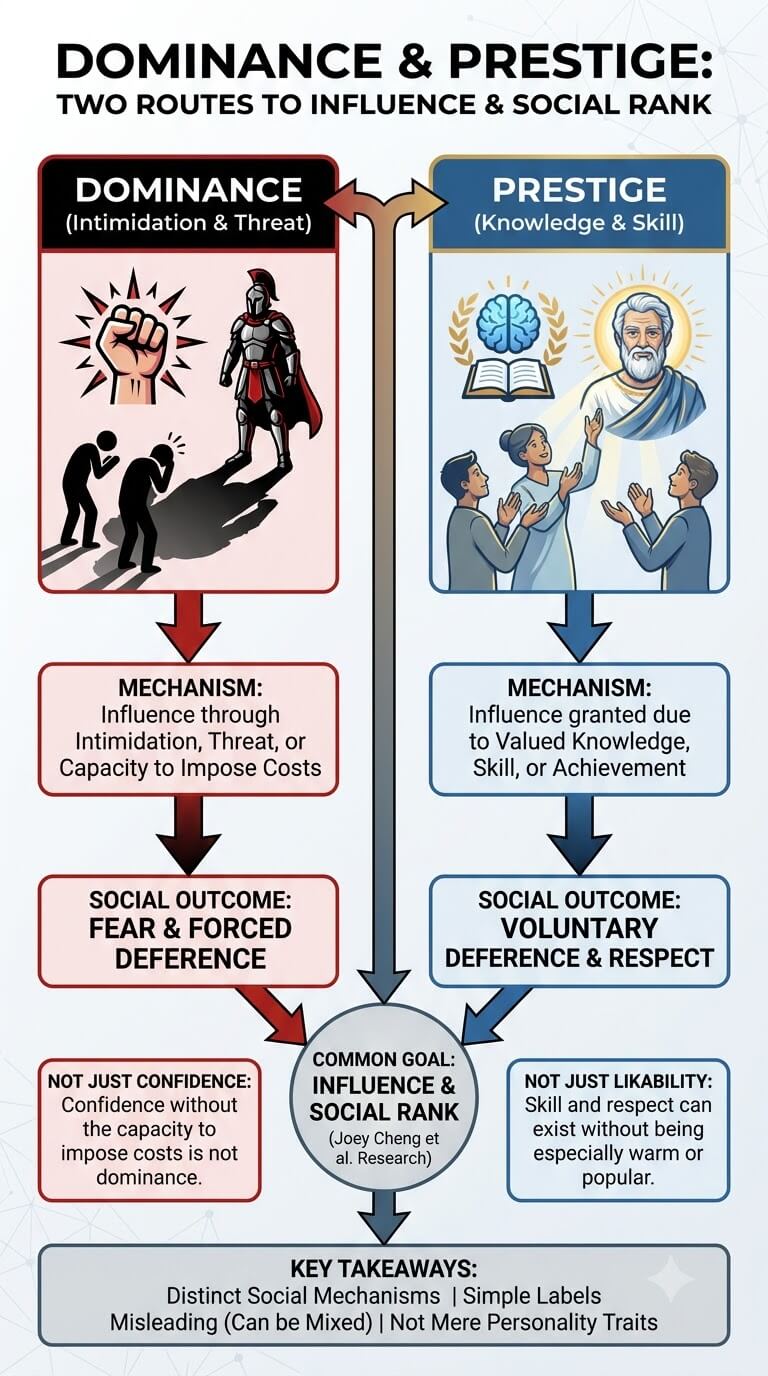
Two people may both gain influence while creating very different reasons for others to defer to them.
Fear and voluntary deference create different social relationships
Research by Joey Cheng and colleagues provides evidence that dominance and prestige can operate as distinct routes to social rank. Dominance involves influence through intimidation, threat, or the capacity to impose costs. Prestige involves influence granted because others value a person’s knowledge, skill, or achievement. Their study of dominance and prestige found that both could be associated with rank and influence, even though the social mechanisms differed.
Dominance is not simply confidence, and prestige is not simply likability. A confident person may have little capacity to impose costs. A highly skilled person may be respected without being especially warm or popular. People can also use mixtures of these routes, which is one reason simple “dominant type” labels are often misleading.
Why Legitimate Authority Feels Different From Mere Control
When people believe a role has a legitimate right to make a decision, they may comply without needing a threat or reward. Legitimacy can come from accepted rules, fair procedures, delegation, or shared expectations about responsibility.
Legitimacy is not the same as truth. A person can hold authority and still be wrong. It is also not the same as credibility. A respected expert may be highly credible about a technical issue but have no right to direct another person’s unrelated choices.
Why Threats to Status Can Feel So Personal
Criticism, exclusion, being ignored, public failure, or a challenge to competence can carry more than informational meaning. A person may also interpret the event as evidence that respect, rank, or reputation is falling. That interpretation can intensify anger, defensiveness, withdrawal, self-promotion, or efforts to restore standing. When people believe their rank or reputation may decline, status threat can help explain why criticism, exclusion, or comparison feels unusually consequential.
The important distinction is between the event and the perceived rank implication. A correction can be accurate without meaning that someone has lost all respect. Conversely, repeated public humiliation or deliberate undermining can genuinely affect social standing. The useful question is not “Should anyone care about status?” but “What is actually threatened here: accuracy, belonging, competence, reputation, role, or rank?”
What Having More or Less Power May Change
Relative power can alter constraints, attention, and action tendencies, but it does not determine a person’s character. A separate question is why power changes behavior, including its effects on action, attention, confidence, risk, and perspective-taking.
Greater power can increase freedom to act
One influential framework proposed by Dacher Keltner, Deborah Gruenfeld, and Cameron Anderson links greater power with increased rewards and freedom, and lower power with greater constraint and attention to possible threat. Their power, approach, and inhibition framework helped organize research on how power may affect attention and action.
The careful wording matters. Power does not automatically produce the same personality change in everyone. Effects depend on goals, norms, accountability, individual differences, how power is obtained, and whether the situation is temporary or stable.
Lower power may increase monitoring of other people
When another person’s reaction can strongly affect your outcome, paying close attention to them can be adaptive. A lower-power person may watch mood, timing, approval, social cues, or possible penalties more carefully because more depends on predicting the higher-power person’s response.
This should not be reframed as weakness. Extra monitoring can reflect the realities of constraint. The practical issue is whether the environment allows feedback, appeal, alternatives, and accountability, not whether the lower-power person can simply become more confident.
Power Distance: How Normal Does Unequal Authority Feel?

Power distance describes the extent to which unequal power relationships are expected or accepted within a social setting or cultural context. In a higher power-distance environment, people may expect more deference, centralized decisions, and symbolic distance between ranks. In a lower power-distance environment, questioning and consultation may be more acceptable.
These are broad tendencies, not personality labels for entire nations. Country averages can hide large differences among regions, generations, institutions, families, and individuals. Measurement itself also deserves caution. A 2021 study of Hofstede’s Values Survey Module reported concerns about reliability and validity for revised measures, including power distance. The open-access cross-cultural measurement study is a useful reminder not to treat cultural scores as fixed descriptions of every person.
Power Imbalance: When Unequal Dependence Changes the Interaction

A power imbalance exists when people do not have comparable ability to shape outcomes, protect their interests, access alternatives, or absorb the consequences of disagreement. The imbalance may involve money, information, social support, housing, grades, professional opportunities, caregiving, access to children, reputation, or decision rights.
Unequal power is not automatically abusive. A parent caring for a young child, a teacher grading work, or a licensed professional making a role-specific decision all involve asymmetry. The more useful test is whether the power is limited, transparent, accountable, and compatible with meaningful rights and realistic options for the lower-power person.
Voice, consent, and retaliation reveal more than titles do
Ask what happens when the lower-power person disagrees or says no. Can they ask for reasons? Is there an appeal? Can they seek another option? Are there consequences unrelated to the decision itself? Does the higher-power person punish disagreement by humiliating, isolating, threatening, or withholding essentials?
These questions move the analysis from abstract rank to lived consequences. A relationship may look equal on paper while one person’s practical alternatives are severely restricted.
Healthy Hierarchy, Unequal Power, and Misuse Are Not the Same Thing
The presence of unequal roles tells you less than how those roles are limited, reviewed, and experienced by the people involved.
Coordination, expertise, accountability, and transparent limits
A hierarchy can be functional when roles are clear, expertise is respected, responsibilities are matched with accountability, and people understand how decisions can be questioned. A parent can set age-appropriate limits. A teacher can maintain classroom structure. A community moderator can enforce transparent rules. A specialist can lead a task that requires specialized knowledge.
What makes these arrangements safer is not perfect equality. It is bounded power. The person with more influence has a defined scope, some form of accountability, and no unlimited right to control unrelated parts of another person’s life.
When asymmetry begins to restrict consent, voice, options, or safety
The situation changes when power is used to create fear, isolate someone, control finances without meaningful agreement, threaten retaliation, stalk, humiliate, or make refusal unsafe. Those behaviors are not simply interesting examples of hierarchy. The National Domestic Violence Hotline’s warning signs include patterns such as intimidation, isolation, controlling finances, and preventing independent decisions.
If credible fear or retaliation is present, direct confrontation is not always the safest first step. Outside support, documentation where appropriate, safety planning, and professional or local resources may matter more than trying to improve the conversation.
Which Question Are You Actually Trying to Answer?
Many disagreements about “power” become clearer when the question is narrowed. Use this map to identify the psychological issue underneath the word.
| If you are asking… | The main concept is… |
|---|---|
| Who can affect the outcome? | Social power |
| Who is respected, admired, or treated as higher ranking? | Status |
| Where does the influence come from? | Bases or sources of social power |
| How does the group organize unequal positions? | Social hierarchy |
| Are people deferring because of threat or respected competence? | Dominance versus prestige |
| Why does this person have a recognized right to decide? | Authority and legitimacy |
| Why did criticism feel like a threat to reputation or rank? | Status threat |
| What may change when someone gains more influence? | Psychological consequences of power |
| How acceptable does unequal authority feel in this setting? | Power distance |
| Can the lower-power person realistically refuse or choose another option? | Power imbalance |
Common Misunderstandings About Power and Status
Several common shortcuts create confusion because they collapse different kinds of influence, rank, and control into one label.
High status does not always mean high power
A beloved retired teacher may have enormous prestige in a community but no formal control over current decisions. A bureaucratic gatekeeper may have significant decision power while receiving little respect. Treating status and power as identical hides these common combinations.
Authority does not guarantee credibility
A role may grant decision rights without making every statement by the role-holder accurate. Credibility depends on whether a claim or source deserves belief, which can involve evidence, expertise, honesty, consistency, and relevance. Authority answers a different question: whether the person has a recognized right to decide within a particular scope.
Unequal power does not automatically mean abuse
Many relationships contain asymmetry because responsibilities, expertise, age, resources, or legal roles differ. The presence of asymmetry should prompt questions about limits, accountability, consent, options, and retaliation, not an automatic conclusion about abuse.
Low social power is not the same as low personal agency
Personal agency concerns a person’s capacity to choose and act within the options available. Social power concerns relative influence over other people or shared outcomes. Someone can have strong initiative and clear values while occupying a position with fewer resources or decision rights. Recognizing structural limits does not erase agency, and emphasizing agency should not be used to deny real constraints.
When Power Differences Become a Safety Concern
Ordinary differences in rank become a different kind of problem when fear is used to control behavior. Threats, stalking, coercion, financial control, isolation, humiliation, retaliation, violence, or credible fear deserve a safety-focused response. In those situations, the most useful question is not how to communicate more persuasively with the higher-power person. It is how to increase safety, support, options, and access to trustworthy help.
This article is educational and cannot determine the safety of a specific situation. If you are worried about retaliation or danger, consider reaching out to a trusted local professional, advocate, or relevant support service that can help you think through options without requiring confrontation.
FAQ
These questions clarify the distinctions that most often become blurred when people talk about power and hierarchy.
What is the difference between power and status in psychology?
Power refers mainly to the capacity to affect another person’s outcomes, resources, options, or consequences. Status refers to socially recognized respect, prestige, or rank. They often overlap, but they do not have to. A person may be highly respected without controlling decisions, or hold formal decision power without being admired.
Can someone have status without authority or power?
Yes. A respected artist, elder, specialist, or longtime community member may receive attention and deference while having no formal right to direct anyone and little control over material outcomes. Their standing comes from recognition rather than formal authority or resource control.
Why do social hierarchies form even in informal groups?
Groups often differentiate around competence, experience, reputation, resource access, social connections, dominance, prestige, or who takes responsibility. These differences can make coordination easier, but they can also become self-reinforcing. Informal hierarchies are especially easy to miss because people may behave as if a rank order exists even when nobody has named it.
Does having power always change a person’s behavior?
No. Research suggests that power can change freedom to act, attention, goal pursuit, inhibition, and social monitoring in some contexts, but effects vary. Accountability, norms, goals, personality, the source of power, and whether power is temporary or stable all matter. “Power always corrupts” is too simple to describe the evidence.
When does a normal power difference become a concerning imbalance?
Concern rises when the lower-power person cannot meaningfully refuse, appeal, leave, access outside support, or protect basic interests without disproportionate consequences. Fear, coercion, humiliation, financial control, stalking, threats, retaliation, and violence are especially important warning signs because they change the problem from ordinary asymmetry to safety.
Key Takeaways
- Power is about relative capacity to affect outcomes, while status is about socially conferred respect or rank.
- Authority adds legitimacy, and hierarchy describes the broader arrangement of unequal positions.
- A person can have high status with little formal power, or substantial power with little respect.
- Power differences affect attention, voice, freedom to act, monitoring, opportunity, and the cost of disagreement, but their psychological effects are not identical for everyone.
- Unequal power is not automatically harmful. Limits, accountability, realistic alternatives, consent, and retaliation risk are more informative than rank alone.
- When fear, coercion, stalking, humiliation, financial control, threats, or violence appear, safety should take priority over ordinary communication advice.
Final Thoughts
The most useful next step is to stop treating power as a single trait and identify the exact relationship you are trying to understand. Ask who can affect the outcome, who receives respect, who has legitimate decision rights, and what happens when someone disagrees. Those four questions usually reveal whether the issue is power, status, authority, hierarchy, or a more serious imbalance.
Michael Reed is the Founder & Lead Writer at Psychology Exposed, where he explains human behavior, relationships, emotional patterns, self-awareness, and everyday decisions in clear, research-aware language.

Michael Reed is the Founder and Lead Writer at Psychology Exposed. He writes about human behavior, relationships, emotional patterns, self-awareness, and practical psychology topics using research-informed, easy-to-understand content.
Read More About Michael Reed: https://psychologyexposed.com/michael-reed/