

A person may behave differently when nobody can easily identify them, when they are one face in a large crowd, or when responsibility feels spread across many people. That change is often described with the word deindividuation. The tempting explanation is that anonymity makes people “lose themselves” and become reckless. Psychology gives a more complicated picture.
Reduced visibility can change self-awareness, accountability, and attention. Yet the direction of behavior depends heavily on the setting. An anonymous participant in one online community may become hostile because hostility is rewarded there. In another, anonymity may make it easier to ask for help, admit uncertainty, or support strangers because those behaviors fit the local norms.
The useful question is therefore not, “Does anonymity make people bad?” It is, “What becomes less visible, what becomes more psychologically important, and what behavior does this setting reward?” That distinction helps explain crowds, online spaces, uniforms, temporary groups, and high-anonymity settings without treating people as mindless or without agency.
Quick Answer: What Deindividuation Means
Deindividuation refers to changes in self-awareness, accountability, or behavior that can occur when personal identity is less visible within a group or anonymous setting. Classic accounts emphasized reduced restraint, but modern research does not support a simple rule that anonymity causes aggression. Local norms, shared identity, responsibility cues, and the specific context help determine whether behavior becomes harmful, neutral, cooperative, candid, or prosocial.
The Classic Idea and the Modern Caution
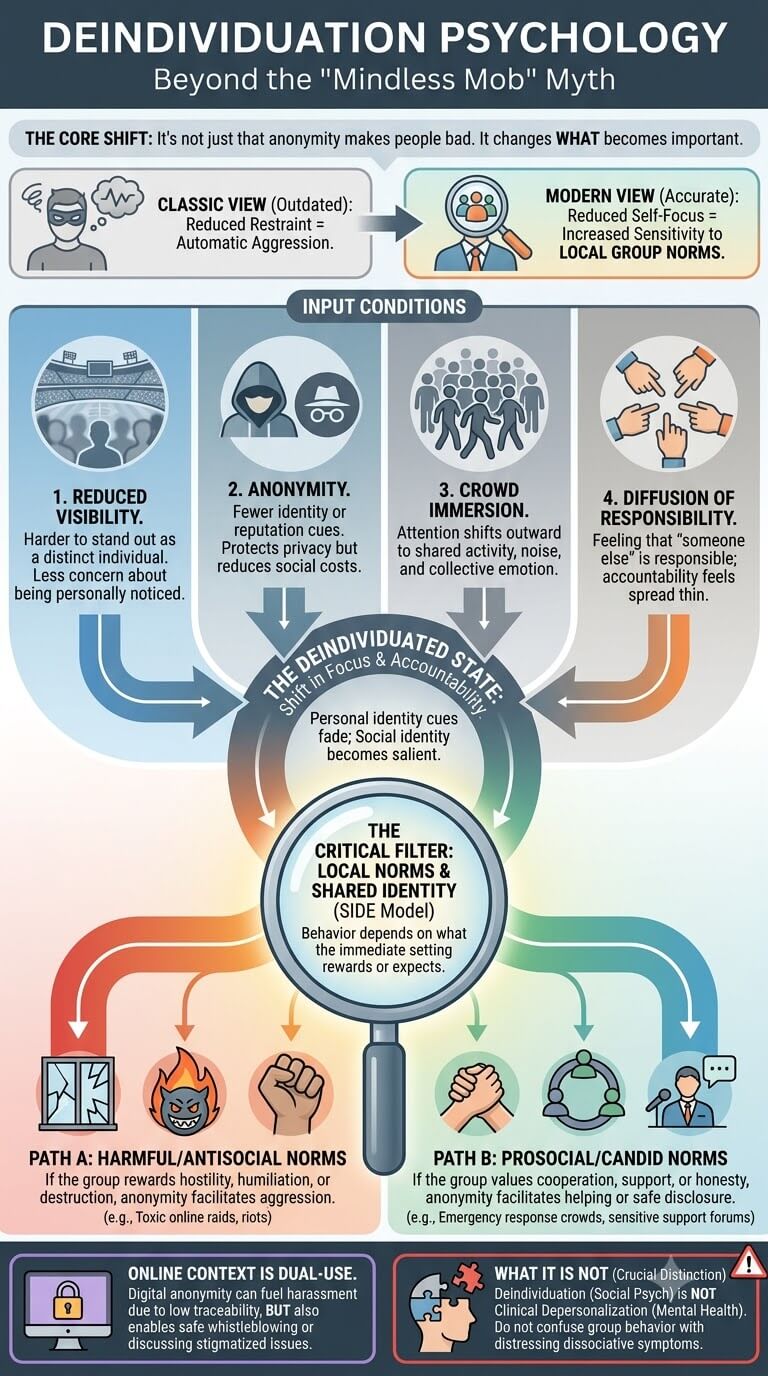
Early explanations of deindividuation focused on what might happen when the individual becomes less noticeable inside a group. The APA Dictionary of Psychology definition of deindividuation reflects this historical emphasis on reduced self-awareness and inner restraint under conditions such as anonymity or immersion in a group.
Anonymity, reduced self-awareness, and diffused responsibility in classic accounts
Imagine a person wearing the same costume as hundreds of others at a large event. Their name is not visible, their individual actions are harder to track, and attention may be pulled toward the crowd rather than toward their private standards. Classic models proposed that this combination could reduce self-monitoring and weaken the feeling that “I personally will be answerable for what happens.”
That idea overlaps with diffusion of responsibility, but the terms are not identical. Diffusion of responsibility describes a reduced sense that one person must act because responsibility feels spread across several people. Deindividuation is broader, involving changes in visibility, self-focus, accountability, and the influence of group context.
Why research does not support a simple “anonymity causes aggression” rule
The simple version of deindividuation became influential because it seemed to explain riots, vandalism, hostile crowds, and aggressive behavior. The problem is that the evidence has never fit a single deterministic path. Postmes and Spears’ meta-analysis of 60 studies found little support for the idea that deindividuating conditions reliably create a special antinormative state. Behavior was better explained by situation-specific norms.
This changes the practical interpretation. Anonymity may remove some personal reputation cues, but that does not leave a psychological vacuum. People may become more attentive to whatever identity, rule, expectation, or behavior is most meaningful in the immediate setting.
Four Conditions Often Discussed in Deindividuation

Deindividuation is not one switch that flips on or off. It is more useful to examine several conditions that can alter how strongly people experience themselves as individually visible and accountable.
Reduced personal visibility
Visibility is about how easily a person stands out as a distinct individual. In a small meeting, everyone can see who said what. In a crowd of several thousand people, one person may feel far less noticeable. Online, an account without a real name or photograph can create a similar reduction in personal visibility.
Lower visibility can reduce reputational pressure, which may make some people less cautious. It can also reduce social anxiety or embarrassment. A person who would never ask a sensitive question under their full name may ask it anonymously because the cost of being personally recognized is lower.
Anonymity or difficulty identifying individuals
Anonymity is not all-or-nothing. A person may be visually anonymous but still traceable through an account. They may be unknown to other participants but identifiable to a platform or organizer. They may be known by a stable pseudonym that carries its own reputation.
These differences matter. When consequences can still be traced to a stable identity, behavior may differ from a setting where people believe nothing follows them from one interaction to the next. “Anonymous” therefore describes several different social arrangements rather than one psychological condition.
Crowd immersion and attentional focus
Large groups can change what captures attention. Noise, movement, shared chants, coordinated activity, or collective emotion may pull attention outward. A person may focus less on private self-evaluation and more on what everyone around them appears to be doing.
But crowd immersion does not tell you what behavior will follow. A crowd at a marathon may cheer strangers. A religious gathering may become quiet and reflective. A concert crowd may sing in unison. An emergency crowd may organize practical help. The group setting amplifies some cues, but the content of those cues matters.
Diffusion of responsibility and weaker personal accountability cues
When many people are present, each person may feel that somebody else will notice, decide, intervene, clean up, report the problem, or take responsibility. OpenStax Psychology 2e discusses deindividuation as a group situation involving anonymity and reduced accountability, while distinguishing it from other forms of social influence.
Weak accountability cues are especially important when stakes are high. If a team decision affects safety, finances, or vulnerable people, “everyone was involved” should not mean “nobody was responsible.” Clear ownership can reduce ambiguity without requiring constant surveillance.
| Condition | What may change | What it does not prove |
|---|---|---|
| Reduced visibility | Less concern about being personally noticed | That restraint disappears |
| Anonymity | Fewer identity and reputation cues | That behavior becomes antisocial |
| Crowd immersion | Attention shifts toward surrounding people and shared activity | That the crowd becomes mindless |
| Diffused responsibility | Personal obligation may feel less clear | That nobody remains responsible for choices |
Group Cues and Local Norms Matter

One of the most important updates to classic deindividuation thinking is that people do not necessarily become normless when individuality is less visible. In some conditions, they may become more responsive to the norms that define the immediate group.
Anonymous settings can increase attention to situation-specific group norms
The Social Identity Model of Deindividuation Effects, often called SIDE, challenged the idea that anonymity simply erases social control. A review of the SIDE model by Russell Spears explains that anonymity can sometimes strengthen the psychological importance of group identity and group norms, especially in computer-mediated settings.
Consider two anonymous discussion boards. One consistently rewards careful explanations and respectful correction. The other rewards ridicule and status contests. The same reduction in personal visibility may produce very different behavior because the local signals tell people what counts as accepted participation.
Why prosocial norms can produce prosocial behavior
Anonymous behavior is not inherently hostile. In experiments on computer-mediated communication, Postmes and colleagues found that anonymity strengthened behavior consistent with experimentally primed group norms. When a prosocial norm was made salient, anonymous participants behaved in ways that matched it more strongly.
This finding is useful because it reverses the usual assumption. Reduced personal identifiability may sometimes make group cues more influential, and those cues can point toward cooperation, generosity, accuracy, restraint, or care just as they can point toward hostility.
Why harmful outcomes depend on context, not anonymity alone
Harm is more likely when a setting combines low accountability with norms that reward humiliation, intimidation, harassment, destruction, or retaliation. Anonymity may make those behaviors easier to express, but it is not a sufficient explanation by itself.
Look at the whole environment: What receives approval? What gets ignored? Who is protected from consequences? Are harmful actions celebrated as loyalty? Are there reporting channels? A setting can make harmful behavior easier without removing personal responsibility for choosing it.
Crowds Without the “Mindless Mob” Myth
Describing crowds as if individuality simply disappears can obscure what people are actually responding to. Crowds contain different identities, purposes, expectations, and social rules.
Shared cues, identities, and expectations shape crowd behavior
A crowd often has a reason for being together. Sports fans share a team identity. Volunteers at a community event share a task. People at a ceremony share expectations about appropriate conduct. Even when individuals are less visually distinct, these shared meanings help organize behavior.
This is why the same person may act differently in two crowds without becoming a different person. The setting changes what feels relevant, what others appear to expect, and what consequences seem likely. Individual values still matter, but they operate inside a different social field.
Different crowds can produce very different behavior
One crowd may create pressure to shout. Another may create pressure to stay silent. One may encourage people to help a stranger who falls. Another may normalize walking past. The existence of a crowd tells you very little unless you also know the crowd’s purpose, norms, leadership, emotional tone, and accountability structure.
That perspective also discourages sensational explanations after a harmful event. Saying “the crowd took over” can hide the specific processes that deserve attention, including organized encouragement, weak consequences, local norms, or deliberate individual choices.
Online Anonymity as One Context
Digital spaces make deindividuation especially visible because identity cues can be selectively hidden, changed, or reduced. Yet online anonymity has both protective and risky uses.
Reduced visibility and reputational cues
An anonymous account may reduce the fear that a question, mistake, opinion, or personal disclosure will follow someone into work, school, or family life. That can increase candor. It can also reduce the reputational cost of cruelty, misinformation, or repeated disruption.
The difference often lies in what remains traceable. A stable pseudonym can develop a reputation even when the person’s legal name is unknown. Moderation records can create accountability even when users are anonymous to each other. Technical anonymity and social accountability are not the same thing.
Local platform and community norms
People learn quickly what a digital community rewards. Likes, replies, moderator decisions, badges, visibility, and repeated examples all teach members what “works” socially. If calm expertise receives status, anonymity may coexist with thoughtful discussion. If humiliation receives attention, anonymity may lower the cost of joining in.
Design therefore matters. Rules that are specific, consistently enforced, and paired with visible examples of constructive behavior can make local expectations easier to read.
Why anonymity can support candor, privacy, or support as well as hostility
Anonymous environments can be useful for discussing stigmatized experiences, asking embarrassing questions, reporting wrongdoing, seeking peer support, or testing an idea without attaching it to a public identity. These benefits should not be dismissed simply because anonymity can also be misused.
A better decision is to match the level of anonymity to the purpose and stakes. A low-stakes support forum may reasonably prioritize privacy. A high-stakes financial approval process may need stronger traceability. The psychological question is not whether anonymity is good or bad in general, but what problem it solves and what risks it creates in that setting.
Uniforms, Masks, and Shared Symbols
Uniforms and shared symbols are often used as visual examples of deindividuation because they can make individuals look more alike. But looking alike can do more than reduce distinctiveness.
Reduced individuation can coexist with stronger group identity cues
A uniform may make one person less visually unique while making membership in a role or group more visible. A sports jersey, medical uniform, volunteer vest, or ceremonial clothing tells others, and often the wearer, what category is relevant in that moment.
This means the same object can reduce personal distinctiveness and increase social identity salience at the same time. The behavioral result depends partly on what that identity represents and what conduct is expected from its members.
Context determines whether accountability is weakened or group norms become more salient
A shared uniform can actually increase accountability when the role carries clear standards. A staff member in identifiable work clothing may feel more obligated to follow professional expectations, not less. In another setting, a mask that hides identity and is paired with weak consequences could reduce personal accountability.
Do not infer the psychological effect from appearance alone. Ask what the symbol means, whether conduct is traceable, and which norms it activates.
Deindividuation vs Conformity
Deindividuation and conformity can overlap, but they answer different questions. Confusing them makes group influence look simpler than it is.
Reduced visibility and accountability versus alignment with group judgments
Conformity is about changing a judgment or behavior in response to group information or pressure. Deindividuation is about conditions such as anonymity, reduced self-focus, immersion, and accountability cues that may change how a person behaves.
A person can conform in a brightly lit meeting where everyone knows exactly who they are. A person can also be anonymous without conforming to anyone, such as when privately submitting an anonymous survey response that differs from the majority.
The processes can overlap but are not synonyms
Anonymity can sometimes make a salient group norm more influential, which may increase conformity to that norm. In that case the processes interact. Still, the explanation should identify both pieces: the anonymity or identifiability conditions, and the group standard the person is aligning with.
This distinction helps avoid calling every group-shaped behavior “deindividuation.” Sometimes the simplest explanation is ordinary conformity. Sometimes anonymity changes the social conditions. Sometimes both are involved.
Deindividuation vs Self-Categorization “Depersonalization”
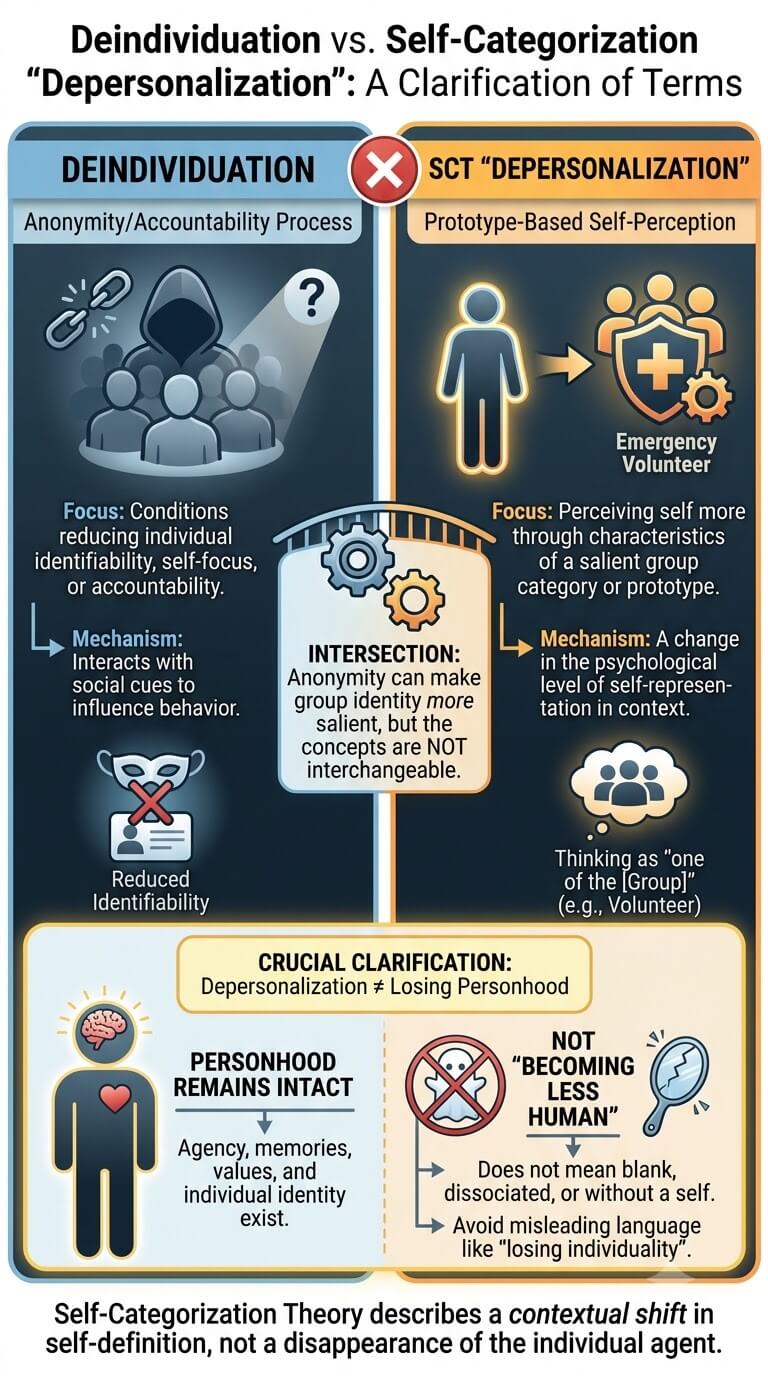
The word depersonalization has a technical meaning in Self-Categorization Theory that is easy to misunderstand. It does not mean becoming less human, blank, dissociated, or without a self.
Anonymity/accountability process versus prototype-based self-perception
In Self-Categorization Theory, technical depersonalization means perceiving oneself more through the characteristics of a salient group category or prototype. For example, a person may think more as “one of the emergency volunteers” than as a unique individual when that identity becomes relevant.
Deindividuation, by contrast, focuses on conditions that reduce individual identifiability, self-focus, or accountability and on how those conditions interact with social cues. The two ideas can meet when anonymity makes group identity more salient, but they are not interchangeable.
Why technical depersonalization does not mean losing personhood
A person who self-categorizes at the group level still has agency, memories, values, and an individual identity. The theory describes a change in the level at which the self is psychologically represented in a particular context, not a disappearance of the person.
This matters because language such as “losing individuality” can accidentally turn a precise social-psychology mechanism into something dramatic and misleading.
Deindividuation vs Clinical Depersonalization/Derealization
Clinical depersonalization and derealization belong to a different area of psychology and mental health. They should never be used as synonyms for deindividuation.
Social psychology term versus clinical symptom experience
Cleveland Clinic describes depersonalization and derealization as experiences of detachment from oneself or one’s surroundings that can become persistent and distressing. These are subjective experiences, not descriptions of anonymity in a crowd or reduced accountability in a group.
Someone feeling detached from their body or surroundings is not experiencing “deindividuation” simply because both words involve the self. Likewise, someone behaving differently in an anonymous group should not be described as clinically depersonalized.
Never use one concept to explain or diagnose the other
If a person reports persistent or distressing experiences of unreality or detachment, that deserves an appropriate mental-health conversation rather than a social-psychology label. Reading about group behavior cannot determine whether someone has a dissociative condition.
Keeping the terms separate protects both accuracy and the person. One concept explains social context and accountability; the other concerns experiences that may require clinical assessment when persistent or impairing.
| Term | Main question | What it does not mean |
|---|---|---|
| Deindividuation | How do anonymity, visibility, self-focus, and accountability affect behavior in group contexts? | Automatic aggression or literal loss of self |
| Self-categorization depersonalization | When does a person perceive the self more through a group prototype? | Dissociation or loss of personhood |
| Clinical depersonalization/derealization | Is a person experiencing distressing detachment from self or surroundings? | A synonym for anonymous group behavior |
Accountability Without Assuming Isolation Is the Answer
If reduced accountability contributes to a problem, the solution is not necessarily to make every person highly exposed or to eliminate group belonging. Privacy and group identity can have real benefits. The better goal is to make responsibility clear enough for the stakes.
Make individual roles and consequences visible
In a team, assign ownership for decisions and follow-up. In an online community, keep moderation records and make consequences predictable. At a public event, make staff roles identifiable and reporting routes easy to find. These steps clarify responsibility without requiring everyone to surrender privacy.
Accountability works best when people know what they are responsible for before something goes wrong.
Strengthen clear prosocial local norms
Do not rely only on rules that say what not to do. Show what constructive behavior looks like: verify before sharing, help someone who is isolated, challenge ideas without humiliating people, report threats, and stop escalation rather than rewarding it with attention.
Visible examples matter because people infer norms from repeated behavior, not only from written policies.
Build channels for private dissent and reporting
Some groups need anonymity precisely because speaking publicly is costly. A private reporting route can increase accountability at the system level while protecting the person who raises a concern.
If anonymous behavior includes threats, stalking, credible retaliation, targeted humiliation, or attempts to isolate and control someone, treat that as a safety problem rather than an interesting example of group psychology. Communication tips are not an adequate response to credible fear.
A Context Check for Anonymous or Crowd Settings

When behavior changes in a high-anonymity or crowd setting, use a four-question check instead of assuming “deindividuation caused it.” The framework is Visibility → Accountability → Norm → Salient Identity.
What behavior is locally rewarded or punished?
Look at what earns approval, status, attention, protection, or exclusion. A written rule may say “be respectful” while actual group behavior rewards sarcasm and public shaming. The lived norm is often more predictive than the official statement.
Is responsibility traceable enough for the stakes?
Ask whether someone can identify who made a high-stakes decision, who should respond to harm, and what happens if standards are violated. The greater the potential harm, the stronger the case for clear responsibility.
Traceability does not always require public identity. It may be enough for a trusted moderator, employer, organizer, or system to know who is accountable.
What identity or symbol is being made salient?
What does the person feel they represent in that moment: a profession, team, fan community, volunteer group, anonymous peer network, or temporary crowd? Which behaviors are associated with being a “good” member of that group?
This question is especially important when visual anonymity coexists with strong symbols, uniforms, slogans, or shared goals.
Are people safer or less safe because of the anonymity?
Anonymity can protect a whistleblower, a person seeking sensitive support, or someone asking a stigmatized question. It can also make targeted harassment harder to stop. Evaluate both sides rather than assuming identifiability is always safer.
If the setting creates credible fear, threats, stalking, retaliation, or coercive control, prioritize safety, documentation, appropriate reporting, and specialized support over attempts to reason with the group.
Why Norms and Identity Change What Anonymity Does
Two nearby ideas help make deindividuation more precise. Group norms explain why similar levels of anonymity can produce opposite behaviors, while self-categorization explains how a group identity can become psychologically prominent even when individual identity cues fade.
Group norms help explain why anonymous groups can move in different directions
If members understand that “people here help newcomers,” anonymity may make that norm easier to follow without self-consciousness. If the local rule is “mock anyone who hesitates,” the same anonymity can lower the social cost of cruelty. The environment supplies the direction.
That is why interventions aimed only at identity exposure can miss the deeper problem. If the norm itself rewards harmful conduct, adding real names may suppress some behavior without changing what the group admires.
Self-categorization helps distinguish salient group identity from reduced individual visibility
Reduced personal visibility answers one question: how identifiable is this person as a distinct individual? Self-categorization answers another: which level of identity feels relevant right now? The two can move together or separately.
A useful interpretation keeps both dimensions in view. Someone may be anonymous yet highly aware of a group identity, or fully identifiable while thinking mainly as a group member. Neither condition erases individual choice.
FAQ
The questions below clarify where anonymity matters, where responsibility fits, and why several similar-sounding psychology terms should not be treated as interchangeable.
Does deindividuation make people aggressive?
No. Aggression is one possible outcome in some settings, but research does not support a general rule that deindividuation causes aggression. Local norms, group identity, accountability, arousal, expectations, and the situation all matter. Anonymous people can also behave cooperatively, cautiously, generously, or supportively when those behaviors are locally meaningful.
Is online anonymity always harmful?
No. Online anonymity can reduce reputational accountability, which may create opportunities for harassment or deception. It can also protect privacy, enable sensitive questions, support whistleblowing, and help people discuss stigmatized experiences. The better question is whether the platform combines the needed level of privacy with norms, moderation, and accountability appropriate to the stakes.
What is the difference between deindividuation and diffusion of responsibility?
Diffusion of responsibility is specifically about feeling less personally responsible when responsibility seems distributed across other people. Deindividuation is broader and can involve anonymity, reduced personal visibility, self-awareness, immersion, and accountability cues. Diffusion of responsibility may contribute to deindividuation-related behavior, but the concepts are not interchangeable.
Is deindividuation the same as depersonalization?
No. In Self-Categorization Theory, depersonalization is a technical term for perceiving oneself more through a group prototype. In clinical contexts, depersonalization refers to distressing experiences of detachment from the self. Deindividuation concerns social conditions such as anonymity and reduced individual accountability. These three meanings should be kept separate.
Can deindividuation increase prosocial behavior?
Yes, under some conditions. Research influenced by the SIDE model suggests that anonymity can strengthen responsiveness to salient group norms. If the relevant norm supports helping, cooperation, restraint, or respectful participation, anonymous group members may behave more consistently with those prosocial expectations rather than less.
Key Takeaways
- Deindividuation is best understood through changes in visibility, self-focus, accountability, and group context, not as a literal loss of identity.
- Anonymity does not automatically cause aggression. Situation-specific norms help explain why similar anonymous settings can produce very different behavior.
- Reduced personal visibility can coexist with a stronger sense of group identity, especially when shared symbols or local norms are salient.
- Deindividuation is different from conformity, Self-Categorization Theory’s technical depersonalization, and clinical depersonalization/derealization.
- Online anonymity can create both risks and benefits, including reduced accountability, greater candor, privacy, support, and safer disclosure.
- A useful next step is to examine visibility, accountability, local norms, and salient identity before deciding why behavior changed in a crowd or anonymous setting.

Michael Reed is the Founder and Lead Writer at Psychology Exposed. He writes about human behavior, relationships, emotional patterns, self-awareness, and practical psychology topics using research-informed, easy-to-understand content.
Read More About Michael Reed: https://psychologyexposed.com/michael-reed/