

You may feel like the same person at home, at work, with close friends, in a sports community, or inside an online group. Yet the version of you that becomes most noticeable can shift with the setting. A quiet person may become outspoken when defending a team. Someone who disagrees privately may still stay silent or vote with the group because belonging has become part of the situation.
Social identity psychology helps explain these changes without assuming that people lose individuality or free choice. It focuses on what happens when membership in a group becomes part of how a person understands the self, who counts as “us,” what behavior feels normal, and what social consequences seem likely. The goal is not to label strong groups as good or bad. It is to understand how belonging, expectations, pressure, judgment, and accountability interact.
Quick Answer: How Group Membership Changes the Social Self

Social identity is the part of self-understanding that comes from belonging to social groups or categories. When a group feels psychologically important, its expectations, norms, goals, and boundaries may influence attention, judgment, and behavior. This influence can support cooperation and meaning, but it can also make disagreement harder. Group influence matters, yet personal values and responsibility still matter too.
What Social Identity Means in Psychology

The APA Dictionary of Psychology defines social identity as the part of self-concept derived from membership in social groups or categories. That can include a family, profession, neighborhood, hobby community, sports team, faith community, nationality, online community, or any other membership that feels relevant to who a person is.
Membership alone is not enough. Social identity becomes more influential when a person sees the group as meaningful or experiences other members as part of a shared “we.”
Personal identity and group-based identity can coexist
Personal identity includes the traits, preferences, memories, relationships, values, and life experiences that make you feel like a particular individual. Group-based identity refers to aspects of the self understood through membership in a social category. These are not mutually exclusive.
A nurse may think of herself as patient, introverted, a parent, a runner, and a member of a medical team. During an emergency at work, professional identity may move to the foreground. At a race, being a runner may matter more. The person has not become someone else. Different parts of self-understanding have become more salient.
Belonging is psychologically meaningful without erasing individuality
The APA describes the need to belong as a motivation to be part of relationships and groups and to be accepted by others. Belonging can provide connection, coordination, and shared meaning.
Group members can share a strong identity while disagreeing about priorities, methods, or values. Belonging does not require perfect sameness.
Why Group Identity Matters in Everyday Life
Social psychology examines how situations and other people affect thoughts, feelings, and behavior. Group behavior is rarely explained well by “the group made me do it” or “that is just my personality.” Both person and context matter.
Groups provide belonging, coordination, meaning, status, and expectations
Groups solve practical problems by helping people coordinate tasks, share knowledge, divide responsibility, and work toward goals that may be difficult alone. They also provide social meaning. A profession can signal what competence looks like, while a family may carry stories about loyalty or responsibility across generations.
Groups also create expectations. Some are explicit, such as a code of conduct. Others are learned through reactions: who gets praised, who gets ignored, what jokes are acceptable, which mistakes are forgiven, and what behavior draws disapproval. Those expectations can influence behavior even when no one gives a direct order.
The same group process can support cooperation or create unhealthy pressure
Many group processes are not inherently harmful. Conformity can support coordination, cohesion can help a team persist, and shared identity can motivate mutual help.
The difficulty appears when the same processes make dissent too costly, discourage careful thinking, or reduce accountability. A group that values harmony may become uncomfortable with necessary disagreement. A strong shared identity may make criticism feel like betrayal. Anonymity may reduce self-consciousness in one setting and reduce accountability in another. Context and local norms often determine which direction a group process takes.
The Core Mental Model: Group Category → Identification → Norms and Expectations → Social Pressure → Group Behavior → Consequences

A useful way to understand group influence is to follow it from the first moment of categorization to the consequences that follow. Think of this as a sequence, not a rigid law. People can enter the sequence at different points, resist it, reinterpret it, or leave the group entirely.
| Stage | Psychological question | Everyday example |
|---|---|---|
| Group category | Who counts as “us” here? | “We are the night-shift team.” |
| Identification | How much does this membership matter to who I am? | “Being part of this team matters to me.” |
| Norms and expectations | What do people like us usually approve, expect, or avoid? | “We always help the next person before leaving.” |
| Social pressure | What information, approval, belonging, or accountability cues are present? | “Everyone else is staying late, and I do not want to let them down.” |
| Group behavior | How does the person or group act under those cues? | A member stays, speaks up, stays silent, cooperates, or follows the majority. |
| Consequences | What happens to performance, relationships, judgment, and responsibility? | The team coordinates better, or dissent disappears and a weak decision goes unchallenged. |
Group category: noticing an “us”
Group influence starts with categorization. People notice patterns that separate one set of people from another: our department and theirs, residents and visitors, beginners and experienced members, home supporters and away supporters. Categories can be formal or informal, temporary or long-lasting.
A category does not automatically create hostility. It simply creates a meaningful distinction that may become relevant to perception and behavior.
Identification: when membership becomes part of the self
Identification describes the psychological step from “I am technically in this group” to “this group says something about who I am.” The APA overview of Social Identity Theory emphasizes that group membership can influence self-concept, especially when people categorize themselves as group members and identify strongly with the group.
Identification varies. A person may feel deeply attached to one group, loosely connected to another, and indifferent to a third. The same membership may also feel more important in some situations than others.
Norms and expectations: what members perceive as normal or approved
Norms are shared expectations about what members typically do or what they believe members ought to do. A group may value punctuality, humor, deference, direct disagreement, privacy, generosity, toughness, politeness, risk-taking, or careful review.
Some norms are spoken aloud. Others are learned through observation. A newcomer may notice that people who admit mistakes are respected, or that bad news is quietly hidden.
Social pressure: information, approval, belonging, and accountability cues
Pressure is broader than overt coercion. People may align because others seem better informed, because acceptance matters, or because they do not want to let teammates down. Visibility can increase accountability, while anonymity or shared responsibility may reduce it.
These cues may be subtle, even when the social setting helped shape which option felt easiest, safest, or most normal.
Group behavior and consequences: coordination, judgment shifts, responsibility, and outcomes
Once identity, norms, and pressure combine, behavior may shift toward cooperation, silence, risk-taking, stronger opinions, or reduced accountability. The same person may act differently across groups because the cues differ.
The useful question is not “Are groups powerful?” They clearly can be. A better question is “Which group process is operating here, and what consequences is it producing?”
Identity Foundations: Three Questions About the Social Self
Three related ideas explain why group membership matters, how individual and group-based identity differ, and why one identity becomes salient.
Social Identity Theory: why group membership matters to self-concept and intergroup comparison
Social Identity Theory focuses on how group memberships become part of self-concept and how people evaluate their groups in relation to other groups. It is especially useful for understanding why “us” and “them” distinctions can become psychologically meaningful even when the groups began from relatively simple categories.
The theory does not say that every group identity creates hostility. It helps explain why group membership can influence self-evaluation, comparison, and preferences. Even fairly minimal categorization can affect allocation or judgment in experiments, although real-world identities are far more complex than laboratory group assignments. A peer-reviewed review of ingroup favoritism and social identity offers a broader account of how categorization and group identification relate to intergroup behavior.
Personal Identity vs Social Identity: what feels uniquely “me” versus group-based “we”
This distinction asks which part of self-understanding is experienced as individual and which part is experienced through membership. Personal identity might include “I am cautious, curious, and good with detail.” Social identity might include “I am one of the senior technicians here, and people like us double-check our work.”
The two can support each other or conflict. A person may value honesty while belonging to a group that rewards silence about mistakes. That tension shows that group influence does not erase individual values.
Self-Categorization Theory: when a group identity becomes salient
People belong to many groups at once, so why does one identity matter in one moment and not another? Self-Categorization Theory addresses how context makes a particular level of self-definition more salient. At one moment you may think of yourself as an individual. In another, you may think mainly as a member of a team, profession, generation, or community.
This approach also uses the technical idea of depersonalization, meaning that a person sees the self more through the characteristics of a relevant group category. It does not mean clinical depersonalization, dissociation, or becoming less human.
Group Expectations and Belonging: How Groups Shape Everyday Alignment
Once a group feels meaningful, norms, conformity, and cohesion describe different parts of expectation, alignment, and commitment.
Group Norms Psychology: the standards members learn and enforce
Norms make group behavior more predictable. They can describe what most members do or what members approve and expect, and they spread through instruction, imitation, praise, correction, silence, and routine.
The interesting question is not only what a norm says, but how it formed, how newcomers learn it, who enforces it, and whether members privately agree. A team can have a visible rule encouraging questions while an unwritten norm punishes anyone who admits uncertainty. That gap matters.
Conformity Psychology: how individuals align with group judgments or behavior
Conformity is the individual response to group behavior or expectations. OpenStax distinguishes forms of conformity linked to wanting social acceptance from those linked to believing the group has better information. Its overview of conformity and group processes also distinguishes conformity from obedience and describes groupthink, group polarization, and deindividuation.
Conformity does not automatically mean weakness. In many settings, aligning with others is efficient and sensible. The important distinction is whether agreement reflects genuine judgment, useful coordination, uncertainty, fear of social cost, or pressure that has become coercive.
Group Cohesion Psychology: what keeps members connected and committed
Cohesion refers to forces that keep members connected to a group. Shared goals, trust, repeated interaction, mutual dependence, and shared identity can contribute. Cohesion may be social or centered on commitment to shared work.
Cohesion often helps coordination and persistence. It becomes risky to decision quality only when closeness makes disagreement feel disloyal or when maintaining unity becomes more important than examining evidence. Strong connection and open disagreement can coexist.
Shared Identity and Group Judgment: What Can Happen Once a “We” Is Strong
A strong sense of “we” can shape shared stories, judgment, and accountability. The concepts below describe distinct outcomes.
Collective Identity Psychology: the shared story of who “we” are
Social identity describes how group membership becomes part of an individual’s self-concept. Collective identity focuses on the shared understanding of who “we” are as a group. That shared understanding may be built from common history, symbols, rituals, goals, memories, boundaries, or stories about what the group stands for.
Collective identity can support cooperation, but it can also make disagreement feel personal when criticism is interpreted as an attack on “who we are.” Durable groups can update their shared story without treating every challenge as betrayal.
Groupthink Psychology: when consensus pressure reduces critical evaluation
Groupthink refers to a decision process in which the push toward agreement or unity interferes with careful consideration of alternatives. Signs may include self-censorship, an illusion that everyone agrees, pressure on dissenters, or overconfidence in the group’s judgment.
It is not a synonym for any bad team decision. A group can make a poor decision after open debate, and a group can reach fast agreement because the evidence is genuinely clear. The concern is reduced critical evaluation caused by consensus pressure.
Group Polarization Psychology: when discussion strengthens an initial group tendency
Group polarization occurs when discussion moves a group toward a stronger version of the direction its members initially leaned. A mildly cautious group may become more cautious. A group already leaning toward risk may become more willing to take it.
This is different from groupthink. Polarization is about the direction and strength of judgment after discussion. Groupthink is about the quality of evaluation under pressure for consensus. Polarization can happen even when members are actively discussing reasons rather than suppressing dissent.
Deindividuation Psychology: how anonymity, visibility, accountability, and local norms can alter behavior
Deindividuation addresses situations in which personal visibility, self-awareness, or individual accountability is reduced. Crowds, uniforms, anonymous online settings, and situations where responsibility is spread across many people may change how behavior is regulated.
Older popular accounts often treated reduced individuality as a path toward irrational or aggressive behavior. Contemporary group research is more nuanced. A peer-reviewed review of mass-gathering psychology notes that the old idea that crowds simply cause people to lose the self has lost academic credibility, while shared identity and local group norms can guide behavior in more organized ways. Deindividuation does not automatically mean aggression, and strong prosocial norms can support helping behavior.
Healthy Belonging vs Harmful Group Pressure

| Healthy belonging often includes | Pressure becomes more concerning when it includes |
|---|---|
| Room to disagree without losing basic respect | Humiliation for questioning the group |
| Clear expectations that can be discussed | Threats or retaliation for dissent |
| Accountability for leaders and members | Rules that protect powerful members from accountability |
| Permission to maintain other relationships and identities | Pressure to isolate from outside relationships |
| Voluntary participation and realistic choices | Coercion, stalking, financial control, or credible fear |
Healthy groups allow disagreement, accountability, and multiple identities
A psychologically strong group does not need every member to think, dress, speak, or prioritize exactly the same way. Members can share goals while preserving individual perspectives. They can challenge decisions without being treated as disloyal. Leaders can be questioned. Mistakes can be acknowledged.
It is also a good sign when people can belong to more than one community without being forced to prove loyalty by cutting off other parts of life. Multiple identities can give people perspective and reduce the sense that one group must provide every form of meaning, approval, and support.
Warning signs that pressure has crossed into coercion, humiliation, retaliation, or credible fear
Ordinary social pressure and coercive control are not the same thing. Feeling awkward because friends prefer one restaurant is very different from fearing punishment for disagreement. If group pressure includes threats, stalking, forced isolation, humiliation, retaliation, financial control, violence, or credible fear, the issue is no longer just an interesting example of conformity.
In those situations, prioritizing safety and outside support is more appropriate than trying to become better at fitting in or debating the group. Communication advice should not be treated as a substitute for practical safety planning when someone expects retaliation.
Group Context Does Not Eliminate Personal Values or Responsibility
Context can make some choices easier or harder, while personal standards still affect what people accept, resist, or challenge.
Situations influence behavior without making choice meaningless
Group psychology can help explain why a behavior became more likely. It does not automatically excuse the behavior. Situational pressure, uncertainty, anonymity, and norms matter, but people still differ in what they notice, what they resist, and what they are willing to do.
A useful stance is to hold both truths at once: behavior is shaped by context, and individuals still have agency.
How personal values can constrain or challenge group expectations
Personal values often become most visible when they conflict with group expectations. Imagine a workplace where everyone casually hides small errors. A newcomer may feel pressure to adapt, but a strong personal commitment to accuracy may create discomfort. That discomfort can lead to silence, resistance, a private conversation, a request for a clearer process, or leaving the environment.
The point is not that values always win. It is that group influence creates a psychological field of pressures and incentives rather than mechanically controlling behavior. Reflection becomes especially useful when a person notices, “I would not normally do this alone, so what is different here?”
Where to Go Deeper Based on Your Question
| If your main question is… | The concept to explore more deeply |
|---|---|
| Why does group membership become part of self-concept? | Social Identity Theory |
| What is individual identity versus group-based identity? | Personal Identity vs Social Identity |
| Why does one group identity become important in a particular moment? | Self-Categorization Theory |
| How do groups develop and enforce expectations? | Group Norms |
| Why do individuals align with a majority? | Conformity |
| What keeps members committed and connected? | Group Cohesion |
| How does a shared “we” form across members? | Collective Identity |
| When does consensus pressure damage decision quality? | Groupthink |
| Why can discussion make a group’s initial view stronger? | Group Polarization |
| How do anonymity and reduced accountability change behavior? | Deindividuation |
If your question is about identity theory or self-definition
Focus on the distinction between the individual self and the group-based self, then ask what makes a particular identity meaningful in context. This is where Social Identity Theory, personal versus social identity, and Self-Categorization Theory answer different but complementary questions.
If your question is about norms, conformity, or cohesion
Separate the social standard from the individual response. Norms describe what the group treats as normal or approved. Conformity describes alignment with those standards or with other members’ judgments. Cohesion describes the connection and commitment that keep members attached to the group.
If your question is about shared identity, group decisions, polarization, or accountability
Ask whether the issue is the shared definition of “who we are,” the quality of group decision-making, a shift in the strength of the group’s view, or reduced personal visibility and accountability. These processes often appear together in real life, but they are not interchangeable.
Common Misunderstandings About Social Identity and Group Dynamics
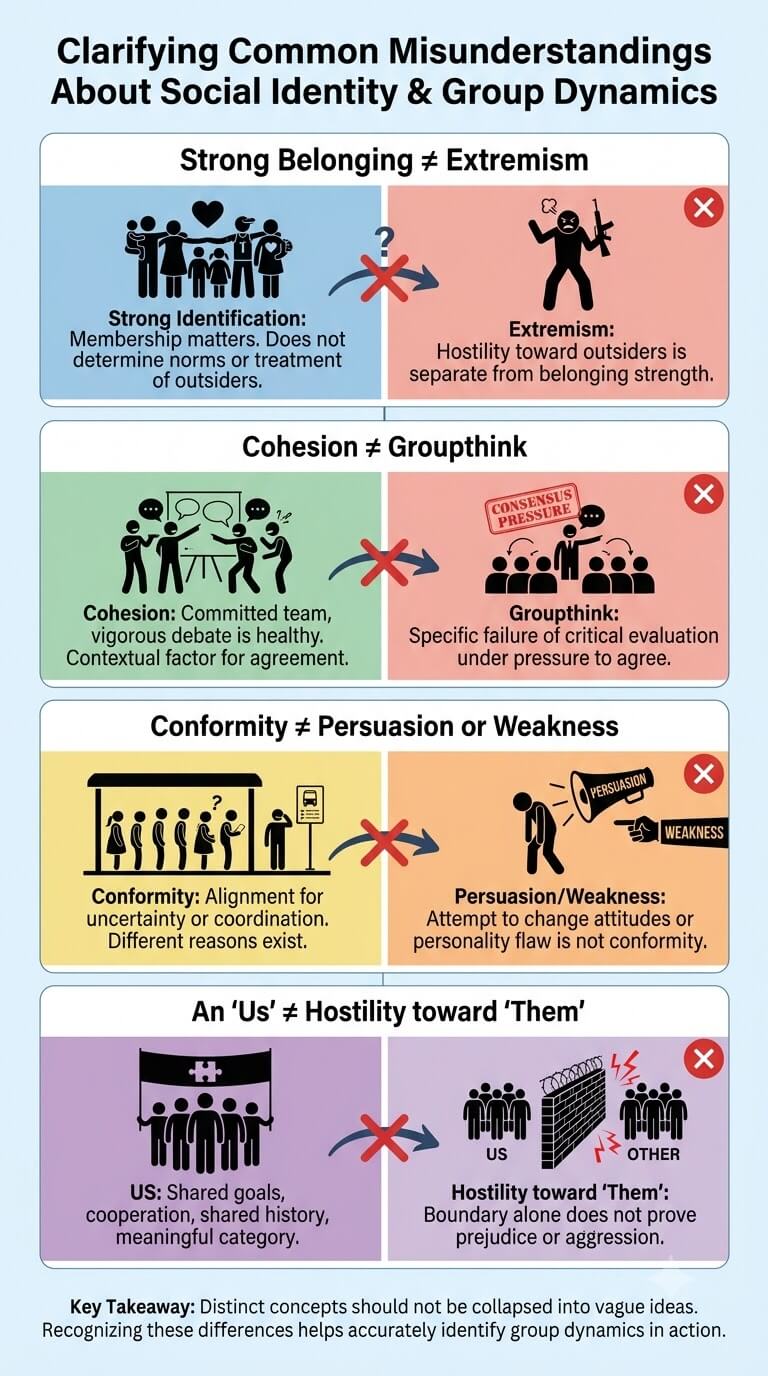
Several familiar terms are often collapsed into one vague idea of group influence. Keeping them distinct helps identify what is actually happening.
Strong belonging is not automatically extremism
People can identify strongly with families, professions, volunteer groups, sports communities, neighborhoods, and many other groups without becoming hostile toward outsiders. Strong identification tells you that membership matters. It does not tell you what the group’s norms are or how members treat nonmembers.
Cohesion is not the same as groupthink
A close, committed team may debate vigorously. A loosely connected committee may still suppress criticism. Cohesion can be one contextual factor that makes agreement valuable, but groupthink requires a more specific failure of critical evaluation under consensus pressure.
Conformity is not the same as persuasion or weakness
Persuasion involves messages attempting to change attitudes or behavior. Conformity involves alignment with group behavior, judgments, or norms. People also conform for different reasons, including uncertainty and coordination, so conformity is not proof of a weak personality.
An “us” does not automatically require hostility toward “them”
A shared “us” can exist because people cooperate, share history, pursue common goals, or simply recognize a meaningful category. Ingroup preference and outgroup hostility are not identical. Group boundaries can become a basis for bias, but the existence of a boundary alone does not prove prejudice or aggression.
FAQ
These questions clarify multiple identities, outsider bias, useful norms, group behavior, and the boundary between ordinary pressure and safety concerns.
Can a person have several social identities at the same time?
Yes. A person can simultaneously identify with a family, profession, neighborhood, hobby community, nationality, friendship network, and many other groups. Which identity becomes most noticeable depends partly on context. A work identity may dominate during a meeting, while a family or community identity may matter more in another setting.
Does social identity always make people biased against outsiders?
No. Social identity can create meaningful ingroup and outgroup distinctions, and some settings may encourage favoritism or bias. But identification does not automatically produce hostility. Norms, goals, relationships between groups, leadership, history, and the specific context all shape how group boundaries affect behavior.
Can group norms be healthy and useful?
Absolutely. Norms make coordination easier because members do not have to renegotiate every expectation from scratch. Norms can encourage fairness, careful work, mutual aid, honesty, safety, or respectful disagreement. Problems arise when norms protect harmful behavior, punish reasonable dissent, or become difficult to question.
Why do people sometimes act differently in groups than alone?
Groups change the information people receive, the expectations they notice, the social costs they anticipate, and the identities that feel relevant. Those shifts can make cooperation, silence, risk-taking, helping, or agreement more likely.
How can I tell ordinary belonging from unsafe group pressure?
Ordinary belonging may involve compromise, shared expectations, and occasional discomfort. Unsafe pressure is more concerning when disagreement is met with threats, humiliation, stalking, forced isolation, financial control, retaliation, violence, or credible fear. In those circumstances, the priority shifts from understanding group influence to protecting safety and seeking appropriate outside support.
Key Takeaways
- Social identity is the part of self-understanding that comes from psychologically meaningful group membership.
- Personal identity and group-based identity can operate at the same time, with different aspects becoming more salient in different settings.
- A useful sequence is category → identification → norms → social pressure → behavior → consequences.
- Norms, conformity, cohesion, groupthink, polarization, collective identity, and deindividuation describe different processes and should not be treated as synonyms.
- Belonging can support meaning, coordination, and cooperation without requiring hostility toward outsiders.
- Group context influences behavior, but it does not erase personal values, agency, or responsibility.
Final thought: The next time you notice yourself acting differently in a group, do not jump straight to “I was pressured” or “that is just who I am.” Ask a more precise question: Which part of the group situation changed what felt normal, meaningful, safe, or expected? That question usually points toward the specific psychological process worth examining.
Educational note: This article explains established ideas from social psychology for general education. It is not a diagnostic tool and should not be used to label individuals or groups. When group pressure includes credible threats, coercion, stalking, violence, or retaliation, practical safety support matters more than analyzing the social process alone.

Michael Reed is the Founder and Lead Writer at Psychology Exposed. He writes about human behavior, relationships, emotional patterns, self-awareness, and practical psychology topics using research-informed, easy-to-understand content.
Read More About Michael Reed: https://psychologyexposed.com/michael-reed/