
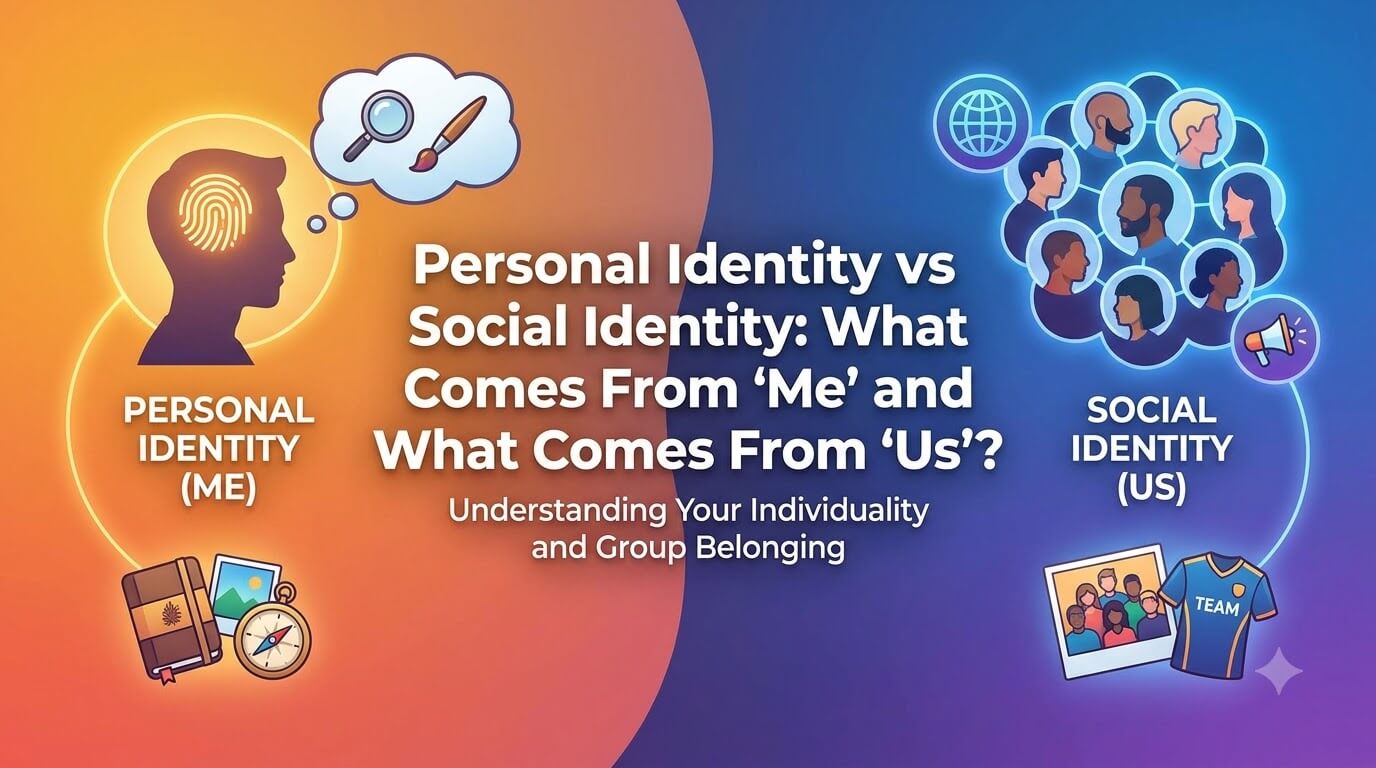
You may describe yourself one way when you are alone, another way at work, and another way around family or close friends. That does not necessarily mean you are inconsistent. Different settings can make different parts of the self more noticeable. A person can be curious, private, ambitious, a parent, an engineer, a football supporter, a volunteer, and a member of a neighborhood community without any one description telling the whole story.
The distinction between personal identity and social identity helps make sense of this. Personal identity emphasizes what feels individually distinctive about you. Social identity emphasizes the parts of self-understanding connected to groups and categories you belong to. The useful question is not “Which one is the real me?” but “Which part of who I am is most relevant in this situation, and how much influence do I want it to have?”
Quick Answer: The Difference in One Clear Framework
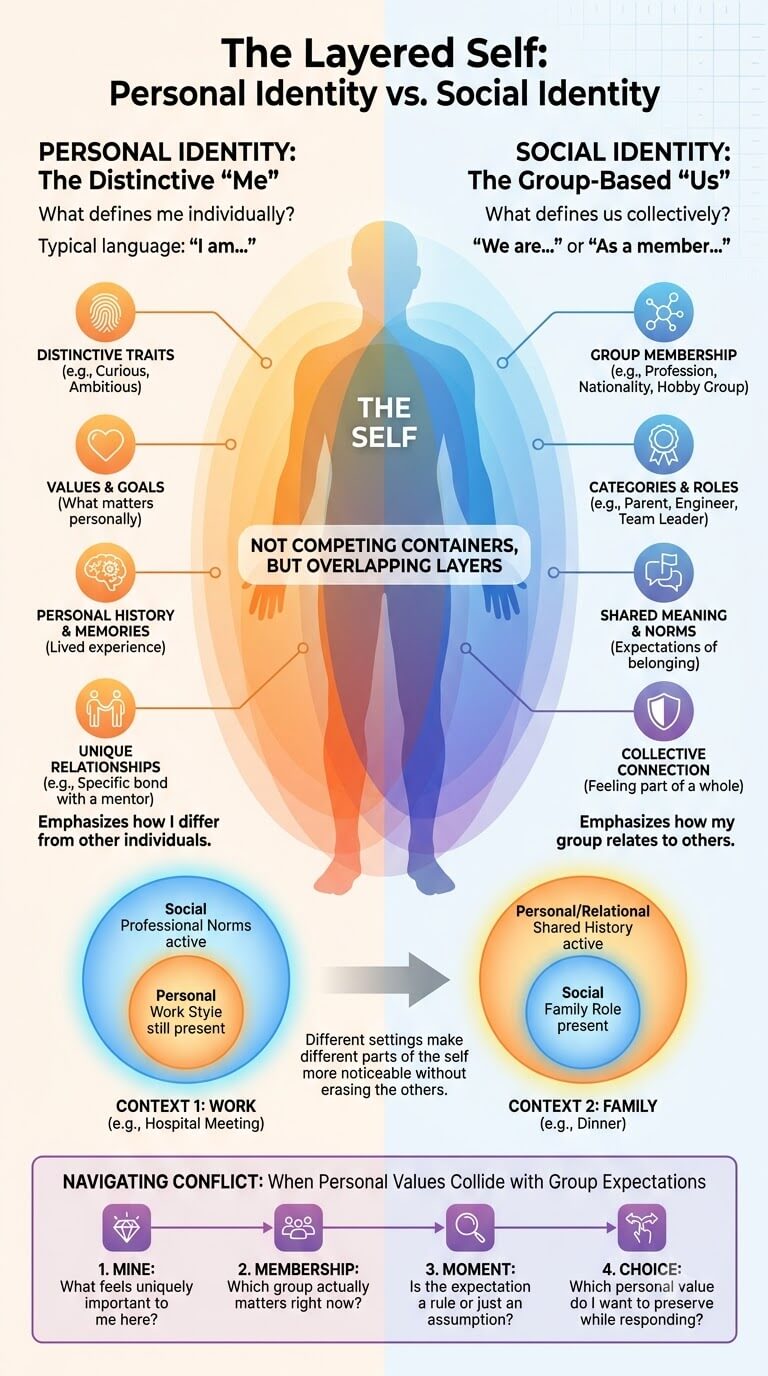
Personal identity refers to the characteristics, experiences, values, goals, relationships, and life history that help you experience yourself as a particular individual. Social identity refers to the part of self-concept connected to membership in groups or social categories. Both can be active at the same time, and the balance can shift with context without erasing individuality.
| Question | Personal identity | Social identity |
|---|---|---|
| What defines me here? | My distinctive traits, preferences, goals, memories, values, and personal relationships | My membership in a group or category and what that membership means |
| Typical language | “I am…” | “We are…” or “As a member of this group…” |
| Main comparison | How I differ from other individuals | How my group relates to other groups or categories |
| Can it change with context? | Yes, different personal qualities can become more relevant | Yes, different memberships can become more relevant |
| Does one eliminate the other? | No. Individual distinctiveness and group belonging can coexist. | |
Personal Identity: The Individually Distinctive Side of the Self
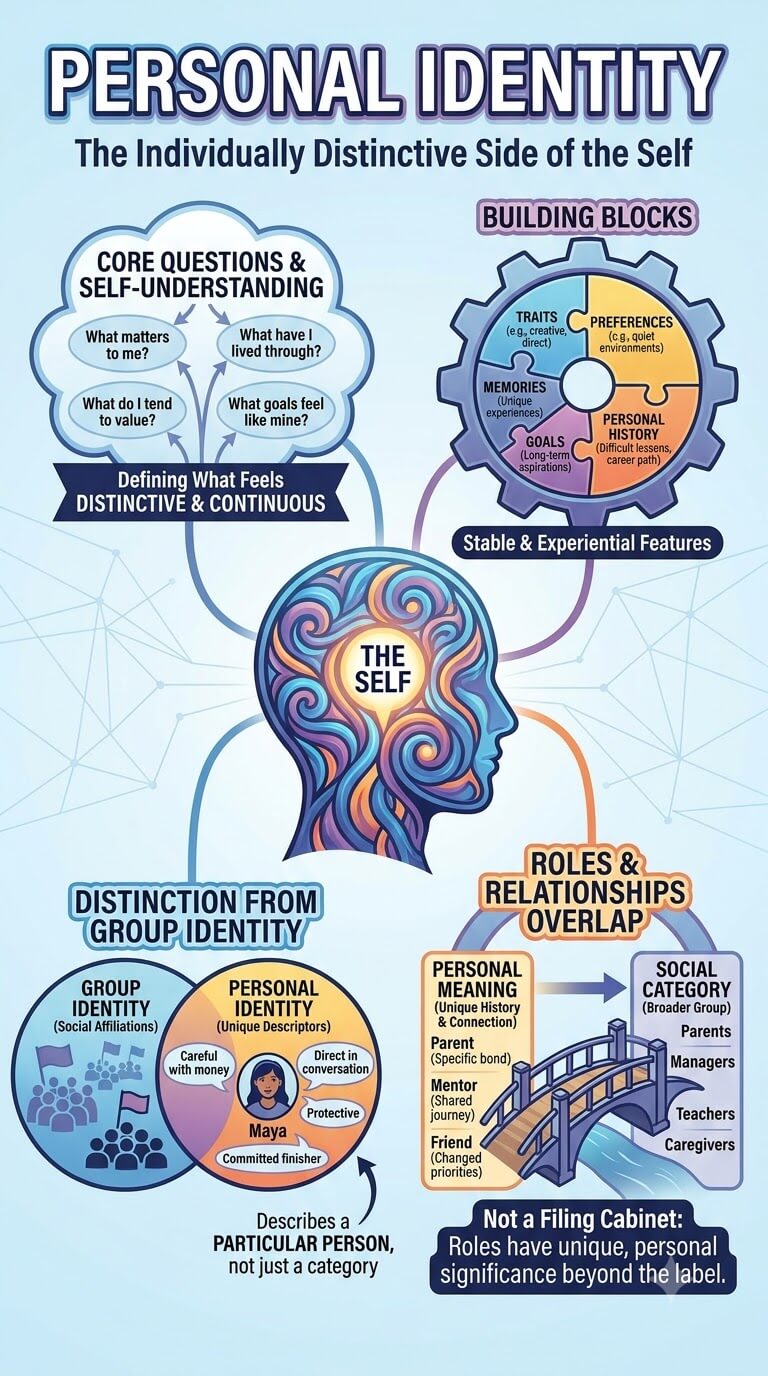
The APA Dictionary of Psychology definition of identity includes both distinctive personal characteristics and social affiliations. That is already a clue that identity is broader than a single label. Personal identity is the side of self-understanding that answers questions such as: What matters to me? What have I lived through? What do I tend to value? What goals feel like mine? What kind of person do I try to be?
Traits, preferences, memories, goals, and personal history
Personal identity includes features that make you experience your life as yours. Some are relatively stable, such as a long-standing preference for quiet environments or a strong interest in learning. Others are built from experience, such as a career choice, a difficult lesson, a friendship that changed your priorities, or a goal you have worked toward for years.
The APA definition of self-concept describes people’s understanding and evaluation of their own characteristics, skills, roles, and other qualities. Personal identity overlaps with this broader self-concept, but it is especially useful when thinking about what feels distinctive and personally continuous across situations.
For example, Maya may think of herself as careful with money, direct in conversation, creative, protective of younger relatives, and deeply committed to finishing what she starts. None of those descriptions requires a group comparison. They help describe Maya as a particular person.
Roles and relationships can be personally meaningful without being purely group-based
Not every role fits neatly into an “individual” or “group” box. Being a parent, mentor, spouse, friend, or team leader can become part of personal identity because the relationship has a unique history and meaning. At the same time, the role may also connect someone to a broader category, such as parents, managers, teachers, or caregivers.
This overlap matters because identity is not organized like a filing cabinet. A relationship can tell you something about your personal values and also place you inside a social category. The same label may carry a different meaning for two people because each person connects it to different memories, commitments, and expectations.
Social Identity: The Group-Based Side of the Self
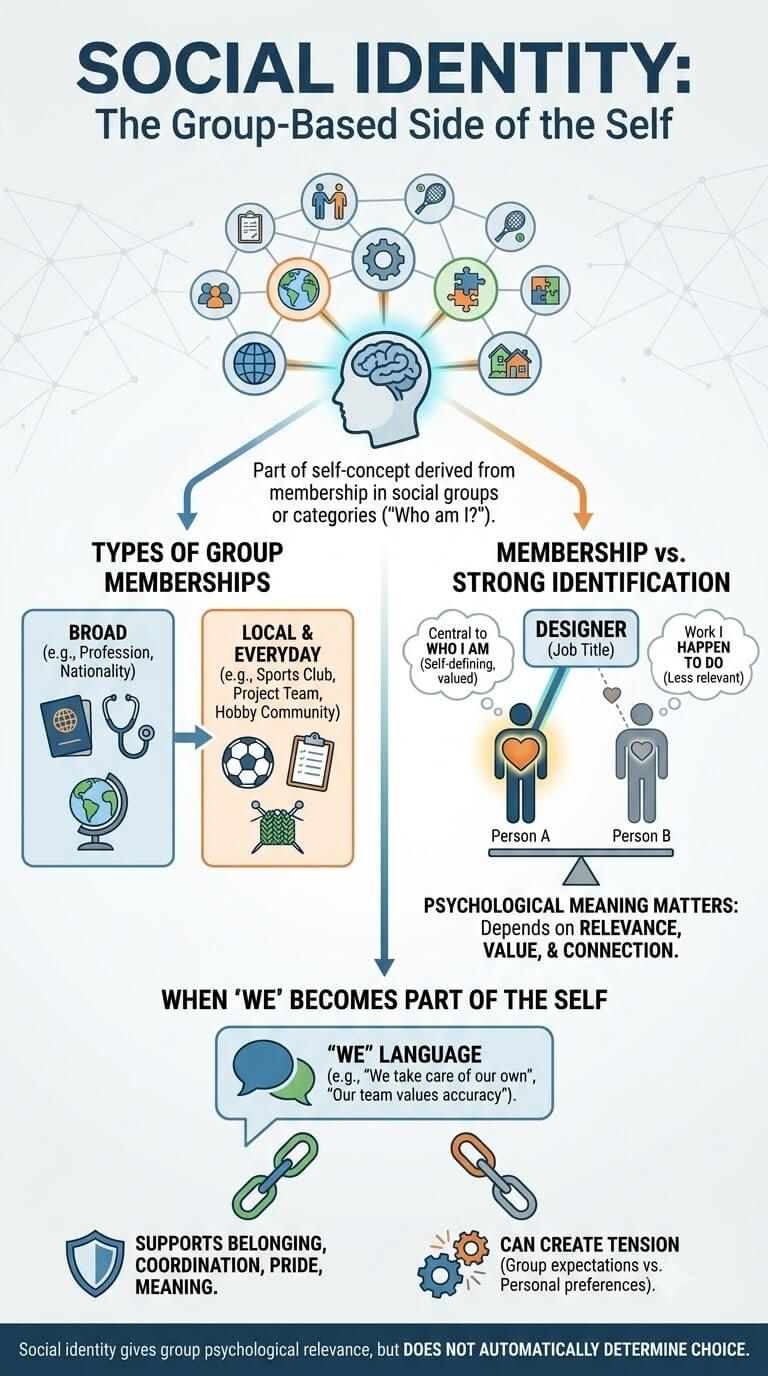
Social identity becomes relevant when belonging to a group or category helps answer “Who am I?” The APA Dictionary describes social identity as the part of self-concept derived from membership in social groups or categories. These memberships can be broad, such as profession or nationality, or local and everyday, such as a sports club, project team, hobby community, neighborhood group, or online community.
Membership categories and the meaning attached to them
Simply fitting a category is not the same as strongly identifying with it. Two people can hold the same job title but experience it very differently. One may see “designer” as central to who they are, while another sees design as work they happen to do. The psychological meaning of membership depends on how relevant, valued, and self-defining the category feels.
This helps explain why the same group label can matter strongly to one person and only weakly to another. Membership becomes self-relevant when the person experiences a real connection between the group and who they are.
When “we” becomes part of how a person describes themselves
You can often hear social identity in ordinary language. “We take care of our own.” “Our team values accuracy.” “People in this profession are expected to stay calm.” “In our family, we show up when someone needs help.” These statements do more than describe other people. They can carry expectations about what a member should value or do.
That shared “we” can support belonging, coordination, pride, and meaning. It can also create tension when group expectations collide with personal preferences or values. Social identity gives the group psychological relevance, but it does not automatically determine the person’s choice.
Personal and Social Identity Are Not Competing Containers
A common misunderstanding is to imagine personal identity and social identity as two fixed halves of the self. Psychology offers a more flexible picture. A person can think of themselves through individually distinctive qualities and through group membership, sometimes in the same moment. Social Identity Theory explains more specifically how group membership can enter self-concept and shape comparison and evaluation.
The same person can be distinctive and group-connected at once
Consider a physician speaking in a hospital meeting. Professional membership may matter because standards, responsibilities, and shared language are relevant. At the same time, the physician may be more cautious than colleagues, more willing to ask uncomfortable questions, or personally committed to a particular communication style. Group membership shapes the setting without turning everyone into the same person.
This is why “group influence = loss of individuality” is misleading. People interpret membership through their own history and values. Two equally committed members can disagree about what the group should stand for.
Identity is layered rather than split into two fixed halves
Research comparing personal and social identity likewise treats them as related ways of defining the self rather than two sealed systems. Personal identity emphasizes idiosyncratic attributes, while social identity emphasizes affiliations with groups or categories.
A useful way to picture this is as layers. Some layers describe what makes you distinctive. Others describe relationships or roles. Others connect you to larger groups. The active layer changes with the situation, but the rest of the self does not disappear.
Why Identity Salience Changes Across Contexts
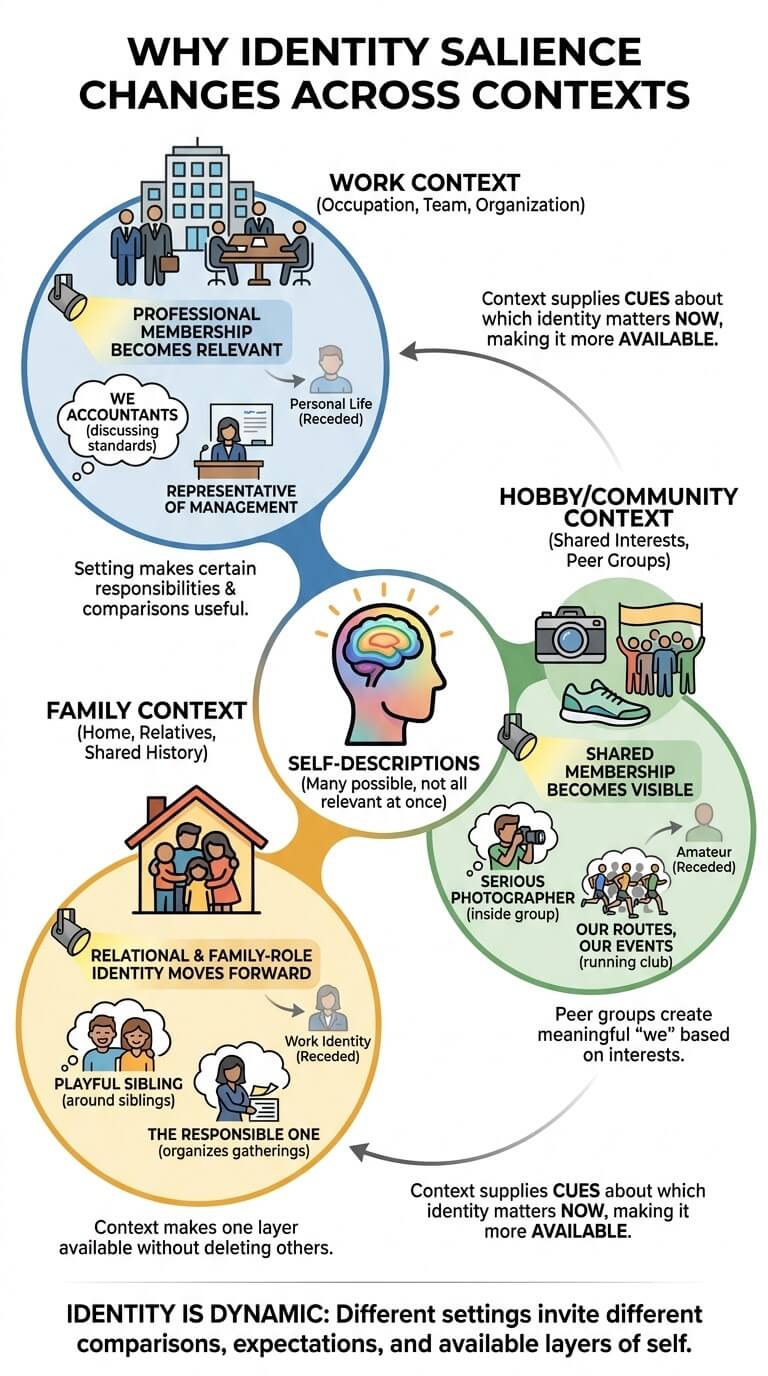
People carry many possible self-descriptions, but not all are equally relevant every minute. Context supplies cues about which identity matters now. A job interview, family gathering, professional conference, local sports match, and reunion with old friends each invite different comparisons and expectations.
Work: professional membership becomes more relevant
At work, occupation, organization, department, or team membership may become especially visible. A person who rarely thinks about being an accountant outside work may suddenly think “we accountants” when discussing professional standards with another department. A supervisor may feel more like a representative of management during a policy meeting than during lunch with a close colleague.
This does not prove that work identity is more authentic than other identities. It means the setting makes certain responsibilities, categories, and comparisons useful.
Family: relational and family-role identity moves forward
Family settings can activate roles such as sibling, parent, adult child, grandparent, or cousin. Someone who is confident and authoritative at work may become playful around siblings because that relationship carries a long shared history. Another person may become unusually responsible at family gatherings because “the one who organizes everything” has become part of how they understand their place in the family.
Some of this is relational and personal, some is group-based, and much of it overlaps. The important point is that context can make one layer of identity more available without deleting the others.
Hobby, community, and peer settings: shared membership becomes more visible
Shared interests can also create a meaningful “we.” A person may feel like an amateur photographer among coworkers but a serious photographer inside a photography group. A newcomer to a running club may gradually start thinking in terms of “our routes,” “our events,” and “what runners like us do.”
Peer groups can make style, humor, risk, status, or shared interests more noticeable. The influence may be mild and adaptive, such as learning the norms of a new activity, or it may create pressure when fitting in seems to require violating personal values.
A Six-Context Example Map
The same person can move through several settings in one week and experience a different emphasis in each. The table below shows how a shift in self-description can be understood without assuming the person is fake or fragmented.
| Context | What may become salient | What the person may feel | What it may mean | Useful next question |
|---|---|---|---|---|
| Work team | Department or professional membership | Responsible for representing the team well | Shared standards and reputation matter in this setting | Which expectations are genuinely useful, and which do I disagree with? |
| Family dinner | Sibling, parent, or family member | More protective, playful, or obligated | Long-term relationships activate familiar roles | Am I choosing this role, or automatically falling back into it? |
| Professional conference | Occupation or field | Proud, competent, or aware of professional norms | The profession is relevant to self-definition here | Which parts of this professional identity fit my own values? |
| Hobby group | Shared interest | More expressive or enthusiastic | A valued interest is being recognized by similar others | What do I enjoy here even if nobody approves of me? |
| Neighborhood event | Local community membership | Concerned about shared spaces and cooperation | Local membership creates common practical interests | Where do community expectations end and personal choice begin? |
| Old peer group | Long-standing friendship identity | Like an earlier version of yourself | Shared history can reactivate familiar ways of speaking and behaving | Does this version of me still fit who I want to be now? |
When Personal Values Conflict With Group Expectations
The difference between personal and social identity becomes especially visible when “what I believe” and “what people like us do” point in different directions. These moments can create discomfort because two meaningful parts of self-understanding are asking for different responses.
Belonging pressure without assuming total loss of choice
Imagine a close-knit project team that treats staying late as proof of commitment. You value the team and want colleagues to see you as dependable, but you also value keeping promises to your family. The pressure is real even if nobody explicitly orders you to stay.
Seeing the conflict clearly helps preserve agency. You can acknowledge, “I care about being a reliable member of this team, and I do not want unlimited availability to become the price of belonging.” That is different from pretending group expectations have no influence or assuming they control you completely.
How people can accept, negotiate, resist, or reinterpret a group expectation
Group expectations are not all-or-nothing demands. A member may accept a norm because it aligns with personal values. They may negotiate how the norm is expressed, resist it, or argue that the group’s deeper values support a different behavior.
For example, a sports club may prize toughness. One member interprets toughness as ignoring injuries, while another argues that responsible recovery allows athletes to stay committed over time. Both are responding to the same group identity, but personal judgment changes how they enact it.
When expectations involve threats, humiliation, coercion, isolation, retaliation, or credible fear, the issue is no longer just an interesting tension between belonging and individuality. Personal safety deserves priority over trying to become better at fitting in or negotiating with the group.
Personal Identity vs Social Identity vs Identity Development
These topics overlap in everyday language, but they ask different psychological questions. Keeping them separate prevents a useful comparison from turning into a broad story about how identity changes across an entire life.
Structure of the self now versus development of identity over time
Personal identity versus social identity asks: Which parts of self-definition are individually distinctive, and which parts come from group membership? The focus is on the content and context of identity in the present.
Identity development asks how a person’s sense of self forms, is explored, becomes committed, and changes across time. A recent open-access review on developmental and social-psychological perspectives on identity explicitly distinguishes these traditions while also examining how they interact. That distinction is useful: you can compare personal and social identity without turning every context shift into a developmental milestone.
Why lifespan stages and identity crises belong elsewhere
Feeling different around family than around coworkers does not by itself indicate an identity crisis. Nor does changing how much a group matters over time necessarily signal a problem. People encounter new roles, leave old communities, deepen commitments, and revise priorities throughout life.
If the question is “How did I become this person?” or “How is my identity changing across adolescence, adulthood, or major transitions?” a developmental lens is more appropriate. If the question is “Why does being a member of this group matter to who I am in this setting?” the personal-social distinction is more useful.
Personal Identity vs Social Identity vs Self-Categorization Theory
Another nearby idea concerns not what your identities contain, but how one level of self-definition becomes especially relevant in a given situation. That is where Self-Categorization Theory becomes useful.
Comparison of self-content versus mechanism of category salience
| Question | Personal vs social identity | Self-Categorization Theory |
|---|---|---|
| Main focus | What parts of the self are individually distinctive versus group-based? | How and when people categorize themselves at individual or group levels |
| Useful for | Clarifying identity content | Explaining category salience, prototypes, and context-dependent group self-perception |
| Example question | Is “engineer” part of how I define myself through group membership? | Why did “engineer” become the most relevant way I saw myself in that meeting? |
A modern overview of self-categorization and social identification describes self-categorization as applying social categorization to oneself and explains why group self-definition can vary across people and situations. That mechanism deserves its own treatment rather than being squeezed into a simple identity comparison.
When a theory explanation is the better next read
If you mainly want to understand why different settings bring different memberships to the foreground, the theory of self-categorization is the more precise tool. If you want to know whether a self-description is primarily distinctive and individual or based on group membership, stay with the personal-social distinction.
The two questions complement each other. One tells you what kind of identity content is active. The other helps explain why that content became psychologically prominent now.
A Self-Reflection Matrix for Mixed Identities
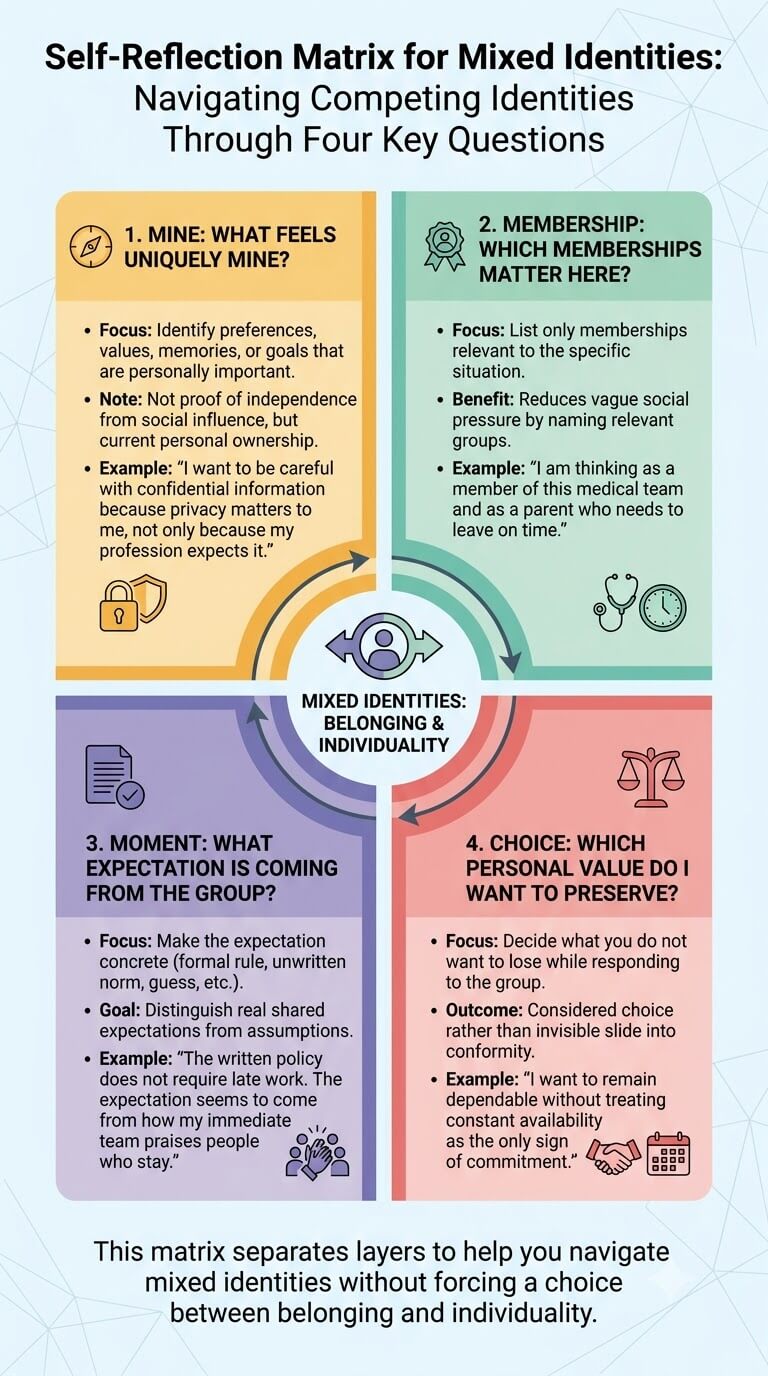
When several identities pull in different directions, a short reflection can separate the layers without forcing you to choose between belonging and individuality. Use four questions: Mine, Membership, Moment, Choice.
What feels uniquely mine?
Name the preference, value, memory, goal, or personal commitment that feels important even if the group disappeared tomorrow. This is not proof that the value developed without social influence. It simply identifies what you currently experience as personally owned.
Example: “I want to be careful with confidential information because privacy matters to me, not only because my profession expects it.”
Which memberships matter here?
List only the memberships that are relevant to the situation. You may belong to dozens of groups, but perhaps only one or two matter in this moment. Naming them reduces vague feelings of social pressure.
Example: “I am thinking as a member of this medical team and as a parent who needs to leave on time.”
What expectation is coming from the group?
Make the expectation concrete. Is it a formal rule, an unwritten norm, a guess about what others want, or something one influential person keeps saying? Group pressure feels more manageable when you distinguish a real shared expectation from an assumption.
Example: “The written policy does not require late work. The expectation seems to come from how my immediate team praises people who stay.”
Which personal value do I want to preserve?
Finally, decide what you do not want to lose while responding to the group. You may still choose to adapt, cooperate, or compromise. The difference is that the response becomes a considered choice rather than an invisible slide into whatever the group seems to expect.
Example: “I want to remain dependable without treating constant availability as the only sign of commitment.”
What to Do When You Feel “Different Around Different Groups”
People often worry that changing across settings means they are being fake. That concern matters if you repeatedly abandon values to avoid rejection, but ordinary context sensitivity is part of social life.
Treat context shifts as information, not proof that you are fake
Notice what changes. Do you become quieter, more competitive, more humorous, more careful, or more agreeable? Then ask what the setting rewards, expects, or makes relevant. The answer may reveal a role, a relationship history, a desire to belong, or a part of yourself that rarely has room elsewhere.
A person who speaks more confidently in a professional group may not be pretending. They may be in a setting where competence is recognized and familiar language makes expression easier. Someone who becomes reserved around an old peer group may be reacting to a history in which certain parts of them were not welcomed.
Look for consistency in values even when behavior adapts
Consistency does not require identical behavior everywhere. You can be formal with clients and relaxed with friends while valuing respect in both settings. You can be a team player at work and independent in a hobby without betraying either identity.
A more useful test is whether your adaptations still fit your chosen values. If you repeatedly act against what matters to you because rejection feels intolerable, that conflict deserves closer attention. If your behavior changes while your deeper commitments remain recognizable, the variation may simply show flexible social functioning.
How Different Identity Layers Lead to Different Group Processes
Once you can distinguish individual and group-based self-definition, several other social processes become easier to understand. The key is to keep the questions separate rather than treating every group effect as the same thing.
Why context-dependent identity points toward self-categorization
When you ask, “Why did I suddenly think of myself mainly as a team member rather than as an individual?” you are moving from identity content to identity salience. That question is about the conditions that make a group category stand out, the comparisons that become relevant, and the expectations that follow.
This is also where group norms and conformity can become relevant later. First a membership has to matter psychologically. Then the person can notice what “people like us” usually do and decide how much to align with it.
How individual social identity differs from a shared group identity
Social identity is experienced by an individual: “Being part of this group is part of who I am.” A shared group identity adds another level: “We have a common understanding of who we are.” Those ideas often reinforce each other, but they are not interchangeable.
For instance, a volunteer may strongly identify with a community organization even while disagreeing with other members about its story, symbols, or future direction. The person has a social identity tied to membership, while the group may still be negotiating its shared collective identity.
FAQ
The distinction becomes clearest when applied to ordinary questions about work, belonging, and changing behavior across settings.
Can personal identity and social identity conflict?
Yes. A personal value or goal can conflict with what a meaningful group expects. You might value direct disagreement while belonging to a group that prizes harmony, or family time while a team treats long hours as commitment. The conflict does not make either identity false. It means two meaningful parts of self-definition point toward different responses, so name the expectation and decide which values you want to preserve.
Is a job title part of personal identity or social identity?
It can be both. A job title is group-based when it places you in a professional category with shared expectations and standards. It can also become personally meaningful through your history, skills, and goals. One person may experience “teacher” as central to who they are, while another sees teaching as important work but not a major part of self-definition.
Why do I feel more like “myself” in some groups than others?
Some settings make valued parts of you easier to express. You may feel understood, competent, relaxed, or less monitored. Other groups can activate older roles, strong norms, or concern about disapproval. Feeling more like yourself somewhere does not make every other version fake. It may mean the setting fits your values better or makes a different part of identity more relevant.
Does social identity mean losing individuality?
No. Group membership can influence self-definition, expectations, and behavior without erasing personal judgment. People who strongly identify with the same group can still differ in temperament, values, interpretations, and choices. Social identity explains why membership matters to the self, not why a person becomes interchangeable with other members.
How is this different from identity development?
Personal versus social identity compares two ways the self can be defined: through individually distinctive characteristics and through group membership. Identity development asks how a sense of self forms and changes over time. If you are asking why a profession or peer group matters to self-concept today, the personal-social distinction fits. If you are asking how that identity emerged across life stages, a developmental perspective fits better.
Key Takeaways
- Personal identity emphasizes the traits, values, goals, memories, relationships, and experiences that feel distinctive to you as an individual.
- Social identity emphasizes the parts of self-concept connected to membership in groups or social categories.
- The two are layered and overlapping, not two fixed halves that compete for control.
- Context can make one role or membership more salient without proving that other versions of you are fake.
- When group expectations conflict with personal values, separating the expectation from your own choice can help preserve both agency and belonging where possible.
- A useful next step is to ask four questions: what feels mine, which membership matters, what expectation is active, and which value I want to preserve.
Educational note: This page explains social-psychological concepts for general understanding. It does not diagnose identity problems or mental health conditions. If group pressure involves threats, coercion, humiliation, stalking, isolation, retaliation, or credible fear, treat the situation as a safety concern rather than only a question of fitting in.

Michael Reed is the Founder and Lead Writer at Psychology Exposed. He writes about human behavior, relationships, emotional patterns, self-awareness, and practical psychology topics using research-informed, easy-to-understand content.
Read More About Michael Reed: https://psychologyexposed.com/michael-reed/