

You can feel like the same person at home, at work, with old friends, and inside a hobby community, yet different parts of who you are may come forward in each setting. Sometimes you think mainly as an individual. At other times, being a parent, teammate, profession member, local resident, fan, or community member becomes especially meaningful. Social Identity Theory helps explain what changes when group membership becomes part of how you understand yourself.
The theory is useful because it does not require people to lose individuality before group membership matters. It asks a narrower question: when a group becomes psychologically meaningful, how can that membership influence self-evaluation, comparisons with other groups, and behavior toward people seen as part of “us” or “them”? It also helps explain why group boundaries can matter even when there is no long history of hostility.
Quick Answer: What Social Identity Theory Tries to Explain

Social Identity Theory explains how membership in social groups can become part of a person’s self-concept. It emphasizes social categorization, identification with a group, and comparison between relevant groups. These processes can make group status, belonging, and distinctiveness personally meaningful. The theory does not say that people always favor their own group, dislike outsiders, conform automatically, or stop making individual choices.
The Problem the Theory Was Built to Address
Many explanations of behavior begin with the individual: personality, preferences, motives, beliefs, or past experience. Those factors matter, but they do not fully explain why a person may think and act differently once a meaningful group boundary enters the situation. Social Identity Theory was developed to take group membership seriously as a psychological part of the self rather than treating groups as background scenery.
Why group membership can affect self-definition
People belong to many categories at once, from professions and teams to neighborhoods, hobby communities, and friend groups. Membership matters psychologically when a person experiences the category as relevant to who they are, not merely as a label someone else could apply.
The APA Dictionary of Psychology definition of Social Identity Theory emphasizes that groups can influence members’ self-concepts and self-esteem, especially when people categorize themselves as group members and identify with the group. This is why a criticism of “people like us,” a success achieved by “our team,” or a comparison with a rival group can feel more personal than a detached observation about strangers.
Why intergroup behavior cannot be reduced to personality alone
Imagine two departments in the same organization. Most employees may be cooperative and reasonable one to one, yet a resource dispute can quickly be framed as “our department” versus “theirs.” The behavior that follows cannot always be explained by saying one side contains more competitive personalities. The meaning of the category, the comparison being made, and the perceived interests or status of each group may reshape the situation.
This does not make personal motives irrelevant. It means behavior can sometimes be organized around a group frame. Even someone who disagrees with fellow members may care about how outsiders evaluate the group because the membership still feels self-relevant.
Tajfel and Turner at an Accessible Level
Henri Tajfel’s work on social categorization and intergroup behavior, followed by theory developed with John Turner, shifted attention toward the psychological significance of group membership. Their work challenged the idea that meaningful intergroup behavior requires deep personal hostility, a long conflict history, or obvious material competition before group boundaries can matter.
The historical question behind the theory
A central question was surprisingly simple: how little is needed before people begin treating an ingroup and an outgroup differently? Tajfel and colleagues studied situations in which participants were assigned to categories on minimal grounds, with no meaningful prior relationship between the groups.
In the classic 1971 social categorization experiments, participants could favor members of their assigned group in reward allocations even when the categories themselves were relatively trivial. The finding did not prove that arbitrary labels inevitably produce prejudice. It showed that categorization alone can sometimes become behaviorally meaningful under surprisingly thin conditions.
What the theory added to social psychology
The broader contribution was to treat the self as capable of being defined through personal characteristics and through memberships carrying emotional and evaluative significance. Some social behavior therefore needs an explanation that takes structured group relations seriously, not only person-to-person interaction.
That argument is visible in Tajfel’s 1979 discussion of individuals and groups in social psychology, which explicitly pushed against purely individualistic explanations of intergroup behavior. Social Identity Theory became one way to connect self-concept with group membership, social comparison, and the structure of relations between groups.
The Three Core Processes of Social Identity Theory
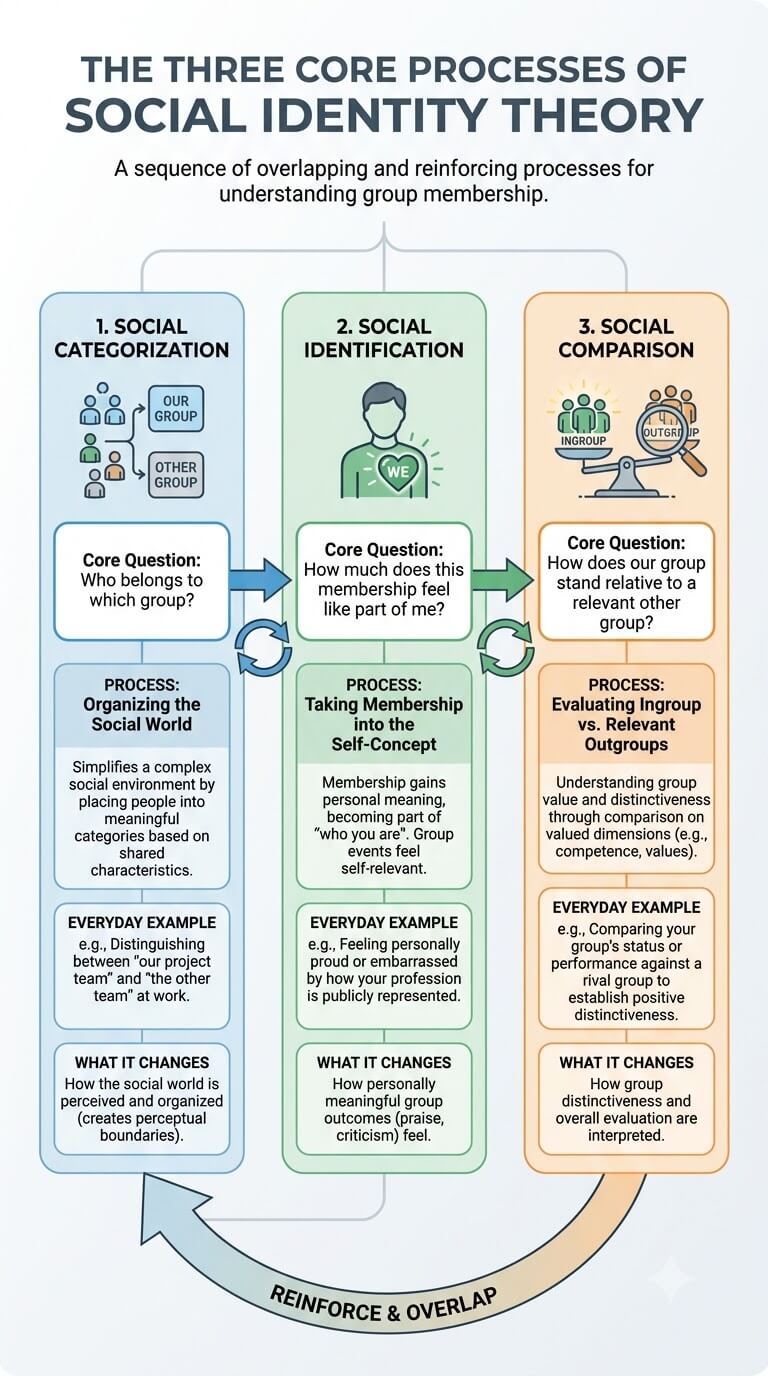
A useful way to understand the theory is as a three-part sequence. These processes are often taught separately, but in everyday life they can overlap and reinforce one another.
| Process | Core question | Everyday example | What it changes |
|---|---|---|---|
| Social categorization | Who belongs to which group? | “Our project team” and “the other team” | How the social world is organized |
| Social identification | How much does this membership feel like part of me? | Feeling proud or embarrassed by how your profession is represented | How personally meaningful group outcomes feel |
| Social comparison | How does our group stand relative to a relevant other group? | Comparing competence, status, values, or performance | How group distinctiveness and evaluation are interpreted |
Social categorization: organizing people into meaningful groups
Categorization simplifies a complicated social environment. Instead of processing every person as entirely unique in every moment, people notice categories that seem relevant: experienced employees and newcomers, home team and visiting team, residents and tourists, one school and another, one profession and another.
Categories do not all carry the same weight. A person may barely think about being a cyclist until road design becomes the topic, or about their neighborhood until another area becomes the comparison. Categorization creates a perceptual boundary, but it does not dictate a feeling or behavior.
Social identification: taking group membership into the self-concept
Identification is the step that gives membership personal meaning. Being placed in a category by someone else is not the same as experiencing that category as part of who you are. A temporary task group may feel like a practical arrangement to one member and a meaningful “we” to another.
When identification is stronger, group events may become self-relevant. Praise directed at the group can feel affirming. Public criticism may feel uncomfortable even when it is not aimed at the individual personally. Group norms and reputation may carry more weight because membership has become tied to self-understanding.
Social comparison: evaluating the ingroup in relation to relevant outgroups
Groups are often understood comparatively. “We are creative” becomes more meaningful when another group is seen as conventional, while “we value reliability” becomes distinctive against a different standard. The comparison may concern one valued dimension rather than overall worth.
This is an important reason not to reduce Social Identity Theory to simple liking. People may compare groups on competence, warmth, tradition, innovation, fairness, prestige, toughness, independence, or almost any valued characteristic. Which dimension matters can change with circumstances.
Positive Distinctiveness Without Oversimplifying It

One of the most recognizable ideas associated with Social Identity Theory is positive distinctiveness. In simple terms, people often prefer a social identity that allows their ingroup to be seen as positively different from relevant comparison groups. The phrase is easy to misunderstand if it is translated into “people need to believe their group is superior in every way.”
Why favorable group comparisons can support self-evaluation
If a membership forms part of the self, the value attached to that membership can matter for how a person evaluates themselves socially. A musician may care that their ensemble is respected for creativity. An employee may feel pride when their team is known for reliability. A volunteer may value belonging to a group recognized for service.
But the relationship between social identity and self-esteem is more complicated than a one-line formula. Reviews of the self-esteem hypothesis have found mixed support for the strong claim that low self-esteem reliably drives people toward intergroup discrimination. An open-access discussion of this evidence notes that self-esteem should not be treated as the whole theory. Group status, legitimacy, stability, boundaries, and the meaning of a comparison also matter.
Why distinctiveness does not require hatred or aggression
Positive distinctiveness can be expressed without hostility. Hobby communities, schools, or professional groups may emphasize different strengths while still respecting or cooperating with one another.
Even ingroup preference is not identical to active outgroup harm. Favoring your own team for a recognition award, choosing to spend more time with familiar group members, stereotyping another group, excluding outsiders, and deliberately harming an outgroup are psychologically and ethically different outcomes. A careful use of the theory keeps those distinctions visible.
What Minimal Group Research Shows and Does Not Show

Minimal group research is memorable because the groups were deliberately stripped of much of what real groups usually contain. There was little history, no meaningful shared culture, and no established personal conflict. That made the experiments useful for asking whether mere categorization could influence allocation behavior.
How arbitrary categories can become behaviorally meaningful
The striking lesson is not that trivial categories instantly create deep loyalty. It is that once an ingroup-outgroup distinction is made psychologically available, people may organize choices around it even when the category itself has little substance. This suggests that group boundaries can influence judgment earlier than common sense might predict.
A short workshop offers a simple parallel. Split strangers into Team A and Team B for a friendly challenge, and some quickly use “we” language or celebrate their side’s wins. The temporary category is not a complete identity, but it can become a meaningful frame for the moment.
Why minimal-group findings should not be treated as a complete model of real-world conflict
Real groups have histories, institutions, unequal resources, reputations, relationships, laws, status differences, and cultural narratives. A laboratory category cannot reproduce all of that. Minimal group findings therefore demonstrate a psychological possibility, not a universal explanation for war, discrimination, organizational rivalry, or long-standing social divisions.
They also do not show that hostility is inevitable. The studies are better read as evidence that categorization can influence some choices under certain conditions. What follows depends on identification, comparison, norms, incentives, social structure, and personal values.
How Social Identity Can Affect Self-Evaluation and Behavior
The theory becomes especially useful when a group membership carries value and emotional significance. At that point, events that seem external can be experienced as relevant to the self.
Status, belonging, and the meaning attached to membership
Consider a newly qualified professional entering a respected field. Membership may provide pride, belonging, shared language, and a sense of continuity with others doing similar work. If the profession is publicly criticized, the person might feel defensive even if the criticism does not describe their own behavior. The reaction is easier to understand when the group is not merely something they belong to, but part of how they define themselves. This process sits within the broader psychology of social identity, where group membership can shape self-definition, expectations, and behavior.
The same process can appear in a neighborhood association, sports club, family business, volunteer network, or online creative community. What matters is the meaning attached to membership, not simply how formal the group is.
Context changes which group comparison matters
You have many possible identities, and they do not guide behavior at once. A designer may think in professional terms during a project dispute but identify more broadly as an employee when the whole company faces an outside challenge.
This context sensitivity is one reason Social Identity Theory should not be used as a fixed label for a person. Someone is not permanently “acting from group identity.” Different settings make different memberships relevant, and personal identity continues to matter alongside them.
“Us” and “Them” Without Automatic Hostility
The words “us” and “them” often sound negative because they are associated with conflict. Psychologically, however, a boundary is not the same thing as hostility. Categories can help people coordinate, cooperate, share responsibility, celebrate traditions, or organize common goals.
Categorization creates boundaries before it creates moral judgment
At a conference, badges may distinguish speakers, organizers, and attendees. Those categories communicate roles and access without requiring anyone to dislike another category. A boundary can answer “who is in which group?” before anyone evaluates which group is better.
This distinction matters because group psychology is sometimes discussed as though noticing an ingroup and outgroup is already evidence of prejudice. It is not. Bias can emerge from group processes, but moral judgment, stereotyping, exclusion, and discrimination require additional explanation.
Cooperation, neutrality, competition, and bias are different possible outcomes
Groups can cooperate because their goals align. They can remain mostly neutral because the comparison does not matter. They can compete in a bounded way, as sports teams do under shared rules. They can also develop biased judgments when identity, threat, status, or norms push interpretation in that direction.
OpenStax’s overview of ingroups and outgroups in social psychology provides a useful general-reader introduction to how group membership can become connected with identity and ingroup preference. The key is not to treat every form of group attachment as equivalent to prejudice.
Social Identity Theory vs Self-Categorization Theory

These two theories are closely related, and modern discussions often place them together under the broader social identity approach. They are still worth distinguishing because they emphasize different questions.
| Question | Social Identity Theory | Self-Categorization Theory |
|---|---|---|
| Main focus | How group membership, comparison, and group value become psychologically meaningful | How and when people categorize themselves at personal or group levels |
| Key emphasis | Intergroup relations, identification, comparison, positive distinctiveness | Category salience, prototypes, context, perceived within-group similarity and between-group difference |
| Best question to ask | What does belonging to this group mean for the self and for relations with other groups? | Why is this particular group identity shaping perception right now? |
SIT asks what group membership and comparison do
Social Identity Theory is especially concerned with the consequences of group membership becoming part of self-concept and with how people evaluate their group in relation to others. It helps explain why group status or distinctiveness can become personally meaningful and why intergroup comparisons can influence behavior.
SCT asks how and when a category becomes salient in the self
Self-Categorization Theory goes further into the cognitive process by which a person comes to see themselves more as an individual in one moment and more as a group member in another. That involves concepts such as salience and prototypes, which deserve their own explanation rather than being compressed into Social Identity Theory.
Social Identity Theory vs Collective Identity
Another useful distinction concerns the level at which identity is being described. Social identity refers to the part of an individual person’s self-concept that comes from group membership. Collective identity refers more to a shared understanding among members about who “we” are as a group.
Individual self-concept derived from membership
If being a nurse, runner, parent, volunteer, or member of a cultural community influences how you see yourself, that is an individual-level social identity process. The group may matter even if members disagree about what the group stands for.
Shared group-level understanding of “who we are”
Collective identity becomes more visible when members share narratives, symbols, traditions, boundaries, or goals that define the group itself. A local volunteer organization might develop a strong shared story about being dependable during emergencies. Individual members can incorporate that group identity into their own self-concepts, but the shared “we” is not identical to any one person’s identity.
Common Misunderstandings and Limits
Social Identity Theory is powerful partly because it explains more than obvious conflict. That same breadth makes it easy to stretch too far. Several limits keep the theory useful rather than turning it into a catch-all explanation for anything that happens in groups.
The theory is not a claim that individuality disappears
People do not become interchangeable machines when a group matters to them. They still have personal values, memories, relationships, motives, and the ability to disagree. A strong team identity can coexist with an independent judgment that the team is making a bad decision.
This is also why group influence does not erase responsibility. Understanding that a group frame shaped someone’s perception can explain part of a behavior without excusing harmful choices.
It does not explain every form of prejudice, conflict, or conformity by itself
Prejudice can involve learned beliefs, threat, competition, history, stereotypes, institutions, and unequal power. Conformity may instead reflect social costs or uncertainty, while poor group decisions can arise from hierarchy, incentives, or weak information.
Social Identity Theory can contribute to understanding these outcomes when group membership is psychologically relevant, but it should not replace more specific explanations. A recent open-access overview of ingroup favoritism and social identity processes illustrates how researchers separate identity-based mechanisms from other preferences and beliefs rather than treating all favoritism as one thing.
Real groups involve history, institutions, relationships, and power beyond minimal categories
A workplace division created last month and a community with generations of shared history are both groups, but they are not psychologically or socially equivalent. Real group relations can involve status hierarchies, formal authority, resource inequality, collective memory, repeated contact, discrimination, and changing social norms.
The theory helps explain how membership and comparison matter without replacing the need to understand the social structure around them.
A Practical Reflection: Notice the Group Frame Before Assuming the Motive
Social Identity Theory becomes practical when it helps you ask better questions about behavior. Instead of jumping from “they defended their group” to “they are irrational” or “they hate outsiders,” use a three-step reflection: boundary, meaning, and context.
Identify the relevant group boundary
Ask which “we” and “they” are active in this particular moment. The boundary may be obvious, such as two teams, or subtle, such as long-time members versus newcomers. Sometimes the crucial category is not the one you first assume.
- Which group membership seems relevant right now?
- Is the category formal, informal, temporary, or long-standing?
- Would the same person likely frame the situation differently in another setting?
Ask what comparison, status, or belonging meaning is active
Next, consider what the group distinction means to the person. Are they protecting belonging, reacting to a status comparison, defending a valued group characteristic, or trying to preserve a sense of positive distinctiveness? These are hypotheses to test, not conclusions to impose.
For example, a veteran employee who reacts sharply to a newcomer’s criticism may be defending more than a procedure. The criticism may feel like a challenge to the competence of “people who built this place.” That possibility helps explain the reaction while leaving room for other motives, including habit, personality, or legitimate disagreement.
Keep personal agency and situational constraints in view
Finally, do not let the group explanation swallow the individual. People can question comparisons, redefine membership, cooperate across boundaries, or reject group expectations. They may also face hierarchy, incentives, exclusion costs, or limited information.
A good explanation therefore asks both what the group frame makes psychologically meaningful and what choices remain available to the person in that situation.
How Identity Salience and a Shared “We” Extend the Picture
Two questions naturally follow once the basic theory is clear. First, why does one group identity become important in a particular moment while another stays in the background? Second, how does an individual sense of group membership relate to a genuinely shared understanding among members?
From identity theory to self-categorization and identity salience
Self-Categorization Theory addresses the first question more directly. It examines how context changes the level at which people define themselves and why a particular category becomes salient. That helps explain why the same person may think as an individual in one setting and as “one of us” in another without experiencing any contradiction.
From individual social identity to a shared collective identity
Collective identity addresses the second question. An individual can derive self-definition from membership, while the group also develops a shared story about its values, history, symbols, and future. Keeping these levels separate prevents the common mistake of treating a person’s social identity and a group’s shared identity as identical concepts.
FAQ
These questions address the distinctions readers most often need when using the theory to interpret everyday group behavior without stretching it beyond what it can explain.
What are the three main processes in Social Identity Theory?
The theory is commonly explained through social categorization, social identification, and social comparison. Categorization organizes people into meaningful groups. Identification describes the extent to which membership becomes part of self-concept. Comparison concerns how an ingroup is evaluated relative to relevant outgroups. In practice, these processes interact rather than unfolding as rigid stages.
Does Social Identity Theory say people always favor their ingroup?
No. Ingroup favoritism is an important research finding, but it is not an automatic outcome in every setting. Identification strength, group status, norms, comparison dimensions, relationships between groups, and the broader social context all affect what happens. People can also cooperate across group boundaries or criticize their own group.
What did the minimal group studies demonstrate?
They showed that even relatively arbitrary categorization could influence allocation behavior under controlled conditions. Their importance lies in demonstrating that deep hostility or long-standing conflict is not always necessary for an ingroup-outgroup distinction to affect judgment. They do not show that trivial categories inevitably produce hatred or that laboratory groups fully model real-world conflict.
Is Social Identity Theory the same as Self-Categorization Theory?
No, although they are closely related. Social Identity Theory focuses on how group membership, comparison, and the value attached to membership shape self-concept and intergroup behavior. Self-Categorization Theory focuses more closely on how and when a person defines themselves at a personal or group level, including the role of category salience and group prototypes.
Can social identity matter without conflict between groups?
Yes. Group identity can support belonging, cooperation, shared meaning, coordination, pride, and mutual support. A group boundary simply distinguishes “us” from “them.” Whether that distinction leads to neutrality, cooperation, friendly competition, bias, or hostility depends on additional psychological and social conditions.
Key Takeaways
- Social Identity Theory explains how group memberships can become part of an individual’s self-concept and make group outcomes personally meaningful.
- Its core processes are social categorization, social identification, and social comparison, which together help explain why “us” and “them” can matter psychologically.
- Positive distinctiveness concerns favorable group differentiation, but it should not be reduced to a claim that people always need superiority or that low self-esteem automatically causes discrimination.
- Minimal group research shows that thin categories can influence some decisions, not that arbitrary labels inevitably create real-world hostility.
- Social Identity Theory and Self-Categorization Theory are related but distinct: one emphasizes group membership and comparison, while the other explains when a group category becomes salient.
- Understanding a group-based explanation does not erase personal agency, responsibility, history, institutional context, or the many other forces that shape behavior.
Final Thoughts
The most useful first step is to notice when a situation has shifted from “me and you” to “us and them.” Then ask what that boundary means: belonging, status, reputation, shared values, competition, or something else. Social Identity Theory does not give a single motive for every group behavior. It gives a disciplined way to see when group membership has become part of the psychological situation, while still leaving room for individuality, context, and choice.

Michael Reed is the Founder and Lead Writer at Psychology Exposed. He writes about human behavior, relationships, emotional patterns, self-awareness, and practical psychology topics using research-informed, easy-to-understand content.
Read More About Michael Reed: https://psychologyexposed.com/michael-reed/