
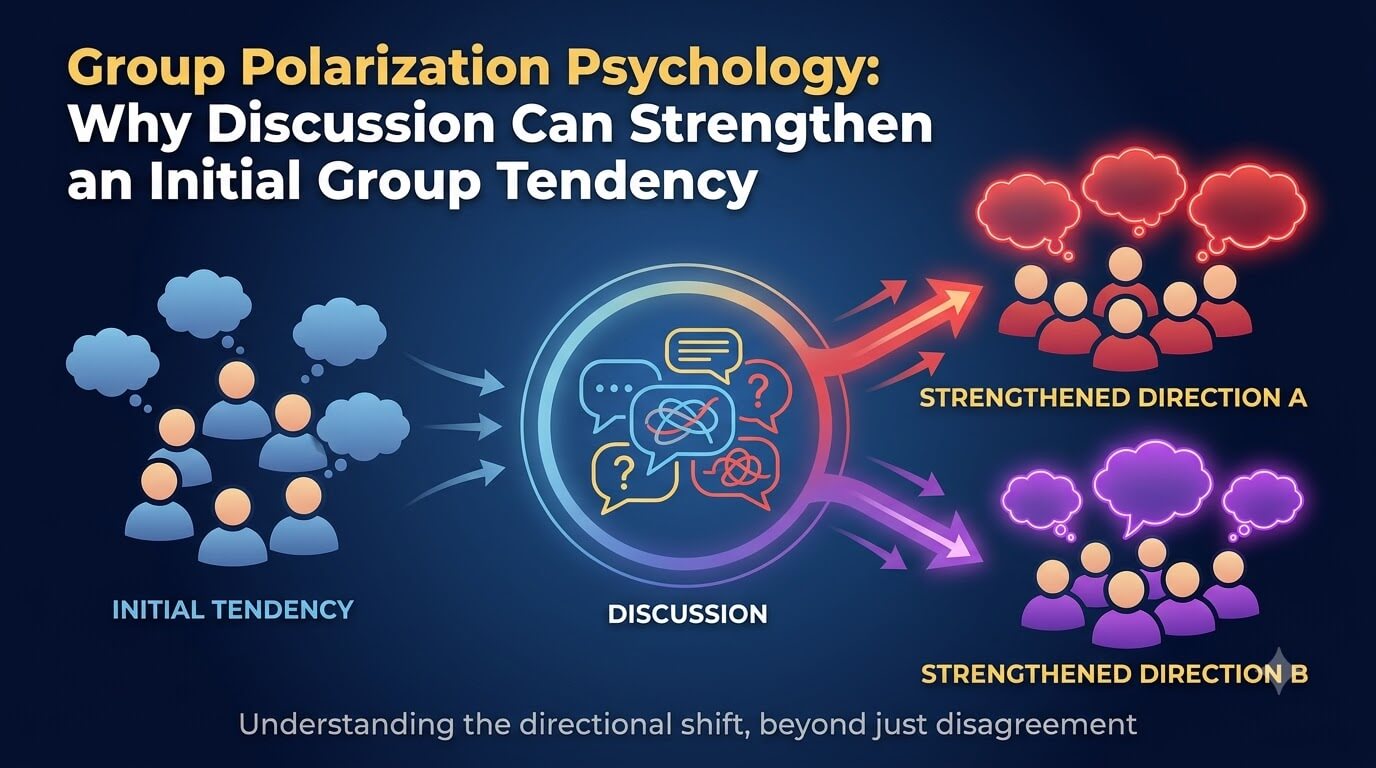
A group does not have to begin at an extreme position to end a discussion further in one direction. A product team that already leans toward a bold launch may become more enthusiastic after exchanging reasons for moving fast. A cautious family may become even more cautious after everyone shares what could go wrong. A hobby community may leave a discussion more committed to a standard it already preferred.
Group polarization psychology helps explain that kind of before-and-after shift. The key is not that people disagree with an opposing camp, nor that every member ends up with the same opinion. It is that discussion strengthens the group’s initial average tendency. Understanding that distinction makes the concept useful far beyond politics and helps separate it from groupthink, conformity, and ordinary persuasion.
The practical question is simple: what changed between the group’s starting lean and its position after discussion? Looking at new arguments, social comparison, perceived norms, and the quality of disagreement is more informative than labeling any strong group opinion as “polarized.”
Quick Answer: What Group Polarization Is

Group polarization is the tendency for group discussion to strengthen an initial shared direction. If members begin moderately favorable toward an option, discussion may move the group toward stronger support. If they begin cautious or opposed, discussion may make them more cautious or more opposed. The effect is about directional change from a starting point, not automatically about politics, conflict, irrationality, or extremism.
Polarization Means a Directional Shift, Not Simply Disagreement Between Camps
The term “polarization” is often used in everyday language to describe two sides moving apart. In social psychology, group polarization has a more specific meaning. OpenStax Psychology 2e describes group polarization as a strengthening of an original group attitude after members discuss their views.
Initial group tendency
To identify a directional shift, you need a baseline. Imagine six colleagues privately rate a proposed expansion from 1, strongly oppose, to 10, strongly support. Their average before discussion is 6.5. That starting average suggests a modest lean toward expansion, even if individuals differ.
Without that baseline, a strong final position tells you very little. A final rating of 8 could represent polarization if the group started at 6.5, moderation if it started at 9, or no meaningful shift if it started near 8.
Post-discussion movement toward a stronger version of that tendency
After discussion, the group may move from 6.5 to 8. That is the pattern of interest: the group’s existing direction became stronger. The same logic works in the opposite direction. If a family begins moderately cautious about a risky purchase and becomes strongly cautious after sharing concerns, that can also fit group polarization.
This is why “risky shift” is too narrow as a general label. Groups do not always become riskier. They can become more conservative, more generous, more strict, more enthusiastic, or more skeptical depending on where they begin.
Why “more extreme” is relative to the starting point
Calling a post-discussion view “more extreme” can be misleading if it sounds like a moral judgment. In research, the useful comparison is relative movement along the same dimension. A group that moves from mild caution to strong caution has shifted further in its original direction even if nobody would describe the final position as socially extreme.
A better everyday question is, “Did discussion amplify the direction that was already present?” That wording keeps attention on change rather than on labels.
From Risky Shift to Group Polarization
Early research on group decisions drew attention to cases where groups appeared to choose riskier options than individuals did before discussing the issue. Researchers later found that the pattern was broader than risk taking.
Why early research first focused on risk
Choice-dilemma studies gave researchers a convenient way to compare private judgments with decisions made after discussion. The surprising observation was that groups sometimes became more willing to accept risk rather than simply averaging toward the middle.
That finding generated theories about why discussion changes decisions. But later work showed that the direction depended on the group’s initial lean and the issue being discussed. Some groups shifted toward caution instead.
How the concept broadened beyond risky choices
Moscovici and Zavalloni’s classic work helped establish the broader idea that discussion could intensify attitudes beyond risk-taking tasks. Later, Myers and Lamm’s Psychological Bulletin review summarized evidence across attitudes, judgments, negotiations, and other settings, framing risky and cautious shifts as cases of a wider polarization phenomenon.
This history matters because it prevents a common misunderstanding: group polarization is not a theory that “groups take more risks.” It describes a stronger post-discussion tendency in the direction the group already favored.
Three Mechanisms That Can Push a Group Further

No single mechanism explains every case. Three ideas are especially useful for understanding why discussion may shift a group: persuasive arguments, social comparison, and norm perception. A 1986 review and meta-analysis by Daniel Isenberg concluded that persuasive argumentation and social comparison can operate together, with argument effects often stronger in the reviewed studies.
Persuasive arguments: hearing additional reasons supporting the initial lean
Before a discussion, each member knows only some of the reasons that support the group’s favored direction. During conversation, people hear additional arguments they had not considered. If most of those arguments point the same way, the evidence landscape can feel more compelling.
Suppose a team already prefers a new software platform. One member likes its price, another knows its automation features, and another has seen better reporting. Once those reasons are pooled, each person now has a larger set of pro-adoption arguments than before. The group may become more favorable without anyone being directly pressured.
This mechanism does not mean the arguments are necessarily poor. New information may genuinely justify a stronger conclusion. Polarization describes the shift, not whether the shift is rational.
Social comparison: adjusting toward the position seen as more representative or valued
People also learn where they stand relative to others. Someone who thought their position was strongly supportive may discover that peers are even more supportive. If being a good or committed member is associated with that direction, the person may adjust toward what seems more representative or socially valued.
This does not require conscious imitation. Comparison can subtly change what feels moderate, loyal, competent, cautious, adventurous, or appropriate inside the group. Classic work by Burnstein and Vinokur on persuasive argumentation and social comparison illustrates the long-running effort to separate these mechanisms rather than treating group influence as one process.
Norm perception: learning what “people like us” seem to believe
Groups provide reference points for what members think “people like us” normally believe or do. The APA Dictionary of Psychology definition of a reference group captures this idea: groups can serve as standards people use when evaluating their own attitudes and beliefs.
During discussion, members may update their perception of the local norm. A team may realize that bold experimentation is more valued than they assumed. A professional community may discover that its members favor stricter standards. Once that norm becomes clearer, judgments may shift toward the position that seems most representative of the group.
| Mechanism | What changes during discussion | Everyday clue |
|---|---|---|
| Persuasive arguments | Members hear additional reasons supporting the initial lean | “I had not thought of that reason, and it strengthens the case.” |
| Social comparison | Members learn how their position compares with others | “I thought I was strongly in favor, but most people here go further.” |
| Norm perception | The position seen as typical or representative becomes clearer | “This seems to be what people in this group consider the normal stance.” |
Repeated Agreement Changes the Information Environment
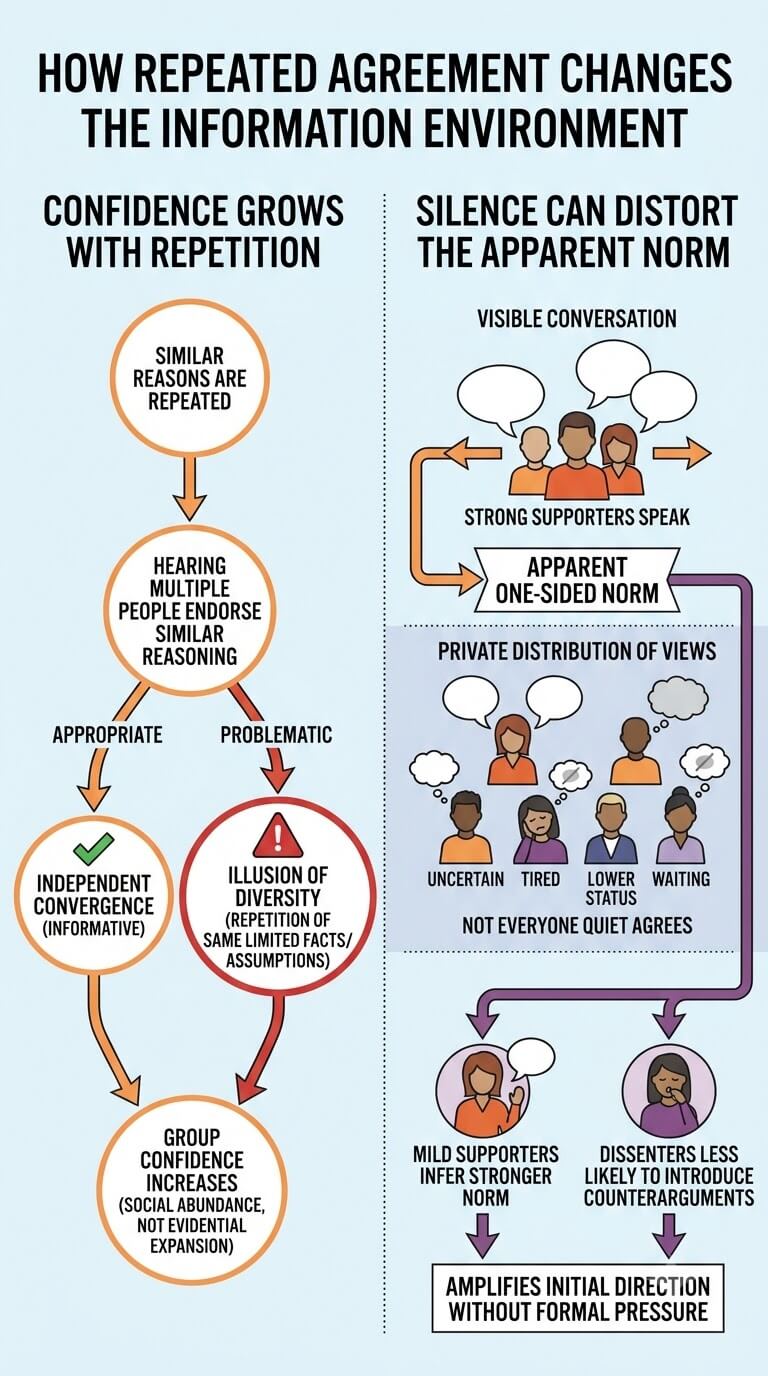
Discussion does not merely reveal opinions. It changes which reasons are repeated, which doubts receive airtime, and how much confidence members place in a position.
Confidence grows when similar reasons are repeated
Hearing several people independently endorse similar reasoning can increase confidence. Sometimes that is appropriate because independent convergence is informative. The problem is that repetition can also create an impression of evidence diversity when everyone is drawing from the same assumption, story, or limited set of facts. This process sits within the broader psychology of social identity, where group membership can shape self-definition, expectations, and behavior.
Ten versions of the same reason are not the same as ten independent reasons. A group can become more certain because an argument is socially abundant, even when its evidential base has not expanded much.
Silence can make the apparent norm look more one-sided than it is
Not everyone who stays quiet agrees. Some people may be uncertain, tired, lower in status, or waiting to see how discussion develops. If only the strongest supporters speak, the visible conversation can look more one-sided than the private distribution of views.
That apparent one-sidedness can influence later contributions. Members who were only mildly supportive may infer that stronger support is the local norm, while dissenters become less likely to introduce counterarguments. This creates conditions that can amplify the initial direction without requiring formal pressure for unanimity.
Everyday Examples Beyond Politics
The concept is easier to use responsibly when it is not reduced to ideological conflict. Group polarization can involve risk, caution, quality standards, enthusiasm, spending, or other judgments.
A team becoming more enthusiastic about a risky project
Situation: A product team begins slightly favorable toward an ambitious launch. During discussion, members contribute different reasons the upside could be large.
What members may feel: Increasing confidence and excitement. What it may mean: New pro-launch arguments are accumulating while downside arguments remain thin. What to do next: Ask a separate question about failure conditions before translating confidence into commitment.
A family becoming more cautious after sharing worries
Situation: A family is already hesitant about a major purchase. Each person adds a different concern about maintenance, debt, timing, or uncertainty.
What members may feel: Their caution seems increasingly justified. What it may mean: The initial cautious direction has gained additional supporting arguments. What to do next: Compare the strongest concerns with concrete benefits and decision thresholds rather than assuming caution itself is the problem.
A hobby group becoming more committed to a preferred standard
Situation: Members of a photography group mildly prefer manual editing over automated presets. Discussion focuses on control, craft, consistency, and learning.
What members may feel: A stronger sense that manual editing represents serious participation. What it may mean: Arguments and identity-relevant norms are reinforcing one another. What to do next: Separate quality criteria from membership signals and test whether alternative methods can meet the same standard.
An online community strengthening an existing opinion
Situation: An online forum already leans toward one interpretation of a new product. Highly visible posts repeat similar positive experiences, while mixed experiences attract less engagement.
What members may feel: The favored interpretation seems increasingly obvious. What it may mean: Visibility and repetition may be narrowing the apparent range of reasons. What to do next: Look deliberately for high-quality counterexamples and ask what evidence would weaken the current conclusion.
Online Discussion Is One Context, Not the Definition
Digital platforms can make polarization easier to notice because opinions are visible, repeatable, searchable, and often sorted by engagement. But group polarization existed as a research topic long before social media.
Visibility, repetition, and selective interaction can amplify local tendencies
Online environments can increase exposure to repeated positions and make social approval unusually visible through likes, reactions, rankings, and replies. Selective participation can also mean that people interact more often with others who already lean in a similar direction.
A systematic review of polarization in social-media debate describes how fragmented information environments and like-minded interaction can contribute to polarizing dynamics online. Those digital features are relevant contexts, but they are not necessary for the basic phenomenon.
Why “echo chamber” should not replace the broader psychological concept
An echo chamber generally refers to an information environment where similar views circulate and opposing views are limited or discounted. Group polarization refers to a directional shift after interaction. The two can overlap, but they are not interchangeable.
A like-minded group can fail to polarize. A group can also polarize during one face-to-face discussion without living inside a long-term echo chamber. Keeping the concepts separate makes causal thinking more precise.
Group Polarization vs Groupthink

These concepts are often confused because both concern group decisions. Their central questions are different.
Stronger directional tendency versus reduced critical evaluation
Group polarization asks whether the group moved further in its initial direction after discussion. Groupthink asks whether pressure for consensus weakened the evaluation of alternatives, risks, or warning signs.
A group can hear vigorous disagreement, examine evidence carefully, and still move from moderate support to strong support. That could fit polarization without groupthink. Conversely, a group may suppress dissent and settle prematurely on a position without showing a clear before-and-after directional shift.
Why one can occur without the other
The difference is easiest to see by measuring different things. For polarization, compare the group’s average tendency before and after discussion. For groupthink, inspect the quality of deliberation: whether objections were voiced, alternatives were tested, and disagreement was socially possible.
| Concept | Main unit of interest | Key question |
|---|---|---|
| Group polarization | Change in the group’s direction | Did discussion strengthen the initial lean? |
| Groupthink | Quality of group deliberation | Did consensus pressure reduce critical evaluation? |
| Conformity | Individual response to group influence | Did a person align with the group? |
Group Polarization vs Conformity
Conformity happens at the level of an individual adjusting behavior or judgment toward a group. Polarization describes a shift in the group’s aggregate position after interaction.
Group-level shift versus individual alignment
A member can conform without the group becoming more polarized. For example, one hesitant employee may adopt the team’s existing moderate view, bringing opinions closer together without moving the group’s average position much further.
Likewise, polarization can occur because members hear new arguments and independently update their judgments in the same direction, even if nobody feels pressured to match anyone else.
How conformity can affect discussion without fully explaining polarization
Conformity may still matter. If people with reservations stay quiet, the argument pool becomes more one-sided and the perceived norm looks stronger. That can contribute to a directional shift. But treating all polarization as conformity misses the informational role of discussion.
Group Polarization vs Persuasion
Persuasion usually focuses on how messages, arguments, communicators, and recipients influence attitudes. Group polarization can include persuasive content, but its distinctive feature is the social interaction among members who begin with a shared directional lean.
Multiple group-generated arguments and social comparison versus a message-centered influence process
In a standard persuasion situation, a person might encounter a campaign, presentation, or argument designed to change a belief. In a polarizing group discussion, members collectively generate reasons, compare their positions, and infer local norms. No single speaker needs to be trying to persuade the rest.
That distinction helps explain why a conversation can shift a group even when there is no obvious persuader. The influence is distributed across the discussion.
How Genuine Disagreement Can Improve Deliberation
The goal is not to force groups toward the middle. A stronger post-discussion position may be justified. The useful safeguard is to improve the variety and independence of reasoning before confidence hardens.
Independent judgments before discussion
Ask members to record an initial rating, prediction, or preferred option privately before the conversation starts. This preserves the baseline and reduces the chance that early speakers define the apparent norm for everyone else.
Reasons from outside the dominant starting position
Do not ask only, “Does anyone disagree?” That question places the social burden on dissenters. Instead, require the group to generate the strongest reasons for another direction, regardless of anyone’s personal position.
This widens the reason set without treating disagreement as disloyalty.
Asking for evidence that would reverse the group’s direction
A practical prompt is, “What evidence would make us move the other way?” If nobody can answer, the group may be treating its position as identity or commitment rather than as a revisable judgment.
Good deliberation has conditions for updating. A team can remain strongly supportive while still knowing what evidence would make it slow down.
Avoiding token dissent that no one takes seriously
Assigning someone to “play devil’s advocate” can become ceremonial if everyone knows the objections will be dismissed. Genuine disagreement requires the group to engage with the substance of the alternative, not merely allow it to be spoken.
One useful practice is to restate the strongest counterargument in a form its advocate would accept before answering it.
A Before-and-After Test for Group Polarization

A simple framework helps keep the concept measurable: Starting Lean → Discussion Inputs → Social Reference → Directional Shift → Recheck.
What was the group’s average tendency before discussion?
Capture private starting views when possible. You do not need formal statistics. A scale from 1 to 10, a probability estimate, or a ranked preference is enough to establish whether the group began mildly supportive, strongly supportive, cautious, or divided.
What changed after discussion: evidence, confidence, norm perception, or all three?
After discussion, compare both position and confidence. Then ask why they changed. Did members hear genuinely new reasons? Did they discover that peers were further in one direction? Did a position become associated with being a representative member?
Different answers point to different mechanisms and different ways to improve future deliberation.
Did people hear genuinely new reasons or only repeated ones?
Count distinct arguments, not just endorsements. If five comments are variations of “customers will love it,” the discussion may sound rich while adding little informational diversity.
A useful recheck is to summarize the strongest distinct reasons on both sides after discussion. If one side is thin because nobody explored it, confidence should be interpreted cautiously.
What to Do Next When a Group Is Becoming More One-Sided
Becoming more one-sided is not automatically a failure. The aim is to make sure stronger confidence has earned its strength.
Slow the decision and widen the reason set
Pause commitment long enough to collect at least one independent judgment and one serious alternative. In a fast-moving team, this may require only ten minutes. In a high-stakes decision, it may justify outside input or a second meeting.
Ask each person to name one reason supporting the current direction and one reason that could support the opposite direction. This reduces the chance that participation becomes a contest in finding more reasons for what the group already prefers.
Separate confidence from evidence quality
A group can feel more certain because agreement is socially reinforcing. Before acting, ask whether the evidence became more diverse, more independent, and more diagnostic, or whether the same claim simply became more familiar.
Confidence is useful when it tracks evidence. It is less useful when it mostly tracks repetition.
How Norms and Decision Pressure Shape the Shift
Group polarization sits alongside other group processes without being reducible to them. Norms influence which positions feel representative, while decision pressure influences how freely alternatives are explored.
Groupthink is a different problem involving critical evaluation
A polarized group is not necessarily closed-minded. If members seriously consider opposing evidence and still move further in their initial direction, the shift may reflect updated judgment. Concern about groupthink becomes more relevant when preserving agreement interferes with scrutiny.
Group norms shape what feels like a representative position
Members do not interpret every opinion in a social vacuum. A stance that signals expertise in one group may signal recklessness in another. Understanding local norms can therefore help explain why social comparison pushes judgment in one direction rather than another.
This is also why disagreement from a respected insider may have a different effect from disagreement that members dismiss as irrelevant to the group’s standards.
FAQ
These questions address common misunderstandings about directional shifts in group discussion.
Does group polarization always make opinions more extreme?
It makes the group’s initial directional tendency stronger, which researchers may describe as movement toward a more extreme position relative to the starting point. That does not mean the final position is politically extreme, irrational, dangerous, or socially unusual. The relevant comparison is the group’s own pre-discussion baseline.
Can a cautious group become even more cautious?
Yes. The history of the research moved beyond the original “risky shift” because groups can shift toward greater caution when caution is their initial tendency. A family, committee, or team that begins wary of a plan may become more wary after members exchange additional concerns.
Is group polarization the same as an echo chamber?
No. An echo chamber describes an information environment dominated by reinforcing views and limited engagement with alternatives. Group polarization describes a change in direction after group interaction. Echo-chamber conditions may encourage polarization, but one concept does not prove the other.
How is group polarization different from groupthink?
Group polarization is about a stronger post-discussion directional tendency. Groupthink is about consensus pressure reducing critical evaluation. A group can polarize after open, thoughtful debate, and a group can show weak deliberation without a clear polarization shift.
Can disagreement reduce group polarization?
It can change the discussion by adding reasons that were missing, correcting norm perceptions, and reducing the appearance that only one position is legitimate. But disagreement does not guarantee movement toward the middle. Strong counterevidence could even justify a larger shift in the original direction. The better goal is informed updating, not automatic moderation.
Key Takeaways
- Group polarization is a before-and-after directional shift: discussion strengthens the group’s initial average tendency.
- The effect can move groups toward greater risk or greater caution, stronger approval or stronger opposition.
- Persuasive arguments, social comparison, and perceived group norms can all contribute to the shift.
- Repeated agreement can increase confidence without necessarily increasing the diversity or independence of evidence.
- Group polarization is different from groupthink, conformity, persuasion, and echo-chamber conditions.
- A useful next step is to record initial judgments, widen the reason set, and ask what evidence would move the group in the opposite direction.

Michael Reed is the Founder and Lead Writer at Psychology Exposed. He writes about human behavior, relationships, emotional patterns, self-awareness, and practical psychology topics using research-informed, easy-to-understand content.
Read More About Michael Reed: https://psychologyexposed.com/michael-reed/