

You join a new team and notice that nobody challenges the manager in meetings. In a family, everyone knows which topics are “not worth bringing up,” even though no one has ever declared them forbidden. In an online community, newcomers quickly learn which jokes earn approval and which opinions trigger a cold response. These are examples of group norms: shared expectations about what people in a group usually do and what they are expected to approve, avoid, praise, or criticize.
Group norms matter because they make social life more predictable. They can help people coordinate, cooperate, and know what behavior fits a setting. They can also keep weak practices alive, silence disagreement, or make an unhealthy expectation feel normal simply because it is familiar. Understanding group norms means looking beyond the rule itself to the process that creates it, teaches it, enforces it, keeps it in place, and sometimes changes it.
Quick Answer: What a Group Norm Is

Group norms are shared expectations about what members normally do or what members believe people should do. Some are explicit, such as a written rule about meeting conduct. Others are learned indirectly through observation, praise, correction, silence, teasing, or exclusion. A norm is the social standard itself. Conformity is one possible response to that standard.
Group Norms Are Social Standards, Not Just Repeated Habits
The APA Dictionary of Psychology definition of social norm centers on shared standards or expectations that guide socially appropriate behavior. That distinction matters because not every common behavior is a norm. If most people on a team happen to drink coffee, that may simply be a pattern. If people start treating coffee breaks as the expected time for informal bonding, then the behavior carries social meaning.
A useful way to recognize a norm is to ask two questions: “What seems normal here?” and “What seems socially approved here?” Sometimes the answers match. Sometimes they do not.
What members perceive as normal
Groups constantly provide information about what people like us tend to do. A classroom where most students arrive early communicates one kind of expectation. A gaming group where nearly everyone uses voice chat communicates another. Repetition turns behavior into a reference point, especially for newcomers who do not yet know what is typical.
People often use that reference point because it reduces uncertainty. When you are unsure how formal to be, how much to speak, or whether disagreement is welcome, observing others offers a quick social map. The behavior does not have to be morally good or personally preferred to become informative.
What members perceive as approved or disapproved
A second layer is evaluative. Members learn what earns nods, praise, invitations, trust, teasing, eye rolls, silence, correction, or exclusion. These reactions tell people what the group appears to approve.
This is why norms can feel powerful even when no rule exists on paper. A person may never hear “do not disagree publicly,” yet repeated reactions can teach that disagreement carries a social cost. On the positive side, a group can create a strong norm of asking for help by responding warmly when someone admits uncertainty.
Descriptive Norms vs Injunctive Norms
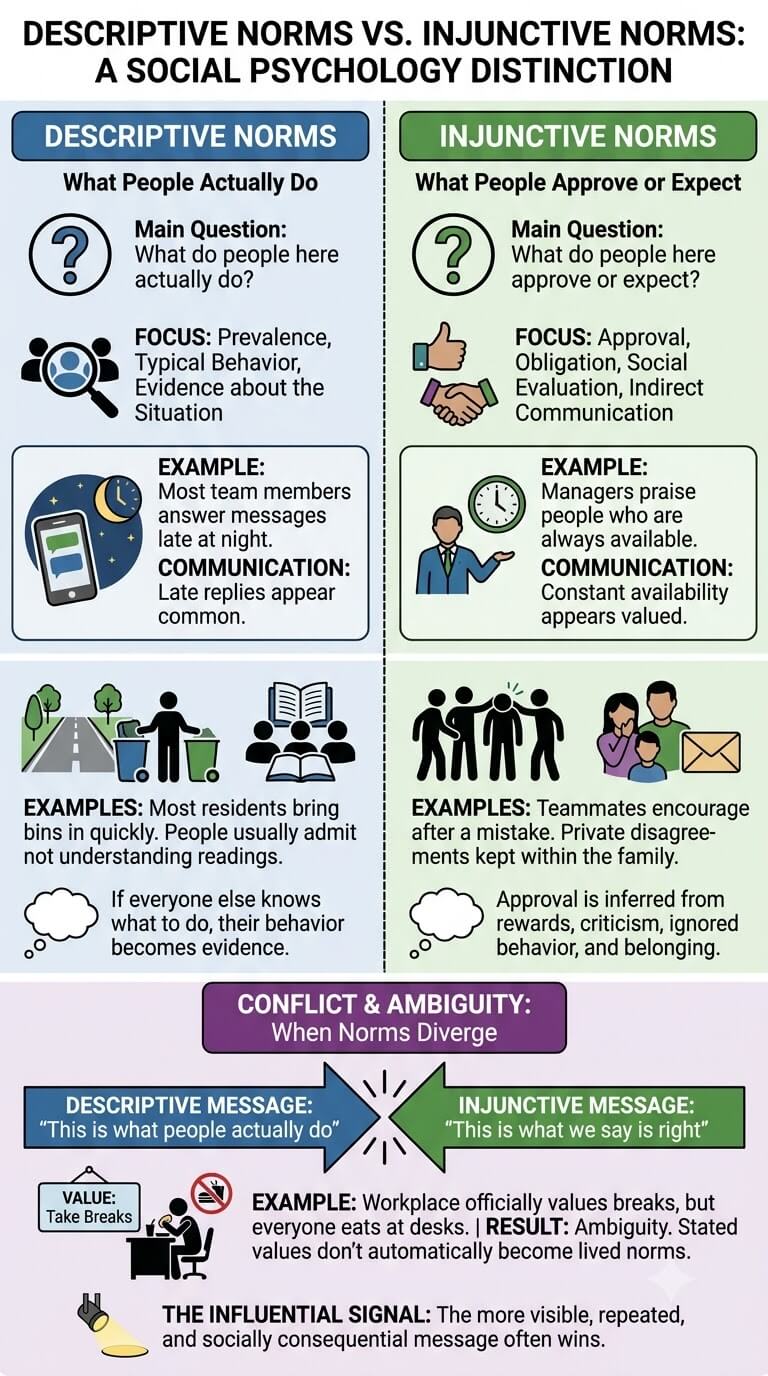
One of the most useful distinctions in social psychology separates what people do from what people approve. The classic Focus Theory of Normative Conduct developed this distinction by treating descriptive and injunctive norms as related but psychologically different kinds of information.
| Norm type | Main question | Everyday example | What it communicates |
|---|---|---|---|
| Descriptive norm | What do people here actually do? | Most team members answer messages late at night. | Late replies appear common. |
| Injunctive norm | What do people here approve or expect? | Managers praise people who are always available. | Constant availability appears valued. |
Descriptive norms: what people appear to do
Descriptive norms give information about prevalence. They tell you what behavior seems typical. In a neighborhood, you might notice that most residents bring bins in quickly after collection. In a study group, you may notice that people usually admit when they did not understand a reading.
These observations can shape expectations even without direct pressure. If everyone else seems to know what to do, their behavior becomes evidence about the situation.
Injunctive norms: what people appear to approve or expect
Injunctive norms concern approval, obligation, or social evaluation. A sports team may have an injunctive norm that members should encourage a teammate after a mistake. A family may have an injunctive norm that private disagreements should not be discussed with outsiders.
The important point is that approval can be communicated indirectly. People infer it from who is rewarded, who is criticized, whose behavior is ignored, and which actions seem to affect belonging.
What happens when the two norms conflict
Descriptive and injunctive norms sometimes point in opposite directions. A workplace may officially value taking breaks, while everyone visibly eats lunch at a desk. A friend group may say gossip is unfair, while regularly rewarding dramatic stories with attention.
These conflicts create ambiguity because people receive two messages at once: “This is what we say is right” and “this is what people actually do.” In practice, the more visible, repeated, and socially consequential signal may become more influential. This is one reason stated values do not automatically become lived norms.
Explicit vs Implicit Group Norms
Some groups state expectations clearly. Others rely heavily on inference. The difference is not simply formal versus informal. A written rule may be ignored, while an unwritten expectation may be strongly enforced.
Rules that are stated directly
Explicit norms include meeting rules, codes of conduct, team agreements, classroom expectations, and openly discussed family rules. Their advantage is visibility. Members can point to them, question them, clarify them, and negotiate changes.
Yet stating a norm does not guarantee that it guides behavior. If a group says “everyone can disagree” but punishes the first person who disagrees, members learn that the real expectation is different from the official one.
Rules learned through observation, correction, silence, and reactions
Implicit norms often arrive as a series of small lessons. A newcomer notices who speaks first, whose humor is accepted, whether mistakes are admitted, whether people interrupt, and how the group reacts when someone violates an expectation.
Silence can also be informative, but it is easy to misread. If nobody objects to a harsh joke, each person may assume others approve when several members are actually uncomfortable. That gap between private views and perceived group consensus becomes important later.
How Group Norms Form
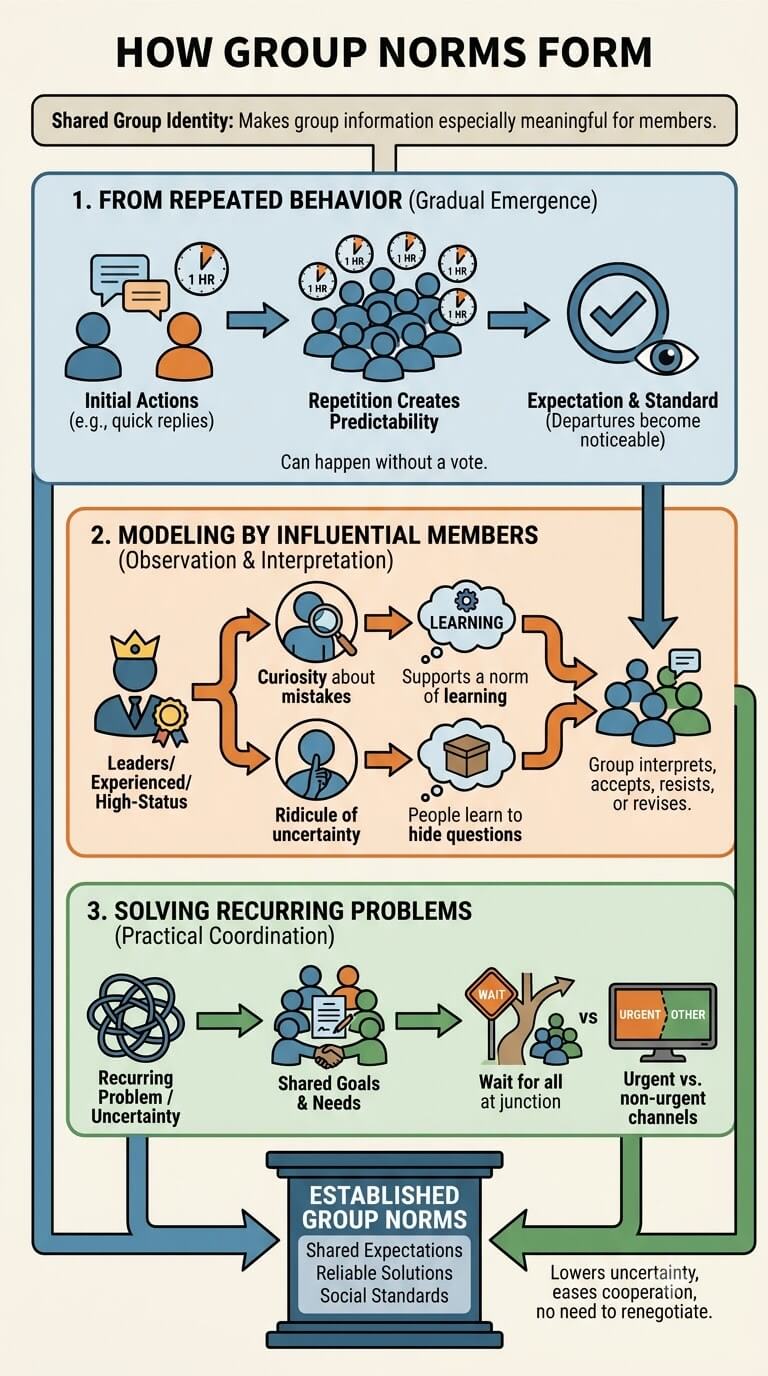
Norms do not all begin in the same way. Some emerge gradually from repeated coordination. Some are modeled by influential members. Some arise because a group needs a reliable solution to a recurring problem. Research on self-categorization and norm formation also shows why shared group identity can matter: when people see a particular group as relevant to who they are in a situation, information from that group can become especially meaningful.
Repeated behavior becomes a reference point
Imagine five people forming a volunteer committee. At first, nobody knows how quickly messages should be answered. Two members respond within an hour, others follow, and rapid replies gradually become expected. What began as behavior has become a standard.
This can happen without a vote. Repetition creates predictability, predictability creates expectation, and expectation makes departures more noticeable.
Influential members model what is acceptable
Not every member contributes equally to early norm formation. Leaders, experienced members, high-status participants, or people seen as representative of the group may receive more attention. If they respond to mistakes with curiosity, that can support a norm of learning. If they ridicule uncertainty, people may learn to hide questions. At a broader level, social identity psychology connects this process with belonging, norms, group judgment, and individual agency.
Influence does not mean one person controls the group. Other members still interpret, accept, resist, or revise what they observe. Norms are social because they depend on shared expectations, not simply on one person’s preference.
Shared goals and recurring problems create coordination needs
Many norms solve practical problems. A hiking group develops a rule that nobody leaves a trail junction until the last person arrives. A remote team decides that urgent matters go in one channel and everything else waits. A family agrees to text if plans change.
These norms can be useful precisely because members do not need to renegotiate the same question every time. Good coordination lowers uncertainty and makes cooperation easier.
How Newcomers Learn the Norms
Entering a group is a high-information period. New members often pay close attention because they lack history and do not yet know which behaviors are safe, ordinary, or valued.
Observation and imitation
Newcomers first watch. Who gets listened to? How formal is the language? Are questions welcomed? Is arriving five minutes late treated as normal or disrespectful? When the correct behavior is unclear, copying established members is an efficient way to reduce mistakes.
Imitation can therefore be practical rather than submissive. It is often how people learn local expectations before deciding which ones they personally support.
Feedback, approval, teasing, correction, and exclusion signals
Groups also teach by reacting. A friendly correction can make a standard clear without threatening belonging: “We usually let the person finish before responding.” Teasing can serve the same instructional function, but it can become confusing or hurtful if people cannot tell whether the message is playful or punitive.
Exclusion is a stronger signal. Being left out of information, invitations, or opportunities after violating a norm may communicate that membership is conditional. When the consequence involves intimidation, threats, humiliation, retaliation, stalking, or financial control, the issue is no longer just ordinary social regulation. Safety and coercion deserve separate attention.
Why newcomers can overestimate how strongly everyone agrees
A new member sees public behavior, not private opinion. If people comply outwardly while disagreeing privately, the group may look more unanimous than it really is. Newcomers can then imitate the visible pattern and accidentally strengthen the appearance of consensus.
This creates a loop: people act as if the norm is widely supported because they believe others support it, and their behavior becomes evidence for everyone else.
How Norms Are Enforced Without Formal Rules
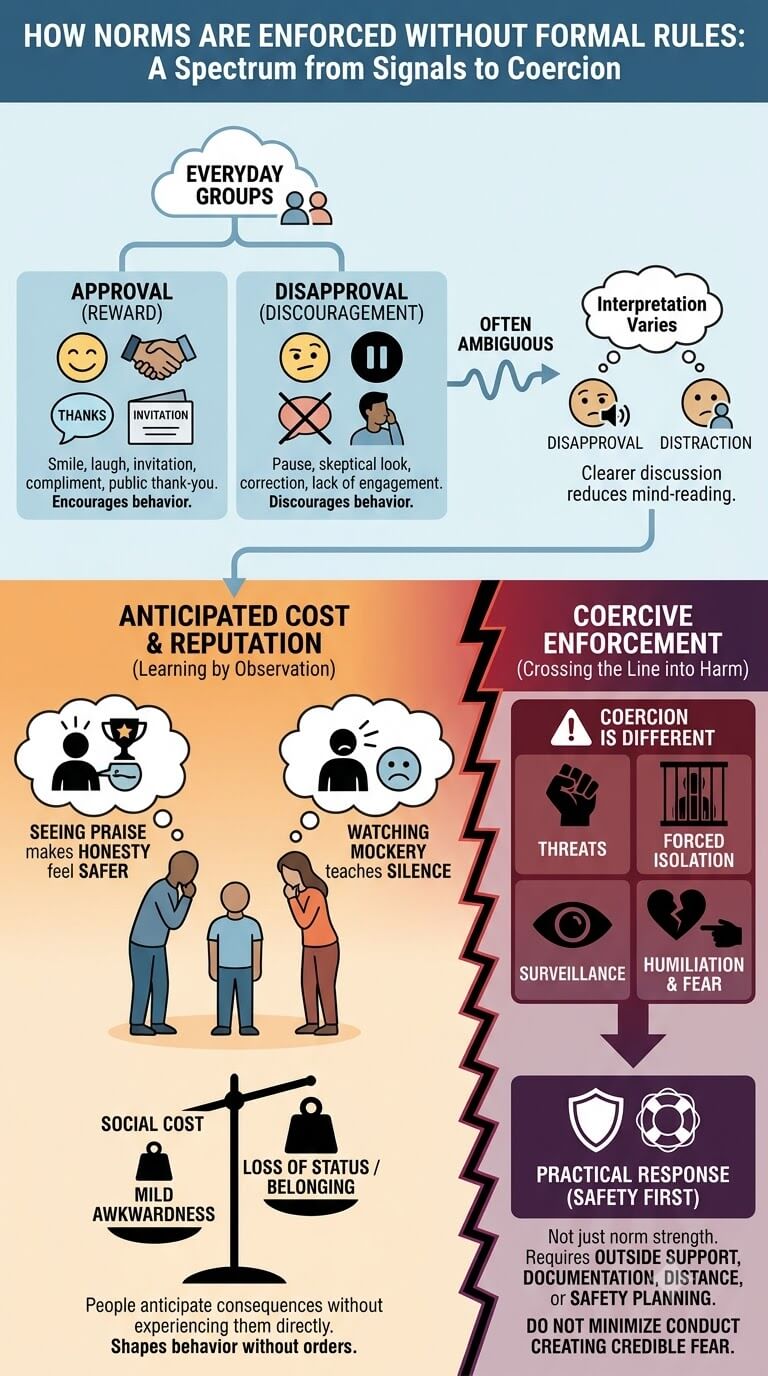
Norm enforcement ranges from tiny social cues to serious punishment. Most everyday groups rely on subtle responses long before they use formal sanctions.
Social approval and disapproval
A smile, laugh, invitation, compliment, or public thank-you can reward behavior. A pause, skeptical look, correction, or lack of engagement can discourage it. These signals help members update their sense of what fits.
Because the signals are often ambiguous, people may disagree about what the group expects. One person sees silence as disapproval. Another sees it as distraction. Clearer discussion reduces the amount of mind-reading required.
Reputation, belonging, and anticipated social cost
People do not need to experience a consequence directly to anticipate it. Watching another member get mocked for asking a basic question can teach everyone else to stay quiet. Seeing a teammate praised for admitting a mistake can make honesty feel safer.
The social cost can be small, such as mild awkwardness, or meaningful, such as loss of status or belonging. This helps explain why norms can shape behavior even when no authority gives an order.
When enforcement becomes coercive rather than ordinary social regulation
Disapproval is part of ordinary group life. Coercion is different. A group crosses an important line when compliance is driven by credible threats, forced isolation, surveillance, humiliation, retaliation, or fear of harm.
In those situations, the practical question is not simply “How strong is this norm?” A person may need outside support, documentation, distance, or safety planning depending on the context. Psychological concepts should not be used to minimize conduct that creates credible fear.
Why Group Norms Persist
Once established, norms can survive even after the original reason disappears. Persistence is often less mysterious than it looks. Norms continue because they simplify coordination, become habitual, and create expectations about how other members will react.
Coordination benefits
A stable norm saves effort. If everyone knows how decisions are made, how meetings start, or what counts as acceptable preparation, members do not have to solve those questions repeatedly. Even an imperfect rule may persist because predictable imperfection can feel easier than constant renegotiation.
Habit and expectation loops
Repeated behavior becomes familiar, and familiarity can be mistaken for necessity. People may keep following a norm because they expect others to follow it and expect others to expect the same from them.
This loop is especially sticky when nobody wants to be the first person to test whether the old expectation still matters.
Pluralistic ignorance and the illusion of agreement
Pluralistic ignorance describes situations in which people misperceive what others privately think or feel. A recent review of pluralistic ignorance emphasizes that group members can systematically misjudge peers’ private attitudes, feelings, or behavior.
Consider a class where students avoid asking questions because each assumes everyone else understands the material. Many may be confused, yet public silence makes confusion look rare. The apparent norm of “competent people do not ask” persists partly because private uncertainty is hidden.
How Group Norms Change
Norms are durable, but they are not fixed. A recent open-access review on social norm change describes norms as dynamic, capable of emerging, spreading, persisting, and shifting as group processes and circumstances change.
In everyday groups, change often begins when people obtain new information about what others actually think, when respected members model a different behavior, or when repeated practice makes a new expectation feel normal.
Visible dissent can reveal hidden disagreement
One person saying “I do not think this is working” can provide information that was previously missing. Others who privately agreed may become more willing to speak once they learn they are not alone.
This does not mean dissent automatically changes a norm. The group still has to decide what to do with the disagreement. But visible dissent can break the false impression of unanimity.
New leaders, new members, new goals, and new evidence can shift standards
A group changes when its circumstances change. A new coach may normalize asking for feedback. New employees may question a tradition that no longer serves a purpose. A volunteer group may become more structured as membership grows.
External evidence can matter too. If a team learns that its “efficient” meeting norm actually causes recurring errors, members have a practical reason to revise what they consider acceptable.
Small norm changes become stable when expectations change with behavior
Behavioral change is fragile if everyone still expects the old rule to return. Lasting change is more likely when people begin to expect the new behavior from one another and see that the new behavior receives social support.
For example, one meeting where a manager invites dissent is an event. Several meetings where dissent is welcomed, considered, and never punished can create a different expectation about how disagreement works.
Healthy Norms vs Harmful Norms

A norm is not automatically healthy because many people follow it. Popularity tells you something about prevalence, not about psychological safety, fairness, effectiveness, or morality.
| Area | Healthier group norm | Potentially harmful group norm |
|---|---|---|
| Mistakes | Errors can be named and corrected without humiliation. | People hide errors to avoid ridicule. |
| Disagreement | Members can challenge ideas without losing basic respect. | Loyalty is measured by public agreement. |
| Boundaries | Members can say no to reasonable requests without retaliation. | Availability is treated as proof of commitment. |
| Information | Questions and uncertainty are allowed. | Admitting uncertainty lowers status. |
| Belonging | Connection does not require surrendering all personal judgment. | Difference is treated as betrayal. |
Healthy norms support safety, coordination, fairness, and constructive disagreement
Healthy norms do not require endless comfort or agreement. A group may expect punctuality, preparation, direct feedback, or strong effort. The key is whether the expectation is clear enough to understand, proportionate to the setting, open to revision, and compatible with basic dignity.
Good norms also make room for correction. A standard that cannot be questioned may become detached from the problem it was supposed to solve.
Popularity does not prove a norm is psychologically healthy or morally right
“Everyone does it” and “everyone approves” are descriptive claims about a group, not proof that the behavior is wise. Groups can normalize overwork, ridicule, exclusion, reckless risk, or unfair treatment.
Social psychology helps explain why such norms can persist. It should not be used to excuse them. Members still make choices, and groups still have responsibility for the standards they reward.
Group Norms vs Conformity
Norms and conformity are closely related, but they answer different questions. OpenStax describes conformity as behavior that changes to go along with a group. Group norms are the expectations that provide part of the social context in which that alignment may occur.
Norm is the standard
A norm says, in effect, “This is what people here normally do,” “this is what we expect,” or “this is what receives approval.” It can exist whether or not a particular individual follows it.
Conformity is a person’s alignment with the standard or group information
Conformity concerns what an individual does in response to group behavior, expectations, or information. Someone may conform publicly while disagreeing privately, or may genuinely accept the group’s judgment. Those mechanisms deserve their own analysis.
Keeping the distinction clear prevents a common mistake: treating every norm as proof that every member has been pressured into agreement.
A Norm Audit for Everyday Groups
You can understand a group more clearly by looking at behavior and reactions rather than relying only on its stated values. The following four-part audit is designed for ordinary reflection, not for diagnosing a group.
What do people actually do?
Look for repeated patterns. Who speaks? Who interrupts? How do people handle mistakes? Do members ask for help? Are deadlines treated as firm, flexible, or negotiable? This identifies the descriptive layer.
What do they praise or punish?
Notice where approval and disapproval go. Who gets trusted? What behavior earns laughter, recognition, invitations, silence, or criticism? This reveals the injunctive layer that may be stronger than formal rules.
What happens when someone disagrees?
A group’s reaction to dissent is highly informative. Does disagreement create discussion, curiosity, defensiveness, ridicule, exclusion, or retaliation? A group can value unity while still allowing members to challenge ideas.
Is the norm explicit enough to challenge or revise?
Unspoken norms are difficult to negotiate because people may not agree on what the rule actually is. Naming an expectation can make it testable: “Are we actually expected to answer messages after 9 p.m., or did that just become a habit?”
A useful first step is to separate observation from accusation. Describe what seems to happen, ask how others understand it, and compare the stated expectation with the lived one.
How Identity and Cohesion Can Make Norms More Powerful
Norms do not operate in a vacuum. Their psychological weight depends partly on how meaningful the group is to a person and how connected members feel to one another.
When group identity makes an expectation feel personally relevant
If a group is central in a particular moment, its norms may feel less like outside instructions and more like information about “what people like us do.” This does not erase personal choice. It helps explain why the same person may care deeply about one group’s standards while barely noticing another group’s expectations. Once a group identity becomes salient, norms can become more relevant because they signal what members like “us” typically do or approve—a process clarified by Self-Categorization Theory.
Why cohesion can strengthen both helpful and unhelpful norm transmission
Strong connection can make coordination easier because members trust one another and care about shared goals. It can also make social approval more consequential. A norm of mutual support may spread quickly in a cohesive team. So may a norm of never criticizing the team in public.
Cohesion is therefore not automatically good or bad. The content of the norm, the way it is enforced, and the room for independent judgment still matter.
FAQ
These questions focus on how group norms work as shared standards, especially when the rules are partly invisible.
What is the difference between descriptive and injunctive group norms?
Descriptive norms concern what people appear to do, while injunctive norms concern what people appear to approve, expect, or disapprove. The two can match, but they can also conflict. A team might officially praise work-life balance while most members routinely respond to messages late at night.
Can a group norm exist if no one says it out loud?
Yes. Many norms are implicit. Members infer them from repeated behavior and social reactions. An unwritten norm can be powerful if people reliably reward compliance or make violations socially costly. At the same time, ambiguity increases the risk that members misread what others actually expect.
Why do people follow norms they privately dislike?
There are several possible reasons. They may want to avoid social cost, assume others know better, believe the norm has practical value, or incorrectly think most members support it. Following a norm does not prove private agreement, which is why visible behavior alone can exaggerate perceived consensus.
How do group norms change when many members secretly disagree?
Change becomes more possible when private disagreement becomes visible. A dissenter, anonymous feedback, changing leadership, new evidence, or repeated alternative behavior can reveal that the old expectation has less support than people assumed. For change to last, members usually need new expectations about what others will do and approve going forward.
Are all group norms forms of peer pressure?
No. Some norms coordinate behavior with little felt pressure, such as taking turns in a discussion or using a shared channel for urgent messages. Pressure becomes more central when belonging, reputation, approval, or punishment strongly depends on compliance. Serious threats or retaliation should not be reduced to ordinary peer pressure.
Key Takeaways
- Group norms are shared expectations about what members normally do and what they are expected to approve or avoid.
- Descriptive norms describe typical behavior; injunctive norms communicate approval, obligation, or disapproval.
- Norms form through repeated behavior, influential examples, shared goals, and the reactions members give one another.
- Newcomers learn norms by observing behavior and social consequences, which can make a group look more unanimous than it really is.
- Norms persist because they simplify coordination and because people develop expectations about what others expect from them.
- Norm change becomes more durable when both behavior and shared expectations shift, not when a group merely announces a new value.
Final Thoughts
The most useful question about an unwritten group rule is not simply, “Do people follow it?” Ask where the expectation came from, what signals keep it alive, whether members actually agree with it, and what happens when someone challenges it. That turns an invisible social rule into something you can examine rather than automatically obey or reject.
In a group you care about, choose one recurring expectation and map it in four steps: what people do, what people praise or punish, what disagreement costs, and whether the rule can be discussed openly. That small exercise often reveals whether a norm is helping the group coordinate or simply continuing because nobody has tested it lately.

Michael Reed is the Founder and Lead Writer at Psychology Exposed. He writes about human behavior, relationships, emotional patterns, self-awareness, and practical psychology topics using research-informed, easy-to-understand content.
Read More About Michael Reed: https://psychologyexposed.com/michael-reed/