
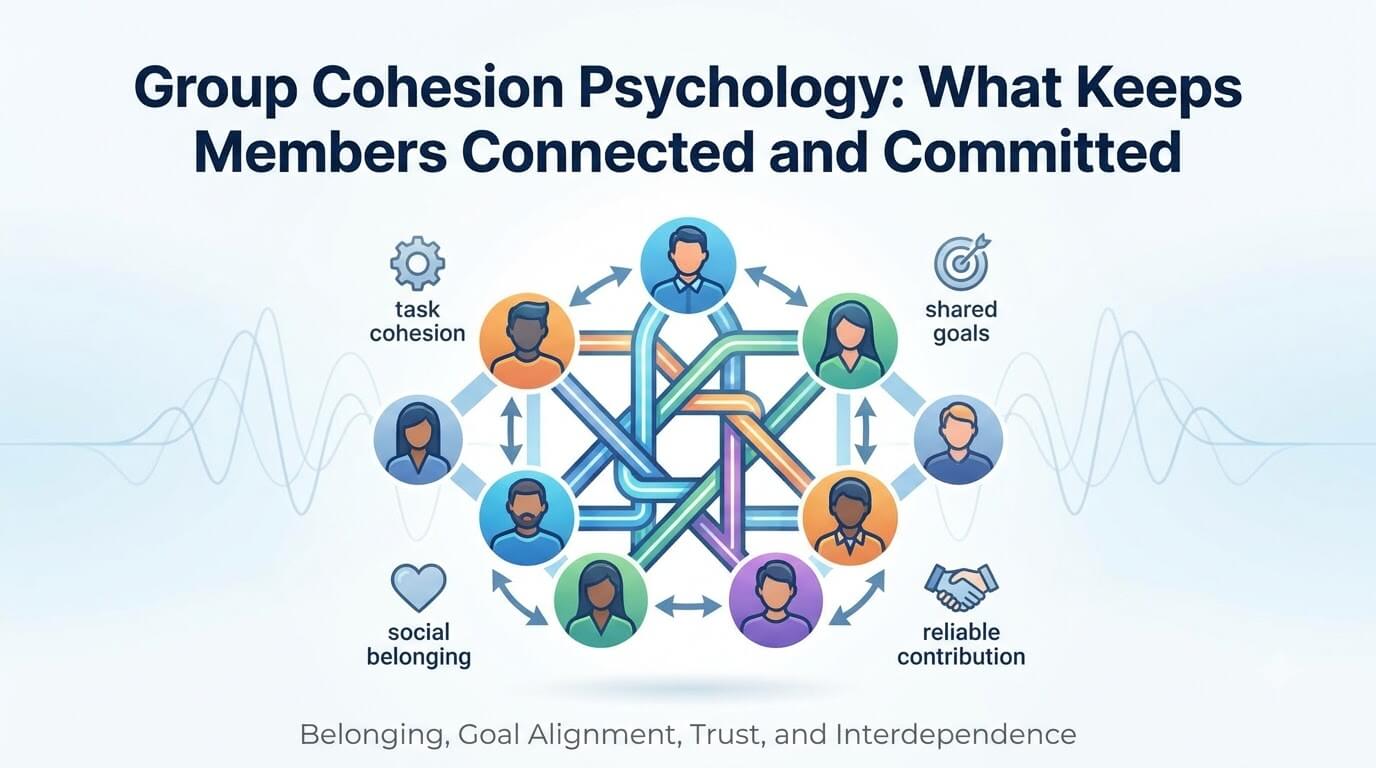
A group can look close from the outside and still feel fragile on the inside. Another group may not socialize much at all, yet its members reliably show up, coordinate well, and remain committed when the work becomes difficult. Group cohesion psychology helps explain this difference by looking at the forces that keep people connected to a group and willing to invest in its continued success.
Cohesion matters because membership is not only about being physically present. People also decide, often gradually, whether a group feels worth staying with, whether its goals feel shared, whether other members can be counted on, and whether their own contribution matters. Those judgments shape cooperation, persistence, and the social weight of disagreement. Strong cohesion can support excellent teamwork, but connection alone does not guarantee good judgment.
Quick Answer: What Group Cohesion Means
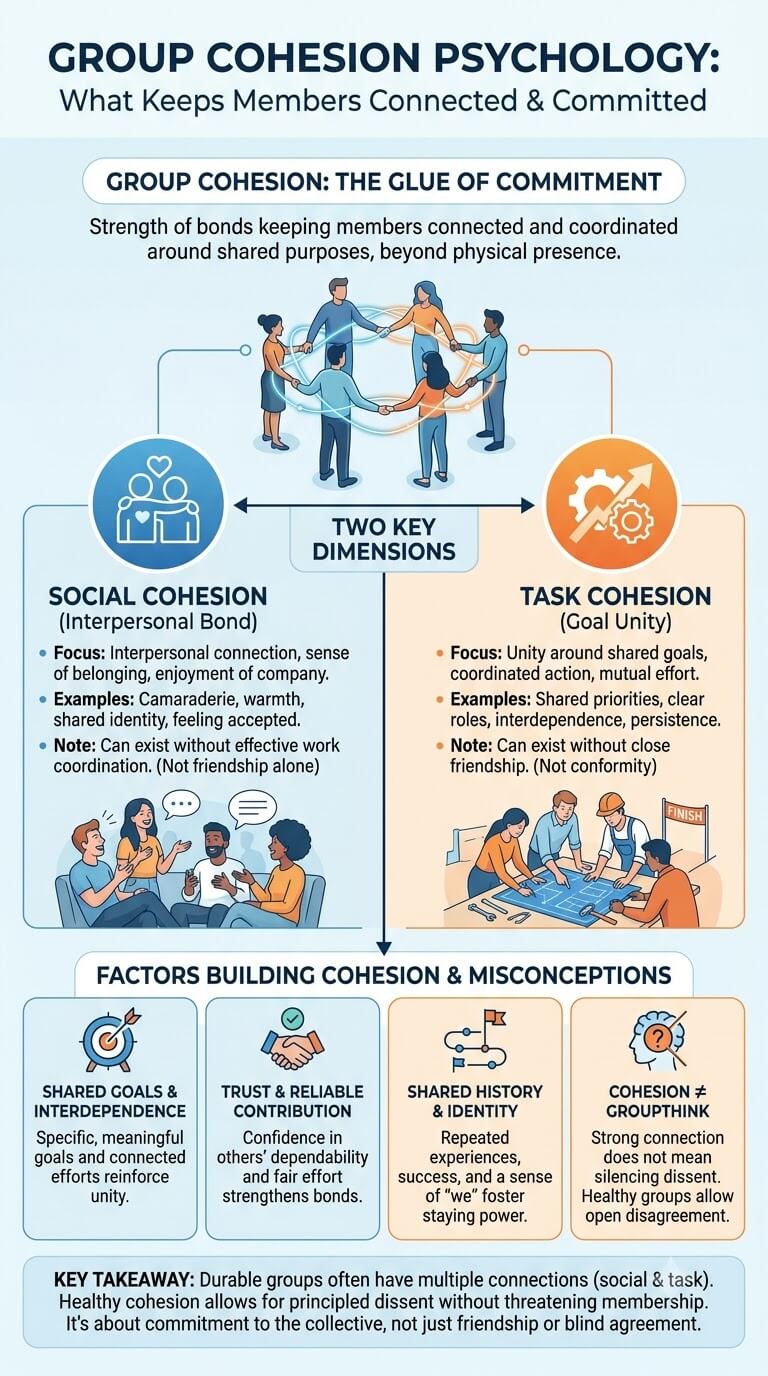
Group cohesion is the strength of the bonds and commitments that keep members connected to a group and coordinated around its purposes. It can include social belonging, attachment to the group, commitment to shared goals, and willingness to work together. Cohesion is not the same as friendship, conformity, trust, or groupthink. A cohesive group can disagree openly, and a friendly group can still struggle to work together.
Cohesion Is More Than Liking Each Other
The APA Dictionary of Psychology definition of group cohesion emphasizes unity, solidarity, belonging, attraction to the group, and coordination toward goals. That broad definition matters because cohesion is not reducible to one feeling such as liking, loyalty, or closeness.
The forces that keep members attached to a group
Imagine a neighborhood volunteer team that meets twice a month. Some members are close friends, some mainly care about the project, and others value the sense that their work improves the neighborhood. Their reasons for staying differ, but the group can still develop a strong pull if people experience membership as worthwhile and believe the group functions as a real unit.
That pull can come from enjoyment, shared identity, common goals, interdependence, or pride in what the group has built. Cohesion is better understood as a pattern of connection than as one emotion.
Why commitment can exist even when members are not close friends
A surgical team, class project group, production crew, or competitive sports team may have strong task commitment without much social intimacy. Members may not spend their weekends together, yet they can still feel responsible to the group, coordinate carefully, and protect the quality of collective work.
The reverse is possible too. A group of friends may enjoy spending time together while repeatedly missing deadlines on a shared project. Their social bond is real, but that does not automatically produce coordination, accountability, or commitment to the task. This is why it helps to separate social cohesion from task cohesion.
Social Cohesion vs Task Cohesion

Researchers have often treated cohesion as multidimensional rather than as one undifferentiated quality. Measures such as the Group Environment Questionnaire distinguish social and task-related aspects of group connection, and later research continues to examine these dimensions in team settings. An open-access discussion of the Group Environment Questionnaire and cohesion dimensions describes social cohesion as interpersonal bonding and task cohesion as unity around performance goals.
| Dimension | Main question | What it can look like | What it does not guarantee |
|---|---|---|---|
| Social cohesion | Do members feel connected to one another? | Warmth, camaraderie, belonging, enjoyment of time together | Good execution, accountability, or strong decisions |
| Task cohesion | Do members feel united around what the group is trying to accomplish? | Shared priorities, coordination, mutual effort, persistence | Friendship or emotional closeness |
Social cohesion: interpersonal connection and belonging
Social cohesion concerns the interpersonal side of membership. People enjoy being together, feel accepted, and experience a sense of connection with other members. In a hobby group, this may be the pleasure of seeing familiar people each week. In a classroom team, it may be the ease of joking, asking casual questions, or including one another outside formal tasks.
Social cohesion can make participation more rewarding and can give people reasons to remain involved when there is no immediate payoff. Still, a pleasant social atmosphere should not be confused with effective collaboration. Members can genuinely like each other and still avoid difficult conversations about missed work or poor decisions.
Task cohesion: commitment to shared goals and coordinated work
Task cohesion concerns unity around what the group is trying to accomplish. It grows when members see the goal as shared, understand how their efforts fit together, and believe that coordinated action matters. A research team may have strong task cohesion because everyone is invested in producing accurate work, even if personalities differ.
Task cohesion becomes especially visible when progress requires interdependence. When one person’s work affects the next person’s, reliable cooperation becomes part of the group bond. The connection is not only social. It is also practical and collective.
How one can be high while the other is lower
These dimensions can move independently. A newly assembled emergency-response team may have modest social cohesion but high task cohesion because roles are clear and the mission matters. A long-running social club may have high social cohesion but low task cohesion if members no longer agree on what the club is trying to accomplish.
This distinction prevents a common mistake: assuming that visible warmth tells you everything about a group. To understand cohesion, ask both how connected members feel and how united they are around what the group is for.
How Group Cohesion Forms
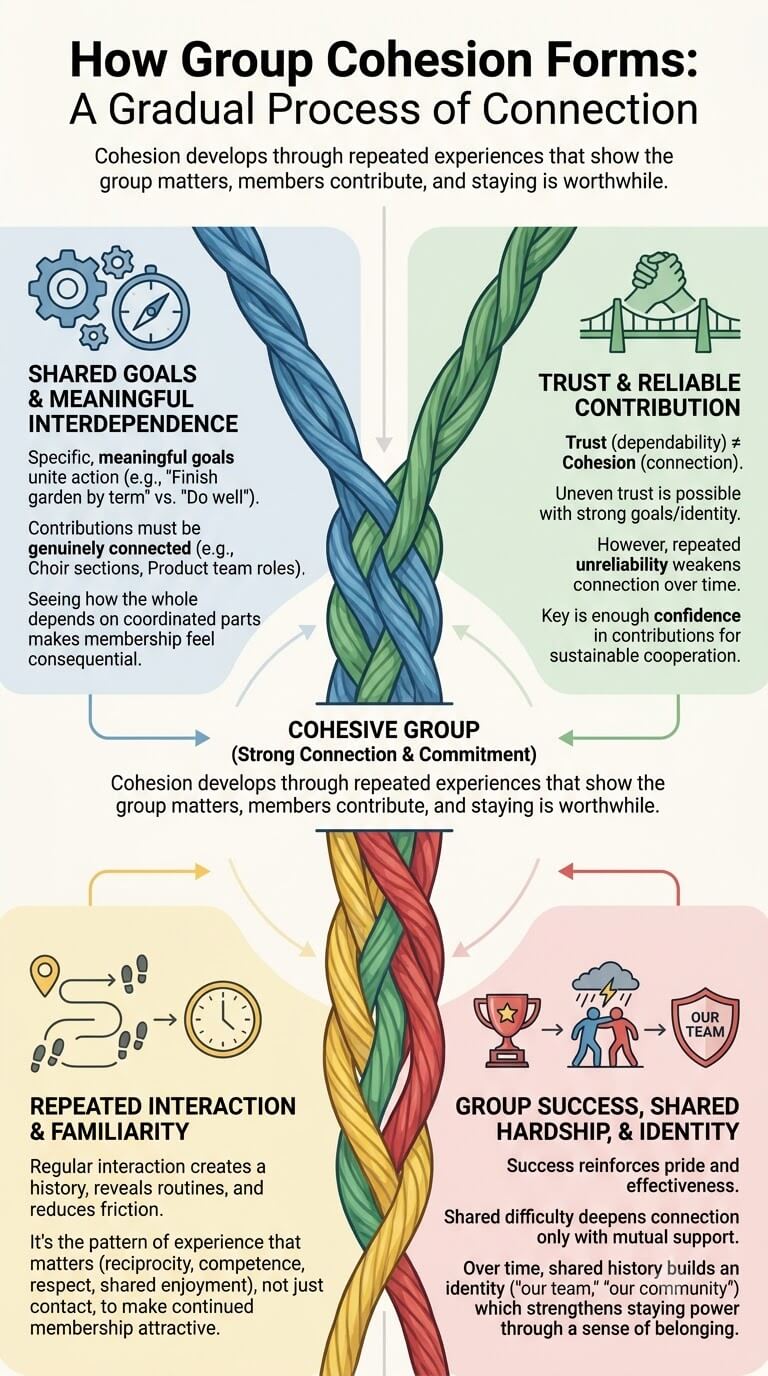
Cohesion rarely appears because of one event. It tends to develop through repeated experiences that tell members, “this group matters, people here contribute, and staying connected is worthwhile.” Different groups build that feeling through different combinations of goals, reliability, history, and identity.
Shared goals and meaningful interdependence
A goal can unite people when it is specific enough to coordinate action and meaningful enough to justify effort. “Do well” is vague. “Finish the community garden before the school term starts” gives members a common endpoint and a reason to organize around one another.
Interdependence strengthens this effect when contributions are genuinely connected. A choir needs sections to listen to one another. A product team needs design, engineering, testing, and support to fit together. When members can see how the whole depends on coordinated parts, membership often feels more consequential.
Trust and reliable contribution
Trust can contribute to cohesion, but the concepts are not interchangeable. Trust asks whether someone or something is expected to be dependable, honest, or safe enough in a relevant situation. Cohesion asks how strongly members are connected and committed to the group as a whole.
A group can have uneven trust and still remain cohesive, especially when a shared identity or goal is strong. Over time, however, repeated unreliability can weaken connection because members stop expecting effort to be reciprocal. The useful question is not whether everyone trusts everyone equally. It is whether members have enough confidence in one another’s contribution for cooperation to feel sustainable.
Repeated interaction and familiarity
Regular interaction creates a history. People learn who follows through, how disagreement tends to unfold, who needs more context before deciding, and which routines make coordination easier. Familiarity can reduce the friction of constantly renegotiating how the group works.
Repeated contact does not automatically produce cohesion. A group can repeatedly meet and become more frustrated. What matters is the pattern of experience that accumulates. Familiarity is more likely to strengthen cohesion when interaction includes enough reciprocity, competence, respect, or shared enjoyment to make continued membership attractive.
Group success, shared hardship, and identity
Success can reinforce cohesion because members begin to associate the group with effectiveness and pride. Shared difficulty can also deepen connection when people face it together and experience mutual support. The key is not hardship by itself. Being mistreated together does not make a group psychologically healthy.
As members build a shared history, the group may also become part of how they describe themselves: “our team,” “our class,” “our community.” That identity can strengthen staying power because leaving would mean giving up more than a task. It may also mean giving up a valued sense of belonging or shared accomplishment. For the wider picture, social identity psychology explains how belonging, group expectations, identity, and behavior fit together.
A Cohesion Map: Belonging, Goal Alignment, Trust, and Interdependence
A useful way to think about cohesion is to check four dimensions rather than asking a single yes-or-no question. The map below is not a diagnostic test. It is a practical way to notice which forces are holding a group together and which ones are weak.
| Dimension | Question to ask | When it is stronger | When it is weaker |
|---|---|---|---|
| Belonging | Do members feel accepted as part of the group? | People feel included and membership has personal meaning | Members feel disposable, peripheral, or chronically excluded |
| Goal alignment | Do members broadly agree on what the group is trying to accomplish? | Priorities are shared enough to guide effort | People pull toward incompatible outcomes |
| Trust contribution | Can members reasonably expect others to contribute? | Follow-through is visible and repair happens after misses | Work and sacrifice become persistently one-sided |
| Interdependence | Do members experience their efforts as meaningfully connected? | People can see how their work affects the whole | Membership feels interchangeable or disconnected from outcomes |
What each dimension contributes
Belonging gives the group emotional significance. Goal alignment gives it direction. Reliable contribution makes cooperation feel fair enough to continue. Interdependence turns separate efforts into something members experience as genuinely collective.
These dimensions can compensate for one another for a time. A demanding project may retain people because the goal matters even when social warmth is low, while strong relationships may carry a community group through temporary uncertainty. Persistent weakness across several dimensions is harder to sustain.
Why no single factor guarantees a cohesive group
Shared goals do not guarantee friendship, and friendship does not guarantee reciprocal effort. Interdependence can even become resented if some members feel trapped into carrying others.
Looking at the combination gives a more realistic picture than treating cohesion as “team spirit.” Strong groups often have multiple reasons for staying connected, which makes them less dependent on any one moment of enthusiasm.
The Benefits of Cohesion

Cohesion can make collective action easier because people have reasons to invest beyond immediate personal convenience. Research on cohesion and performance generally finds a positive relationship, but the size and form of that relationship depend on how cohesion and performance are measured and on the kind of work being done.
Cooperation and persistence
When people feel attached to a group, they may be more willing to keep contributing through ordinary frustration. A volunteer may stay for an unpleasant clean-up shift because the project and the people matter.
A meta-analysis of cohesion and group performance found that different components of cohesion related to performance in different ways, with stronger relations under some performance definitions and workflow conditions. That is a useful reminder that cohesion is not a magic performance switch.
Coordination and willingness to support other members
Cohesive groups may share information sooner, cover temporary gaps, and make small adjustments that protect collective work. These behaviors are easier when success is experienced as shared rather than purely individual.
Task structure matters. Research reviewing cohesion and performance has found that the relationship can be stronger when work is more interdependent. A meta-analysis examining task interdependence highlights why the value of cohesion depends partly on how much members actually need one another to perform.
Meaning, belonging, and resilience during ordinary setbacks
Groups can also provide continuity. A failed presentation, lost game, or rejected proposal may feel less isolating when members still experience themselves as part of a functioning “we.”
This does not mean cohesion prevents disappointment or conflict. It means the relationship to the group may survive those moments. Members can think, “that went badly, but we are still working on it together,” which can make recovery and continued participation more likely.
Psychological Safety Is Related but Distinct
Cohesion and psychological safety are often mentioned together because both affect group life, but they answer different questions. Treating them as synonyms can hide an important possibility: members may feel deeply attached to a group while still being reluctant to speak candidly inside it.
Cohesion asks whether members feel connected and committed
A cohesive member is pulled toward the group. They may value the relationships, identify with membership, care about the goal, or feel responsible for the collective outcome. The central issue is connection and commitment.
That connection can be strong even in a group with strict hierarchy or unwritten rules against disagreement. High cohesion does not tell you whether people feel free to question a plan, admit an error, or say they do not understand.
Psychological safety asks whether interpersonal risk feels safe enough for speaking up
Amy Edmondson’s foundational work defined team psychological safety around a shared belief that the team is safe for interpersonal risk taking. Her study of work teams linked that climate with learning behaviors such as discussing errors and seeking feedback. The original psychological safety research helps clarify why a team can be bonded yet still poor at surfacing uncomfortable information.
A useful contrast is this: cohesion can make you want to remain part of the group; psychological safety can make it easier to risk temporary discomfort inside it.
When Strong Cohesion Increases Pressure to Agree
The same connection that supports cooperation can raise the social cost of disagreement. If membership matters deeply, a person may hesitate before challenging respected peers or questioning a choice tied to group pride. Cohesion changes what is socially at stake.
Protecting harmony can become more important than surfacing disagreement
Consider a committee that has worked together successfully for years. Members may know one another well and genuinely care about the group. When a questionable proposal appears, someone who sees a problem may think twice before being the person who “makes things difficult.”
The risk is subtle because silence can feel prosocial. Someone may believe they are protecting morale or avoiding unnecessary conflict. If several people make the same calculation, the group loses information because members care about preserving harmony.
Loyalty can be confused with silence
Groups become brittle when loyalty is defined as visible agreement. A member who raises a concern may be treated as less committed even when trying to prevent a mistake, teaching people to perform unity instead of contributing honestly.
A healthier definition of loyalty leaves room for accurate bad news, principled disagreement, and correction. If belonging depends on humiliation, threats, retaliation, isolation, or punishment for reasonable dissent, the issue is no longer simply “strong cohesion.” Those behaviors raise safety and coercion concerns.
Why this still does not automatically equal groupthink
High cohesion is sometimes treated as proof of groupthink, but that leap is too large. Groupthink refers to a problematic decision process in which pressure toward consensus can reduce scrutiny of alternatives and warning signs. Cohesion may be one condition in the background, but it does not establish that such a process is occurring.
A highly cohesive team may invite criticism, use independent review, and change course when evidence changes. Decision procedures matter in addition to how bonded members feel.
Group Cohesion vs Conformity vs Groupthink
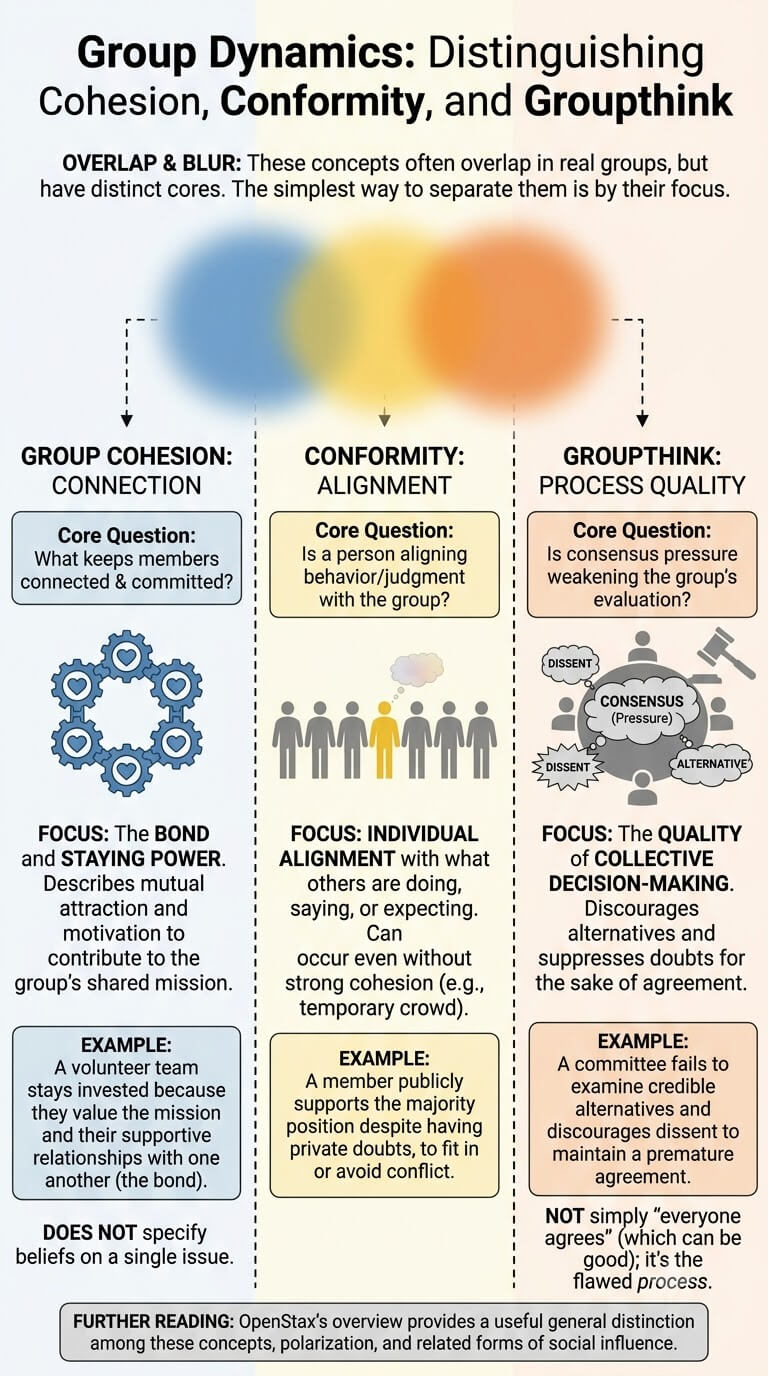
These concepts overlap in real groups, which makes them easy to blur. The simplest way to separate them is to ask whether you are describing connection, individual alignment, or the quality of collective decision-making.
| Concept | Core question | Example |
|---|---|---|
| Group cohesion | What keeps members connected and committed? | A volunteer team stays invested because members value both the mission and one another |
| Conformity | Is a person aligning behavior or judgment with the group? | A member supports the majority position publicly despite private doubts |
| Groupthink | Is consensus pressure weakening the group’s evaluation of options? | A committee discourages dissent and fails to examine credible alternatives |
Cohesion: connection to the group
Cohesion describes the bond. It helps explain why membership has staying power and why members may be motivated to contribute. It does not specify what someone believes on a particular issue or how a specific decision was made.
Conformity: alignment with group judgments or behavior
Conformity describes a person’s alignment with what others are doing, saying, or expecting. A cohesive group may create stronger reasons to conform because belonging matters, but conformity can also occur in groups that are not especially cohesive, such as a temporary crowd or unfamiliar classroom.
Groupthink: a decision process where consensus pressure reduces evaluation
Groupthink is about what happens to collective judgment. It is not simply “everyone agrees.” Agreement may reflect excellent evidence and independent thinking. The concern is whether the process discourages alternatives, suppresses doubts, or treats consensus as more important than careful evaluation.
OpenStax’s overview of conformity and group decision processes provides a useful general distinction among conformity, groupthink, polarization, and related forms of social influence.
Healthy Cohesion Without Silencing Dissent
Strong cohesion does not require disagreement to disappear. Membership is more durable when it can survive useful disagreement and when challenging an idea is not treated as rejecting the group.
Shared goals plus permission to disagree
A group can make its shared purpose explicit while also making disagreement normal. A project team might say, “We all want the launch to succeed, so concerns about timing should be raised before we commit.” The goal becomes a reason to surface problems rather than a reason to hide them.
This is especially valuable when expertise is distributed. If the person closest to a risk feels socially unable to speak, the group loses the benefit of having different members in the first place.
Separate loyalty to the group from agreement with every decision
One practical test is how the group responds to: “I still care about this team, and I think this plan is wrong.” In a resilient group, commitment and disagreement can coexist without automatically threatening the person’s standing.
Reciprocity matters here. Members should not expect only junior, quiet, or unpopular people to absorb the social cost of dissent. Leaders and high-status members can make disagreement safer by changing their minds publicly, thanking people for corrections, and avoiding retaliation after a challenge.
Reward useful dissent and accurate bad news
Groups learn what is welcome by watching consequences. If someone reports a problem and is mocked, ignored, or quietly excluded, the lesson spreads beyond that person. If a concern is examined seriously, even when the group ultimately chooses another path, members learn that honesty has a legitimate place.
Healthy cohesion includes confidence that membership does not depend on constant performance of agreement.
A Cohesion Self-Check for Everyday Groups
You do not need a formal scale to reflect on an everyday group. These questions help separate durable cohesion from closeness that depends on easy circumstances or enforced agreement.
Would people stay connected after disagreement?
Think about the last meaningful disagreement. Did members continue sharing information and treating one another as legitimate participants afterward? Or did dissent lead to freezing out, ridicule, gossip, or pressure to prove loyalty?
A group that absorbs disagreement without threatening membership has a more durable bond than one that appears united only when nobody challenges anything.
Are contributions and sacrifices reciprocal enough?
Cohesion weakens when the same people repeatedly carry the unpleasant work while others receive the benefits of membership. Perfect equality is rarely realistic, but persistent one-sidedness sends a message that some members’ time matters less.
Ask whether effort is visible, missed commitments are addressed, and contributions can be rebalanced. Investment is easier to sustain when sacrifice feels meaningful rather than exploited.
Does belonging depend on silence or total agreement?
A cohesive group can have norms, standards, and shared values without requiring identical opinions. If members must suppress ordinary disagreement to remain accepted, the group may look unified while becoming less adaptable.
Try a simple thought experiment: could a respected member oppose a popular proposal and still be treated as a respected member tomorrow? The answer says a great deal about whether connection is robust or conditional.
How Norms and Decision Pressure Interact With Cohesion
Cohesion does not operate in isolation. The group’s expectations help determine what membership requires, while decision procedures determine whether strong connection improves coordination or quietly narrows what people feel permitted to say.
Group norms help define what “good membership” looks like
Every group develops expectations about what committed members do. One team may value preparation and challenge; another may discourage public disagreement. Cohesion can make those expectations more influential because members care about remaining in good standing.
This is why the content of norms matters. Strong cohesion around norms of accuracy, reciprocity, and respectful dissent can support excellent cooperation. Strong cohesion around silence or unquestioned deference can make the same sense of belonging harder to use well.
Groupthink becomes a relevant risk only when decision conditions suppress scrutiny
If a close group faces a high-stakes decision, the key question is not “Are these people too cohesive?” It is “How are they testing their own thinking?” Independent input, explicit alternatives, permission to question assumptions, and attention to disconfirming evidence all matter.
Cohesion is the strength of the bond. Whether it supports careful thinking or protects premature consensus depends on what the group rewards when someone brings discomfort into the room.
FAQ
These questions clarify common differences between cohesion, friendship, conformity, and group decision pressure.
What is the difference between social cohesion and task cohesion?
Social cohesion refers mainly to interpersonal connection, belonging, and enjoyment of the group. Task cohesion refers to unity around shared goals and coordinated effort. A group can be strong on one and weaker on the other. Coworkers may collaborate extremely well without becoming close friends, while friends may enjoy one another but struggle to complete a shared task.
Can a group be cohesive even if members are not friends?
Yes. Friendship can contribute to social cohesion, but it is not required for group cohesion. Members may be strongly committed because they share a meaningful goal, rely on one another’s expertise, identify with the group, or have developed a dependable working rhythm. Respect and coordinated commitment can create a durable bond even when private social lives remain separate.
Does high cohesion cause groupthink?
No. High cohesion does not by itself establish groupthink. A cohesive group may make careful decisions if members can question assumptions, surface bad news, consider alternatives, and disagree without losing standing. Groupthink concerns a decision process in which consensus pressure interferes with critical evaluation. Cohesion may affect the social stakes, but it is not the same phenomenon.
How is cohesion different from conformity?
Cohesion describes connection and commitment to a group. Conformity describes a person aligning their judgment, behavior, or expressed opinion with the group. A highly cohesive group may create stronger motivation to align, but the concepts are not interchangeable. Someone can feel deeply connected and still disagree, while someone can conform in a temporary group they barely care about.
Can a group have strong cohesion and healthy disagreement?
Yes, and that combination is often more resilient than unity based on silence. Healthy disagreement becomes easier when members share a purpose, believe their standing can survive a challenge, and treat correction as useful rather than disloyal. The practical sign is not the absence of conflict. It is whether the group can keep working together while real differences are examined.
Key Takeaways
- Group cohesion is the strength of the connection and commitment that keeps members attached to a group and coordinated around its purposes.
- Social cohesion concerns interpersonal belonging, while task cohesion concerns unity around shared goals and coordinated work.
- Shared goals, reliable contribution, repeated interaction, interdependence, success, and group identity can all contribute to cohesion.
- Cohesion is not the same as trust, psychological safety, conformity, or groupthink, even though these processes can influence one another.
- Strong cohesion becomes more useful when members can disagree without having to prove that they still belong.
- A practical next step is to ask what currently holds your group together and whether that bond still leaves room for accurate bad news and principled dissent.

Michael Reed is the Founder and Lead Writer at Psychology Exposed. He writes about human behavior, relationships, emotional patterns, self-awareness, and practical psychology topics using research-informed, easy-to-understand content.
Read More About Michael Reed: https://psychologyexposed.com/michael-reed/