

A group can agree quickly for good reasons. People may have reviewed the same evidence, challenged one another’s assumptions, considered realistic alternatives, and still reached the same conclusion. Agreement becomes more concerning when preserving unity starts to matter more than testing the decision.
That is the problem groupthink psychology is meant to describe. The risk is not simply that people “think alike.” It is that doubts stay private, inconvenient information gets less attention, alternatives are rejected too early, and silence is mistaken for confidence. A team can then appear certain even when several members are privately uneasy.
The most useful way to recognize groupthink is to look at the quality of the decision process. Did people have room to disagree? Was contradictory evidence seriously examined? Were alternatives compared before commitment hardened? Those questions are more informative than asking whether the final decision turned out well or badly.
Quick Answer: What Groupthink Is

Groupthink is a decision-making problem in which pressure for agreement or unity interferes with careful evaluation. Members may censor doubts, assume silence means support, discount warning signs, or stop searching for alternatives. It does not mean every cohesive group is irrational, and it should not be used as a label for every poor collective decision.
Groupthink Is a Decision-Process Problem, Not a Synonym for Bad Decisions
A group can make a poor decision after a thoughtful process because information was incomplete, uncertainty was high, or an unlikely outcome occurred. It can also reach a good outcome through a weak process and simply get lucky. Groupthink is therefore better understood by examining how the group evaluated information before acting.
Agreement can be healthy
Consensus is not automatically suspicious. A design team may compare several prototypes, invite criticism from different specialists, run tests, and then agree on one option. A family may discuss several travel plans, hear everyone’s constraints, and reach a decision that most members genuinely support. In both cases, agreement follows scrutiny rather than replacing it.
Healthy agreement has a visible history. People can explain what alternatives were considered, what objections mattered, what evidence changed minds, and what uncertainties remain. Members do not need to perform disagreement for its own sake. The point is that disagreement was possible without being treated as disloyal.
The key issue is reduced scrutiny of alternatives and warnings
The APA Dictionary of Psychology definition of groupthink emphasizes concurrence seeking that interferes with effective group decision making. That framing matters because it directs attention toward the process: the problem is not unity itself, but unity becoming costly to question.
A useful test is to ask what happened to inconvenient information. If a warning was discussed and rejected for clear reasons, that is different from a warning being mocked, hurried past, or never voiced because members expected social consequences. The second pattern is much closer to the concern behind groupthink.
Where the Idea of Groupthink Comes From
The term is strongly associated with psychologist Irving Janis, who developed a framework for understanding how highly involved decision-making groups could become too focused on concurrence. His work became influential because it gave names to recognizable processes such as self-censorship, perceived unanimity, pressure on dissenters, and overconfidence.
Janis at an accessible level
Janis was interested in cases where capable people in important groups appeared to miss problems that, in hindsight, seemed obvious. Rather than assuming that every member lacked intelligence or information, he examined how the social conditions of the group might narrow the decision process.
In the classic framework, certain conditions may increase risk, recognizable symptoms may appear during deliberation, and the final decision process may become less complete. Later educational summaries, including OpenStax Psychology 2e, describe features such as self-censorship, perceived unanimity, suppression of dissent, and shielding decision makers from opposing views.
Why later research requires careful, non-mechanical use of the concept
The historical framework is useful, but it should not be treated as a checklist that proves groupthink whenever several boxes are ticked. Empirical work has not supported every proposed causal relationship equally. One comprehensive investigation of the model found only partial support for Janis’s predicted links among antecedents, symptoms, and outcomes.
That empirical test of the groupthink model is a useful reminder to avoid mechanical claims such as “high cohesion causes groupthink.” A stronger approach is probabilistic: certain social and structural conditions may make shallow evaluation more likely, especially when several pressures operate together.
Conditions That May Increase Groupthink Risk

No single setting guarantees groupthink. Risk is more plausible when multiple conditions make dissent harder, outside information less available, or agreement more rewarding than continued evaluation.
Strong pressure for unity
Unity can become a hidden decision criterion. Members may begin asking, “Can we all get behind this?” before they have asked, “Have we tested this enough?” The social cost of slowing the group down may rise, especially when members feel that the group needs to appear confident or loyal.
This can happen in warm, well-intentioned groups. A family planning a major purchase may avoid raising financial concerns because everyone is excited. A volunteer committee may suppress doubts about an event because months of work have created emotional investment. Pressure does not have to be aggressive to shape what gets said.
Insulation from independent information
Groups become more vulnerable when they mostly hear their own reasoning repeated back to them. Insulation can be physical, informational, or social. A committee may rely on the same internal reports, a team may consult only people who helped create the plan, or members may dismiss outside criticism before examining its substance.
Independent information does not automatically improve a decision, but it creates opportunities for assumptions to be tested against a different evidence stream. Without that friction, a coherent internal story can feel stronger simply because fewer alternatives are entering the room.
Directive expectations or signals about the preferred answer
A leader does not need to order agreement explicitly. Early statements such as “I think option A is clearly the right move” can influence what others choose to raise, particularly when status differences are large. Members may redirect their analysis toward supporting the apparent preference rather than independently evaluating the problem.
The same effect can come from influential peers, founding members, senior relatives, or informal experts. What matters is whether the group receives a strong signal about the acceptable conclusion before independent judgments have had room to form.
Stress, time pressure, or perceived threat as possible contributors
Time pressure can make structured disagreement feel inefficient. Under stress, a group may prefer a fast, coherent story to a slower discussion of uncertainty. Perceived threat can also increase the emotional value of unity, especially when members believe the group must present a common front.
These conditions still do not prove groupthink. Sometimes urgent decisions genuinely require speed. The practical question is whether urgency is being used to remove scrutiny that could still be achieved with a faster method, such as private judgments, a short risk review, or a preselected dissent role.
Why no single condition proves groupthink
Cohesive groups are not doomed to poor judgment. Directive leaders do not always silence discussion. Stress does not automatically eliminate critical thinking. An open-access scoping review of groupthink in professional teams illustrates both the continuing relevance of the framework and the difficulty of isolating groupthink cleanly in real-world settings.
Use conditions as questions, not verdicts. “Are we insulated?” is useful. “We are cohesive, therefore this is groupthink” is not.
The Groupthink Process: From Consensus Pressure to Narrower Evaluation
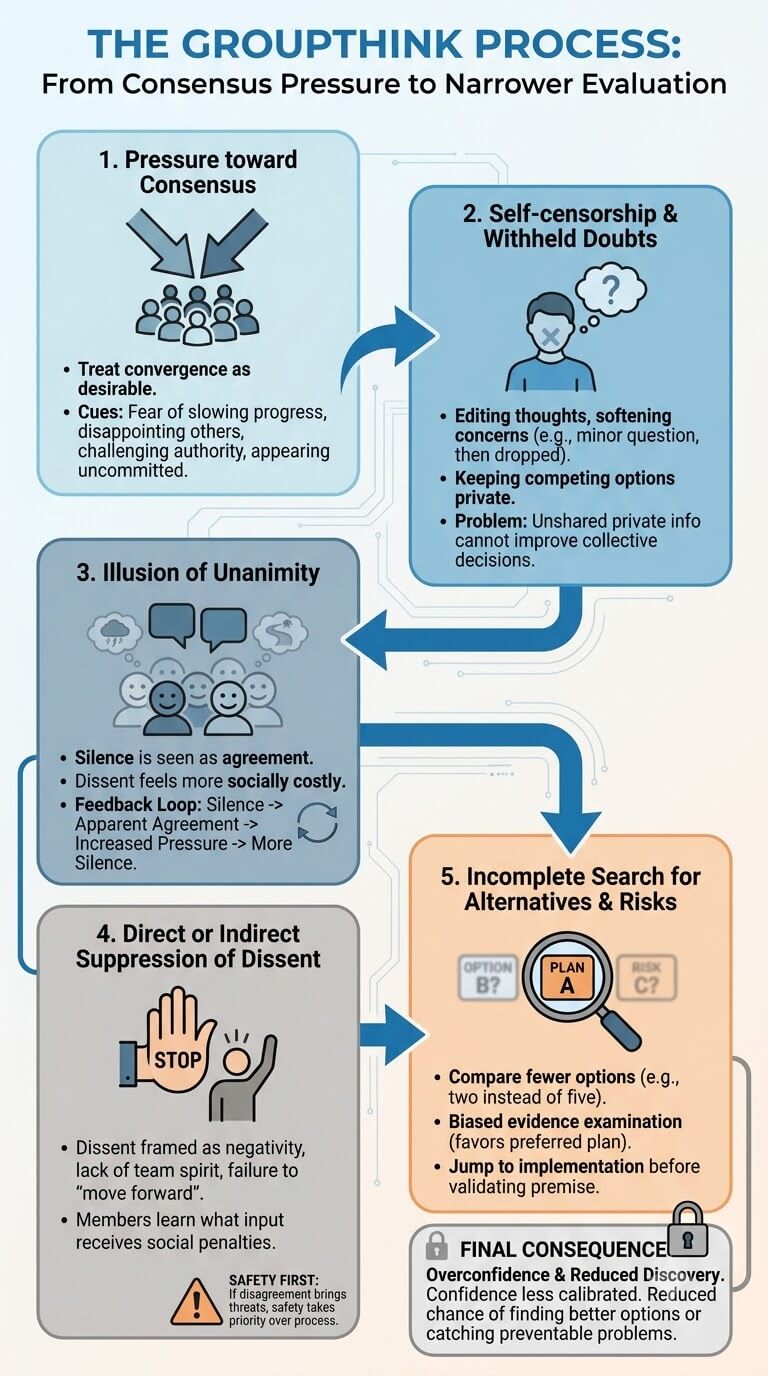
A practical way to understand the process is: Pressure → Silence → Apparent Unanimity → Narrow Search → Overcommitment. The sequence is not inevitable, but it shows how a group can move from ordinary social discomfort to a weaker decision process without anyone deciding to suppress critical thought.
Pressure toward consensus
The group starts to treat convergence as desirable in itself. Members notice subtle cues that continued questioning will slow progress, disappoint others, challenge a respected person, or make them appear less committed. At a broader level, social identity psychology helps connect this process with belonging, norms, group judgment, and individual agency.
Self-censorship and withheld doubts
People begin editing what they say. A member who thinks the budget assumption is unrealistic may soften the concern into a minor question, then drop it when the room moves on. Another may keep a competing option private because “everyone else seems convinced.”
Self-censorship matters because private information cannot improve a collective decision if it never becomes shared information.
Illusion of unanimity
Once several people stay quiet, silence becomes misleading evidence. Each member sees fewer objections and concludes that agreement is stronger than it really is. The apparent consensus then makes later dissent feel even more socially costly.
This can create a feedback loop: silence looks like agreement, apparent agreement increases pressure, and increased pressure produces more silence.
Direct or indirect suppression of dissent
Dissent may be discouraged openly through ridicule or interruption, but suppression is often subtler. A concern can be reframed as negativity, lack of team spirit, unnecessary pessimism, or failure to “move forward.” Members learn which types of input receive curiosity and which receive social penalties.
If disagreement brings threats, humiliation, retaliation, stalking, isolation, or credible fear, the issue goes beyond ordinary decision dynamics. Personal safety and outside support take priority over improving the meeting process.
Overconfidence in the group’s judgment
As contrary information disappears, confidence can become less calibrated. Members may interpret the absence of objections as evidence that the plan is unusually strong. Past success can reinforce this effect if the group starts treating previous wins as proof that its current judgment is also reliable.
Incomplete search for alternatives and risks
The final consequence is narrower evaluation. The group may compare only two options when five are realistic, examine evidence that supports the preferred plan more carefully than evidence against it, or spend most of the meeting on implementation before deciding whether the premise is sound.
The decision may still succeed. The concern is that the group has reduced its chances of discovering a better option or catching a preventable problem.
What Groupthink Can Look Like in Everyday Groups
Political and military cases are often used historically, but the process is easier to recognize when it is translated into ordinary settings. These examples are not diagnoses. They show what reduced scrutiny might look like in daily group decisions.
A work team rushing toward the leader’s preferred plan
Situation: A manager enthusiastically presents a launch date and asks for “any final concerns.” Several specialists privately think testing time is too short, but no one wants to be the person who delays the project.
What members may feel: Concern mixed with social hesitation. What it may mean: The leader’s early preference has become a cue about the desired answer. What to do next: Collect private risk estimates before discussing the final date.
A family avoiding alternatives to preserve unity
Situation: A family strongly favors one plan for caring for an older relative. A quieter member sees practical problems but worries that raising them will look selfish.
What members may feel: Loyalty, guilt, and reluctance to disrupt harmony. What it may mean: Agreement is carrying emotional meaning beyond the practical decision. What to do next: Separate the shared goal from the chosen method, then compare at least two workable plans.
A committee interpreting silence as agreement
Situation: A committee chair asks whether anyone objects. No one speaks, and the proposal is recorded as unanimous.
What members may feel: Uncertainty about whether a concern is strong enough to voice publicly. What it may mean: Silence is being treated as positive evidence. What to do next: Ask each member for an independent rating or use a brief private vote before calling the decision unanimous.
A community group dismissing inconvenient warning signs
Situation: A local organization has invested months in an event. New information suggests turnout may be much lower than expected, but members keep describing the data as “too negative.”
What members may feel: Investment, pride, and fatigue. What it may mean: Protecting commitment may be crowding out evaluation. What to do next: Define in advance what evidence would justify scaling down, postponing, or changing the plan.
Groupthink vs Ordinary Agreement

The cleanest distinction is not whether the group agrees, but how the agreement was produced and maintained.
Agreement after open scrutiny
In strong deliberation, members can describe the rejected alternatives, unresolved uncertainties, strongest objection, and evidence that could change the decision. The final consensus may be enthusiastic, but it is not fragile. Questioning the plan does not threaten membership.
Agreement maintained by avoiding or suppressing scrutiny
In a weaker process, consensus depends on keeping certain questions small. Alternatives receive superficial treatment, people wait for status cues before expressing preferences, and objections are interpreted socially rather than analytically.
| Decision signal | Open agreement | Consensus-pressure warning |
|---|---|---|
| Dissent | Expected and examined | Seen as disloyal, negative, or obstructive |
| Alternatives | Compared before commitment | Rejected quickly or never developed |
| Silence | Not assumed to mean support | Treated as evidence of unanimity |
| Contrary evidence | Can change the decision | Explained away to protect the preferred plan |
| Confidence | Calibrated to uncertainty | Strengthened by apparent consensus |
Groupthink vs Conformity
These concepts overlap, but they answer different questions. Keeping the unit of analysis clear prevents the terms from becoming interchangeable.
Individual alignment versus group-level decision process
Conformity concerns a person changing or aligning judgment or behavior in response to a group. Groupthink concerns what happens to the quality of a collective decision when concurrence seeking narrows evaluation.
One person can conform even when the group’s decision process is otherwise thorough. Conversely, a group can develop a shallow process through shared assumptions, information filtering, or premature commitment even if no single member reports feeling strong pressure to conform.
Conformity can contribute without being sufficient for groupthink
If several members privately disagree but publicly align, the group loses potentially useful information. That can contribute to false unanimity. But conformity alone is not enough to establish groupthink because the wider process also matters: how alternatives were generated, how evidence was handled, and whether criticism could affect the decision.
Groupthink vs Group Polarization
Both involve groups and judgment, but the central change is different.
Reduced critical disagreement versus directional shift after discussion
Groupthink describes weakened scrutiny under consensus pressure. Group polarization describes a group moving toward a stronger version of its initial tendency after discussion. OpenStax Psychology 2e distinguishes groupthink from group polarization by treating the latter as strengthening of an initial group attitude after discussion.
Why a group can polarize without groupthink and vice versa
A group can openly debate, hear dissent, and still move in a stronger initial direction because members encounter persuasive arguments supporting that direction. That would fit polarization without requiring suppressed scrutiny.
A different group might stay at roughly the same position but reach it through self-censorship, weak alternative search, and apparent unanimity. That could show groupthink-like decision problems without a meaningful directional shift.
Safeguards That Improve Deliberation

The goal is not to force conflict. It is to design the process so useful disagreement can appear before commitment becomes socially expensive.
Collect independent judgments before discussion
Ask members to write down a preferred option, confidence level, or top risk before hearing the room. This reduces the chance that early speakers become anchors for everyone else. Private input is especially useful when status differences are large.
Assign a genuine dissent or critique role without making it ceremonial
A “devil’s advocate” role helps only if the critique can affect the outcome. If everyone knows the dissenter is performing a ritual that will be ignored, the safeguard becomes theater. The group should respond to the critique by changing evidence requirements, revisiting assumptions, or explaining why the concern does not alter the decision.
Experimental research on dissent and group decision quality found that prediscussion disagreement improved information exchange and decision quality in a hidden-profile task, even when the dissenting preference itself was not initially correct. The value came partly from stimulating deeper discussion.
Require multiple alternatives and explicit disconfirming evidence
Before selecting a plan, require the group to articulate at least two plausible alternatives. Then ask what evidence would make the preferred option less attractive. This shifts the task from defending a favorite answer to comparing competing explanations or courses of action.
Separate idea generation from final commitment
When brainstorming and commitment happen in the same conversation, early enthusiasm can harden too quickly. A better sequence is to generate options first, assess risks second, and decide after members have had a chance to reconsider independently.
Invite outside or independent input when stakes justify it
An external reviewer, another team, or a person who was not involved in building the plan can notice assumptions insiders take for granted. Independence matters more than simple disagreement. The outside person should have access to enough information to make a meaningful critique.
A Five-Question Groupthink Check Before a Decision
This check is not a diagnostic test. It is a short deliberation tool for making hidden assumptions and hidden dissent easier to surface.
What evidence could change our mind?
If the group cannot name any realistic evidence that would alter the decision, confidence may have become identity-protective rather than evidence-responsive. Define a threshold in advance when possible.
Which alternative did we reject too quickly?
Look for the option that received a label instead of an analysis, such as “too cautious,” “too expensive,” or “not how we do things.” Reopen it long enough to identify its strongest case.
Has anyone privately disagreed but stayed silent?
Use a private channel when the stakes or status differences justify it. Asking “Any objections?” in a public room is not the same as creating conditions where objections are easy to express.
Are we treating loyalty as agreement?
A committed member can oppose a plan because they care about the group’s outcome. Research summarized on PubMed has even found conditions in which strongly identified members were more willing to dissent about collective problems. Identification does not have to produce silence.
Who has not been heard yet?
This question is about information, not politeness. The quietest member may hold unique technical knowledge, a different constraint, or a perspective that becomes visible only when they are asked directly and given time to answer.
What to Do Next if a Group Is Already Committed
Once people have invested reputation, time, and identity in a decision, attacking the group as irrational usually increases defensiveness. A smaller reopening is often more practical.
Reopen one decision assumption rather than attacking the group identity
Choose a concrete assumption that can be tested: expected demand, available time, cost, staffing, risk probability, or user response. Instead of saying, “Everyone here is caught in groupthink,” try, “What would we need to see for this assumption to be wrong?”
This keeps attention on evidence and preserves room for members to change their minds without admitting that the entire group was foolish.
Create a reversible test or staged decision where possible
If a full reversal is politically or emotionally difficult, reduce the cost of reconsideration. Run a pilot, delay one irreversible step, set a review date, or define a stop condition. Reversibility can make dissent easier because the conversation becomes about learning rather than winning.
Not every decision can be staged, but the principle is useful: when uncertainty is real, avoid creating more commitment than the evidence currently supports.
How Cohesion and Conformity Can Feed the Same Decision Pressure
Groupthink sits near several other group processes, which is why the distinctions matter. Cohesion can make membership rewarding, while conformity can make alignment more likely. Neither process automatically creates groupthink.
Cohesion can be healthy while still creating pressure that must be managed
A cohesive team may trust one another enough to disagree openly, which can improve deliberation. Trouble begins when preserving closeness becomes a reason not to test the plan. The decision process, not the mere presence of connection, is what deserves attention.
Conformity explains one path by which individual doubts stay unspoken
Normative pressure can help explain why a member publicly aligns despite private doubts. When several people do this at once, the group can misread silence as consensus. That makes conformity one possible ingredient in the broader decision problem, not a substitute term for it.
FAQ
These questions help separate groupthink from ordinary agreement and other group effects that are often confused with it.
Is every bad group decision an example of groupthink?
No. Groups can make poor decisions because information is missing, forecasts are wrong, incentives are misaligned, expertise is limited, or uncertainty is unavoidable. Groupthink is a more specific claim about how concurrence pressure weakens evaluation. Look for the process, not merely the disappointing outcome.
Does group cohesion cause groupthink?
Not by itself. Cohesion can support cooperation, trust, and candid discussion. It may become a risk factor when members value harmony so strongly that criticism feels disloyal or threatening. Later empirical work also cautions against treating any one antecedent as a simple cause.
Can a group have groupthink even if no one explicitly pressures dissenters?
Yes, pressure can be indirect. Members may infer that disagreement is unwelcome from a leader’s early preference, past reactions to critics, time pressure, or repeated praise for unity. Self-censorship can therefore develop without anyone saying, “Do not disagree.” The important question is whether doubts and alternatives still enter the decision process.
How is groupthink different from group polarization?
Groupthink is about reduced critical scrutiny under consensus pressure. Group polarization is about discussion moving the group toward a stronger version of its initial tendency. A group can polarize after vigorous debate, and a group can show poor scrutiny without moving to a more extreme position.
What is the simplest safeguard against false consensus?
Collect independent judgments before public discussion, especially when hierarchy or status could shape responses. Even a short private rating of preferred option, confidence, and biggest concern can reveal disagreement that a public “Does everyone agree?” question might hide.
Key Takeaways
- Groupthink is best understood as a weakened group decision process, not as a synonym for disagreement, cohesion, or a bad outcome.
- The most informative warning signs involve self-censorship, false unanimity, suppressed dissent, overconfidence, and incomplete search for alternatives.
- Cohesion, directive expectations, insulation, stress, and time pressure may increase risk in some settings, but no single condition proves groupthink.
- Conformity concerns individual alignment, while groupthink concerns how consensus pressure affects the group’s evaluation process.
- Group polarization strengthens an initial tendency after discussion; groupthink reduces critical scrutiny. They can occur separately.
- Independent judgments, real dissent, multiple alternatives, disconfirming evidence, and reversible tests can make collective decisions more robust.

Michael Reed is the Founder and Lead Writer at Psychology Exposed. He writes about human behavior, relationships, emotional patterns, self-awareness, and practical psychology topics using research-informed, easy-to-understand content.
Read More About Michael Reed: https://psychologyexposed.com/michael-reed/