

Attribution and locus of control are easy to confuse because both involve explanations about causes, control, and outcomes. The difference becomes clearer when you notice the question each concept is answering. Attribution asks, “Why did this particular event happen?” Locus of control asks, “What do I generally expect to determine outcomes in my life?”
That difference matters because the same person can make an external attribution for one event and still have a relatively internal locus of control overall. Someone can say, “The storm caused today’s cancellation,” while still believing that preparation and personal choices usually influence what happens next. Likewise, an internal attribution for one failure does not prove that the person generally feels in control of life.
Quick Answer

Attribution explains the perceived cause of a specific behavior, event, success, or failure. Locus of control describes a broader expectation about whether outcomes generally depend more on one’s own actions or on outside forces such as chance, powerful others, or circumstances. They overlap around ideas of internal and external causes, but attribution is event-specific while locus of control is a more generalized belief about control.
The Core Difference in One Sentence
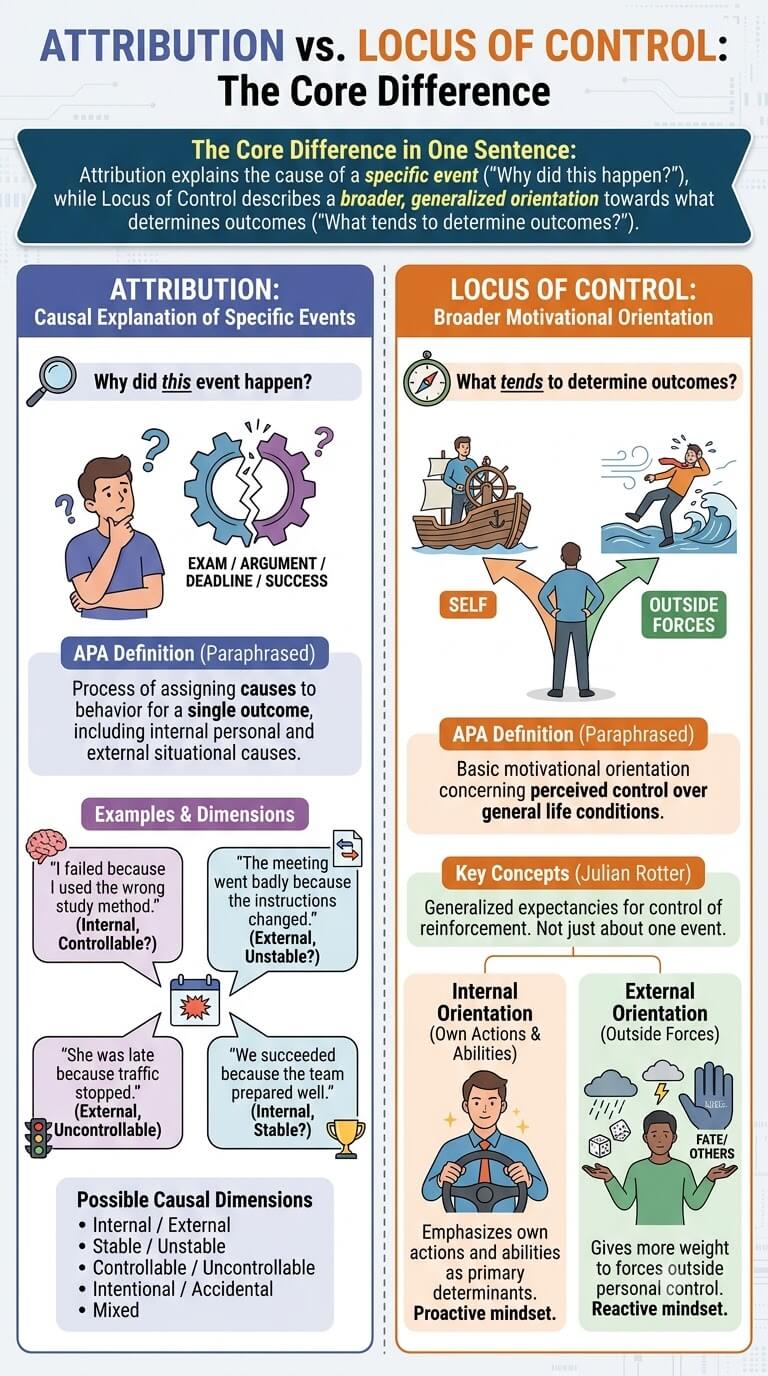
Attribution asks: Why did this event happen?
Attribution concerns causal explanation. After an exam, argument, promotion, missed deadline, or unexpected success, people try to identify what produced the outcome. The APA Dictionary of Psychology definition of attribution theory describes this process as assigning causes to behavior, including internal personal causes and external situational causes.
Examples include: The event-specific side of this comparison belongs to event-specific attribution psychology, where the central question is why a particular outcome occurred.
- “I failed because I used the wrong study method.”
- “The meeting went badly because the instructions changed.”
- “She was late because traffic stopped.”
- “We succeeded because the team prepared well.”
Each statement explains one event or outcome. The cause may be internal, external, stable, unstable, controllable, uncontrollable, intentional, accidental, or mixed.
Locus of control asks: What tends to determine outcomes?
Locus of control is broader. The APA Dictionary definition of locus of control describes it as a basic motivational orientation concerning how much control people perceive over the conditions of their lives. An internal orientation emphasizes one’s own actions and abilities. An external orientation gives more weight to forces outside personal control.
The concept comes from Julian Rotter’s social learning work. Rotter’s classic formulation described generalized expectancies for internal versus external control of reinforcement. The word generalized is important. Locus of control is not simply a label for the cause of one event.
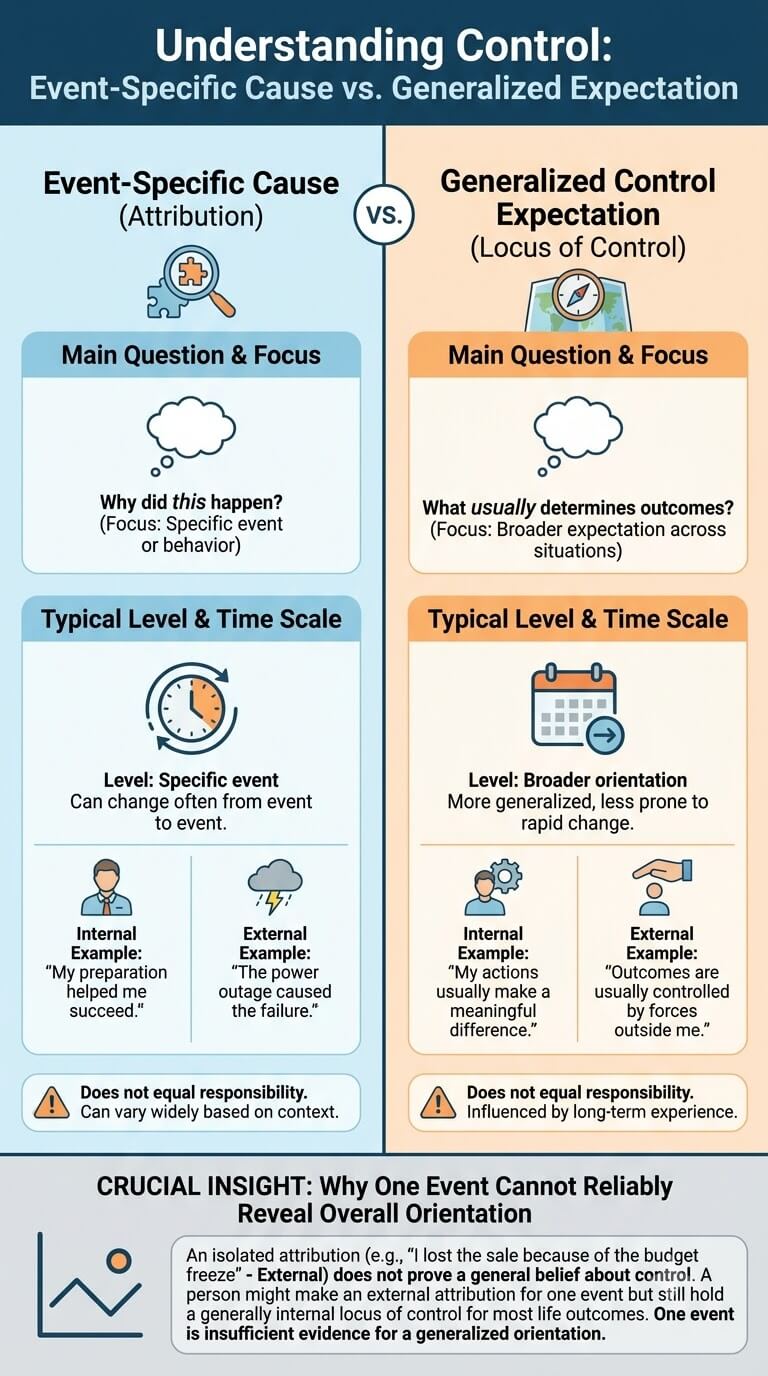
Event-Specific Cause vs Generalized Control Expectation
| Feature | Attribution | Locus of control |
|---|---|---|
| Main question | Why did this happen? | What usually determines outcomes? |
| Typical level | Specific event or behavior | Broader expectation across situations |
| Internal example | “My preparation helped me succeed.” | “My actions usually make a meaningful difference.” |
| External example | “The power outage caused the failure.” | “Outcomes are usually controlled by forces outside me.” |
| Can change from event to event? | Yes, often | More generalized, though not perfectly fixed |
| Does it equal responsibility? | No | No |
Why the time scale matters
Attribution can change from one event to the next. You may attribute today’s success to preparation, yesterday’s delay to traffic, and last month’s failure to a confusing system. There is no contradiction in using different explanations when different causes actually mattered.
Locus of control operates at a broader level. It reflects what a person tends to expect about control across outcomes. That orientation can be influenced by context and experience, but it is not normally inferred from one isolated explanation.
Why one event cannot reliably reveal a person’s overall locus of control
Suppose someone says, “I lost that sale because the client froze the budget.” That is an external attribution. It does not tell you whether the salesperson usually believes effort, preparation, and skill influence results.
Likewise, “I failed because I did not study enough” is an internal attribution, but the person might still believe that most major life outcomes depend on luck, institutions, or powerful others. One event does not provide enough evidence for a generalized orientation.
Internal and External Attribution
Internal attribution: causes located within the person
An internal attribution places an important cause within the person. Common examples include effort, ability, intention, strategy, knowledge, mood, or a personal decision.
“I performed poorly because I did not practice” is internal because the proposed cause is the person’s preparation. “He apologized because he felt guilty” also uses an internal cause because the explanation refers to an internal state.
External attribution: causes located in circumstances
An external attribution points to factors outside the person, such as luck, timing, task difficulty, rules, social pressure, another person’s behavior, or environmental conditions.
“The event was canceled because of severe weather” is external. So is “The project slowed down because the software provider had an outage.” An external attribution can be completely accurate without saying anything about the person’s general sense of control.
Why internal and external attributions are not personality categories
People do not need to choose one side permanently. Accurate causal reasoning often uses both. A failed project might reflect weak planning, an unexpected equipment problem, staffing shortages, and a late client change at the same time.
This is why cognitive biases in causal judgment matter when a single cause feels too obvious. A person-focused explanation may overlook circumstances, while an entirely external explanation may overlook choices that genuinely mattered.
Internal and External Locus of Control
Internal locus of control
An internal locus of control refers to a broader tendency to expect that one’s behavior, effort, choices, or abilities meaningfully influence outcomes. It does not mean believing that everything is controllable.
A person with a relatively internal orientation can still recognize bad luck, structural barriers, other people’s decisions, illness, discrimination, or random events. The important point is that personal action is expected to matter across many situations, not that external causes are denied.
External locus of control
An external locus of control gives more weight to outside forces, such as chance, fate, powerful others, institutions, or circumstances beyond personal influence. Again, this is a generalized orientation rather than an explanation for every event.
A person with a more external orientation can still take responsibility for a specific mistake. They may say, “I caused this error,” while continuing to believe that most major outcomes depend heavily on forces beyond their control.
Why locus of control should not be treated as a moral ranking
It is tempting to frame internal control as good and external control as bad. That is too simple. Some situations really are constrained by systems, resources, chance, health, power differences, or other people’s choices. A strong internal orientation can become unrealistic if it encourages someone to assume control over outcomes that were never fully controllable.
The existing locus of control psychology discussion is the better place for a full treatment of how internal and external control orientations work. Here, the important distinction is that locus of control is a broader expectancy rather than a label for one cause.
Why External Attribution Does Not Equal External Locus of Control
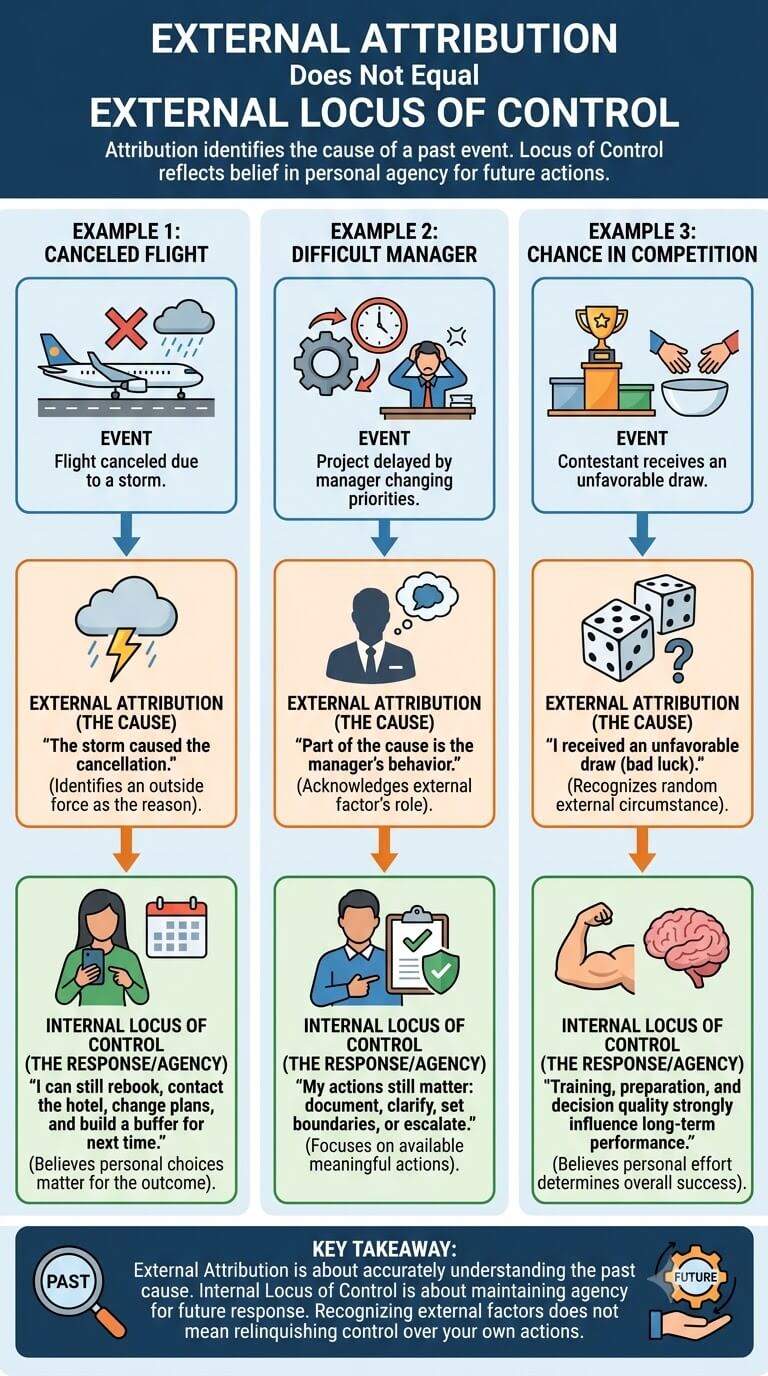
Example: a canceled flight
Event: Your flight is canceled because a storm closes the airport.
Attribution: “The storm caused the cancellation.” This is external.
Locus of control: You may still believe that your planning choices matter. You can rebook, contact the hotel, change the meeting time, and build more travel buffer next time.
The external attribution identifies what caused the event. It does not require the conclusion “I have no control over anything.”
Example: a difficult manager
Event: A project is delayed because a manager repeatedly changes priorities.
Attribution: You may reasonably assign part of the cause to the manager’s behavior.
Locus of control: You might still expect your own actions to matter through documentation, clarification, escalation, boundary-setting, or deciding whether to remain in the role.
This is where personal agency becomes a useful neighboring idea. Attribution identifies what caused the current problem. Agency asks what meaningful action remains available now.
Example: chance in a competition
A contestant may say, “I received an unfavorable draw.” That can be a legitimate external attribution. The same person may still believe training, preparation, and decision quality strongly influence long-term performance.
Recognizing luck in one outcome is not evidence of an external control orientation. Sometimes accurate reasoning requires acknowledging chance.
Why Internal Attribution Does Not Equal Internal Locus of Control
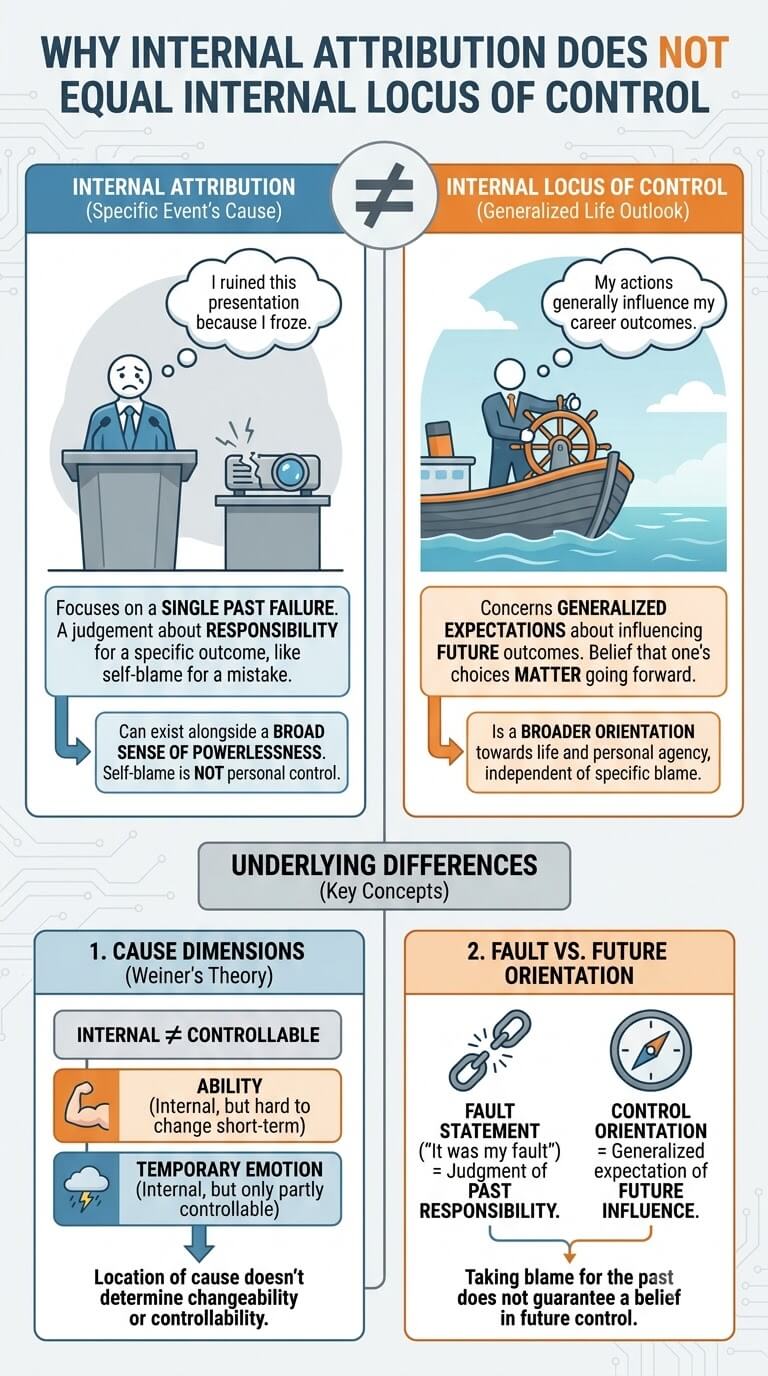
Specific self-blame can exist alongside a broad sense of powerlessness
A person may blame themselves for a specific failure and still feel that life in general is controlled by outside forces. “I ruined this presentation because I froze” is an internal attribution. It does not tell us whether the person believes their actions usually influence career outcomes.
This matters because self-blame is sometimes mistaken for personal control. In reality, a person can accept or even exaggerate personal responsibility while still feeling broadly powerless.
Internal cause does not automatically mean controllable cause
Even within attribution theory, “internal” and “controllable” are different dimensions. Ability may be interpreted as internal but relatively difficult to change in the short term. A temporary emotional state may be internal but only partly controllable. Intention may be internal and highly relevant to responsibility.
Bernard Weiner’s attributional theory of achievement motivation and emotion is useful here because it separates locus of causality from stability and controllability. The location of a cause does not by itself tell us how changeable or controllable that cause is.
Why “it was my fault” is not a measure of control orientation
A statement of fault is a judgment about responsibility for an event. Locus of control concerns generalized expectations about what controls outcomes. These are not interchangeable. For a three-dimension view of success and failure, Weiner’s attribution theory separates locus, stability, and controllability.
A person may repeatedly take too much blame while believing they have very little ability to influence the future. Another person may acknowledge one external cause while maintaining a strong sense that their choices matter going forward.
Attribution, Locus of Control, and Responsibility
Cause is not the same as blame
If an outcome has an internal cause, that does not automatically mean the person deserves blame. A person may contribute unintentionally, act with limited information, face severe constraints, or have only partial control.
If an outcome has an external cause, that does not automatically remove all responsibility. A system problem may matter while a person’s preventable decision also contributes.
Control is not the same as total responsibility
Real control is often partial. You may control preparation but not the examiner’s questions. You may control whether you communicate clearly but not whether another person responds fairly. You may control your application but not the hiring decision.
A more useful responsibility judgment asks what the person knew, what they could realistically influence, what other causes were active, and what consequences were reasonably foreseeable.
Neither concept should be used to judge worth or character
Attribution and locus of control are explanatory concepts, not measures of moral worth. An external control orientation is not proof that someone is lazy. An internal attribution is not proof that someone is responsible for everything that went wrong.
Using these ideas responsibly means keeping causal explanation, perceived control, capability, agency, and moral judgment separate until the evidence supports connecting them.
Four Examples Where Attribution and Locus of Control Cross
| Situation | Specific attribution | Possible broader control belief | Why they differ |
|---|---|---|---|
| Exam failure | “I used an ineffective study strategy.” | “My actions usually matter.” | Internal attribution and internal control expectation can align. |
| Exam failure | “The exam contained material we were not taught.” | “My preparation usually matters.” | External attribution can coexist with internal control expectation. |
| Job rejection | “I answered one key question poorly.” | “Hiring is mostly controlled by connections and luck.” | Internal attribution can coexist with a more external control expectation. |
| Travel disruption | “The storm caused the cancellation.” | “I can usually shape how well I handle disruptions.” | External cause does not remove present agency. |
Exam performance
Suppose a student earns a low grade. They may attribute the result to ineffective study strategy, an internal cause. If they generally believe effort and preparation influence academic outcomes, the attribution and locus of control point in a similar direction.
But imagine the student attributes this exam to an unusually unfair question set while still believing that preparation usually determines performance. The event-specific explanation is external, while the broader control expectation remains relatively internal.
Work and hiring
A job candidate may say, “I did not prepare a strong answer for the leadership question.” That is an internal attribution. The same person might hold a broader belief that hiring outcomes depend heavily on connections, economic conditions, and decisions by powerful gatekeepers.
This combination is psychologically coherent. One event can have an internal cause even when the person sees the broader system as externally controlled.
Relationships
Imagine a partner arrives late because their train is stopped for an emergency. “The train delay caused the lateness” is an external attribution. That explanation does not determine whether either person generally believes they can influence relationship outcomes.
Locus of control is also not the best tool for judging the quality of one relationship event. In relationships, specific behavior, communication, reliability, boundaries, and mutual choices usually provide more useful information than assigning someone a control-orientation label.
Health and daily routines
A person may recognize that a health setback was influenced by an uncontrollable infection while still believing that sleep, treatment adherence, exercise, or appointments can affect some parts of health management. External causation and meaningful personal control can coexist.
The distinction protects against two extremes: blaming people for conditions they did not control, and assuming that an uncontrollable cause means there are no useful actions left.
Attribution vs Locus of Control vs Self-Efficacy vs Agency
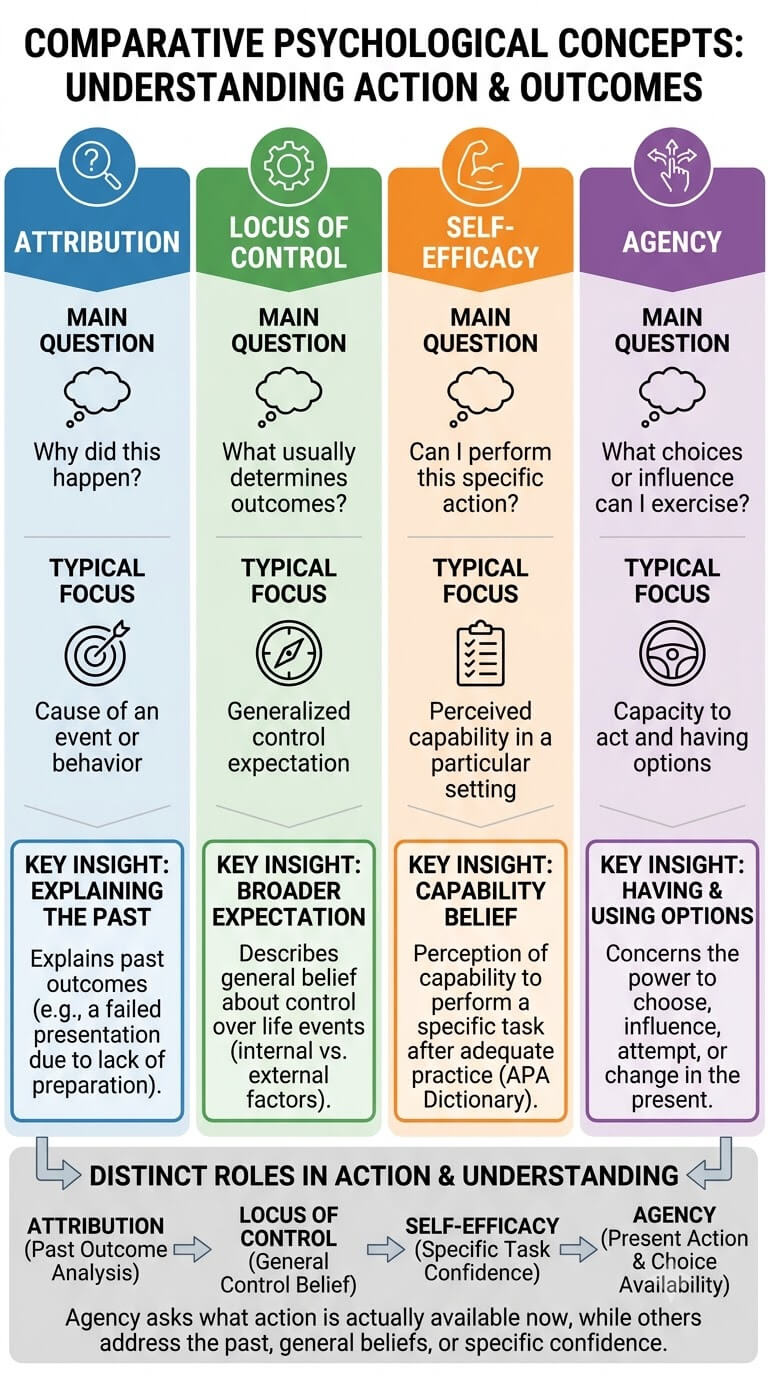
| Concept | Main question | Typical focus |
|---|---|---|
| Attribution | Why did this happen? | Cause of an event or behavior |
| Locus of control | What usually determines outcomes? | Generalized control expectation |
| Self-efficacy | Can I perform this specific action? | Perceived capability |
| Agency | What choices or influence can I exercise? | Capacity to act |
Self-efficacy is about capability
The APA Dictionary definition of self-efficacy describes it as a person’s perception of their capability to perform in a particular setting or attain desired results. That is different from explaining why a previous result occurred.
You can attribute a failed presentation to lack of preparation while still having high self-efficacy for presenting after adequate practice. You can also believe your actions generally matter while doubting your capability for one specific task.
The Psychology Exposed discussion of self-efficacy psychology is the better place to examine capability beliefs in depth.
Agency is about having and using options
Agency concerns the power or capacity to act. It is a present-tense question about what you can choose, influence, attempt, refuse, or change.
Attribution may tell you why the outcome happened. Locus of control may describe your broader expectation about control. Self-efficacy may tell you whether you believe you can perform a specific action. Agency asks what action is actually available now.
A Four-Question Concept Sorter
When attribution and locus of control start blending together, use four questions.
1. Am I explaining one event or a general pattern of control?
If you are asking why one outcome happened, you are mainly in attribution territory. If you are asking what usually determines outcomes across life or across many situations, you are closer to locus of control.
2. Am I locating a cause or estimating who controls outcomes?
“The deadline changed” locates a cause. “My choices usually influence whether I meet deadlines” expresses a broader control expectation. The words internal and external may appear in both, but the psychological claim is different.
3. Am I confusing personal cause with personal capability?
“I caused this mistake” does not mean “I can fix this skill easily.” “The environment caused this problem” does not mean “I am incapable of doing anything useful.” This question separates attribution from self-efficacy and agency.
4. What would I conclude if the next event had a different cause?
This is a useful test. If one external event immediately makes you label someone as having an external locus of control, the inference is too fast. A generalized orientation should be based on a broader pattern of expectations, not one causal explanation.
Common Mix-Ups
“External attribution means external locus of control”
No. External attribution can be the most accurate explanation for one event. A power outage, storm, policy change, another person’s decision, or random failure can genuinely cause an outcome.
“Internal attribution means taking control”
No. An internal attribution only locates a cause inside the person. The cause may feel stable, uncontrollable, shame-inducing, or difficult to change. Taking control is a separate question about what action is available.
“Internal locus of control means everything is my responsibility”
No. A relatively internal orientation emphasizes the importance of personal action, but it should not erase external constraints or other people’s choices. Believing your choices matter is different from believing every outcome is your fault.
“External locus of control means someone never takes responsibility”
No. A person can hold more external generalized expectations and still accurately accept responsibility for a specific mistake. The construct should not be used as a character accusation.
“Self-efficacy and locus of control are basically the same”
No. Self-efficacy is about perceived capability for a specific action. Locus of control is about where control over outcomes is generally expected to reside. Someone may believe effort matters but still doubt their ability to perform a particular task.
What to Use Each Concept For
Use attribution when you need to understand a specific outcome
Ask what caused the event, which causes were internal or external, how stable they are, how controllable they were, and what evidence supports them. Attribution is especially useful after success, failure, conflict, or an unexpected result.
Use locus of control when you are examining broader control expectations
Ask whether a person generally expects outcomes to depend on their own behavior or on chance, powerful others, institutions, or circumstances. Look for patterns across situations rather than one isolated statement.
Use both when the question is how one explanation interacts with a broader belief
Sometimes the concepts become useful together. A person who repeatedly interprets outcomes as externally caused may strengthen a broader expectation that personal action rarely matters. Another person may maintain an internal sense of control while still making accurate external attributions when circumstances genuinely dominate.
The relationship is possible, but it should be observed rather than assumed.
FAQ About Attribution and Locus of Control
These questions clarify the places where the two concepts most often become confused.
Is attribution the same as locus of control?
No. Attribution concerns the perceived cause of a particular behavior, event, success, or failure. Locus of control is a broader expectation about whether outcomes generally depend more on one’s own actions or on outside forces. They can influence each other, but they operate at different levels.
Can someone make an external attribution and still have an internal locus of control?
Yes. A person can accurately recognize that a storm, policy change, another person’s choice, or chance caused one event while still believing that their own preparation and decisions usually matter. External attribution is not evidence of helplessness by itself.
Does blaming yourself mean you have an internal locus of control?
No. Self-blame is an internal attribution about a specific outcome. A person may blame themselves while also feeling broadly powerless. In some cases, self-blame can even coexist with the belief that outside forces control most important outcomes.
Is locus of control fixed?
It is better understood as a generalized orientation than a permanent identity. Experiences, domains, and circumstances can affect perceptions of control. The concept is useful for describing tendencies, not for putting people into rigid categories based on one response.
Which concept is more useful after a mistake?
Attribution is usually the more direct starting point because it asks what caused the mistake. Once the causes are clear, locus of control may help explain broader expectations about whether future action will matter. For practical change, self-efficacy and agency may also matter because they address capability and available action.
Key Takeaways
- Attribution asks why a specific event happened; locus of control asks what generally tends to determine outcomes.
- An external attribution does not imply an external locus of control, and an internal attribution does not prove an internal locus of control.
- In attribution theory, cause location, stability, and controllability are separate dimensions, so “internal” does not automatically mean “controllable.”
- Locus of control should not be used as a moral ranking or a shortcut for judging responsibility, motivation, or character.
- Self-efficacy concerns capability, while agency concerns the ability to act; both differ from causal attribution and generalized control expectations.
- When the concepts blur together, ask whether you are explaining one event, describing a generalized control belief, judging capability, or identifying a present option for action.
About the author: Michael Reed is the Founder & Lead Writer at Psychology Exposed. He explains human behavior, decision-making, self-awareness, and everyday psychological concepts in clear, research-aware language for general readers. This article is educational and is not a diagnosis or a substitute for individualized professional advice.

Michael Reed is the Founder and Lead Writer at Psychology Exposed. He writes about human behavior, relationships, emotional patterns, self-awareness, and practical psychology topics using research-informed, easy-to-understand content.
Read More About Michael Reed: https://psychologyexposed.com/michael-reed/