
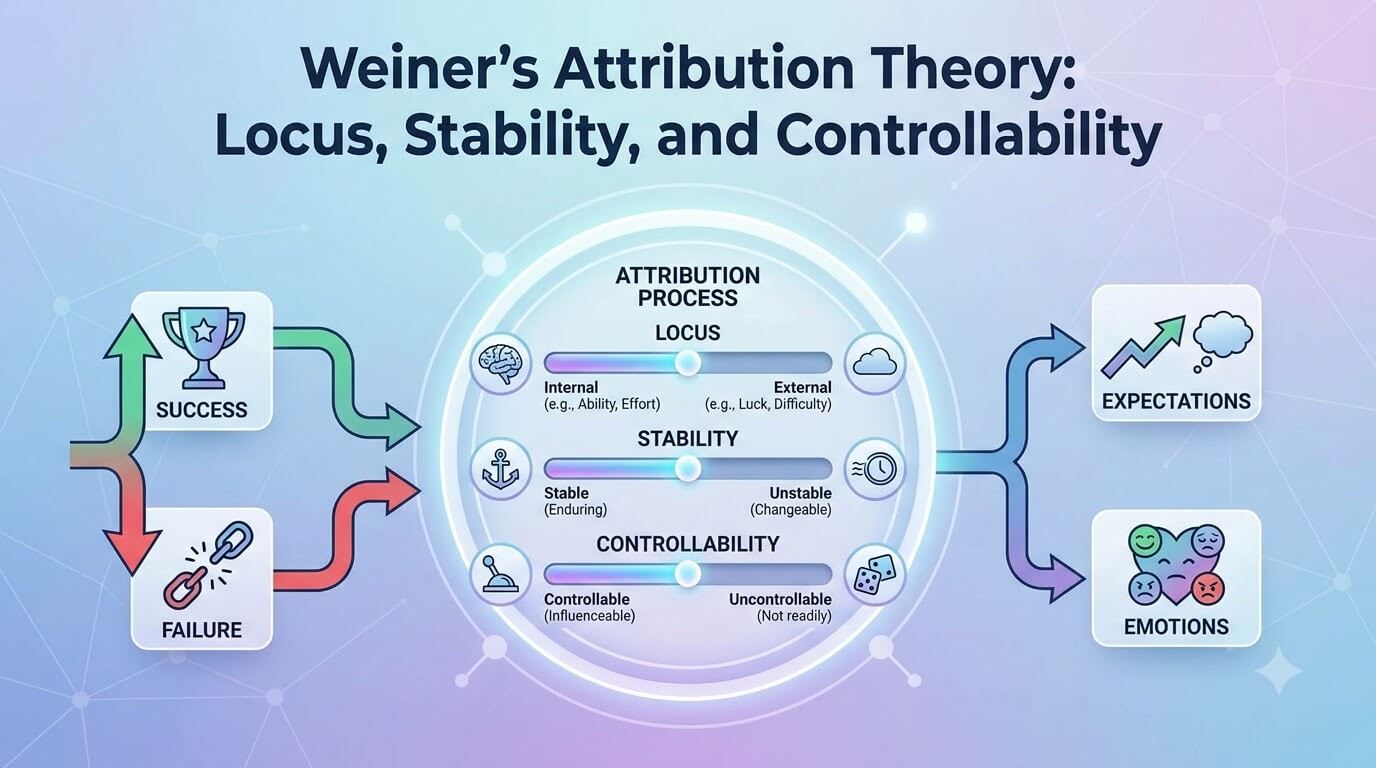
After success or failure, the first explanation that comes to mind can shape much more than the story we tell ourselves. “I am not good at this,” “I used the wrong strategy,” “the task was unusually hard,” and “I got lucky” all describe the same kind of question: what caused the outcome? Yet they point to very different expectations about what might happen next.
Bernard Weiner’s attribution theory offers a practical way to sort these explanations. Instead of treating every cause as interchangeable, the model asks where the cause is located, whether it is likely to persist, and how controllable it is. Those distinctions help explain why one interpretation can produce pride, guilt, sympathy, anger, persistence, or resignation while another interpretation of the same result produces something different.
Quick Answer
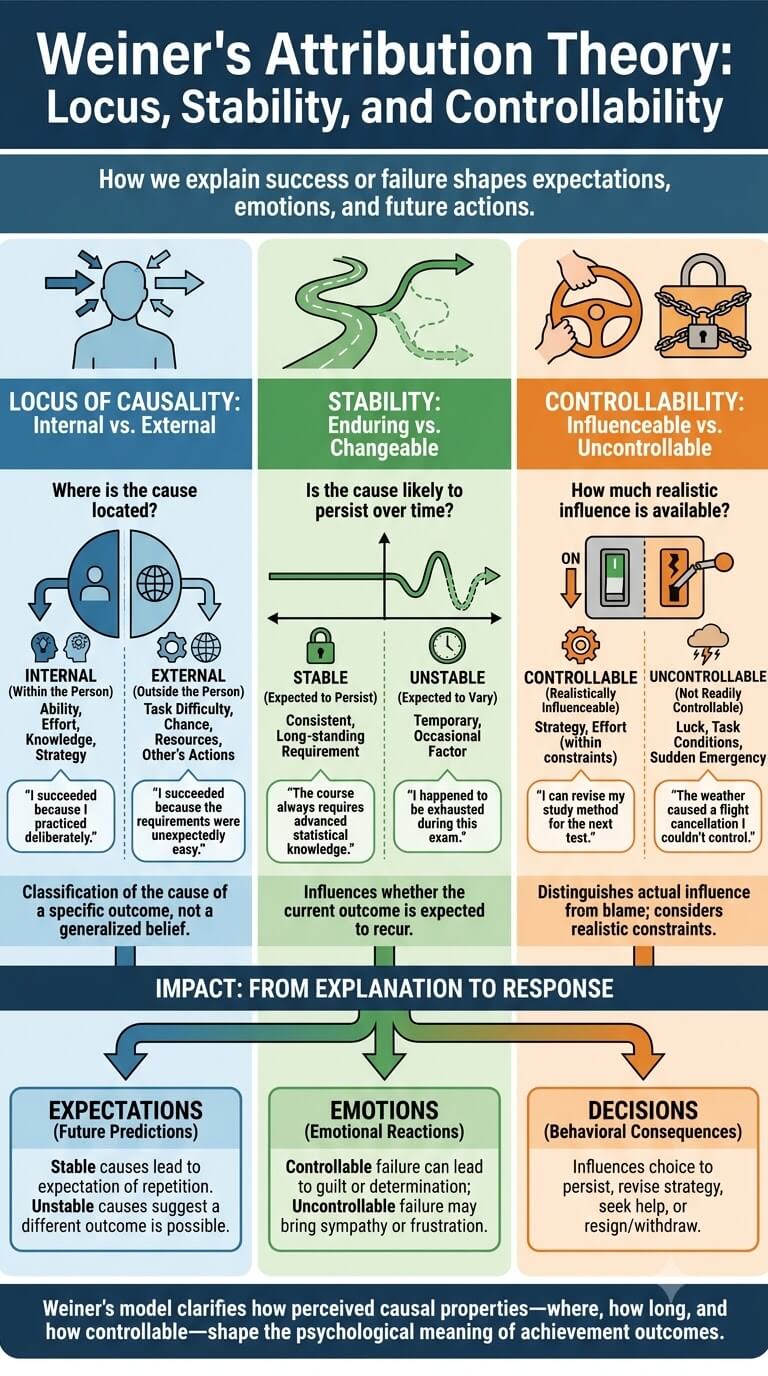
Weiner’s attribution theory classifies perceived causes of success and failure along three main dimensions: locus of causality, stability, and controllability. Locus asks whether the cause is internal or external, stability asks whether it is likely to persist, and controllability asks how much influence a person realistically has over it. These dimensions can shape future expectations, emotional reactions, and decisions about whether to try again.
What Weiner’s Attribution Theory Explains
Why success and failure trigger causal questions
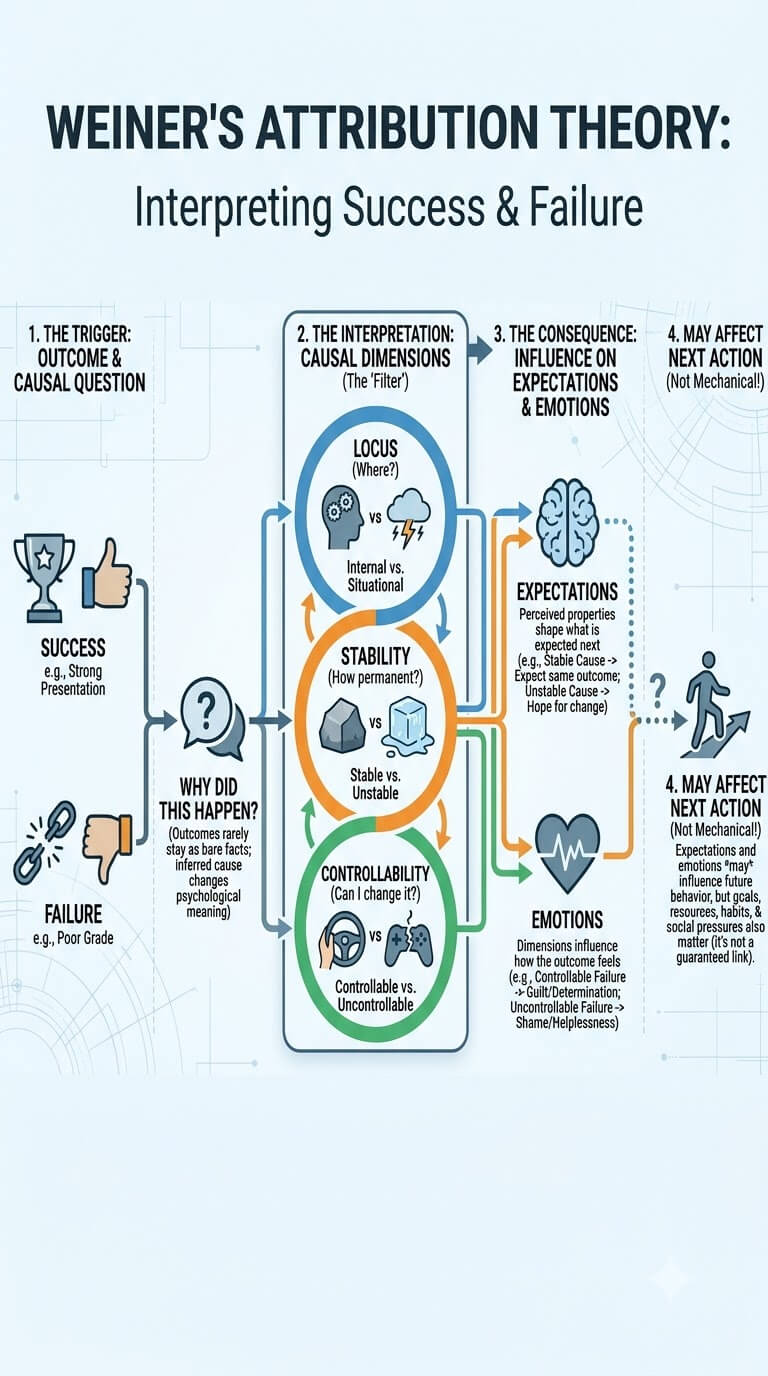
An outcome rarely stays as a bare fact. A poor grade becomes “I did not study enough,” “the exam was unfair,” or “I am bad at math.” A strong presentation becomes “I prepared well,” “the audience was easy,” or “I am naturally good at speaking.” The observable result may be identical, but the inferred cause changes its psychological meaning.
The APA Dictionary of Psychology description of attribution theory places this process within the broader study of how people infer internal or situational causes for behavior and outcomes. Weiner’s contribution was especially influential in achievement settings, where people repeatedly interpret success and failure and then decide what those outcomes imply about the future.
From outcome explanation to expectation and emotion
Weiner’s 1985 formulation proposed that causal explanations are not merely labels placed after an event. Their perceived properties can influence what a person expects next and how the outcome feels. The original Psychological Review paper indexed by PubMed describes locus, stability, and controllability as central properties of perceived causes in achievement contexts.
This gives the model a useful sequence:
- An outcome occurs.
- The person asks what caused it.
- The proposed cause is interpreted along several dimensions.
- Those dimensions influence expectations and emotions.
- Expectations and emotions may affect the next action.
The sequence does not mean one attribution mechanically produces one behavior. Goals, resources, habits, and social pressures also matter. The model simply shows how causal meaning can enter the chain between an outcome and a response.
The Three Causal Dimensions
Locus of causality: internal versus external cause
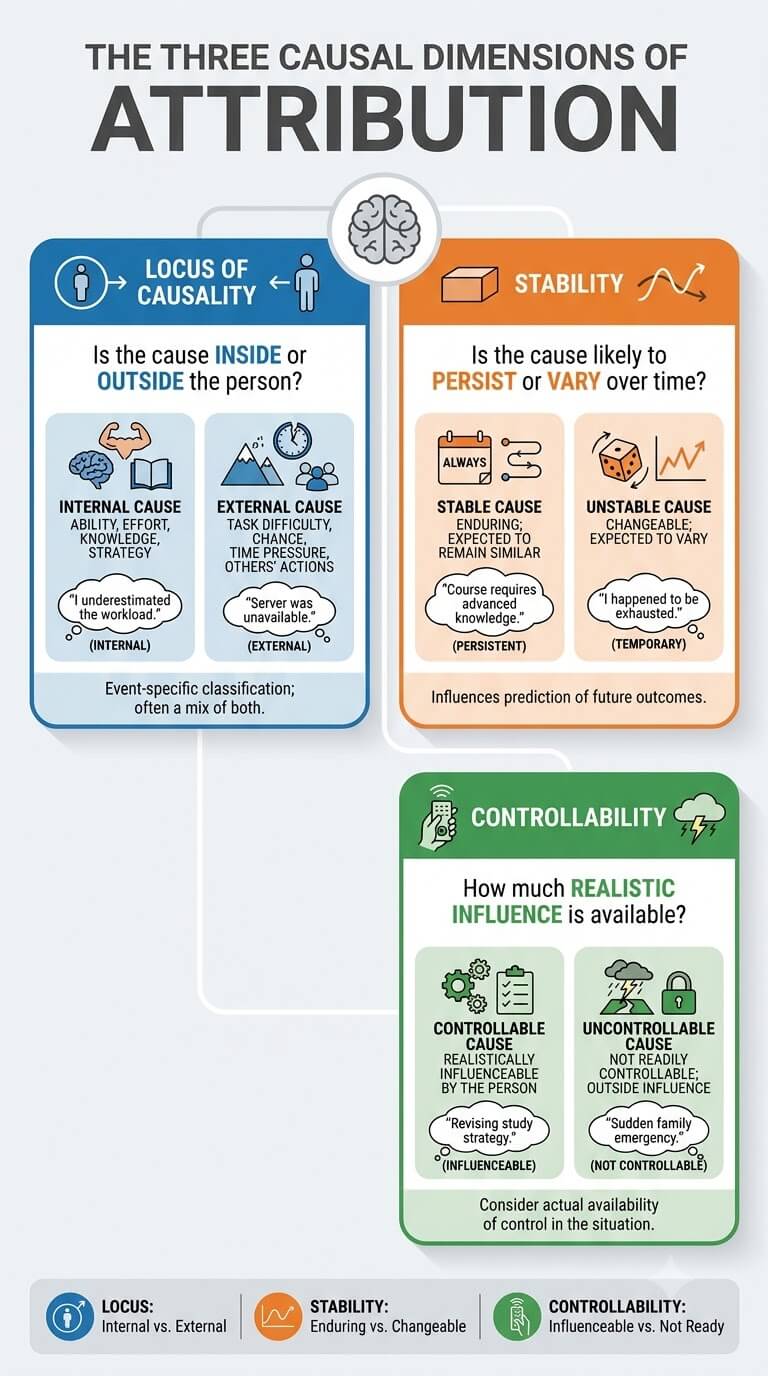
Locus of causality asks where the proposed cause is located. Internal causes are located within the person, such as ability, effort, knowledge, intention, or strategy. External causes are located outside the person, such as task difficulty, chance, time pressure, available resources, or another person’s actions. Weiner’s dimensions provide one classification system within the wider attribution process.
This is an event-specific classification. Saying “I missed the deadline because I underestimated the workload” places an important cause inside the person. Saying “I missed it because the server was unavailable for six hours” places an important cause outside the person. In many real situations, both descriptions may contain part of the truth.
Stability: enduring versus changeable cause
Stability asks whether the cause is expected to remain similar over time. A cause perceived as stable is expected to persist or recur. A cause perceived as unstable is expected to vary. The APA Dictionary entry on locus of stability emphasizes this distinction between relatively constant and more variable causes.
For example, “the course always requires advanced statistical knowledge” sounds more stable than “I happened to be exhausted during this exam.” Stability matters because it changes what the current outcome seems to predict. If the cause is expected to remain unchanged, a person may expect the same result again. If the cause is temporary, the next attempt may look more open.
Controllability: realistically influenceable versus not readily controllable
Controllability asks how much influence the relevant person realistically has over the cause. Study strategy may often be changeable. The weather usually is not. A person’s preparation may be partly controllable, while a sudden family emergency may not be.
The word realistically matters. Labeling “effort” as controllable can ignore illness, caregiving duties, unsafe conditions, disability, scarce resources, or unreasonable demands. The useful question is what control was actually available in that situation.
| Dimension | Main question | Example contrast |
|---|---|---|
| Locus of causality | Is the cause inside or outside the person? | Skill vs task difficulty |
| Stability | Is the cause likely to persist or vary? | Long-standing requirement vs one bad night’s sleep |
| Controllability | How much realistic influence is available? | Revising a strategy vs changing the weather |
The Critical Difference Between Locus of Causality and Locus of Control
Cause classification for one outcome
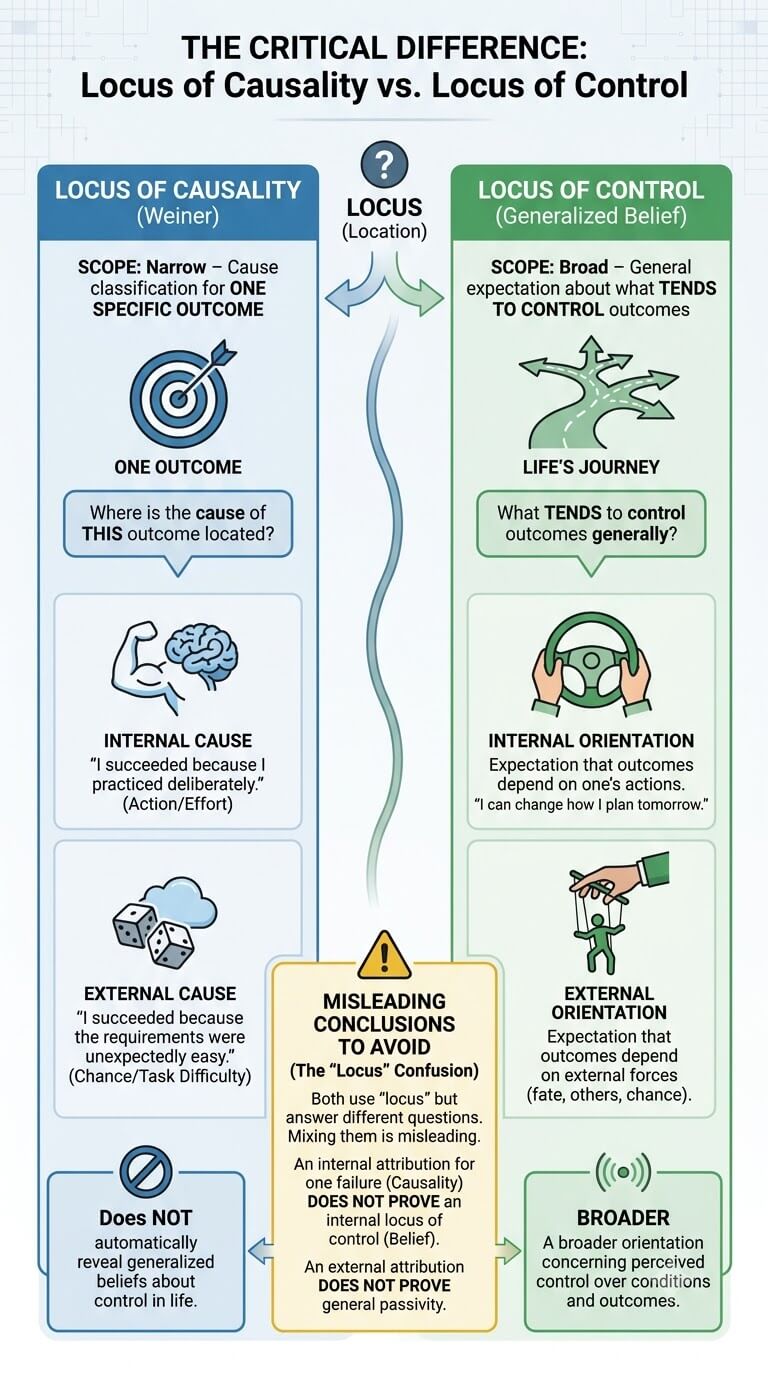
Weiner’s locus of causality asks where the cause of a particular outcome is located. If someone says, “I succeeded because I practiced deliberately,” the proposed cause is internal. If they say, “I succeeded because the requirements were unexpectedly easy,” the proposed cause is external.
The question is narrow: Where is the cause of this outcome located? It does not automatically tell us what that person generally believes about control in life.
Generalized belief about what tends to control outcomes
Locus of control psychology addresses a broader expectation about whether outcomes tend to depend on one’s actions or on external forces. The APA Dictionary definition of locus of control describes it as a broader orientation concerning perceived control over conditions and outcomes.
A person can make an external attribution for one event while still expecting their choices to matter later. “The flight cancellation made me miss the meeting, but I can change how I plan tomorrow” shows the difference. The difference between attribution and locus of control is important because locus of causality classifies one cause, while locus of control describes broader expectations.
Why the word locus creates confusion
Both concepts use the word locus, but they answer different questions. In Weiner’s model, locus refers to the location of a proposed cause. In locus of control, it refers to a broader belief about where control over outcomes tends to reside.
Mixing them creates misleading conclusions. Someone may blame themselves for one failure while feeling generally powerless, so an internal attribution does not prove an internal locus of control. An external attribution also does not prove passivity, especially when the cause really was external.
Mapping Common Explanations Across the Dimensions
Textbook examples sort ability, effort, task difficulty, and luck into neat boxes, but everyday explanations are more flexible. What matters is how the person perceives the cause in context.
| Proposed cause | Typical locus | Possible stability | Possible controllability |
|---|---|---|---|
| Ability | Internal | Often perceived as relatively stable | Often perceived as less directly controllable |
| Effort | Internal | Often variable | Often partly controllable |
| Strategy | Internal | Often variable | Often partly controllable |
| Task difficulty | External | May be stable or variable | Often less directly controllable |
| Luck or chance | External | Usually variable | Usually uncontrollable |
Ability
Ability is usually treated as an internal cause. A student who says “I did well because I understand spatial reasoning” is locating the cause within personal competence. Ability is often perceived as relatively stable, which can make it feel predictive of future outcomes.
Ability is not literally fixed. Skills can develop and different tasks can require different abilities. The key is how the person currently interprets the cause.
Effort
Effort is also internal, but it is commonly perceived as more changeable than ability. “I did poorly because I started studying too late” points toward something that may be different next time. This can preserve an expectation that another attempt could go better.
Effort should not be moralized. Exhaustion, health limitations, competing responsibilities, or inadequate support may restrict it. Calling effort “controllable” without checking those constraints can become unfair.
Strategy
Strategy is especially useful because it separates trying from trying in a particular way. Someone may work for hours and still use a poor study method, practice the wrong skill, or prepare for the wrong task.
An attribution to strategy asks what approach could be tested next. That is more specific than “I am incapable” and less moralizing than “I did not care enough.”
Task difficulty
Task difficulty is typically external because the challenge is located in the task rather than the person. But stability varies. One professional certification may be consistently demanding, while one unusually confusing assignment may be a temporary exception.
An external cause can be accurate and still leave choices available, such as more preparation, different resources, extra time, or deciding the goal is not worth the cost.
Luck and chance
Luck is external, unstable, and usually uncontrollable. A random equipment failure, favorable draw, unexpected traffic jam, or accidental opportunity can affect an outcome without reflecting ability or effort.
Overusing luck can hide genuine competence, while ignoring luck can erase favorable conditions that mattered.
Why classifications can depend on how the person understands the cause
The same label can mean different things. “Ability” may sound fixed to one person and trainable to another. “Effort” may be available in one week and constrained in another. Task difficulty may be stable or a one-time exception.
This is why Weiner’s dimensions are best applied to the perceived cause, not simply to the dictionary meaning of the label.
Stability and Expectations About the Future
Stable causes and expectations of repetition
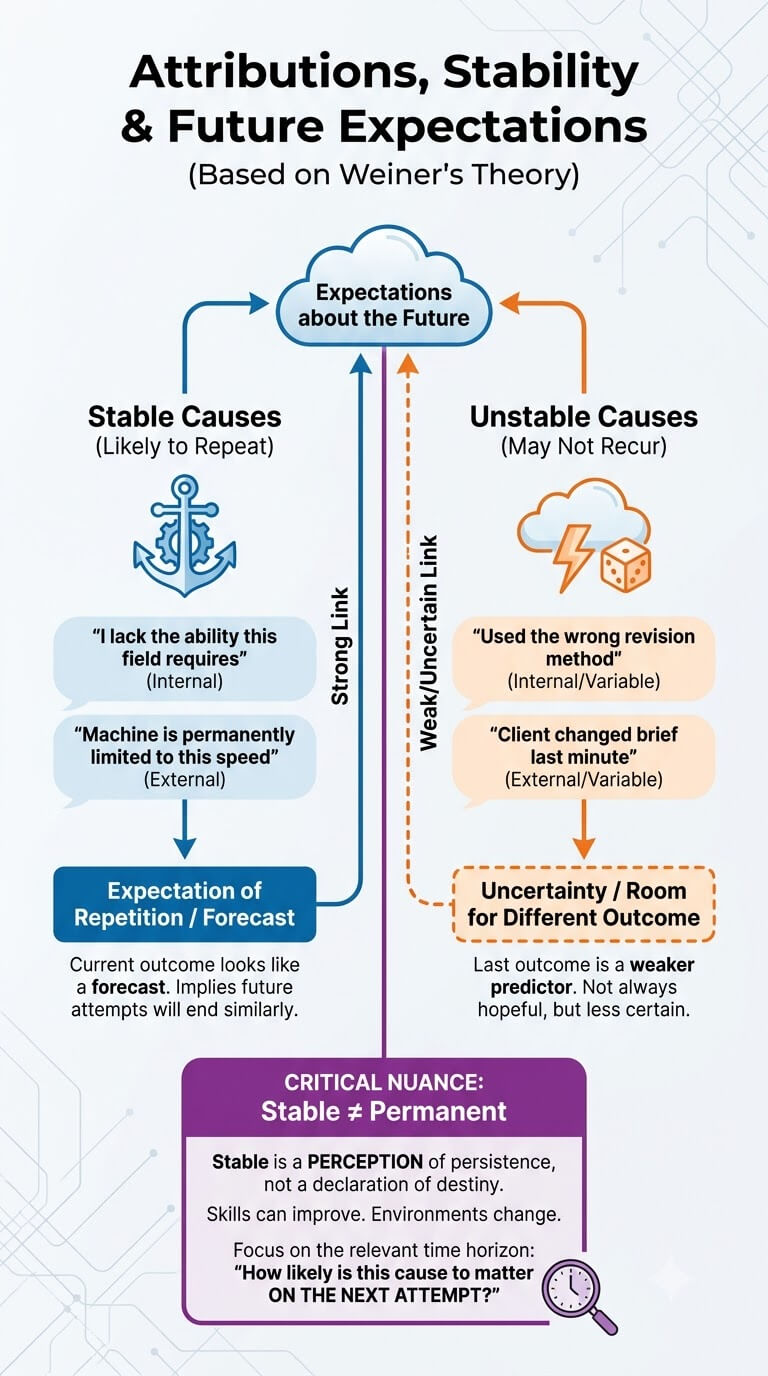
If a person believes the same cause will remain present, the current outcome can start to look like a forecast. “I failed because I lack the ability this field requires” may imply that future attempts will end similarly. “The machine is permanently limited to this speed” also suggests repetition, even though the cause is external.
Weiner’s theory gives stability a particularly important role in expectations. A later meta-analysis of attribution research in achievement contexts examined the model’s links among causal dimensions, expectancy, and behavioral consequences across thousands of participants.
Unstable causes and room for a different outcome
An unstable explanation leaves more uncertainty about what comes next. “I used the wrong revision method,” “I had a migraine that day,” or “the client changed the brief at the last minute” all describe causes that may not recur in the same form.
Unstable does not automatically mean hopeful. An unpredictable, uncontrollable cause can still be frustrating. It simply makes the last outcome a weaker predictor of the next one.
Why stable does not mean permanent in every context
Stable is a perception about persistence, not a declaration of destiny. A stable work requirement can later change. A long-standing skill gap can improve. A recurring environmental barrier may remain stable for months but not forever.
Stay close to the relevant time horizon: “How likely is this cause to matter on the next attempt, and what evidence supports that expectation?”
Controllability and Emotional Reactions
Guilt, anger, sympathy, and responsibility judgments
Controllability can alter how people respond emotionally to themselves and others. If a failure is attributed to something perceived as controllable, a person may feel more responsibility, guilt, frustration, or determination. If the cause is perceived as uncontrollable, observers may respond with more sympathy and less blame. How causal dimensions shape emotion and behavior becomes clearer after locus, stability, and controllability have been identified.
A systematic review of teacher attributions summarizes how Weiner’s framework links the three dimensions to expectations, perceived responsibility, and emotions such as pride, hope, guilt, anger, and sympathy. The peer-reviewed review on causal attributions also illustrates why the same performance outcome can lead to different interpersonal responses depending on the assumed cause.
Why controllability is not identical to blame
Control is only one part of responsibility. Someone may have had some influence without intending the outcome, understanding the risk, or possessing enough power to prevent it. Conversely, a cause can be uncontrollable without making the outcome insignificant.
A practical responsibility judgment may need at least four questions:
- What did the person realistically control?
- What did they know or reasonably foresee?
- What constraints limited their options?
- What consequences still need repair, regardless of intent?
Across work, relationships, and caregiving, “could have influenced” is not the same as “fully caused” or “deserves blame.”
Realistic constraints on effort and strategy
“Just try harder” assumes that more effort is both available and useful. Sometimes the limiting factor is time, information, access, discrimination, physical capacity, conflicting obligations, or a task that effort alone cannot solve.
Personal agency is more useful when it is grounded in realistic options. In attribution terms, the better question is not “Was effort theoretically controllable?” but “What meaningful choices were actually available here?”
Attribution After Failure: Four Worked Examples
I failed because I lack ability
Imagine a student who fails a statistics exam and concludes, “I do not have the ability for statistics.” The proposed cause is internal and likely perceived as stable. It may also feel relatively uncontrollable, especially if the student treats ability as fixed.
What the student may feel: discouragement, embarrassment, or reduced confidence.
What the explanation may predict: another attempt may seem unlikely to succeed.
What to examine next: whether the evidence really supports a broad ability conclusion. Did the student understand prerequisite material? Was the study method effective? Were practice conditions similar to the exam?
I failed because my strategy was ineffective
Now imagine the same result explained as, “I spent hours rereading notes, but the exam required problem solving.” Strategy is internal, usually variable, and often at least partly controllable.
What the student may feel: disappointment mixed with a clearer sense of what can change.
What the explanation may predict: the next attempt is not predetermined because the preparation method can be revised.
What to do next: test practice questions, spaced retrieval, feedback, or another approach that matches the task.
I failed because the task was unusually difficult
Suppose the exam contained material far beyond the stated requirements. Task difficulty is external. If this was a one-time problem, the cause may be unstable. If every exam in the course is designed this way, the difficulty may be relatively stable.
What the student may feel: frustration or reduced self-blame.
What the explanation may predict: future expectations depend on whether the same task conditions are likely to recur.
What to do next: verify the standard, compare preparation with actual requirements, and decide whether additional resources or a different plan are needed.
I failed because of bad luck or timing
Imagine a power outage corrupting a file minutes before submission. Luck or chance is external, unstable, and largely uncontrollable. The result says little about the person’s ability.
What the person may feel: frustration, disappointment, or relief that the failure does not define competence.
What the explanation may predict: the same outcome is not necessarily expected next time.
What to do next: distinguish what was random from what is preventable. The outage was not controllable, but backups or earlier submission may reduce future exposure if those options are realistic.
Attribution After Success: What Changes?
Ability and competence explanations
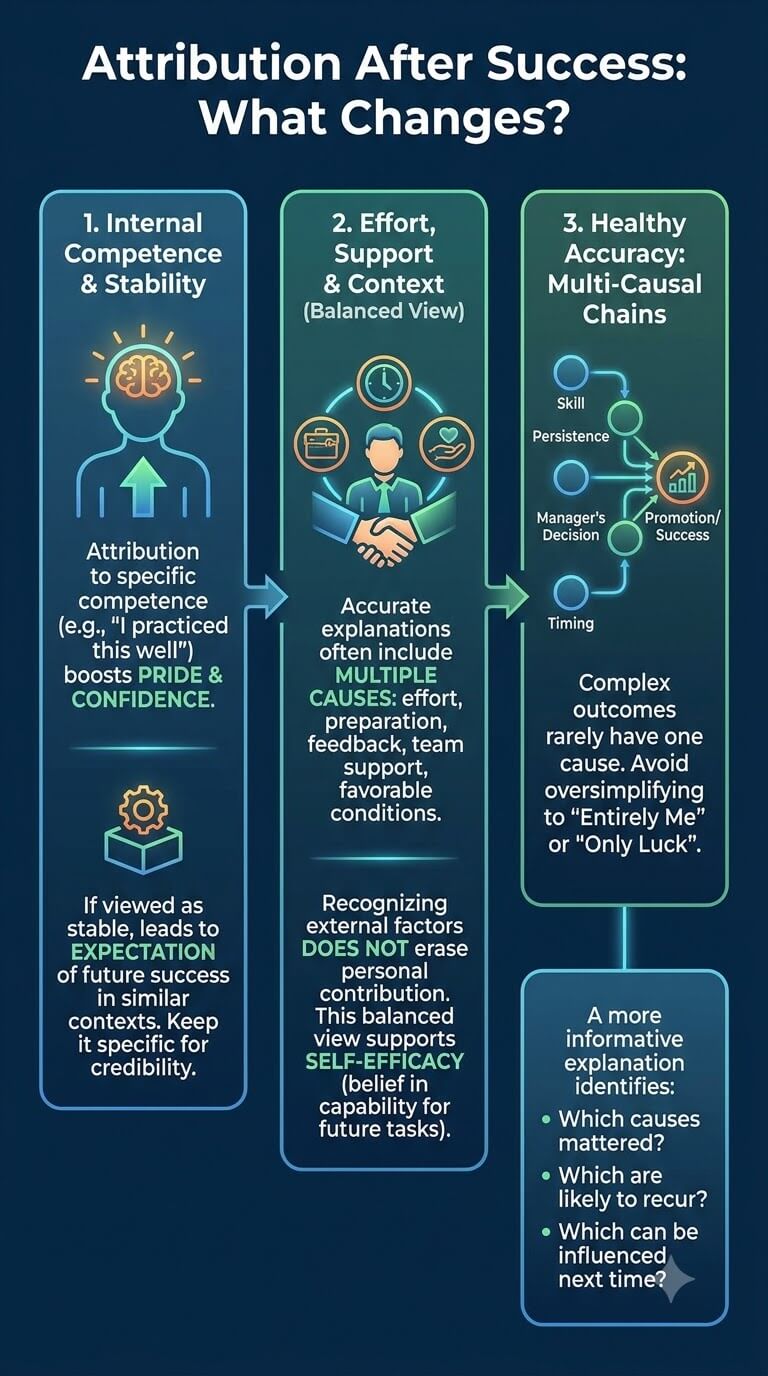
Success attributed to competence can support pride and confidence because the cause is located within the person. If competence is also viewed as stable, the person may expect to perform well again.
That can be useful when the explanation fits the evidence. But one success rarely proves broad ability across every context. A strong attribution stays specific enough to remain credible: “I handled that presentation well because I know this subject and practiced the difficult sections.”
Effort, preparation, support, and favorable conditions
Accurate success explanations often include several causes. A person may have prepared carefully, received useful feedback, worked with a supportive team, and benefited from favorable timing. Recognizing external support does not erase personal contribution, just as recognizing skill does not erase the environment.
This balanced view also matters for self-efficacy. Believing “I can perform this task” is different from deciding why one past outcome occurred. A specific success can inform confidence, but attribution and capability belief remain distinct questions.
Why healthy accuracy can include multiple causes
Complex outcomes usually have causal chains. A promotion may reflect skill, persistence, an available opening, a manager’s decision, market conditions, and timing. “Entirely me” and “only luck” can both discard useful information.
A more informative explanation identifies which causes mattered, which are likely to recur, and which can be influenced next time.
How Weiner’s Model Connects Causal Explanation to Motivation
Expectations about trying again
Motivation is affected by more than attribution, but causal explanations can alter what another attempt seems worth. If failure is tied to a stable cause that appears unlikely to change, expected success may fall. If failure is tied to a variable strategy that can be revised, another attempt may look more promising.
The takeaway is not “always choose an unstable explanation.” The aim is an accurate explanation that reveals real possibilities without forcing optimism.
Controllable alternatives and strategy revision
When a controllable factor genuinely contributed, the attribution can point toward a concrete adjustment. “I need a different practice method” contains a possible next action. “I am bad at this” does not specify what to test, even if a genuine skill gap exists.
A practical sequence is to identify the cause, assess whether it can change, then choose an action that targets it. If the cause is external and uncontrollable, adaptation may make more sense than self-correction.
Why emotion and action depend on the meaning of the cause
Two people can receive the same feedback and respond differently because they assign different causes. One hears “your preparation method did not match the task” and revises the method. Another hears the same result as proof of permanent incompetence and withdraws. A third concludes that the evaluator was inconsistent and seeks clarification.
None of these reactions proves which explanation is true. The model makes the causal assumption easier to inspect before acting on it.
Weiner’s Theory vs Attribution Style
Locus, stability, controllability versus internal, stable, global
Weiner’s framework and recurring explanatory patterns both concern causal explanations, but the dimensions are not interchangeable. Weiner’s achievement model emphasizes locus of causality, stability, and controllability. Attributional style research commonly adds global versus specific explanations and asks whether similar explanatory tendencies repeat across events.
The overlap in words such as “internal” and “stable” can make the models look identical. They are better understood by asking what each framework is trying to classify.
Event classification versus recurring explanatory tendency
Weiner’s model can be applied to one exam, one project, or one success. Attribution style asks whether a person repeatedly explains events in similar ways across time or situations.
For example, “I failed because this strategy was ineffective” can be classified in Weiner’s terms without saying anything about the person’s long-term explanatory style. To infer a recurring style, we would need a pattern across multiple explanations. Recurring optimistic and pessimistic explanations extend beyond classifying a single cause and describe patterns across events.
A Three-Dimension Attribution Worksheet
Name the proposed cause
Write the explanation as a concrete cause rather than a verdict. “I failed because I am useless” is too broad to analyze well. “I did not know how to solve the final two problem types” is more specific.
Prompt: What exactly am I claiming caused this outcome?
Classify locus, stability, and controllability
Then describe the cause along the three dimensions. Avoid forcing certainty when the answer is mixed.
- Locus: Is the cause mainly internal, external, or a combination?
- Stability: Is it likely to remain similar at the next relevant attempt?
- Controllability: What part, if any, is realistically influenceable?
Check whether the classification fits the actual context
Ask what evidence supports the explanation, and look for missing constraints or alternative causes. A poor performance after three hours of sleep may say something different about ability than the same result after months of well-designed practice. Broader cognitive biases in everyday judgment can also make one explanation feel more obvious than the evidence warrants.
This step also guards against treating psychological categories as moral labels. The question is what caused the outcome, not what story would make the person easiest to praise or blame.
Ask what the explanation predicts about the next attempt
Finally, make the prediction explicit. If the cause stays the same, what do you expect next time? If it can change, what needs to change? If it is uncontrollable, what adaptation could reduce exposure?
| Worksheet step | Question | Useful output |
|---|---|---|
| 1. Cause | What am I saying caused the result? | A specific, testable explanation |
| 2. Dimensions | Where is it, will it persist, can it be influenced? | Locus, stability, controllability |
| 3. Evidence | What supports or challenges this explanation? | A more accurate causal picture |
| 4. Prediction | What does this imply for the next attempt? | A realistic expectation or adjustment |
FAQ About Weiner’s Attribution Theory
The most useful distinctions become clearer when the dimensions are separated rather than treated as one overall judgment.
What are the three dimensions in Weiner’s attribution theory?
The three central dimensions are locus of causality, stability, and controllability. Locus asks whether a cause is internal or external. Stability asks whether the cause is expected to persist or vary. Controllability asks how much realistic influence is available over the cause. A cause can occupy different combinations of these dimensions.
Is ability always stable and uncontrollable?
No. Ability is often used as a classic example of an internal, relatively stable cause, but people’s beliefs about ability differ. Someone may view a skill as trainable and therefore changeable over time. It is safer to classify the cause as the person perceives it in the relevant context rather than assume every use of “ability” means the same thing.
Is effort always controllable?
No. Effort is commonly treated as more controllable than luck or task difficulty, but real control can be limited by health, time, caregiving, unsafe conditions, resources, fatigue, or competing demands. The psychologically useful question is how much meaningful control was actually available, not whether effort is theoretically under personal control.
How does Weiner’s locus differ from locus of control?
Weiner’s locus of causality classifies the cause of a particular outcome as internal or external. Locus of control is a broader expectation about whether outcomes generally depend on one’s actions or outside forces. One external attribution for a single event does not imply an external locus of control, and one internal attribution does not prove an internal locus of control.
Why does controllability affect emotion?
Perceived control changes how people interpret responsibility. When a cause appears controllable, observers may be more likely to respond with anger or blame, while the person involved may experience guilt or determination. When a cause appears uncontrollable, sympathy may increase. These are tendencies, not fixed rules, and accurate judgments still require context, knowledge, intention, constraints, and evidence.
Key Takeaways
- Weiner’s attribution theory classifies perceived causes of success and failure through locus of causality, stability, and controllability.
- Stability is especially relevant to what the current outcome seems to predict about future attempts.
- Controllability should be judged in context. Partial influence is not the same as full responsibility or moral blame.
- Ability, effort, strategy, task difficulty, and luck are useful examples, but their exact classification can depend on how the cause is understood.
- Locus of causality is event-specific and should not be confused with the broader concept of locus of control.
- A useful next step after success or failure is to name the proposed cause, classify its dimensions, test it against the evidence, and ask what it realistically predicts or changes.
Author note: Michael Reed, Founder & Lead Writer at Psychology Exposed, writes about human behavior and everyday psychological concepts in clear, research-aware language. This material is educational and is not a diagnosis or a substitute for individualized professional advice.

Michael Reed is the Founder and Lead Writer at Psychology Exposed. He writes about human behavior, relationships, emotional patterns, self-awareness, and practical psychology topics using research-informed, easy-to-understand content.
Read More About Michael Reed: https://psychologyexposed.com/michael-reed/