
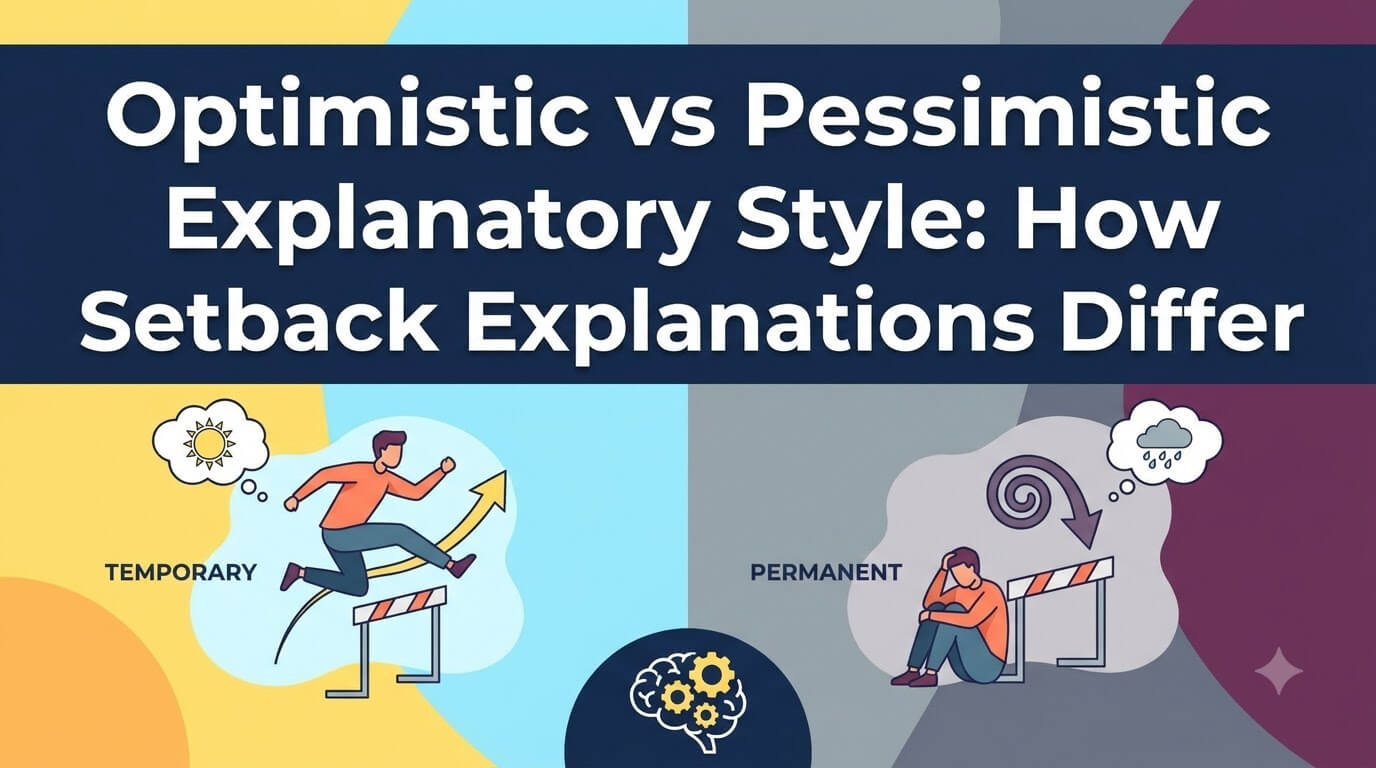
A setback does not arrive with one built-in meaning. Two people can receive the same rejection, miss the same target, or have the same argument and walk away with very different explanations. One may think, “This was a difficult situation, and I can change part of what happened.” Another may think, “This always happens because something is wrong with me.” The event is the same, but the explanation changes what the event seems to say about the future.
That difference is at the heart of optimistic and pessimistic explanatory style. The useful distinction is not “positive person versus negative person.” It is how people tend to explain causes, especially whether a setback feels permanent, widespread, and personally defining. A realistic explanation can include responsibility, difficult facts, and limits. It does not require forced positivity.
Quick Answer
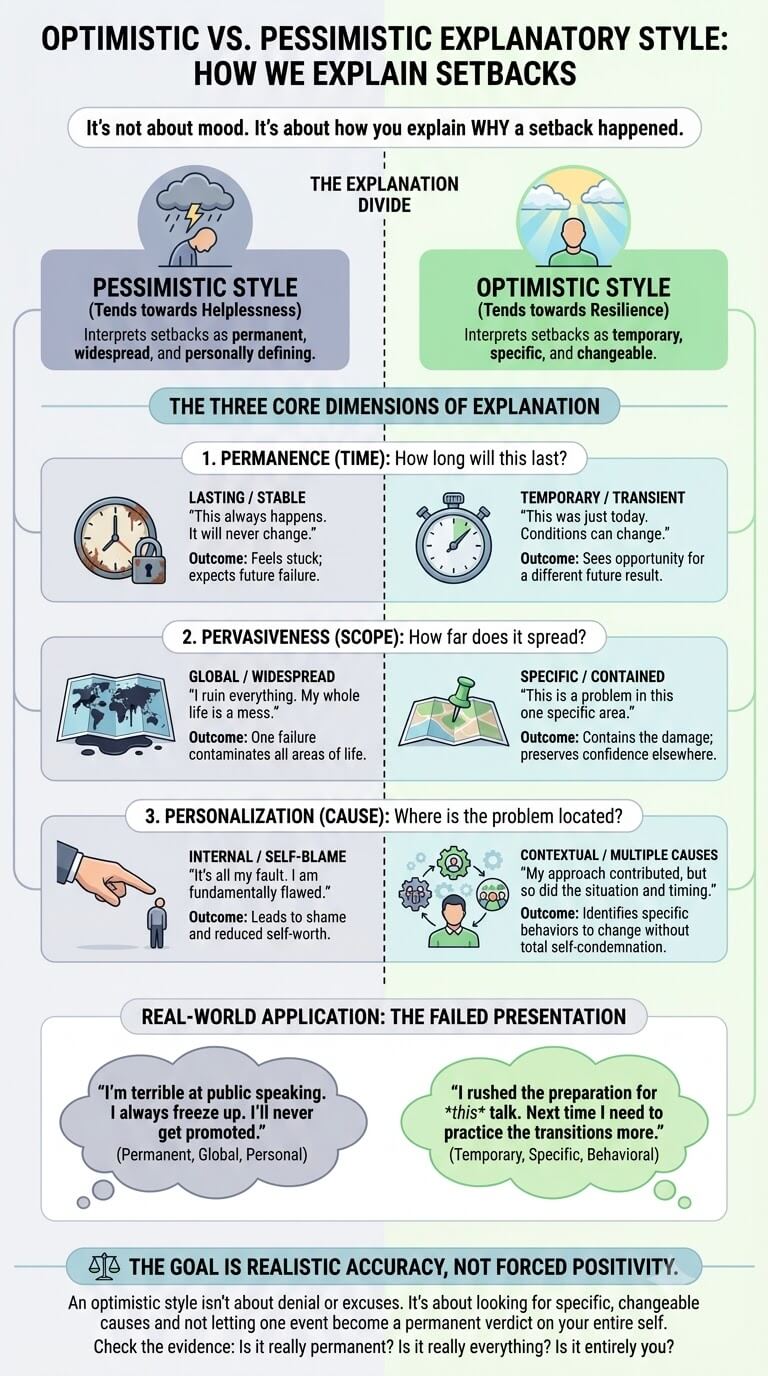
An optimistic explanatory style tends to explain setbacks as more temporary, specific, and open to change, while a pessimistic explanatory style tends to interpret setbacks as more lasting, widespread, and personally defining. These are tendencies rather than fixed identities. The most useful goal is not to choose the most positive explanation, but to choose the most accurate explanation without making one event broader, more permanent, or more personal than the evidence supports.
What Makes an Explanatory Style Optimistic or Pessimistic?
It is about causal explanations, not simply mood
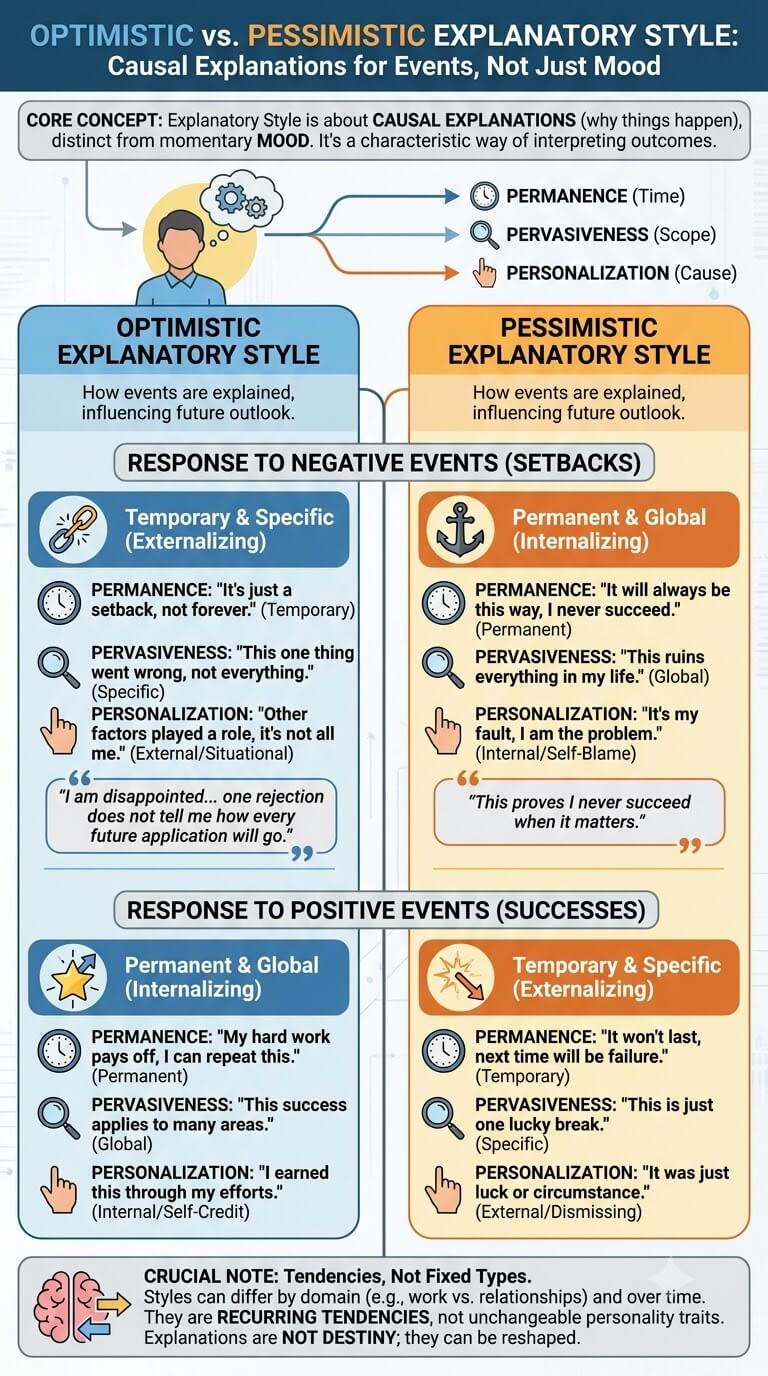
Explanatory style refers to the way a person describes why events happen. The APA Dictionary of Psychology definition of explanatory style describes it as a person’s characteristic way of explaining events or personal history. In everyday life, this means that a disappointing outcome may be interpreted as evidence about the self, the situation, the future, or some combination of all three.
Someone can feel sad and still make a relatively flexible explanation: “I am disappointed because this mattered to me, but one rejection does not tell me how every future application will go.” Someone else can feel calm while making a broad, pessimistic explanation: “This proves I never succeed when it matters.” Mood and explanatory style can influence each other, but they are not the same thing. Optimistic and pessimistic patterns are one focused part of the psychology of causal explanation.
Why style can differ across positive and negative events
People do not necessarily explain good and bad events in mirror-image ways. A person may accept credit for success but become highly self-critical after failure. Another may blame themselves for setbacks while dismissing success as luck. Explanations can also differ by domain. Someone may be flexible about work mistakes but highly global when interpreting relationship rejection.
This is one reason it is more accurate to think in terms of recurring tendencies than fixed personality types. Historical research has found some stability in explanatory style for negative events, but not the same pattern for positive events in every sample. A long-term study of explanatory style across adulthood, for example, found relative stability for negative-event explanations in its sample while positive-event explanations showed a different pattern. That does not mean a person’s explanations are destiny.
Three Comparison Dimensions
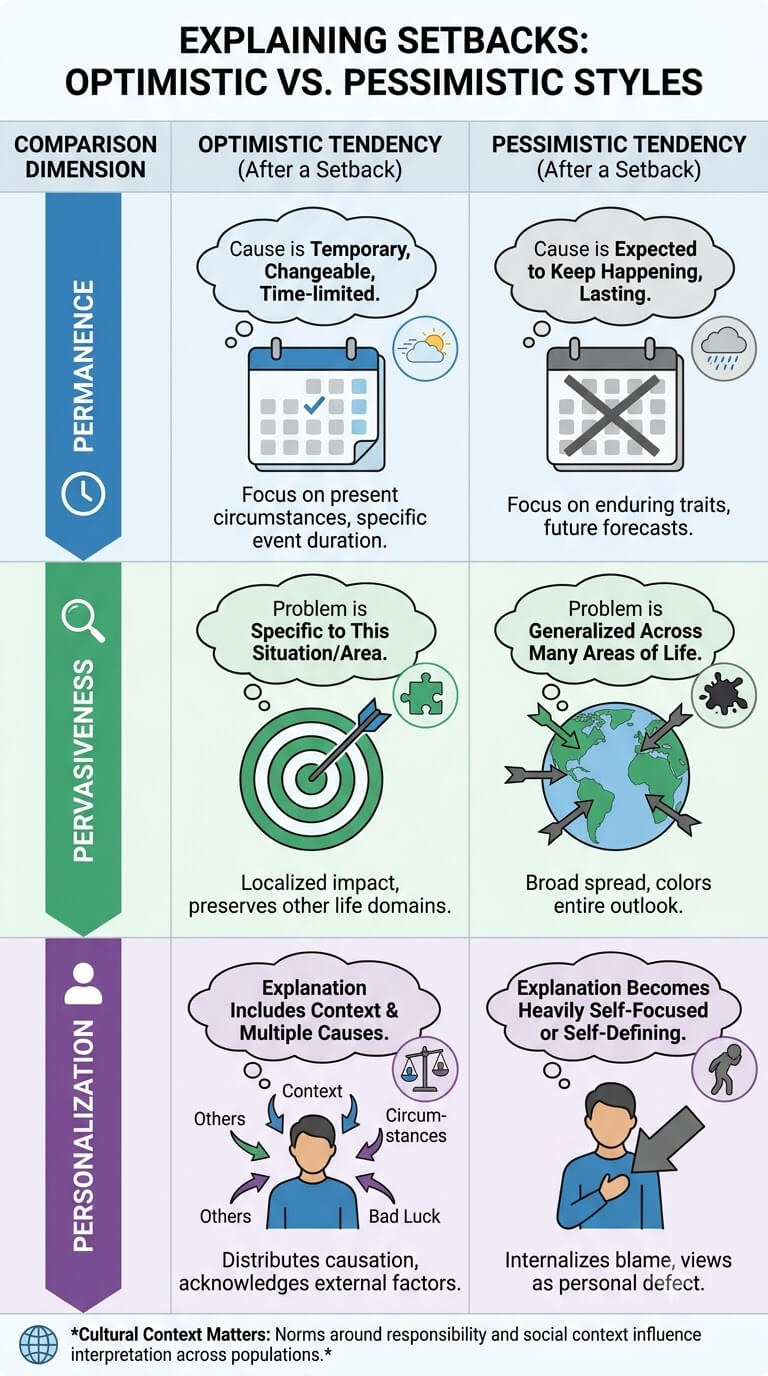
Optimistic and pessimistic explanatory styles are often discussed through three related questions: How long will this cause last? How much of life does it affect? How much does the explanation locate the problem in the self?
| Dimension | More optimistic tendency after a setback | More pessimistic tendency after a setback |
|---|---|---|
| Permanence | The cause is temporary, changeable, or time-limited | The cause is expected to keep happening |
| Pervasiveness | The problem is specific to this situation or area | The problem is generalized across many areas of life |
| Personalization | The explanation includes context and multiple causes | The explanation may become heavily self-focused or self-defining |
Permanence: temporary versus lasting explanations
Permanence is about time. A temporary explanation sounds like, “I handled this meeting badly because I was underprepared today.” A permanent explanation sounds like, “I always freeze when anything important happens.” The second statement does more than explain one meeting. It turns the event into a forecast.
Temporary explanations are not automatically better. If the same problem has repeated for years under similar conditions, calling it “just a bad day” may be inaccurate. The useful question is whether the proposed cause is actually likely to remain present, not whether a temporary explanation feels more encouraging.
Pervasiveness: specific versus broad-life explanations
Pervasiveness asks how far the explanation spreads. A specific explanation stays close to the domain: “I struggle with unstructured presentations.” A pervasive explanation spreads beyond the evidence: “I am bad at everything that requires confidence.”
Broad explanations can make one outcome feel larger than it is. A difficult conversation with one friend may become “I ruin every relationship.” A disappointing sales month may become “Nothing I do ever works.” Specificity helps preserve information. It shows which part of the situation needs attention without turning a local problem into a total life verdict.
Personalization: self-focused versus context-inclusive explanations
Personalization concerns how much the explanation locates the cause within the self. “The relationship ended because I am impossible to love” is strongly self-focused and global. “We wanted different things, I avoided a few difficult conversations, and we both stopped repairing conflict” distributes causation more carefully.
Context-inclusive does not mean avoiding responsibility. Sometimes a person’s choices genuinely contributed. The difference is whether the explanation identifies the specific contribution or turns the whole outcome into proof of personal defect. The latter usually adds more certainty than the event can support.
A recent scoping review of explanatory style across Asian populations also highlights why cultural context matters. Explanations that appear more personal or situational cannot always be interpreted the same way across populations, because norms around responsibility, self-presentation, and social context differ.
How the Styles Often Differ After a Setback
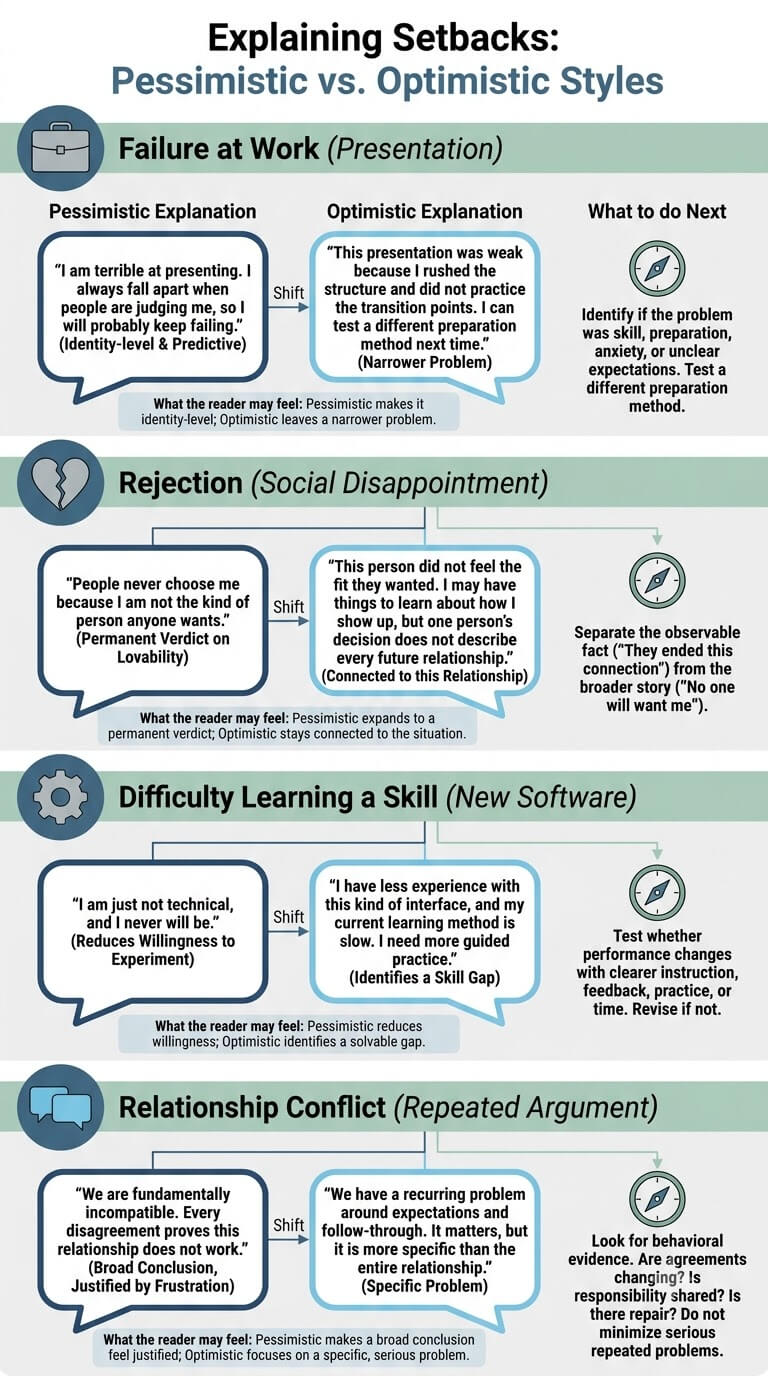
Failure at work
Situation: You lead a presentation that receives weak feedback.
A more pessimistic explanation might be: “I am terrible at presenting. I always fall apart when people are judging me, so I will probably keep failing.”
A more optimistic explanation might be: “This presentation was weak because I rushed the structure and did not practice the transition points. I can test a different preparation method next time.”
What the reader may feel: the first explanation can make the setback feel identity-level and predictive; the second may still feel disappointing but leaves a narrower problem to solve.
What to do next: identify whether the problem was skill, preparation, anxiety, unclear expectations, or something else. Do not use the optimistic label as a reason to skip uncomfortable evidence.
Rejection or social disappointment
Situation: Someone you hoped to date says they do not want to continue.
A more pessimistic explanation might be: “People never choose me because I am not the kind of person anyone wants.”
A more optimistic explanation might be: “This person did not feel the fit they wanted. I may have things to learn about how I show up, but one person’s decision does not describe every future relationship.”
What the reader may feel: rejection can still hurt in either case. The difference is whether the explanation stays connected to this relationship or expands into a permanent verdict about lovability.
What to do next: separate the observable fact from the broader story. “They ended this connection” is a fact. “No one will want me” is a prediction that requires much more evidence.
Difficulty learning a skill
Situation: You struggle to learn a new software tool while coworkers appear faster.
A more pessimistic explanation might be: “I am just not technical, and I never will be.”
A more optimistic explanation might be: “I have less experience with this kind of interface, and my current learning method is slow. I need more guided practice.”
What the reader may feel: the first explanation may reduce willingness to keep experimenting. The second identifies a skill gap without pretending the gap is already solved.
What to do next: test whether performance changes with clearer instruction, feedback, practice, or time. If it does not, revise the explanation again.
Relationship conflict
Situation: You and your partner have the same argument about household responsibilities for the third time.
A more pessimistic explanation might be: “We are fundamentally incompatible. Every disagreement proves this relationship does not work.”
A more optimistic explanation might be: “We have a recurring problem around expectations and follow-through. It matters, but it is more specific than the entire relationship.”
What the reader may feel: repeated conflict can make a broad conclusion feel justified, especially when frustration is high.
What to do next: look for behavioral evidence. Are agreements changing? Is responsibility shared? Is there repair after conflict? A specific explanation should not be used to minimize a serious repeated problem.
How the Styles Can Differ After Success
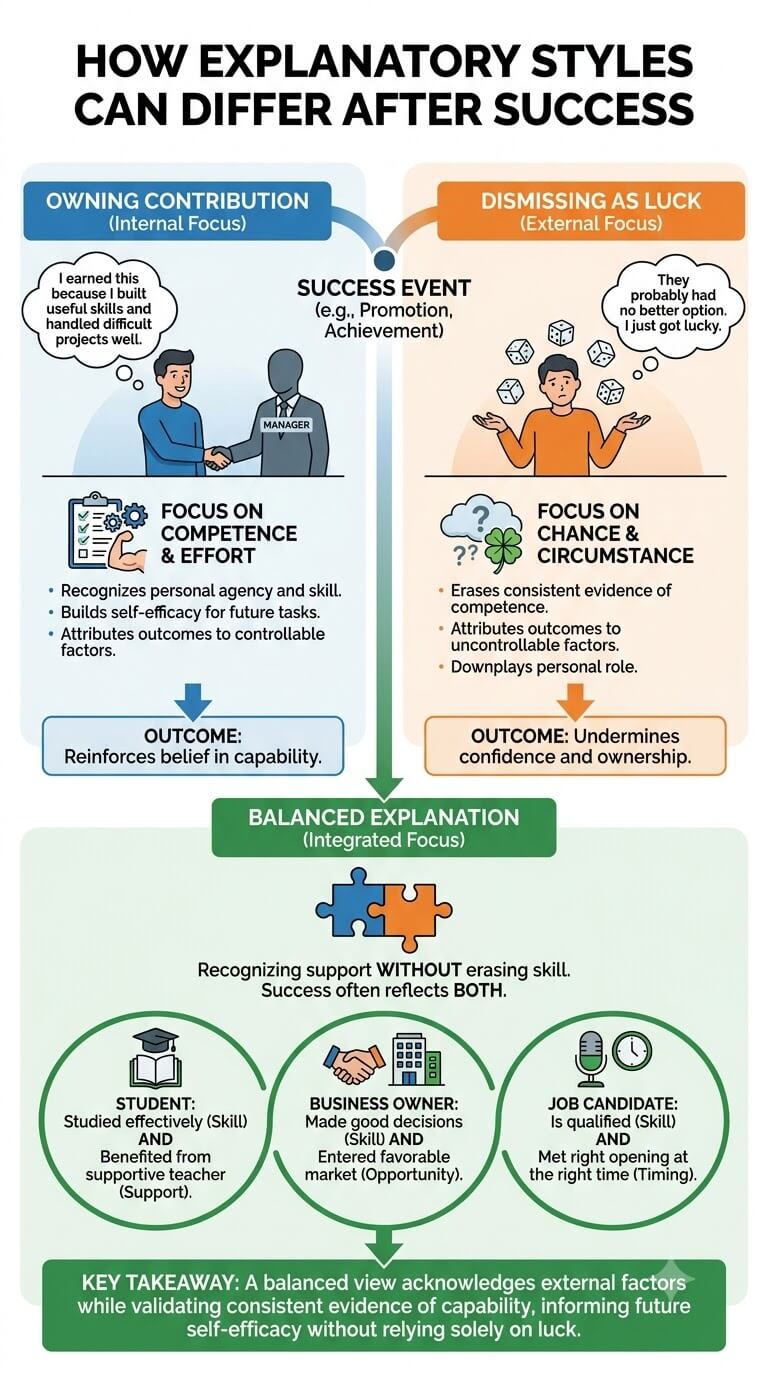
Owning contribution versus dismissing success as luck
Explanatory style also affects positive outcomes. After a promotion, one person may think, “I earned this because I built useful skills and handled several difficult projects well.” Another may think, “They probably had no better option. I just got lucky.”
Luck and opportunity can be real causes. The problem appears when external explanations erase consistent evidence of competence. If someone repeatedly performs well, receives specific feedback, and succeeds across different conditions, “pure luck” becomes less complete as an explanation.
Recognizing support without erasing skill
A balanced explanation does not require choosing between “I did it” and “the situation did it.” Success often reflects both. A student may have studied effectively and benefited from a supportive teacher. A business owner may have made good decisions and entered a favorable market. A job candidate may be qualified and meet the right opening at the right time.
This distinction connects naturally with self-efficacy. Recognizing specific evidence of successful performance can inform beliefs about capability, but explaining why one outcome happened is still a different psychological question from deciding whether you can perform a future task.
Pessimistic Explanations Are Not Automatically False
When a stable or broad problem is genuinely present
Some problems really are persistent. A workplace may have an entrenched culture of intimidation. A course may consistently require skills a student does not yet have. A relationship may show the same unresolved behavior after repeated discussions. Describing a recurring cause as stable is not automatically pessimistic distortion.
Likewise, one problem can affect several areas of life. Chronic financial strain, caregiving pressure, discrimination, or severe sleep disruption may influence work, relationships, concentration, and mood at the same time. Specificity is useful, but it should not be used to pretend interconnected problems are isolated when they are not.
The goal is evidence-based specificity, not compulsory optimism
Forced positivity can create a new error: refusing to acknowledge what the evidence repeatedly shows. “Everything will be fine” is not more psychologically accurate than “everything will fail” merely because it sounds hopeful.
The better standard is proportion. How long has the cause actually lasted? Where does it apply, and where does it not? Which parts are personal, situational, relational, structural, or random? What evidence would make you revise the explanation? These questions keep optimism from becoming denial and pessimism from becoming overgeneralization.
Optimistic Explanations Are Not Excuses
Temporary does not mean consequence-free
Suppose you miss an important deadline because you underestimated the work. “I planned this badly” is more temporary and specific than “I am completely unreliable,” but it still names responsibility. A useful explanation can protect against global self-condemnation without pretending the mistake did not affect other people.
The next step may be repair: acknowledge the missed commitment, reduce the impact if possible, and change the planning process. Optimistic style is most credible when it remains connected to behavior.
Context does not remove accountability
Situational factors matter, but they do not automatically erase choice. Stress may explain why someone became impatient, yet it does not make hurtful behavior irrelevant. A difficult manager may contribute to a failed project, while an employee may still have omitted information that should have been shared sooner.
This is where personal agency can be a useful distinction. Attribution asks what caused the outcome. Agency concerns what choices and actions remain available now. A person can acknowledge external constraints and still act on the part they can influence.
Self-compassion does not require denying one’s influence
People sometimes fear that a kinder explanation means letting themselves “off the hook.” That creates a false choice between harsh self-blame and no responsibility. A more accurate middle position might be: “My choice contributed, I understand why I made it, and I still need to change what I do next.”
That kind of explanation is neither flattering nor condemning. It is specific enough to support accountability without turning one decision into a total identity judgment.
Attribution Style vs Optimistic and Pessimistic Explanatory Style
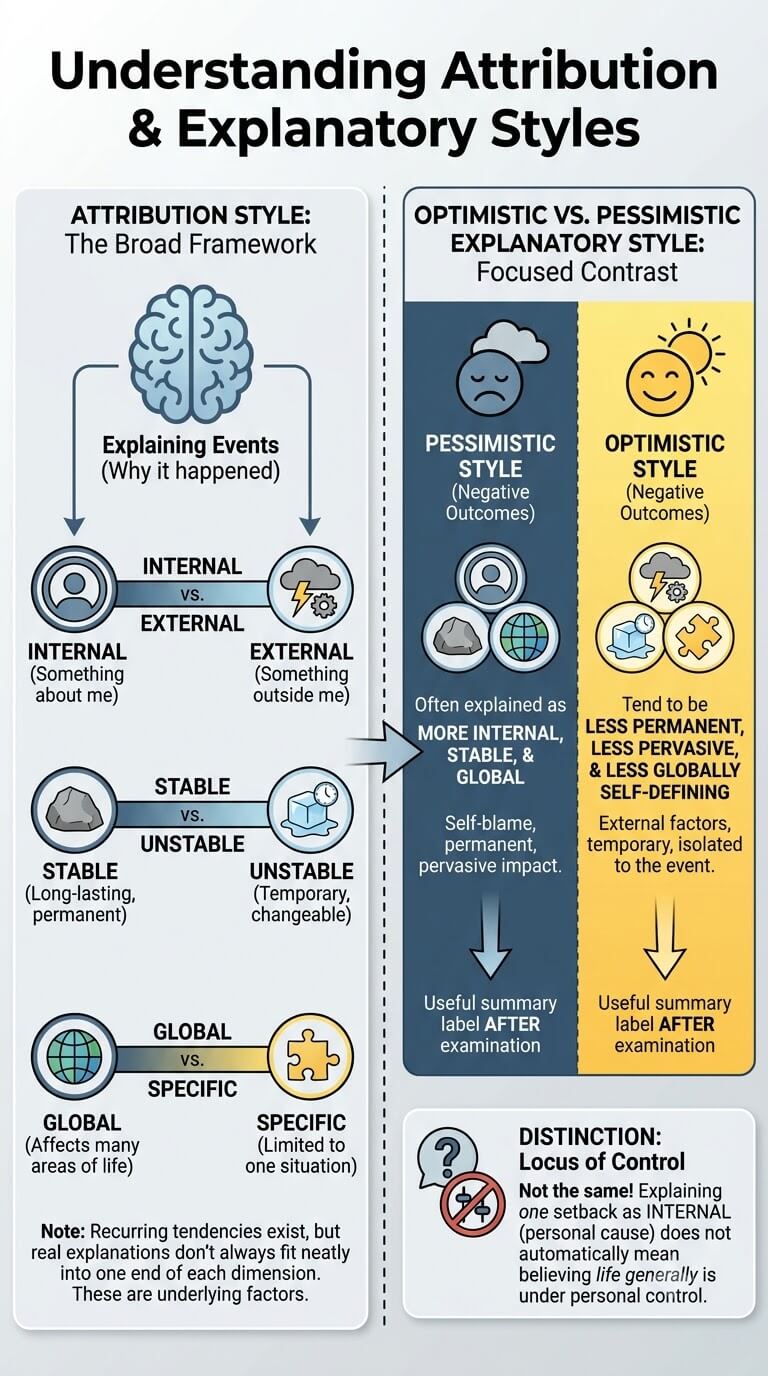
The broad framework versus this focused contrast
Attribution style is the broader idea that people can show recurring tendencies in how they explain events. Optimistic versus pessimistic explanatory style is one way of describing those tendencies, especially in relation to negative and positive outcomes.
The broader framework also helps separate dimensions that are easy to collapse together. An explanation can be internal but unstable, external but stable, specific but personally caused, or global while involving several external conditions. The labels “optimistic” and “pessimistic” are useful summaries only after the underlying explanation has been examined.
Where internal, stable, and global explanations fit
In classic explanatory-style research, pessimistic explanations for negative events are often described as more internal, stable, and global. More optimistic explanations tend to be less permanent, less pervasive, and less globally self-defining. But real people do not always occupy one clean end of each dimension.
This is also different from locus of control. Explaining one setback as internal does not automatically mean a person generally believes outcomes are under personal control. A person may blame themselves for a specific failure while also believing that life is mostly controlled by outside forces.
A Realism Check for Setback Explanations
When a setback starts turning into a broad story about yourself or your future, use four checks. The aim is not to manufacture a positive interpretation. It is to reduce conclusions that exceed the evidence.
What part of this cause is temporary or changeable?
Name the time-sensitive part precisely. Maybe the poor performance followed a week of sleep loss. Maybe the relationship problem reflects a communication habit that has repeated for years. The first may be temporary; the second may require sustained behavior change. Do not call something temporary simply because you wish it were.
Am I generalizing beyond the evidence?
Identify the domain in which the outcome actually occurred. “I mishandled this negotiation” is narrower than “I am terrible with people.” “This friendship ended” is narrower than “I cannot keep relationships.” If the broad conclusion is true, there should be evidence across multiple situations, not only one emotionally intense event.
What was my influence and what was outside my control?
Divide the causal picture. What did you choose? What did other people choose? What role did timing, resources, rules, luck, or structural conditions play? This prevents both excessive self-blame and automatic externalization. Causal explanations versus control expectations are related but distinct: one explains events, while the other concerns what generally shapes outcomes.
Cognitive biases in causal judgment can make one explanation feel obvious before competing evidence has been considered. Treat your first story as a hypothesis, especially when the outcome is emotionally charged.
What explanation best predicts a useful next step?
An explanation becomes more useful when it points toward a test. If you believe strategy caused the failure, change the strategy. If you believe the environment caused it, ask whether the environment can be changed, avoided, or planned around. If you believe ability is the main cause, define which skill is missing and whether it can be developed.
A useful prediction is not proof. If the next attempt goes differently, update the explanation. If the same pattern returns despite a well-designed change, take that evidence seriously too.
Five Reframes That Preserve Reality
From permanent to time-bounded when evidence supports it
Instead of: “I always fail when I am under pressure.”
Try: “I have struggled in the last three high-pressure situations, especially when I prepared late.”
The second version does not erase the pattern. It defines the time frame and adds a possible condition that can be tested.
From global to domain-specific
Instead of: “I am bad at relationships.”
Try: “I have difficulty speaking up early when I am unhappy, and that has affected several close relationships.”
This reframe still identifies a repeated problem, but it narrows the target from the whole self to a specific behavior.
From total self-blame to divided causal responsibility
Instead of: “The project failed because I was not good enough.”
Try: “I underestimated the timeline, the requirements changed twice, and the team did not resolve a major dependency early enough.”
Dividing causes is not an excuse. It helps identify which part belongs to you and which part does not.
From luck-only success to mixed contribution
Instead of: “I only got the opportunity because I was lucky.”
Try: “Timing helped, and I was also prepared enough to use the opportunity when it appeared.”
This preserves favorable circumstances without erasing skill or preparation.
From forced positivity to a testable explanation
Instead of: “Everything happens for a reason, so this will work out.”
Try: “I do not know how this will turn out. I can identify what happened, what I can influence, and what evidence I need before drawing a bigger conclusion.”
Uncertainty can be more realistic than either optimism or pessimism.
How Explanations Affect Motivation and Future Behavior
Expectations after stable versus temporary explanations
When a negative cause is interpreted as stable, future outcomes may begin to feel predetermined. “This is who I am” leaves less room for experimentation than “this is what happened under these conditions.” A temporary explanation, when accurate, makes change easier to imagine because the cause itself is not expected to remain identical. How explanations affect future behavior is the next question after a recurring explanatory pattern has been identified.
That does not guarantee motivation. A temporary cause can still be uncontrollable, and a stable cause can sometimes be manageable. Explanatory style is one influence among many, including available resources, rewards, habits, support, and perceived capability.
What a constructive explanation makes possible
A constructive explanation tends to do three things at once: it fits the evidence, it preserves the boundaries of the event, and it identifies what could realistically change. “I need to develop this skill” is often more actionable than “I am a failure.” “This environment is not giving me the resources required” may be more accurate than blaming effort when resources are the real constraint.
The next step is therefore not to become “more optimistic” in the abstract. Choose one recent setback and write the explanation you currently believe. Then test it for permanence, pervasiveness, personalization, and omitted context. Keep what fits the evidence. Revise what has become broader than the event itself.
FAQ About Optimistic and Pessimistic Explanatory Style
The distinction becomes most useful when it is treated as a way of examining explanations, not a label for sorting people into two personality types.
Is optimistic explanatory style the same as positive thinking?
No. Positive thinking often refers broadly to maintaining hopeful thoughts or expectations. Optimistic explanatory style is more specific: it concerns how causes are interpreted, especially whether setbacks are seen as permanent, pervasive, or personally defining. An evidence-based optimistic explanation may still acknowledge a serious problem, responsibility, or an uncertain outcome.
Can an optimistic explanation still include personal responsibility?
Yes. “I handled that badly because I avoided preparation, and I need a different process next time” is personally responsible without becoming global or permanent. The person owns a specific contribution while leaving room for behavior change. Optimistic explanatory style does not require blaming the situation for every negative outcome.
Can a pessimistic explanation sometimes be accurate?
Yes. Some causes are stable, some problems affect several areas of life, and sometimes a person’s repeated choices genuinely contribute to an outcome. The concern is not whether an explanation sounds pessimistic, but whether it goes further than the evidence. Accuracy takes priority over choosing the most comforting interpretation.
What is the difference between permanence and pervasiveness?
Permanence concerns time: whether the cause is expected to last. Pervasiveness concerns scope: whether the cause is seen as affecting one area or many areas. A problem can be stable but specific, such as a long-standing difficulty with one technical skill. It can also be temporary but broad, such as a short period of severe sleep loss affecting several areas at once.
Does explanatory style stay the same in every part of life?
Not necessarily. People may explain work, relationships, health, learning, and social setbacks differently. Research has found some stability in certain explanatory tendencies, but patterns can vary by event type, context, culture, and time. It is more useful to look for repeated explanations than to assume one global style governs every situation.
Key Takeaways
- Optimistic and pessimistic explanatory styles describe how causes are interpreted, not whether someone is simply cheerful or negative.
- After setbacks, the key dimensions are permanence, pervasiveness, and personalization: how long the cause seems likely to last, how widely it applies, and how much it becomes a judgment about the self.
- A more optimistic explanation is not automatically more accurate. Persistent problems, real constraints, and personal responsibility should not be minimized.
- Optimism does not require excuses. A person can own a mistake while keeping the explanation specific, proportionate, and open to change.
- Success deserves the same causal care as failure. Recognizing skill, effort, support, timing, and luck together often produces a more complete explanation.
- A practical next step is to test one setback explanation for whether it is more permanent, pervasive, or personal than the evidence supports.
Author note: Michael Reed, Founder & Lead Writer at Psychology Exposed, writes about human behavior, emotional patterns, and everyday psychological concepts in clear, research-aware language. This material is educational and is not a diagnosis or a substitute for individualized professional care.

Michael Reed is the Founder and Lead Writer at Psychology Exposed. He writes about human behavior, relationships, emotional patterns, self-awareness, and practical psychology topics using research-informed, easy-to-understand content.
Read More About Michael Reed: https://psychologyexposed.com/michael-reed/