
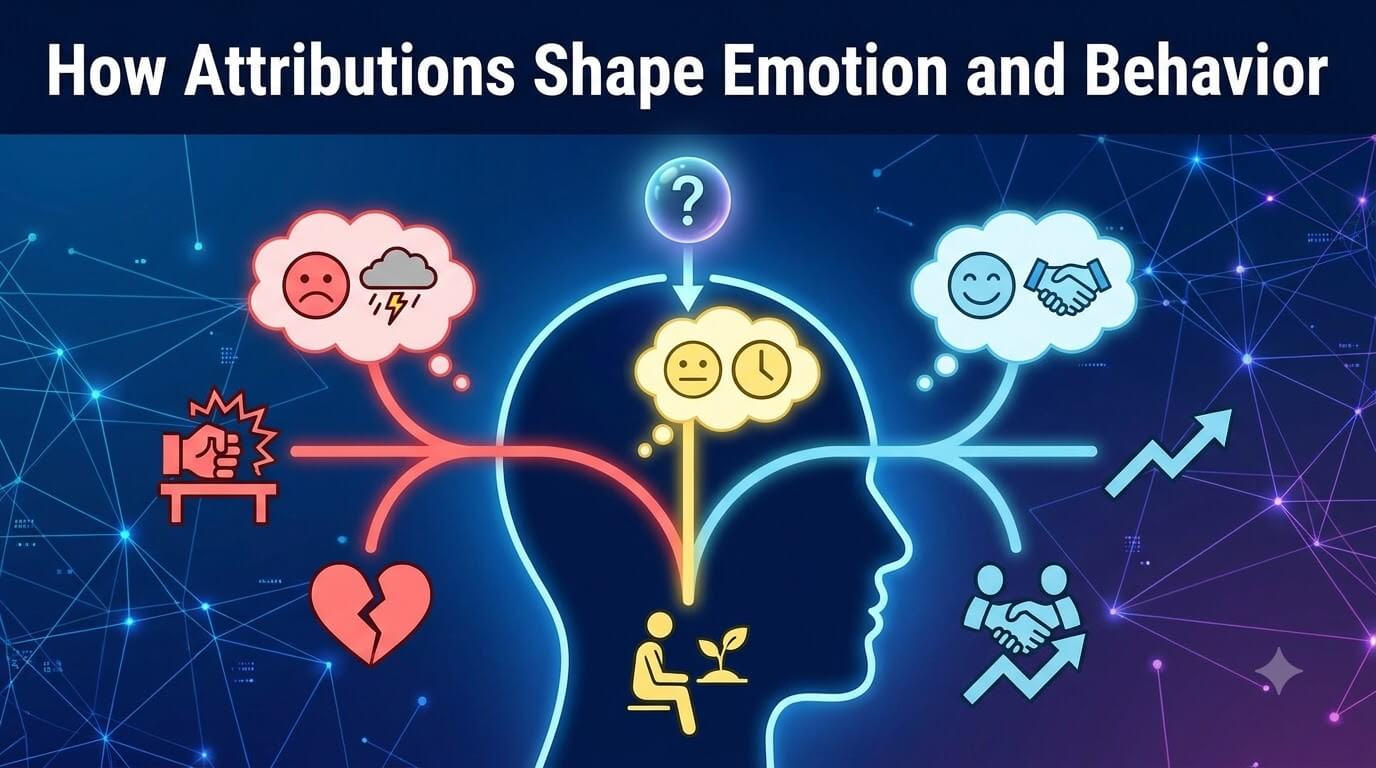
The event itself is only part of what drives a reaction. Imagine sending an important message and receiving no reply for several hours. If you conclude, “They are ignoring me on purpose,” anger may rise quickly. If you conclude, “They are probably overwhelmed,” concern or patience may come first. If you think, “This always happens because people do not value me,” the silence may feel much bigger than one delayed response.
Psychology uses the idea of attribution to describe how people explain causes. Those explanations matter because they influence what an event seems to mean, what emotion follows, what you expect to happen next, and what action feels reasonable. The explanation may be accurate, partly accurate, or wrong. What matters here is understanding the pathway from causal interpretation to response so that the assumption itself can be examined before it quietly controls the next move.
Quick Answer
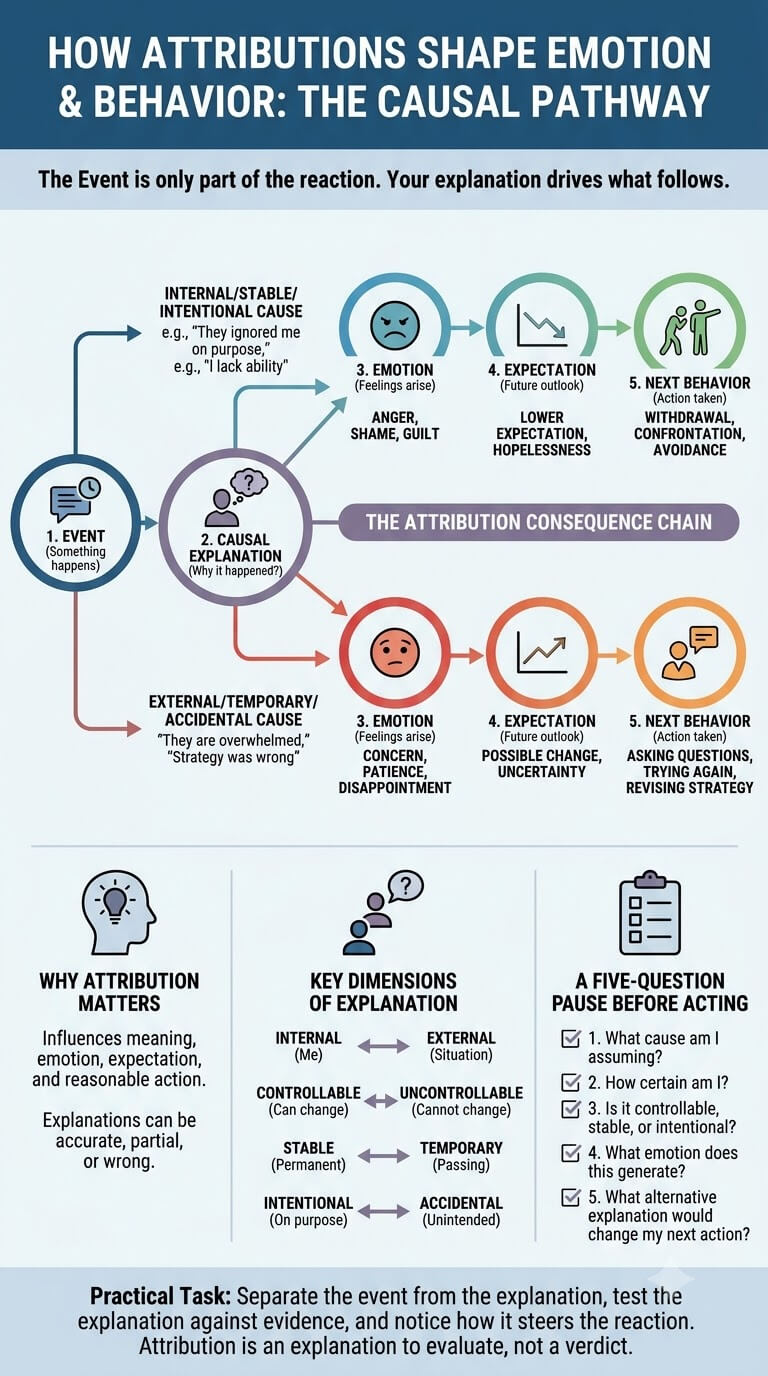
Attributions shape emotion and behavior by changing the meaning assigned to an event. A cause seen as intentional may increase anger, a cause seen as uncontrollable may reduce blame, and a stable negative cause may lower expectations for change. These are tendencies, not fixed rules. The practical task is to separate the event from the explanation, test the explanation against evidence, and notice how that explanation is steering the next reaction.
The Attribution Consequence Chain
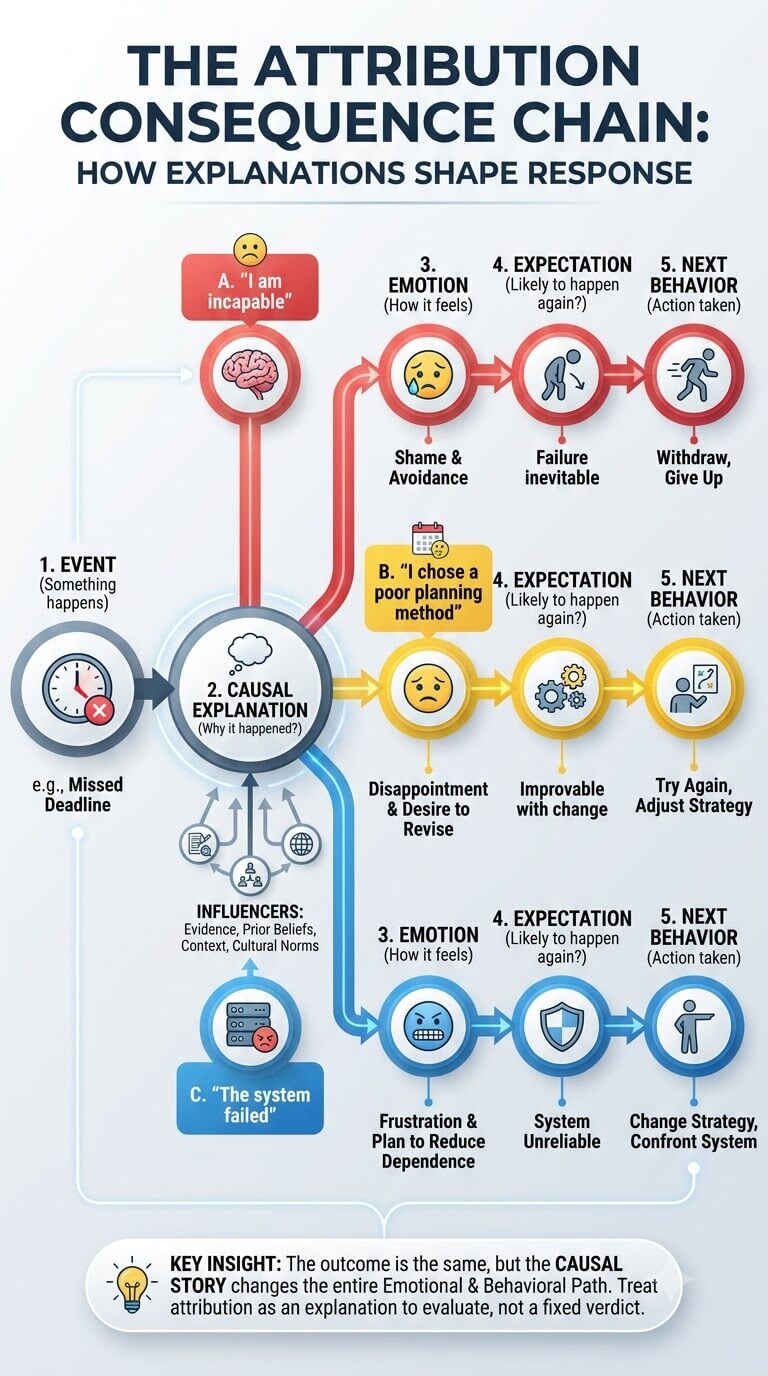
Event → causal explanation → emotion → expectation → next behavior
A useful way to understand attribution is as a five-part chain:
- Event: Something happens.
- Causal explanation: You decide, consciously or quickly, why it happened.
- Emotion: The explanation changes how the event feels.
- Expectation: The cause suggests whether the same thing is likely to happen again.
- Next behavior: You act on that meaning, perhaps by trying again, withdrawing, confronting someone, asking questions, or changing strategy.
The APA Dictionary of Psychology description of attribution theory places attribution within the study of how people infer personal or situational causes for behavior. The consequence chain extends that basic idea into everyday life: the cause you believe often changes the response that seems justified.
Consider a missed deadline. “I am incapable” may produce shame and avoidance. “I chose a poor planning method” may produce disappointment plus a desire to revise the method. “The system failed at the final hour” may produce frustration and a plan to reduce dependence on that system. The outcome is the same, but the causal story changes the emotional and behavioral path. The consequence chain begins with a causal judgment inside the broader attribution process.
Where evidence, prior beliefs, and context enter the chain
The chain does not begin with perfect information. People interpret events using incomplete evidence, previous experiences, expectations about others, cultural norms, and current emotional states. A person who has repeatedly been let down may interpret ambiguity differently from someone with a long history of reliable interactions.
Context can also change the plausibility of a cause. A coworker arriving late during a citywide transit shutdown means something different from arriving late every day despite repeated reminders. A partner forgetting one task during a family emergency means something different from repeatedly agreeing to tasks and never following through.
This is why attribution should be treated as an explanation to evaluate, not a verdict that becomes true because it feels convincing.
Why the Cause You Choose Changes the Feeling

Internal and controllable causes
When a negative outcome is attributed to something inside the person and realistically controllable, emotions can include guilt, frustration, regret, or determination. “I skipped preparation even though I had time” is more likely to invite personal responsibility than “the building lost power.”
That does not make guilt mandatory or prove full responsibility. An internal cause may be only one contributor among several. The useful distinction is that a controllable personal cause gives the person something specific to review or change.
External and uncontrollable causes
When an outcome is attributed to circumstances outside realistic control, blame may decrease and sympathy may increase. A canceled flight, sudden illness, equipment failure, or unexpected rule change can alter results without saying much about someone’s motivation or character.
External attribution can also produce frustration, helplessness, or anger at the situation. “Not my fault” does not automatically mean “not upsetting.” It simply changes where responsibility is located and what kind of response makes sense.
Intentional versus accidental causes
Perceived intention often changes social emotion more sharply than simple cause location. If someone bumps into you because they were pushed from behind, the physical result may be identical to someone deliberately shoving you, yet the second interpretation is more likely to invite anger and confrontation.
Research on moral emotion has found that anger responds strongly to cues about harm and intentionality. In one set of studies, perceived intentionality was associated with stronger moral anger. That does not mean anger proves intent. It means perceived intent can become an important input to anger.
Stable versus temporary causes
A cause believed to be stable can turn one event into a prediction. “The client changed the brief this week” suggests a temporary problem. “This client always changes requirements at the last minute” suggests recurrence. “I am simply bad at this kind of work” may sound even more stable because the proposed cause is located in the self.
Temporary causes often leave more room for a different result next time. Stable causes can lower that expectation, although they do not automatically mean nothing can change.
Controllability and Reactions to Responsibility
When controllable personal causes may increase guilt or determination
Suppose a student fails after choosing not to prepare despite having adequate time and resources. If the student attributes the outcome to that decision, guilt may appear because the cause feels personal and preventable. The same attribution can also support determination: “I know what I need to do differently.”
Weiner’s influential attributional theory of achievement motivation and emotion proposed that perceived causal dimensions such as stability and controllability help organize emotional and expectancy reactions after success and failure.
The productive part of a controllable attribution is specificity. “I need to change how I prepare” identifies a behavior. “I am a failure” turns an event into an identity judgment and adds information the outcome does not establish.
When uncontrollable causes may increase sympathy or reduce blame
Imagine a colleague misses an important meeting because a close family member was taken to hospital unexpectedly. If others understand the cause as outside realistic control, they may feel more sympathy and assign less personal blame than if they believe the colleague simply chose not to attend. Other-directed blame becomes more likely when a cause is interpreted as intentional and controllable.
This pattern is not universal. People may still feel disappointed, inconvenienced, or angry about consequences. The key distinction is that emotional response to impact can coexist with a different judgment about responsibility.
Why controllability is rarely all-or-nothing
Real situations often contain partial control. A person cannot control a storm, but may be able to make backup plans. Someone cannot control another person’s reaction, but may control whether they communicate clearly. A worker may influence preparation but not staffing levels, discrimination, changing requirements, or a manager’s final decision.
Personal agency is most useful when it is grounded in those real options. Treating every outcome as fully controllable can create unfair blame. Treating every difficult condition as completely uncontrollable can hide meaningful choices. Attribution works better when influence is divided rather than forced into an all-or-nothing category. Self-protective attribution adds another layer when a causal judgment also helps the observer feel less vulnerable.
Intentionality and Social Emotion
Intentional harm and anger
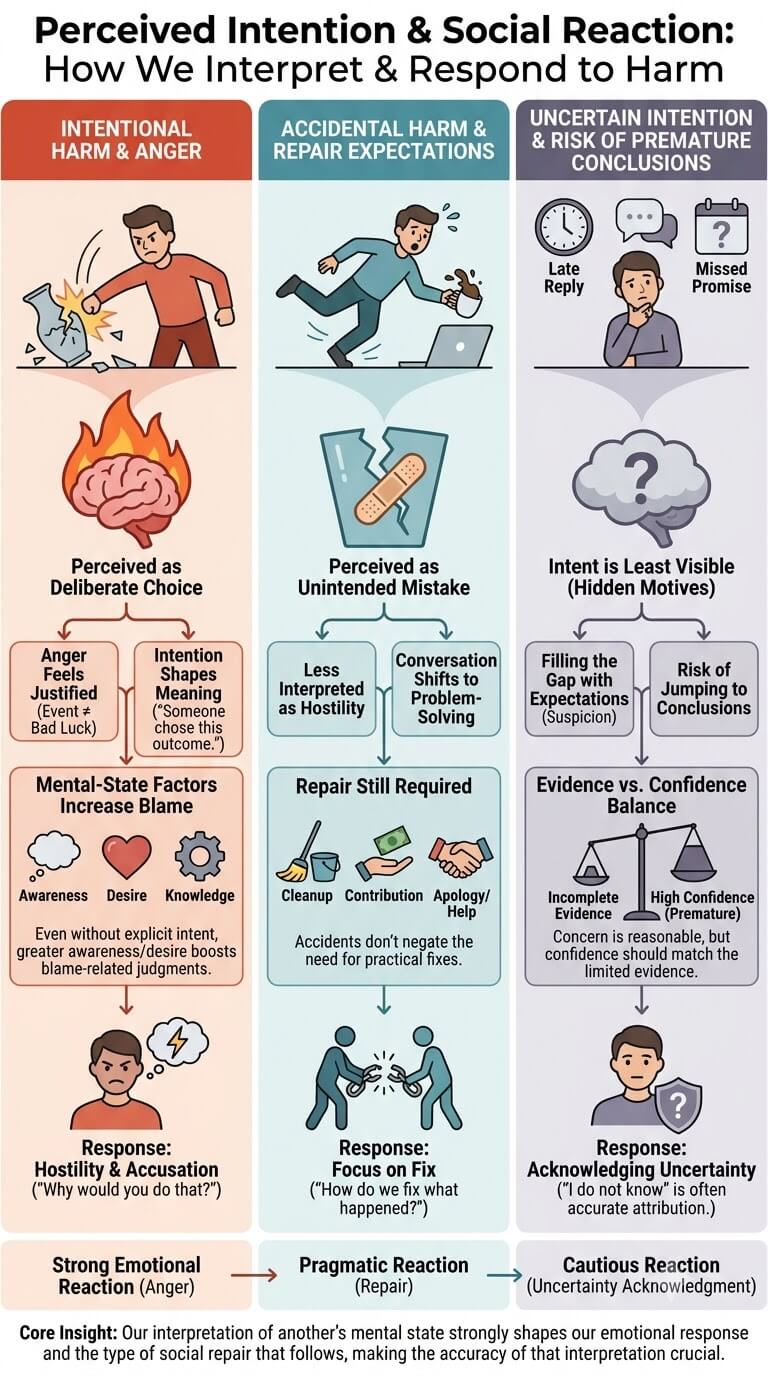
When people believe another person meant to cause harm, anger often feels more justified because the event is no longer interpreted as bad luck or carelessness. Intention changes the social meaning from “something went wrong” to “someone chose this outcome.”
Studies of blame also show that people consider mental-state information such as awareness, desire, and knowledge when judging harmful actions. Research on unintended harm and perceived mental states found that greater awareness or desire increased anger and blame-related judgments in the tested scenarios even when the harmful outcome was not explicitly intended. The important point is not that intent is easy to infer, but that our interpretation of another person’s mental state can strongly shape the emotional response.
Accidental harm and different repair expectations
An accident can still require repair. If a friend spills coffee on your laptop by tripping, you may still expect an apology, help with cleanup, or contribution to replacement costs. The difference is that you are less likely to interpret the act as hostility.
This changes the conversation. Instead of “Why would you do that to me?” the useful question may be “How do we fix what happened?” Causal explanation affects not only emotion but the type of repair that seems appropriate.
Uncertain intention and the risk of premature conclusions
Intent is often the least visible part of an interpersonal event. You can observe a late reply, an interrupted sentence, a missed promise, or a sharp tone, but you cannot directly observe the other person’s motive. Under uncertainty, people may fill the gap with the explanation that best fits prior expectations.
This is where suspicion psychology becomes relevant. Concern about hidden motives can be reasonable when evidence is incomplete, but confidence should match the evidence. “I do not know whether this was intentional” is sometimes the most accurate attribution available.
Stability and Expectations About Change
Stable negative causes and lower expectations
Stability matters because people use causes to forecast the future. If an employee thinks, “My manager gives unclear instructions every week,” the next project may already feel risky. If a student concludes, “I do not have the ability required for this subject,” another attempt may seem less worthwhile.
A large meta-analysis of attribution research in achievement contexts found support for a cognition-expectancy-action sequence in which causal dimensions relate to behavioral adjustment through psychological consequences. The findings also showed substantial variation across studies, a reminder that attribution is one influence among many rather than a complete explanation of behavior.
Temporary causes and willingness to try again
A temporary explanation makes the previous outcome less predictive. “I used an ineffective study method” can invite another attempt with a new method. “I was unusually exhausted that day” suggests conditions may differ next time.
But temporary does not automatically mean controllable. A random equipment failure may be temporary yet impossible to prevent. The next action may be another attempt with a backup plan rather than greater effort.
Why stable explanations can be accurate without being hopeless
Some stable causes are real. A chronic skill gap, a fixed regulation, a long-term caregiving responsibility, or a consistently difficult environment may genuinely affect repeated outcomes. Calling the cause stable is not automatically pessimistic.
Stability answers “Is this likely to remain relevant?” It does not answer “Is there nothing I can do?” A stable external constraint may call for adaptation. A stable skill gap may call for learning. A stable harmful pattern in another person may call for firmer boundaries rather than endless attempts to reinterpret it positively.
Attribution After Success
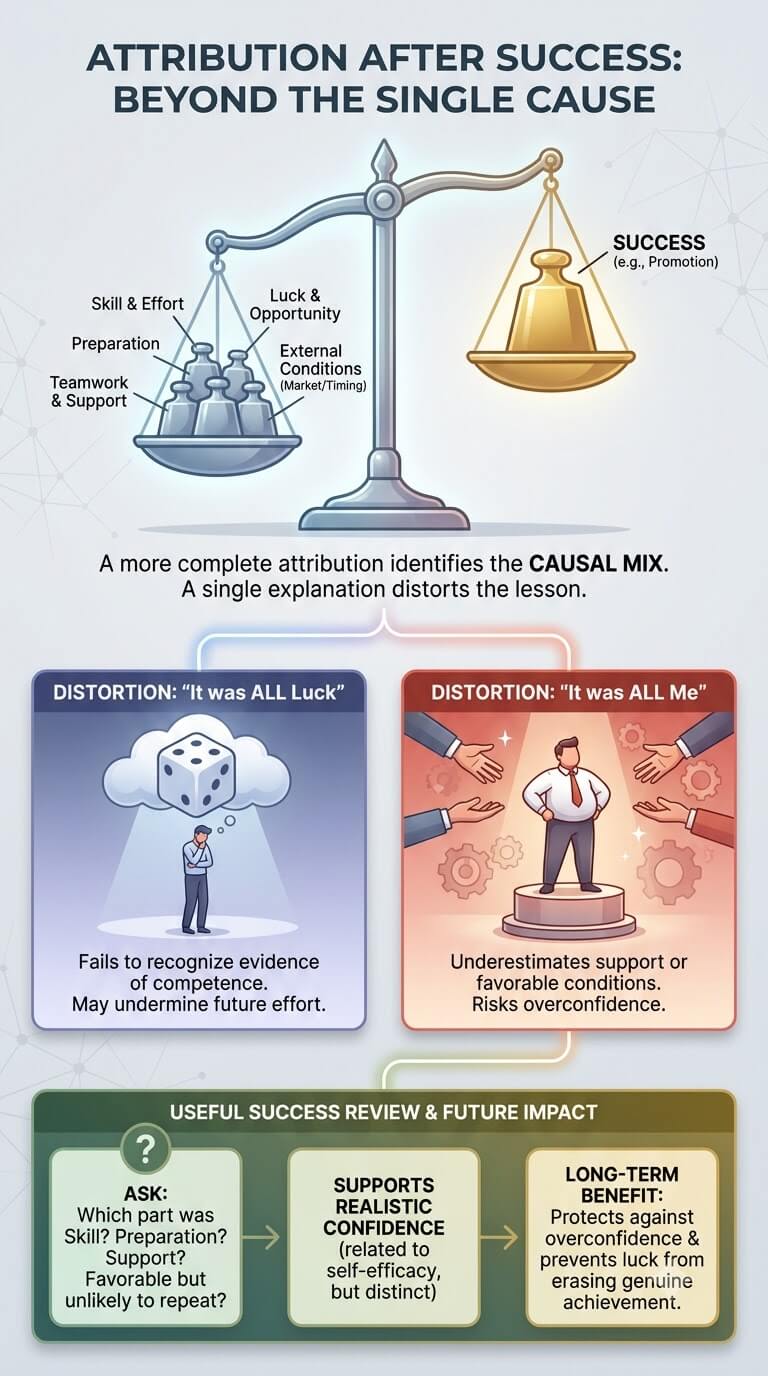
Skill, effort, teamwork, luck, and opportunity
Success also needs explanation. A promotion may reflect skill, preparation, a supportive team, timing, market conditions, and opportunity at once. Giving all credit to one cause can distort the lesson.
If someone attributes every success to luck, they may fail to recognize evidence of competence. If they attribute every success entirely to themselves, they may underestimate support or favorable conditions. A more complete attribution identifies the causal mix.
How explanations influence confidence and future preparation
Success attributed to repeatable skill or preparation may support confidence because the person can see what contributed. That is related to, but not identical with, self-efficacy, which concerns belief in one’s ability to perform a specific action.
A useful success review asks: Which part came from skill? Which part came from preparation? What support mattered? What was favorable but unlikely to repeat? This protects confidence from becoming overconfidence and prevents luck from erasing genuine achievement.
Attribution After Failure
Ability, strategy, effort, task conditions, and chance
Failure can be explained through many causes. “I lack the ability” points toward competence. “My strategy was wrong” points toward method. “I did not prepare enough” points toward effort. “The task requirements changed” points toward conditions. “The equipment failed randomly” points toward chance.
These explanations differ in locus, stability, and controllability, so they suggest different emotional reactions and different next steps. The goal is not to pick the explanation that feels best. It is to identify the one that fits the evidence closely enough to guide a useful response.
How the same failure can produce withdrawal, anger, persistence, or revision
Imagine three people receiving the same rejected proposal:
- Stable ability explanation: “I am not good enough for this kind of work.” The person may withdraw because future success seems unlikely.
- Changeable strategy explanation: “My proposal did not answer the decision criteria clearly.” The person may revise and resubmit elsewhere.
- External unfairness explanation: “The process was biased.” The person may feel anger and challenge the process, seek evidence, or decide not to participate again.
Any of the three explanations could be accurate, inaccurate, or incomplete. Behavior becomes more sensible when the attribution has been tested rather than simply obeyed.
Relationship Example: Same Event, Different Attribution
Late reply interpreted as indifference, overload, or accident
Situation: You send a message about an important weekend plan at noon. By 7 p.m., there is no reply.
| Attribution | Likely emotional direction | Likely next behavior |
|---|---|---|
| “They do not care enough to answer.” | Hurt, anger | Accusatory message, withdrawal, scorekeeping |
| “They may be overwhelmed at work.” | Concern, patience | Wait, send a practical follow-up |
| “Something may have happened.” | Uncertainty, concern | Check in without assuming motive |
| “They always ignore me when plans matter.” | Resentment, lower expectation | Raise the repeated pattern rather than debate one reply |
What you may feel: each explanation makes a different emotion feel reasonable.
What it may mean: one delayed reply gives limited evidence about motive. A repeated pattern gives more information about reliability, although motive may still remain uncertain.
What to do next: match your response to what you actually know. If this is one ambiguous event, ask for clarity. If it is a repeated pattern with clear consequences, discuss the pattern and follow-through rather than arguing over hidden intent.
How attribution changes the next message and conflict trajectory
Compare these two messages:
Intent assumed: “You clearly do not care enough to answer me when something matters.”
Observation plus question: “I did not hear back about the weekend plan, and I need to confirm tonight. Are you tied up, or did you miss the message?”
The second version does not require pretending everything is fine. It simply leaves room for information before assigning motive. If the person responds, “I saw it and decided your plans were not important,” the attribution can become firmer because new evidence has arrived.
Achievement Example: Same Result, Different Next Step
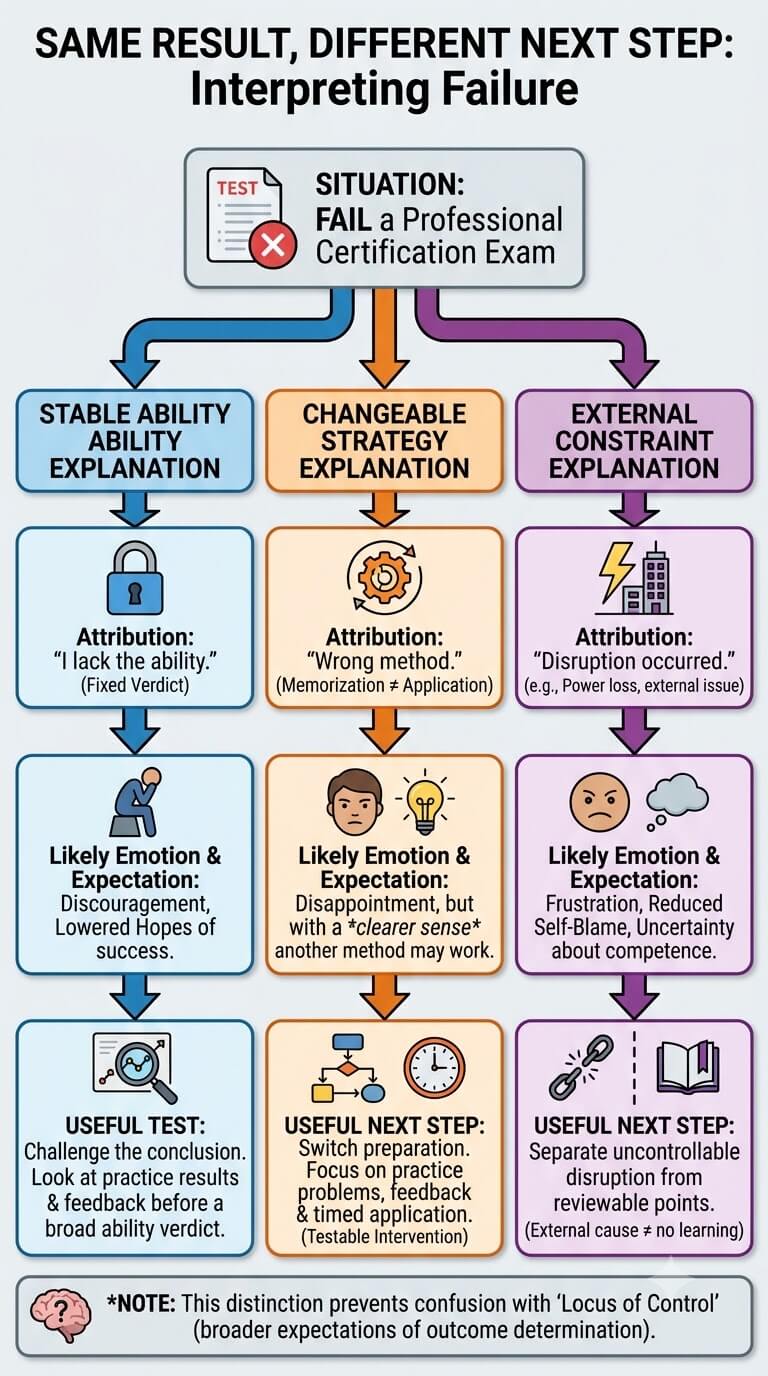
Stable ability explanation
Situation: You fail a professional certification exam.
Attribution: “I do not have the ability for this field.”
Likely emotion and expectation: discouragement, embarrassment, and lower expectation that another attempt will work.
Useful test: look at practice results, prerequisite knowledge, feedback, and performance across different task types before turning one result into a broad ability conclusion.
Changeable strategy explanation
Attribution: “I memorized definitions, but the exam required application.”
Likely emotion and expectation: disappointment with a clearer sense that another method may change the result.
Useful next step: switch preparation toward practice problems, feedback, and timed application. The attribution creates a testable intervention rather than a verdict about identity.
External constraint explanation
Attribution: “The testing center lost power halfway through and the rescheduled section affected my performance.”
Likely emotion and expectation: frustration, perhaps reduced self-blame, with uncertainty about whether the result reflects competence.
Useful next step: separate the uncontrollable disruption from anything still worth reviewing. An external cause does not mean no learning is possible, and an internal cause does not mean the whole outcome was personally controlled. This distinction also prevents confusion with locus of control, which concerns broader expectations about what tends to determine outcomes.
Attribution Consequences vs Attribution Accuracy
A useful feeling does not prove the explanation is true
An explanation can motivate useful behavior and still be wrong. Anger might push someone to set a needed boundary, but anger does not prove the other person’s harmful intent. Confidence might encourage another attempt, but confidence does not prove the previous failure was only bad luck.
Emotions provide information about how you are interpreting an event. They are not a laboratory test for causality.
An uncomfortable explanation may still fit the evidence
Sometimes the accurate attribution is uncomfortable. You may discover that poor preparation really did contribute to failure. A team may have to admit that unclear roles caused repeated mistakes. A relationship may contain a repeated behavior that cannot be explained away as one misunderstanding.
Cognitive biases can influence which evidence receives attention, but applying a bias label too quickly can create another shortcut. A better standard is evidence: What happened repeatedly? What alternative causes fit? What information would change the conclusion?
A Five-Question Pause Before Acting on an Attribution
What cause am I assuming?
State the explanation in one sentence. “They ignored me because they do not care.” “I failed because I lack ability.” “The project succeeded because I got lucky.” Naming the attribution turns an invisible assumption into something you can inspect.
How certain am I?
Give your confidence a rough level: low, medium, or high. Then ask what evidence justifies that level. Direct statements, repeated behavior, records, and observable conditions usually support stronger conclusions than guesses about motive.
Is the cause controllable, stable, or intentional?
These properties matter because they change the response. A stable cause affects expectations. A controllable cause may suggest a change in behavior. An intentional cause can alter blame and social emotion. If you are uncertain about one dimension, keep it uncertain.
What emotion does this explanation generate?
Notice the emotional direction without using it as proof. Does the attribution make you angry, ashamed, relieved, guilty, sympathetic, or resigned? The emotion may reveal what the causal story implies about responsibility and the future.
What alternative explanation would change my next action?
Generate one plausible alternative, not ten remote possibilities. If “they ignored me” leads to confrontation, would “they missed the message” lead to a question first? If “I am incapable” leads to withdrawal, would “my strategy was mismatched” lead to another test?
The point is not to talk yourself out of a serious conclusion. It is to make sure the next action is not resting on a cause you have never examined.
Where Attribution Style and Weiner’s Theory Fit
Repeated explanation patterns
One attribution is an explanation for one event. Over time, people may develop recurring ways of explaining setbacks and successes. Someone who repeatedly interprets setbacks as lasting and broadly self-defining may begin to expect failure across situations. Someone who always assigns success to luck may discount evidence of competence.
Those recurring tendencies are different from the immediate consequence chain in this article, but they matter because repeated explanations can make certain emotions and expectations more familiar. Repeated attribution patterns can make certain emotions, expectations, and responses more familiar over time.
Locus, stability, and controllability as one mechanism lens
Weiner’s framework provides a more formal way to examine why certain causes produce different downstream effects. Locus asks whether the cause is internal or external, stability asks whether it is likely to persist, and controllability asks how much realistic influence is available.
Those dimensions are useful because they explain why “I lack ability,” “I used the wrong strategy,” and “the task was unusually difficult” can lead to different expectations even when all three follow the same failure. They do not replace the need to check evidence, context, intention, and other causes.
FAQ About Attribution, Emotion, and Behavior
These questions focus on the gap between what an explanation makes us feel and what the available evidence actually establishes.
Why does perceived intention change anger so much?
Intent changes the social meaning of an outcome. Accidental harm suggests that something went wrong, while intentional harm suggests that another person chose or accepted the harmful result. Research indicates that anger is sensitive to perceived intention, but that does not make anger proof of intention. When motive is unclear, it is worth separating observable behavior from the mental state you are inferring.
Can an uncontrollable attribution reduce motivation?
It can, especially when the uncontrollable cause is also expected to remain stable and block future attempts. But uncontrollable does not always mean “give up.” A person may adapt, seek support, change environments, reduce exposure, or work around the constraint. Motivation depends on more than attribution, including available options, goals, resources, and confidence.
Do temporary explanations always increase persistence?
No. A temporary cause may still be costly, unpredictable, or outside control. “The system failed randomly” is temporary but may not create confidence unless there is a backup plan. Temporary explanations simply make the previous outcome less certain as a forecast. Whether someone persists depends on what options remain and whether another attempt seems worthwhile.
Can changing an attribution change behavior immediately?
Sometimes a new explanation changes the next action quickly, especially when it identifies a specific controllable factor. But changing words does not automatically change habits, skills, resources, or relationships. A revised attribution is most useful when it leads to a testable behavior, such as asking for clarification, changing preparation, or gathering better evidence.
How can I test an attribution before reacting?
Name the assumed cause, rate your certainty, separate observable facts from inferred motive, check whether the cause is stable or controllable, and identify one plausible alternative. Then ask what evidence would distinguish between the explanations. If the issue involves repeated harmful behavior, focus on the behavior and its impact even when motive remains uncertain.
Key Takeaways
- Attributions matter because causal explanations change the emotional meaning of an event, expectations about what comes next, and the behavior that feels reasonable.
- Perceived controllability can affect guilt, sympathy, blame, and determination, but realistic control is often partial rather than all-or-nothing.
- Perceived intention can intensify anger, yet emotional intensity does not prove that the inferred motive is accurate.
- Stable causes can lower expectations for change, while temporary causes make the previous outcome a weaker predictor of the next one.
- Success and failure usually have multiple causes, so useful explanations should include skill, effort, context, support, chance, and constraints where the evidence supports them.
- Before acting on an attribution, name the assumed cause, check your certainty, notice the emotion it creates, and ask what alternative explanation would meaningfully change your next step.
About the author: Michael Reed is the Founder & Lead Writer at Psychology Exposed. His work translates research on human behavior, relationships, and self-awareness into practical explanations for general readers. This article is for education and reflection, not individual diagnosis or professional treatment.

Michael Reed is the Founder and Lead Writer at Psychology Exposed. He writes about human behavior, relationships, emotional patterns, self-awareness, and practical psychology topics using research-informed, easy-to-understand content.
Read More About Michael Reed: https://psychologyexposed.com/michael-reed/