

When something goes wrong, assigning blame can feel almost automatic. A missed deadline becomes “they were careless.” A tense conversation becomes “they wanted to provoke me.” A failed group project becomes “the others did not do their part.” Sometimes those explanations are accurate. Other times, they leave out context, exaggerate intention, or protect us from looking at our own contribution.
Psychologically, blaming another person often involves an external attribution, an explanation that places an important cause outside the self. But external attribution is not the same as unfair blame. Another person may genuinely be responsible for a harmful choice. The more useful question is how we move from observable behavior to conclusions about cause, intention, character, and accountability, and whether each step is supported by evidence.
Quick Answer
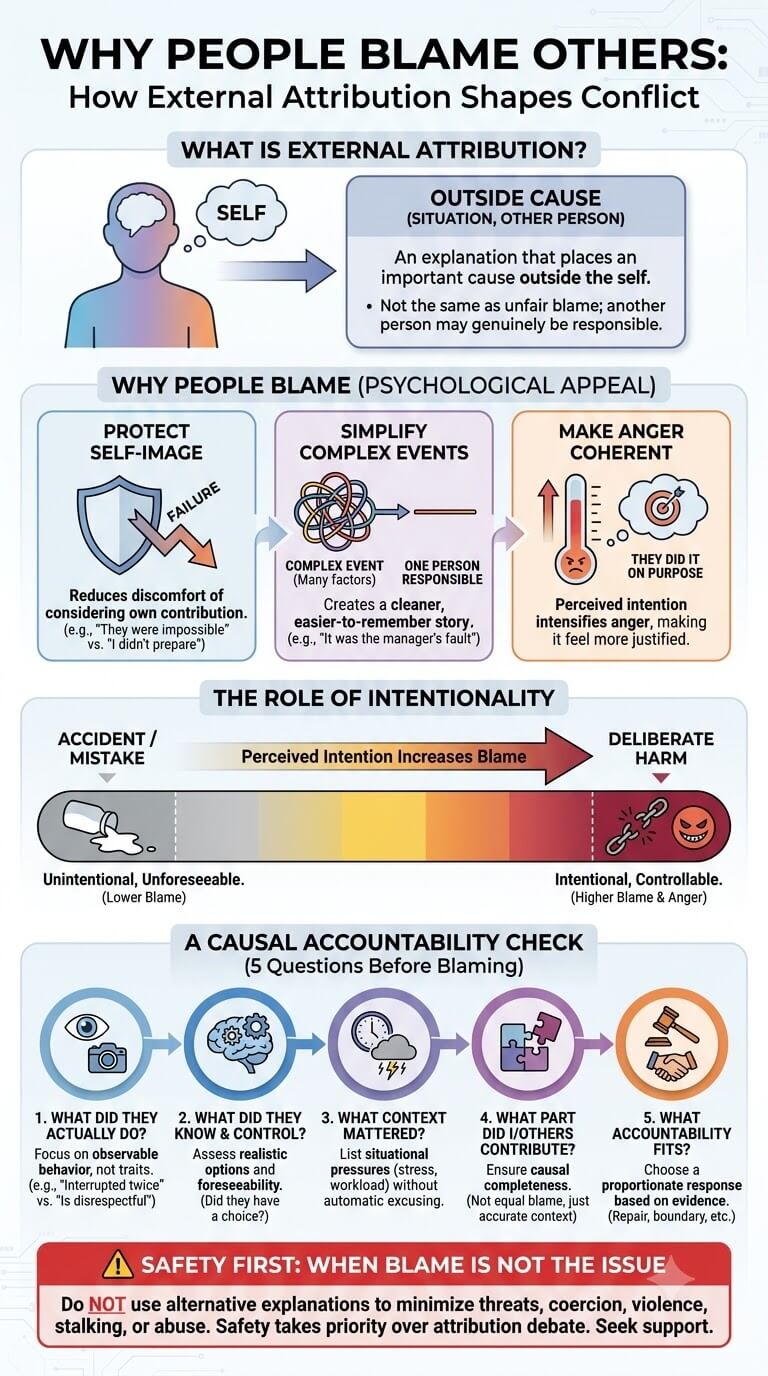
People may blame others because external explanations protect self-image, simplify a complex event, or make anger feel more coherent. Blame also increases when another person’s behavior seems intentional, controllable, or foreseeable. Sometimes that judgment is accurate. The goal is not to avoid blame at all costs, but to separate observable behavior, causal contribution, intention, context, and accountability so that responsibility is neither exaggerated nor erased.
Blaming Others as a Causal Explanation
External attribution toward another person’s actions or choices
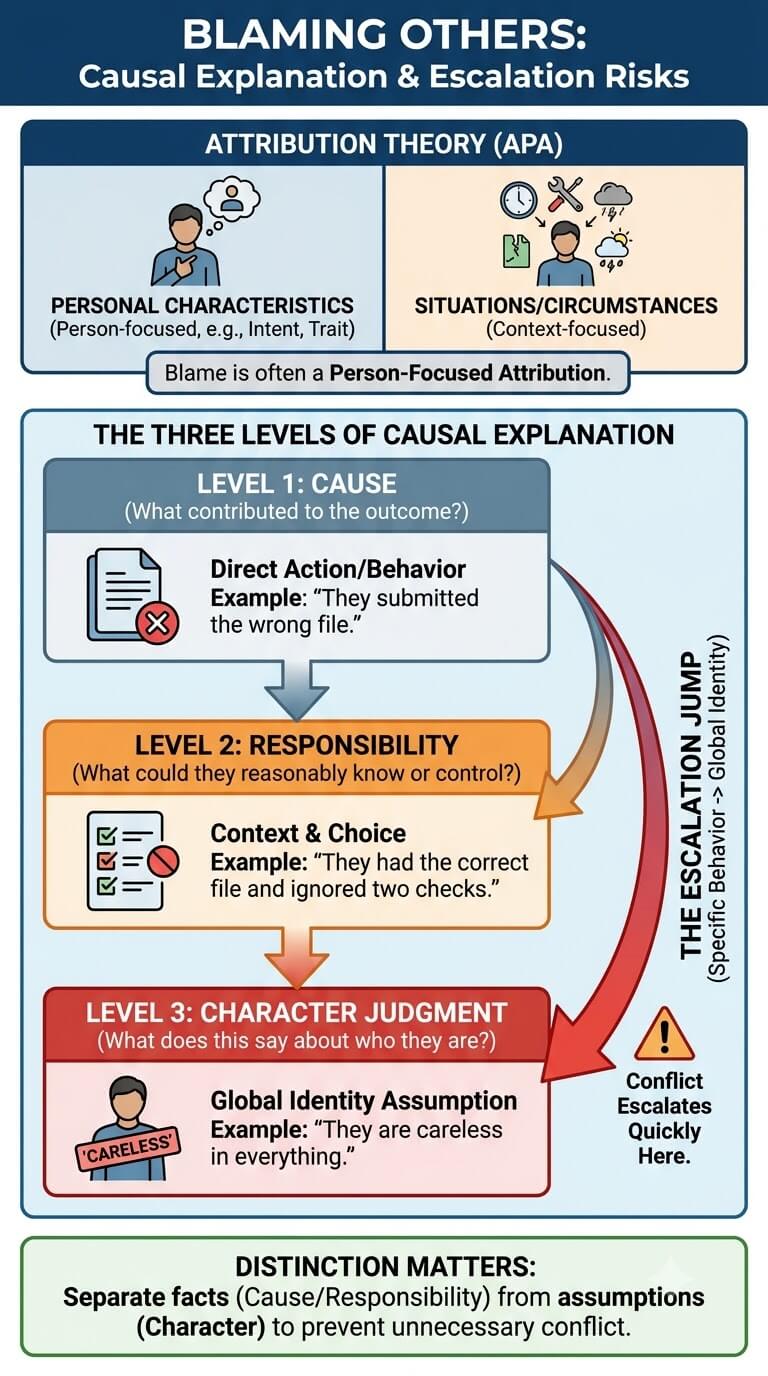
Attribution concerns how people explain causes. The APA Dictionary of Psychology description of attribution theory distinguishes explanations located in personal characteristics from explanations located in situations and circumstances. When we blame another person, we often make a person-focused attribution: “The problem happened because of what they chose, intended, failed to do, or are like.”
That conclusion may be justified. If a coworker knowingly deletes required data, their action belongs in the causal chain. If a partner repeatedly breaks an agreement after clearly understanding it, their choices matter. The difficulty begins when “their behavior contributed” becomes “they caused everything,” or when one action becomes proof of a fixed character trait. Blaming another person is one route causal reasoning can take within the broader psychology of attribution.
Cause, responsibility, and character judgment are different levels
It helps to separate three levels:
| Level | Question | Example |
|---|---|---|
| Cause | What contributed to the outcome? | They submitted the wrong file. |
| Responsibility | What could they reasonably know or control? | They had the correct file and ignored two checks. |
| Character judgment | What does this say about who they are? | They are careless in everything. |
The first two can sometimes be supported by direct evidence. The third usually requires a broader pattern. This distinction matters because conflict often escalates when a specific behavior is converted too quickly into a global identity judgment.
Why External Blame Can Be Psychologically Appealing
Protecting self-image after a negative outcome
Blaming someone else can reduce the discomfort of considering our own contribution. If a presentation fails, “the client was impossible” may be easier to tolerate than “I did not prepare for the most likely objection.” If a friendship deteriorates, “they are selfish” may feel simpler than examining whether both people stopped communicating clearly.
Self-protection does not mean the external cause is false. The client may truly have changed expectations repeatedly. The friend may genuinely have acted selfishly. The question is whether the explanation includes all supported causes or only the causes that protect the self.
Reducing uncertainty by naming one responsible person
Complex events are mentally demanding. A failed launch may involve unclear ownership, bad timing, technical problems, weak decisions, missing information, and market conditions. Naming one person can create a cleaner story: “It was the project manager’s fault.”
Cleaner stories are easier to remember and act on, but they may be causally incomplete. A useful attribution asks whether removing that one person’s action would actually have prevented the outcome, and what other conditions were still necessary.
Preserving a simple story when the causal chain is complex
People often prefer causes that are easy to identify. A visible mistake by one person may attract more blame than less visible system failures that made the mistake more likely. This is especially common when we know little about the context behind another person’s behavior.
That is one reason cognitive biases in everyday judgment can matter when blame feels immediate. A strong first explanation may be psychologically efficient without being complete.
Perceived Intentionality Changes the Meaning of the Same Outcome
Deliberate harm, negligence, mistake, and accident
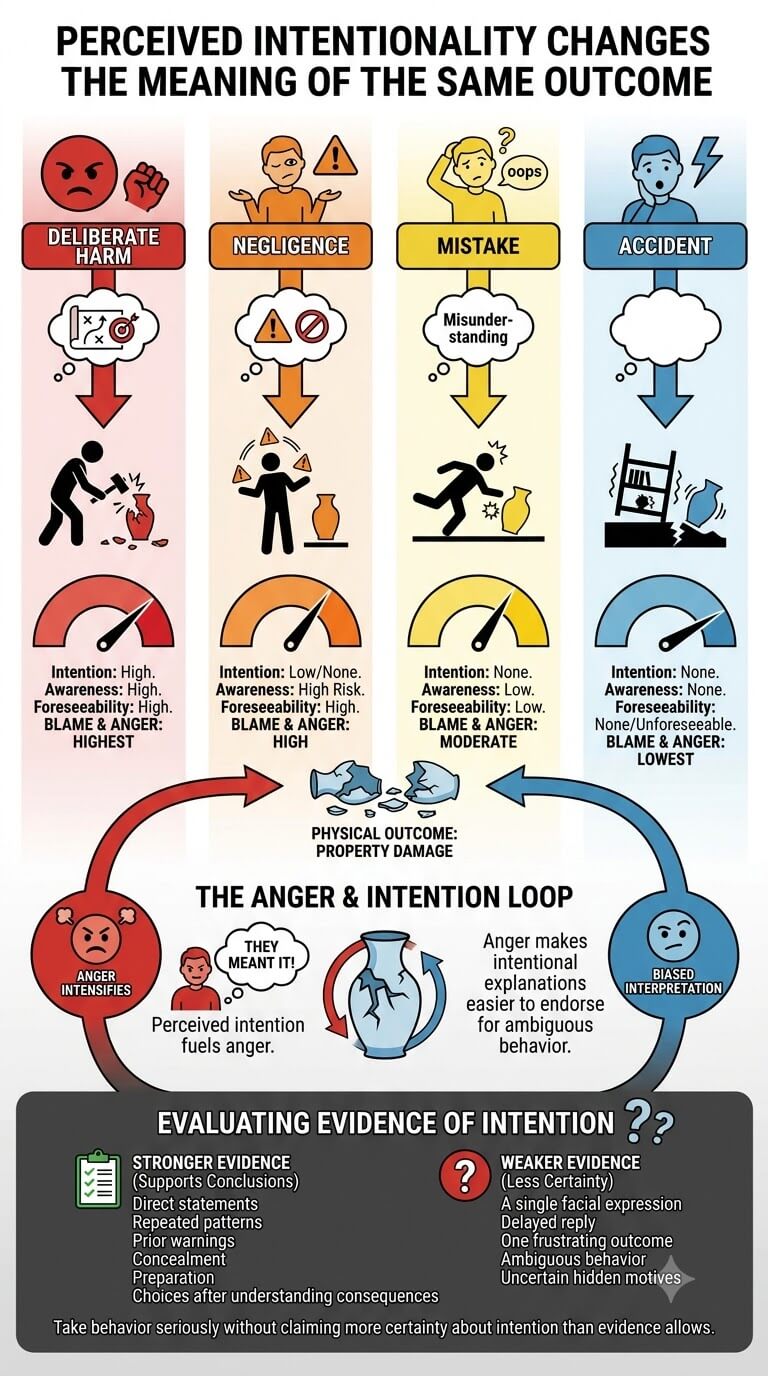
Imagine four versions of the same outcome: someone damages your property. In the first, they do it deliberately. In the second, they know there is a serious risk and proceed carelessly. In the third, they make a reasonable mistake. In the fourth, an unforeseeable accident occurs.
The physical outcome may be similar, but responsibility feels different because intention, awareness, and foreseeability differ. Research on blame shows that these mental-state judgments influence how people assign responsibility. In experimental work on intentionality, foreseeability, cause, and blame, intentional actions and more foreseeable outcomes received stronger causal and blame judgments than unintentional or less foreseeable events.
Why inferred intention can intensify anger
Anger often rises when we believe another person meant to create the problem or knowingly accepted the risk. A late response interpreted as “they forgot” may be irritating. The same delay interpreted as “they wanted to make me wait” can feel insulting. How attributions influence emotion and behavior helps explain why the same event can lead to anger, sympathy, confrontation, or restraint.
There is also evidence that anger itself can influence how ambiguous behavior is interpreted. One study found that anger increased intentionality judgments for ambiguous actions in the tested experiments. That finding is important because the relationship can run both ways: perceived intention can intensify anger, and anger may make intentional explanations easier to endorse.
What evidence actually supports an intention claim?
Before moving from behavior to motive, ask what evidence exists. Direct statements, repeated patterns, prior warnings, concealment, preparation, and choices made after understanding likely consequences can support stronger conclusions. A facial expression, delayed reply, or one frustrating outcome usually provides less certainty.
Suspicion becomes especially relevant when hidden motives are uncertain. It is possible to take a behavior seriously without claiming more certainty about intention than the evidence allows.
The Context Gap
You know your constraints better than another person’s
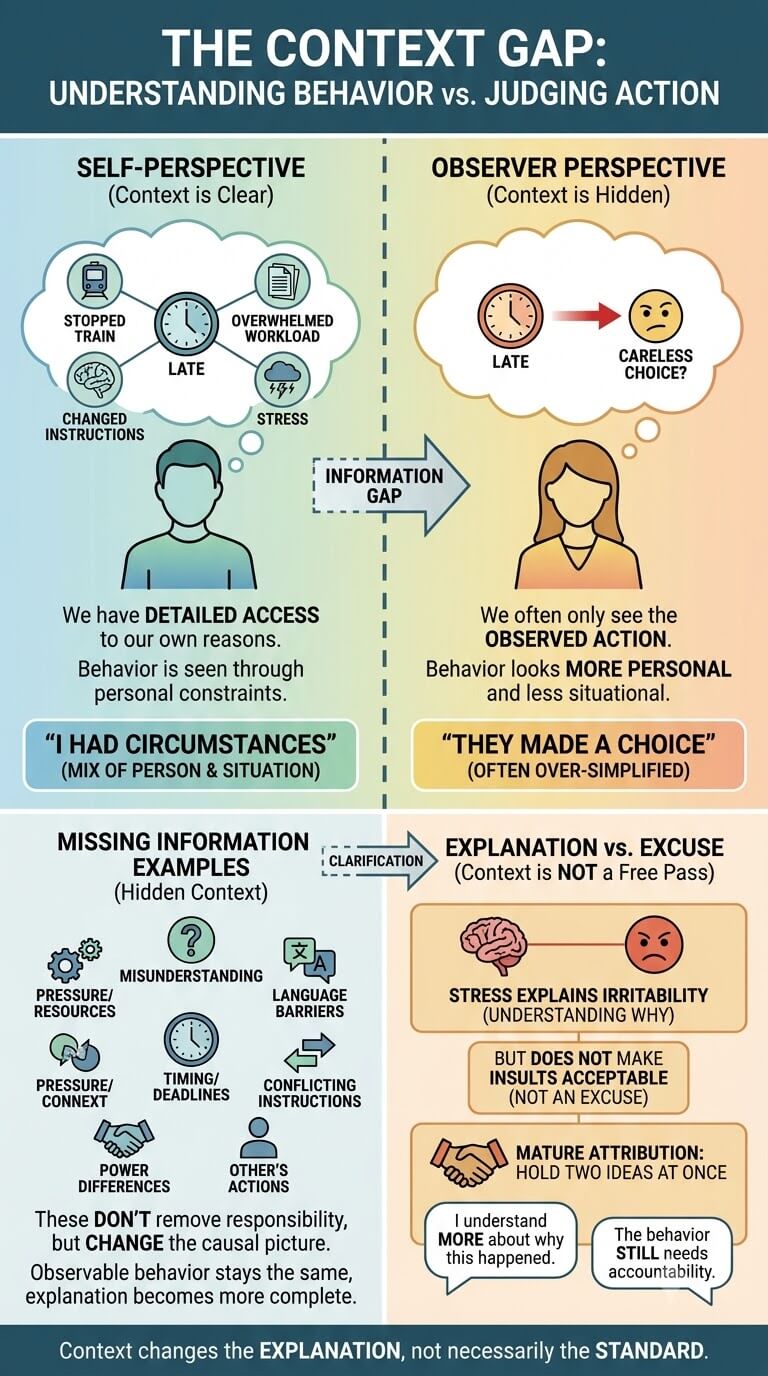
People have detailed access to their own reasons. You know that you were late because the train stopped, that your tone was sharp because you were overwhelmed, or that you missed a detail because the instructions changed. When someone else behaves similarly, you may see only the action.
This information gap can make other people’s behavior look more personal than our own. “I had circumstances” and “they made a choice” can become an uneven comparison even when both cases contained a mix of person and situation causes.
Missing information about pressure, resources, misunderstanding, or timing
Context can include workload, conflicting instructions, health limitations, language barriers, misunderstanding, power differences, missing resources, timing, incentives, or another person’s actions. None of these automatically remove responsibility. They simply change the causal picture.
Suppose a coworker misses a handoff. If they forgot despite clear instructions and adequate time, accountability may be straightforward. If three managers gave contradictory deadlines, the same missed handoff has a different causal structure. The observable behavior stays the same, but the explanation becomes more complete.
Why context can explain behavior without excusing it
Explanation and excuse are not synonyms. Stress can explain why someone became irritable without making insults acceptable. Poor training can explain an error while the organization still needs to correct the damage. Fear can explain avoidance without making every consequence irrelevant.
A mature attribution can hold two ideas at once: “I understand more about why this happened” and “the behavior still needs accountability.” Context changes the explanation, not necessarily the standard.
Responsibility Shifting
When external attribution protects the self from accountability
External blame becomes defensive when it is used to remove every personal contribution. “The instructions were bad” may be true, but did you also fail to ask a question you knew was necessary? “They made me angry” describes an emotional trigger, but did you still choose what you said next?
A useful sign of responsibility shifting is that every negative outcome has a different external cause, while your own behavior is never included. The pattern is not proof that the external causes are imaginary. It suggests the causal review may be incomplete.
Signs that one’s own contribution is being omitted
Look for statements such as:
- “I had no choice,” when several realistic options existed.
- “They made me do it,” when the final action was still voluntary.
- “Anyone would have reacted that way,” used to erase responsibility for the specific reaction.
- “The whole thing was because of them,” when several independent causes were involved.
- “Their behavior proves I did nothing wrong,” as though two people’s responsibilities cancel each other out.
These phrases do not automatically indicate dishonesty. People often simplify events when they are angry or defensive. The value is in reopening the causal chain.
How to add self-contribution without creating false equivalence
Adding your own contribution does not require pretending both sides were equally responsible. You might conclude, “I communicated poorly, and they also lied about a major fact.” Those are two separate behaviors with different weight.
False equivalence is especially dangerous when one person’s behavior involves coercion, threats, violence, stalking, or deliberate exploitation. In those situations, acknowledging a communication mistake by the harmed person does not make them responsible for someone else’s abusive choice.
When Blaming Another Person Is Accurate
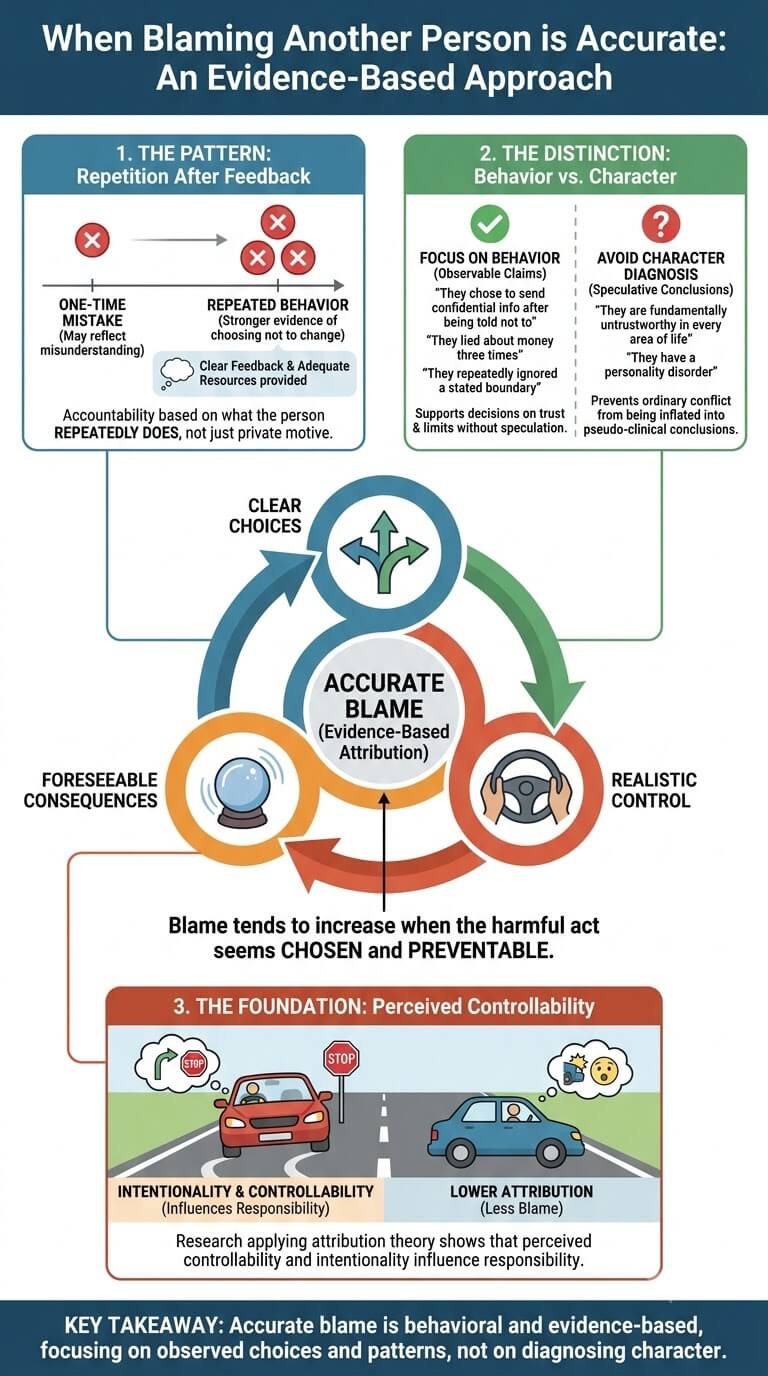
Clear choices, foreseeable consequences, and realistic control
Blame can be evidence-based when another person had meaningful control, understood the likely consequence, and chose the behavior anyway. Research applying attribution theory to driving found that perceived controllability and intentionality influenced responsibility and anger in roadway scenarios. The broader point is that blame tends to increase when the harmful act seems chosen and preventable.
This does not require certainty about personality. “They chose to send confidential information after being told not to” may be well supported. “They are fundamentally untrustworthy in every area of life” requires more evidence.
Repeated behavior after feedback
Repetition changes the attribution picture. A one-time mistake may reflect misunderstanding or inexperience. The same behavior repeated after clear feedback, adequate resources, and specific agreements provides stronger evidence that the person is choosing not to change that behavior.
At that point, focusing endlessly on alternative explanations can become less useful than evaluating the pattern. Accountability can be based on what the person repeatedly does, even when their private motive remains uncertain.
Harmful conduct can be accurately attributed without diagnosing character
You do not need a personality label to take behavior seriously. “They lied about money three times,” “they threatened retaliation,” or “they repeatedly ignored a stated boundary” are observable claims. They can support decisions about trust, limits, or distance without speculating about a diagnosis.
This distinction helps keep blame behavioral and evidence-based. It also prevents ordinary conflict from being inflated into pseudo-clinical conclusions.
Accountability vs Global Character Judgment
“They did this” versus “they are this kind of person”
Behavior statements are narrower: “They interrupted me repeatedly in that meeting.” Character judgments are broader: “They are disrespectful.” Sometimes a pattern eventually supports a trait-level conclusion, but it should be earned by repeated evidence rather than assumed from one event.
Character language feels powerful because it explains many events at once. That is exactly why it should be used carefully. A broad label can make new context seem irrelevant before it has even been considered.
Why trait labels can close off causal investigation
Once a person is labeled “lazy,” “selfish,” or “careless,” later behavior may be interpreted through that label. Missed details become proof of carelessness, requests for help become proof of laziness, and disagreement becomes proof of selfishness.
This is one place where moral hypocrisy and self-serving explanations can overlap with blame. People may judge another person’s conduct more harshly while explaining their own similar behavior through context. The useful correction is not to abandon moral judgment, but to apply comparable evidence standards to both sides.
How Blame Escalates Conflict
Attribution → anger → accusation → defensiveness → narrower attribution
Blame can create a self-reinforcing loop. You infer a negative cause, perhaps “they ignored me because they do not care.” That interpretation increases anger. Anger changes your tone. The other person becomes defensive. Their defensiveness then appears to confirm the original conclusion that they do not care about your perspective. When blame helps an observer feel safer or more distant from another person’s misfortune, defensive causal reasoning is the more precise mechanism.
The loop is powerful because every new reaction becomes evidence for the previous attribution. The more conflict escalates, the harder it becomes to distinguish the original event from the behaviors produced by the argument itself.
Why certainty often increases as context decreases
During conflict, people often stop asking open questions because they feel they already understand the cause. “You did it because you wanted to hurt me” leaves little room for new information. The other person may respond by defending intention rather than addressing impact.
Reducing certainty does not mean minimizing the problem. It can sound like: “I know what happened and I know the impact. I am less certain about why you did it.” That distinction can preserve accountability while leaving motive open to evidence.
A Causal Accountability Check
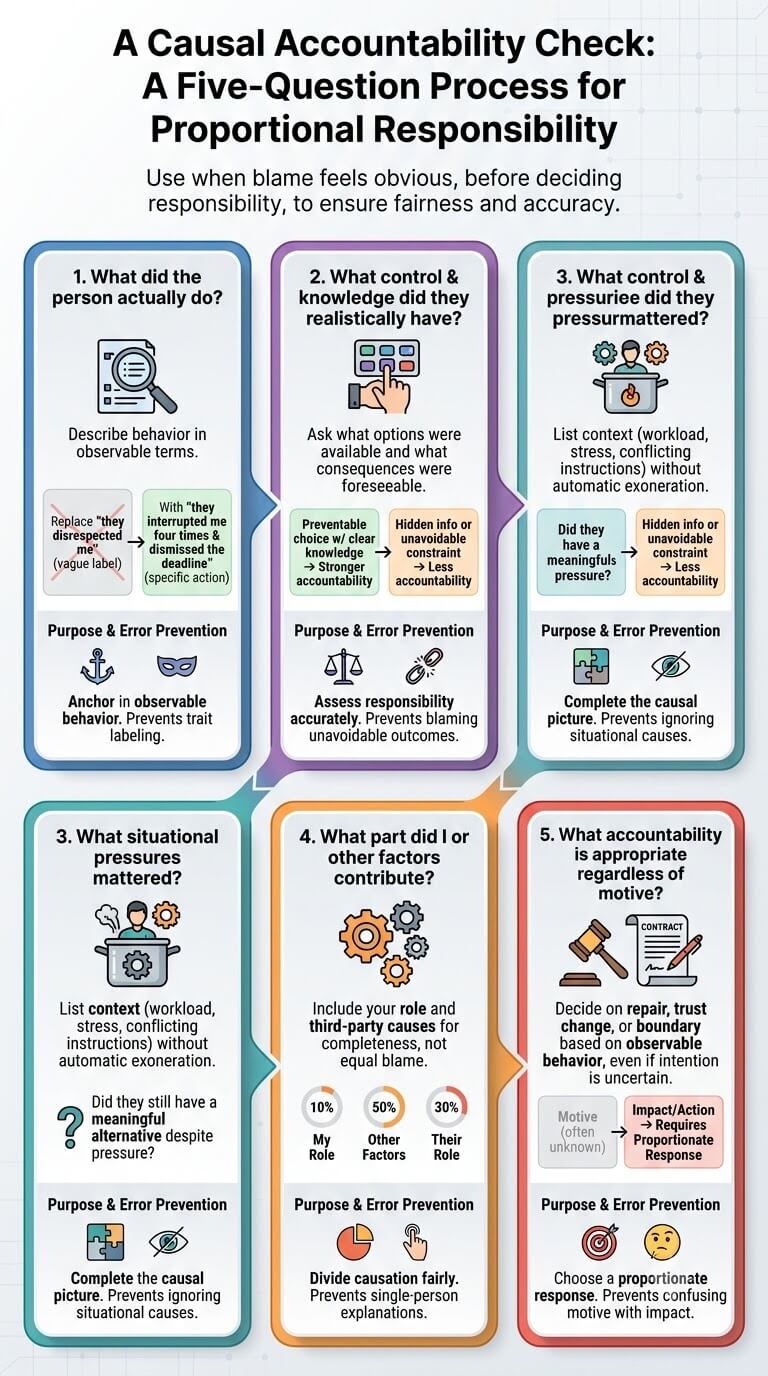
When blame feels obvious, use five questions before deciding how much responsibility belongs to the other person.
What did the person actually do?
Describe behavior in observable terms. Replace “they disrespected me” with “they interrupted me four times and dismissed the deadline I had raised.” Replace “they sabotaged the project” with the specific action that created the problem.
What control and knowledge did they realistically have?
Ask what options were available and what consequences they could reasonably foresee. A preventable choice made with clear knowledge supports stronger accountability than an outcome produced by hidden information or unavoidable constraints.
What situational pressures mattered?
List context without using it as automatic exoneration. Workload, conflicting instructions, stress, power pressure, limited resources, or misunderstanding may have influenced behavior. Then ask whether the person still had a meaningful alternative.
What part did I or other factors contribute?
Include your role and third-party causes where relevant. This step is about completeness, not equal blame. Your contribution may be small, large, or nonexistent.
What accountability is appropriate regardless of motive?
Sometimes motive cannot be known. You can still decide that a missed commitment needs repair, a repeated lie changes trust, or a harmful action requires a boundary. Observable behavior may be sufficient for accountability even when intention remains uncertain.
| Question | Purpose | Common error it prevents |
|---|---|---|
| What happened? | Anchor in observable behavior | Trait labeling |
| What did they know and control? | Assess responsibility | Blaming unavoidable outcomes |
| What context mattered? | Complete the causal picture | Ignoring situational causes |
| What else contributed? | Divide causation fairly | Single-person explanations |
| What accountability fits? | Choose a proportionate response | Confusing motive with impact |
How to Test Alternative Explanations Without Excusing Harm
Generate alternatives as hypotheses, not absolution
If your first explanation is “they ignored me on purpose,” one alternative might be “they misunderstood the request.” You are not required to believe the alternative. Its purpose is to identify what evidence would distinguish the explanations.
If the person later says, “I understood and decided not to respond,” the evidence changes. Alternative explanations should update when facts arrive, not become permanent excuses.
Keep boundaries separate from certainty about motive
You do not need perfect knowledge of intention to set a limit. “I do not know whether you meant to embarrass me, but discussing my private information publicly is not acceptable to me” is both cautious about motive and clear about behavior.
This can be useful in ordinary conflict because it prevents the entire conversation from becoming an argument about what someone “really meant.” Impact and repeated conduct can be addressed directly.
Ask for evidence, repair, and changed behavior where appropriate
If accountability is warranted, look for behavior that matches it. Does the person acknowledge what happened? Do they correct the damage? Do they change the process that caused the problem? Do they repeat the same behavior after understanding the impact?
Words about intention matter, but changed behavior often provides stronger information about whether the problem is being addressed.
How External Attribution Connects to Other Forms of Blame
Event-specific external causes
Blaming another person is one form of external attribution, but external causes also include systems, chance, task difficulty, social pressure, and environmental constraints. “My coworker caused the delay” and “the software outage caused the delay” are both external explanations, but only one assigns agency to another person.
This distinction matters because blame usually requires more than external causation. People consider intention, control, knowledge, and foreseeability when deciding whether another person deserves responsibility. When responsibility turns inward too strongly, the psychology of self-blame becomes especially relevant.
When another person’s misfortune triggers self-protective blame
There is also a different process in which observers explain someone else’s misfortune in ways that make themselves feel safer or more distant from the event. That is not the same as ordinary blame during direct conflict. It involves how threat, similarity, and perceived control can shape causal judgment from the outside.
Keeping these mechanisms separate prevents every act of blaming another person from being treated as the same psychological process.
When Safety Matters More Than Attribution Debate
Threats, coercion, stalking, humiliation, violence, or retaliation
Considering context is useful in ordinary conflict. It should not be used to explain away coercion, threats, stalking, violence, sexual pressure, deliberate intimidation, or retaliation. The National Domestic Violence Hotline guidance on abusive behavior states that abuse is a choice and that a person experiencing abuse is not responsible for their partner’s abusive actions.
If fear or retaliation is present, the priority is not to improve your attribution accuracy so that you can communicate more effectively with the person causing harm. The priority is safety, support, and realistic options.
Do not use alternative explanations to minimize clear harmful behavior
“Maybe they were stressed” can be relevant to understanding a harsh tone. It is not an adequate response to repeated threats or violence. “Maybe they are insecure” does not remove responsibility for stalking or coercive control.
Alternative explanations are useful when evidence is ambiguous. They become harmful when they are used to talk someone out of recognizing a clear pattern of danger.
FAQ About Blaming Others
These questions focus on the boundary between legitimate accountability and overly simple external blame.
Is blaming others always an external attribution?
Blaming another person usually places an important cause outside the self, so it is often a form of external attribution. But external attribution is broader than interpersonal blame. Bad weather, chance, task difficulty, system failure, and social constraints are also external causes. Blame adds a judgment about another person’s role, control, or responsibility.
How can I tell blame from accountability?
Accountability stays close to observable behavior, realistic control, knowledge, and repair. Blame becomes less reliable when it jumps immediately to global character judgments, assumes hidden motives without evidence, or treats one person as the sole cause of a complex event. Accountability can be firm without needing an exaggerated story about who the person is.
Why does assumed intention make conflict worse?
Intentional explanations often intensify anger because they make the event feel chosen rather than accidental. If the intention is uncertain, an accusation may push the other person into defending motive instead of addressing impact. When evidence of deliberate behavior is strong, intention can be named more confidently. When it is weak, separating behavior from inferred motive can keep the discussion more accurate.
Can context matter even when someone is still responsible?
Yes. Context can explain why behavior became more likely without removing responsibility. Stress may help explain impatience, poor training may help explain an error, and time pressure may help explain a rushed decision. The question is whether the person still had realistic control and what accountability remains appropriate after the context is considered.
How do I consider alternative causes without excusing harmful behavior?
Treat alternatives as hypotheses that need evidence. Keep boundaries based on observable behavior, especially when the behavior is repeated or harmful. You can say, “I am open to understanding why this happened, and I still need this behavior to stop.” In situations involving coercion, threats, stalking, violence, or retaliation, safety takes priority over searching for a more generous explanation.
Key Takeaways
- Blaming another person often involves an external attribution, but external causation, responsibility, and global character judgment are separate questions.
- Perceived intention, control, and foreseeability can increase blame, while anger may also make intentional explanations easier to endorse when behavior is ambiguous.
- Context can improve causal accuracy without excusing harmful conduct or erasing accountability.
- Responsibility shifting occurs when external causes are used to remove every personal contribution, but adding your own contribution does not require false equivalence.
- A useful accountability check focuses on what happened, what the person knew and controlled, what context mattered, what else contributed, and what response is proportionate.
- Alternative explanations should never be used to minimize coercion, threats, stalking, violence, intimidation, exploitation, or retaliation.
About the author: Michael Reed is the Founder & Lead Writer at Psychology Exposed. He translates research on human behavior, relationships, self-awareness, and everyday judgment into practical explanations for general readers. This article is educational and is not a diagnosis, legal opinion, or substitute for individualized professional or safety support.

Michael Reed is the Founder and Lead Writer at Psychology Exposed. He writes about human behavior, relationships, emotional patterns, self-awareness, and practical psychology topics using research-informed, easy-to-understand content.
Read More About Michael Reed: https://psychologyexposed.com/michael-reed/