

When we hear about someone else’s misfortune, we do more than ask what happened. We may also ask, often quietly, “Could that happen to me?” That second question can change the first. If an event feels frightening, unpredictable, or uncomfortably similar to our own life, assigning more responsibility to the person who suffered it may create emotional distance: “They made choices I would never make, so I am safer.”
Psychologists use the idea of defensive attribution to describe this kind of self-protective causal reasoning. It does not mean that every judgment of responsibility is defensive, or that every observer who blames someone is consciously trying to feel safe. The concept is most useful as a warning about how vulnerability, perceived similarity, controllability, and the wish for predictability can influence causal judgments, especially when the outcome is threatening.
Quick Answer

Defensive attribution is a tendency to explain another person’s misfortune in ways that protect the observer’s sense of safety or distance from the event. An observer may exaggerate the other person’s control or responsibility because “they caused it” feels safer than “this could happen under circumstances I cannot fully control.” Research supports parts of this idea in some contexts, but findings are mixed, so defensive attribution should be treated as one possible influence rather than a universal rule.
What Defensive Attribution Means
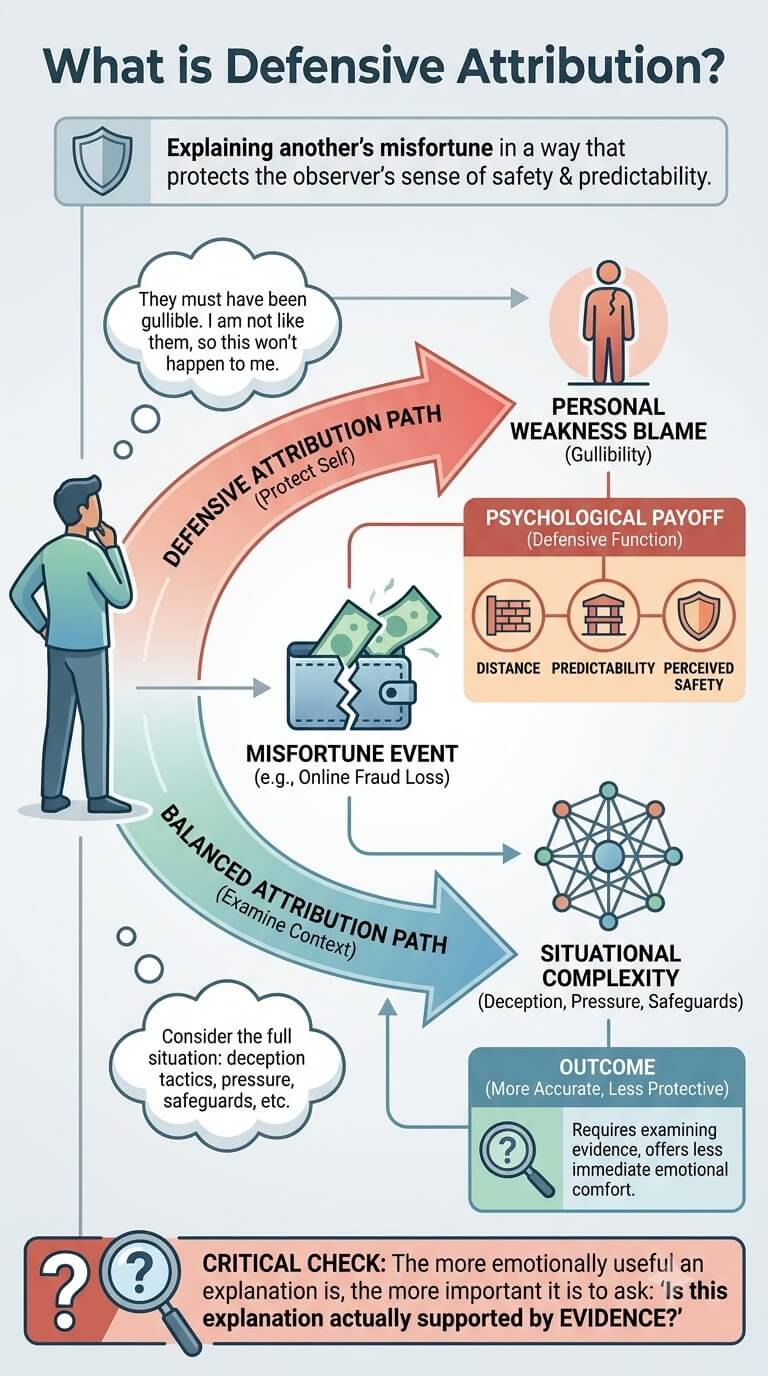
Explaining another person’s misfortune in a way that protects the observer
Attribution refers to the explanations people construct for behavior and outcomes. The APA Dictionary of Psychology description of attribution theory distinguishes explanations based on personal factors from those based on circumstances. Defensive attribution adds a motivational question: could the explanation itself help the observer feel less vulnerable?
Imagine hearing that someone lost money in an online fraud. One response is to examine the full situation: deception tactics, missing information, time pressure, platform safeguards, and the person’s decisions. A defensive response may jump to “They must have been gullible.” That explanation separates the observer from the victim by implying a personal weakness: “I am not that kind of person, so this would not happen to me.” Defensive explanation belongs to the broader attribution framework, with an added question about the protective function a causal judgment may serve.
The defensive function: distance, predictability, and perceived safety
The psychological payoff is not necessarily comfort in a warm sense. It is a stronger feeling that the world remains understandable. If bad outcomes happen mainly because other people make obvious mistakes, then avoiding those mistakes appears to offer protection.
This logic can be appealing after accidents, fraud, public mistakes, financial losses, harassment, and violence. Yet the more emotionally useful an explanation is to the observer, the more important it becomes to ask whether the explanation is also supported by evidence.
Why Threatening Outcomes Invite Self-Protective Explanations
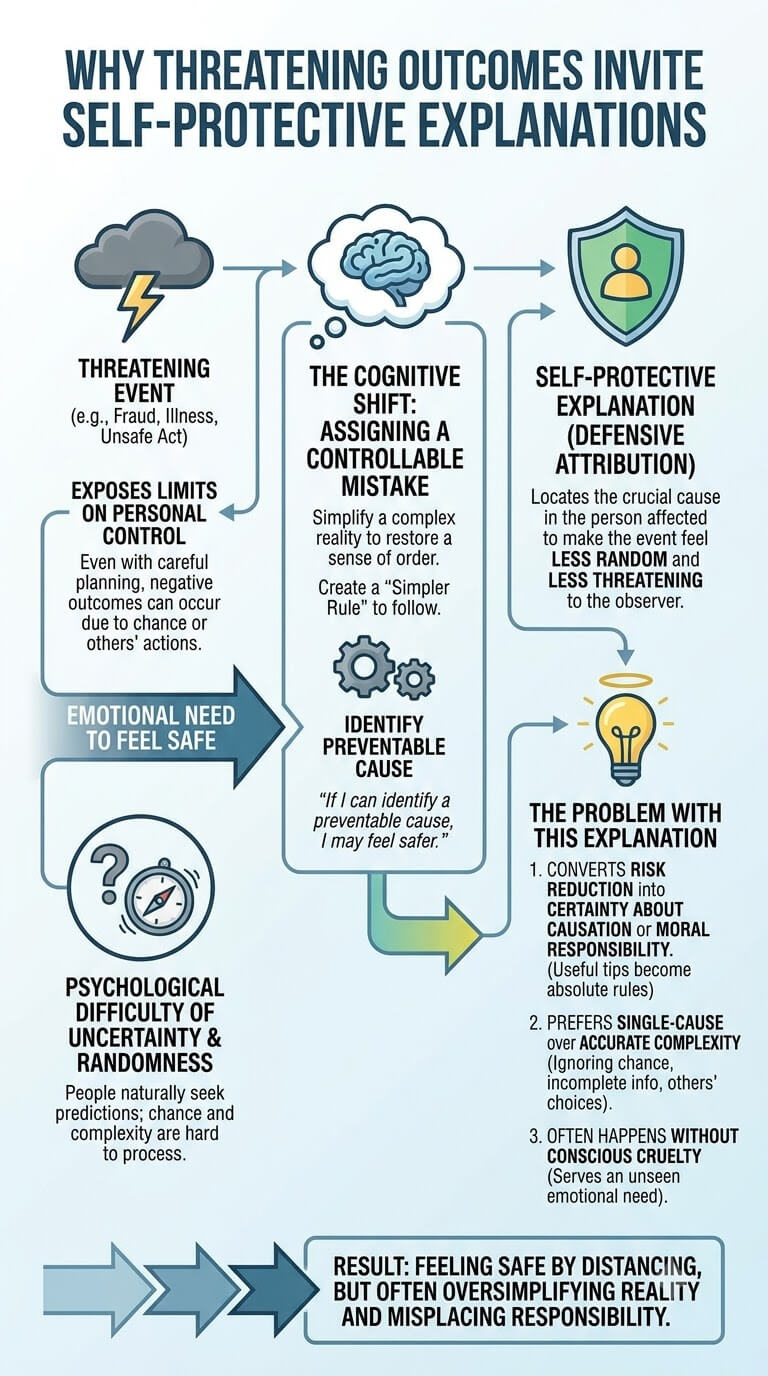
“If I can identify a preventable cause, I may feel safer”
A threatening event can expose limits on personal control. Someone can plan carefully and still encounter fraud, illness, an unsafe driver, a dishonest employer, or another person’s harmful choice. That uncertainty can be difficult to hold.
Assigning the outcome to a controllable mistake can restore a simpler rule: “Do not do what they did, and you will be safe.” Sometimes that rule contains useful information. Wearing protective equipment, checking financial requests, or following safety procedures can reduce risk. The problem is when risk reduction is converted into certainty about causation or moral responsibility.
Why uncertainty and randomness are psychologically difficult
People naturally look for explanations that help them predict what comes next. “A combination of chance, incomplete information, and another person’s choices produced this” may be more accurate than a single-cause explanation, but it leaves more uncertainty.
A defensive attribution reduces that uncertainty by locating the crucial cause in the person affected. The event then feels less random and less personally threatening to the observer. This can happen without conscious cruelty. The explanation may feel like common sense precisely because it serves an emotional need that is easy to miss. How causal judgments shape emotion and behavior matters here because a protective explanation can change both vulnerability and the observer’s next response.
Similarity and Perceived Vulnerability

When the person affected feels similar to the observer
Similarity can matter because it changes perceived vulnerability. If the person affected is the same age, works in a similar job, lives in a similar neighborhood, or made choices the observer recognizes in themselves, psychological distance becomes harder to maintain.
Defensive attribution research has examined whether perceived similarity changes blame. A 2020 study of defensive attribution and perceived vulnerability tested this idea with 618 male and female undergraduates who read fictional police reports of a reported rape. The theory received partial support: among women in that sample, blame was associated with reduced perceived vulnerability, while the same pattern did not appear among men.
The finding is useful because it shows both the possible mechanism and its limits. Defensive attribution may operate differently across groups and situations. It should not be treated as a fixed law of social judgment.
When distance can make blame easier
Sometimes dissimilarity may allow an observer to separate themselves from the person affected: “That would not happen to someone like me.” In other situations, similarity may increase empathy and reduce blame because the observer can imagine being in the same position.
Older research examining perceived similarity and attribution of blame illustrates why similarity has been studied as part of defensive attribution, but results across the broader literature have not produced one simple direction that applies everywhere.
Why similarity effects are not simple or universal
Similarity is only one input. Gender norms, cultural beliefs, prior experience, attitudes about responsibility, perceived control, details of the event, and beliefs about the world can all influence judgment.
A safer interpretation is therefore: perceived similarity may alter how vulnerable an observer feels, and that vulnerability can sometimes affect attribution. It is not accurate to say that similar observers always blame less, always blame more, or always engage in defensive attribution.
Controllability Judgments
Estimating what the person could realistically control
Responsibility judgments often turn on control. Could the person foresee the risk? Did they have realistic alternatives? Did another person conceal information? Was there coercion, time pressure, unequal power, or a safety threat? Were the supposed alternatives actually available?
A useful controllability judgment stays close to what was realistic at the time. “They could theoretically have done something else” is much weaker than “they clearly understood the risk, had a safe alternative, and voluntarily chose the action anyway.”
How hindsight can inflate perceived control
Once the outcome is known, protective actions can look more obvious. After fraud, people ask why the target did not verify the message. After an accident, they identify the precaution that would have helped. After relationship harm, they ask why warning signs were not recognized sooner.
These questions can support learning, but they can also exaggerate the clarity of the earlier situation. Knowledge of the outcome changes how previous information looks. An observer may then assign the person more control than they actually had when the decision was made.
Why controllability is not a synonym for blameworthiness
Even genuine control does not settle every question of blame. A person may have been able to reduce risk without causing the harmful act. Someone may have chosen to walk home alone, for example, but that choice does not make them responsible for another person’s decision to assault them.
This distinction is fundamental: risk management and responsibility for harm are different questions. A person’s precaution choices can be discussed without transferring responsibility for another person’s abusive, violent, deceptive, or criminal conduct.
From Defensive Attribution to Victim-Blaming Risk

Overstating the victim’s causal role
Victim-blaming occurs when responsibility for harm is shifted toward the person who experienced it. Defensive attribution can contribute when the observer needs the event to feel avoidable and therefore magnifies the victim’s actions: “If they had not trusted that person,” “if they had left sooner,” or “if they had been more careful.”
Research continues to examine defensive attribution as one explanation for victim-blaming. A recent open-access study of factors related to victim blame describes the defensive attribution hypothesis as linking perceived vulnerability, perceived similarity, and blame. The important caution is that victim-blaming has multiple influences, including social norms, stereotypes, beliefs about fairness, and details of the situation. Defensive attribution is not the only mechanism.
Ignoring coercion, offender choice, power imbalance, or constrained options
Defensive explanations become especially harmful when they erase the actions of the person who caused the harm. Coercion restricts options. Threats change what “just leave” means. Financial control can make independence difficult. Stalking can continue after separation. Deception can hide information the person would have needed to make a different decision.
The National Domestic Violence Hotline guidance on abusive behavior is explicit that abusive acts are choices made by the person using abuse and that the person experiencing abuse is not responsible for those abusive actions.
How self-protection can distort responsibility
A defensive explanation may shift attention from “Who chose the harmful act?” to “What could the harmed person have done differently?” The second question is sometimes useful for future safety planning, but it cannot replace the first.
If someone deceives, assaults, stalks, coerces, or exploits another person, responsibility for that behavior remains with the person choosing it. Precautions may change exposure to risk, but they do not create moral or causal responsibility for another person’s harmful choice.
Defensive Attribution vs Fundamental Attribution Error
Self-protective motive versus person-over-situation tendency
Defensive attribution and the fundamental attribution error can lead to similar-looking judgments, but they describe different ideas. Fundamental attribution error concerns the tendency to overemphasize dispositional causes for another person’s behavior while underweighting situational influences. Defensive attribution focuses on the possibility that causal judgment serves a protective function for the observer.
For example, “They lost their savings because they are careless” could reflect a person-focused attribution that neglects sophisticated deception and situational pressure. It becomes specifically defensive when the explanation also helps the observer maintain distance: “I am careful, so I am safe.”
Why the concepts can overlap without being identical
One judgment may contain both processes. An observer may underestimate context and also gain a sense of safety from the person-focused explanation. But one process does not prove the other.
Cognitive biases in judgment provide a broader framework for person-versus-situation errors. Defensive attribution is narrower because it asks what emotional or protective function the explanation may serve.
Defensive Attribution vs Just-World Belief
Why the ideas can interact
Defensive attribution is also related to, but different from, belief in a just world. The APA Dictionary of Psychology explanation of the just-world hypothesis describes the belief that the world is generally fair and that people tend to receive outcomes they deserve. When an innocent person suffers, that belief can be threatened.
Blaming the person may restore a sense of order: “There must have been something about their behavior that explains why this happened.” Defensive attribution can reach a similar destination through perceived vulnerability: “If their choices caused it, I can avoid those choices and remain safe.”
Why this is not a full just-world explanation
The concepts differ in emphasis. Just-world belief is about fairness and deserved outcomes. Defensive attribution is about protecting the observer from perceived vulnerability or similarity. They may interact, but they should not be collapsed into one label.
This matters because victim-blaming can arise through different psychological and social routes. One observer may be motivated by fairness beliefs, another by self-protection, another by stereotypes, and another by incomplete information. A single label can hide those differences.
A Safer Responsibility-Evaluation Framework

When a threatening event triggers immediate blame, use the SAFE responsibility check: Separate the harmful act, Assess realistic control, Find omitted causes, Examine the protective payoff.
Separate the actual harmful action
First identify who did what. If there was fraud, who deceived whom? If there was violence, who chose the violent act? If there was a workplace failure, which actions directly changed the outcome?
This prevents discussion of the victim’s behavior from displacing the behavior that created the harm.
Assess realistic control, information, and constraints
Ask what each person actually knew, what options were available, and whether those options were safe. Include power differences, threats, money, transportation, social pressure, time, deception, health, and access to support where relevant.
Do not evaluate control using information learned only after the outcome.
Find omitted causes
Look beyond the most visible choice. What did another person do? What system failed? What role did chance, timing, incentives, deception, organizational rules, or missing information play?
Complex outcomes often become unfairly personalized when less visible causes disappear from the story.
Examine whether the explanation mainly makes the observer feel safer
Ask a less comfortable question: “If I believed the person did everything reasonably possible and the event still happened, would I feel more vulnerable?” If the answer is yes, self-protection may be influencing the attribution.
That does not prove the current judgment is wrong. It identifies a reason to examine it more carefully.
| SAFE check | Question | Error it helps prevent |
|---|---|---|
| Separate | Who actually chose the harmful action? | Shifting focus away from the actor causing harm |
| Assess | What could each person realistically know and control? | Imaginary hindsight options |
| Find | What causes or constraints are missing? | Single-person explanations |
| Examine | Does this explanation mainly make me feel safer? | Self-protective overconfidence |
Everyday Examples Beyond Severe Harm
Workplace setback
Situation: A coworker is laid off during a restructuring.
Defensive attribution: “They probably were not valuable enough. Good employees are safe.”
What the observer may feel: reassurance that their own job is protected by competence.
What it may mean: performance could matter, but restructuring, budget cuts, role duplication, politics, or strategy changes may also matter.
What to do next: check what is actually known before turning the layoff into a character judgment or a guarantee about your own security.
Financial loss
Situation: Someone loses money to a sophisticated investment scam.
Defensive attribution: “Only greedy or gullible people fall for that.”
What the observer may feel: distance from the victim and confidence that intelligence or caution provides complete protection.
What it may mean: personal decisions may matter, but so can deceptive social proof, impersonation, urgency, technical sophistication, and incomplete information.
What to do next: extract useful precautions without treating vulnerability to deception as proof of a defective character.
Public mistake or accident
Situation: A driver makes an error that causes a minor collision during confusing roadworks.
Defensive attribution: “Competent drivers do not make mistakes like that.”
What the observer may feel: confidence that personal skill makes the same event unlikely.
What it may mean: driver error may be real while road design, visibility, signage, fatigue, and traffic conditions also contributed.
What to do next: preserve accountability for the actual mistake while resisting the leap from one error to total personal immunity.
How to Evaluate Responsibility Without Using Explanation as Emotional Protection
Ask what evidence would change the attribution
A strong attribution should be revisable. If nothing could change your view that “the victim caused it” or “the person was careless,” the conclusion may be functioning more like a protective belief than an evidence-based explanation.
Identify one fact that would make you assign less responsibility and one fact that would make you assign more. This forces the explanation to remain responsive to evidence.
Compare person and situation causes symmetrically
Use the same standard you would want applied to yourself. If you would expect others to consider your time pressure, missing information, or reasonable mistake, consider whether the other person also had context worth examining.
This does not mean every situation is morally equal. It simply makes the causal method more consistent.
Notice when distance is doing more work than evidence
Listen for language that creates identity distance: “People like that,” “I would never,” “Anyone sensible would know,” or “That only happens if you…” These phrases may contain a real judgment, but they also deserve scrutiny because they divide the world into safe observers and flawed victims.
A more grounded question is: “What specific causal evidence supports this conclusion, and what uncertainty remains?”
How Defensive Attribution Relates to Blame and Social Judgment
External blame assignment
Defensive attribution can overlap with blaming others, but the two are not identical. Ordinary blame asks whether another person caused or controlled a negative outcome. Defensive attribution asks whether the explanation is partly serving the observer’s need to feel less vulnerable.
Someone can accurately hold another person accountable without using a defensive attribution. Likewise, someone can make a defensive judgment about a person they have never met and with whom they are not in direct conflict.
Attribution errors are related but broader or different processes
Fundamental attribution error, self-serving bias, just-world belief, and defensive attribution can all influence causal judgment, but they answer different psychological questions. Treating every unfair judgment as the same bias removes useful detail.
The better approach is to ask what is happening in this case: Is context being ignored? Is the self being protected? Is fairness belief being defended? Is similarity changing vulnerability? Is responsibility actually supported by evidence?
Safety and Ethical Boundary
Abuse, assault, stalking, coercion, violence, and exploitation are choices made by the person causing harm
When another person chooses abuse, assault, stalking, coercion, violence, exploitation, or deliberate intimidation, responsibility for that behavior belongs to the person choosing it. A victim’s clothing, relationship history, decision to trust, decision to stay, delayed recognition of warning signs, or imperfect safety choices do not cause another person’s abusive act.
Risk factors and responsibility are different concepts. Discussing how someone might reduce future risk can be useful only if it does not rewrite the cause of the original harm.
Do not use attribution analysis to transfer responsibility to a victim
Questions such as “What could they have done differently?” can sound practical while quietly shifting attention away from the person who chose the harmful behavior. In unsafe situations, realistic options may also be constrained by threats, financial dependence, children, isolation, disability, stalking, or fear of retaliation.
Attribution analysis should make the causal picture more accurate, not turn survival decisions into evidence of culpability.
Where to seek safety support when relevant
If a situation involves fear, coercion, threats, stalking, violence, sexual pressure, or retaliation, specialized safety support is more appropriate than debating whether the harmed person should have acted differently. A domestic violence advocate or other qualified local service can help assess options in context.
If there is immediate danger, contact local emergency services or an appropriate crisis resource in your location.
FAQ About Defensive Attribution
These questions clarify what defensive attribution can explain, where the evidence is mixed, and where the concept should not be used.
What is a simple example of defensive attribution?
Suppose someone hears that a careful homeowner was burglarized and immediately says, “They must have left a window open.” If the main psychological effect of that explanation is “I always lock my windows, so this cannot happen to me,” the attribution may be serving a defensive function. The factual question remains separate: was an unlocked window actually involved?
How is defensive attribution related to victim blaming?
Defensive attribution can contribute to victim-blaming when an observer exaggerates the harmed person’s control in order to feel less vulnerable. “They caused it by making a bad choice” can create emotional distance from a frightening outcome. However, victim-blaming also has other influences, including stereotypes, social norms, fairness beliefs, and incomplete information, so defensive attribution is not a complete explanation.
Is defensive attribution the same as the just-world belief?
No. Just-world belief concerns the idea that the world is generally fair and that people tend to receive outcomes they deserve. Defensive attribution focuses more specifically on the observer’s vulnerability and psychological distance from the person affected. The two can interact because both can make blame feel reassuring, but they are conceptually different.
How is it different from fundamental attribution error?
Fundamental attribution error concerns overemphasizing personal causes and underestimating situational causes when explaining other people’s behavior. Defensive attribution asks whether the causal explanation also protects the observer’s sense of safety. A person-focused judgment can involve both, either one, or neither.
Why can similarity to a victim change an observer’s explanation?
Similarity can make the observer feel more vulnerable because the event seems more personally relevant. That may encourage empathy in some situations or defensive psychological distance in others. Research findings are mixed across populations and contexts, so similarity should be treated as one factor that may influence blame, not a rule that predicts exactly how every observer will respond.
Key Takeaways
- Defensive attribution describes causal explanations that may protect an observer’s sense of safety, predictability, or distance from another person’s misfortune.
- Perceived vulnerability and similarity can influence blame in some contexts, but research does not support one simple similarity rule that applies to everyone.
- Controllability should be judged using the person’s realistic information, options, constraints, and safety at the time, not hindsight.
- Risk-reduction choices and responsibility for harm are different questions. A victim does not cause another person’s abusive, violent, coercive, deceptive, or exploitative act.
- Defensive attribution can overlap with fundamental attribution error and just-world belief, but each concept describes a different psychological process.
- The SAFE check helps separate the harmful action, assess realistic control, find omitted causes, and examine whether the explanation mainly serves the observer’s need to feel safer.
About the author: Michael Reed is the Founder & Lead Writer at Psychology Exposed. He writes about human behavior, social judgment, emotional patterns, and self-awareness for general readers using clear, research-aware explanations. This article is educational and is not a diagnosis, legal conclusion, or substitute for individualized safety or professional support.

Michael Reed is the Founder and Lead Writer at Psychology Exposed. He writes about human behavior, relationships, emotional patterns, self-awareness, and practical psychology topics using research-informed, easy-to-understand content.
Read More About Michael Reed: https://psychologyexposed.com/michael-reed/