

Authority is easy to confuse with power. A manager may have authority to approve a schedule. A respected specialist may influence the same schedule without having any formal right to decide it. A socially intimidating person may pressure others into agreement without possessing legitimate authority at all. The visible result may be compliance, but the psychological route to that compliance can be very different.
Authority psychology focuses on legitimacy: why people believe that a person, role, rule, or institution has a recognized right to direct, decide, set limits, or establish procedures within a particular scope. People may follow authority because they accept the role and feel an obligation to respect its decisions, not merely because they fear punishment or expect a reward.
This distinction matters in families, schools, workplaces, professional settings, community groups, and public institutions. Authority can help coordinate responsibility when its scope is clear and accepted. It can also lose legitimacy when rules become arbitrary, procedures feel unfair, or a role-holder treats limited authority as permission to control unrelated areas of life. Understanding authority does not require assuming that all authority is harmful or that every act of compliance is obedience without thought.
Quick Answer

Authority in psychology is the socially recognized or perceived legitimate right of a person, role, rule, or institution to direct behavior, make decisions, or set rules within a defined scope. Authority differs from raw power because it involves legitimacy, and it differs from expertise or credibility because someone can be knowledgeable or believable without having the right to decide for others.
What Authority Means Psychologically
Authority is not simply the ability to get another person to do something. Its defining feature is that people recognize some basis for the direction. They may believe a teacher can set classroom rules, a referee can enforce game rules, a board can make decisions under an agreed charter, or a parent can make certain age-appropriate decisions for a child. Authority is one part of the wider relationship among power, status, and hierarchy.
Tom Tyler’s influential review of psychological legitimacy describes legitimacy as the belief that an authority, institution, or social arrangement is appropriate, proper, and just. When authority is seen as legitimate, people may defer voluntarily because they believe they ought to respect the decision, not only because compliance is rewarded or noncompliance is punished.
Authority involves a perceived right to direct, decide, or set rules
A role becomes authoritative when the surrounding social system recognizes certain decision rights. The right might come from law, organizational rules, family responsibilities, professional standards, an election, a contract, or a shared agreement.
That right is usually limited. A teacher can assign coursework but does not thereby gain control over a student’s friendships. A club treasurer may enforce spending rules but cannot dictate members’ private beliefs. A moderator may enforce platform rules while having no authority over users outside that platform.
Authority depends on legitimacy, not only on capacity
Someone may be able to force an outcome without being recognized as having the right to do so. That is power without legitimate authority. Conversely, a person may possess a recognized decision right while having little capacity to enforce it.
This is why “Who can make this happen?” and “Who has the recognized right to decide?” are separate questions. Authority belongs to the second question.
Authority vs Power, Expertise, Credibility, and Conformity

Several nearby concepts can produce similar behavior. A person may comply with an expert, copy a group, accept a credible source, or follow someone with raw power. The underlying reason tells us whether authority is actually involved.
| Concept | Core question | How it differs from authority |
|---|---|---|
| Authority | Does this person or role have a recognized right to direct or decide? | Legitimacy is central. |
| Power | Can this person affect valued outcomes? | Power can exist without a legitimate right to use it. |
| Expertise | Does this person have relevant knowledge or skill? | Expertise may justify listening without transferring the final decision. |
| Credibility | Does this source or claim deserve belief? | Credibility concerns trustworthiness and accuracy, not decision rights. |
| Conformity | Am I aligning with group expectations or behavior? | Conformity can occur without a recognized authority figure. |
Authority vs social power: legitimate direction versus capacity to affect outcomes
Power is broader. A person who controls access to money, information, opportunities, or social inclusion may have substantial leverage even if nobody believes that person has a legitimate right to direct others.
Authority adds a normative layer. The group recognizes that certain decisions belong to the role or institution. That recognition can make compliance more voluntary and less dependent on continuous reward or punishment.
Authority vs expertise: decision right versus relevant knowledge
An expert may know more without having final authority. A structural engineer can explain whether a building is safe, while an elected board may hold the formal authority to approve spending. In good decision-making, authority and expertise may cooperate, but one does not automatically replace the other.
Problems arise when role-holders assume that authority makes them experts in every domain, or when experts assume that knowledge alone gives them the right to control another person’s choices.
Authority vs credibility: being entitled to decide versus deserving belief
A source can be highly credible without having authority over you. A scientist may provide reliable information but cannot necessarily make your personal decision. Likewise, a person with formal authority may have weak credibility if they repeatedly communicate inaccurately, ignore evidence, or operate outside their competence.
Psychology Exposed’s guide to credibility psychology examines how people judge whether a source deserves belief. Authority asks a different question: who is recognized as having the right to decide or direct within this setting?
Authority vs conformity: role-based direction versus group alignment
Conformity occurs when people align with group behavior, opinions, or expectations. It may happen because people want acceptance or assume the group has useful information. No formal authority is required.
Authority becomes relevant when the source of direction is a recognized person, role, rule, or institution. A student copying classmates is a conformity process. A student following an instructor’s stated classroom procedure involves authority.
Where Legitimate Authority Comes From

Authority can be recognized for several reasons. The psychological question is not merely what the rule says, but why people accept that the rule-holder is entitled to direct the situation.
Formal roles and institutional rules
Many forms of authority come from explicit positions. Judges, teachers, referees, supervisors, committee chairs, administrators, and moderators receive defined responsibilities through institutional rules.
The classic French and Raven discussion of legitimate power treated accepted role relationships and internalized norms as important bases for influence. Their framework is about social power, while authority psychology goes further into the question of why that legitimacy is recognized and maintained.
Shared agreements and delegated decision rights
Authority does not always require a large institution. Four friends planning a trip may agree that one person will handle bookings within a fixed budget. A volunteer group may delegate scheduling to one coordinator. A family may agree that the person with medical authorization handles communication with a clinic.
Delegated authority works best when the scope is clear. Agreement to handle one category of decisions should not quietly expand into control over everything else.
Professional, legal, and moral expectations
Some authority is attached to recognized duties. A licensed professional may have decision rights under specific regulations. A parent may have responsibilities tied to the care and safety of a young child. A designated emergency coordinator may have temporary authority during a crisis.
These examples show why authority should be understood by domain. A legitimate right in one area does not imply superiority or unlimited control in other areas.
The Role of Legitimacy
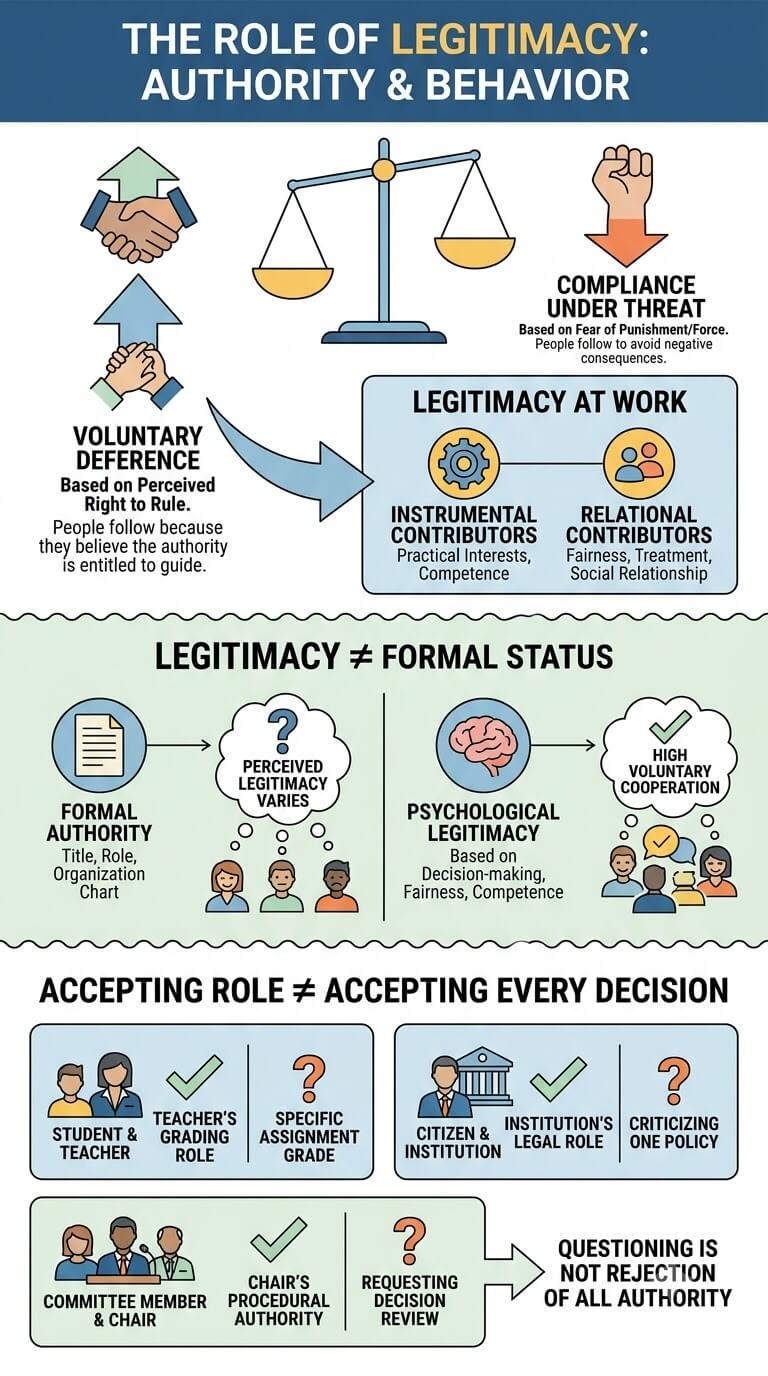
Legitimacy helps explain why an authority can influence behavior without constantly displaying force. People may comply because they see the rule or role as appropriately entitled to guide behavior.
Voluntary deference is different from compliance under threat
If someone follows a rule only because punishment feels unavoidable, coercive power may be doing much of the work. If the person follows because they believe the rule-holder has a proper right to decide, legitimacy is more central. How much deference people expect authority to receive is partly a question of power distance rather than legitimacy alone.
A review of voluntary deference to authorities found support for both relational and instrumental contributors to legitimacy across legal, managerial, educational, political, and family settings. In other words, people’s acceptance of authority can reflect both practical interests and the quality of the social relationship.
Legitimacy is psychological, not merely a line on an organization chart
A title can create formal authority, but perceived legitimacy can vary. Two people may occupy the same role and receive very different levels of voluntary cooperation because people view their decision-making, fairness, competence, or treatment of others differently.
Formal status therefore does not guarantee psychological legitimacy. A rule may exist on paper while members privately regard the process as arbitrary or inappropriate.
People can accept a role while questioning a particular decision
Recognizing authority does not require treating every decision as correct. A student can accept that a teacher grades assignments while disputing a particular grading decision. A citizen can recognize an institution’s legal role while criticizing one policy. A committee member can accept the chair’s procedural authority while asking for a decision to be reviewed.
This distinction is important because questioning authority is not automatically rejection of all authority.
Procedural Fairness and Perceived Legitimacy
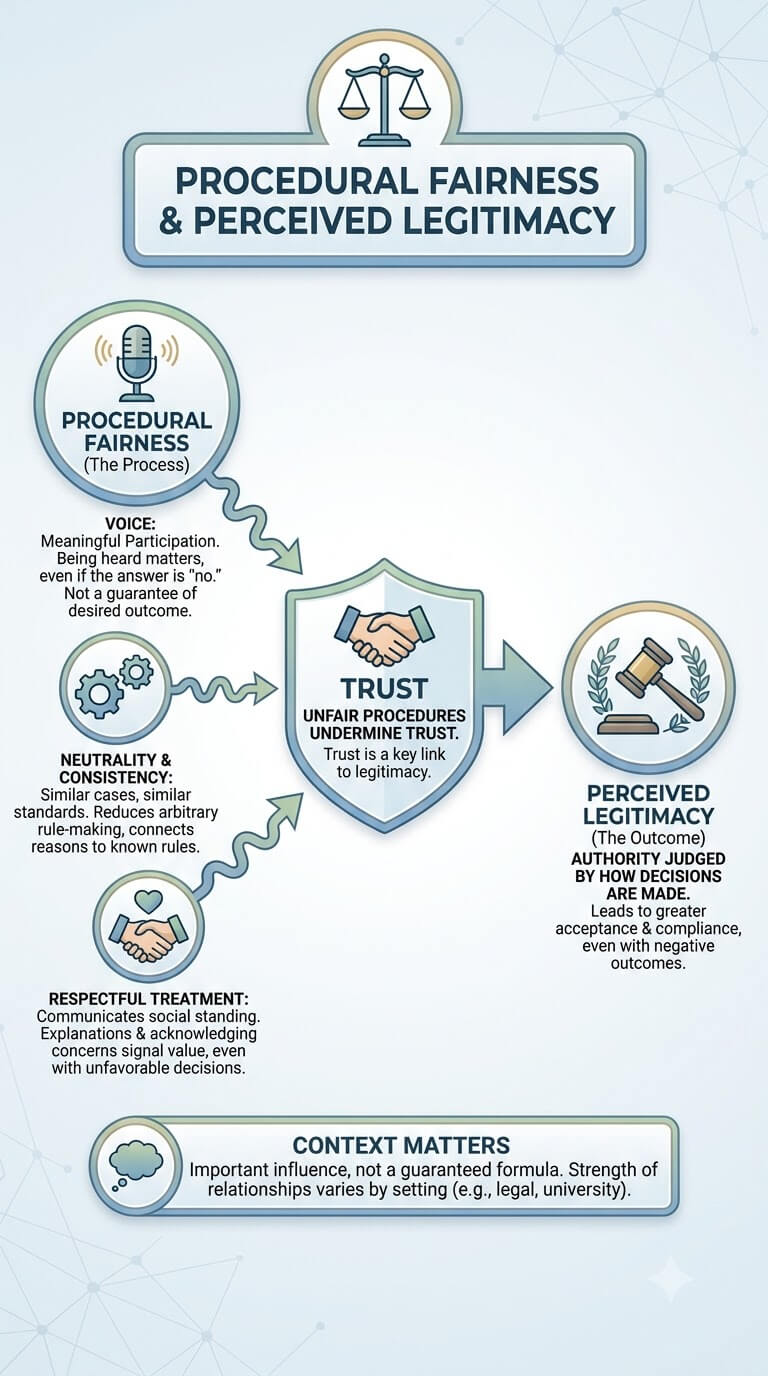
People often judge authority not only by the outcome they receive but by how decisions are made. Voice, neutrality, consistency, respectful treatment, and explanations can influence whether a process feels fair.
Being heard can matter even when the answer is no
A person may accept an unfavorable decision more readily when they had a genuine opportunity to explain relevant information and believe it was considered. Being heard does not mean receiving the desired outcome. It means the procedure allows meaningful participation where participation is appropriate.
Neutral and consistent procedures reduce arbitrary rule-making
Authority feels less arbitrary when similar cases are treated by similar standards, reasons are connected to known rules, and personal favoritism does not determine every outcome.
Research on procedural fairness and authority power found that unfair procedures can undermine trust in authorities, with trust helping explain effects on perceived legitimacy and other attitudes. The strength of these relationships can vary by setting, so procedural fairness should be treated as an important influence on legitimacy rather than a guaranteed formula.
Respectful treatment communicates social standing
People also infer meaning from how authority is exercised. Being spoken to with basic respect, receiving an explanation, and having relevant concerns acknowledged can signal that the person remains a valued member of the group even when the authority decides against them.
Studies of university students have similarly found links between procedural fairness and perceived legitimacy of university authorities, illustrating that these processes are not limited to legal settings.
Role Expectations Shape How People Respond to Authority
Authority works partly because people carry expectations about what roles are supposed to do. Those expectations can make a direction feel ordinary in one setting and inappropriate in another.
The same instruction can feel legitimate from one role and intrusive from another
A lifeguard telling swimmers to leave the water during dangerous conditions fits the role. A stranger giving the same order may be ignored unless they provide compelling information. A teacher asking students to submit an assignment follows a classroom role; the same teacher directing an adult student’s romantic life would exceed that role.
Role clarity can reduce unnecessary power struggles
Conflict sometimes grows because people disagree about the scope of authority rather than the underlying task. One person assumes they were delegated the final decision, while another thought they were only asked to coordinate information.
Clarifying who decides what, what requires consultation, and what can be appealed can prevent an ordinary role disagreement from becoming a broader struggle over respect or control.
Authority Without Trust or Credibility
Authority, trust, and credibility often reinforce one another, but they can separate. A person may retain formal decision rights after trust has weakened.
A role can remain valid while confidence in the role-holder declines
A supervisor may still be authorized to approve leave even if employees believe the supervisor communicates poorly. A moderator may retain enforcement rights even if users question the moderator’s judgment. A parent may have legitimate responsibilities while a teenager increasingly doubts the parent’s knowledge about a specific technical issue.
These situations should not be flattened into “the authority no longer exists.” The role and the perceived quality of the role-holder are separate questions.
Low credibility limits how far authority should substitute for evidence
Authority can settle who makes a decision, but it does not make every factual claim true. When evidence matters, good authority should be able to consult expertise, explain reasoning, and revise decisions when new information appears.
This is especially important in technical or health-related matters, where a formal role should not be used as a shortcut around relevant evidence.
How Authority Loses Legitimacy
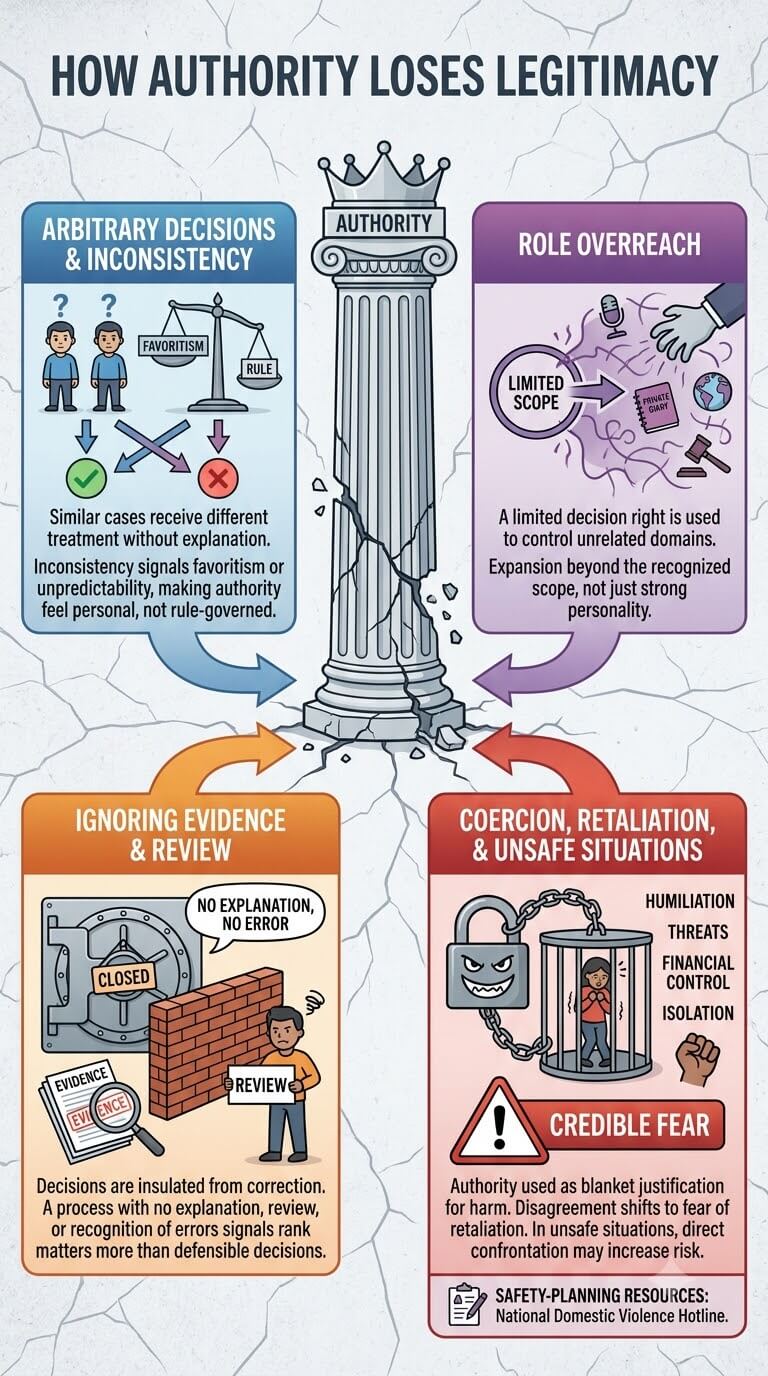
Legitimacy can weaken even when formal rules remain unchanged. People may begin to see a role-holder or institution as less entitled to voluntary deference.
Arbitrary decisions and inconsistent rules
If similar cases receive very different treatment without explanation, members may infer favoritism or unpredictability. Authority begins to feel personal rather than rule-governed.
Role overreach
Overreach occurs when a limited decision right is treated as permission to control unrelated domains. A coordinator asked to schedule meetings begins dictating private friendships. A teacher uses grading authority to pressure students about unrelated personal choices. A volunteer leader treats temporary responsibility as permanent social superiority.
The issue is not simply a strong personality. It is expansion beyond the recognized scope of the role.
Ignoring evidence or refusing meaningful review
Authority can become less legitimate when decisions are insulated from correction. A process that allows no explanation, no review, and no recognition of obvious errors can signal that maintaining rank matters more than making a defensible decision.
Humiliation, retaliation, or coercion
Authority should not be used as a blanket justification for humiliation, threats, stalking, financial control, isolation, or violence. When saying no or questioning a decision creates credible fear of retaliation, the situation is no longer adequately described as a normal disagreement about legitimate authority.
In unsafe situations, direct confrontation may increase risk. Safety-planning resources from the National Domestic Violence Hotline can be more appropriate than trying to prove that the authority figure is wrong.
Authority Has Limits
Healthy authority is bounded. It answers a specific coordination or responsibility problem instead of turning one role into global superiority.
Scope: where does the decision right apply?
A referee has authority during the game under the agreed rules. A physician has professional authority to make certain clinical judgments but does not own a competent adult patient’s personal values. A school administrator may set campus procedures but cannot claim expertise about every student’s private life.
Accountability: who reviews the authority?
Authority becomes safer when decisions can be explained, records exist where appropriate, conflicts of interest are managed, and higher-level review is available for significant disputes.
Exit and appeal: what can a person do when they disagree?
Not every setting can offer unlimited choice, but meaningful alternatives matter. Can the person ask for clarification, seek a second opinion, appeal a decision, change groups, contact another responsible person, or use an independent complaint process? When one authority controls several outcomes and the other side has few alternatives, the relationship may also involve a meaningful power imbalance.
The fewer realistic alternatives exist, the more consequential the authority relationship becomes.
Questioning Authority Without Treating All Authority as Harmful
Questioning a decision can be compatible with recognizing the role itself. The practical goal is to separate the authority’s scope from the quality of a particular decision.
Ask what rule, role, or agreement gives the person decision rights
A useful question is: “What makes this decision part of this role?” The answer may be a policy, professional responsibility, legal rule, family agreement, delegated task, or shared norm.
Ask whether the decision stays inside that scope
A legitimate role can still overreach. If the decision extends into unrelated areas, ask whether that extension was actually authorized or merely assumed.
Separate disagreement from disrespect
People sometimes interpret questions as attacks on rank. A more precise approach is to challenge the reasoning, procedure, or scope without making the conversation about personal worth.
For example: “I understand that the final scheduling decision is yours. I want to clarify which criteria were used because the current plan creates a conflict we did not discuss.” The statement recognizes the role while questioning the process.
Everyday Authority Examples
Authority becomes clearer when the same legitimacy questions are applied across different settings.
Classroom: authority with clear scope
Situation: A teacher sets a deadline under the course policy. What a student may feel: disappointed or inconvenienced. What it may mean: the teacher is exercising a recognized classroom decision right. What to do next: if a problem exists, ask about the policy, exceptions, or appeal route rather than treating the deadline as evidence of personal hostility.
Volunteer group: delegated authority becomes ambiguous
Situation: A member asked to coordinate an event begins approving every purchase without consultation. What others may feel: confused about whether the person’s role expanded. What it may mean: the group has unclear authority boundaries. What to do next: clarify what was actually delegated and which decisions still require group approval.
Family: expertise and authority point to different people
Situation: A parent has responsibility for a young child’s safety, while another relative has more expertise about a particular medical device. What people may feel: uncertainty about whose judgment should control the moment. What it may mean: legitimate caregiving authority and task-specific expertise are separate. What to do next: use expertise to inform the decision without confusing knowledge with ownership of the role.
Online community: rule enforcement without universal credibility
Situation: A moderator removes a post under a stated rule, but members disagree with the moderator’s factual explanation. What members may feel: mixed acceptance and skepticism. What it may mean: enforcement authority can coexist with a credibility dispute. What to do next: separate whether the rule applies from whether the explanation is factually sound.
Professional setting: legitimacy weakens through inconsistent procedure
Situation: A supervisor approves exceptions for favored employees but refuses to explain similar denials for others. What people may feel: resentment and distrust. What it may mean: formal authority remains, but perceived procedural fairness and legitimacy may be eroding. What to do next: focus on criteria, consistency, documentation, and available review rather than only on personality conflict.
A Four-Part Authority Check: Right, Scope, Process, Review
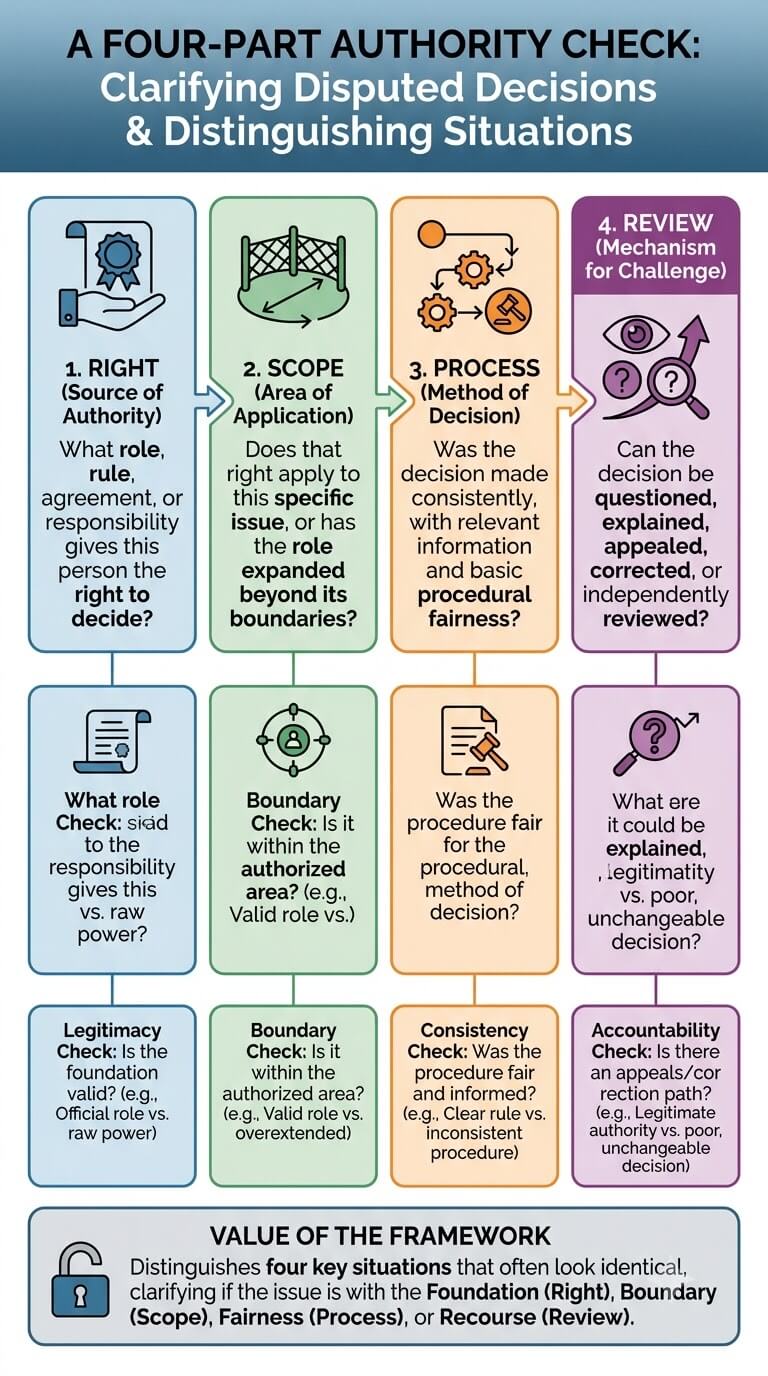
When authority is disputed, four questions can clarify what is actually wrong.
| Question | What to examine |
|---|---|
| Right | What role, rule, agreement, or responsibility gives this person the right to decide? |
| Scope | Does that right apply to this specific issue, or has the role expanded beyond its boundaries? |
| Process | Was the decision made consistently, with relevant information and basic procedural fairness? |
| Review | Can the decision be questioned, explained, appealed, corrected, or independently reviewed? |
This framework helps distinguish several situations that can otherwise look identical. The authority may be legitimate but the decision poor. The role may be valid but overextended. The rule may be clear but the procedure inconsistent. Or the person may possess raw power without any recognized decision right at all.
Where Authority Fits With Social Power and Hierarchy
Authority is one way unequal influence can become organized, but it is not the whole story.
Social power asks who can affect outcomes
A person can have power through resources, information, rewards, threats, expertise, or social connections. Authority is narrower because it asks whether the direction is recognized as legitimate.
Legitimate power names one source inside a wider taxonomy
French and Raven’s legitimate power is one of several bases of social power. Reward, coercive, expert, referent, and informational power can all operate without being identical to authority. A person may combine several bases at once.
Hierarchy organizes several authority and status positions
A school, family, organization, or community may contain multiple levels of formal authority plus informal status differences. Authority describes recognized decision rights within that ordering. Hierarchy describes the wider arrangement.
FAQ
These questions address the boundaries that most often cause authority to be confused with power, expertise, or blind compliance.
Is authority the same as power?
No. Power is the broader capacity to affect another person’s outcomes. Authority involves a recognized or perceived legitimate right to direct, decide, or set rules. Someone may have coercive, financial, informational, or social power without legitimate authority. A person may also hold formal authority while having relatively little practical leverage.
Can someone have authority without being credible?
Yes. A role-holder can retain legitimate decision rights even when people doubt their expertise, accuracy, or reliability. That does not make credibility irrelevant. Authority may determine who makes the final decision, while credibility and evidence determine whether the reasoning deserves confidence. Good systems usually create ways for authority to consult expertise and correct mistakes.
Why do people obey legitimate authority voluntarily?
People may internalize an obligation to follow rules or decisions they consider proper and appropriately issued. They may also care about group membership, fair treatment, predictability, and the practical benefits of coordinated rules. Voluntary deference does not mean people stop thinking critically or agree with every decision.
Does questioning authority mean rejecting authority?
No. A person can accept that a role has decision rights while questioning a particular decision, asking for reasons, challenging an error, or using an appeal process. Recognizing authority is compatible with asking whether the decision stayed within scope and whether the procedure was fair.
When does authority become coercive rather than legitimate?
Legitimate authority and coercive power can coexist, so the boundary is not always all-or-nothing. Coercion becomes more central when behavior is driven mainly by feared costs rather than accepted decision rights. If threats, retaliation, isolation, humiliation, financial control, stalking, violence, or credible fear are present, the issue requires a safety lens rather than ordinary advice about respecting authority.
Key Takeaways
- Authority is the recognized or perceived legitimate right to direct, decide, or set rules within a particular scope.
- Authority differs from social power, expertise, credibility, and conformity even though all can influence behavior.
- Legitimacy helps explain voluntary deference that is based on obligation or acceptance rather than only reward or punishment.
- Procedural fairness, consistency, respectful treatment, and opportunities for voice can shape perceived legitimacy, but their effects vary across settings.
- A role can remain formally valid while trust, credibility, or perceived legitimacy of the role-holder declines.
- Healthy authority has boundaries, accountability, and some mechanism for clarification, review, or correction when stakes are significant.
The most useful next step when authority feels confusing is to separate four questions: What gives the person the right to decide? Where does that right stop? Was the decision made through a defensible process? What review is available? That approach allows you to recognize legitimate roles without treating every decision as unquestionable or every disagreement as a rejection of authority.

Michael Reed is the Founder and Lead Writer at Psychology Exposed. He writes about human behavior, relationships, emotional patterns, self-awareness, and practical psychology topics using research-informed, easy-to-understand content.
Read More About Michael Reed: https://psychologyexposed.com/michael-reed/