

Two people can become influential for almost opposite reasons. One may be difficult to challenge because others expect conflict, punishment, exclusion, or another cost. The other may be sought out because people value their knowledge, skill, judgment, or contribution. Both can receive attention and deference, yet the psychology underneath that deference is different.
This is the central distinction between dominance and prestige. Dominance relies more on coercive capacity, intimidation, threat, or the ability to impose costs. Prestige relies more on voluntarily granted respect because others value what a person knows, does, or contributes. Neither term should be used as a personality diagnosis, and neither is a synonym for confidence, leadership, popularity, aggression, or high status in general.
The distinction matters because surface behavior can be misleading. A group may listen closely to both a feared member and a respected expert, but one form of attention may be driven by caution while the other is driven by interest or learning. Understanding the reason for deference helps explain why similar rank can create very different social climates.
Quick Answer
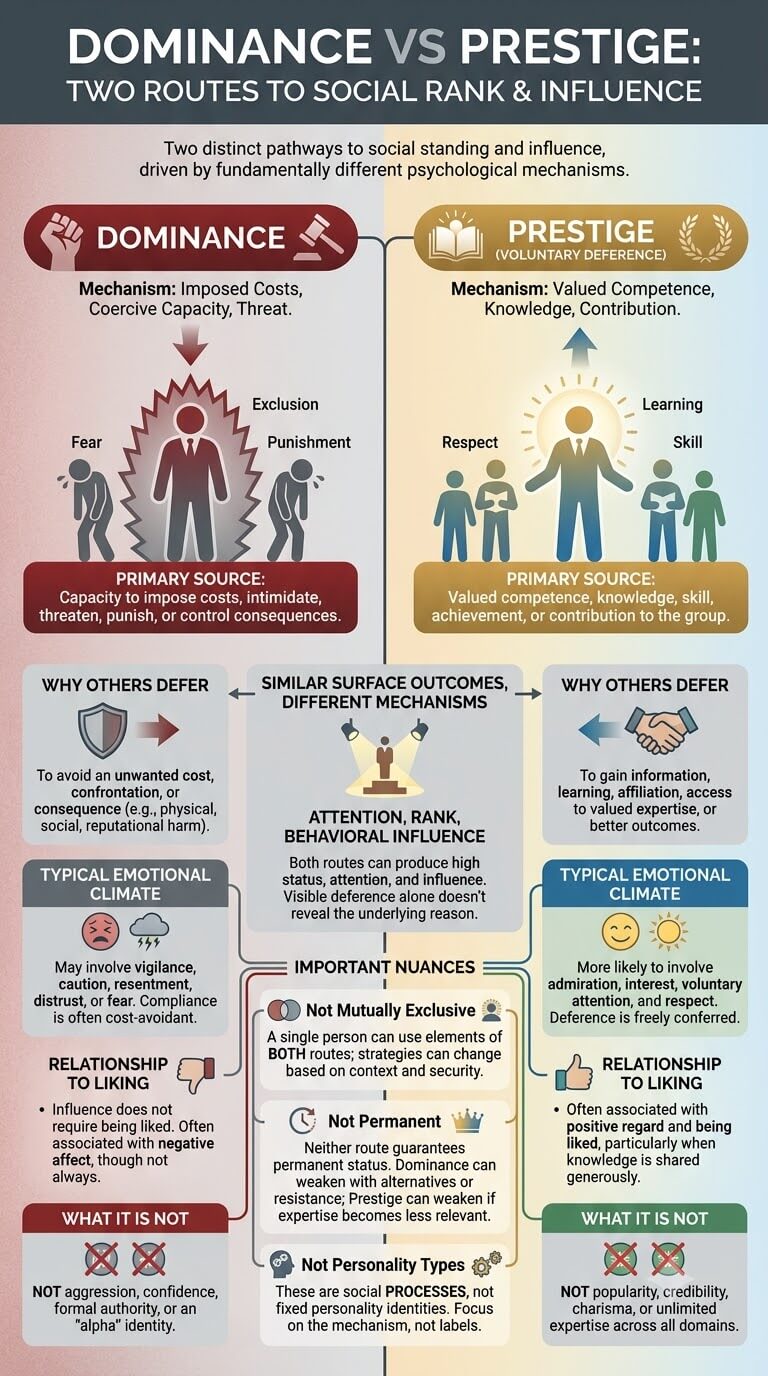
Dominance and prestige are two distinct routes through which people may gain social rank or influence. Dominance depends more on intimidation, threat, coercive capacity, or the ability to impose costs. Prestige depends more on respected competence, knowledge, skill, or achievement that leads others to grant deference voluntarily. People can show elements of both, and neither route guarantees permanent status. These two routes make more sense within the wider psychology of power, status, and hierarchy.
The Core Difference: Imposed Costs vs Voluntary Deference

The clearest way to separate dominance from prestige is to ask why other people are yielding, listening, or following. Are they trying to avoid a cost, or are they voluntarily giving someone more weight because that person seems valuable to learn from?
In their influential study, Cheng and colleagues described dominance and prestige as distinct routes to social rank and influence. In their group studies, both routes were associated with greater perceived and behavioral influence, but prestige was associated with being liked while dominance was not. The finding is useful because it shows that influence alone does not tell you what kind of social process produced it.
Dominance relies more on threat, intimidation, force, or capacity to impose costs
Dominance is most clearly present when other people defer because resistance could be costly. The cost might be physical in some settings, but human dominance can also involve social exclusion, punishment, withholding valued resources, reputational harm, or other consequences.
The mechanism is therefore not simply “being assertive.” A person can speak firmly without creating dominance-based deference. The key feature is that others perceive a meaningful capacity to impose costs and adjust their behavior partly to avoid those costs.
Prestige relies more on valued competence, knowledge, achievement, or contribution
Prestige is built through a different exchange. People voluntarily attend to someone because they believe proximity, observation, advice, or cooperation may provide something useful. The admired person may possess technical skill, artistic ability, practical knowledge, good judgment, experience, or another quality the group values.
Henrich and Gil-White’s classic account of prestige as freely conferred deference proposed that prestige is closely tied to social learning. Their evolutionary explanation is one influential framework rather than the only possible interpretation, but the distinction between coerced and voluntarily granted deference remains central to later research.
How Dominance Produces Influence

Dominance works when the possibility of an unwanted consequence changes how people behave. The dominant person does not need to threaten someone in every interaction. If the capacity to impose costs is already understood, anticipation may be enough.
Anticipated cost can change behavior even without admiration
Imagine a peer who routinely reacts to disagreement by mocking people publicly and excluding them from social plans. Others may stop challenging that person, not because they admire the behavior, but because speaking up has become expensive.
The same principle can appear in more formal settings. A person who controls a valued resource may receive compliance because others do not want to lose access. What makes the process dominance-like is the connection between deference and anticipated cost.
Fear-based deference is not the same as legitimacy or respect
If someone yields because refusing feels risky, the resulting behavior should not automatically be interpreted as respect. Compliance can coexist with resentment, distrust, or a belief that the demand is unfair.
This is especially important when rank is inferred from visible behavior. A person who speaks last, avoids disagreement, or quickly agrees may be responding to consequences rather than acknowledging the other’s superior judgment.
Dominance and aggression overlap but are not identical
Aggression refers to behavior intended to cause harm, while dominance is about a rank process based on coercive capacity or imposed costs. Aggressive behavior can contribute to dominance, but not every aggressive act creates stable social rank. Likewise, dominance can involve credible threats or control over consequences without frequent overt aggression.
A modern open-access review of dominance in humans emphasizes this broader coercive logic and also notes the challenges of translating dominance concepts from nonhuman animals into complex human social settings.
How Prestige Produces Influence
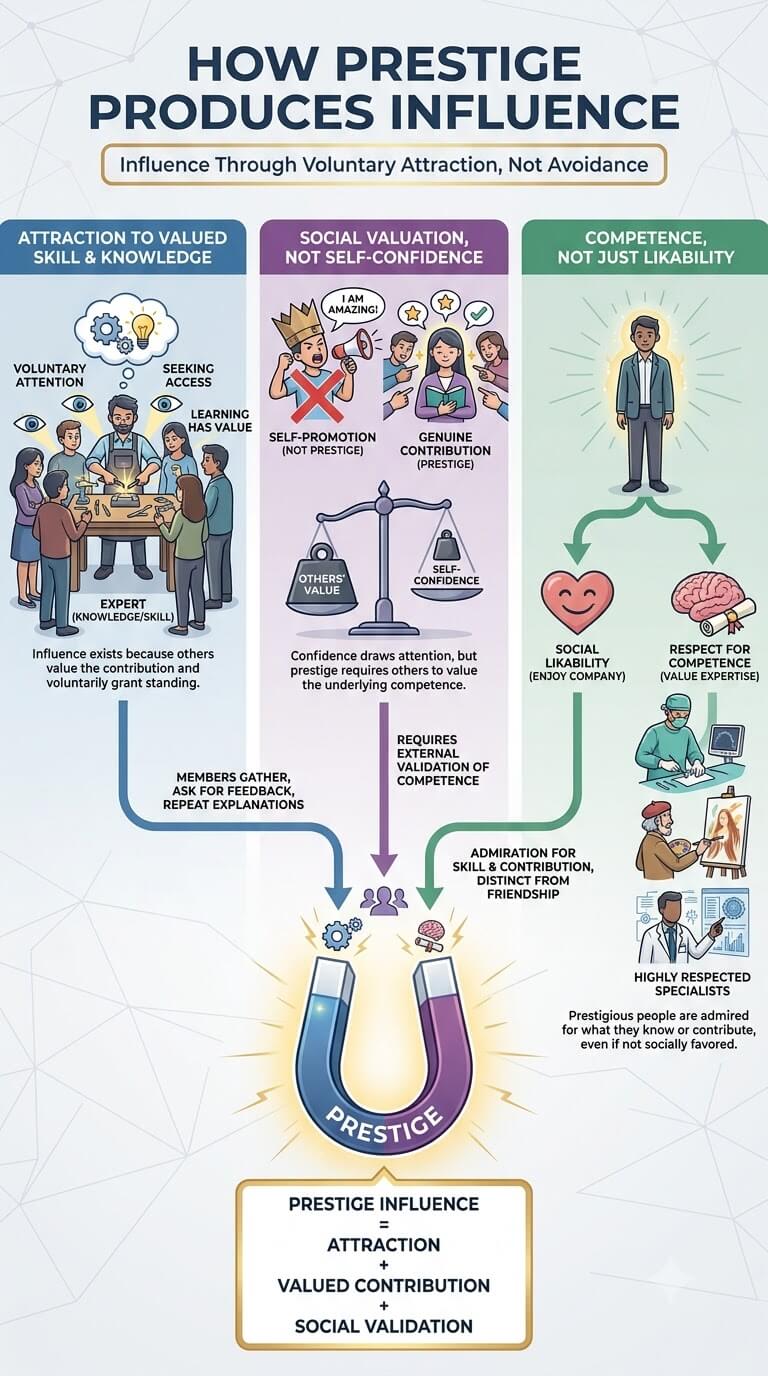
Prestige depends more on attraction than avoidance. Other people want access to a person’s knowledge, skill, example, or contribution, so they voluntarily pay attention and may grant that person more influence.
Others voluntarily attend to valued skill and knowledge
Consider a hobby group with one member who has spent years developing a difficult craft. Nobody can punish the others for ignoring this person. Yet members gather around when the expert demonstrates a technique, ask for feedback, and repeat the expert’s explanations later.
The influence exists because learning has value. If the person’s advice repeatedly stops being useful, prestige may decline even if prior reputation delays that change.
Prestige depends on social valuation, not simply self-confidence
Someone cannot create prestige merely by behaving as though they deserve admiration. Confidence may draw attention, but prestige requires other people to value the underlying contribution or competence.
This is why self-promotion and prestige are not the same. A person may describe themselves as highly skilled without receiving voluntary deference. Conversely, a quiet person can become prestigious because others repeatedly seek out their knowledge.
Prestige and likability can diverge
Prestigious people are often liked, particularly when they share useful knowledge generously, but likability is not the definition. A highly respected surgeon, teacher, artist, craftsperson, or technical specialist may be admired for competence without being everyone’s favorite person socially.
The stronger question is whether people grant standing because they value what the person knows or contributes, not whether they simply enjoy the person’s company.
Dominance and Prestige Can Produce Similar Surface Outcomes
The reason these concepts are easy to confuse is that both may produce rank, attention, influence, and deference. The visible outcome can look similar even when the underlying mechanism is different.
Both can increase attention, rank, or behavioral influence
In Cheng and colleagues’ experiments, both dominant and prestigious group members received greater visual attention and greater influence than people low on both dimensions. That means attention itself does not identify the route to rank.
People watch a respected expert because useful information may follow. They may watch a dominant person because missing a reaction could carry a cost. The eyes may move in the same direction for different reasons.
Why the underlying reason for deference matters
The mechanism affects what happens when conditions change. If influence is based on expertise, it may weaken when the task moves outside the person’s domain. If influence is based on intimidation, it may weaken when other members gain protection, alternatives, or collective support.
The mechanism also affects what deference means. Voluntary attention suggests value-seeking. Cost-avoidant compliance suggests constraint. Treating both as generic “respect” erases this difference.
Dominance vs Prestige: Side-by-Side Comparison
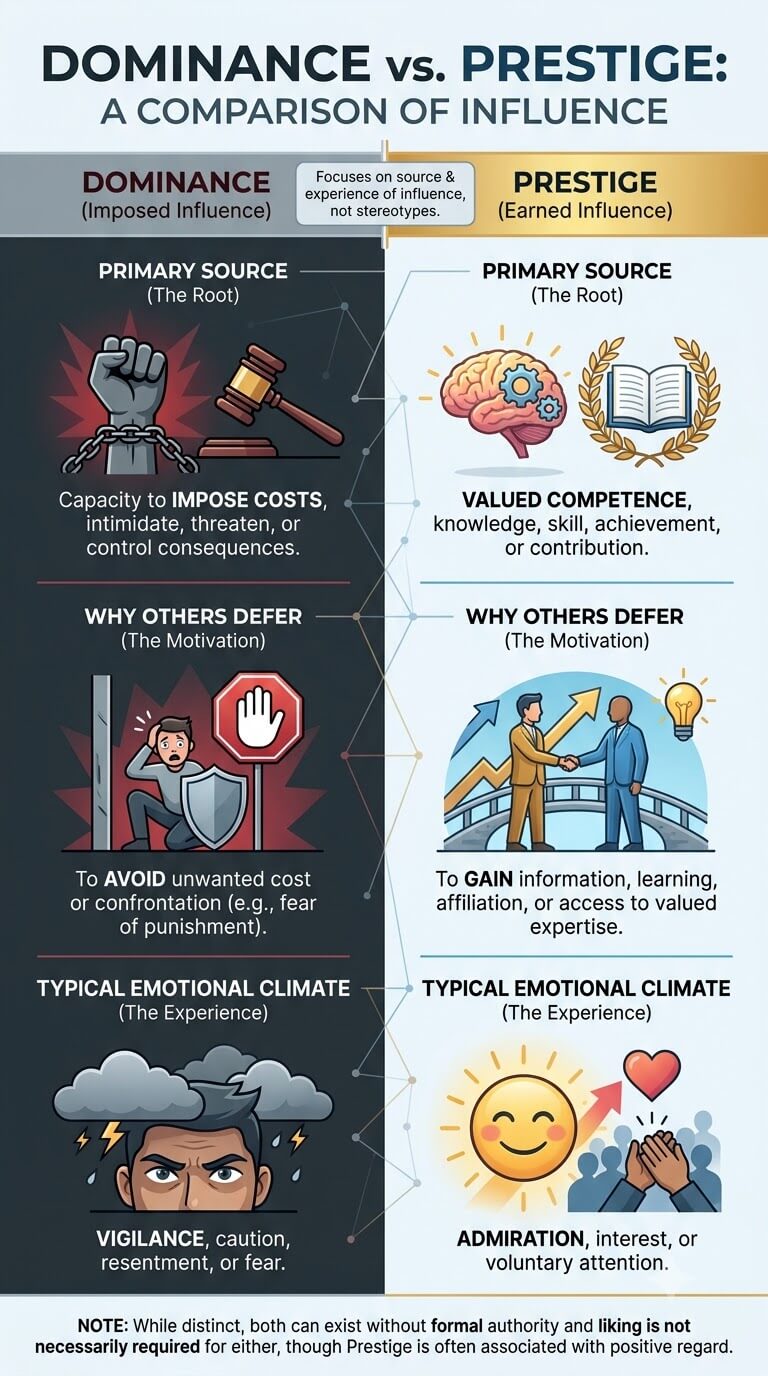
A comparison is most useful when it focuses on the source and experience of influence rather than on stereotypes about what a dominant or prestigious person “looks like.”
| Dimension | Dominance | Prestige |
|---|---|---|
| Primary source | Capacity to impose costs, intimidate, threaten, punish, or control consequences. | Valued competence, knowledge, skill, achievement, or contribution. |
| Why others defer | To avoid an unwanted cost or confrontation. | To gain information, learning, affiliation, or access to valued expertise. |
| Typical emotional climate | May involve vigilance, caution, resentment, or fear. | More likely to involve admiration, interest, or voluntary attention. |
| Relationship to liking | Influence does not require being liked. | Often associated with positive regard, though liking is not required by definition. |
| What can weaken it | Reduced threat credibility, more alternatives, collective resistance, or stronger safeguards. | Loss of perceived competence, relevance, contribution, or reputation. |
| Relationship to formal authority | Can exist with or without formal authority. | Can exist with or without formal authority. |
Can One Person Use Both Dominance and Prestige?
Yes. The framework describes separable routes, not mutually exclusive human types. One person may be highly competent and respected while also having a strong capacity to impose costs. Another may move between the two depending on the situation.
Mixed strategies and changing contexts
A coach may be respected for deep knowledge but also control playing time. A community elder may possess valued historical knowledge and also have the social influence to exclude someone from important networks. A technical expert may earn admiration in one setting but resort to intimidation when their status is challenged.
Research in naturally occurring groups supports the idea that dominance and prestige hierarchies can coexist. The exact relationship between them varies by context, measurement, and the qualities a group values.
Labels should describe patterns, not fixed identities
Saying “this interaction looks dominance-based” is more precise than saying “this person is a dominant type.” The first description points to a mechanism. The second can easily become a global personality claim that ignores context.
People also change strategies. Someone may rely on expertise when they feel secure and become more coercive under competition. Another may have a forceful communication style without actually possessing the leverage required for dominance.
What Dominance Is Not
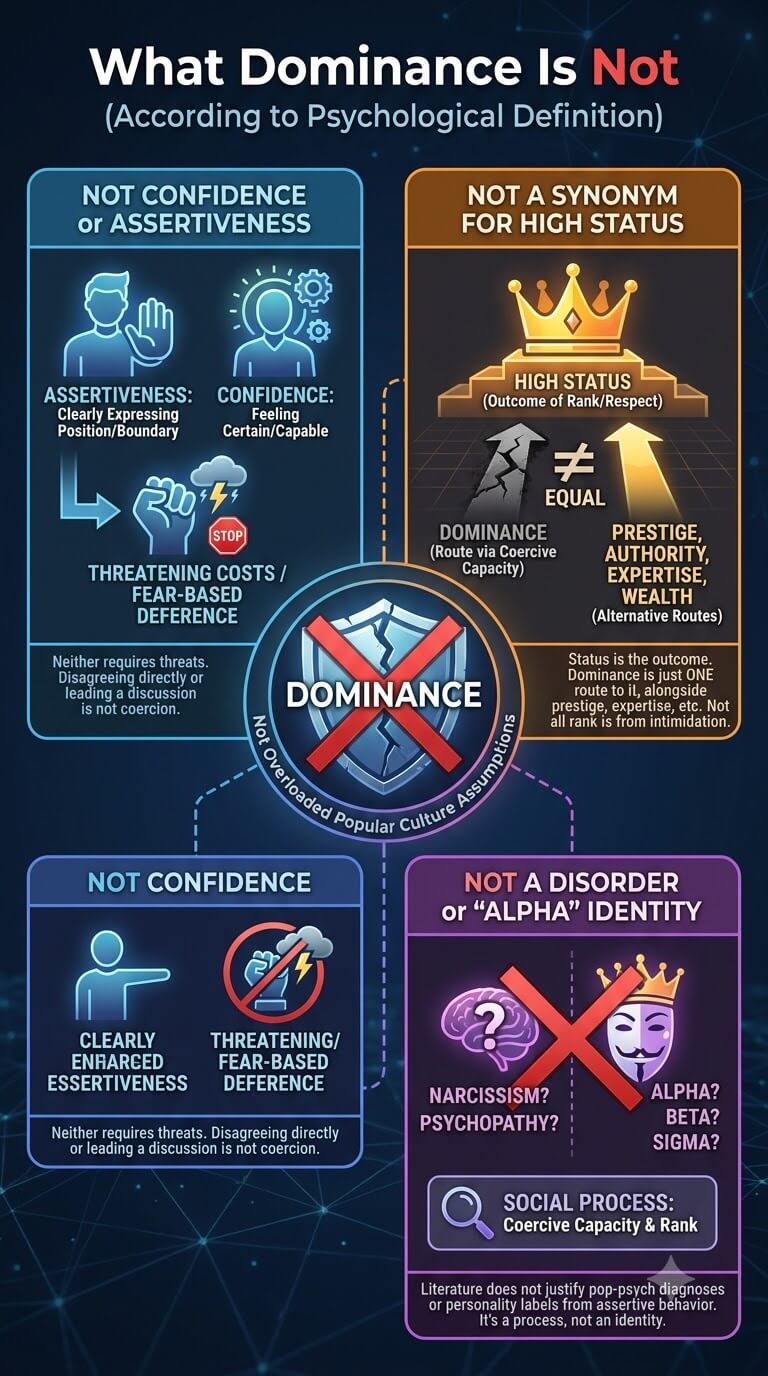
Dominance has become overloaded in popular culture, especially online. Several common assumptions are not supported by the psychological definition.
Not every confident or assertive person is dominance-based
Assertiveness means expressing a position or boundary clearly. Confidence means a person feels relatively certain or capable. Neither requires threatening costs. A person can disagree directly, lead a discussion, or make a firm decision without creating fear-based deference.
The distinction prevents ordinary confidence from being mislabeled as coercion.
Dominance is not a synonym for high status
High status describes the outcome of rank or respect. Dominance describes one possible route to influence and rank. Prestige is another. Formal authority, wealth, reputation, expertise, and institutional position can also shape standing.
A highly ranked person therefore cannot be assumed to have obtained that position through intimidation.
Dominance is not a personality disorder or an “alpha” identity
The dominance-prestige literature does not justify diagnosing narcissism, psychopathy, or another disorder from assertive behavior, body language, confidence, or social rank. It also does not support internet claims that people can be neatly divided into alpha, beta, or similar personality categories.
Dominance here refers to a social process involving coercive capacity and rank. It should not be turned into a pop-psychology identity label.
What Prestige Is Not

Prestige is also easily confused with several positive social qualities that may overlap without being equivalent.
Prestige is not the same as popularity
Popularity may come from friendliness, entertainment, visibility, beauty, social centrality, or other qualities. Prestige specifically emphasizes standing linked to valued competence, knowledge, skill, or contribution.
A person can therefore be popular without being a major source of expertise, or prestigious without being socially central.
Prestige is not the same as credibility
A prestigious person may be given more initial attention because of reputation. That does not guarantee that every claim they make deserves belief. Relevant expertise, evidence quality, accuracy, and conflicts of interest still matter.
Prestige can create a shortcut for attention. It should not replace evaluation of the claim itself.
Prestige is not unlimited expertise
Skill is usually domain-specific. A celebrated musician may deserve extraordinary respect for musical judgment without having unusual insight into medicine, finance, or parenting. Prestige becomes misleading when standing in one domain is automatically generalized to unrelated questions.
Short-Term and Longer-Term Social Consequences
Dominance and prestige differ not only in how rank is gained but also in what tends to sustain it. Claims about durability should remain cautious because real-world settings vary and rank depends on institutions, norms, resources, and changing group needs.
Compliance, resistance, learning, coalition support, and reputation
Dominance can generate rapid compliance when the cost of resistance is high. It may also generate dislike, avoidance, coalition-building, or attempts to limit the dominant person’s leverage. Prestige can generate learning, voluntary attention, imitation, and reputational benefits when the contribution continues to be valued.
Cheng’s review of dominance, prestige, and leveling in human hierarchy argues that humans often tolerate prestige-based inequality more readily while also developing ways to resist coercive aggrandizement. This is a theoretical synthesis of a broad literature, not a rule that every group responds in exactly the same way.
Why dominance may be less stable when people gain alternatives
Dominance depends partly on the credibility of imposed costs. If members can leave, coordinate with one another, appeal decisions, share resources, or reduce dependence, intimidation can lose effectiveness. These dynamics can become especially visible when someone experiences a threat to their social standing and becomes motivated to protect or restore rank.
Prestige also has limits. If the valued expertise becomes irrelevant or the person’s judgment repeatedly proves poor, voluntary deference may decline. Neither route guarantees permanent standing.
Why norms and institutions matter
Groups can make coercive rank easier or harder to sustain. Clear rules, transparent decisions, shared access to resources, and meaningful appeal channels can reduce a single person’s capacity to impose arbitrary costs. Conversely, concentrated control and weak accountability can strengthen that capacity.
Norms also shape prestige. Groups decide which achievements count, whose knowledge is recognized, and whether contribution is visible. Prestige is socially granted, so it depends partly on what the group values.
Everyday Examples Without Glorifying Either Route
The easiest way to apply the distinction is to examine why deference occurs in a specific situation.
Temporary team task: expertise earns voluntary attention
Situation: A group is planning an outdoor event, and one member has extensive safety experience. What others may feel: relief that someone understands the risks. What it may mean: prestige is developing around relevant expertise. What to do next: give the expertise appropriate weight while keeping unrelated decisions open to the rest of the group.
Community expertise: respected competence without formal power
Situation: A long-time gardener becomes the person neighbors consult about soil and seasonal planting. What people may feel: admiration and interest in learning. What it may mean: valued knowledge is creating prestige-based influence. What to do next: keep the deference tied to the domain where the person’s experience is relevant.
Peer group intimidation: compliance without respect
Situation: One member mocks people who disagree and threatens to exclude them from gatherings. What others may feel: vigilance and reluctance to challenge the person. What it may mean: deference may be dominance-based because anticipated social costs are shaping behavior. What to do next: do not mistake silence for admiration, and consider whether group safeguards or independent support are needed.
Online group influence: two routes operating together
Situation: A moderator is technically skilled and genuinely helpful but can also remove members. What people may feel: both respect and caution. What it may mean: prestige from expertise and coercive capacity from moderation powers coexist. What to do next: separate why people value the person’s knowledge from why they may hesitate to challenge a moderation decision.
Family decision: standing changes with the domain
Situation: An older relative receives general deference, but a younger family member has the most relevant knowledge about a digital financial system. What people may feel: uncertainty about whose view should carry more weight. What it may mean: established status and task-specific prestige are competing. What to do next: identify which expertise is relevant rather than assuming one person should dominate every decision.
Dominance vs Status, Power, Authority, and Aggression
Using precise terms prevents dominance from becoming a catch-all word for anyone who appears socially strong.
| Concept | What it mainly means | How it differs from dominance |
|---|---|---|
| Dominance | Influence or rank supported by coercive capacity, threat, intimidation, or imposed costs. | This is the focal mechanism. |
| Status | Socially recognized rank, respect, or standing. | Status is an outcome or position; dominance is one possible route to it. |
| Power | Relative capacity to affect valued outcomes. | Power is broader and can come from many non-dominance sources. |
| Authority | Recognized legitimate right to direct, decide, or set rules. | Authority can exist without intimidation, and intimidation can exist without legitimacy. |
| Aggression | Behavior intended to harm. | Aggression can support dominance, but the concepts are not identical. |
First Step: Ask Why Others Are Deferring
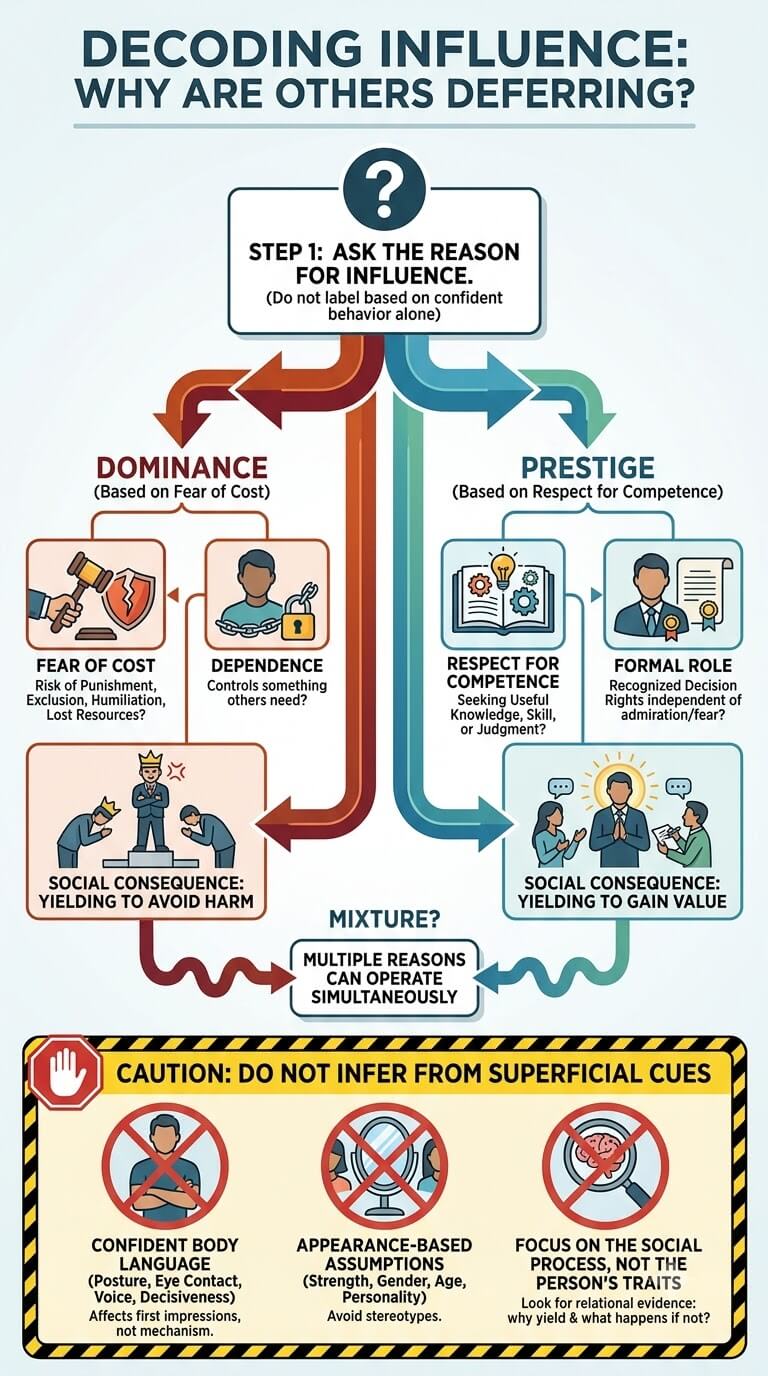
Before labeling a person dominant or prestigious, examine the reason people are giving them influence. The same confident behavior can produce very different meanings depending on the social consequences around it.
Fear of cost, respect for competence, formal role, dependence, or some mixture?
- Fear of cost: Would disagreement risk punishment, exclusion, humiliation, lost resources, or another consequence?
- Respect for competence: Are people seeking useful knowledge, skill, or judgment?
- Formal role: Does the person have recognized decision rights independent of admiration or fear?
- Dependence: Does the person control something others need?
- Mixture: Are several reasons operating at the same time?
Do not infer the mechanism from confident body language alone
Posture, eye contact, vocal volume, clothing, or decisiveness can affect first impressions, but they do not establish whether someone’s influence is dominance-based or prestige-based. The more reliable evidence is relational: why are others yielding, and what happens if they do not?
That same caution applies to appearance-based assumptions about strength, gender, age, or personality. A dominance-prestige analysis should focus on the social process rather than stereotypes.
How Rank, Hierarchy, and Social Power Clarify the Picture
Dominance and prestige become easier to interpret when they are placed beside three broader concepts.
Status describes the standing that results
Status concerns respect, recognition, and rank. Dominance and prestige help explain two different ways a person may attain or maintain higher standing. They should not be used as synonyms for status itself.
Hierarchy describes the wider ordering
A group hierarchy includes the positions occupied by several people and the expectations attached to those positions. Dominance and prestige can contribute to that ordering, but formal roles, resources, seniority, institutional rules, and other status processes may also matter.
Social power describes capacity to affect outcomes
Dominance relies on one particular kind of power: capacity to impose costs or restrict benefits. Prestige can create influence even when the respected person has little formal control over outcomes. Keeping power and prestige separate prevents respected expertise from being mistaken for coercive control.
When Dominance Becomes a Safety Concern
Ordinary competition, assertiveness, disagreement, and uneven status are not automatically unsafe. The safety context changes when influence depends on credible threats, stalking, isolation, financial control, humiliation, retaliation, violence, or fear that saying no could lead to harm.
When those conditions are present, direct confrontation may increase risk. Safety-planning resources from the National Domestic Violence Hotline emphasize individualized planning and support rather than assuming that clearer communication will solve coercive dynamics.
This distinction also prevents dominance research from being misused. Explaining how intimidation can produce deference is not advice for gaining influence. If pressure is being used deliberately to restrict another person’s freedom, the relevant concern may extend beyond ordinary status competition into coercion or manipulation. Psychology Exposed’s discussion of manipulation psychology covers that separate issue.
FAQ
These questions address the places where dominance and prestige are most often confused with broader personality or status labels.
Is dominance the same as aggression?
No. Aggression is behavior intended to harm, while dominance is a rank process supported by coercive capacity or the ability to impose costs. Aggression can help create dominance in some settings, but a single aggressive act does not automatically produce stable rank. Dominance can also operate through credible social or material consequences without repeated overt aggression.
Is prestige the same as popularity or charisma?
No. Popularity reflects liking or visibility, and charisma usually describes an interpersonal quality that attracts attention or enthusiasm. Prestige specifically concerns standing granted because others value competence, knowledge, skill, achievement, or contribution. A charismatic person can lack expertise, and a prestigious expert can be quiet or socially reserved.
Can a person be both dominant and prestigious?
Yes. The two routes are distinct but not mutually exclusive. A person may be respected for expertise while also controlling consequences that make disagreement costly. The useful question is not which permanent category the person belongs to, but which mechanism is producing deference in a particular interaction.
Does dominance always create high status?
No. Attempts at intimidation can fail, provoke resistance, damage reputation, or cause people to leave when alternatives exist. Dominance is a possible route to influence when coercive capacity is credible, not a guarantee of durable status. Group norms, coalitions, accountability, and the availability of alternatives all affect whether dominance can be sustained.
Why can prestige create influence without formal power?
People often grant extra attention to someone whose knowledge or skill they value because doing so may help them learn or make better decisions. That voluntary deference can create substantial influence even when the prestigious person cannot approve, punish, reward, or formally direct anyone. Expertise can therefore produce standing without formal authority.
Key Takeaways
- Dominance and prestige are distinct routes to social rank and influence, not two fixed personality types.
- Dominance depends more on anticipated costs, intimidation, threats, or coercive capacity; prestige depends more on voluntarily granted respect for valued competence or knowledge.
- Both routes can produce attention and influence, so visible deference alone does not reveal why people are yielding.
- Dominance is not the same as aggression, confidence, authority, high status, or an “alpha” identity.
- Prestige is not the same as popularity, charisma, credibility, or unlimited expertise across domains.
- When influence involves threats, retaliation, stalking, isolation, financial control, humiliation, violence, or credible fear, safety matters more than classifying the person’s status strategy.
The most useful next step is to look past the visible rank and ask what is sustaining it. If people defer because they want access to skill or knowledge, prestige is the better explanation. If they defer because resistance carries a meaningful cost, dominance may be more relevant. If both are present, name both instead of forcing the person into a single label.

Michael Reed is the Founder and Lead Writer at Psychology Exposed. He writes about human behavior, relationships, emotional patterns, self-awareness, and practical psychology topics using research-informed, easy-to-understand content.
Read More About Michael Reed: https://psychologyexposed.com/michael-reed/