
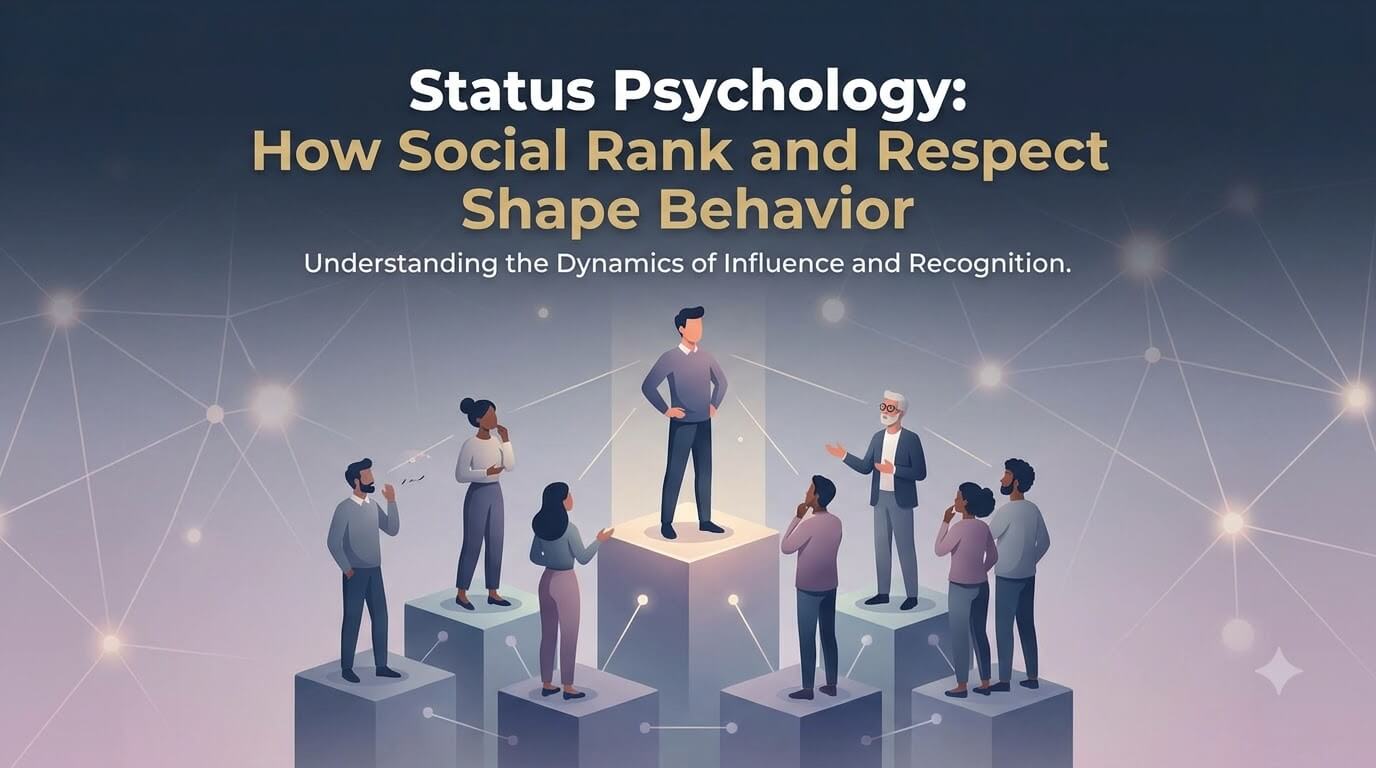
Some people are listened to before they have said much. Others are interrupted, overlooked, or expected to prove themselves first. In one group, a person may be treated as the natural expert. In another, the same person may receive little attention. These differences are often described with a single word: status.
Status psychology is about socially recognized standing. It concerns the respect, admiration, prestige, recognition, and deference people receive from others. That makes status different from personal self-worth and different from social power. A person may be widely respected without controlling important decisions, while another person may control resources or rules without being admired.
This view helps explain why people notice rank cues, why reputation shapes expectations, and why deference can differ even without a formal hierarchy. It also prevents popularity, confidence, power, and status from being treated as interchangeable.
Quick Answer

Status in psychology refers to a person’s socially recognized standing relative to others, often expressed through respect, admiration, prestige, recognition, or voluntary deference. Status can be formal or informal, earned or assigned, stable or temporary. It may affect who gets noticed, consulted, interrupted, trusted, or deferred to, but it is not the same as power, popularity, self-esteem, or human worth.
What Social Status Means in Psychology

The APA Dictionary of Psychology definition of social status describes it as relative prestige, authority, and privilege within a group or society, with many possible bases for that standing. In social-psychological research, a narrower and especially useful view focuses on how much respect, admiration, and voluntary deference other people grant someone.
A major review by Cameron Anderson, John Hildreth, and Laura Howland defines status in terms of the respect, admiration, and voluntary deference afforded by others. This definition makes status fundamentally social. You cannot create high status simply by deciding that you deserve it. Other people have to confer some form of standing on you.
Respect, admiration, recognition, and voluntary deference
These elements overlap without being identical. Respect reflects positive regard for someone’s standing. Admiration responds to valued qualities or achievements. Recognition makes that standing visible. Voluntary deference appears when others willingly give the person’s view more weight.
A 2024 review of how status is defined and measured argues that respect, admiration, and voluntary deference capture cognitive, emotional, and behavioral sides of status. That three-part lens is useful because status is not only an internal opinion. It becomes visible through how a group thinks about, feels toward, and responds to a person.
| Part of status | What it means in everyday life | Possible sign |
|---|---|---|
| Respect | Others see the person as valuable, capable, or worthy of regard. | Their judgment is taken seriously even when people disagree. |
| Admiration | Others positively value qualities, achievements, or contributions. | People look to them as an example or want to learn from them. |
| Voluntary deference | Others willingly give the person more weight or room to influence. | People seek their view, yield speaking space, or follow suggestions without formal pressure. |
Status is a social judgment, not private self-worth
Status answers, “How am I regarded here?” Self-worth answers a different question: “How do I value myself as a person?” Someone can have high status while privately feeling insecure. Another person can have stable self-respect while holding a low-status position in a particular group.
Changes in rank do not determine personal value. Being new, less visible, or lower-ranked in one setting can change social standing without settling anything about character, intelligence, or worth.
The Building Blocks of Status

Status becomes easier to recognize when it is broken into concrete social processes rather than treated as a vague feeling of importance.
Social rank and relative standing
Status is partly relational. Being high-status usually means being granted more standing than others in a particular group or on a particular dimension. A person may rank highly for technical judgment, artistic skill, reliability, local knowledge, athletic ability, or community contribution.
Status is often domain-specific. The person most respected for financial advice may not hold the same standing on parenting, art, or technical problems.
Reputation and recognition
Reputation carries information about how a person is known across interactions. Someone who repeatedly contributes useful ideas may develop a reputation for competence. Someone who keeps commitments may become known for reliability. Once established, reputation can shape expectations before a new interaction begins.
Recognition matters because status depends on social perception. Valuable contribution that remains unseen may not translate into standing, even though visibility does not make a person more deserving.
Visibility and attention
High-status people may receive more attention because others expect them to matter. Greater visibility can then create more chances to demonstrate competence or shape expectations.
This process can become self-reinforcing. Magee and Galinsky’s review of social hierarchy describes how prior status can generate expectations and opportunities that help preserve status advantages over time.
Expectations about competence, voice, and deference
Once someone is seen as high-status, others may expect better judgment or give that person more speaking room. Those expectations are not always accurate. Status is a social evaluation, not proof of correctness.
That is one reason status deserves careful interpretation. A respected person can be mistaken. A low-status newcomer can be right. Social standing influences whose ideas receive attention, but it should not substitute for evaluating the evidence or reasoning itself.
Earned, Assigned, Formal, and Informal Status

Not all status begins in the same way. Some standing develops through demonstrated contribution, while some is attached to roles, categories, seniority, credentials, or established conventions.
Status linked to achievement or valued contribution
A volunteer may gain status after repeatedly solving difficult problems. A musician may earn standing through skill. A friend may become the person others trust to organize complicated plans because they consistently follow through. This type of status is often grounded in qualities or contributions the group values.
Even earned status is socially conferred. Skill alone is not enough if the group does not recognize or value that skill. A brilliant specialist may have high standing in one community and little standing in another that values different abilities.
Status linked to role, category, seniority, or convention
Some status is partly assigned before the person demonstrates much. A senior member may receive deference because of tenure. A person entering with an elite credential may be assumed to know more. Family roles, professional titles, age norms, and institutional traditions can also shape expected standing.
Assigned status can later be reinforced or challenged. A title may create initial expectations, while visible competence or repeated poor judgment can move informal respect in either direction.
Why informal respect can diverge from official rank
A committee chair may hold the highest formal position while another member receives the most genuine respect. A teacher may have formal standing in a classroom while students view a particular peer as the strongest source of technical help. A moderator may control platform rules while a long-time member sets the tone for what others admire.
The divergence exposes two questions: who occupies the recognized role, and who is voluntarily granted respect?
How People Read Status Signals

Status is not printed above a person’s head. People infer it from patterns of behavior, attention, access, symbols, and the reactions of others. These cues can be informative, but they can also mislead.
Who is listened to, interrupted, consulted, or deferred to
Conversation provides many subtle signals. Who gets to finish a point? Whose disagreement changes the direction of discussion? Who is asked to make the final call when the group is uncertain? Whose joke receives attention? Who gets introduced as the person everyone should know?
No single behavior proves status. Look for repeated patterns across several interactions and several group members.
Access, visibility, symbols, introductions, and social proof
Status may also be inferred from where someone sits, who approaches them, whether others seek introductions, what credentials are displayed, or which symbols the group associates with prestige. The APA Dictionary notes that a status symbol can communicate perceived prestige or high standing, although signals can exaggerate actual rank.
People also use others’ reactions as information. If respected members repeatedly seek one person’s input, newcomers may infer that person’s standing before knowing why.
Why a signal is not always accurate evidence of actual standing
Expensive possessions can signal wealth without creating respect. Loud confidence can attract attention without producing voluntary deference. A prominent title may create formal rank while coworkers privately disregard the person’s judgment. Online follower counts can indicate visibility without revealing whether a specific community grants meaningful respect.
Treat a signal as evidence, not a verdict. The stronger test is whether the group repeatedly grants recognition, regard, and voluntary deference.
Why Humans Monitor Relative Standing
People often notice who is gaining attention, whose contribution matters, and where they stand relative to others. This does not mean everyone is constantly competing for prestige. It does mean rank can affect access to social and practical outcomes.
Access to attention, opportunities, influence, and belonging
Status can affect who gets heard, invited, trusted with responsibility, or granted another chance. That makes standing useful information about how a group may respond.
The Anderson, Hildreth, and Howland review concludes that the desire for status is widespread and psychologically important, while also distinguishing status from money, power, and belonging. That nuance matters. Wanting respect is not identical to wanting control, and wanting inclusion is not identical to wanting rank.
Uncertainty about one’s place in a group
New or changing groups create uncertainty. People watch who is consulted, who receives agreement, and who can challenge others without much social cost to learn the informal ordering.
Status monitoring may intensify when roles are unclear or opportunities depend on reputation. Still, not every comparison or self-conscious moment is a status concern.
Status motives are common, not identical in everyone
People differ in how much they care about recognition, prestige, visibility, or rank. Context matters too. Someone may care deeply about status in a professional community but very little about rank among neighbors. Another person may value respect within a close friendship group more than public prestige.
Research about status motives describes tendencies, not a universal script for every person in every setting.
How Status Shapes Interaction
Status affects social behavior partly because it changes expectations. People enter an interaction with assumptions about whose judgment matters and who is likely to receive deference.
Speaking time, interruption, eye contact, and deference
Higher-status people may receive more conversational space, more visual attention, or more willingness from others to follow their suggestions. These patterns can be subtle. A group may repeatedly turn toward the same person after a difficult question, even though nobody has formally assigned that person authority.
Research on rank also shows that different routes to high standing can produce different patterns of attention and influence. For example, research comparing dominance and prestige found that both could be associated with greater influence and visual attention, even though they produced that rank through different social processes. The distinction deserves its own treatment because high rank does not tell you why others are deferring.
Expectations can arrive before the person speaks
Credentials, reputation, age, role, or prior success can create expectations before someone speaks. These cues may attract attention, but they become unfair shortcuts when treated as proof of competence.
This is where status can affect opportunity. The person expected to contribute well may be given more chances to contribute, making it easier to confirm the original belief. A newcomer who receives less speaking space may have fewer opportunities to demonstrate equally strong judgment.
Lower-status positions can increase monitoring of higher-status people
When another person’s evaluation matters, people often pay close attention to that person’s reactions. A junior member may notice whether a senior member approves. A student may track a teacher’s expression while presenting. A newcomer may watch established members for cues about what counts as appropriate.
This monitoring does not imply weakness. It can reflect uncertainty about expectations and consequences.
High Status Without High Power and High Power Without High Status
Status and power often reinforce each other, but status concerns standing while power concerns capacity to affect valued outcomes.
A respected expert with limited decision rights
Imagine a retired engineer invited to advise a neighborhood project. Everyone values her judgment, waits for her assessment, and treats her technical opinion with respect. Yet she has no vote on the budget and cannot approve the work. Her status is high, while her formal decision power is limited.
Her influence may still be substantial because people voluntarily listen. But if the committee rejects her recommendation, she cannot impose the outcome.
A formal decision-maker with limited respect
Now consider an administrator who can approve or reject requests but is viewed as inconsistent and poorly informed. People comply with decisions because the role carries consequences, not because the administrator receives admiration or voluntary deference.
This person may have considerable power and low status at the same time. The example shows why obedience or compliance should not automatically be interpreted as respect.
Status vs Popularity, Power, Prestige, and Self-Esteem

Several concepts sit close enough to status that ordinary language often blends them together. Separating them prevents inaccurate assumptions.
| Concept | Main question | How it differs from status |
|---|---|---|
| Status | How much respect, admiration, recognition, or rank is this person granted? | This is the focal concept. |
| Popularity | How liked, known, or socially visible is this person? | A person can be widely liked without receiving high rank or deference. |
| Power | How much can this person affect valued outcomes? | Control over outcomes can exist without respect. |
| Prestige | Is standing being granted because others value competence, knowledge, or achievement? | Prestige is one important route or form of respected standing, not every status process. |
| Self-esteem | How positively does the person evaluate themselves? | Self-esteem is internal self-evaluation, not a group’s judgment of rank. |
Popularity is not necessarily rank
A highly likable person may make everyone feel welcome but receive little deference on difficult decisions. Another person may be respected for expertise without being especially socially popular. Visibility, liking, and status can overlap, but they answer different questions.
Prestige is not every form of status
Prestige typically refers to standing granted because others value someone’s competence, knowledge, skill, or achievement. Status is broader. People can receive standing for formal roles, convention, seniority, social identity, dominance, reputation, or other bases depending on the group.
Status is not self-esteem
High status does not guarantee healthy self-esteem, and low status does not prove low self-esteem. A person can recognize that they occupy a junior rank without concluding that they are less worthy. Keeping social standing separate from self-evaluation is especially useful when entering a new group or learning a new skill.
Everyday Status Examples Across Different Groups

Status becomes easier to understand when the same concept is observed in settings that reward different qualities.
Family: the person whose judgment carries special weight
Situation: Several relatives are discussing a difficult family decision, and everyone turns to one aunt before settling on a plan. What someone may feel: reassurance, irritation, or curiosity about why her view matters more. What it may mean: she has accumulated informal status through reliability, history, or judgment. What to do next: separate the family’s respect for her from whether her view is correct in this particular case.
Friendship group: high visibility without much deference
Situation: One friend is funny, socially active, and at the center of many gatherings, but the group rarely seeks their advice on serious decisions. What someone may feel: confusion because popularity looks like high status from the outside. What it may mean: social visibility and liking are high, while decision-related respect may be more limited. What to do next: notice what kind of standing the group actually grants rather than relying on follower counts or attention.
Classroom: expertise creates local status
Situation: A quiet student becomes the person classmates consult during a difficult statistics project. What the student may feel: more recognition than in ordinary class discussion. What it may mean: task-specific competence has created local status. What to do next: avoid assuming that this new standing automatically transfers to unrelated subjects or relationships.
Professional group: title and informal respect diverge
Situation: A senior role-holder leads meetings, but participants consistently ask a lower-ranked specialist to evaluate technical claims. What people may feel: tension between official rank and practical respect. What it may mean: formal position and informal status are not aligned. What to do next: identify whether the current question requires authority, expertise, or both.
Online community: reputation grows through repeated contribution
Situation: A member with no moderation privileges becomes widely recognized for accurate explanations and fair summaries. What the member may feel: increased attention and responsibility. What it may mean: reputation has produced informal status without formal power. What to do next: maintain the distinction between being respected and being authorized to enforce rules.
When Status Becomes Unstable
Status can change when the qualities a group values change, when performance becomes visible, when new members arrive, or when someone’s reputation is challenged. The emotional impact depends partly on what the person believes is at stake.
Comparison, public mistakes, exclusion, and challenges to competence
A public correction may feel different from a private one because an audience adds a reputation dimension. Being left out of a decision may be interpreted as evidence that one’s standing has fallen. A highly capable newcomer may make an established member wonder whether their expertise is still valued.
These events do not automatically produce a real status loss, but they can create uncertainty about recognition, rank, or respect.
Distinguish a status change from a status threat
A status change is an observable shift in standing, such as losing a role, receiving less deference over time, or no longer being treated as the group’s main expert. A status threat is the perception that standing may be endangered. The perception may be accurate, exaggerated, or based on ambiguous evidence.
That distinction matters because defensive behavior can begin before rank has actually changed. If a public correction feels like “everyone will stop respecting me,” the emotional reaction may be responding to the feared social meaning rather than to the correction itself.
First Step: Identify What Kind of Standing Is Actually in Question
When status feels relevant, avoid asking only, “Am I high status or low status?” A more precise assessment is usually more useful.
Name the group and the dimension of rank
Status exists in a social context. Ask: whose respect matters here, and for what? Are you thinking about technical competence, moral judgment, popularity, seniority, creativity, reliability, social influence, or something else?
A person can be highly respected on one dimension and ordinary on another. Naming the dimension reduces the temptation to convert one setback into a global conclusion about standing.
Ask whether the issue is respect, power, popularity, role, or self-evaluation
- Respect: Are people treating your judgment or contribution as valuable?
- Power: Can someone materially affect your options or outcomes?
- Popularity: Is the issue how liked or visible someone is?
- Role: Does a formal position create decision rights regardless of admiration?
- Self-evaluation: Are you turning the group’s response into a conclusion about your worth?
If the main question is whether someone’s confidence, expertise, title, or standing makes their claims believable, that is better treated as a question of credibility psychology. Status can influence first impressions, but rank is not proof that information is true.
How Status Connects With Hierarchy, Dominance, Prestige, and Threat
Status rarely exists in isolation. It sits inside larger patterns of rank and can be gained, protected, lost, or challenged in different ways.
Hierarchy describes the wider ordering
Status describes where a person stands or how much respect they receive. A hierarchy describes the larger arrangement of unequal standing or influence across several people or roles. A group can therefore have many individual status positions within one broader hierarchy.
Dominance and prestige describe different routes to rank
Prestige is generally associated with voluntarily granted respect based on valued competence or knowledge. Dominance involves influence obtained more through intimidation, threat, or capacity to impose costs. Both may produce high rank, but the social meaning of that rank differs. Treating every high-status person as dominant erases this distinction. People can reach higher rank through different social processes, including the contrasting routes of dominance and prestige.
Status threat concerns possible loss of standing
Once status is important or established, criticism, exclusion, public failure, or comparison may be interpreted as a threat to reputation or rank. That is a different question from what status itself means. The useful distinction is between having standing and appraising that standing as endangered.
FAQ
These questions address some of the most common ways status gets confused with nearby social concepts.
Is social status the same as popularity?
No. Popularity usually concerns liking, visibility, or social attention, while status concerns standing that includes respect, admiration, or voluntary deference. A person can be popular because they are entertaining or sociable without being treated as especially authoritative or worthy of deference. A respected expert can also have high status without being broadly popular.
Can someone be respected but have little power?
Yes. A person may receive substantial respect and attention while lacking control over resources, decisions, or consequences. An admired adviser is a simple example. People may voluntarily listen to the adviser, but the adviser may have no ability to approve or block the final outcome. This is one of the clearest reasons to keep status and power separate.
Is status always formally assigned?
No. Formal roles can carry status, but informal status often develops through reputation, contribution, expertise, reliability, seniority, or social recognition. Groups can form clear status differences even when nobody has a title. Informal standing can also diverge from official rank, especially when the person with the formal role is not the person the group most respects.
Why do people care about rank even in informal groups?
Standing can affect whose ideas receive attention, who is included, who receives opportunities, and whose judgment others treat as valuable. That gives rank practical and social consequences even without official roles. People vary widely in how strongly they care about status, so noticing rank should not be treated as evidence that everyone is equally competitive or prestige-seeking.
Does low status mean low self-esteem?
No. Status is socially conferred standing within a particular context. Self-esteem concerns how a person evaluates themselves. Someone can be new, junior, or low-ranked in a group while maintaining stable self-respect. It is also possible to hold high status and still feel insecure. The two can influence each other, but they are not the same psychological construct.
Key Takeaways
- Status is socially granted standing expressed through respect, admiration, recognition, and voluntary deference.
- A person’s status can be formal or informal, earned or assigned, and specific to a group or domain.
- Attention, consultation, speaking space, reputation, and social proof can signal status, but no single cue proves someone’s actual standing.
- Status differs from power, popularity, prestige, and self-esteem, even though these concepts may overlap in everyday life.
- High status does not guarantee control over outcomes, and formal power does not guarantee respect.
- When standing feels threatened, separate observable changes in rank from fears about what criticism, comparison, or exclusion might mean.
A useful next step is to name the exact group and the exact kind of standing you are evaluating. Ask whether the issue is respect, role, influence, popularity, or control over outcomes. That small distinction often makes a confusing social situation much easier to interpret without turning rank into a judgment of personal worth.

Michael Reed is the Founder and Lead Writer at Psychology Exposed. He writes about human behavior, relationships, emotional patterns, self-awareness, and practical psychology topics using research-informed, easy-to-understand content.
Read More About Michael Reed: https://psychologyexposed.com/michael-reed/