

Two people can both influence the same decision for completely different reasons. One person may have an official right to decide. Another may control a reward. A third may be the only person who understands the problem. Someone else may be followed because people identify with them or value their approval. The outcome may look similar, but the source of the influence is not.
The classic bases of social power framework asks where influence comes from. Role-based authority, rewards, punishments, expertise, identification, and persuasive information create different kinds of dependence and have different limits.
The best-known framework began with five bases proposed by John R. P. French Jr. and Bertram Raven: legitimate, reward, coercive, expert, and referent power. Informational power was added in later development of the model. These categories remain influential, but they are better treated as a map of common power sources than as a complete inventory of every way human beings influence one another.
Quick Answer
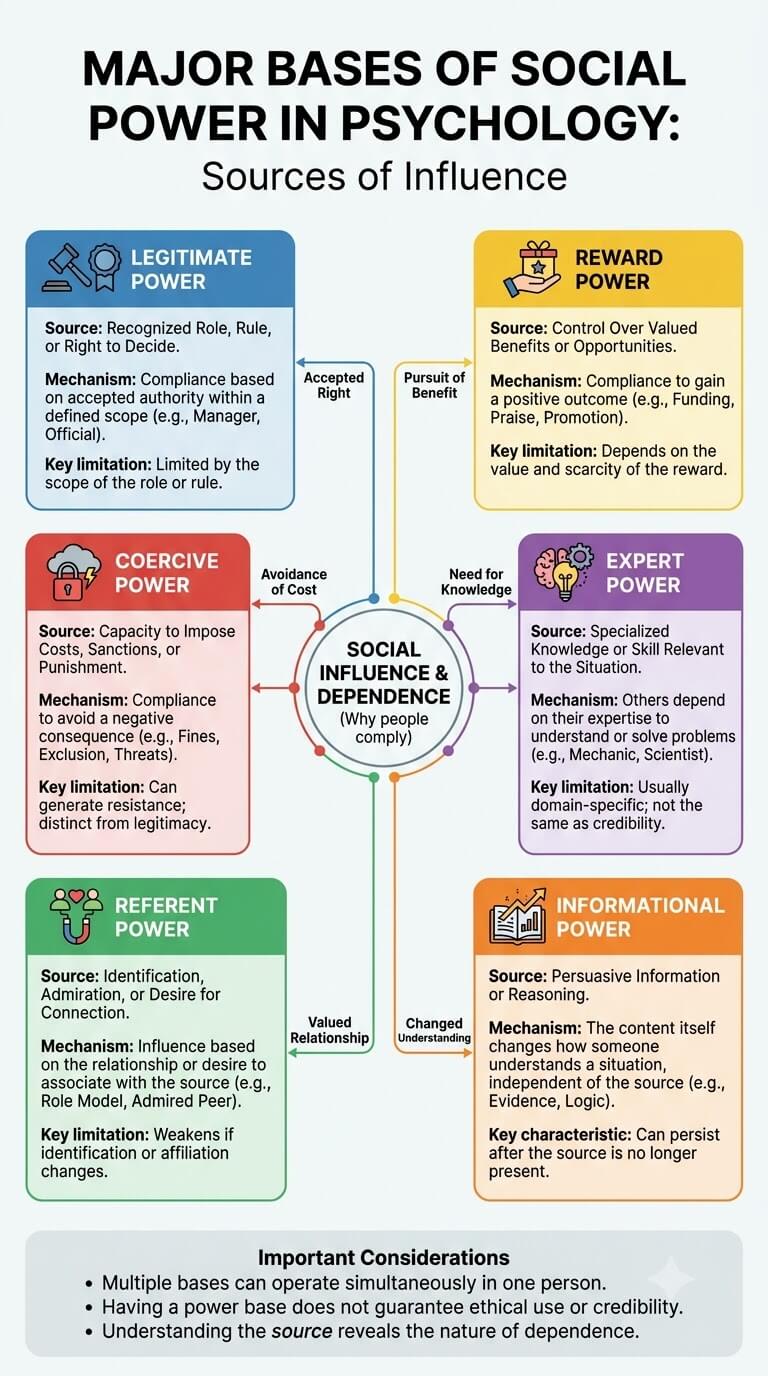
The major types of social power are legitimate, reward, coercive, expert, referent, and informational power. They differ in what gives one person leverage over another: a recognized role, valued rewards, possible costs, specialized knowledge, identification or admiration, or compelling information. More than one type can operate at the same time, and having a power base does not automatically make its use ethical, credible, or legitimate. These individual power bases sit within the broader relationship among power, status, authority, and hierarchy.
Why the Source of Power Matters
Knowing that someone can affect an outcome is only the first step. To understand the interaction, ask what makes their influence possible. Is the other person complying because a rule gives the influencer decision rights? Because a reward is available? Because refusal could bring a cost? Because the person knows something important? Because others identify with them? Or because the information itself changes the decision?
The original French and Raven framework on the bases of social power was built around this source question. It identified legitimate, reward, coercive, referent, and expert power and examined how each base could produce different forms of dependence and social change.
Two people can influence the same outcome for different reasons
Suppose a community group needs to choose a venue. The coordinator can approve the booking because the role includes that responsibility. A donor can offer to cover the cost of one option. A safety specialist can explain which venue is accessible. A respected long-term member may sway preferences because others identify with them. All four people may affect the choice, but their leverage comes from different places.
Calling all of this simply “influence” hides useful information. A source-based view shows what the group depends on and why a particular person’s view carries extra weight.
Power bases affect dependence, resistance, and durability differently
Some forms of power depend on the source remaining present. A promised reward matters only while the person can provide it. Coercive pressure may disappear when the threat is no longer credible. Expert power may weaken outside the expert’s domain. Informational power can persist after the conversation if the evidence changes how someone understands the situation.
This difference helps explain why the same request can feel acceptable in one context and pressured in another. The wording of the request matters, but so does the resource behind it.
The Classic Social Power Framework
The framework is often introduced as a list of power types, but its deeper value is comparative. Each base asks a different question about why one person’s position can change another person’s behavior, judgment, or options.
What French and Raven were trying to classify
French and Raven were not describing personality types. They were classifying bases that can support social power in a relationship. In their model, the relevant source can be a person, a role, a group, a norm, or another social agent. The focus is on why the target perceives that source as capable of affecting behavior or outcomes.
A later peer-reviewed overview of the French and Raven model describes the expanded framework as including six bases: coercive, reward, legitimate, expert, referent, and informational power. This later version is useful for general readers because informational power helps distinguish influence that comes from the quality or relevance of information from influence that depends on the source’s ongoing position.
Why the framework should be treated as influential rather than exhaustive
Real relationships do not fit neatly into six boxes. Network access, timing, reputation, procedures, and combined resources can cross categories, and researchers have refined the distinctions over time.
The framework is most useful as a disciplined set of questions: What does this person control? Why does that matter to someone else? What would happen if the source disappeared? Does the effect depend on a role, a consequence, a relationship, expertise, or the content of information?
Legitimate Power
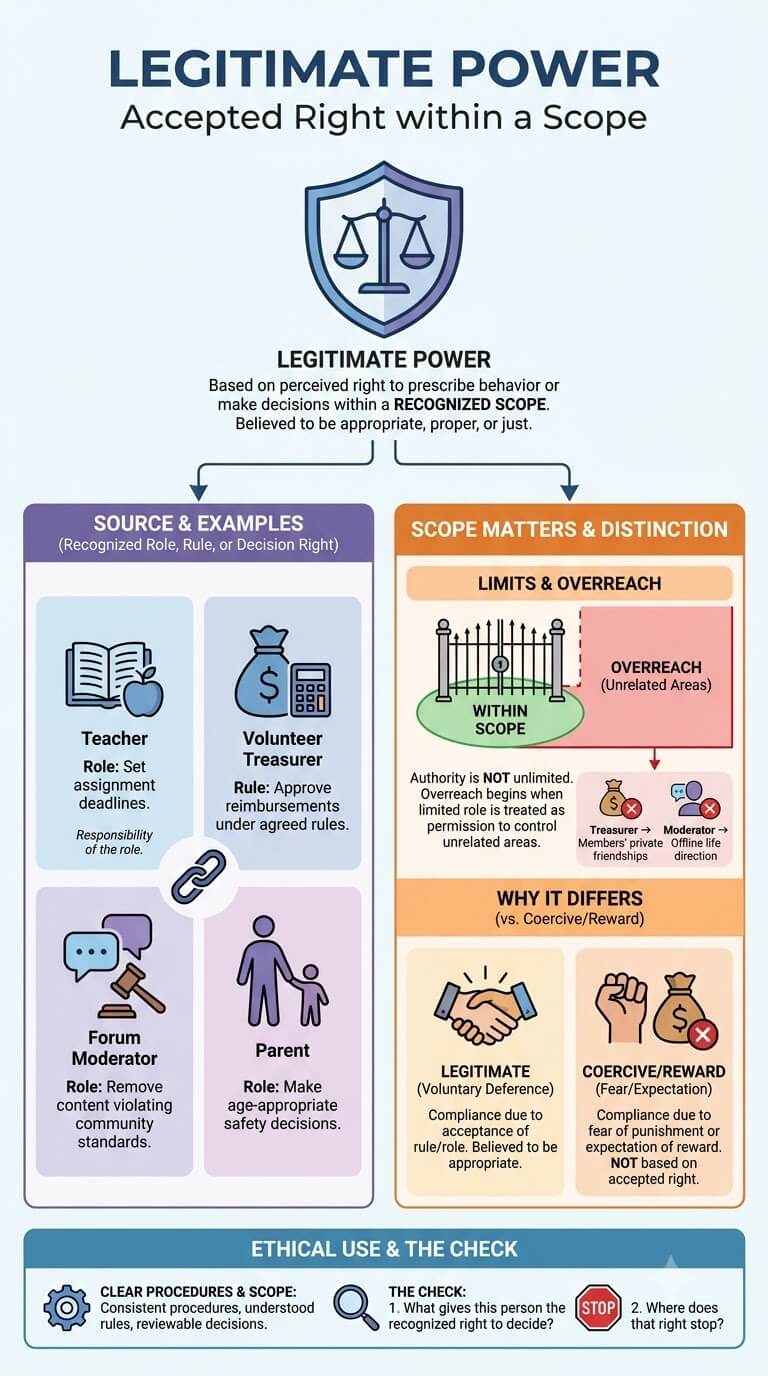
Legitimate power comes from a perceived right to prescribe behavior or make a decision within a recognized scope. The emphasis is not simply on being able to force an outcome. It is on the belief that a person, role, rule, or institution has some accepted claim to direct what happens.
Source: a recognized role, rule, or decision right
A teacher can set assignment deadlines because that responsibility belongs to the role. A volunteer treasurer may approve reimbursements under agreed rules. A forum moderator may remove content that violates community standards. A parent may make age-appropriate safety decisions for a young child.
The scope matters. Legitimate power in one domain does not create unlimited authority elsewhere. The treasurer’s role does not grant control over members’ private friendships, and a moderator’s platform responsibilities do not create a right to direct someone’s offline life.
Why legitimacy differs from fear or reward
People may comply with a legitimate decision because they accept the rule or role, not because they expect a reward or fear punishment. Tom Tyler’s review of psychological legitimacy emphasizes voluntary deference rooted in the belief that an authority or arrangement is appropriate, proper, or just.
This makes legitimate power conceptually different from coercive power. A person can have practical leverage without being seen as having a legitimate right to use it. Likewise, a legitimate role can remain recognized even when the role-holder has limited ability to punish or reward.
Ethical use, overreach, and limits
Legitimate power is easier to use responsibly when the scope is clear, procedures are consistent, affected people understand the rules, and decisions can be reviewed when necessary. Overreach begins when a limited role is treated as permission to control unrelated areas.
A useful check is simple: what gives this person the recognized right to decide, and where does that right stop?
Reward Power
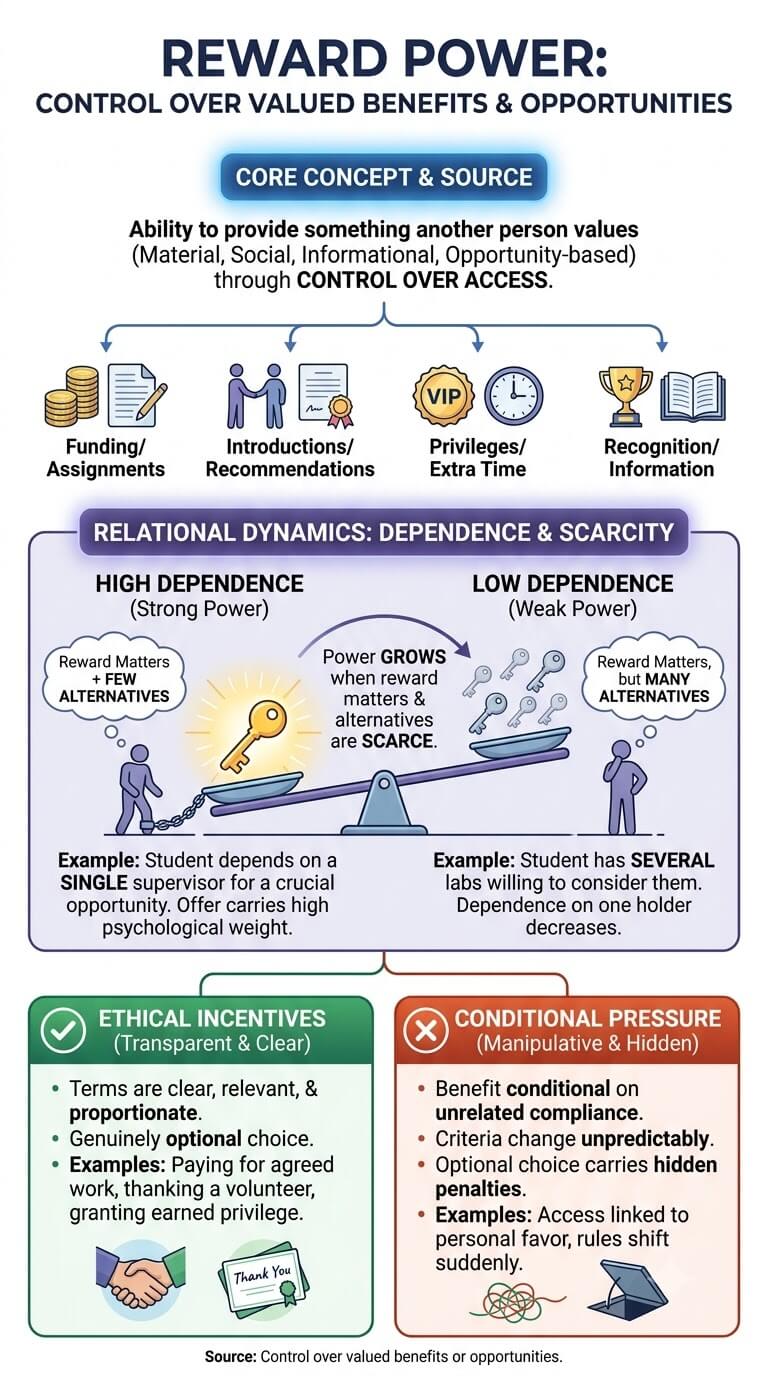
Reward power comes from the ability to provide something another person values. The reward may be material, social, informational, or opportunity-based.
Source: control over valued benefits or opportunities
Examples include access to funding, preferred assignments, introductions, invitations, recommendations, privileges, useful information, extra time, or recognition. A parent may control access to a car. A club may offer scarce travel support. A mentor may be able to recommend someone for an opportunity.
Reward power grows when the benefit matters and alternatives are scarce. If equivalent opportunities are widely available, dependence on one reward-holder decreases.
Dependence increases when the reward matters and alternatives are scarce
Imagine two students who both want research experience. One has several labs willing to consider them. The other depends on a single supervisor. The same offer can carry very different psychological weight because the second student has fewer alternatives. When one side controls several important rewards, consequences, or alternatives at once, those power bases can contribute to a broader power imbalance.
This is why reward power is relational. The existence of a reward alone is not enough. The recipient must value it, and the source must have meaningful control over access.
Ethical incentives versus conditional pressure
Rewards are not inherently manipulative. Paying someone for agreed work, thanking a volunteer, or granting a clearly earned privilege can be ordinary and transparent. Concerns grow when access to an important benefit is made conditional on unrelated compliance, when criteria change unpredictably, or when a supposedly optional choice carries hidden penalties.
Ask whether the terms are clear, relevant, proportionate, and genuinely optional.
Coercive Power
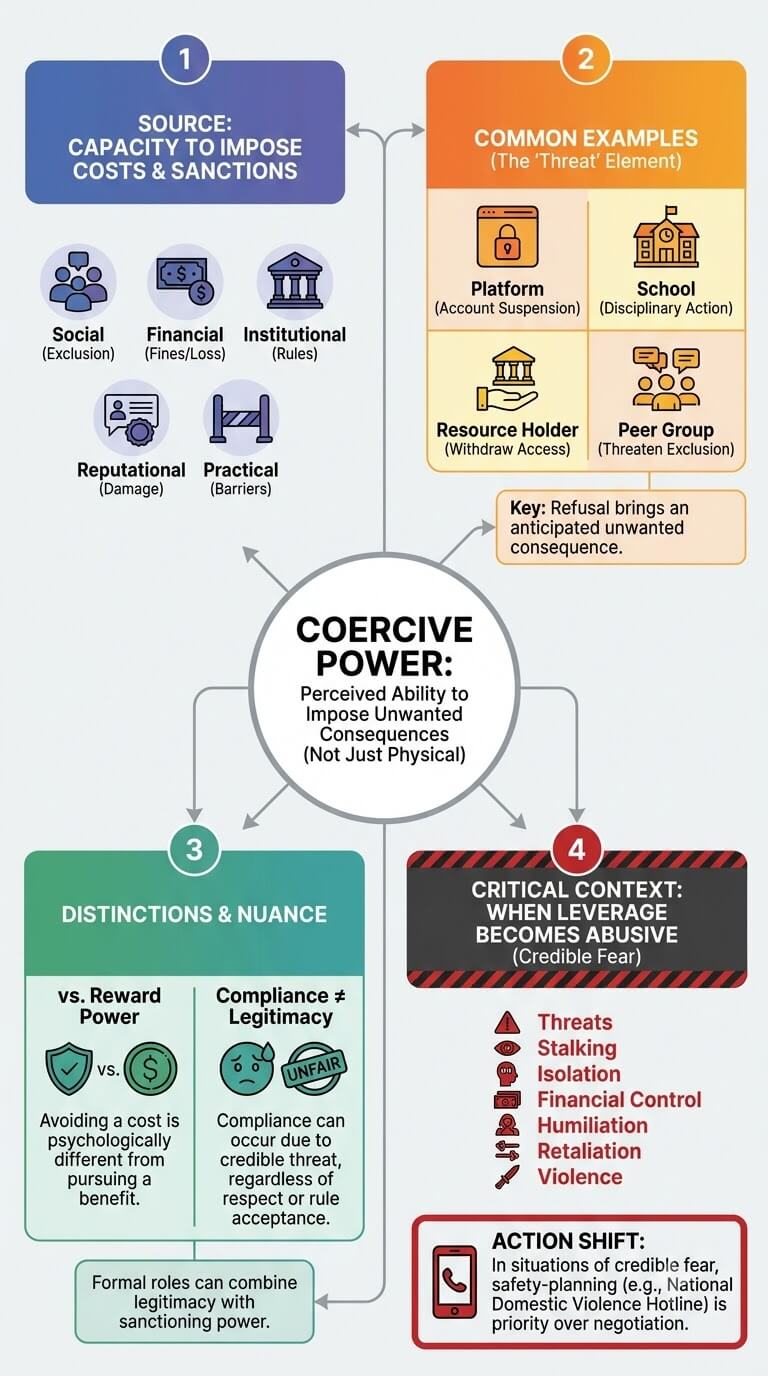
Coercive power comes from the perceived ability to impose costs, sanctions, punishment, or unwanted consequences. It does not require physical force. The anticipated cost can be social, financial, institutional, reputational, or practical.
Source: capacity to impose costs or sanctions
A platform can suspend an account. A school can impose a disciplinary consequence under established rules. A person controlling access to a shared resource may threaten to withdraw it. A peer may threaten exclusion from a group. The common element is that refusal may bring an unwanted consequence.
The original French and Raven framework explicitly distinguished coercive power from reward power because avoiding a cost is psychologically different from pursuing a benefit.
Compliance through anticipated cost is not the same as legitimacy
A person may comply because the consequence is credible even while believing the demand is unfair or illegitimate. That is why observed compliance alone does not tell you whether an authority is respected or whether a rule is accepted.
Formal roles may combine legitimate decision rights with sanctioning power. The two bases can coexist without being identical.
When coercion changes the safety context
Not every consequence is abusive. Rules often include proportionate consequences. The context changes when leverage involves threats, stalking, isolation, financial control, humiliation, retaliation, violence, or credible fear, especially when the person cannot safely refuse or seek alternatives.
In such situations, the question is no longer merely which power base is operating. Safety-planning guidance from the National Domestic Violence Hotline can be more appropriate than trying to negotiate directly with a person whose pressure creates credible fear.
Expert Power
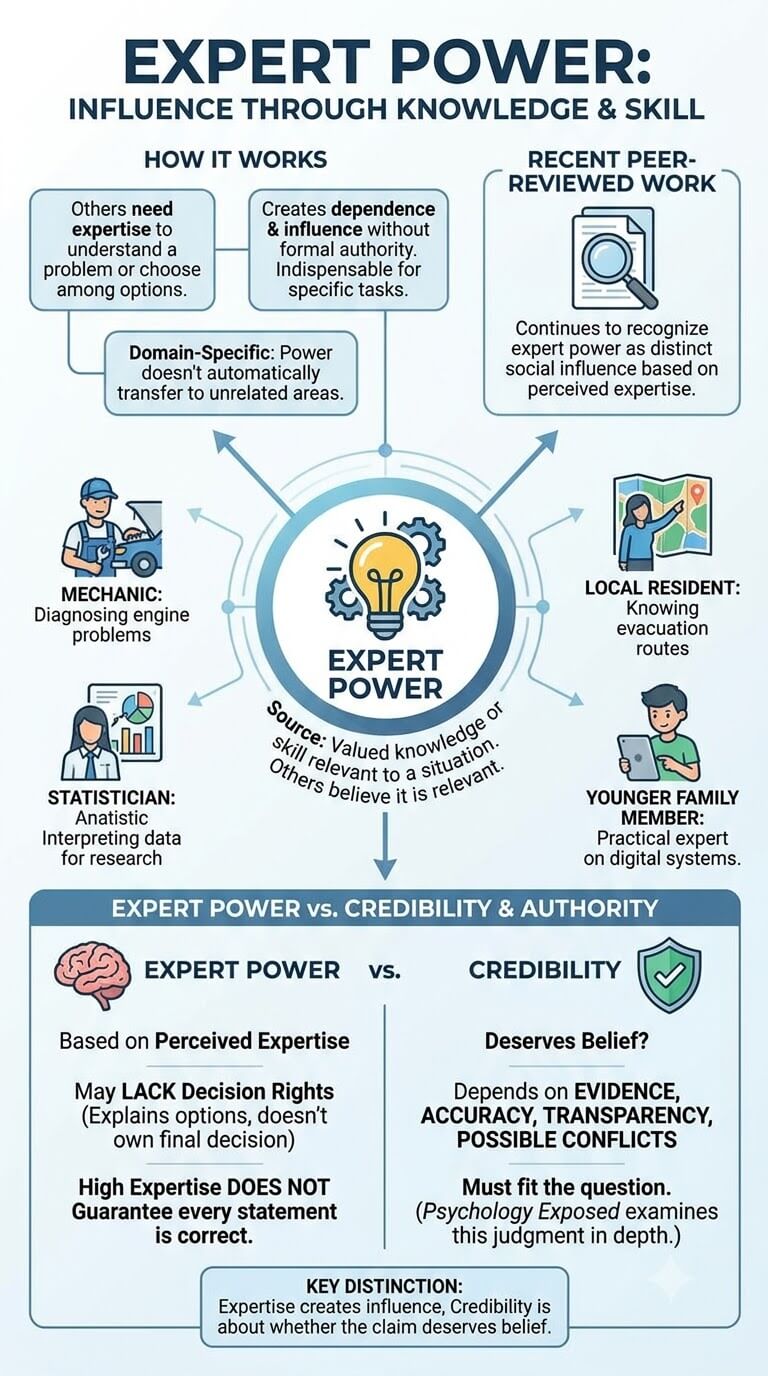
Expert power comes from knowledge or skill that other people believe is relevant to the situation. It is strongest when others need that expertise to understand a problem or choose among options.
Source: valued knowledge or skill relevant to the decision
A mechanic may have expert power when diagnosing an engine problem. A statistician may shape how a research team interprets data. A local resident may know evacuation routes better than visitors. A younger family member may become the practical expert on a digital system.
Expert power is therefore often domain-specific. Knowledge about one topic does not automatically create power over unrelated decisions.
Why expertise can create influence without formal authority
A person does not need a title to become indispensable to a task. If others cannot evaluate or complete something without specialized knowledge, they become partly dependent on the expert. Recent peer-reviewed work also continues to use expert power as a distinct form of social influence grounded in perceived expertise.
The expert may still lack decision rights. A specialist can explain options without owning another person’s final decision.
Expert power is not the same as credibility
Expertise is one reason a person may have influence, but credibility asks whether the source or claim deserves belief. Relevant qualifications matter, yet credibility also depends on evidence, accuracy, transparency, possible conflicts, and whether the expertise actually fits the question.
Psychology Exposed’s explanation of credibility psychology examines that judgment in more depth. High perceived expertise can create power without guaranteeing that every statement is correct.
Referent Power
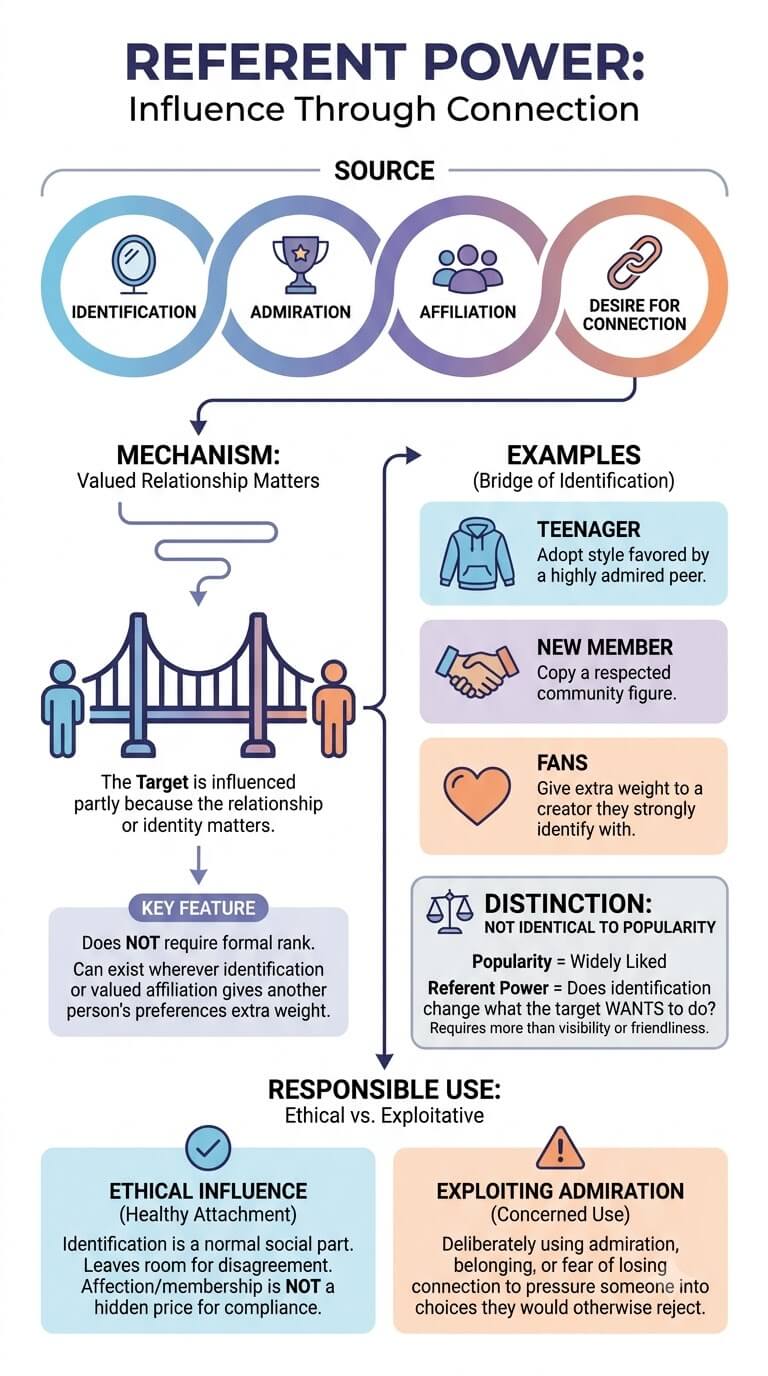
Referent power comes from identification, admiration, affiliation, or a desire for connection with a person or group. The target is influenced partly because the relationship or identity matters.
Source: identification, admiration, affiliation, or desire for connection
A teenager may adopt a style favored by a highly admired peer. A new member may copy a respected community figure. Fans may give extra weight to a creator they strongly identify with. A close friend may have influence because maintaining connection and mutual approval matters.
Referent power does not require formal rank. It can exist wherever identification or valued affiliation gives another person’s preferences extra weight.
Why referent power is not identical to popularity
A popular person may be widely liked without strongly shaping another person’s choices. Referent power requires more than visibility or friendliness. The relevant question is whether identification with the person or group changes what the target wants to do.
Referent influence can also be narrow. Admiring someone’s discipline does not make that person a reliable source in unrelated domains.
Ethical influence versus exploiting attachment or admiration
Identification is a normal part of social life. It becomes concerning when admiration, belonging, or fear of losing connection is deliberately used to pressure someone into choices they would otherwise reject.
A responsible use of referent influence leaves room for disagreement. Affection, group membership, or admiration should not become a hidden price attached to compliance.
Informational Power
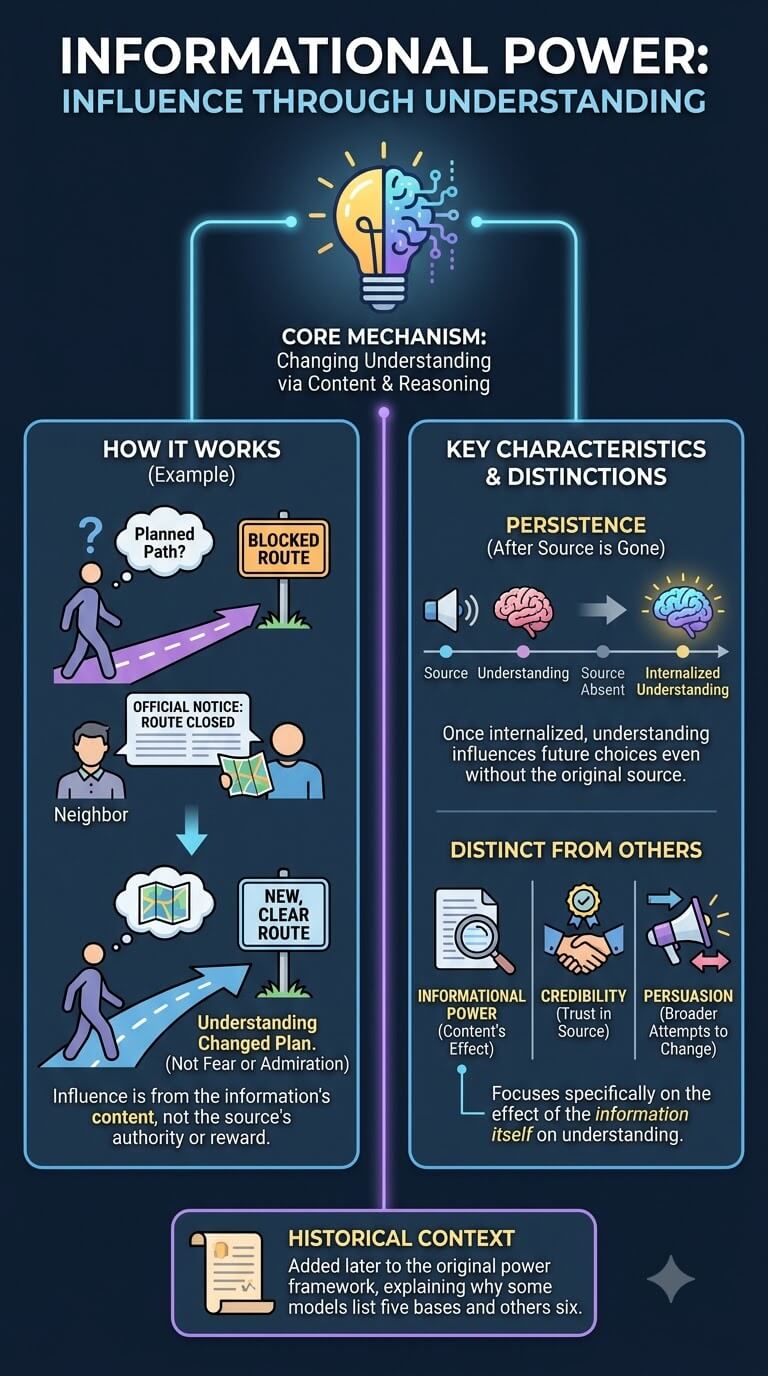
Informational power is based on information or reasoning that changes how someone understands a situation. It was added in later development of the original framework, which is why some descriptions list five bases while later versions list six.
Source: information that changes how someone understands a choice
Imagine a neighbor who explains that a planned route will be closed for construction and shows the official notice. You change your travel plan because the information changes your understanding, not because you admire the neighbor, fear a punishment, or recognize their authority.
A modern discussion of social power notes that informational power was added after the original five-base framework. That historical detail helps explain why lists of the bases sometimes differ.
Why informational power may persist after the source is gone
Once information changes your reasoning, the source may no longer be necessary. Understanding why a bridge is unsafe can influence tomorrow’s choice even when the original speaker is absent.
That makes informational power different from a reward that must still be delivered or a punishment that must remain credible. The influence can become internalized through understanding.
Information is not the same as credibility or persuasion tactics
Information has power when its content changes a person’s understanding. Credibility affects whether people initially trust the source. Persuasion refers more broadly to attempts to change attitudes or behavior. These can overlap, but informational power is most clearly about the effect of the information itself.
One Person Can Hold Several Power Bases at Once
Real interactions rarely involve only one source. A person may have a recognized role, valued expertise, access to rewards, and a strong relationship with the same group.
Role plus expertise
A teacher may have legitimate power to set course requirements and expert power in the subject. Students may comply with a deadline because of the role while accepting a conceptual explanation because of the teacher’s knowledge.
If the teacher leaves the role but remains a respected specialist, legitimate power may disappear while expert power remains.
Reputation plus access to rewards
A community organizer may be admired for years of contribution and also control access to a small grant program. Referent and reward power can operate together. People may value the organizer’s approval while also depending on a tangible opportunity.
The combination matters because it can make the interaction feel stronger than either source alone.
Why mixed bases can strengthen or complicate influence
Mixed power bases can create ambiguity. Was a person agreeing because they respected the expertise, because the role had authority, because a reward was available, or because refusal felt costly? The answer may be several at once.
When stakes are high, separating the bases reveals which influence rests on legitimacy, scarce resources, or pressure and where more accountability may be needed.
Temporary vs Durable Power
Power sources differ in how long they last. Some depend on a momentary resource. Others persist as long as a role, relationship, skill, or shared belief remains.
Context-specific access can disappear quickly
The only person with a key has temporary leverage until another key is made. A translator may become central during one meeting. A friend who knows the venue owner may have unusual influence for one event. These are real forms of leverage, but their range is narrow.
Expertise, relationships, and institutional roles may persist differently
Expertise can remain valuable across many situations within the same domain. Referent power may continue as long as identification remains strong. Legitimate power may move with a role rather than stay with the individual. Reward or coercive power may vanish when control over the relevant consequence changes.
Durability is therefore not a moral ranking. A long-lasting power base is not automatically better than a temporary one. It simply depends on a different kind of relationship.
Power-Base Comparison Map
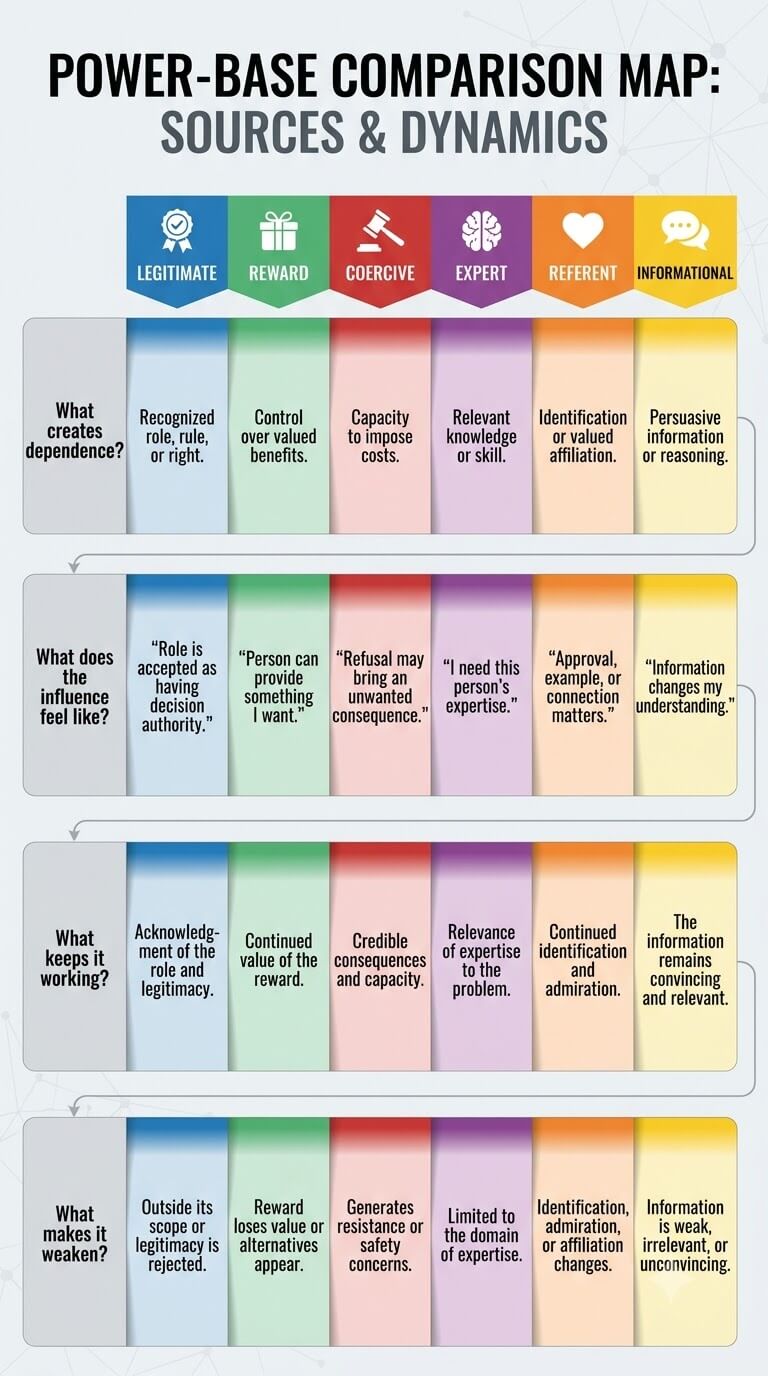
The six bases can be compared through four questions: What creates dependence? What does the influence feel like? What keeps it working? What makes it weaken?
| Power base | Main source | Typical reason for influence | Common limitation |
|---|---|---|---|
| Legitimate | Recognized role, rule, or right | “This role is accepted as having decision authority here.” | Weakens outside its scope or when legitimacy is rejected. |
| Reward | Control over valued benefits | “This person can provide something I want.” | Weakens when the reward loses value or alternatives appear. |
| Coercive | Capacity to impose costs | “Refusal may bring an unwanted consequence.” | Depends on credible consequences and may generate resistance or safety concerns. |
| Expert | Relevant knowledge or skill | “I need this person’s expertise.” | Usually limited to the domain where expertise is relevant. |
| Referent | Identification or valued affiliation | “This person’s approval, example, or connection matters to me.” | Weakens if identification, admiration, or affiliation changes. |
| Informational | Persuasive information or reasoning | “This information changes how I understand the situation.” | Fails when the information is weak, irrelevant, or unconvincing. |
What This Framework Does Not Tell You
A taxonomy can explain why influence is possible without telling you whether it is wise, ethical, accurate, or fair.
It does not prove someone is credible
An expert may be outside their actual field. A respected person may repeat weak information. A role-holder may misunderstand the facts. Power describes leverage, not truth.
It does not prove someone is ethical or legitimate
A person can control rewards or punishments without having a justified right to use them. A legitimate role can also be used poorly. Ethical judgment requires additional questions about consent, fairness, proportionality, transparency, and consequences.
It does not explain every form of social influence
People influence one another through norms, imitation, persuasion, emotion, shared identity, habits, and many other processes. Not every change in behavior requires an asymmetric power relationship.
It does not justify coercion or manipulation
Describing coercive or referent power is not a recommendation to use threats, attachment, or social pressure strategically. A psychological framework can identify a mechanism without endorsing it.
First Step: Ask What the Other Person Actually Controls
When an interaction feels unusually influential, avoid jumping straight to a label. Identify the resource or basis first.
Role, reward, cost, expertise, relationship, or information?
- Role: Does an accepted rule or position give this person decision rights?
- Reward: Can they provide a benefit, opportunity, access, or recognition that matters?
- Cost: Can they impose or credibly threaten a meaningful consequence?
- Expertise: Do others depend on their specialized knowledge or skill?
- Relationship: Does identification, admiration, or belonging give their preferences extra weight?
- Information: Is the content itself changing how the situation is understood?
Then ask how dependent the target is on that source
The same base can carry very different weight depending on alternatives. A reward is less powerful when equivalent opportunities are easy to find. Expert power shrinks when several independent experts are available. Referent power weakens when belonging is secure enough to tolerate disagreement.
A practical four-part check is: Source, Dependency, Scope, Safeguard. Identify what creates the leverage, how dependent the other person is, where that leverage legitimately applies, and what limits or accountability surround its use.
How Authority and Credibility Fit Into the Picture
Two nearby concepts deserve special care because they overlap with legitimate and expert power without meaning the same thing.
Authority asks whether direction is seen as legitimate
Legitimate power is one base of social power. Authority goes deeper into why a role or institution is recognized as having the right to direct, decide, or set rules. Questions about procedural fairness, accepted mandates, and loss of legitimacy therefore require more than simply naming the legitimate-power category.
Credibility asks whether a source deserves belief
Expert and informational power can make a person’s contribution influential, but credibility concerns whether the source or claim should be trusted. Relevant expertise helps, but evidence quality and reliability still matter. Someone can possess recognized expertise and still be wrong about a particular claim.
Social power asks the broader relational question
All six bases fit within the larger question of relative influence: what makes one person’s choices, resources, knowledge, role, or information capable of changing another person’s outcomes? The taxonomy identifies common sources of that capacity. It does not replace the broader relational analysis.
FAQ
These questions address the distinctions that most often cause confusion when the classic power-base framework is used outside a textbook.
What are the main types of social power in psychology?
The classic framework began with five bases: legitimate, reward, coercive, expert, and referent power. Informational power was added in later development of the model, so modern summaries often describe six. The categories identify different sources of leverage rather than six fixed kinds of people.
Is expert power the same as being credible?
No. Expert power comes from perceived relevant knowledge or skill that others depend on. Credibility is the judgment that a source or claim deserves belief. Expertise can contribute to credibility, but a person may be outside their field, rely on weak evidence, or make an inaccurate claim. Power and truth are separate questions.
Is legitimate power the same as authority?
They overlap closely, but authority is the broader question of recognized legitimacy and right to direct or decide. Legitimate power names one source of influence within the French and Raven taxonomy. A deeper authority analysis asks why that right is accepted, where its boundaries are, and what happens when legitimacy is contested.
Can referent power exist without high status?
Yes. A close friend, admired peer, family member, or small-community figure may strongly influence someone through identification even without broad social rank. Referent power depends on the target’s relationship to the source, not on universal prestige. It can therefore be highly personal and context-specific.
Why can coercive power produce compliance without respect?
Coercive power works through anticipated costs. If a consequence is credible, someone may comply even while viewing the demand as unfair, disliking the source, or rejecting the source’s legitimacy. That is why compliance by itself cannot tell you whether a person is respected, trusted, or seen as having a rightful authority.
Key Takeaways
- The bases of social power explain where influence comes from, not whether the person using it is good, correct, or ethical.
- The original French and Raven framework identified legitimate, reward, coercive, expert, and referent power; informational power was added later.
- Each base creates a different kind of dependence, and its strength changes with value, alternatives, scope, and context.
- One person can hold several power bases at once, such as legitimate authority plus expertise or referent influence plus reward control.
- Expert power should not be confused with credibility, and legitimate power should not be treated as the entire psychology of authority.
- When coercion includes threats, retaliation, isolation, financial control, stalking, violence, or credible fear, safety becomes more important than classifying the influence.
A practical next step is to identify the source before judging the interaction. Ask what the person actually controls, why that matters, how many alternatives exist, and where the influence should reasonably stop. Those questions reveal more than simply deciding that someone “has power.”

Michael Reed is the Founder and Lead Writer at Psychology Exposed. He writes about human behavior, relationships, emotional patterns, self-awareness, and practical psychology topics using research-informed, easy-to-understand content.
Read More About Michael Reed: https://psychologyexposed.com/michael-reed/