
A person gives up an evening to sit with a distressed friend. A commuter returns a wallet with cash still inside. Someone anonymously pays for another person’s groceries. These actions may look altruistic, but the visible behavior does not tell us everything about the motive behind it.
That distinction is central to altruism psychology. The useful question is not simply whether someone helped. It is what may have motivated the help, especially when helping required time, effort, money, comfort, opportunity, or personal risk. Concern for another person’s welfare may matter, but so can relief from guilt, a wish to feel like a good person, social approval, reputation, habit, values, or several motives operating at once.
Psychology can study patterns that make different explanations more or less plausible. It cannot look inside a real person’s mind and certify that an act was perfectly selfless. A careful approach therefore separates behavior from motive, treats mixed motives as normal, and avoids turning altruism into a test of moral worth.
Quick Answer
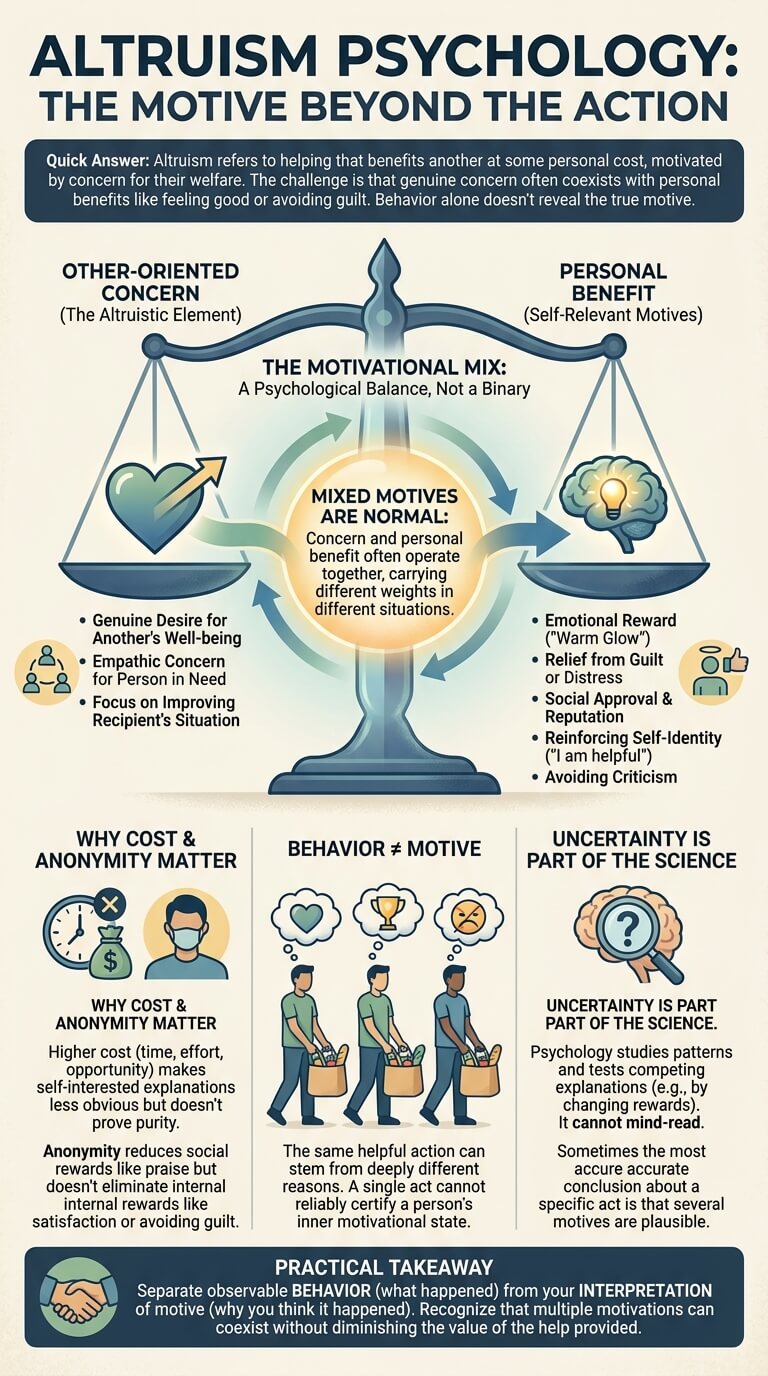
In psychology, altruism refers to helping that benefits another person and is understood in relation to concern for that person’s welfare, often when the helper accepts some cost. The difficult part is motive: feeling good, avoiding guilt, gaining approval, or caring deeply can coexist. An apparently generous act alone cannot prove that a person’s motive was purely altruistic or purely self-interested.
Altruism is a motivation question, not simply a visible behavior label
If you see someone carry a neighbor’s groceries upstairs, you can confidently describe the behavior as helping. You cannot confidently conclude why the person did it. They may care about the neighbor, value being useful, expect future reciprocity, enjoy helping, want to avoid feeling guilty, or simply see the action as the obvious thing to do.
What Altruism Means in Psychology
Altruism as concern for another person’s welfare in prosocial action
The APA Dictionary of Psychology describes altruism as apparently unselfish behavior that benefits others at some cost to the individual, while also noting that whether such behavior is free of egoistic motivation is debated. That last point matters. The definition itself contains the tension that makes altruism psychologically interesting.
Imagine two people who each donate $50. One gives because a particular family’s hardship feels personally important. The other gives because friends are watching and generosity improves social standing. The visible outcome is similar, but the motivational structure may differ. A third person may feel genuine concern and also enjoy the approval that follows. Real motives do not always arrive in clean, mutually exclusive categories.
For a general reader, the safest working distinction is this: prosocial behavior describes behavior intended to benefit others, while altruism asks whether concern for another person’s welfare is a substantial reason for acting. That does not require pretending that every other benefit disappears.
Why personal cost matters to the discussion but does not prove motive
Cost is relevant because sacrifice can make some self-interested explanations less obvious. Giving ten minutes when you have ten free minutes is different from missing a valued opportunity to help. Donating an amount you barely notice is different from giving up something you planned to use. Staying to assist may be different when leaving would be much easier.
Still, cost does not function like a lie detector for motive. A costly action can produce pride, meaning, identity reinforcement, gratitude from others, spiritual satisfaction, relief from guilt, or reputational benefit. A person may even value sacrifice itself because it fits an important self-image.
The better conclusion is modest: higher cost gives us more information about what a person was willing to give up. It does not reveal a single hidden motive with certainty.
Altruism vs Prosocial Behavior vs Helping
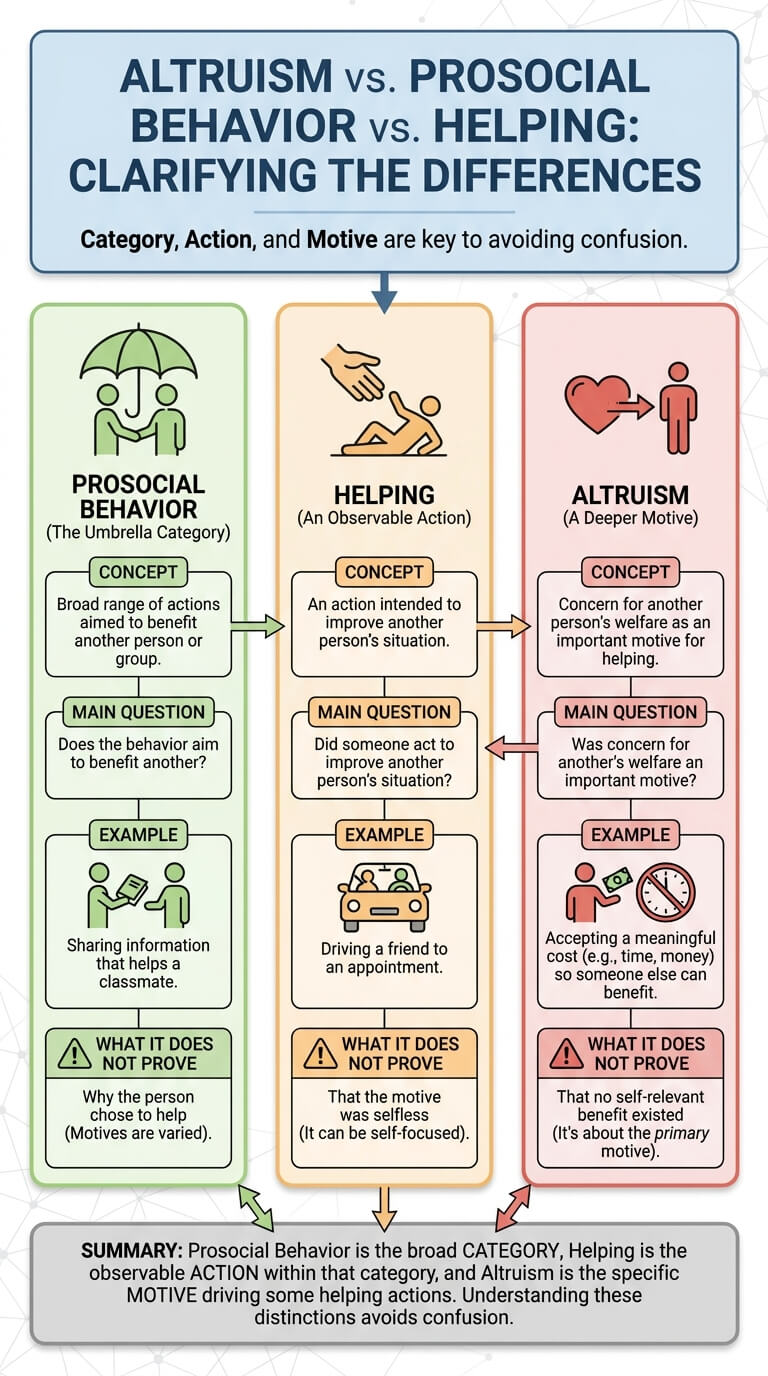
These terms overlap, but using them as synonyms creates confusion. The differences become clearer when you separate category, action, and motive.
| Concept | Main question | Example | What it does not prove |
|---|---|---|---|
| Prosocial behavior | Does the behavior aim to benefit another person or group? | Sharing information that helps a classmate | Why the person chose to help |
| Helping | Did someone act to improve another person’s situation? | Driving a friend to an appointment | That the motive was selfless |
| Altruism | Was concern for another person’s welfare an important motive? | Accepting a meaningful cost so someone else can benefit | That no self-relevant benefit existed |
Prosocial behavior is the umbrella
Prosocial behavior covers a broad range of actions intended to benefit others. It can include helping, sharing, comforting, cooperating, donating, providing information, or contributing to a shared outcome. These behaviors may arise from many motives.
Helping describes an action
Helping answers a more observable question: did a person do something intended to improve another person’s situation? The APA Dictionary’s definition of helping places it within prosocial behavior and notes that helping involves some cost to the person providing it.
Altruism concerns why some helping may occur
Altruism moves one level deeper. Suppose a colleague covers your shift despite having no expectation that you can repay the favor. The action is helping. The altruism question is whether concern for your welfare, rather than only reputation, future advantage, guilt reduction, or some other self-focused outcome, substantially motivated the choice.
The Central Question: Other-Oriented Concern or Personal Benefit?
Other-oriented explanations
An other-oriented explanation begins with the recipient’s welfare. The helper notices another person’s need, feels concern, and wants the person’s situation to improve. If helping requires effort or cost, that concern may be strong enough to outweigh competing interests.
Other-oriented motivation does not require the helper to suffer. It also does not require the helper to dislike the experience of helping. Wanting another person to be better off and enjoying the act of helping can occur together.
Egoistic explanations such as relief, reward, reputation, or self-image
Self-relevant motives can point toward the same behavior. A person may help to reduce uncomfortable guilt, escape another person’s visible distress, receive thanks, gain approval, strengthen a reputation, avoid criticism, or confirm an identity such as “I am the kind of person who helps.”
A more useful question is which outcome appears to be driving the decision under the circumstances. Research can test competing predictions by changing whether escape is easy, whether help is anonymous, whether social approval is available, or how much cost the helper must accept.
Why the same action can fit more than one plausible explanation
Consider an anonymous donation. It reduces obvious reputation benefits because other people may never know who gave. That makes some explanations less likely, but it does not eliminate every self-relevant benefit. The donor may still anticipate satisfaction, live according to a personal value, or avoid feeling bad about doing nothing.
This is a recurring lesson in altruism research: removing one possible reward is not the same as proving that no self-focused reward exists. The most defensible interpretations often compare explanations rather than declaring one pure motive.
Empathic Concern and the Empathy-Altruism Hypothesis
The basic claim in accessible language
The empathy-altruism hypothesis, associated with C. Daniel Batson’s work, proposes that empathic concern for a person in need can create an altruistic motivation whose ultimate goal is improving that person’s welfare.
In simple terms, the theory says that sometimes we help not merely because another person’s distress makes us uncomfortable, but because we genuinely want that person to be better off. This is different from helping only to make our own uncomfortable feelings disappear.
The distinction is subtle because both routes can begin with witnessing another person’s need. The difference is the motivational target. Is the desired endpoint “I want this person to be better,” or mainly “I want my own unpleasant state to stop”?
What empathic concern may change about willingness to bear cost
If another person’s welfare becomes emotionally important, a helper may stay involved even when helping is inconvenient. Cost becomes informative because an easy self-focused escape is available but the person still chooses to assist.
A broad review of empathy-related responding and prosocial behavior describes prosocial behavior as compatible with several motives, including sympathy or other-oriented concern, self-focused emotional relief, rewards, social approval, and moral values. That is useful context because empathy should not be treated as a single switch that automatically produces altruism.
Empathic concern may increase the weight placed on another person’s welfare. Whether action follows still depends on ability, cost, risk, opportunity, competing obligations, and the form of help available.
Why empathy does not guarantee helping and is not the whole prosocial story
You can care deeply and still not help effectively. You may lack the necessary skill. You may be too far away. The requested action may exceed your resources. Direct involvement may be unsafe. Someone else may be better placed to respond.
Likewise, people sometimes help without feeling strong empathy. They may act from duty, habit, a social norm, a principle, a commitment, or a practical belief that assistance is appropriate.
That means empathy and altruism should not collapse into one concept. Empathy concerns responses to another person’s state. Altruism concerns motivation directed toward another person’s welfare. Helping is the behavior that may or may not follow.
Warm Glow, Relief, and the Problem of Emotional Reward
Feeling good after helping does not automatically establish selfish motivation
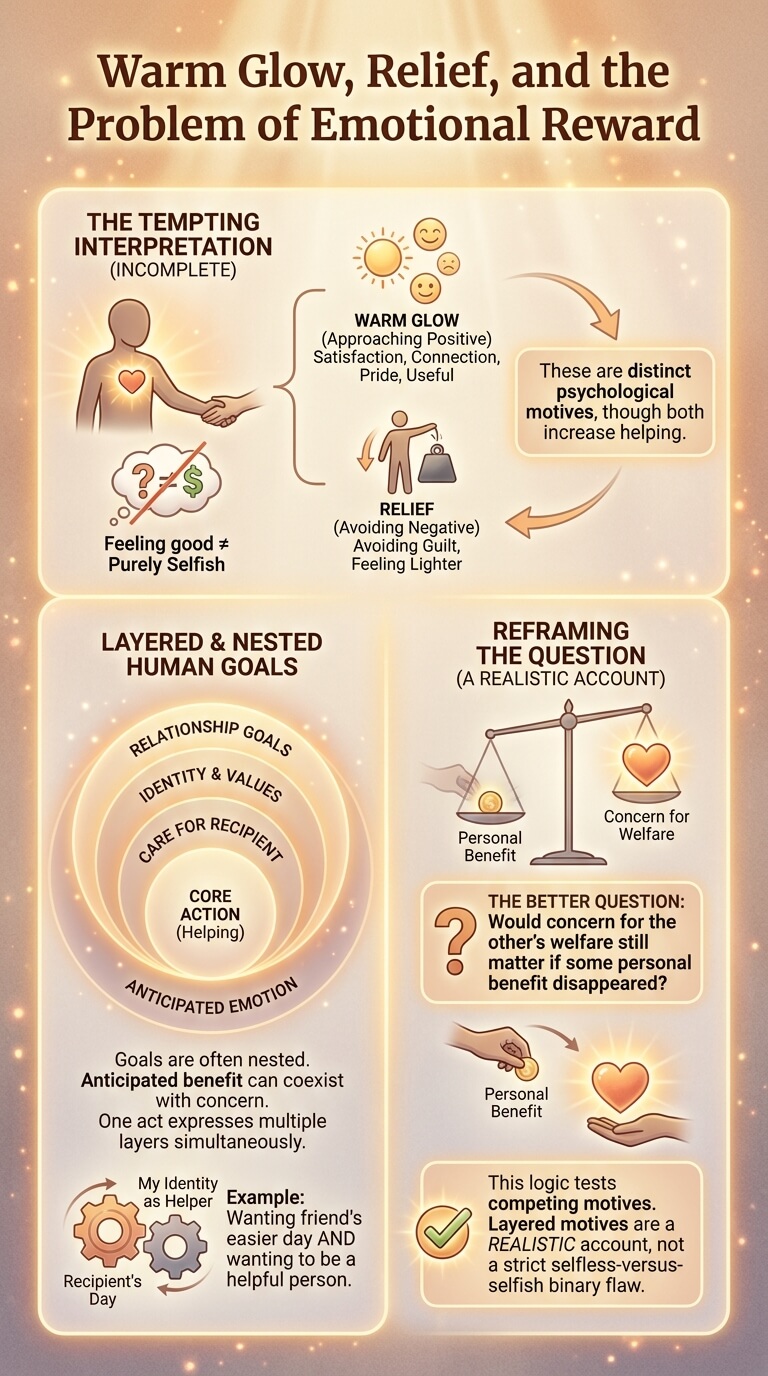
Many people experience satisfaction after helping. They may feel lighter, connected, useful, proud, relieved, or simply glad that another person is doing better. A tempting interpretation is that this pleasant feeling proves the helper “really did it for themselves.”
Researchers often use the idea of a “warm glow” to describe positive feelings associated with giving or helping. Research on anticipated warm glow and anticipated guilt also distinguishes approaching a positive emotional reward from avoiding the negative feeling of not helping. Those are psychologically different possibilities, even though both can increase helping.
Anticipated emotional benefit can coexist with concern for another person
Trying to force these into a single “real” motive can make the psychology less accurate, not more. Human goals are often nested. You can want your friend to have an easier day and want to be the kind of person who helps friends. One goal is about the recipient, another about identity, and both may influence action.
The existence of self-relevant benefit therefore changes the question. Instead of asking, “Did the helper get anything from this?” ask, “Would concern for the other person’s welfare still matter if some personal benefit disappeared?” That is closer to the logic researchers use when testing competing motives.
Why psychological motives are often layered rather than pure
A single act can express care, identity, values, obligation, reputation, habit, anticipated emotion, and relationship goals at once. Which motive carries the most weight may change from one situation to another.
Layered motives are not a flaw in the explanation. They are often a more realistic account of ordinary behavior than a strict selfless-versus-selfish binary.
Costly, Anonymous, and Sacrificial Helping
What higher cost changes about the evidence we can observe
High-cost helping attracts attention because the helper gives up something meaningful. Cost may involve time, money, physical effort, emotional energy, comfort, privacy, or opportunity. If an action remains attractive despite these costs, some easy reward-based explanations become less persuasive.
Good analysis therefore asks what the cost meant in context rather than ranking actions by how dramatic they look from the outside.
What anonymity reduces and what it cannot reveal
Anonymity is useful because it can reduce social rewards such as praise, status, and reputation. If nobody knows you helped, public approval becomes less available as an explanation.
Yet anonymity does not remove internal rewards. A person can still feel satisfaction, live according to a value, avoid guilt, experience meaning, or strengthen a private self-image. Anonymous helping may make some other-oriented explanations more plausible, but it is not definitive proof of pure altruism.
Sacrifice without romanticizing self-neglect or boundary violations
Altruism should not become a reason to glorify unlimited sacrifice. Repeatedly giving away sleep, money, privacy, safety, or emotional capacity until you are depleted is not required to prove that you care.
A meaningful cost can be part of altruistic behavior, but a boundary is not evidence of moral failure. You can care about another person’s welfare and still decline a request that exceeds your ability, violates consent, exposes you to danger, or creates responsibilities you cannot sustain.
This matters especially in relationships where someone uses prior help, gifts, sacrifice, or emotional pressure to demand access or obedience. Helping does not create an unlimited debt, and another person’s need does not cancel your right to safety and autonomy.
Why Mixed Motives Are Common
Concern for another person and self-relevant benefits can operate together
Think of motive as a set of weights rather than a courtroom verdict. Concern for another person’s welfare might carry substantial weight while social approval, identity, meaning, or emotional reward also matter.
Calling all of these actions selfish because the helper receives something psychologically positive would make altruism nearly impossible by definition. Calling them purely selfless would ignore real self-relevant incentives. Mixed motivation gives us a more flexible middle ground.
Motives can change across situations and over time
The same person may help for different reasons on different days. Early in a relationship, reputation may matter more. Over time, genuine attachment and concern may deepen. A repeated helping role may start from obligation and later become personally meaningful, or the reverse.
This flexibility is one reason broad labels such as “altruistic person” or “selfish person” are less informative than examining the actual decision in context.
Behavior alone rarely reveals a single definitive motive
Three people can perform the same helpful act for different reasons, and one person can perform three similar acts for different reasons. Observing the outcome is only the first layer.
When motive really matters, look for patterns across situations. Does the person help when nobody is watching? Do they still help when repayment is unlikely? Does concern disappear when praise disappears? Do they respect the recipient’s wishes, or is the act mainly about appearing helpful? These observations can inform interpretation, but they still do not provide certainty about inner experience.
What Psychology Can and Cannot Infer About Altruism
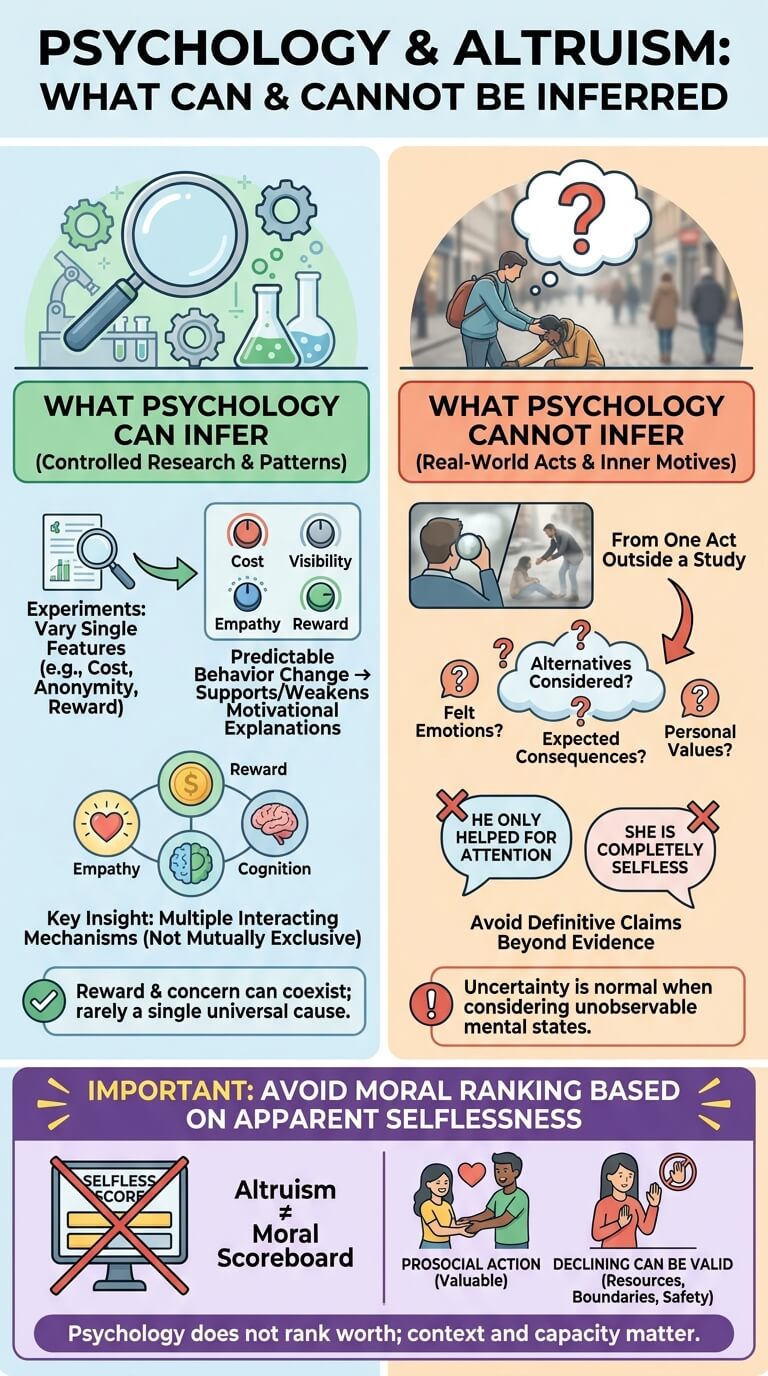
Research can test patterns and competing explanations
Experiments can change one feature at a time. Researchers can vary cost, anonymity, ease of leaving, emotional connection, visibility, perceived responsibility, or the availability of rewards. If behavior changes predictably, the results can support or weaken particular motivational explanations.
A review of prosocial mechanisms notes that helping may be rewarding while also discussing empathy as a route to prosocial action, illustrating why reward and concern should not automatically be treated as mutually exclusive categories. The review emphasizes multiple interacting mechanisms rather than a single universal cause.
It cannot reliably diagnose a real person’s true inner motive from one act
Outside a controlled study, we usually know less. We may not know what alternatives the person considered, what emotions they felt, what social consequences they expected, or what values mattered most.
Statements such as “he only helped for attention” or “she is completely selfless” often go beyond the available evidence. Sometimes the fairest conclusion is simply that several motives are plausible.
This uncertainty is not a failure of psychological thinking. It is part of thinking carefully about unobservable mental states.
Avoid moral ranking based on apparent selflessness
Altruism is often treated as a moral scoreboard: the more selfless the motive, the better the person. Psychology does not require that conclusion.
Likewise, someone who declines a costly request is not automatically selfish. Resources, responsibilities, health, competence, safety, and boundaries affect what a person can reasonably give.
Altruism vs Empathy and Morality
Prosocial motive versus moral concern and judgment
Empathy, morality, and altruism meet in some situations, but they answer different questions. Moral psychology asks how people evaluate right and wrong, obligation, harm, fairness, loyalty, blame, and related judgments. Empathy concerns responses to another person’s emotional state or perspective. Altruism asks whether benefiting another person is itself an important goal of the behavior.
You can judge that helping is morally right without feeling strong empathy. You can feel another person’s distress vividly but be unable to help. You can also perform a prosocial act from a mixture of moral principle, empathic concern, identity, and self-relevant reward.
When empathy is a bridge rather than the main explanation
Empathy is especially relevant when another person’s need becomes emotionally salient. It may help explain why their welfare matters enough to influence your choice. But it should not swallow the entire explanation.
If the central question is how empathy affects moral judgment or selective concern, that is a different problem. If the central question is whether concern for another person’s welfare motivates costly helping, altruism is the more precise lens.
A Better First Step for Thinking About Motive
Separate what happened from why you think it happened
Begin with observable facts. “She stayed two extra hours to help.” “He donated anonymously.” “They gave up their seat.” These statements describe behavior.
Then name the interpretation separately. “I think she cared about the person.” “I suspect he wanted to feel generous.” This simple separation prevents an assumption about motive from being smuggled into the description as if it were a fact.
Consider multiple plausible benefits and concerns
A useful reflection is to list three columns: benefit to the other person, cost to the helper, and possible self-relevant consequences. This is not a formula for detecting hidden selfishness. It is a way to keep the analysis balanced.
| Question | What to notice |
|---|---|
| What improved for the recipient? | Relief, safety, information, time, money, comfort, opportunity, or another concrete benefit |
| What did the helper give up? | Time, effort, money, comfort, opportunity, privacy, or another meaningful resource |
| What might the helper also gain? | Satisfaction, meaning, approval, reputation, identity reinforcement, reciprocity, or guilt reduction |
| What remains uncertain? | Which motive mattered most and whether the motivational mix would change under different conditions |
Treat uncertainty about motive as a legitimate conclusion
Sometimes you will end with “I do not know.” That can be the most accurate answer. We often want motive to be simple because simple motives make people easier to judge. Human behavior rarely cooperates.
You can still evaluate the consequences of an action, whether boundaries were respected, whether help was useful, and whether a pattern is reliable without pretending to know the exact percentage of care, guilt, reward, identity, or reputation behind it.
When Another Question Gives You a Better Explanation
Use the helping process when the puzzle is whether action happens
If your main question is why someone noticed a need but hesitated, what made them feel responsible, whether they felt competent, or how cost and time pressure shaped the decision, the psychology of helping behavior is the more precise lens. Those are questions about the path from need to action, not primarily about the purity of motive.
Use the broader prosocial lens when several types of beneficial action are involved
If you are comparing helping, sharing, cooperation, reciprocity, comforting, or contributing to a group, the broader concept of prosocial behavior is more useful. Altruism is only one motivational possibility within that larger field.
Pay special attention to unfamiliarity when the recipient is a stranger
Helping an unfamiliar person changes the information available. There may be less obligation, less knowledge about need, less expectation of future reciprocity, and more uncertainty about risk. Altruistic concern may still matter, but unfamiliarity adds a situational layer that deserves separate attention.
FAQ About Altruism Psychology
Does feeling good after helping make the act selfish?
No. Feeling good is evidence that helping had a positive consequence for the helper, not proof that positive feeling was the only or ultimate reason for acting. Concern for another person’s welfare and personal satisfaction can coexist. To distinguish motives, researchers look at patterns such as what happens when rewards, recognition, escape, or other incentives change.
Can altruism and self-interest coexist?
They can. A person may genuinely want another person to benefit while also valuing reputation, identity, meaning, relationship strength, or emotional satisfaction. Mixed motives are common. The presence of self-interest does not automatically erase other-oriented concern, just as concern for others does not mean self-relevant benefits disappear.
Is anonymous helping stronger evidence of altruistic motivation?
Anonymity removes or reduces some obvious social rewards, especially public approval and reputation. That makes it useful when thinking about motive. It still does not remove internal satisfaction, personal values, guilt reduction, or private self-image. Anonymous helping can narrow the set of plausible explanations without proving a perfectly pure motive.
Can psychology know whether a person is truly altruistic?
Psychology can test theories and identify conditions under which other-oriented explanations are supported. It cannot reliably certify the true inner motive of a specific real person from one visible act. Motives are partly unobservable, often mixed, and sensitive to context. A cautious interpretation is usually more defensible than a moral label.
Is sacrifice required for altruism?
Cost is important in many definitions and theories because altruism becomes especially interesting when helping competes with the helper’s own interests. The cost does not have to be dramatic. Time, effort, money, comfort, or opportunity may matter. More sacrifice also does not automatically mean a purer motive, and altruism should never be used to glorify unsafe or unsustainable self-neglect.
Key Takeaways
- Prosocial behavior is the broad category, helping describes an action, and altruism focuses on whether another person’s welfare substantially motivates that action.
- Personal cost makes motive especially interesting, but cost alone cannot prove that a behavior was purely selfless.
- Empathic concern can support other-oriented motivation, yet empathy does not guarantee action and is not the only route to helping.
- Warm glow, meaning, approval, identity, and guilt reduction can coexist with genuine concern rather than automatically canceling it.
- Anonymous or costly helping can reduce some competing explanations, but neither reveals a person’s true motive with certainty.
- A practical next step is to separate the observable behavior from your interpretation of motive and allow uncertainty when the evidence does not justify a stronger conclusion.

Michael Reed is the Founder and Lead Writer at Psychology Exposed. He writes about human behavior, relationships, emotional patterns, self-awareness, and practical psychology topics using research-informed, easy-to-understand content.
Read More About Michael Reed: https://psychologyexposed.com/michael-reed/