
Implicit bias is often discussed as though it were a hidden verdict about character. That framing is too simple. In psychology, the more useful question is whether social categories have become linked with evaluations or expectations that become accessible quickly, sometimes before deliberate reflection.
Those associations matter because judgment is not made in a vacuum. Time pressure, ambiguous criteria, repeated category cues, and limited attention can create room for quick associations to influence interpretation. Still, an automatic response is not the same as a consciously endorsed belief, an intention, or a specific discriminatory act.
This distinction becomes especially important when discussing tools such as the Implicit Association Test, or IAT. Such measures can contribute to research on patterns of association, but a single score should not be treated as a lie detector, a diagnosis, or a window into someone’s “true self.”
Quick Answer

Implicit bias generally refers to relatively automatic group-related associations or evaluative tendencies that may become active without deliberate endorsement. Researchers often study these tendencies with indirect tasks based on response speed. The results can reveal meaningful patterns, especially across groups or repeated measurements, but one test score does not prove hidden prejudice, intention, or future discrimination in a particular person.
What Implicit Bias Means in Psychology
The concept is easiest to understand by separating quick accessibility from deliberate endorsement.
Relatively automatic associations and evaluative tendencies
An implicit attitude is an evaluation that may operate with limited conscious awareness or control. The APA Dictionary of Psychology definition of implicit attitude emphasizes an evaluative response of which a person has little or no conscious awareness. In social psychology, researchers often study how categories such as profession, age, school, region, organization, or other group labels become linked in memory with positive, negative, competent, threatening, familiar, or unfamiliar meanings.
The word automatic does not mean completely involuntary. It points to processing that can occur quickly, with less deliberate reflection. Associations may become easy to retrieve after repeated experience, language, media, or social learning.
Why “implicit” does not simply mean hidden hatred
A common mistake is to translate “implicit” into “secret.” If a quick association appears on an indirect task, people may assume that the task has uncovered a belief the person is intentionally hiding. That inference goes beyond what the measure establishes.
A person can be exposed to an association repeatedly without endorsing it as fair or accurate. Someone can also experience an initial evaluative response and then reject it after considering relevant evidence. The psychological issue is therefore not only what becomes accessible first, but what happens next: whether the person notices the response, what information is available, how the decision is structured, and what behavior follows.
Automatic vs Deliberate Processing
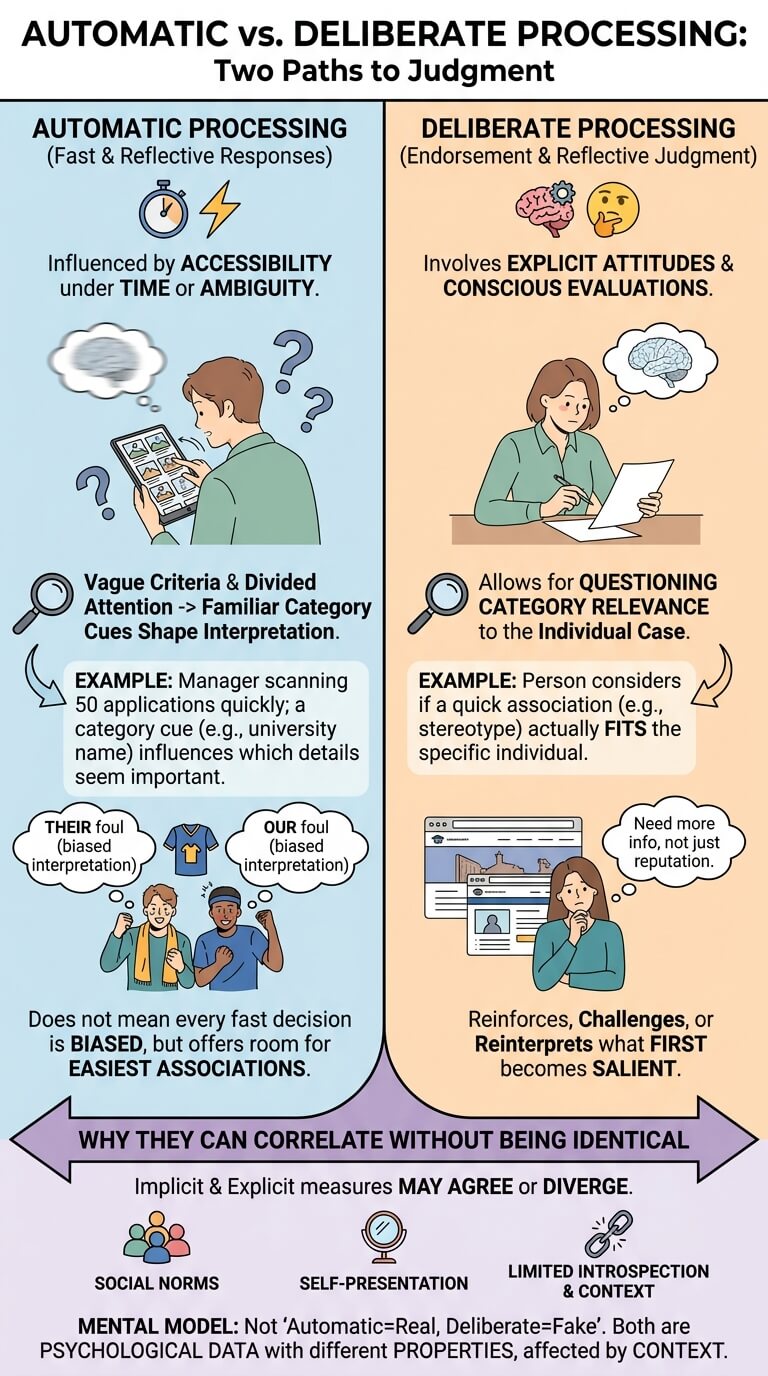
Fast and reflective responses can both shape judgment, but they are not interchangeable.
Fast accessibility under time or ambiguity
Imagine a manager scanning fifty applications in a short period. When criteria are vague and attention is divided, familiar category cues may influence which details seem important. This does not mean every fast decision is biased. It means that a decision with little structure gives more room for whatever associations happen to be easiest to retrieve.
The same principle appears in ordinary life. A student may expect one department to be friendlier than another, or a sports fan may interpret identical behavior differently depending on the team jersey. A category cue can shape the first interpretation even when reflection produces a more nuanced judgment.
Deliberate endorsement and reflective judgment
Explicit attitudes involve evaluations people can consciously report. They may be thoughtful, socially influenced, conflicted, or imperfectly expressed, but they belong to a more deliberate layer of judgment. Reflective judgment also allows a person to consider whether the category is relevant at all.
This is why automatic accessibility should be separated from endorsement. If an association comes to mind quickly, a person can still ask whether it fits the individual case. The broader process of how beliefs guide interpretation can reinforce, challenge, or reinterpret what first becomes salient.
Why the two can correlate without being identical
Implicit and explicit measures may agree or diverge. Social norms, self-presentation, limited introspective access, ambivalence, and context can affect one response more than the other.
A useful mental model is not “automatic equals real, deliberate equals fake.” Both are forms of psychological data with different measurement properties. Each can contribute information, and each can be affected by context.
Implicit Associations vs Stereotypes vs Prejudice
These concepts overlap in research, yet each describes a different psychological layer. These distinctions fit within the broader psychology of stereotypes, prejudice, and group-based judgment, where belief, evaluation, association, and behavior are treated as related but separate layers.
Stereotype as generalized belief or expectation
A stereotype is a generalized belief, expectation, or association about members of a social category. It answers a question such as: “What do I expect from people in this category?” A stereotype can be consciously endorsed, partially endorsed, rejected, or simply made more accessible by repeated exposure.
That makes stereotype activation relevant to implicit measurement, but the concepts are not identical. A stereotype describes the content of a generalized expectation. An implicit measure describes one way researchers may assess relatively automatic associations involving that content.
Prejudice as evaluation
Prejudice concerns evaluation or affect toward people based substantially on perceived group membership. It asks: “How positively or negatively am I orienting toward members of this category?” That evaluation can be explicit, implicit in some theoretical frameworks, or mixed.
This matters because a rapid association is not enough by itself to establish a stable prejudicial attitude. A person may show a response-time difference while reporting little explicit negativity, or may openly endorse a negative evaluation even when an indirect measure is weak or inconsistent.
Implicit association as a measurement-relevant automatic tendency
The most careful wording is often to say that an indirect task captured a relative response tendency under particular testing conditions. That statement is less dramatic than “the test found your hidden bias,” but it is closer to what the data support.
| Concept | Main question | Typical evidence | What it does not prove alone |
|---|---|---|---|
| Stereotype | What is expected about a group? | Beliefs, associations, expectations | Negative evaluation or unfair behavior |
| Prejudice | How is a group evaluated? | Reported attitudes, affect, evaluative measures | A specific discriminatory action |
| Implicit association | What relationships are retrieved relatively quickly? | Response-time or other indirect tasks | Secret intent, moral character, or diagnosis |
| Discrimination | What differential treatment occurred? | Observed decisions or behavior | The exact private motive behind one action |
How Researchers Measure Implicit Associations

Indirect measures usually infer association strength from performance rather than asking for a direct opinion.
Response-time paradigms
Many implicit measures do not ask people directly whether they like or dislike a group. Instead, they infer something from how quickly or accurately people respond when concepts are paired in different ways. The assumption is that combinations that are more strongly associated may be easier to process under certain task conditions.
Response time can capture patterns a questionnaire may miss, but it is also noisy. Attention, task strategy, fatigue, category interpretation, and test structure can affect performance. Researchers therefore rely on controlled comparisons and statistical patterns rather than reading a single reaction time as a transparent mental state.
The Implicit Association Test as one tool
The IAT became prominent after Greenwald, McGhee, and Schwartz introduced it in 1998. In the original method, participants categorized two target concepts and two attributes using shared response keys. Performance differences across compatible and incompatible pairings were interpreted as evidence of differential association. The original IAT paper indexed by PubMed describes this logic and its early experiments.
The IAT is not the only indirect measure. Evaluative priming tasks and other response-based procedures have also been used. Calling every indirect measure an “IAT” can obscure meaningful differences between methods.
What a relative association score represents at a basic level
An IAT score is generally relative. It reflects the difference in performance between two pairing conditions, not an absolute quantity of prejudice stored inside someone. If a task compares Category A with Category B and Positive with Negative, a result reflects the relative ease of those combinations within that test design.
This relativity is easy to miss. A favored pairing may reflect positivity toward one category, negativity toward the other, both, or task features. Interpretation requires more caution than attaching a personality label.
What an IAT Score Does Not Establish

The safest interpretation begins with the conclusions a single score cannot support.
It is not a diagnosis
An IAT score is not a clinical diagnosis, personality diagnosis, or formal determination that a person belongs to a moral category. It does not tell you that someone “is a racist,” “is sexist,” or secretly hates a group. Those statements collapse a noisy measurement into a broad judgment about identity and character.
It is not a lie detector
If an indirect score and a self-report differ, the direct report is not automatically a lie. The person may genuinely reject an automatic association, may understand the category differently, or may show context-sensitive responding. Self-presentation can influence explicit reports, but disagreement between measures does not tell us why they disagree.
It does not directly reveal intention
Intent involves goals, plans, and reasons for action. A response-time task does not observe those things directly. If a person makes a hiring choice, gives feedback, allocates resources, or avoids someone, researchers need additional evidence to understand what produced the behavior.
It does not perfectly predict discriminatory behavior
Indirect measures can relate meaningfully to behavior, but not strongly enough to treat one score as a forecast of a particular future act. A large meta-analysis on IAT measures and intergroup behavior found significant but heterogeneous relationships and limited unique predictive contributions from both implicit and explicit measures.
That pattern supports a middle position. “The IAT predicts nothing” is too strong, but “the IAT tells us who will discriminate” is also too strong.
Reliability, Validity, and Individual-Level Interpretation
Measurement quality determines how confidently a test result can be interpreted.
Test-retest stability is not perfect
A measurement can be useful for research while still being too unstable for strong claims about one person from one testing session. Reviews of IAT research have found better internal consistency than test-retest stability. A best-practices paper reported an average test-retest reliability around .50 across 58 studies and explicitly cautioned that this is not sufficient for treating a single IAT observation as an accurate individual diagnosis. The open-access best-practices review of the IAT discusses these psychometric issues in detail.
Moderate stability allows both stable individual differences and substantial occasion-specific variation.
Group-level associations can be more informative than person-level labels
Suppose a study compares average scores across thousands of participants, relates those averages to experimental conditions, or examines whether a manipulation shifts a distribution. Researchers can obtain useful evidence even when individual scores are noisy. Aggregation reduces some random error and can reveal patterns that are not safe to convert into individual labels.
A measure may therefore answer “Does this condition shift responses on average?” more confidently than “What exactly does this one person believe?”
Measurement error and context matter
Validity asks whether a measure supports the interpretation being made from it. Reliability asks whether measurement is sufficiently consistent. Neither question has a simple yes-or-no answer for all implicit tasks.
Critiques have pointed to task structure, difference scores, strategic processing, and uncertainty about what exactly produces IAT effects. Fiedler, Messner, and Bluemke offered a detailed psychometric critique of diagnostic interpretations in their review of unresolved IAT measurement problems. Such critiques do not make all implicit research useless. They narrow the claims that can responsibly be made.
When Automatic Associations May Matter More
Quick associations have more opportunity to matter when decisions leave room for subjective drift.
Ambiguous criteria
Category-based expectations have more room to shape judgment when the standard itself is unclear. Consider a committee discussing whether someone has “leadership presence.” If nobody has defined what evidence counts, members may fill the gap with different mental prototypes. The problem is not that ambiguity guarantees bias. It is that ambiguity makes it harder to distinguish relevant evidence from expectations that entered through the category.
Time pressure and divided attention
Under divided attention, people may rely more on information that is easiest to retrieve and miss contradictory details. Slowing a decision is not sufficient by itself, but speed can reduce the chance to inspect why a first impression feels convincing.
Repeated category cues
If a social label is repeatedly made salient, it can keep associated expectations mentally available. A team discussion that constantly identifies people by department, region, school, or age group may encourage category-level interpretation when individual evidence would be more useful.
Situations with weak decision structure
Unstructured choices often require people to invent criteria as they go. That flexibility can be convenient, but it also allows standards to drift from one case to another. The broader field of cognitive biases and judgment shortcuts helps explain why structure matters, although implicit group associations are only one specific part of that wider picture.
Context Sensitivity and Change
Indirect responses can vary because people, situations, and recent experiences all contribute.
Associations can shift with context and recent experience
Implicit responses are not necessarily fixed traits. Different exemplars, settings, recent experiences, goals, and comparison categories can change what becomes accessible. That context sensitivity is one reason researchers debate whether an indirect score should be interpreted mainly as a property of the person, the situation, or their interaction.
Context sensitivity does not make a score meaningless. It means the score may reflect more than a permanent disposition, so replication across time and settings matters.
Short-term score change is not the same as durable behavior change
A major meta-analysis synthesized 492 studies involving more than 87,000 participants and found that procedures could change implicit measures, usually by relatively small amounts. Changes in explicit measures were less consistent, and changes in behavior were generally trivial. The meta-analysis of procedures designed to change implicit measures therefore cautions against assuming that moving an indirect score automatically changes real-world behavior.
A lower post-test score after one session may be interesting, but durable improvement requires later evidence on the behavior or outcome that actually matters.
What Research Says About Predicting Behavior
Prediction becomes clearer when the measured association closely matches the behavior and context.
Associations with behavior are generally limited and variable
Behavior reflects multiple influences: automatic reactions, deliberate goals, role obligations, norms, rules, incentives, and self-correction. Their relative influence changes across situations.
This helps explain why prediction is heterogeneous. An implicit measure may relate to some behaviors under some conditions, but the size of that relationship depends on how closely the measure matches the behavior, how behavior is observed, and how much the situation allows personal associations to affect the outcome.
Measurement and outcome definitions affect estimates
“Behavior” may mean a laboratory choice, interpersonal distance, a hiring recommendation, resource allocation, or repeated real-world decisions. Combining very different outcomes can hide important distinctions.
The same applies to the predictor. An IAT involving one category and one attribute may not match a behavior that depends on a different context. Good prediction requires conceptual alignment rather than assuming that one broad score should forecast every action involving a group.
Avoiding all-or-nothing interpretations
Public discussion often swings between two extremes: implicit bias explains hidden discrimination everywhere, or implicit measures are worthless because they are imperfect. Psychological evidence supports a more restrained view. Indirect measures can reveal patterns of automatic association, but interpretation should match their reliability, validity, context, and predictive limits.
A Better Practical Question Than “Am I Biased?”
A single label tends to end inquiry. A decision audit creates something more useful to examine. Instead of asking whether you are a “biased person,” look at where category information could enter a specific judgment.
Where could category information enter this decision?
Identify the moment a social category becomes visible or salient. Is it on an application form, in a first impression, during a meeting, in a recommendation, or through a label used by other people? If the category is irrelevant to the decision, reducing its salience may be useful.
Are criteria defined before seeing the person or case?
Criteria created after seeing a case are easier to bend. When feasible, define relevant standards first. This makes it harder to praise one person for a trait while criticizing another for the same trait under a different label.
Can evidence be documented and compared consistently?
Write down the evidence that supports the judgment. Then ask whether the same evidence would count equally for comparable people from another category. This does not require pretending differences never matter. It requires showing why a difference is relevant to the decision.
Can ambiguity be reduced?
Replace vague criteria such as “good fit,” “seems committed,” or “not leadership material” with observable indicators when the decision is consequential. Ambiguity is not proof of unfairness, but reducing it makes inconsistent reasoning easier to detect.
| Decision step | Question | Useful action |
|---|---|---|
| Category cue | What label became salient? | Remove or de-emphasize irrelevant category information where practical |
| First interpretation | What expectation arrived quickly? | Name it privately without treating it as a fact |
| Evidence | What individual information supports the judgment? | Record specific observations or criteria |
| Consistency | Would the same evidence count the same way for another group? | Compare like cases using the same standard |
| Decision | Can another reviewer understand the reasoning? | Make the decision process reviewable when stakes are high |
Structured Decisions Can Reduce Room for Category-Based Drift

Decision design offers a practical target even when private mental states remain uncertain.
Predefined criteria
Predefined criteria shift attention from a general impression toward relevant evidence. In hiring, evaluation, admissions, team selection, or resource allocation, this can mean deciding what matters before reviewing the person. Structure does not guarantee perfect neutrality, but it limits the opportunity to change standards case by case.
Relevant individuating information
Category information is broad, while decisions concern individuals. Relevant evidence about actual behavior, experience, or performance gives less reason to rely on a group average or generalized expectation.
Accountability and review
Reviewable decisions encourage people to explain the evidence behind a judgment. A second reviewer, scoring guide, written rationale, or comparison across cases can reveal when similar evidence has been interpreted differently.
Accountability is not about forcing confessions of hidden motives. The useful target is whether relevant evidence was used consistently and the outcome can be explained without unsupported category assumptions.
How Automatic Associations Relate to Prejudice and Discrimination
Association, evaluation, and behavior can influence one another without becoming the same thing.
Automatic association does not automatically equal endorsed prejudice
An association that appears quickly may contribute to evaluation, but prejudice refers to a broader evaluative orientation. A person can notice an automatic reaction and consciously disagree with it. Another person can hold explicit prejudicial beliefs without needing an indirect measure to reveal them.
Behavior remains context-dependent
Even when an association and an attitude point in the same direction, behavior still depends on opportunity, rules, incentives, goals, social expectations, and self-regulation. That is why observed treatment deserves separate analysis from inferred mental content.
The broader distinction between what people think, feel, and do is central to understanding social psychology in everyday life. Category-based association is one influence among many, not a complete explanation for every intergroup decision.
Why the attitude-behavior distinction still matters
Suppose a reviewer gives one group lower ratings. The observed rating difference is behavioral evidence. An IAT score may add information in a research design, but it does not by itself establish why the reviewer made each decision. Researchers would still need to examine criteria, comparable cases, explicit attitudes, context, and alternative explanations.
Conversely, a person may show an automatic association without producing unequal behavior in a structured setting. Keeping attitude and behavior separate prevents both over-accusation and under-analysis.
Common Myths About Implicit Bias
Several popular claims become misleading when measurement limits and context are ignored. Implicit bias is also different from stereotype threat, which concerns situational pressure experienced by a person who knows a negative group stereotype may be relevant to their performance.
Myth: Everyone has the same bias
People are exposed to different environments, categories, experiences, and cultural messages. Group averages can hide substantial individual variation. It is more accurate to say that automatic associations are common objects of study than to claim every person has the same association in the same direction or strength.
Myth: One score exposes true beliefs
A single indirect score is an observation produced by a particular task at a particular time. It may contain stable individual differences, temporary context effects, measurement error, and task-specific influences. Strong conclusions require more than one number.
Myth: Awareness automatically changes behavior
Awareness may encourage reflection, but it does not guarantee different decisions. Consequential choices benefit from defined criteria, less irrelevant ambiguity, individual evidence, and consistency checks.
General attitude change is also broader than changing an implicit score. An evaluation may shift through experience, information, social context, repeated behavior, or contact, and those processes do not always move every measurement at the same rate.
FAQ
These questions address the most common points of confusion about implicit measures.
Is implicit bias the same as unconscious prejudice?
Not exactly. The terms overlap in some research and public discussion, but “implicit bias” is often used for relatively automatic associations or evaluations assessed indirectly. Prejudice is a broader evaluative orientation toward people based on group membership. An automatic association may contribute to prejudice, but a single indirect response should not be treated as proof of a stable prejudicial attitude.
How reliable is an individual IAT result?
IAT measures show meaningful reliability for many research purposes, but test-retest stability is only moderate on average. That makes a single administration too noisy for strong individual diagnostic claims. Repeated measurements and group-level analyses can provide more stable information than treating one score as a personal verdict.
Does a high implicit score predict discrimination?
It may be statistically related to some intergroup behaviors, but prediction is limited and varies across outcomes and contexts. A score does not tell you that a particular person will discriminate in a specific future situation. Behavior also depends on explicit beliefs, goals, decision rules, incentives, norms, and the structure of the situation.
Can implicit and explicit attitudes point in different directions?
Yes. A person may consciously reject an association that still becomes accessible quickly, or explicit and implicit measures may be affected differently by context and self-presentation. They can also agree. It is inaccurate to assume they are always independent or that disagreement automatically means the explicit answer is dishonest.
Can implicit associations change?
Yes, indirect measures can change with experience, context, exemplars, goals, and experimental procedures. The harder question is what that change means. A short-term movement in a test score does not automatically show durable change in explicit attitudes or real-world behavior, so outcomes should be measured separately.
Key Takeaways
- Implicit bias is best understood as relatively automatic group-related association or evaluation, not as a diagnosis of hidden character.
- Stereotypes, prejudice, implicit associations, and discrimination describe different psychological or behavioral layers and should not be used as interchangeable labels.
- The IAT compares relative response ease across pairing conditions. One score does not directly reveal intention or guarantee future behavior.
- Research finds meaningful but limited and variable relationships between implicit measures and intergroup behavior, with important measurement and context constraints.
- For consequential decisions, predefined criteria, relevant individual evidence, consistent comparison, and reviewable reasoning can reduce room for category-based drift.
- Changing an implicit measure is not the same as producing durable change in explicit attitudes or observed behavior.
When an automatic association is possible, the most useful next step is usually not to assign yourself or someone else a moral label. Examine the decision in front of you. Identify what category became salient, define the relevant evidence, compare cases consistently, and make the reasoning visible enough to review. That approach respects what implicit-bias research can tell us without pretending it can read minds.
Educational note: This page explains psychological concepts and research methods for general education. It is not a clinical assessment, a legal determination of discrimination, or a tool for diagnosing another person’s beliefs or motives.

Michael Reed is the Founder and Lead Writer at Psychology Exposed. He writes about human behavior, relationships, emotional patterns, self-awareness, and practical psychology topics using research-informed, easy-to-understand content.
Read More About Michael Reed: https://psychologyexposed.com/michael-reed/