
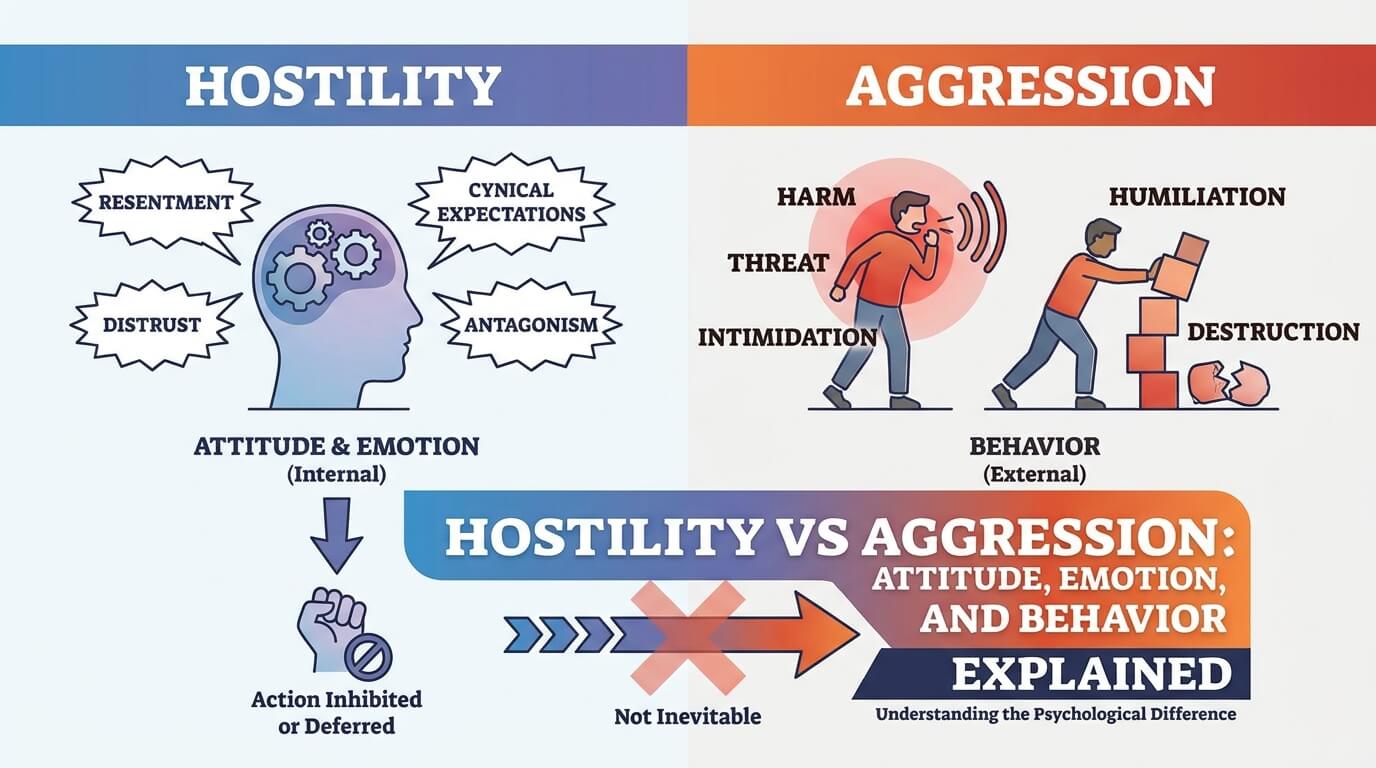
You can dislike someone, expect the worst from them, feel resentful, or carry a generally antagonistic attitude without trying to hurt them. You can also act aggressively in a particular moment without having a broad, long-standing hostile view of the other person. That difference matters because hostility and aggression overlap, but they are not the same psychological construct.
Confusing them can lead to two opposite errors. One is treating hostile thoughts as proof that harmful behavior will follow. The other is overlooking aggressive behavior because the person did not look angry, resentful, or openly antagonistic. A clearer view separates what is happening internally from what a person actually does.
Quick Answer

Hostility refers to a negative, antagonistic orientation that can include resentment, distrust, cynical expectations, or readiness to see others negatively. Aggression refers to behavior intended to harm, threaten, intimidate, humiliate, exclude, or impose an unwanted cost. Hostility may raise the likelihood of hostile interpretations in some situations, but it does not make aggression inevitable.
The Basic Difference: Orientation Versus Action

The most useful distinction is simple: hostility is primarily about an internal orientation toward other people, while aggression is about behavior. This does not mean the two are unrelated. It means that one cannot be used as a substitute for the other.
Hostility as a negative or antagonistic orientation
The APA Dictionary of Psychology entry on hostility places hostility in the territory of antagonism toward others. In everyday life, that may show up as resentment, bitterness, distrust, contemptuous expectations, or a readiness to interpret another person through a negative lens.
Someone might think, “He never respects me,” “She always has an angle,” or “People like that cannot be trusted.” These thoughts can shape attention and interpretation even if the person never insults, threatens, excludes, or attacks anyone.
Aggression as behavior intended to harm
Psychological definitions of aggression focus on behavior directed toward causing harm or another aversive outcome. The APA Dictionary of Psychology definition of aggression is useful here because it keeps attention on action and intention rather than on whether someone appears angry.
A degrading insult, a threat meant to frighten, a shove, deliberate social exclusion intended to hurt, or damaging property to intimidate may qualify as aggressive depending on the context and intention. The behavior is what matters most for classification.
Why thoughts and attitudes do not equal actions
Human beings routinely experience thoughts, emotions, and impulses that they do not act on. A person can resent a supervisor and still behave professionally. Someone can feel intense dislike toward a relative and choose distance rather than humiliation or retaliation. Another person can notice an aggressive urge and decide not to follow it.
This gap between inner experience and outward behavior is one reason it is risky to label someone “aggressive” merely because they sound cynical or admit to angry thoughts. Internal states may matter, but behavior still depends on appraisal, opportunity, inhibition, goals, social consequences, available alternatives, and deliberate choice.
What Hostility Can Include
Hostility is not one single feeling. It can involve several related ways of thinking and relating to other people. Some are brief and situational; others may be more persistent. The common thread is an antagonistic orientation, not necessarily an act of harm.
Resentment and antagonism
Resentment often develops when a person believes they were treated unfairly, overlooked, insulted, betrayed, or denied something they deserved. Antagonism adds a more oppositional tone, such as seeing another person as an adversary or someone to push against.
Neither state automatically produces aggression. Resentment might lead to avoidance, a formal complaint, withdrawal of cooperation, direct discussion, rumination, or no action at all. The route taken depends on what the person believes is justified, safe, effective, and available.
Distrust and cynical expectations
Hostility can also include expectations that others are selfish, dishonest, disrespectful, or likely to exploit weakness. A person with cynical expectations may enter interactions guarded, skeptical, or ready for conflict.
The danger of collapsing distrust into aggression is that distrust describes an expectation, not a harmful act. A guarded employee who documents conversations because they do not trust a manager is not necessarily acting aggressively. The same employee who deliberately humiliates the manager in front of others to cause harm has crossed into different territory.
Readiness to interpret others negatively
When someone is already hostile, negative explanations may come to mind more quickly. A delayed reply may feel dismissive. A neutral correction may sound condescending. An accidental bump may be read as disrespectful.
A systematic review of several kinds of hostility-related interpretation biases found robust associations with aggressive behavior, while also noting unresolved questions about the underlying mechanisms. An association matters, but it is not a guarantee that a hostile interpretation will lead to harmful action.
State-like hostility versus a more persistent orientation
Hostility can be temporary. After a betrayal or humiliating interaction, a person may spend hours or days viewing someone through an antagonistic lens. In other cases, a person may show a more enduring tendency toward cynical or hostile expectations across many situations.
Those are different patterns, and neither should be treated as a diagnosis by itself. Describing the time course is usually more useful than applying a fixed label: “I have been feeling resentful toward this person since the argument” is more precise than “I am a hostile person.”
What Makes Behavior Aggressive
Aggression is identified by what the person does and the intended effect on the target. The exact boundaries vary somewhat across research traditions, but harmful action is central.
Harm, threat, humiliation, exclusion, intimidation, or aversive consequences
Aggressive behavior does not have to be physical. Words can be used to degrade or threaten. Social relationships can be used to isolate or damage reputation. A person can destroy an object to frighten someone else. These examples differ in form, but each may involve an intentional attempt to impose harm or an unwanted cost.
Context still matters. Ending a friendship is not automatically aggression. Correcting someone sharply is not automatically aggression. Excluding someone from a private event is not automatically aggression. Intention, pattern, circumstances, and the nature of the act all affect how the behavior should be understood.
Why observable behavior and intention matter
Two people can perform similar-looking actions for different reasons. One person leaves a conversation to cool down. Another leaves specifically to punish the other person with prolonged uncertainty. One person raises their voice because they are trying to be heard in a noisy room. Another raises their voice to intimidate.
Because intention is not always visible, outside observers should be cautious about certainty. The most defensible description often starts with what can be observed: “He called her degrading names,” “She threatened to damage his belongings,” or “They deliberately excluded a classmate to embarrass them.”
Why one incident should not become a personality label
Aggressive behavior can be serious without proving that a person has a fixed “aggressive personality.” One incident can still require accountability, boundaries, or safety action. The point is not to minimize harm; it is to avoid making a broader psychological claim than the evidence supports.
Repeated behavior can reveal a meaningful pattern, but even then, behavioral description is usually more informative than casual diagnosis. Frequency, severity, triggers, targets, consequences, and whether the person changes their behavior after feedback all provide more useful information.
Four Possible Combinations of Hostility and Aggression

A simple four-part map helps show why these concepts should not be merged. Hostility and aggression can occur together, but either can also appear without the other.
| Internal orientation | Behavior | Example |
|---|---|---|
| Hostile | Non-aggressive | A person resents a coworker but keeps communication civil and limits contact. |
| Low visible hostility | Aggressive | A person calmly threatens another employee to obtain compliance. |
| Hostile | Aggressive | A person feels resentful and deliberately humiliates the target in public. |
| Low hostility | Non-aggressive | A disagreement is handled through clarification, negotiation, or distance. |
Hostility without aggression
Imagine someone who has grown deeply resentful toward a sibling after years of perceived unfairness. They may avoid family events, privately complain, or feel cynical whenever the sibling speaks. Those reactions can be hostile in tone without becoming aggression.
This distinction is especially important when people fear their own thoughts. Having a hostile thought is not the same as carrying out a harmful act. What matters next is how the person responds to that internal state.
Aggression without broad hostility
Some aggression is more instrumental. A person may use a threat, public humiliation, or deliberate exclusion because they believe it will gain compliance, protect status, or produce another desired outcome. They may not show sustained resentment toward the target.
Research models of human aggression describe multiple routes through which cognition, affect, arousal, goals, and situational factors can influence aggressive action. The classic review on the General Aggression Model is one example of an integrative approach that does not reduce aggression to a single emotion.
Hostility followed by restraint or non-aggressive action
A person can feel antagonistic and still pause before acting. They might decide that retaliation would worsen the situation, that they do not actually know the other person’s intent, or that a direct but non-threatening response better serves their goal.
Restraint does not mean the hostility disappears. It means the person has not converted that internal state into harmful behavior. That distinction preserves agency without pretending that context and arousal do not matter.
Hostility and aggression occurring together
Sometimes hostility and aggression clearly reinforce each other. A person enters an interaction expecting disrespect, interprets an ambiguous comment as insulting, becomes more antagonistic, and responds with a degrading remark. The other person retaliates, which then seems to confirm the original expectation.
This kind of loop can make hostility feel self-validating. Yet even here, no single step guarantees the next one. Clarification, inhibition, leaving the situation, or a non-aggressive response can interrupt the sequence.
How Hostility Can Influence Interpretation Without Determining Behavior
Hostility matters partly because it can change what a person notices and how they interpret unclear events. The safest way to understand this is as a shift in probability and accessibility, not as a fixed prediction.
Negative explanations may become easier to access
If you already expect someone to be disrespectful, evidence that fits that belief may stand out quickly. A neutral expression can look dismissive. A short message can feel cold. A forgotten task can seem deliberate rather than accidental.
This does not mean the negative interpretation is always wrong. Sometimes another person really is being insulting, threatening, or manipulative. The useful question is whether the conclusion rests on clear evidence or whether hostility is filling in missing information.
Context, appraisal, inhibition, and alternative responses
Between a hostile interpretation and an aggressive act are several decision points. A person may consider consequences, compare alternative explanations, remember prior outcomes, notice that the situation is unsafe, or decide that direct clarification would be more useful than retaliation.
A review of anger and reactive aggression highlights processes such as automatic hostile interpretations, ruminative attention, and effortful control as relevant pieces of the broader picture. The authors do not reduce aggressive behavior to any one of these processes. That nuance is important because cognitive influences on anger and reactive aggression interact rather than operate as a simple one-way chain.
Why association is not inevitability
When research finds that hostility is associated with aggression, it describes a statistical relationship across people or situations. It does not mean a particular hostile thought predicts what a specific person will do next.
Individual behavior is shaped by many factors: the intensity of the situation, learned habits, perceived consequences, self-control, goals, social norms, substance use, available exits, power differences, and whether the person sees a non-aggressive option as workable. Prediction becomes especially unreliable when someone tries to infer future violence from one mood, one questionnaire score, or one argument.
Hostility, Anger, Suspicion, and Hostile Attribution Bias
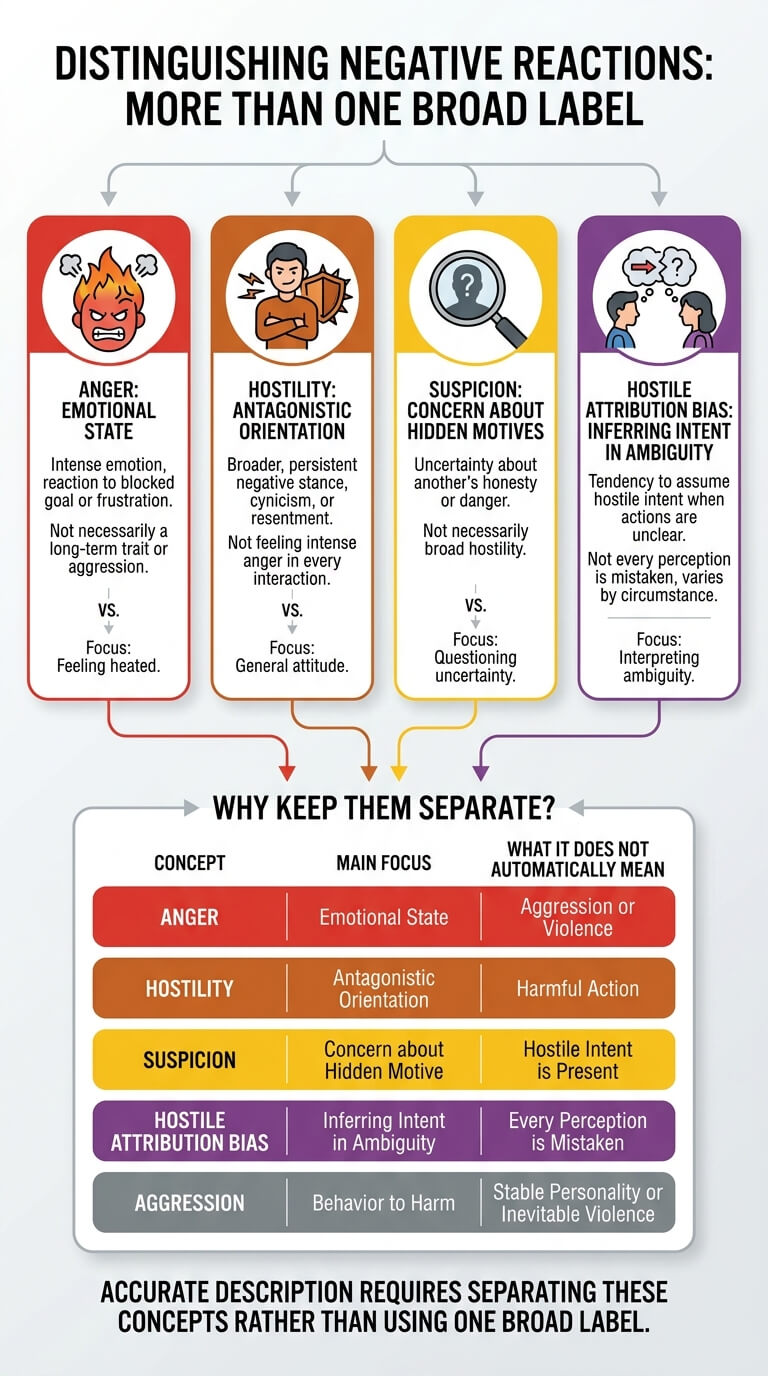
Several nearby concepts are often blurred together. Keeping them separate makes it easier to describe what is actually happening instead of using one broad label for every negative reaction.
Hostility versus anger
Anger is an emotion. Hostility is a more antagonistic stance or orientation toward others. A person can feel angry about a blocked goal without becoming broadly hostile, and someone can hold cynical or resentful attitudes without feeling intense anger in every interaction.
If the immediate problem is high emotional arousal and fear of saying or doing something harmful, a separate guide on controlling anger in the moment addresses regulation more directly. Here, the key distinction is conceptual: anger describes an emotional state, while hostility describes a negative orientation.
Hostility versus suspicion
Suspicion centers on uncertainty about another person’s hidden motives, honesty, or possible danger. Hostility can include distrust, but it is broader because it may involve resentment, antagonism, contempt, or a generally negative stance even when no hidden motive is being investigated.
For example, “I wonder whether he is trying to undermine me” is primarily a suspicious question. “I cannot stand him, and I assume anything he does will be selfish” reflects a broader hostile orientation. They can coexist, but they are not interchangeable.
Hostility versus hostile attribution bias
Hostile attribution bias is narrower than hostility. It refers to a tendency to infer hostile intent when another person’s intention is ambiguous. The focus is not simply “I dislike this person,” but “That unclear action was probably meant to harm or provoke me.”
A meta-analysis of hostile attribution of intent and aggressive behavior found a significant association, while also showing that effect sizes varied across studies and circumstances. That variation is another reason not to treat one interpretation style as destiny.
Why these constructs should not be collapsed into one
| Concept | Main psychological focus | What it does not automatically mean |
|---|---|---|
| Anger | Emotional state | Aggression or violence |
| Hostility | Antagonistic orientation | Harmful action |
| Suspicion | Concern about hidden motive or risk | Hostile intent is actually present |
| Hostile attribution bias | Inferring hostile intent in ambiguity | Every perception of hostility is mistaken |
| Aggression | Behavior intended to harm or impose an aversive outcome | Stable personality or inevitable violence |
Everyday Examples of Attitude Versus Behavior

Examples make the distinction clearer because real interactions often contain several emotions and interpretations at once.
Resenting a coworker without acting to harm them
Situation: Maya believes a coworker repeatedly takes credit for ideas. She feels resentful before meetings and expects him to act selfishly.
What she may feel: irritation, distrust, bitterness, vigilance.
What it may mean: Maya’s internal orientation toward him has become hostile, but there is no aggressive behavior in the example yet.
What to do next: She can separate what she knows from what she assumes, document specific incidents, and choose a proportionate response such as addressing credit clearly or involving an appropriate workplace process.
A deliberate degrading remark without a broad hostile worldview
Situation: During a public disagreement, Theo calmly calls another person incompetent because he wants to embarrass them and make them back down.
What the target may feel: humiliated, threatened, exposed, angry.
What it may mean: The behavior may be verbally aggressive even if Theo does not have a broad pattern of resentment or distrust toward the person.
What to do next: Focus on the conduct itself. The important issue is the deliberate use of humiliation, not whether Theo “seemed angry enough” to count as aggressive.
Expecting bad intent but choosing clarification
Situation: Leila receives a short message from a friend and immediately thinks, “She is trying to disrespect me again.”
What she may feel: tension, resentment, readiness to defend herself.
What it may mean: A hostile expectation may be shaping the first interpretation, but the message is still ambiguous.
What to do next: Leila can check the evidence before acting. A simple clarification such as “Did you mean that as criticism, or am I reading the tone wrong?” creates room for new information without requiring her to dismiss genuine warning signs.
Avoiding Personality Labels
Words such as “hostile” and “aggressive” are often used as character judgments. Psychology is usually more useful when it stays closer to observable behavior, time course, and context.
Describe patterns and actions rather than calling someone a hostile or aggressive person
Compare “He is an aggressive person” with “He threatened a coworker twice this month and deliberately damaged her belongings after disagreements.” The second description contains information that can be evaluated. The first compresses many assumptions into a single label.
The same applies to hostility. “She has expressed resentment toward her manager for several weeks and interprets neutral feedback negatively” tells us more than “She is hostile.” Specific language makes it easier to distinguish thoughts, emotions, interpretations, and actions.
Why repeated behavior still requires context rather than diagnosis
Repeated aggressive behavior deserves attention. Frequency and severity can change the level of concern, and repeated intimidation or threats may require firm boundaries or safety planning. But a repeated behavior pattern still does not authorize a lay diagnosis of a personality disorder or other mental condition.
There are many possible contributors to aggression, and none can be inferred confidently from behavior alone. Explaining a mechanism is not the same as excusing harm, and accountability does not require a diagnostic label.
What to Notice Next
If you are trying to make sense of a tense situation, separating internal experience from outward action can prevent both overreaction and underreaction.
Separate what was thought or felt from what was done
Ask two different questions: “What was the internal state?” and “What behavior actually occurred?” Someone may report resentment, disgust, fear, anger, or distrust. Then describe the action separately: withdrawal, clarification, insult, threat, exclusion, physical contact, or no action.
This prevents a strong feeling from being treated as evidence of aggression and prevents a calm presentation from hiding genuinely harmful behavior.
If intent was ambiguous, examine the interpretation before assuming hostility
When the event itself is unclear, the central issue may be how intent was inferred. Was there direct evidence that the act was deliberate? Are there plausible non-hostile explanations? Has similar behavior occurred repeatedly? Is there a reason the person expects harm based on prior experience?
The aim is not forced optimism. It is calibrated interpretation. Real hostility should not be explained away, but ambiguous situations should not automatically be treated as deliberate attacks either.
If harm escalated, shift attention to behavior and safety
Once threats, intimidation, repeated humiliation, physical assault, stalking, blocked exits, weapon threats, or serious property destruction used to frighten someone enter the situation, conceptual distinctions become less important than immediate risk.
In those circumstances, do not rely on better communication alone. Creating distance, seeking qualified local support, or contacting emergency services when there is immediate danger may be more appropriate than trying to reason through hostility in the moment.
Where These Distinctions Matter Most
Hostility sits near several other processes that are easy to confuse. Knowing which question you are actually asking helps keep the analysis proportionate.
When an unclear act feels deliberately hostile
The useful question becomes: “How am I inferring intent from ambiguous information?” That is narrower than general hostility because it focuses on a specific interpretive judgment about what another person meant to do.
When you need the wider picture of aggressive behavior
If the main concern is why a person moved from provocation, goals, arousal, or interpretation into harmful action, the broader psychology of aggression becomes more relevant than hostility alone. Hostility may be one contributor among many, not the whole explanation.
When a tense exchange starts becoming harmful
When each person’s response becomes a new trigger for the other, the issue shifts toward escalation. Insults, retaliatory behavior, humiliation, and threat displays can create a reciprocal loop that is different from merely holding a negative attitude.
FAQ About Hostility vs Aggression
These questions address the distinctions people most often blur when deciding whether a negative attitude, emotion, or interpretation has become aggressive behavior.
Can someone feel hostile without acting aggressively?
Yes. A person can feel resentful, distrustful, cynical, or antagonistic while choosing not to harm anyone. They may distance themselves, seek clarification, use formal channels, or simply keep the feeling private. Hostility can influence interpretation, but it does not remove choice or make aggression inevitable.
Can aggression occur without resentment or long-term hostility?
Yes. Some aggressive behavior is instrumental or situational. A person may threaten, humiliate, or deliberately exclude someone because they expect a payoff such as compliance, status, or another advantage. Strong visible resentment is not required for behavior to be aggressive.
Is suspicion the same as hostility?
No. Suspicion is more specifically about uncertainty concerning another person’s motives, honesty, or possible danger. Hostility is a broader antagonistic orientation that can include resentment and distrust. A person may be suspicious without feeling broadly hostile, and they may be hostile without actively wondering about a hidden motive.
Does hostility predict violence in an individual person?
No single hostile attitude, thought, or questionnaire result can reliably tell you whether one person will become violent. Research may identify group-level associations between hostility-related processes and aggression, but individual behavior depends on many interacting factors. If there are actual threats, stalking, assault, weapon threats, or credible fear, respond to the concrete safety risk rather than trying to calculate a psychological prediction.
Is anger a form of hostility?
Not exactly. Anger is an emotional state, while hostility is an antagonistic orientation toward others. They often overlap, but a person can be angry about a situation without becoming hostile toward another person, and someone can hold hostile attitudes without feeling intense anger at that moment.
Key Takeaways
- Hostility is mainly an antagonistic orientation; aggression is behavior intended to harm or impose an unwanted cost.
- Hostile thoughts, resentment, or distrust do not prove that aggressive behavior will occur.
- Aggression can occur without broad resentment or obvious anger, especially when harm is used instrumentally.
- Hostility, anger, suspicion, and hostile attribution bias describe different psychological processes and should not be used interchangeably.
- Behavior-first descriptions are more useful than fixed labels such as “hostile person” or “aggressive personality.”
- When credible threats, stalking, physical assault, escalating intimidation, or immediate fear are present, safety takes priority over interpretation.
Final Thoughts
The clearest way to distinguish hostility from aggression is to keep two questions separate: “What is the person thinking or feeling toward others?” and “What are they actually doing?” A hostile orientation can shape interpretation and raise tension, but it is not the same as harmful action. Aggressive behavior should be taken seriously even when it is delivered calmly.
If you are evaluating a real situation, describe the behavior first. Then consider the thoughts, emotions, and interpretations around it. That order reduces mind-reading, preserves nuance, and helps you respond to the level of harm that is actually present.

Michael Reed is the Founder and Lead Writer at Psychology Exposed. He writes about human behavior, relationships, emotional patterns, self-awareness, and practical psychology topics using research-informed, easy-to-understand content.
Read More About Michael Reed: https://psychologyexposed.com/michael-reed/