
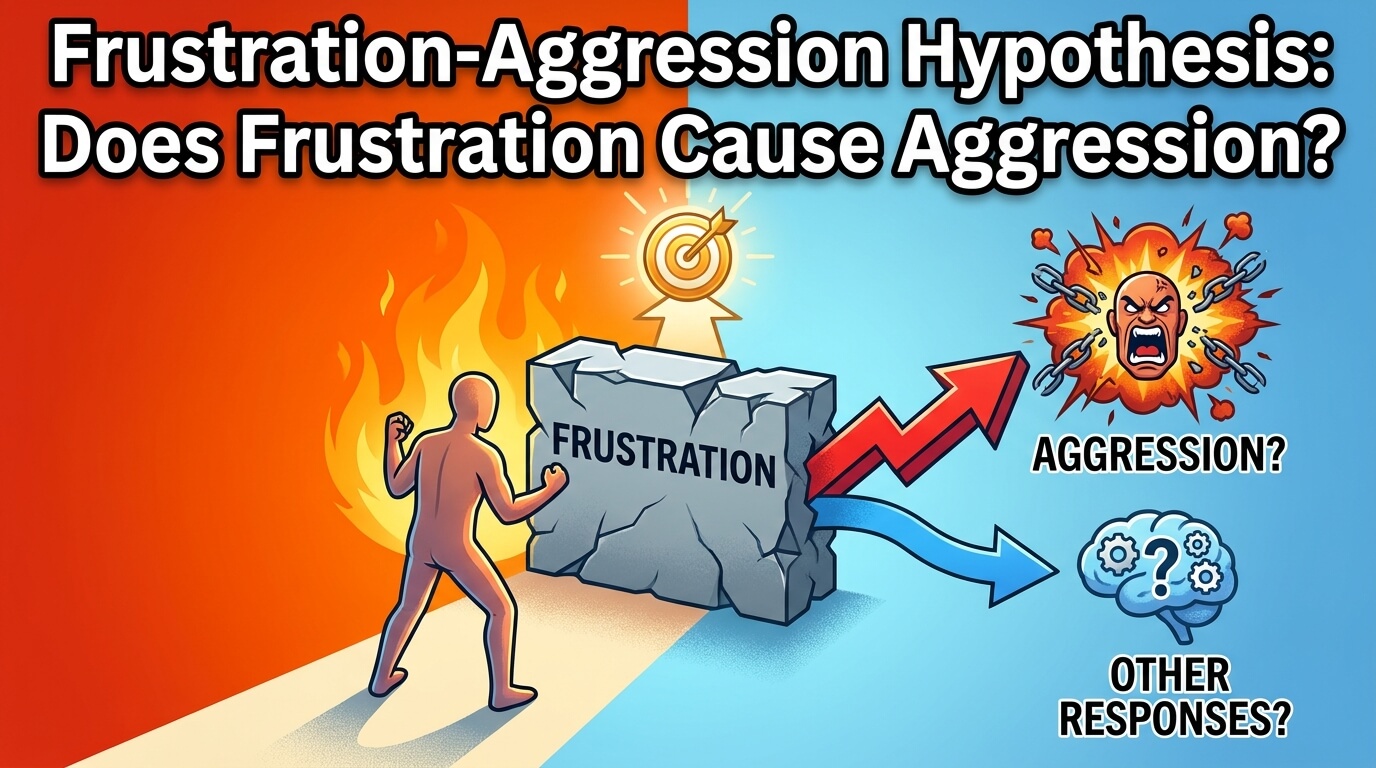
When a goal is blocked, frustration can feel surprisingly intense. A delayed train, a frozen laptop, an unfair decision, or a person who seems to stand in your way can produce irritation, anger, or a strong urge to push back. That everyday experience helps explain why the frustration-aggression hypothesis became so influential in psychology.
But the popular version of the idea is too simple. Frustration does not automatically produce aggression, and aggression does not always begin with frustration. The more useful question is what happens between a blocked goal and a harmful response: how the obstruction is interpreted, how unpleasant it feels, what alternatives are available, and what consequences the person expects.
This distinction matters because explaining a pathway is not the same as excusing harmful behavior. Frustration can help us understand why aggressive impulses sometimes become more likely, while still leaving room for choice, context, accountability, and non-aggressive responses.
Quick Answer
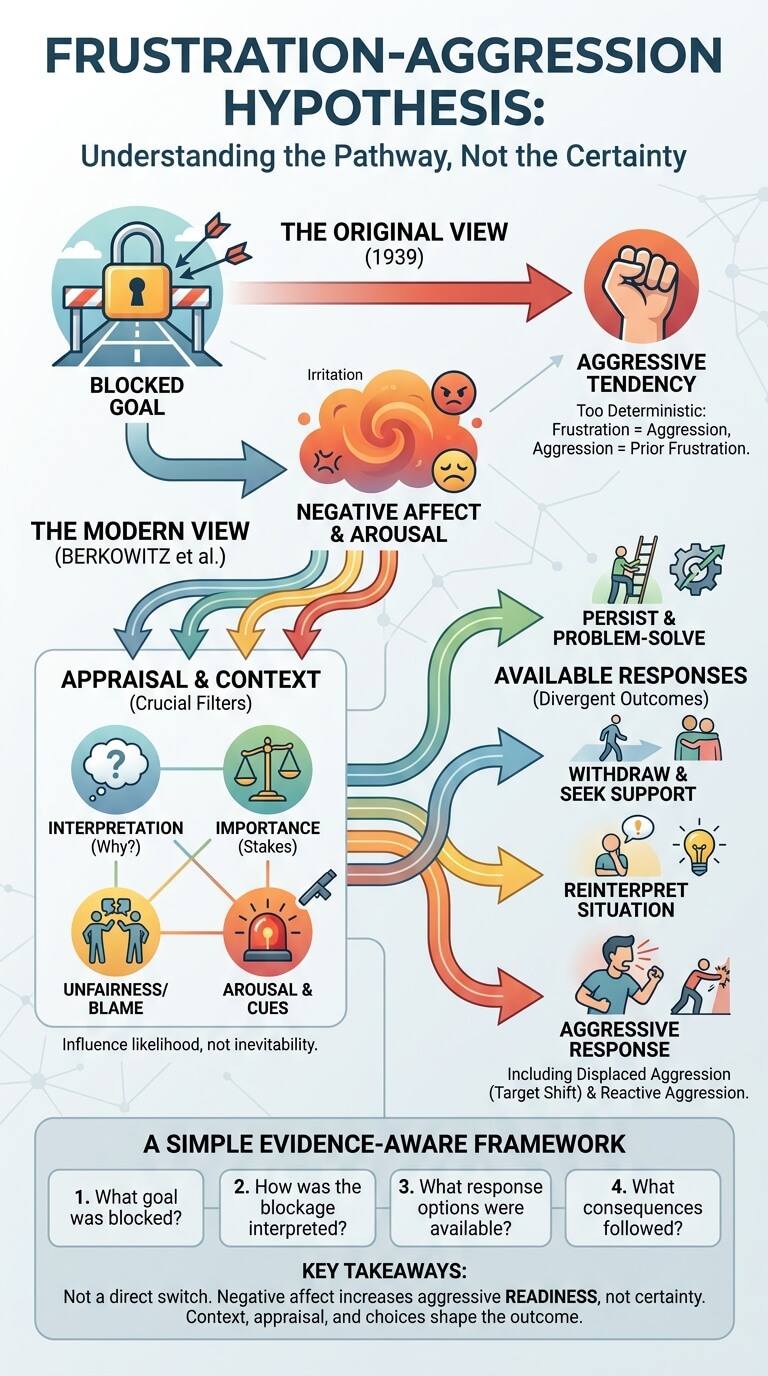
The frustration-aggression hypothesis originally proposed a strong link between blocked goals and aggression. Later research revised that claim. Frustration can increase negative affect, irritation, anger, or aggressive inclinations under some conditions, but it does not make aggression inevitable. People may also persist, problem-solve, withdraw, seek support, reinterpret the situation, or choose another response.
What the Original Frustration-Aggression Hypothesis Proposed
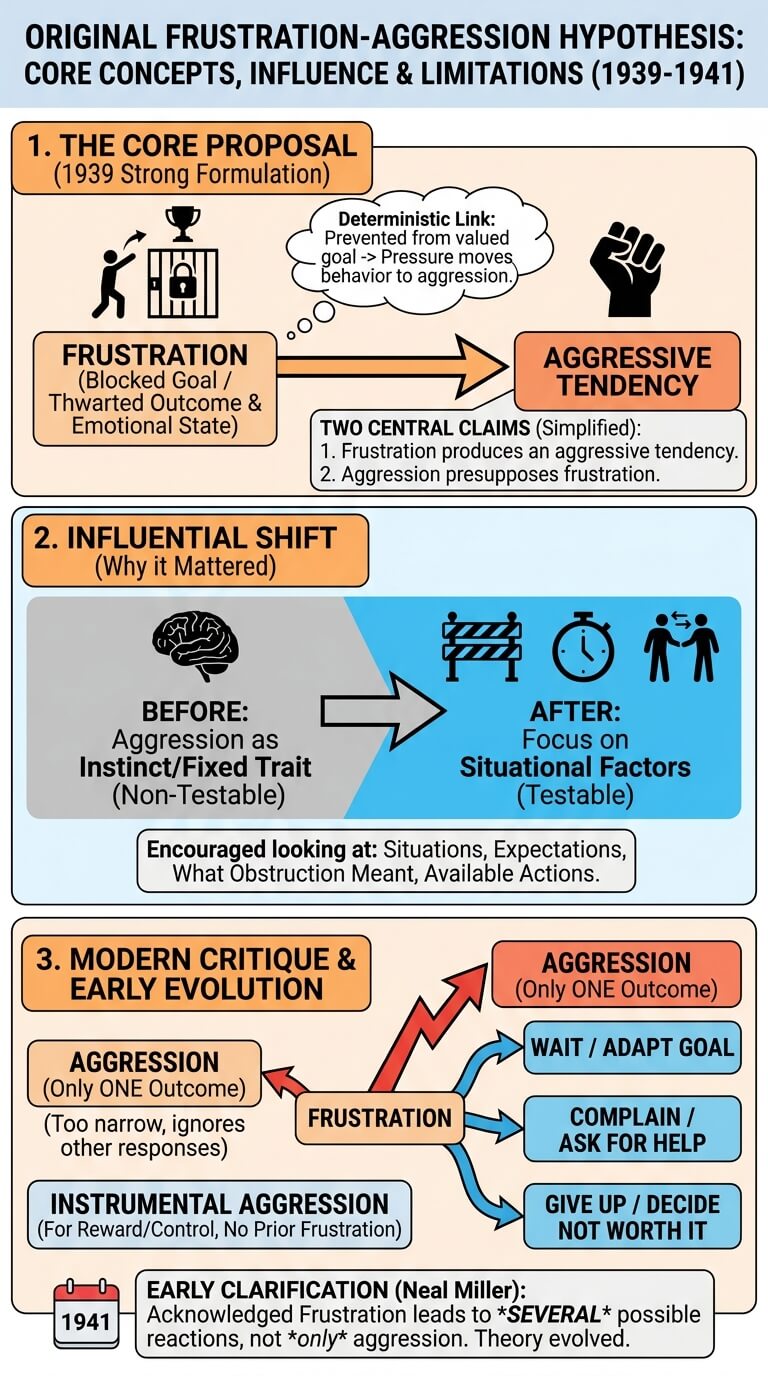
The theory is easiest to understand by starting with what psychologists meant by frustration. The APA Dictionary of Psychology definition of frustration includes the thwarting of an action or impulse that prevents someone from obtaining an expected outcome, as well as the emotional state that can follow that thwarting.
Blocked goals and the early strong formulation
In 1939, John Dollard and colleagues proposed a strong relationship between frustration and aggression. In simplified form, the theory was often summarized as two claims: frustration produces an aggressive tendency, and aggression presupposes frustration.
The idea was attractive because it gave researchers a way to connect everyday obstruction with harmful behavior. If someone is prevented from reaching a valued goal, the theory suggested that the interruption creates pressure that can move behavior in an aggressive direction.
Modern readers should notice how broad that claim was. It treated frustration as a major causal condition behind aggression, even though real people often respond to blocked goals in very different ways.
Why the historical claim was influential
The early theory gave psychology a testable alternative to treating aggression only as an instinct or a fixed personal characteristic. It encouraged researchers to look at situations, expectations, blocked goals, and the social circumstances surrounding a harmful response.
That shift still matters. Someone who reacts aggressively after being blocked is not explained simply by saying, “that person is aggressive.” A fuller explanation asks what happened, what was expected, what the obstruction meant to the person, and what actions seemed available in that moment.
Why the original version is too deterministic for modern use
The strongest version of the hypothesis could not account well for obvious exceptions. People experience frustration constantly without harming anyone. They may wait, complain, ask for help, adapt the goal, try again, or decide the goal is no longer worth pursuing. Aggression can also occur for instrumental reasons, such as obtaining a reward or controlling an outcome, without a clear preceding episode of frustration.
Even early proponents clarified the theory. Neal Miller wrote that frustration can lead to several possible reactions rather than only aggression. A historical copy of Miller’s 1941 clarification is preserved by York University’s Classics in the History of Psychology. That clarification is an important reminder that the theory evolved rather than remaining frozen in its most absolute form.
How the Theory Changed

Later work kept the useful observation that aversive obstruction can matter, while weakening the idea that one event must produce one behavioral outcome. The focus moved toward the emotional and cognitive processes that make some frustrating situations more provocative than others.
Later reformulations
Leonard Berkowitz’s reformulation is central to the modern history of the theory. His 1989 review argued that frustration is better understood as one kind of aversive event that may create an inclination toward aggression to the extent that it produces unpleasant affect. The PubMed record for Berkowitz’s examination and reformulation summarizes this shift from a rigid frustration-to-aggression rule toward a conditional process.
This change is subtle but important. A blocked goal is not treated as a behavioral command. It is an event that can make certain emotions, thoughts, and action tendencies more accessible, while other processes still shape what the person actually does.
Berkowitz and negative affect
Negative affect refers broadly to unpleasant emotional states. Frustration can contribute to irritation, anger, tension, or other aversive feelings. Those states may increase readiness for an aggressive response, especially when the situation is also interpreted as insulting, unfair, intentional, or threatening.
That does not mean anger is required. It also does not mean negative affect mechanically becomes aggression. The useful idea is probabilistic: an unpleasant state can shift the balance of possible responses without removing choice or making a harmful outcome certain.
Aggressive cues, interpretation, and available responses
What happens next depends partly on what the person notices and what the situation seems to mean. A delay caused by bad weather may feel irritating but impersonal. The same delay caused by someone who appears to be deliberately obstructing you may feel provocative in a different way.
Situational cues also matter. A person who sees several acceptable options, such as asking for clarification, switching strategies, or walking away, has a different decision environment from someone who perceives only retaliation or surrender. This is one reason modern explanations of aggression tend to include appraisals and response options rather than treating frustration as a direct switch.
The Modern Process: From Obstruction to Multiple Possible Outcomes

A practical way to read the theory today is to think in branches rather than a straight line. The starting point may be a blocked goal, but the path can split quickly.
Goal blockage and aversive experience
Frustration usually begins with a mismatch between what a person expected or wanted and what is now possible. You expected the printer to work, the queue to move fairly, the meeting to start on time, or another person to keep an agreement. The gap between expectation and outcome creates the aversive experience.
The importance of the goal changes the intensity of that experience. Missing a minor preference is not the same as losing access to something that feels urgent, deserved, identity-relevant, or costly.
Appraisal of fairness, intent, and responsibility
People do not respond only to the obstacle itself. They also interpret why it happened. Was it accidental? Was the rule applied consistently? Did someone benefit from cutting in line? Could the other person reasonably have prevented the problem?
An identical delay can feel very different when it is seen as unavoidable rather than deliberate. This does not mean a person’s interpretation is necessarily accurate. It means perceived intent and fairness can change the emotional weight of the event.
Anger, irritation, or negative affect
Frustration can produce anger, but it can also produce disappointment, fatigue, embarrassment, helplessness, or simple annoyance. That matters because “frustrated” is not one uniform internal state.
Research examining frustration and aggression often focuses on negative affect and angry reactivity. For example, an open-access study in PubMed Central on frustration, anger, and aggression discusses the link between frustrated goal pursuit, negative affect, anger, and aggressive responding while also examining individual differences in regulation.
Response options: persist, problem-solve, withdraw, seek support, or act aggressively
The most important correction to a deterministic reading is that several behaviors can follow the same frustration. One person may persist. Another may change tactics. Someone else may decide the cost is too high and leave. A fourth person may ask for assistance. A fifth may insult the person they blame.
| Blocked-goal experience | Possible interpretation | Possible next response |
|---|---|---|
| A reservation is lost | “This system failed.” | Ask for alternatives or reschedule |
| A reservation is lost | “They deliberately disrespected me.” | Confront, accuse, or escalate |
| A project is delayed | “I need another route.” | Re-plan or seek help |
| A project is delayed | “Someone must pay for this.” | Look for a person to blame or retaliate against |
The table does not imply that interpretation alone determines behavior. It shows why a blocked goal is better treated as the beginning of a process, not the end of the explanation.
When Frustration May Raise Aggression Risk
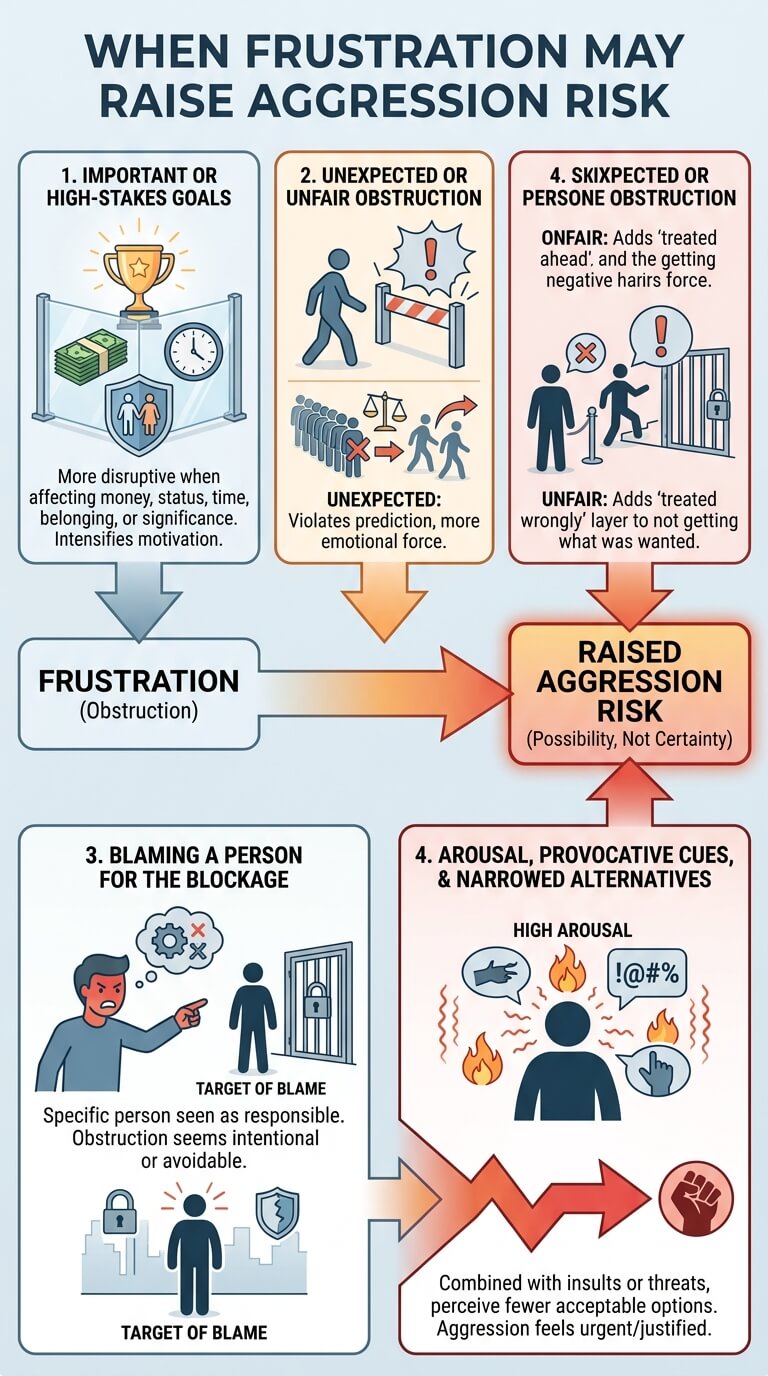
Frustration becomes more relevant to aggression when other conditions make the obstruction especially aversive or make aggressive responses seem more available. These conditions raise possibility, not certainty.
Important or high-stakes goals
The more a goal matters, the more disruptive its obstruction may feel. A person is likely to react differently to a minor inconvenience than to a barrier affecting money, status, time pressure, belonging, or a valued opportunity.
Recent theoretical work has also examined how frustration involving a person’s sense of significance or mattering may intensify aggressive motivation in some circumstances. A 2023 peer-reviewed reconsideration indexed by PubMed argues that the meaning of the frustrated goal can be an important part of the process. That is one contemporary proposal, not a universal explanation for every aggressive act.
Unexpected or unfair obstruction
Unexpected barriers often carry more emotional force because they violate a prediction. Perceived unfairness can add another layer by turning “I did not get what I wanted” into “I was treated wrongly.”
Consider two long waits. In one, everyone is delayed because a system is down. In the other, several people appear to be allowed ahead after arriving later. The clock may show the same delay, but the second situation adds a fairness appraisal that can intensify resentment.
Blaming a person for the blockage
Frustration is more likely to become socially charged when a specific person is seen as responsible. The target of blame may become mentally linked with the unpleasant state, especially if the obstruction seems intentional or avoidable.
That attribution can be mistaken. It can also be correct. A useful psychological explanation should not assume that every accusation is biased, only that judgments about responsibility influence how the event is experienced.
Arousal, provocative cues, and narrowed alternatives
When frustration is combined with high arousal, insults, threatening signals, public embarrassment, or rapid back-and-forth retaliation, people may perceive fewer acceptable options. A response that would have seemed excessive ten minutes earlier may begin to feel justified or urgent.
This is one place where aggression research intersects with escalation. The risk does not come from frustration alone. It comes from frustration entering a setting in which provocative interpretations, cues, and reciprocal behavior make harmful responses easier to select.
Why Frustration Does Not Make Aggression Inevitable
The theory becomes most useful when it explains divergent outcomes rather than pretending that everyone follows the same path.
Alternative explanations and responses
People can reinterpret an obstruction as temporary, accidental, or unrelated to another person’s intentions. They can also keep the interpretation negative while still choosing a non-aggressive response. You can believe a rule is unfair and file a complaint. You can feel angry about a delay and leave. You can decide someone behaved badly and still refuse to humiliate or threaten them.
This distinction protects personal agency. Context matters, but context does not erase responsibility for what a person chooses to do with the frustration.
Social norms, consequences, and self-control
Behavior is shaped by expectations about what is acceptable, likely to work, and likely to carry consequences. A person may inhibit an aggressive impulse because harming someone violates their values, risks damaging an important relationship, or would create practical costs.
They may also have learned non-aggressive responses that are readily available under pressure. If the main problem is acute anger rather than understanding this theory, practical regulation guidance belongs in a different discussion, such as ways to control anger in the moment.
Why frustration tolerance is adjacent but not the whole theory
Frustration tolerance describes how well someone can remain relatively steady when gratification is delayed or obstacles appear. It can be relevant, but it should not replace the theory.
A person with low tolerance may complain, quit, procrastinate, or become distressed without acting aggressively. A person with generally good tolerance may still respond badly in a highly provocative situation. The hypothesis is about conditions surrounding frustration and aggression, not a single trait that predicts behavior.
Everyday Blocked-Goal Examples
Concrete examples make the theory easier to use without turning it into a label for people.
Queue delays and perceived unfairness
Situation: You have been waiting for twenty minutes and someone appears to move ahead of you.
What you may feel: Irritation can become anger if the event feels unfair or disrespectful.
What it may mean: The blocked goal is not just “get served soon.” It may also involve fairness and recognition of your place in line.
What to do next: Check what actually happened before assigning intent. A calm question to staff can clarify whether the person had a different queue, an appointment, or special instructions.
Technology failure and misdirected blame
Situation: A file will not upload minutes before a deadline, and a colleague sends a routine message asking for an update.
What you may feel: The technical problem creates pressure, and the message arrives while that pressure is high.
What it may mean: The colleague did not cause the obstacle, but they are now present when the negative affect is strongest.
What to do next: Separate the actual source of frustration from the nearest available person. If the reaction starts shifting targets, that is a different mechanism from the blocked goal itself.
Competition, interrupted plans, and work obstacles
Situation: You have prepared for an opportunity, but another person receives it.
What you may feel: Disappointment can mix with envy, perceived injustice, or embarrassment.
What it may mean: A meaningful goal has been blocked, but the cause may involve multiple factors rather than one malicious actor.
What to do next: Distinguish evidence about the decision from the emotional need to locate a culprit. That distinction can keep frustration from turning into an unsupported accusation.
Same frustration, different behavioral outcomes
Imagine four people whose flights are cancelled. One immediately looks for another route. One vents privately to a friend. One decides to stay overnight and continue tomorrow. One insults the gate agent who had no control over the cancellation.
The frustration is similar, but the behaviors differ. That is the central lesson of the revised theory: obstruction can create an aversive state, yet appraisal, norms, alternatives, learning, and situational cues help shape what happens next.
Frustration-Aggression vs Displaced Aggression
These concepts are related, but they answer different questions. Keeping them separate prevents a common misunderstanding.
Readiness after blocked goals versus target shift
Frustration-aggression theory asks why an aversive obstruction may increase readiness for aggression. Displaced aggression asks why a harmful response may be redirected away from the original source and toward a different target.
| Question | Frustration-aggression | Displaced aggression |
|---|---|---|
| Main issue | How obstruction can increase aggressive inclination | Why the target of aggression changes |
| Starting point | Blocked goal or aversive event | Provocation plus inability or unwillingness to respond directly |
| Key distinction | Aggression is one possible outcome | The substitute target did not cause the original provocation |
How the two mechanisms can sometimes occur in sequence
A person may first become frustrated by an obstacle and then direct aggression toward someone else. For example, an employee may feel intensely frustrated by an unfair decision from a powerful supervisor, avoid confronting that supervisor, and later snap at an uninvolved person.
The sequence contains two ideas: frustration may have increased aggressive readiness, while displacement explains why the eventual target was someone different. Explaining that sequence does not reduce accountability for harming the substitute target.
Frustration-Aggression vs Motivation and Problem-Solving
A blocked goal can be studied from several psychological angles. The question changes depending on what you want to explain.
Motivation asks what happens to goal pursuit
A motivation perspective may ask whether obstruction increases effort, changes persistence, lowers expectancy, shifts incentives, or leads someone to abandon the goal. Aggression is not required for that analysis.
Problem-solving asks how obstacles are worked through
A problem-solving perspective focuses on defining the obstacle, generating options, testing solutions, and changing strategies. Frustration may be present, but the central issue is how the person finds a workable path forward.
This theory asks when obstruction contributes to aggressive responding
The frustration-aggression question is narrower. It asks how blocked goals or other aversive experiences may create conditions in which aggressive thoughts, urges, or behaviors become more likely. Keeping that question narrow prevents the theory from turning into a general explanation for every reaction to difficulty.
A Simple Evidence-Aware Framework for Reading Frustrating Situations
A four-question framework can help you analyze a frustrating event without assuming that aggression was inevitable or that the first interpretation was correct.
What goal was blocked?
Name the actual goal. Was it speed, fairness, recognition, access, status, control over a plan, or something else? The more precisely you identify the goal, the easier it is to understand why the obstruction mattered.
How was the blockage interpreted?
Separate the event from the meaning assigned to it. “The meeting was cancelled” is different from “they cancelled it to humiliate me.” The second statement contains an inference about intent that may require additional evidence.
What response options were available?
List realistic alternatives that were visible at the time, not idealized options invented afterward. Could the person ask a question, leave, wait, change the plan, seek help, complain through a formal channel, or revisit the issue later?
What consequences followed?
Look at what the chosen response produced. Did it solve the blocked goal, create a new conflict, damage trust, invite retaliation, or reinforce the idea that aggression is effective? Consequences can shape what someone expects to work the next time frustration appears.
How Frustration Connects With Other Aggression Processes
Blocked goals rarely operate in isolation. Several nearby mechanisms can become relevant after the initial frustration, but each explains a different part of the sequence.
When the reaction shifts to another target
If a person cannot or will not confront the original source and later directs aggression toward someone safer or more available, the key issue is target displacement. The important question is no longer just why the person became frustrated, but why the harm landed elsewhere.
When frustration enters a reciprocal interaction
Frustration can also become one ingredient in escalation. A blocked goal may be interpreted as disrespect, followed by an insult, a counter-insult, and increasingly threatening behavior. At that point, the interaction itself begins generating new provocations.
When the function of aggression matters
Frustration is especially relevant to reactive forms of aggression, where perceived provocation or threat precedes the response. Proactive aggression is different because harm may be used instrumentally to obtain a separate goal. Real situations can contain both functions, so motive should not be inferred from one visible act alone.
What This Theory Does Not Prove
The frustration-aggression hypothesis is a model of one possible pathway. It does not show that a frustrated person will become aggressive, that an aggressive act must have started with frustration, or that one stressful event reveals a fixed personality.
- Feeling angry after a blocked goal is not the same as intending harm.
- Having an aggressive urge is not the same as acting on it.
- Perceiving unfairness does not prove malicious intent.
- Explaining the conditions around aggression does not excuse threats, humiliation, intimidation, or physical harm.
- Group-level findings cannot reliably predict what one particular person will do next.
If an interaction includes credible threats, physical assault, stalking, blocked exits, weapon threats, escalating intimidation, or fear of immediate harm, conceptual analysis should not take priority over safety. Create distance where possible and use appropriate local emergency or professional support.
FAQ About the Frustration-Aggression Hypothesis
These questions address the most common places where the theory is overstated or confused with nearby ideas. The answers keep the focus on what frustration may contribute without treating it as a diagnosis or a prediction of any individual person.
Did the original theory say all frustration leads to aggression?
The original 1939 formulation was often expressed in very strong terms, linking frustration with an aggressive tendency and aggression with prior frustration. The theory was soon clarified and later reformulated. Modern use should not treat every frustrating event as a cause of aggressive behavior. Frustration is better understood as one condition that may increase aggressive inclination when combined with negative affect, appraisals, cues, and limited alternatives.
Is frustration necessary for aggression?
No. Aggression can be used instrumentally to obtain a reward, status, compliance, or another outcome without a clear episode of frustration immediately beforehand. The APA Dictionary of Psychology description of aggression distinguishes reactive or affective forms from instrumental forms, which helps explain why frustration is relevant to some aggressive behavior but not all of it.
Why can unfair obstruction feel more provocative than an ordinary delay?
Perceived unfairness adds meaning to the blocked goal. The person is not only waiting or losing an opportunity; they may also believe a rule was violated, someone acted intentionally, or they were treated with less respect than others. Those appraisals can intensify negative affect and make retaliatory thoughts more accessible, although they still do not determine behavior.
Can frustration increase aggression toward someone who did not cause it?
It can under some conditions, but that is better understood through displaced aggression. The original frustration may increase negative affect or aggressive readiness, while displacement explains why the eventual target is different from the source of the frustration. The distinction matters because a substitute target should not be treated as responsible for the original provocation.
Is low frustration tolerance a diagnosis?
No. Frustration tolerance is a descriptive psychological concept, not a diagnosis by itself. Difficulty tolerating delay or obstruction can show up in many ordinary situations and does not establish a mental disorder, personality disorder, or fixed aggressive disposition. Clinical conclusions require a much broader assessment than one behavior or one frustrating event.
Key Takeaways
- The original frustration-aggression hypothesis proposed a much stronger connection between blocked goals and aggression than modern explanations support.
- Berkowitz’s reformulation emphasized negative affect and treated aggression as a possible inclination rather than an automatic outcome.
- Goal importance, perceived unfairness, blame, arousal, provocative cues, social norms, and available alternatives can all shape what happens after frustration.
- The same blocked goal can lead to persistence, problem-solving, withdrawal, support-seeking, or aggression.
- Frustration-aggression explains aggressive readiness after obstruction; displaced aggression explains why harm may shift to a different target.
- A useful next step is to identify the blocked goal, the interpretation attached to it, the options that were available, and the consequences of the response.
Final Thoughts
The most useful version of the frustration-aggression hypothesis is not “frustration makes people aggressive.” It is a question about pathways. A blocked goal can create an unpleasant internal state, but interpretation, context, learned expectations, social rules, and available choices help determine whether that state becomes persistence, withdrawal, problem-solving, or harm.
When you notice frustration rising, the first analytical step is simple: identify what was blocked before deciding who is to blame. That pause does not make the frustration disappear, but it separates the obstacle from the story about the obstacle, which can reveal more than one possible next move.

Michael Reed is the Founder and Lead Writer at Psychology Exposed. He writes about human behavior, relationships, emotional patterns, self-awareness, and practical psychology topics using research-informed, easy-to-understand content.
Read More About Michael Reed: https://psychologyexposed.com/michael-reed/