
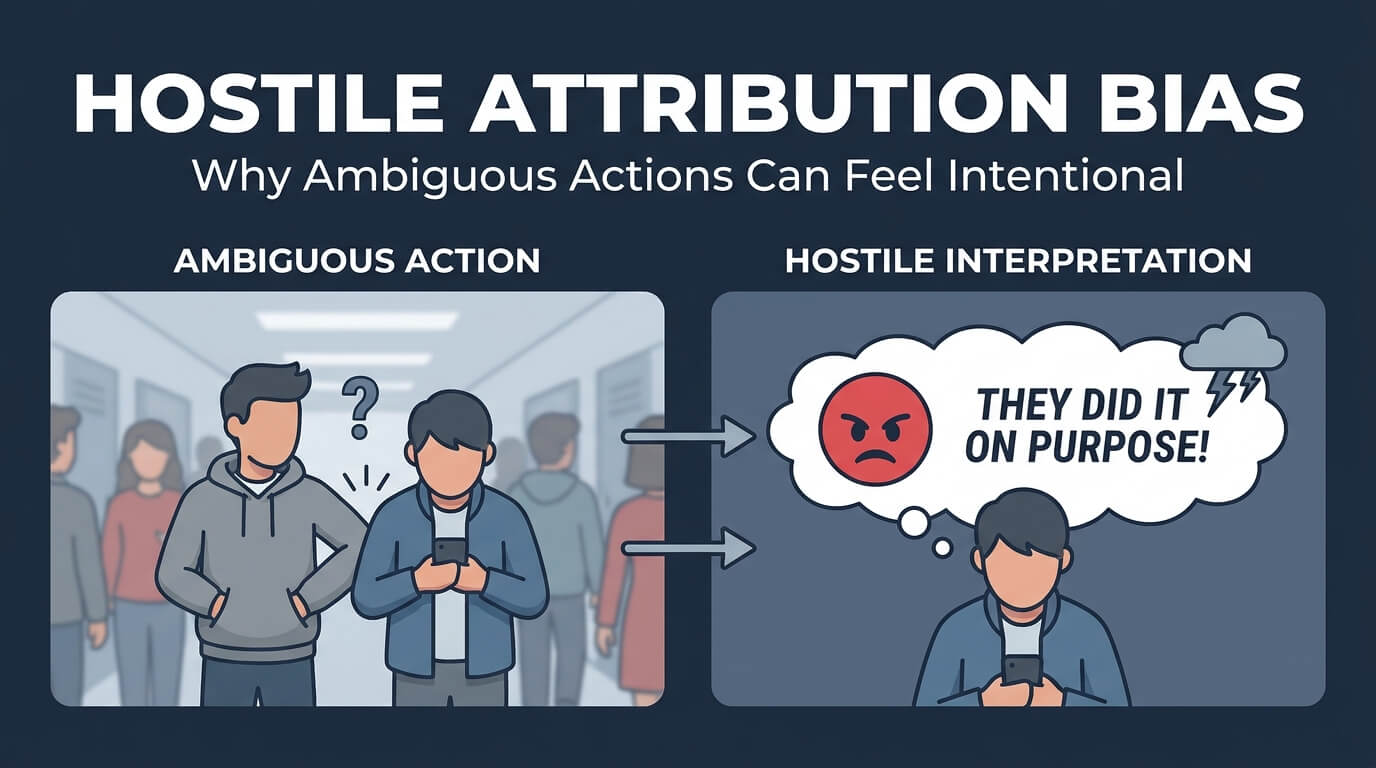
Someone bumps into you without apologizing. A coworker gives a short reply. A friend leaves you out of a plan. A stranger cuts ahead, then looks away. In each case, the behavior may feel disrespectful, but one key piece of information is missing: you do not yet know what the other person intended.
That gap between what happened and why it happened is where hostile attribution bias can matter. The mind has to interpret an unclear social event, and sometimes it fills in the missing intention with a hostile explanation: They did that on purpose. They wanted to embarrass me. They were trying to provoke me. That interpretation can then influence anger, defensiveness, retaliation, or withdrawal.
This does not mean that perceived hostility is usually imaginary. People really do insult, exclude, intimidate, deceive, or provoke others. The useful question is narrower: when intent is genuinely unclear, how does the mind decide whether harm was accidental, careless, neutral, or deliberate?
Quick Answer

Hostile attribution bias is the tendency to interpret another person’s ambiguous behavior as intentionally harmful or hostile. It matters because inferred intent can change how threatening an event feels and how a person responds. Research links hostile-intent attribution with aggressive behavior, but the relationship is not deterministic. Sometimes hostility is real, and careful evidence-checking should help distinguish uncertainty from clear danger rather than teaching automatic self-doubt.
What Hostile Attribution Bias Means

The APA Dictionary of Psychology defines hostile attribution bias as a general tendency to assign harmful or adverse intent to ambiguous behavior. The word ambiguous does most of the work in that definition. If someone clearly threatens you, says they meant to hurt you, or repeatedly acts in an unmistakably intimidating way, you do not need a bias concept to explain why the behavior feels hostile.
The key condition is ambiguous intent
An ambiguous event has more than one plausible explanation. A person who brushes past you in a crowded hallway may have done it deliberately, may not have seen you, may have been distracted, or may simply have misjudged the space. The observable event is real. The uncertainty concerns intention.
This is why hostile attribution bias is not the same as “thinking negatively.” It is a specific inference about another person’s motive in a social situation where the evidence does not clearly settle that motive.
From unclear action to inferred hostile intention
Human beings rarely experience social events as raw facts alone. We rapidly ask what they mean. If the answer becomes “that was intentional disrespect,” the event may feel more personal and more threatening than if the answer is “that was careless” or “I do not know yet.” The behavioral response can shift accordingly.
In research, hostile-intent attribution is often studied with scenarios in which one person causes a negative outcome but the intention is unclear. A major meta-analysis of 111 studies found a positive association between hostile intent attribution and aggressive behavior, while also finding substantial variation across studies. That variation matters because it cautions against treating one interpretation as a guaranteed cause of one response. The open-access meta-analysis is especially useful for seeing both the association and its limits.
Why this is narrower than general attribution
Attribution is the broader process of explaining why behavior or outcomes occurred. A person might attribute a missed deadline to low effort, a confusing instruction, poor planning, or bad luck. Hostile attribution bias asks a much narrower question: when a social act produces a negative outcome and intention is uncertain, do you infer that the other person meant harm?
That distinction prevents a common conceptual mistake. Not every inaccurate explanation is hostile attribution bias, and not every hostile thought is about ambiguous intent.
The Social-Cognitive Pathway
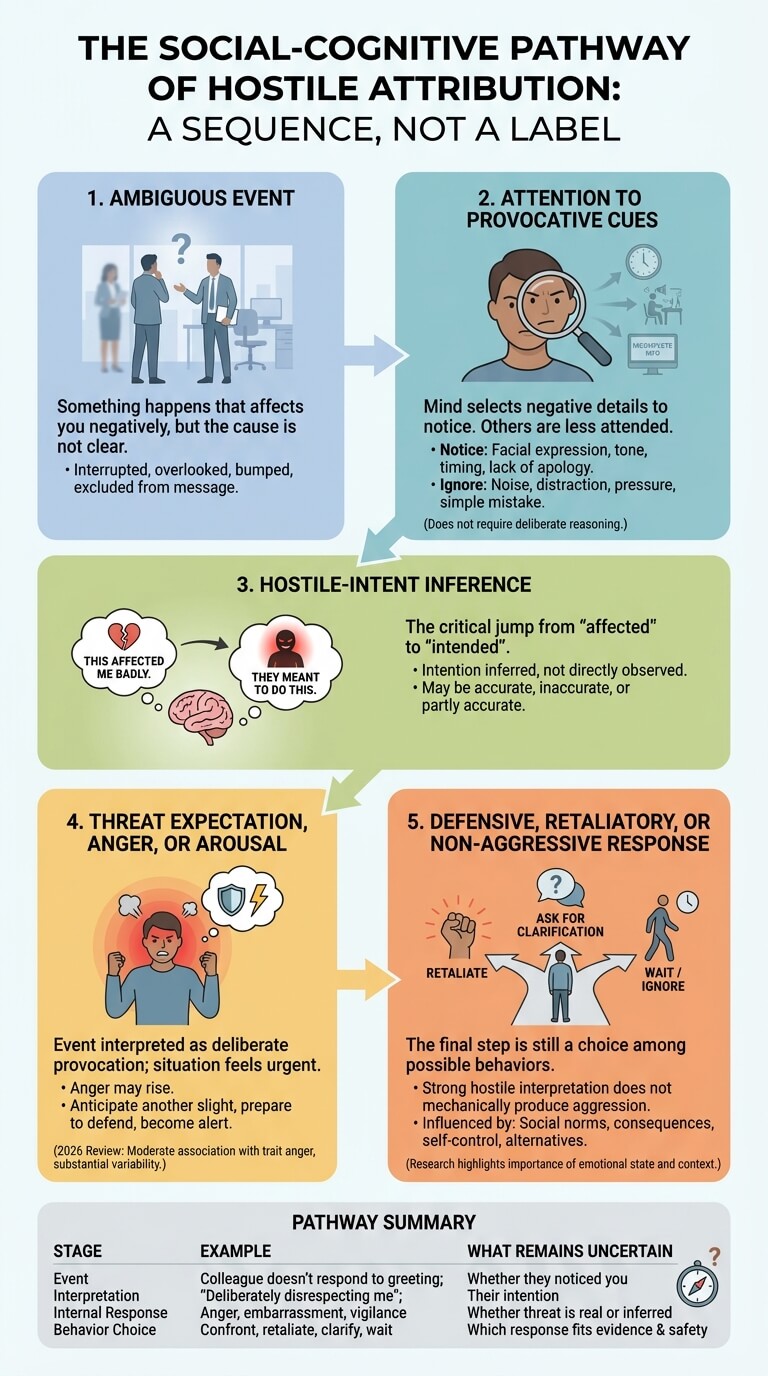
A helpful way to understand hostile attribution is as a sequence rather than a label. The sequence can unfold quickly, sometimes in seconds, but each step adds something different.
Ambiguous event
Something happens that affects you negatively, but the cause is not fully clear. You are interrupted, overlooked, bumped, excluded from a message, corrected abruptly, or receive a terse response.
Attention to provocative cues
The mind selects details to notice. A facial expression, tone, timing, lack of apology, or earlier conflict may become especially salient. Other details may receive less attention, such as noise, distraction, time pressure, incomplete information, or the possibility of a simple mistake.
This does not require deliberate reasoning. Social-information-processing research describes how people encode cues, interpret them, consider goals, generate possible responses, and evaluate what to do next. A review in PubMed Central explains how hostile interpretations have been studied within this broader sequence.
Hostile-intent inference
The critical step is the jump from “this affected me badly” to “they meant to do this to me.” That inference may be accurate, inaccurate, or partly accurate. The important point is that intention has been inferred, not directly observed.
Threat expectation, anger, or arousal
If the event is interpreted as deliberate provocation, the situation may feel more urgent. Anger may rise. The person may anticipate another slight, prepare to defend status or dignity, or become more alert for confirming cues. A 2026 systematic review and meta-analysis found a moderate association between trait anger and hostile attribution bias, with substantial variability across studies, again suggesting relationship rather than inevitability. That review also highlights why emotional state and measurement context deserve careful interpretation.
Defensive, retaliatory, or non-aggressive response
The final step is still a choice among possible behaviors. Someone may retaliate, confront, ask for clarification, leave, wait, ignore the event, or seek more information. Even a strong hostile interpretation does not mechanically produce aggression. Social norms, consequences, self-control, available alternatives, prior learning, and the actual level of danger all matter.
| Stage | Example | What remains uncertain |
|---|---|---|
| Event | A colleague does not respond to your greeting | Whether they noticed you |
| Interpretation | “They are deliberately disrespecting me” | Their intention |
| Internal response | Anger, embarrassment, vigilance | Whether the threat is real or inferred |
| Behavior choice | Confront, retaliate, clarify, wait, or disengage | Which response best fits the evidence and safety level |
What Makes a Situation Ambiguous?
Ambiguity is not the same as harmlessness. It simply means that the evidence allows more than one reasonable explanation. Several everyday situations create this problem repeatedly.
Accidental versus intentional contact
Physical contact is easy to experience as provocative because it is immediate and personal. Yet crowded spaces, poor coordination, distraction, and rushed movement create many accidental contacts. The same bump can therefore be read as an accident, carelessness, or a deliberate challenge depending on context and interpretation.
Silence, delay, exclusion, or interruption with multiple explanations
Not receiving a reply may mean avoidance, punishment, distraction, fatigue, a lost notification, or a simple decision to respond later. Being excluded from one event may be deliberate social harm, but it may also reflect limited space, changing friendships, a planning error, or a group you were never expected to join. Interpretation becomes risky when one explanation is treated as certain before the facts support it.
Short written messages with missing context
Text removes voice tone, facial expression, timing cues, and immediate opportunities to repair misunderstanding. “Fine.” can be hostile, tired, hurried, joking, resigned, or neutral. When a relationship is already tense, the mind may supply the missing tone from the existing conflict rather than from the words themselves.
Why Hostile Interpretations Can Become More Accessible
People do not approach every ambiguous event with a blank slate. Expectations are shaped by prior experiences, current relationships, recent conflicts, cultural norms, and the immediate situation. These influences can make some explanations easier to retrieve than others without fixing anyone into a permanent category.
Prior experience and expectations as context
If someone has repeatedly encountered disrespect from a particular person, expecting another slight may be reasonable. If similar situations have previously ended badly, the mind may learn to scan for warning signs. The problem is not that experience matters. The problem arises when a learned expectation is applied as certainty to a situation whose evidence remains unclear.
This distinction also protects against a harmful oversimplification: past mistreatment should not be used to tell a person that their current concerns are “just a bias.” Context can create both genuine vigilance and occasional overinterpretation.
Threat sensitivity and selective attention
When people expect provocation, they may notice cues that fit that expectation more quickly. A smirk, delayed reply, whisper, or abrupt tone can dominate attention while neutral cues fade into the background. Once the event feels intentional, later information may be interpreted through the same frame.
This is one reason evidence-checking works best when it asks, “What else fits these facts?” rather than insisting, “You are wrong.” The first question widens the field of possibilities. The second can become another source of conflict.
Repeated conflict and self-reinforcing expectations
Two people who have had several hostile exchanges may enter the next interaction prepared for another one. A neutral remark is heard as a jab, the reply becomes sharper, and the other person then responds defensively. The new behavior is genuinely tense, so it appears to confirm the original expectation.
Over time, interpretation and behavior can shape each other. This is not proof that the original interpretation was false. It shows how uncertainty can turn into a reciprocal process.
Why context is not destiny
Even strong expectations do not remove agency. People can notice uncertainty, wait for more evidence, choose a non-aggressive response, or leave a situation. Likewise, a calm interpretation is not always the correct one. Flexible responding means matching confidence to evidence rather than forcing either a hostile or reassuring story.
When the Other Person Really Is Being Hostile
The concept becomes unsafe if it is used to explain away clear mistreatment. Hostile attribution bias concerns uncertain intention, not a rule that people should doubt themselves whenever another person behaves badly.
Bias does not mean all perceived hostility is imaginary
Sometimes the evidence is direct. A person states an intention to humiliate you, makes a threat, repeats the same targeted behavior after being asked to stop, or coordinates exclusion specifically to cause harm. In those situations, the relevant task may be setting limits, documenting what happened, seeking support, or prioritizing safety, not searching endlessly for benign explanations.
Patterns, direct threats, clear intent, and corroborating evidence
Confidence should rise when evidence converges. Direct statements, repeated behavior, independent witnesses, consistent patterns, or actions that make little sense under accidental explanations can all matter. One ambiguous cue is different from a documented pattern.
Why evidence checking should not become reflexive self-doubt
A useful evidence check does not ask you to deny your reaction. It asks you to separate what is known from what is inferred. You can say, “That message felt hostile to me, and I do not yet know whether hostility was intended.” Both parts can be true at once.
If there are credible threats, stalking, blocked exits, physical assault, escalating intimidation, weapon threats, or fear of immediate harm, do not make clarification the priority. Move toward safety and appropriate local or professional support instead.
Accident or Hostile Intent? An Evidence-Checking Framework

When the situation is genuinely ambiguous and safe enough to examine, four questions can slow the leap from event to intention without requiring false optimism.
What facts are directly observable?
Describe the event in camera-like terms. “They did not reply for six hours” is observable. “They ignored me to punish me” adds intention. “She corrected my number in front of the group” is observable. “She wanted everyone to think I was incompetent” is an inference.
What alternative explanations fit the same facts?
Generate two or three plausible explanations, not ten unlikely excuses. A delayed response might reflect workload, avoidance, forgetfulness, uncertainty about what to say, or deliberate withholding. The purpose is not to choose the nicest explanation. It is to notice whether the evidence supports only one.
What evidence supports intentional provocation?
Look for information that specifically bears on intention: prior direct statements, repetition after feedback, timing, consistency, witnesses, or behavior that clearly targets you. Also ask what evidence would make you revise your interpretation. If nothing could change your conclusion, you may no longer be evaluating evidence.
Is clarification safe and appropriate?
In ordinary low-risk situations, a brief question can be useful: “I wasn’t sure how to read that. Were you upset with me?” or “Was that meant as a joke or a criticism?” Clarification is not required when the person is threatening, coercive, violent, stalking, or likely to retaliate. Safety outranks conversational certainty.
| Question | Useful focus | Avoid |
|---|---|---|
| What happened? | Observable actions and words | Mixing facts with motive |
| What else could fit? | A few plausible explanations | Inventing excuses for harmful behavior |
| What supports intent? | Patterns, direct statements, corroboration | Treating a feeling as proof |
| Can I clarify safely? | Low-risk, ordinary ambiguity | Confrontation during credible danger |
Everyday Examples of Hostile Attribution
The same interpretive process can appear across very different settings. What matters is not the setting itself but the uncertainty about intention.
Being bumped or cut off
Situation: Someone bumps your shoulder while moving past. What you may feel: irritation or disrespect. What it may mean: deliberate provocation, carelessness, crowding, or distraction. What to do next: unless there is clearer danger, notice whether you have evidence of intent before retaliating.
Being left out of a plan
Situation: You discover that several friends met without you. What you may feel: hurt, embarrassment, anger. What it may mean: targeted exclusion, a smaller invitation, a spontaneous plan, or a changing relationship. What to do next: look for pattern and context before deciding the exclusion was designed to hurt you.
Being corrected in public
Situation: A colleague corrects a factual error during a meeting. What you may feel: exposed or undermined. What it may mean: an attempt to embarrass you, a concern for accuracy, poor timing, or a blunt communication habit. What to do next: separate the correction itself from the inferred motive, then decide whether a follow-up conversation is useful.
Receiving an ambiguous message
Situation: A person replies, “Do whatever you want.” What you may feel: dismissed or challenged. What it may mean: hostility, resignation, impatience, emotional overload, or literal permission. What to do next: if the relationship is safe, ask what they meant rather than answering the harshest interpretation immediately.
Being ignored when intent is unclear
Situation: You greet someone and get no response. What you may feel: slighted or rejected. What it may mean: deliberate snubbing, distraction, headphones, hearing difficulty, or preoccupation. What to do next: avoid escalating from one uncertain event unless additional evidence supports the hostile reading.
Hostile Attribution Bias vs Nearby Concepts
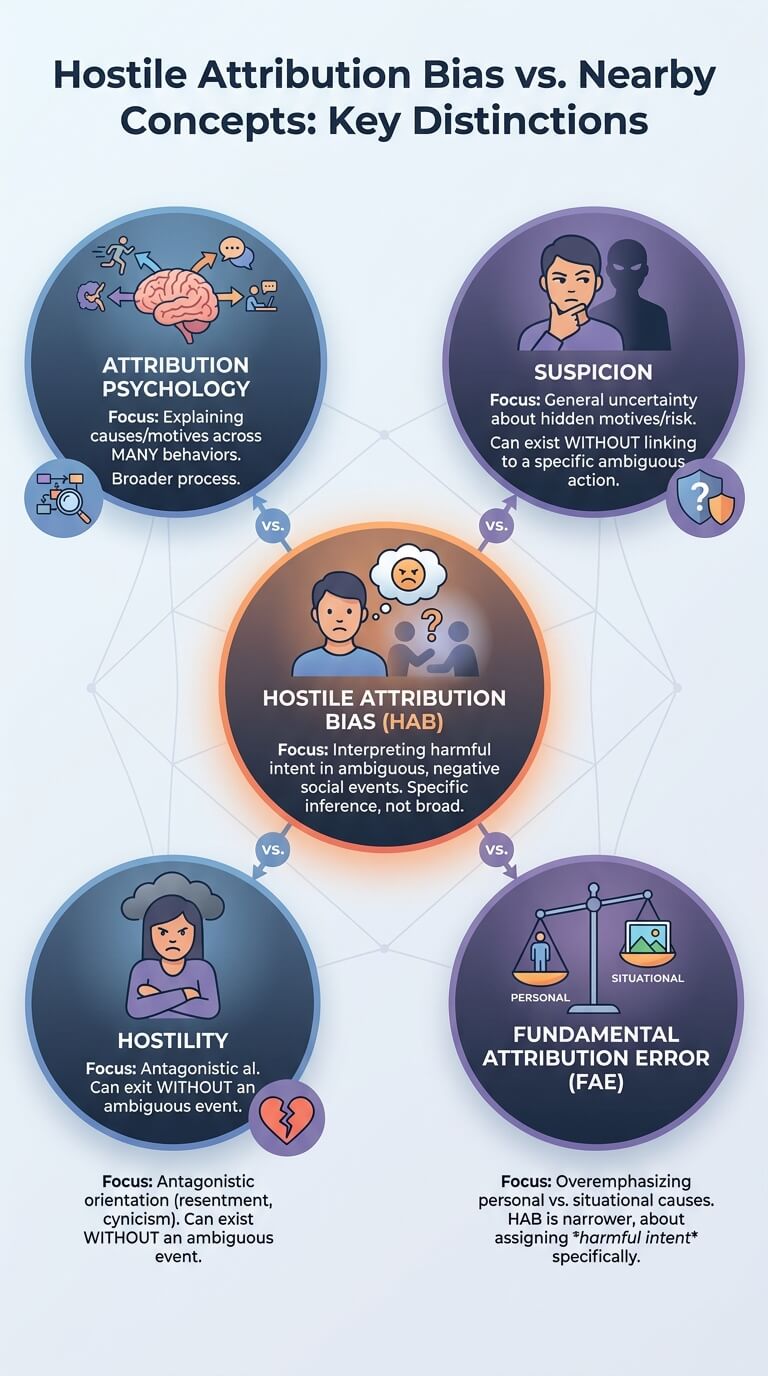
Several psychological ideas involve negative interpretations of other people, but they answer different questions. Keeping them separate prevents the concept from becoming a catch-all label.
Hostile attribution versus attribution psychology
General attribution asks how people explain causes and motives across many kinds of behavior. The APA overview of attribution theory describes this much broader process. Hostile attribution bias concerns one particular inference: hostile intent in an ambiguous social event with a negative outcome.
Hostile attribution versus suspicion
Suspicion is broader uncertainty that another person may have a hidden motive or may pose a risk. You can be suspicious without assigning hostile intent to a specific ambiguous action. Hostile attribution begins when an unclear action is interpreted as deliberately harmful or provocative.
Hostile attribution versus hostility
Hostility is a broader antagonistic orientation that can involve resentment, cynicism, or negative expectations. Someone may feel hostile toward another person even when no ambiguous event is being interpreted. Conversely, a person may make one hostile attribution without having a generally hostile attitude.
Hostile attribution versus Fundamental Attribution Error
The fundamental attribution error refers to overemphasizing personal characteristics and underemphasizing situational influences when explaining behavior. Hostile attribution bias is narrower. The key question is not simply whether a cause is personal or situational, but whether harmful intent is assigned when intent is uncertain.
How Interpretation Can Feed a Reciprocal Loop
A hostile interpretation can matter not only because of what it feels like internally, but because the response may change the social situation itself.
Retaliation changes the other person’s behavior
If an ambiguous remark is interpreted as a deliberate insult, a person may answer sharply. The other person now has a real reason to feel attacked, even if their original remark was not intended that way. They may become defensive, dismissive, or aggressive in return.
The new behavior can appear to confirm the original expectation
The second person’s defensive reply may look like proof that the first interpretation was correct: “See, I knew they were hostile.” But the later hostility may partly be a response to the retaliation. The sequence has changed from ambiguous to genuinely adversarial.
Where the loop can be interrupted without denying real harm
Interruption can happen at several points: delaying retaliation, asking what was meant, checking whether a pattern exists, choosing a neutral boundary, or leaving the interaction. None of these steps require pretending that the other person had good intentions. They simply prevent an uncertain inference from automatically deciding the next behavior.
What to Do Next When Intent Is Unclear
The goal is not to become endlessly doubtful. It is to match the response to the quality of the evidence and the level of risk.
Separate fact from inferred intention
Use two sentences. First, state what happened: “He interrupted me three times.” Then state your interpretation: “I think he may have been trying to undermine me.” Keeping the sentences separate makes it easier to see which part is evidence and which part still needs interpretation.
Delay retaliation when safety allows
Retaliation can create information that looks like confirmation. If there is no immediate danger, even a short delay can create room for additional context. This is not suppression and it is not surrender. It is refusing to let an uncertain motive determine a harmful response.
Clarify only when the situation is safe enough for clarification
For ordinary ambiguity, keep clarification concrete: “When you said that in the meeting, were you criticizing the idea or me?” A good question aims to learn something. It does not disguise an accusation as a question.
Shift to safety-focused action when threats or danger are credible
If the situation includes credible threats, stalking, violence, blocked exits, escalating intimidation, strangulation, weapon threats, or fear of immediate harm, do not treat the problem as a misunderstanding exercise. Create distance when possible and seek appropriate emergency, professional, or local support.
How Hostile Interpretation Fits Into Aggressive Responding
Hostile attribution is one possible interpretation step within a larger behavior sequence. It is especially relevant when aggression follows perceived provocation, but it does not explain every aggressive act.
Reactive aggression focuses on the response function
A reactive aggressive response is typically linked to perceived threat, insult, frustration, or provocation. Hostile attribution can help explain why an ambiguous event is experienced as provocative in the first place. The two ideas overlap, but one concerns interpretation and the other concerns the function and immediate pathway of aggressive behavior.
Escalation focuses on what happens between people
Once one person responds to perceived hostility, the interaction can become reciprocal. Tone sharpens, intentions are reinterpreted, and each new action becomes evidence for the next one. Escalation therefore asks how a sequence develops across people, while hostile attribution asks how unclear intent is interpreted within that sequence.
Broader attribution asks a wider causal question
Attribution psychology includes explanations for success, failure, behavior, responsibility, and outcomes across many domains. Hostile attribution bias should remain a narrow tool for understanding judgments of intent under social ambiguity rather than a substitute for that larger field.
FAQ About Hostile Attribution Bias
These questions focus on the areas where the concept is most often misunderstood.
Is hostile attribution bias the same as being suspicious?
No. Suspicion is a broader concern that another person may have a hidden motive or may pose a risk. Hostile attribution bias refers specifically to assigning hostile intent to behavior whose intention is ambiguous. A person can be suspicious without interpreting a particular action as deliberate harm, and can make one hostile attribution without being generally suspicious.
Can a hostile-intent judgment be accurate?
Yes. The word bias does not mean that every hostile interpretation is wrong. Some people really do act with hostile intent. The useful distinction is between situations where intention is uncertain and situations where direct statements, patterns, corroboration, or clear behavior provide stronger evidence.
Does past mistreatment make someone biased?
Not automatically. Past experience can reasonably shape expectations and vigilance. It may also make hostile explanations more accessible in some ambiguous situations. Neither conclusion should be assumed from a person’s history alone. The best approach is to evaluate the present evidence while respecting the context that makes certain cues feel important.
Why do ambiguous messages feel more hostile during conflict?
Existing tension changes what people expect and which cues stand out. A short reply that would seem neutral on a calm day may feel loaded after an argument. The missing tone in text also leaves more room for interpretation. This does not prove the message was harmless; it means prior conflict can influence how uncertainty is filled in.
Does hostile attribution bias cause aggression by itself?
No. Research shows an association between hostile-intent attribution and aggressive behavior, but aggression has multiple influences and the size of the relationship varies. Interpretation can raise the likelihood of a defensive or retaliatory response in some contexts, yet people still have other response options and many hostile interpretations do not lead to aggression.
Key Takeaways
- Hostile attribution bias concerns ambiguous intention, not clear threats or clearly stated harmful intent.
- The central leap is from an observable negative event to the inference that another person meant to cause harm or provocation.
- Hostile-intent attribution is associated with aggression in research, but it does not predict that a particular person will respond aggressively.
- Evidence-checking means separating facts from inferred motive, considering plausible alternatives, and looking for information that actually bears on intention.
- Evidence-checking should never become a demand to dismiss repeated mistreatment, direct threats, or credible danger.
- When the situation is safe and genuinely unclear, delaying retaliation or asking a concrete clarification question can prevent an uncertain interpretation from becoming a reciprocal conflict.

Michael Reed is the Founder and Lead Writer at Psychology Exposed. He writes about human behavior, relationships, emotional patterns, self-awareness, and practical psychology topics using research-informed, easy-to-understand content.
Read More About Michael Reed: https://psychologyexposed.com/michael-reed/