
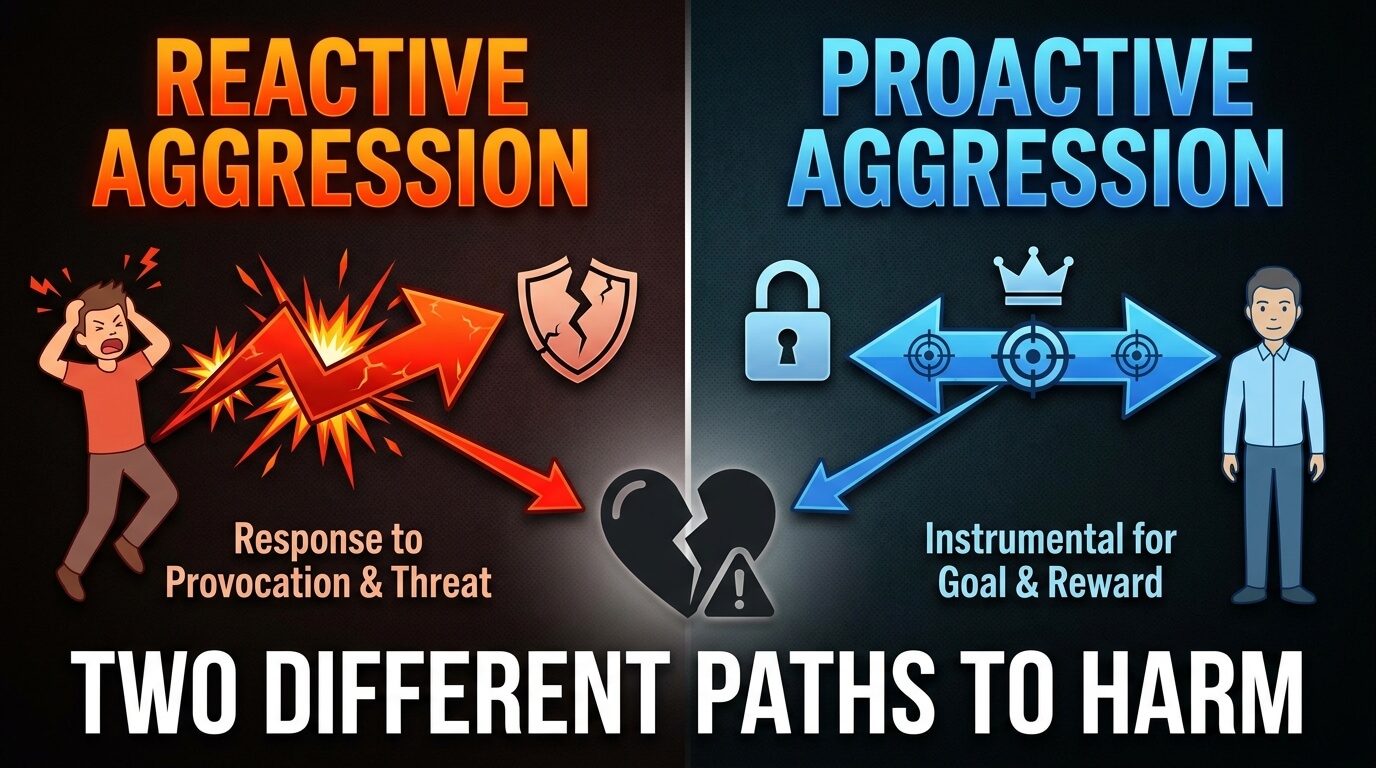
Two aggressive acts can look similar from the outside and still serve very different immediate purposes. One person may lash out seconds after feeling threatened or insulted. Another may use intimidation because they expect it to produce compliance, status, access, or some other advantage. The behavior in both cases may be harmful, but the pathway into that behavior is not necessarily the same.
The distinction between reactive and proactive aggression organizes these pathways by function, not fixed personality type or diagnosis. Perceived threat, emotional arousal, expected reward, learned consequences, and context can all matter. Because motive is inferred rather than directly observed, examine the sequence, apparent goal, and consequences without treating explanation as an excuse for harm.
Quick Answer
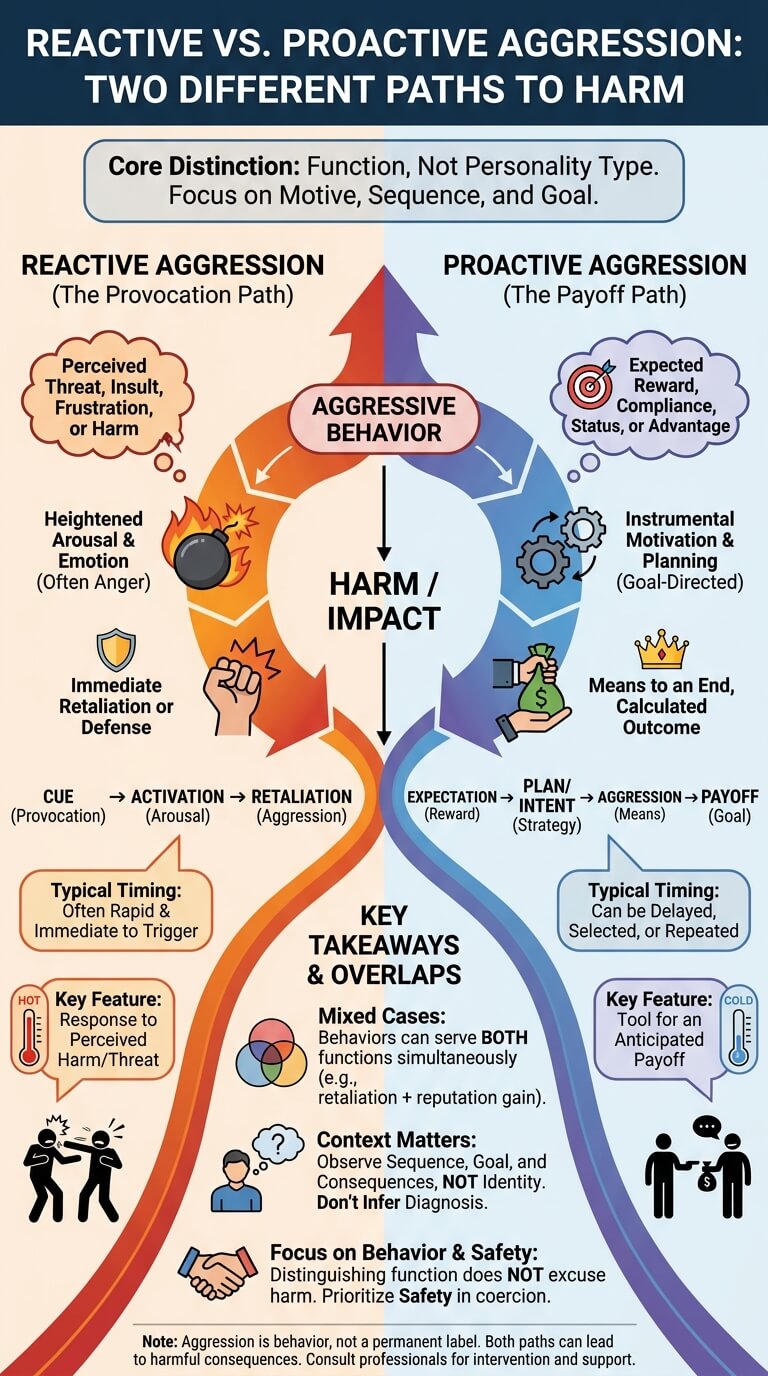
Reactive aggression is aggression that follows perceived provocation, threat, frustration, or harm and is often accompanied by heightened emotion and arousal. Proactive aggression is aggression used more instrumentally to obtain a goal, reward, compliance, status, or advantage. They can overlap, and neither category is a diagnosis or a permanent personality label. These two functions sit within a wider aggression framework that also considers interpretation, form, target, severity, and escalation.
The Core Difference Is Function, Not Personality Type

Reactive and proactive aggression are commonly distinguished by the function or motivation of the aggressive act. Research on these functions treats them as related but distinguishable, not as two completely separate kinds of human beings. A recent open-access review of measurement research notes that the two functions are strongly correlated and often co-occur, while still showing meaningful differences in the processes associated with them (research on reactive and proactive functions of aggression).
Reactive aggression as response to perceived provocation or threat
Reactive aggression is often described as a response to something experienced as threatening, insulting, frustrating, unfair, or harmful. The aggressive act may feel to the person like retaliation, defense, or an immediate answer to provocation.
If someone is bumped in a crowd, assumes it was deliberate, then immediately insults or shoves the other person, the pathway is reactive because the aggression follows perceived provocation and threat.
Proactive aggression as a means toward a goal or reward
Proactive aggression is more instrumental. Harm or intimidation is used because it is expected to help produce another outcome. That outcome might be compliance, access to a resource, social advantage, reputation, or removal of an obstacle.
For example, someone might threaten a peer not because they were just provoked, but because they expect the threat to make the peer surrender something they want. The key question is not whether the person appears calm. It is whether aggression is functioning as a tool for an anticipated payoff.
Why both are dimensions or functions rather than diagnoses
A person may show reactive aggression in one situation, proactive aggression in another, both functions in the same episode, or neither in most of daily life. The categories describe patterns researchers can study, not clinical diagnoses. They should not be used to infer psychopathy, antisocial personality disorder, conduct disorder, or a fixed “aggressive type” from isolated behavior.
The APA Dictionary of Psychology definition of aggression also distinguishes affectively motivated and instrumentally motivated aggression. That distinction is useful because it keeps attention on behavior and motivation rather than turning one incident into a statement about someone’s identity.
The Reactive Pathway

A reactive pathway often unfolds quickly. A person notices a cue, assigns it meaning, experiences activation, and moves toward retaliation or defense. The cue can be genuinely hostile, merely ambiguous, or misunderstood. What matters for understanding the pathway is how the situation is perceived in the moment.
Provocation, threat, insult, frustration, or perceived harm
Reactive aggression usually has a proximal trigger. Someone feels attacked, blocked, disrespected, excluded, cheated, challenged, or harmed. Sometimes the trigger is obvious, such as being struck. Other times it is open to interpretation, such as a laugh across the room, a delayed reply, a correction in front of others, or an accidental collision.
A trigger does not make aggression inevitable or justified. People may step away, clarify, set a boundary, seek help, or do nothing. It explains a starting point, not the final choice.
Arousal, anger, and action readiness
Reactive aggression is often associated with stronger emotional and physiological activation. Anger may be present, attention may narrow toward the provoking cue, and action can feel urgent. A 2026 systematic review and meta-analysis describes reactive aggression as commonly occurring in response to perceived threat or provocation and often involving heightened emotional and physiological arousal (review of emotion regulation and aggression).
Still, anger and aggression are not the same event. Anger is an emotional state, while aggression is behavior intended to harm. A person can feel intense anger and not aggress, and a reactive act does not have to involve dramatic shouting or visible rage.
Retaliation and defensive responding
In a reactive sequence, aggression may be experienced as “getting back” at someone or stopping a perceived threat. That subjective feeling of defense can make the response feel necessary even when the behavior goes beyond what the situation requires.
Protective action and harm-oriented retaliation are not the same. Moving away, calling for help, or blocking immediate harm differs from deliberately humiliating, threatening, or hurting someone to punish them.
Where hostile interpretation can amplify the pathway
When intent is unclear, interpretation becomes especially important. If an ambiguous act is read as deliberate disrespect or threat, arousal and retaliatory impulses may rise before the person has checked what actually happened.
This does not mean perceived hostility is always mistaken. Some behavior is genuinely threatening or aggressive. The narrower issue is whether uncertainty is being filled in with a hostile explanation before enough evidence is available. That process is examined more directly in research on hostile attribution bias.
The Proactive Pathway

Proactive aggression is better understood by asking what the person expects the aggressive behavior to accomplish. The immediate engine is less about responding to a fresh provocation and more about anticipated benefit, learned effectiveness, or goal pursuit.
Expected reward, compliance, status, resources, or advantage
The expected payoff can take many forms. A threat may be used to make someone comply. Public humiliation may be used to discourage challenge. Deliberate exclusion may be used to damage another person’s standing. Physical intimidation may be used to gain access to something or make resistance less likely.
Seeking status, influence, or resources is not inherently aggressive. The defining issue is using intended harm, threat, humiliation, or another aversive consequence as the means.
Planning and reinforcement
Proactive aggression is often described as more planful or goal-directed, but planning exists on a spectrum. It can involve a carefully anticipated act, or a simple learned expectation such as “when I threaten people, they back down.”
Consequences matter. If intimidation repeatedly produces compliance and few immediate costs, the person may expect it to work again. Reinforcement is not the only cause, but it can help an aggressive strategy persist.
Why strong visible anger is not required
Proactive aggression can occur without obvious rage. A person may speak quietly, choose timing carefully, or appear emotionally controlled while still using a threat, humiliation, or other harmful act instrumentally. Visible calmness therefore does not prove that a behavior is non-aggressive.
Proactive does not mean emotionless. Anger, anxiety, pride, resentment, or fear can still be present. The distinction concerns function, not absence of feeling.
When intimidation is instrumental rather than merely expressive
Intimidation can express anger, but it can also be used to change another person’s behavior. Suppose someone blocks a doorway and says, “You are not leaving until you agree.” The important feature is not merely that the speaker is upset. The threatening behavior is being used to restrict another person’s options and obtain compliance.
When threats, blocked exits, stalking, coercion, physical force, or credible fear are present, conceptual analysis should not take priority over safety. The person at risk does not need to determine the aggressor’s exact motive before seeking distance or appropriate support.
Hot vs Cold Is a Useful Analogy With Limits
People sometimes summarize the distinction as “hot” reactive aggression versus “cold” proactive aggression. This can make the contrast easier to picture, but it is only an analogy. Research categories are more nuanced than a temperature metaphor.
Why reactive aggression is often hotter
Reactive episodes frequently involve immediate provocation, stronger negative affect, and urgency. That is why “hot” can be a useful shorthand. It captures the sense of rapid activation following something perceived as threatening or offensive.
Reactive aggression does not require screaming or visible loss of control. A restrained response can still be reactive when it is closely tied to perceived provocation and retaliation.
Why proactive aggression can still involve emotion
Proactive aggression can be deliberate and still emotionally charged. Someone may be angry and also decide that intimidation will produce a useful result. Another person may feel anxious about losing status and use aggression strategically to protect it.
A review of proactive aggression research describes it as goal-oriented and instrumental while also noting behavioral overlap with reactive aggression. “Cold” should not be taken literally.
Why the analogy should not replace the research distinction
“Hot” and “cold” can accidentally turn into assumptions: hot equals impulsive and bad at self-control, cold equals calculating and unemotional. Those inferences go beyond what the basic distinction can establish.
A better question is functional: Was the act mainly a response to perceived provocation, a means to obtain an outcome, or both? This leaves room for mixed motives and incomplete information.
Mixed Cases: When One Act Serves More Than One Function
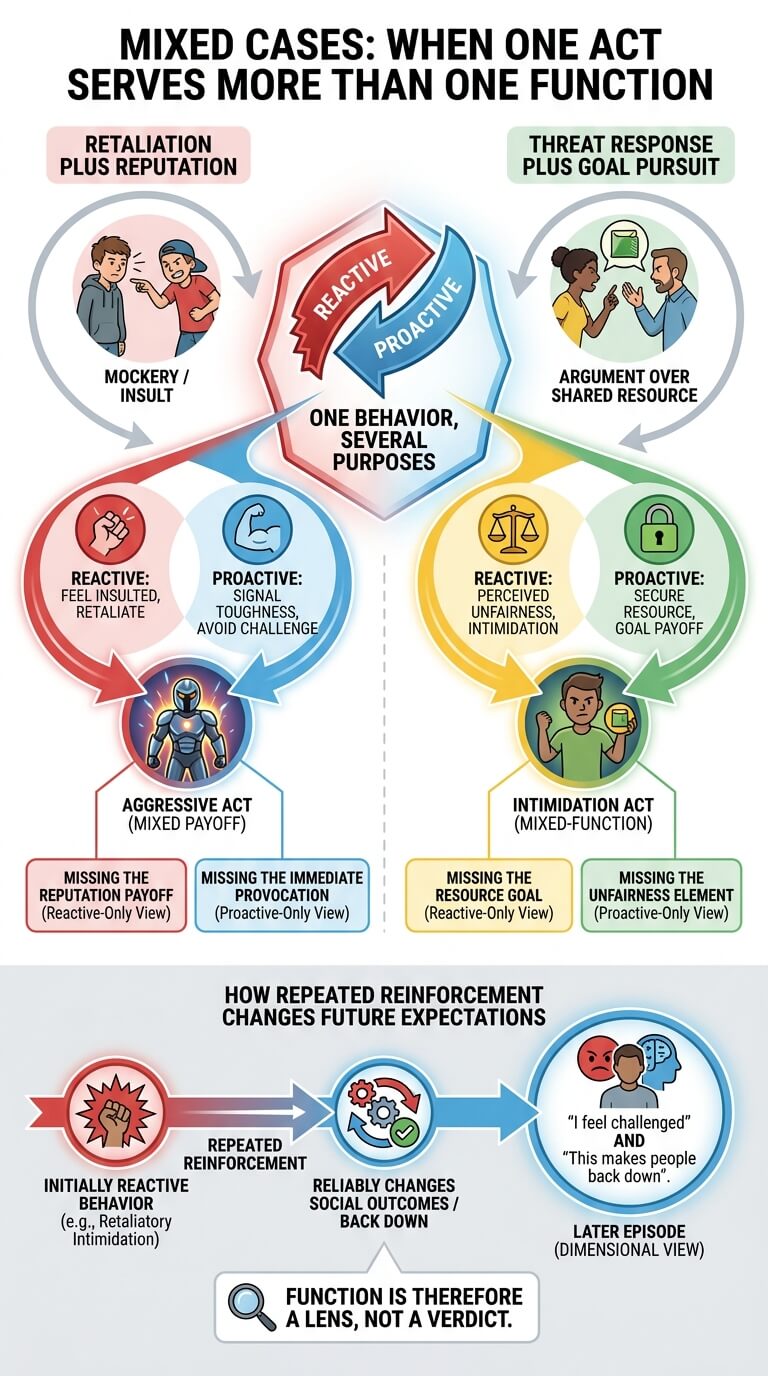
Real behavior often refuses neat categories. A single aggressive act may begin as retaliation and then continue because it produces a social payoff. Or a goal-directed act may become more intense when the other person resists and is then experienced as provocative.
Retaliation plus reputation
Imagine a teenager is mocked in front of friends and responds with a threat. Part of the response may be reactive: the person feels insulted and wants to retaliate. Another part may be proactive: the threat is also meant to signal toughness so others will be less likely to challenge them later.
Calling it purely reactive misses the reputation payoff; calling it purely proactive misses the immediate provocation.
Threat response plus goal pursuit
Suppose two adults are arguing over access to a shared resource. One believes the other is deliberately taking advantage of them and responds with intimidation. The act may contain a reactive element because of perceived unfairness and a proactive element because intimidation is also being used to secure the resource.
Function is therefore a lens, not a verdict. One behavior can serve several purposes at once.
How repeated reinforcement can change future expectations
An initially reactive behavior can acquire an instrumental function over time. If retaliatory intimidation repeatedly causes others to withdraw, the person may learn not only that aggression expresses anger but that it reliably changes social outcomes.
A later episode may involve both pathways: “I feel challenged” and “I know this makes people back down.” Their frequent co-occurrence fits this dimensional view.
What Can and Cannot Be Inferred From the Outside
Behavior is observable. Motive is inferred. That difference is especially important when people try to decide whether an aggressive act was reactive or proactive based on a brief clip, one argument, or a secondhand story.
Observable behavior versus assumed motive
You may be able to observe that someone insulted another person, threatened them, hit them, damaged property to frighten them, or deliberately excluded them to cause social harm. Those observations describe behavior.
Calling the act reactive or proactive requires context: what happened first, what outcome seemed expected, whether threat was perceived, and whether similar behavior had produced a payoff. Without that context, confidence should stay limited.
Why context, sequence, and consequences matter
Three pieces of information are especially useful:
| Question | What it helps clarify | What it does not prove |
|---|---|---|
| What happened immediately before the aggression? | Whether provocation, threat, frustration, or another cue was proximal | That the response was justified or purely reactive |
| What outcome did the person appear to seek? | Whether compliance, advantage, status, access, or retaliation mattered | The person’s complete inner motive |
| What happened after the aggression? | Whether the behavior gained reward, relief, withdrawal, attention, or other consequences | That reinforcement alone caused the behavior |
This sequence-based view is more careful than reading motive from facial expression. A calm voice does not establish proactive aggression, just as visible anger does not establish reactive aggression.
Why one incident does not justify a stable label
Calling someone “a proactive aggressor” or “a reactive aggressor” after one event makes the categories sound like permanent identities. That can hide context, learning, choice, and variation across situations.
It is more accurate to describe the behavior: “That threat followed a perceived insult,” or “The intimidation appeared aimed at obtaining compliance.” This says more about the event and less about who the person supposedly is.
Everyday Cross-Context Examples
The distinction becomes clearer when the settings change. None of these examples diagnose a person or establish motive with certainty. They show the kinds of questions that help differentiate pathways.
Peer provocation and immediate retaliation
Situation: A student hears a classmate make a cutting remark and immediately posts a humiliating reply in a group chat.
What the person may feel: anger, embarrassment, and urgency. What it may mean: the timing suggests a reactive function. What to do next: separate the harmful behavior from assumptions about motive, then examine what immediately preceded it.
Public intimidation used to gain compliance
Situation: Someone repeatedly threatens to embarrass a group member unless that person does unwanted favors.
What the target may feel: pressure, fear, and reduced freedom to refuse. What it may mean: the threat appears instrumental because harm is being used to produce compliance. What to do next: focus on the coercive behavior and safety rather than using motive to normalize intimidation.
A close relationship where retaliation and leverage mix
Situation: During an argument, one partner feels insulted and sends a private message intended to shame the other. They also threaten to share it publicly unless the other person gives in on a separate issue.
What each person may feel: the sender may feel hurt and retaliatory; the recipient may feel pressured or afraid of exposure. What it may mean: shaming may begin reactively while the threat becomes instrumental leverage. What to do next: address the harm, and prioritize safety if threats or coercion create fear.
A brief workplace example without turning this into workplace-conflict analysis
Situation: An employee feels publicly undermined and immediately sends an insulting message to the colleague they blame. In another case, a manager threatens humiliation because they expect it to force faster compliance.
What it may mean: the first example is more reactive; the second is more instrumental. What to do next: keep organizational questions separate from this narrower question of aggression function.
Reactive vs Proactive Aggression Compared With Nearby Concepts
Several nearby ideas can look similar if they are reduced to one word such as anger, control, dominance, or threat. Clear boundaries make the function distinction more useful.
Reactive aggression versus anger
Anger is an emotion. Reactive aggression is behavior. Anger may raise action readiness after provocation, but a person can feel angry and respond with words, distance, problem-solving, a complaint, a boundary, or no action at all.
Reactive aggression therefore should not be used as another name for “being very angry.” The function is a retaliatory or defensive aggressive response to perceived provocation, not the feeling itself.
Proactive aggression versus manipulation
Manipulation is about influence and may involve distorted information, pressure, concealment, or exploitation. Proactive aggression is specifically about using harmful or aversive behavior as a means toward an outcome.
The concepts can overlap. A threat may be both manipulative and proactively aggressive if it is intended to frighten someone into compliance. But influence need not involve aggression, and psychological manipulation covers a wider range of influence processes.
Proactive aggression versus dominance or status pursuit
Wanting influence, rank, recognition, or leadership is not aggression by itself. People can pursue status through competence, prestige, cooperation, competition, visibility, negotiation, or authority that does not rely on harm.
Proactive aggression enters the picture when intended harm, threat, intimidation, humiliation, or another aversive consequence is used because it is expected to improve the person’s position or produce compliance.
Reactive aggression versus hostile attribution bias
Reactive aggression describes the function of harmful behavior after perceived provocation. Hostile attribution bias describes a narrower interpretation process in which ambiguous behavior is inferred to have hostile intent.
The two may connect, but they are not interchangeable. A person may react aggressively to a clearly hostile act without any attribution bias. Conversely, someone may interpret an ambiguous cue as hostile and still choose a non-aggressive response.
What to Notice First When Trying to Understand Function
When the immediate danger has passed and it is actually useful to understand what happened, three questions can organize the analysis without pretending you can read another person’s mind.
What happened immediately before the behavior?
Look for a proximal event: insult, physical contact, exclusion, blocked goal, criticism, perceived betrayal, threat, or sudden frustration. The closer and more emotionally activating the trigger, the more plausible a reactive pathway may be.
Sequence alone is not proof. A person can plan retaliation after a real offense, or use a provocation as an opportunity for a goal-directed act.
What outcome did the behavior appear to pursue?
Ask what changed if the aggression “worked.” Did someone back down? Hand over a resource? Stop challenging the person? Give attention? Restore the person’s sense of retaliation? Allow access? Increase reputation among an audience?
The answer may distinguish immediate retaliation from an expected payoff, or show that both were operating.
What consequences may reinforce or discourage repetition?
Aggressive behavior can produce different consequences: social rejection, disciplinary action, fear in others, compliance, relief, embarrassment, retaliation, or no meaningful payoff. Those consequences can shape future expectations even when they did not cause the first episode.
This is especially relevant when expected reward is central, but reactive retaliation can also be reinforced if it repeatedly brings short-term relief.
Three Other Processes That Can Clarify the Pathway
The reactive-proactive distinction answers one question: what function might the aggressive behavior be serving? Other psychological processes answer different questions about how the situation reached that point.
When ambiguous intent is read as hostile
If a cue has several plausible explanations, interpretation matters. An accidental bump, delayed reply, correction, or exclusion may be read as deliberately hostile. When safe, checking evidence can change the trajectory.
When blocked goals raise aggressive readiness
Frustration can increase negative affect and sometimes make aggressive responding more likely, but it does not force aggression. A blocked goal can also lead to persistence, problem-solving, withdrawal, negotiation, or seeking help.
Frustration is an antecedent condition. Reactive and proactive describe the function of aggression that follows, if aggression occurs at all.
When two people begin feeding an escalation loop
A reactive response can become part of a reciprocal sequence. One person interprets a signal as threatening, responds aggressively, the other reads that response as further threat, and intensity increases.
Once threats, physical force, blocked exits, stalking, weapons, or credible fear enter the situation, safety takes priority over analysis. For relationship abuse or coercive danger, the National Domestic Violence Hotline provides safety-focused information in the United States; readers elsewhere can use qualified local services.
A Practical Comparison: Provocation Path vs Payoff Path
| Question | Provocation Path, more reactive | Payoff Path, more proactive |
|---|---|---|
| Typical immediate cue | Perceived threat, insult, frustration, injury, unfairness | Opportunity to gain compliance, advantage, status, access, or reward |
| Common timing | Often close to the provoking event | May be delayed, selected, or repeated when useful |
| Emotional profile | Often higher anger or arousal | May be calm or emotional; strong anger is not required |
| Immediate function | Retaliate, defend, answer perceived harm | Use harm or threat to obtain another outcome |
| What may maintain it | Relief, perceived self-protection, reciprocal retaliation | Reward, compliance, attention, access, social payoff |
| Main caution | Do not assume provocation excuses aggression | Do not assume calmness proves calculation or personality pathology |
This comparison is a guide to function, not a scoring test. The same act can contain elements from both columns, and the more limited your information, the more cautiously motive should be described.
What Responsible Use of This Distinction Looks Like
The distinction is useful when it improves understanding without becoming a label. It can clarify timing, threat appraisal, expected reward, and learning, but it cannot establish that someone is dangerous, unemotional, mentally ill, or destined to repeat aggression. Context can explain behavior without excusing harm.
If you are examining your own behavior, focus on the sequence rather than identity: what did you perceive, what did you expect aggression to accomplish, and what consequence followed? If you are on the receiving end, you do not need a perfect theory of motive before setting distance or seeking support when behavior is threatening or coercive.
FAQ About Reactive vs Proactive Aggression
These questions address the places where the reactive-proactive distinction is most often oversimplified.
Is reactive aggression always impulsive?
No. Reactive aggression is often rapid and associated with heightened emotion, but “reactive” refers primarily to its connection with perceived provocation or threat. A person can brood over an offense and later retaliate. The delay may make the behavior more planned, but the retaliatory function can still be important. Timing is informative, not decisive by itself.
Is proactive aggression always calm or planned?
No. Proactive aggression is goal-directed, but it does not require emotional coldness or elaborate planning. A person may feel angry, anxious, excited, or threatened while also using aggression because they expect it to achieve a result. “Cold” is best treated as a loose analogy, not a requirement.
Can the same person show both forms?
Yes. Research commonly finds that reactive and proactive functions are related and can co-occur. A person may respond reactively in one setting and instrumentally in another. This is one reason it is safer to describe the function of behavior in context rather than assign a fixed identity.
Can one aggressive act have both reactive and proactive motives?
Yes. Someone can retaliate because they feel provoked while also expecting the aggression to protect reputation, gain compliance, or prevent future challenge. Mixed-function cases are especially important because they show why simple “hot versus cold” categories can miss how several goals operate at the same time.
Are reactive and proactive aggression diagnostic categories?
No. They are research distinctions used to describe functions or pathways of aggressive behavior. They are not, by themselves, mental health diagnoses. Observing one aggressive act does not justify diagnosing a personality disorder, conduct disorder, or any other condition.
Key Takeaways
- Reactive aggression is typically linked to perceived provocation, threat, frustration, or harm, while proactive aggression uses harm more instrumentally toward an expected outcome.
- The distinction is about function, not two permanent kinds of people.
- Reactive aggression is often more emotionally aroused, but it is not simply another name for anger.
- Proactive aggression may be planned or calm, but it can also involve emotion and does not automatically imply a personality disorder or manipulative personality.
- One aggressive act can serve both reactive and proactive functions, especially when retaliation also produces status, compliance, or another payoff.
- When threats, coercion, physical violence, blocked exits, stalking, or credible fear are present, safety matters more than accurately classifying the aggressor’s motive.
Final Thoughts
The most useful first question is not “What type of person does this?” but “What was this aggressive behavior doing in the situation?” If it followed perceived provocation, the reactive pathway may help explain the sequence. If harm was used to obtain another result, the proactive pathway may be more relevant. If both are present, keep both.
That shift from identity to function makes the framework more precise and less stigmatizing. It also leaves room for the most important practical distinction: understanding why aggression happened can guide reflection and prevention, but it does not make the harm acceptable or remove the need for safety and accountability.

Michael Reed is the Founder and Lead Writer at Psychology Exposed. He writes about human behavior, relationships, emotional patterns, self-awareness, and practical psychology topics using research-informed, easy-to-understand content.
Read More About Michael Reed: https://psychologyexposed.com/michael-reed/