
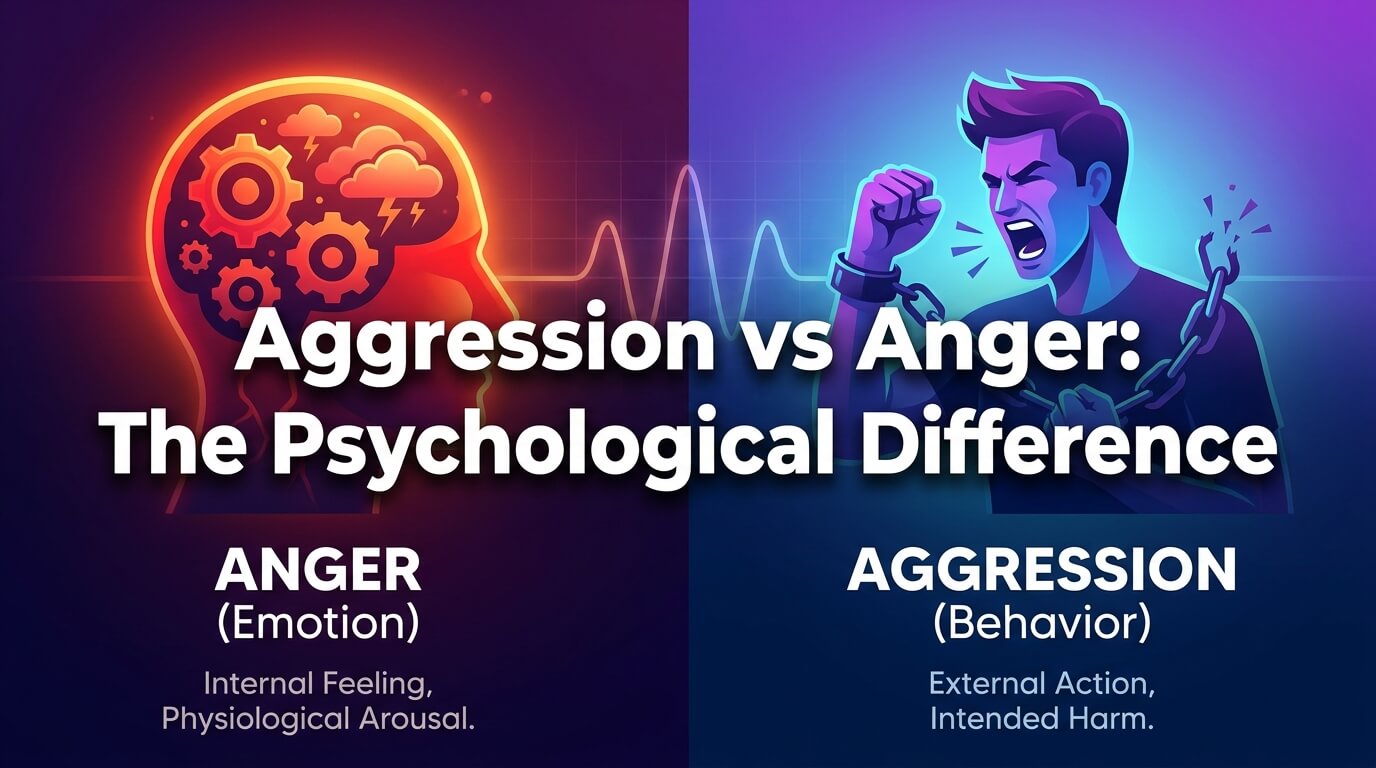
You can be furious and still choose not to harm anyone. You can also behave aggressively while sounding controlled, speaking quietly, or showing very little obvious anger. That is why treating anger and aggression as interchangeable creates confusion.
Psychologically, the distinction is useful because it separates an internal emotional state from an observable form of behavior. Anger can influence what a person feels like doing, but it does not automatically determine what they actually do. Aggression, by contrast, is defined around behavior intended to harm, threaten, intimidate, degrade, or impose an unwanted cost on another person.
This difference matters for self-understanding as well as for judging difficult interactions. If you label anger itself as dangerous, you may miss the fact that anger can accompany firm boundaries, withdrawal, problem-solving, or other non-aggressive choices. If you assume a calm person cannot be aggressive, you may overlook deliberate threats, humiliation, exclusion, or other harmful acts delivered without visible rage.
Quick Answer
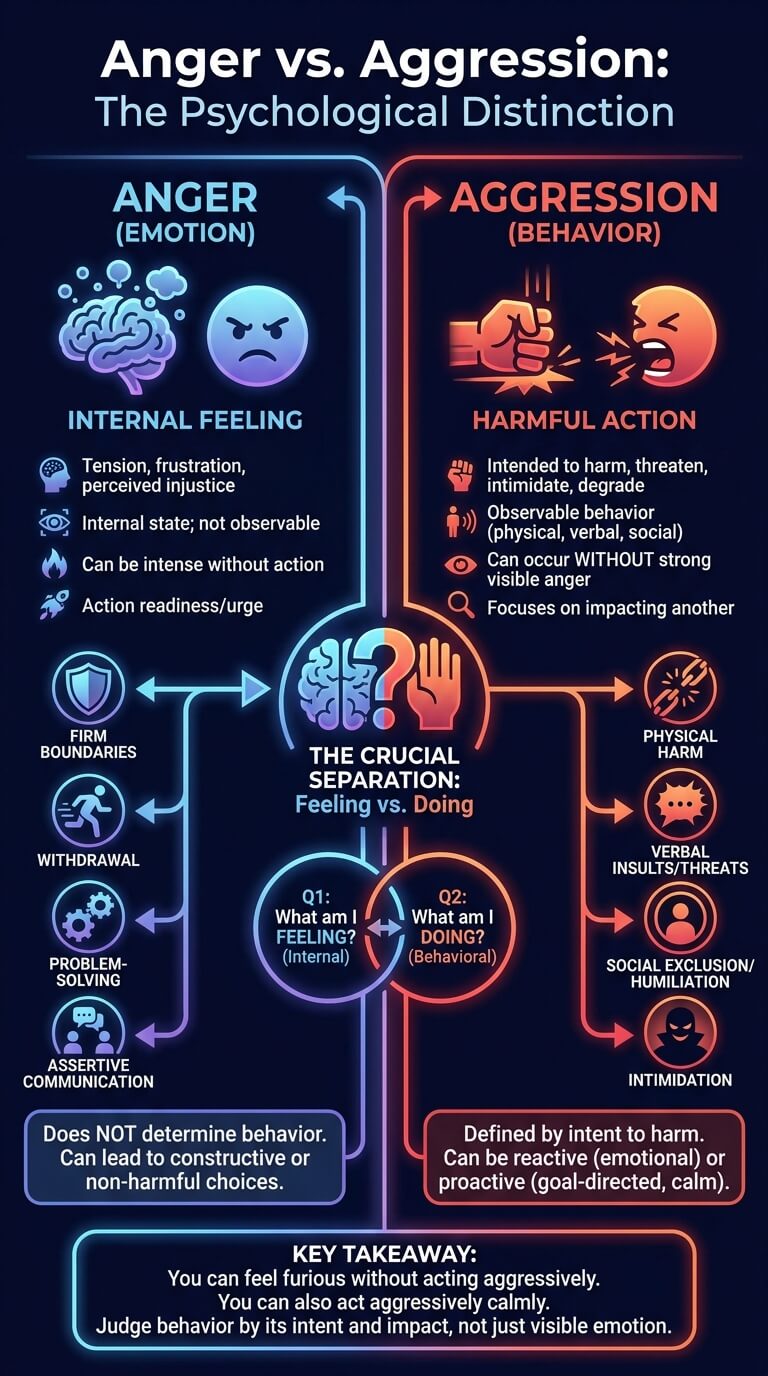
Anger is an emotion; aggression is behavior intended to cause harm. Anger may increase an urge to confront, retaliate, or act forcefully, but most angry moments do not have to become aggressive. Aggression can also occur with little visible anger when harm is used deliberately to intimidate, punish, exclude, or achieve another goal.
Two Different Questions: What Am I Feeling and What Am I Doing?

A practical way to separate anger from aggression is to ask two questions instead of one. The first is internal: “What am I feeling?” The second is behavioral: “What am I doing with that feeling?” These questions overlap, but they are not the same.
Anger as an emotional state
The American Psychological Association describes anger as an emotion involving tension and hostility that may arise from frustration, perceived injury, or injustice. People can experience anger mildly or intensely. It may come with thoughts about unfairness, bodily activation, an urge to respond, or a desire to make something change.
None of those features, by themselves, tell you that aggression has occurred. Someone can feel angry after being insulted and decide to leave. Another person can use that anger to state a boundary. Someone else may channel it into a complaint, a difficult conversation, or determined problem-solving.
Aggression as behavior intended to harm
The APA Dictionary of Psychology defines aggression in behavioral terms, as behavior aimed at harming others physically or psychologically. Intent is important because an accidental bump, an awkward comment, or an unintended mistake can cause harm without necessarily being aggression in the psychological sense.
Aggressive behavior can be physical, verbal, or social. Hitting someone is an obvious example, but so can be deliberately humiliating a person in front of others, threatening consequences to frighten them, or intentionally damaging their relationships to cause social pain. The exact form differs, but the behavioral focus remains central.
Why intention and behavior matter more than visible intensity
People often judge aggression by how dramatic an interaction looks. Shouting, clenched fists, and a red face may seem more aggressive than a quiet voice. Yet visible intensity is not the definition.
A person may raise their voice because they are upset, frightened, or trying to be heard, without intending harm. Another person may calmly say, “If you tell anyone about this, I will make sure you regret it.” The second interaction may involve far less visible emotion while carrying a clearer intention to threaten or intimidate.
| Question | Anger | Aggression |
|---|---|---|
| What is it? | An emotional state | Behavior intended to harm or impose an aversive consequence |
| Can it stay internal? | Yes | No, aggression is expressed through behavior |
| Does it require visible intensity? | No | No |
| Can it occur without the other? | Yes, anger can occur without aggression | Yes, aggression can occur without strong anger |
| What should you observe? | Feeling, thoughts, bodily state, urges | Action, target, context, and apparent intent |
Emotion, Urge, and Action Are Not the Same Level

One of the most useful distinctions is to separate a feeling from an impulse, then separate both from what a person actually does. Collapsing all three into one category can make normal emotions seem more dangerous than they are.
Feeling angry
Anger tells you something has registered as wrong, blocked, unfair, threatening, disrespectful, or unacceptable. The interpretation may be accurate, partly accurate, or mistaken, but the feeling itself is still a real internal event.
You do not have to justify every angry interpretation in order to acknowledge the feeling. You can recognize, “I am angry because I think I was dismissed,” while still checking what happened before deciding how to respond.
Having an aggressive urge
An urge is a readiness or impulse toward action. In an angry moment, a person might imagine yelling, insulting someone, slamming a door, or “getting even.” An unwanted thought or impulse is not identical to carrying it out.
This distinction matters because people sometimes become frightened by their own mental reactions. A thought such as “I want to scream at him” tells you that arousal and action readiness are high. It does not, by itself, mean you have acted aggressively or that you inevitably will.
Acting aggressively
Aggression enters the picture when behavior is used with an intention to harm, intimidate, degrade, threaten, or impose a harmful consequence. The behavior can be immediate and emotional, or it can be delayed and deliberate.
This gives us a simple three-part pathway:
| Level | Example | What it tells you |
|---|---|---|
| Feeling | “I am furious that she embarrassed me.” | An emotional response is present. |
| Urge | “I want to embarrass her back.” | A harmful action tendency has appeared. |
| Behavior | Posting a humiliating story about her to punish her | The urge has been turned into harmful action. |
Why suppression is not the same as non-aggression
Not acting aggressively does not require pretending anger is absent. Someone can acknowledge anger and still choose a non-harmful response. That is different from forcing the emotion underground, denying it, or acting as though nothing matters.
It is also possible to suppress visible anger while behaving aggressively. A person may keep a flat tone while deliberately humiliating a coworker, excluding a peer to punish them, or making a calculated threat. Emotional restraint and behavioral restraint are not interchangeable.
Anger Without Aggression

Anger has many possible behavioral outcomes. Aggression is only one of them. Seeing that range helps prevent a common mistake: treating anger as if it were a warning label that automatically means danger.
Boundary-setting, withdrawal, problem-solving, and constructive action
Imagine that someone repeatedly interrupts you in a meeting. You feel irritated, then angry. One response is to insult them. Another is to say, “I want to finish my point before we move on.” A third is to speak with them later. You might also decide that the meeting is going nowhere and step away.
The anger is present in every version. The behavior changes. Anger can motivate action without requiring aggression, including direct requests, boundaries, advocacy, problem-solving, or temporary withdrawal.
Same emotion, different behavioral outcomes
Consider the same event: a friend shares something private that you asked them to keep confidential.
| Response | Possible behavior | Aggression? |
|---|---|---|
| Direct boundary | “I am angry that you shared that. I need you not to discuss my private information again.” | Not necessarily. It is direct without being intended to harm. |
| Withdrawal | You leave the conversation because you are too upset to continue productively. | Not by itself. |
| Problem-solving | You ask what was shared, with whom, and what can be corrected. | No. |
| Retaliation | You reveal the friend’s private information specifically to hurt them back. | Potentially yes, because harm is the intended response. |
| Humiliation | You mock them publicly to make them feel small. | Potentially yes, because degradation is being used as the response. |
The emotion does not tell you which row will follow. Interpretation, habits, goals, expectations, available alternatives, and situational constraints all influence what happens next.
Why anger should not be treated as inherently dangerous
APA material on anger explicitly separates the emotion from aggression and notes that anger is neither necessary nor sufficient for aggression. That distinction protects against two kinds of error: fearing normal anger as though it were violence, and excusing harmful behavior by saying someone was “just angry.”
Anger deserves attention when it is intense, frequent, or affecting daily life, but the emotion itself is not a diagnosis or a moral failing. If your concern is specifically about managing acute anger before you say or do something you regret, Psychology Exposed has a separate guide on how to control anger in the moment. The purpose here is different: understanding what makes anger distinct from aggressive action.
Aggression Without Strong Anger
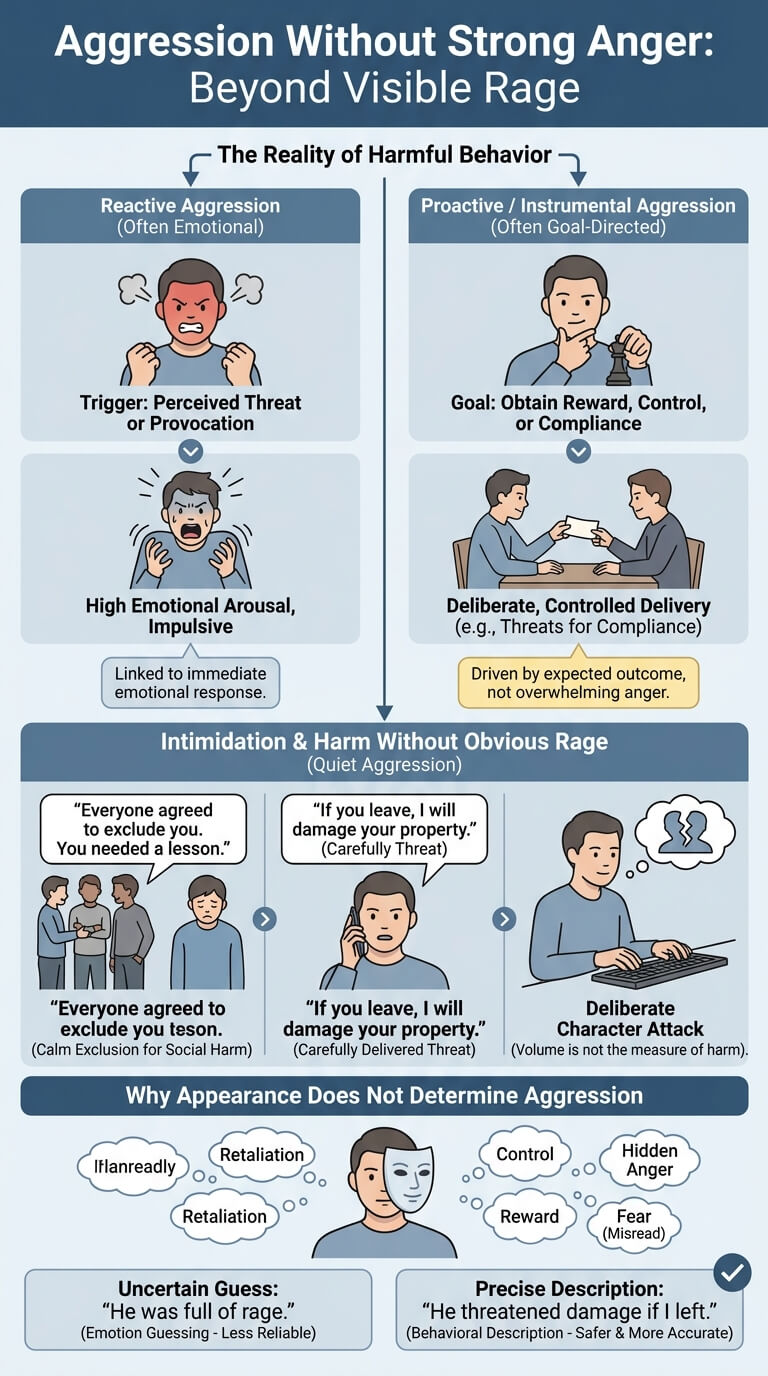
The reverse distinction is equally important. Harmful behavior is not always accompanied by shouting, fury, or obvious loss of control. Some aggressive acts are more deliberate and goal-directed.
Instrumental or goal-directed harm
Researchers often distinguish reactive aggression from proactive or instrumental aggression. A recent systematic review and meta-analysis on emotion regulation and aggression summarizes reactive aggression as commonly linked with perceived threat or provocation and heightened emotional arousal, while proactive aggression is more goal-directed.
For example, someone might threaten a peer not because they are overwhelmed by anger, but because they expect the threat to produce compliance. The harmful act may be controlled in delivery and still be aggressive because intimidation is being used intentionally.
Intimidation, exclusion, or humiliation without obvious rage
Imagine a group member calmly telling another person, “Everyone agreed not to invite you anymore, and I made sure of it because you needed to learn a lesson.” There may be little visible anger. Yet if exclusion was deliberately organized to cause social harm, the absence of shouting does not make the behavior harmless.
The same applies to a carefully delivered threat or a deliberate character attack. Aggression is not measured by volume. Quiet behavior can still carry an intention to harm, while loud behavior is not automatically aggressive.
Why calm appearance does not determine whether behavior is aggressive
From the outside, we rarely know another person’s emotional state with certainty. A calm face could hide anger. A tense face could reflect fear. A person may also act aggressively for reasons involving retaliation, control, reward, or another goal without experiencing intense anger at that moment.
That is why behavioral description is often safer than personality or emotion guessing. “He threatened to damage my property if I left” is more precise than “He was full of rage” when you cannot actually know the person’s inner state.
Where Reactive Aggression Fits
The anger-aggression connection is real even though the concepts are not identical. Reactive aggression is one place where that connection is especially visible.
Why anger and arousal often accompany reactive aggression
Reactive aggression tends to occur after perceived provocation, frustration, insult, or threat. Research reviews commonly describe it as more emotionally charged than proactive aggression, often involving anger and physiological arousal.
If someone is shoved, interprets the act as deliberate, becomes intensely angry, and immediately shoves back to hurt the other person, anger and aggression are closely linked in the sequence. The anger may help energize the retaliatory response, but it is still the shove intended to harm that makes the behavior aggressive.
Why reactive aggression is not simply another name for anger
Reactive aggression is a form or function of aggressive behavior, not a synonym for the emotion that may precede it. The distinction becomes clear when two people experience the same provocation but respond differently.
One feels intense anger and walks away. Another feels intense anger and strikes back. A third feels only moderate anger but deliberately retaliates later. Anger is part of the internal picture, while aggression describes what is done.
Arousal Is a Bridge, Not the Definition
People often use bodily intensity as a shortcut for deciding whether aggression is present. Heart pounding, muscle tension, heat, shaking, or a surge of energy can matter, but arousal is not the defining criterion.
Bodily activation can influence action readiness
Anger can involve physiological activation that makes action feel urgent. Under high arousal, a person may feel more ready to confront, escape, argue, or retaliate. That can narrow attention and make immediate reactions feel more compelling.
Still, arousal does not specify the action. The body can be highly activated while the person chooses distance, requests help, states a boundary, or waits before responding.
Low visible arousal does not rule out aggression
Proactive or instrumental aggression provides the clearest counterexample. A review of proactive aggression describes it as comparatively goal-oriented and instrumental, in contrast with reactive aggression that is more often associated with threat and high arousal.
This does not mean proactive aggression is emotionless or that every calm harmful act is proactive. It simply shows why emotional intensity cannot be used as the test for whether behavior is aggressive.
Aggression vs Anger in Everyday Examples
Abstract definitions become easier to use when the same concepts are placed into ordinary situations. The key is to look separately at emotion, intention, and behavior.
The same insult followed by withdrawal, assertive response, or aggression
Situation: Someone insults you at a family gathering. You feel a strong wave of anger and embarrassment.
Withdrawal: You say, “I am too angry to keep talking right now,” and leave the room. You are angry, but the behavior is not intended to harm.
Direct response: You say, “Do not speak to me like that.” The statement is firm and may sound forceful, but directness alone does not make it aggressive.
Aggressive response: You deliberately reveal something humiliating about the person in front of everyone because you want them to feel the same pain. Here the retaliatory harm is central.
A deliberate threat delivered without shouting
Situation: During a disagreement, someone quietly says, “If you leave this group, I will send those screenshots to everyone.”
What the target may feel: Fear, pressure, confusion, or a sense that their freedom to choose has been narrowed.
What it may mean: The calm tone does not cancel the threat. The relevant question is what the person is trying to make happen through the threatened harm.
What to do next: If the threat is credible or part of intimidation, focus on safety and practical support rather than trying to decide whether the speaker “looked angry enough.”
Observing behavior without pretending to know another person’s inner emotion
Situation: A coworker receives criticism, speaks sharply, and slams a notebook on the desk.
What you may feel: Tension or concern that the interaction could worsen.
What it may mean: You can reasonably describe the sharp speech and forceful gesture. You cannot know with certainty whether the person feels anger, shame, fear, or some mixture without more information.
What to do next: Keep observations concrete. Behavioral descriptions are more reliable than assigning a hidden emotion or a fixed personality label.
Nearby Concepts That Create Confusion
Anger and aggression sit near several other psychological ideas. Keeping the boundaries clear prevents everyday disagreements from being mislabeled and keeps harmful behavior from being minimized.
Anger versus hostility
Anger is an emotional state. Hostility is better understood as a broader antagonistic orientation that can include resentment, cynicism, or expectations that others have bad intentions. A person may feel angry in a specific moment without holding a generally hostile outlook.
Hostility can also exist without aggressive action. Thoughts and attitudes may shape interpretation, but they do not automatically determine behavior.
Anger versus conflict
Conflict is disagreement or incompatibility involving needs, goals, expectations, beliefs, or resources. Conflict can provoke anger, but it can also remain calm. Neither anger nor conflict automatically equals aggression.
Two people can strongly disagree about money, parenting, work, politics, or boundaries and still avoid threats, humiliation, intimidation, and intentional harm.
Aggression versus assertiveness
Assertiveness is direct expression that protects your position while preserving the other person’s basic ability to respond. “I disagree, and I will not accept being spoken to that way” can be firm without being designed to injure or degrade.
Aggression crosses a different line when harm, intimidation, humiliation, or threat becomes part of what the behavior is trying to accomplish. Firmness is not the same thing as aggression.
Aggression versus violence at a high level only
Aggression is a broad category of harm-oriented behavior. Violence generally refers to more severe physical force or injury, although definitions vary across psychological, public-health, and legal settings.
That means verbal or relational aggression can be aggressive without being violence. It also means anger should not be treated as a predictor that someone will become violent. The concepts differ in both level and scope.
What to Do Next With the Distinction
The practical value of this comparison is not merely knowing definitions. It gives you a cleaner way to examine difficult moments without overreacting to emotion or underreacting to harmful behavior.
Name the feeling separately from the behavior
Try using two sentences: “I am angry” and “What I did was ___.” This prevents emotional language from doing all the explanatory work.
For example: “I was angry when he mocked me. I then insulted him back to hurt him.” The first sentence names the feeling. The second takes responsibility for the behavior. One does not erase the other.
Describe the observable action before inferring motive or personality
If you are trying to understand someone else, begin with what happened: “She threatened to share private information,” “He called me degrading names,” or “They excluded her from the group after saying they wanted to punish her.”
That is more useful than jumping directly to “She has anger issues,” “He is an aggressive person,” or another fixed label. Patterns matter, but one episode does not reveal an entire personality.
Use anger-regulation help when the actual problem is managing arousal
Sometimes the main concern really is, “I become so angry that I worry I will say or do something harmful.” That is a regulation problem, not merely a definition problem. In that case, practical anger-management skills may be the more useful next step.
If the central concern is instead that someone is making threats, intimidating you, retaliating, or deliberately humiliating you, focusing only on whether they are angry may distract from the behavior itself.
When the Next Question Is Why Aggression Happened
Once anger and aggression have been separated, a different set of questions becomes possible. Instead of asking whether anger and aggression are the same, you can ask what function the aggressive behavior served or how the situation was interpreted.
When provocation and reaction matter
If harmful behavior followed a perceived insult, threat, or frustration, the next useful distinction may be between reactive and proactive aggression. Reactive aggression is often tied to immediate provocation and emotional arousal, while proactive aggression is more closely tied to obtaining a goal or reward.
That distinction does not change the definition of aggression. It helps explain different pathways to the same broad category of harmful behavior.
When interpreting intent matters
Another question is how a person understood an ambiguous event. Being bumped, ignored, corrected, excluded, or interrupted can be interpreted in several ways. If someone rapidly concludes “They did that on purpose to disrespect me,” the interpretation itself may influence anger and retaliation.
The useful lesson is not to assume hostility is always imagined. Sometimes another person really is behaving aggressively. The task is to separate evidence from inference when intent is unclear.
When Safety Matters More Than Sorting Out the Emotion
In ordinary disagreements, distinguishing anger from aggression can help people respond more accurately. But when there are credible threats, physical assault, stalking, blocked exits, strangulation, weapon threats, serious intimidation, or fear of retaliation, the priority changes.
You do not need to determine whether the other person is “really angry” before taking danger seriously. If you are in an unsafe situation, create distance when possible and use appropriate local emergency or professional support. The National Domestic Violence Hotline also provides safety information for people affected by intimate-partner abuse in the United States.
Safety guidance should be proportionate. A raised voice or disagreement does not automatically mean abuse or imminent danger. At the same time, a calm voice does not make a credible threat harmless.
FAQ About Aggression vs Anger
These questions focus on the places where everyday language most often blurs emotion, impulse, and behavior. Keeping those levels separate makes the answers more precise.
Can someone be very angry and still not be aggressive?
Yes. A person can feel intense anger and still choose not to harm, threaten, humiliate, or intimidate anyone. They may leave the situation, set a boundary, seek clarification, complain, problem-solve, or simply experience the feeling internally. Anger may increase action readiness, but it does not dictate one required behavior.
Can someone act aggressively while sounding calm?
Yes. Calm delivery does not rule out aggression. A calculated threat, deliberate humiliation, or intentional social harm can be carried out without shouting or obvious rage. The more useful questions concern the behavior, the context, and whether harm or intimidation is being used intentionally.
Is an aggressive thought the same as aggressive behavior?
No. Thoughts and urges are internal events. They may be uncomfortable or important to notice, but they are not the same as acting. The distinction becomes especially useful when someone feels an urge to retaliate but chooses not to carry it out.
Does raising your voice automatically count as aggression?
No. Volume alone is not enough to classify an interaction as aggressive. Context, intention, words, and surrounding behavior matter. Yelling insults to degrade someone is different from raising your voice because of distance, panic, or an emotionally intense but non-harmful disagreement.
Does feeling angry mean someone is more likely to become violent?
Anger and aggression are related, especially in some reactive situations, but anger by itself is not a reliable prediction that a particular person will become violent. APA explicitly notes that anger is neither necessary nor sufficient for aggression. Individual behavior depends on many factors, and violence should not be inferred from the presence of an emotion alone.
Key Takeaways
- Anger is an emotional state; aggression is behavior intended to harm, threaten, intimidate, degrade, or impose an unwanted cost.
- Feeling angry, having an aggressive urge, and acting aggressively are three different levels of experience.
- Intense anger can lead to withdrawal, boundaries, problem-solving, or other non-aggressive responses.
- Aggression can occur without obvious rage, especially when harmful behavior is used deliberately toward another goal.
- Visible intensity is a poor shortcut for classification. Quiet threats can be aggressive, while loud emotion is not automatically aggression.
- When credible danger is present, focus on safety rather than trying to decide exactly what emotion is driving the behavior.
Keep Feeling and Behavior Separate
The cleanest way to think about aggression vs anger is to separate inner experience from outward action. Ask first, “What am I feeling?” Then ask, “What behavior followed?” That small distinction makes room for anger without treating it as dangerous, while still holding harmful behavior accountable even when it is delivered calmly.
If you are examining your own reactions, the next useful step is to identify the point where feeling becomes urge and urge becomes action. If you are evaluating someone else’s behavior, stay close to what you can actually observe. Emotion may help explain a moment, but behavior tells you what happened.

Michael Reed is the Founder and Lead Writer at Psychology Exposed. He writes about human behavior, relationships, emotional patterns, self-awareness, and practical psychology topics using research-informed, easy-to-understand content.
Read More About Michael Reed: https://psychologyexposed.com/michael-reed/