

The idea sounds intuitive: telling the truth should be simple, while lying should require extra mental work. A person may have to invent an alternative account, suppress what actually happened, remember what they already said, watch the listener’s reaction, and keep the story consistent. That sounds cognitively demanding.
But the simple version of this idea is too broad. Some lies are prepared, familiar, brief, and easy to repeat. Some truthful accounts are complicated, emotionally stressful, memory-heavy, or difficult to explain. Under those conditions, truth telling can also place substantial demands on attention and working memory.
Cognitive-load research is therefore most useful when it asks a narrower question: under what conditions does deceptive communication require additional mental resources, and what processes create that demand? It is less useful when converted into a rule such as “mental effort proves lying” or a tactic for trying to expose another person.
Quick Answer
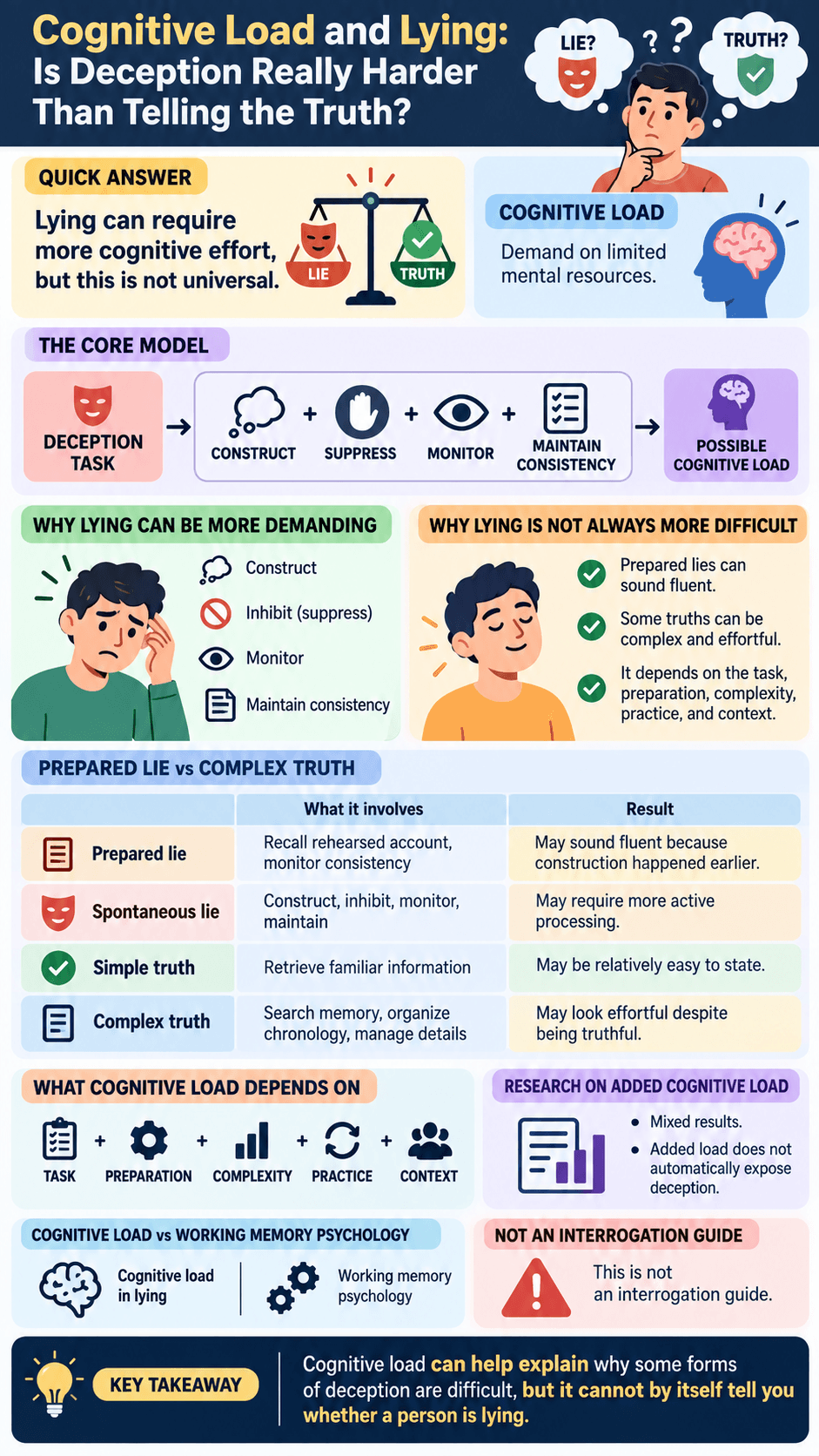
Lying can require more cognitive effort than telling the truth when a person must construct information, suppress a truthful response, monitor consistency, manage impressions, and track what the listener knows. But this is not universal. Preparation, familiarity, complexity, practice, task design, memory demands, and context can change the balance. Cognitive load is a research mechanism, not a standalone lie detector. This is one mechanism within the broader truth and deception judgment process, not a separate shortcut for deciding whether a person is lying.
What Cognitive Load Means in Deceptive Communication
Cognitive load is demand on limited mental resources
Cognitive load refers broadly to the demands a task places on limited resources such as attention and working memory. When several goals must be handled at the same time, performance can become slower, less fluent, more error-prone, or simply feel more effortful.
Deception may add demands because the communicator sometimes has to manage information that is not already available as a straightforward truthful response. However, “more demanding” does not mean “always visibly harder,” and it does not mean an observer can reliably infer deception from apparent effort. Apparent effort can also make an observer feel certain without providing strong evidence, so confidence should remain calibrated to what can actually be verified.
Working memory is related, but not identical
Working memory is the limited mental workspace used to hold and manipulate information over short periods. Cognitive load describes how much demand a task places on that and other cognitive resources.
Siegfried Sporer’s working-memory account of deception argues that researchers should study the processes involved in generating both lies and truths rather than assume that cognitive load by itself explains every difference. His working-memory model of deception emphasizes interactions among attention, working memory, long-term memory, speech production, scripts, and retrieval processes.
Load is a possible mechanism, not visible proof
A person who struggles mentally may be lying, but they may also be trying to remember a complicated event, understand an unexpected question, manage stress, speak in a second language, or explain something that is genuinely difficult.
Likewise, a deceptive person may show little obvious strain if the lie is well rehearsed or easy to construct. Cognitive load is therefore best treated as a property of the task and the person’s processing demands, not as a verdict about truthfulness.
The Core Model: Construct, Suppress, Monitor, Maintain
A useful reader-friendly model is:
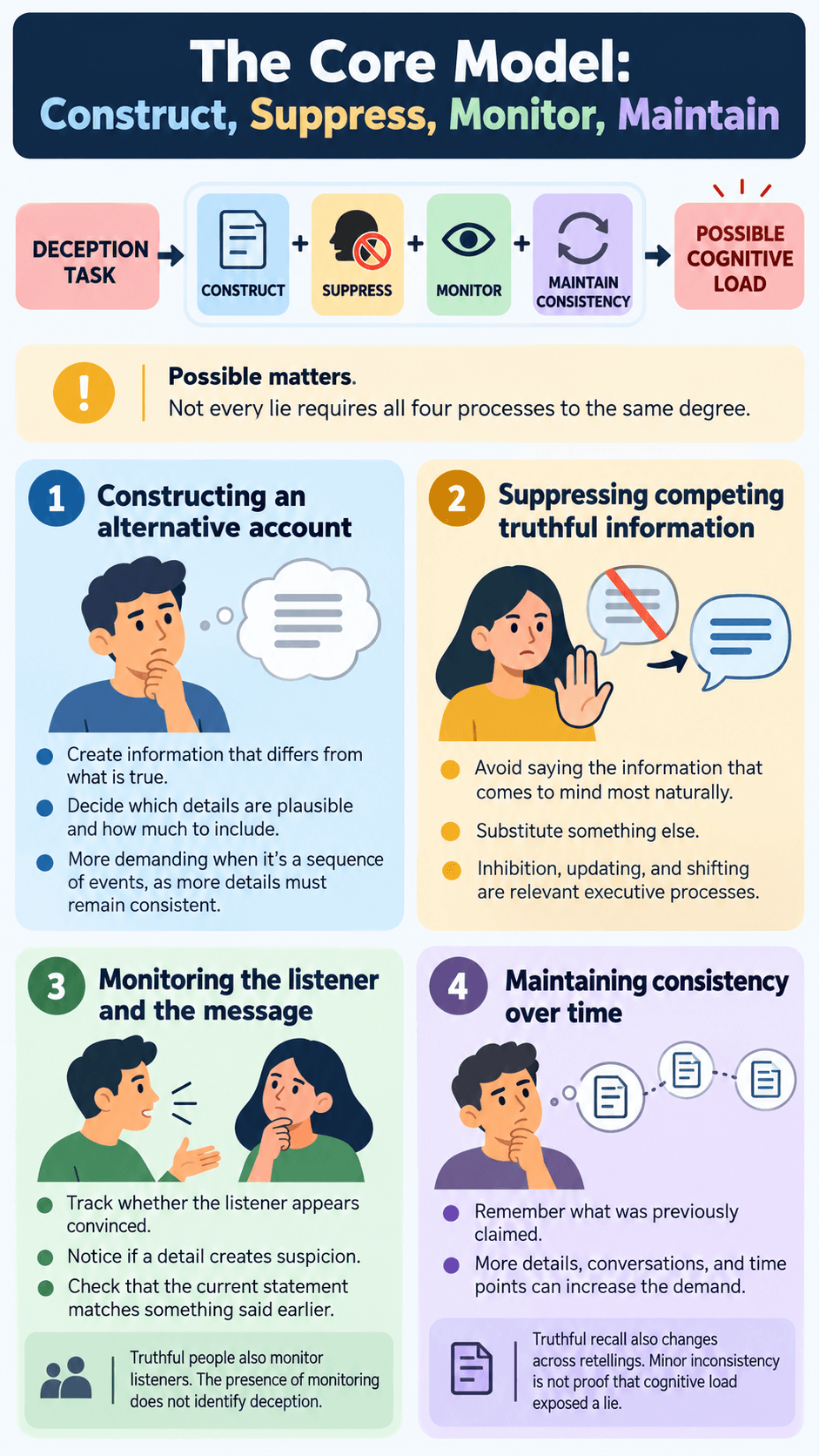
DECEPTION TASK → CONSTRUCT + SUPPRESS + MONITOR + MAINTAIN CONSISTENCY → POSSIBLE COGNITIVE LOAD
The word “possible” matters. Not every lie requires all four processes to the same degree, and truthful communication can involve demanding versions of some of them too.
Constructing an alternative account
Some deception requires creating information that differs from what the person remembers or believes to be true. The communicator may need to decide which details are plausible, which facts the listener already knows, and how much information to include.
This can become especially demanding when the account involves a sequence of events rather than a short yes-or-no response. A complex narrative creates more details that must remain mutually consistent.
Suppressing competing truthful information
If a truthful response is highly accessible, a deceptive response may require inhibition. The person must avoid saying the information that comes to mind most naturally and substitute something else.
Research on cognition and dishonest behavior frequently discusses inhibition, updating, and shifting as executive processes relevant to deception. A recent review of the role of cognition in dishonest behavior describes working memory and executive-control processes as important parts of understanding when dishonest responses become cognitively demanding.
Monitoring the listener and the message
Deception can involve tracking whether the listener appears convinced, whether a detail has created suspicion, and whether the current statement matches something said earlier. That monitoring competes with the resources needed to produce fluent speech.
However, truthful people also monitor listeners. They may watch for misunderstanding, judge whether more explanation is needed, or worry that an accurate account sounds implausible. The presence of monitoring does not identify deception by itself.
Maintaining consistency over time
A deceptive account may require remembering what was previously claimed so that later statements do not conflict with it. The more details, conversations, and time points involved, the greater that maintenance demand may become.
Yet truthful recall also changes across retellings. People do not retrieve every detail identically each time. Minor inconsistency is therefore not proof that cognitive load exposed a lie.
Why Lying Can Sometimes Be More Demanding
Spontaneous deception can require several operations at once
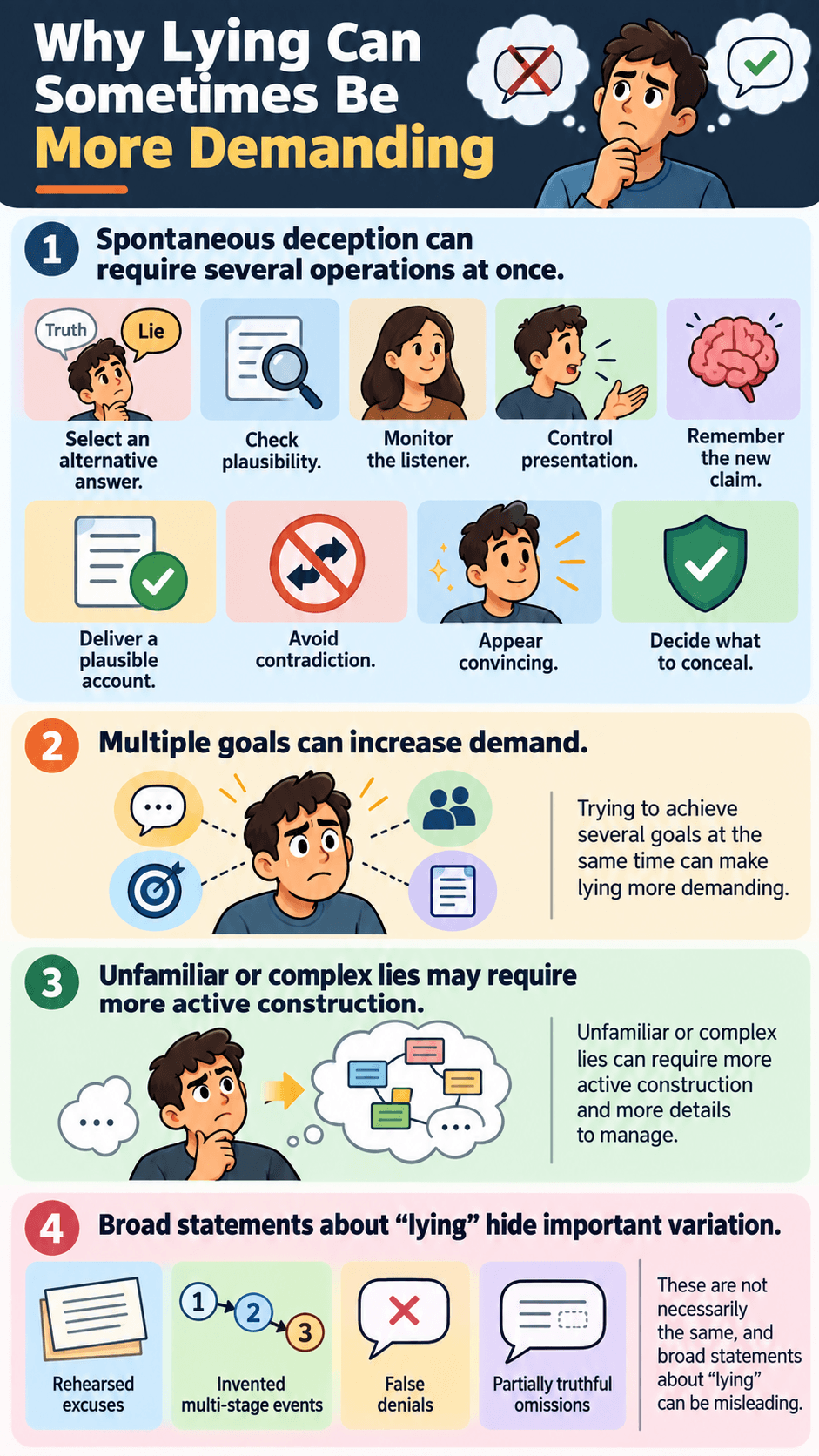
A spontaneous lie may require selecting an alternative answer while the truthful answer is already available, checking plausibility, monitoring the listener, controlling presentation, and remembering the new claim. When these processes happen quickly, they can compete for limited resources.
A review of cognitive-load approaches to deception noted that the field often assumes additional demand in lying but also highlighted the need to identify the specific mechanisms responsible. The review of cognitive mechanisms in deception is useful precisely because it treats “cognitive load” as something that needs explanation rather than as a complete explanation by itself.
Multiple goals can increase demand
A deceptive communicator may be trying to do several things at once: deliver a plausible account, avoid contradicting known facts, remember earlier statements, appear convincing, and decide what information to conceal.
The demands rise when those goals compete. For example, adding detail may make a story sound more natural, but it also creates more information that must remain consistent later.
Unfamiliar or complex lies may require more active construction
A lie about a complicated event may require more effort than a familiar one-line denial. Novel deception often provides fewer ready-made scripts or memories to draw from, so more information has to be generated and managed in real time.
This is one reason broad statements about “lying” hide important variation. The cognitive demands of a rehearsed excuse, an invented multi-stage event, a false denial, and a partially truthful omission are not necessarily the same.
Why Lying Is Not Always More Difficult
Prepared and rehearsed lies can become easier to produce
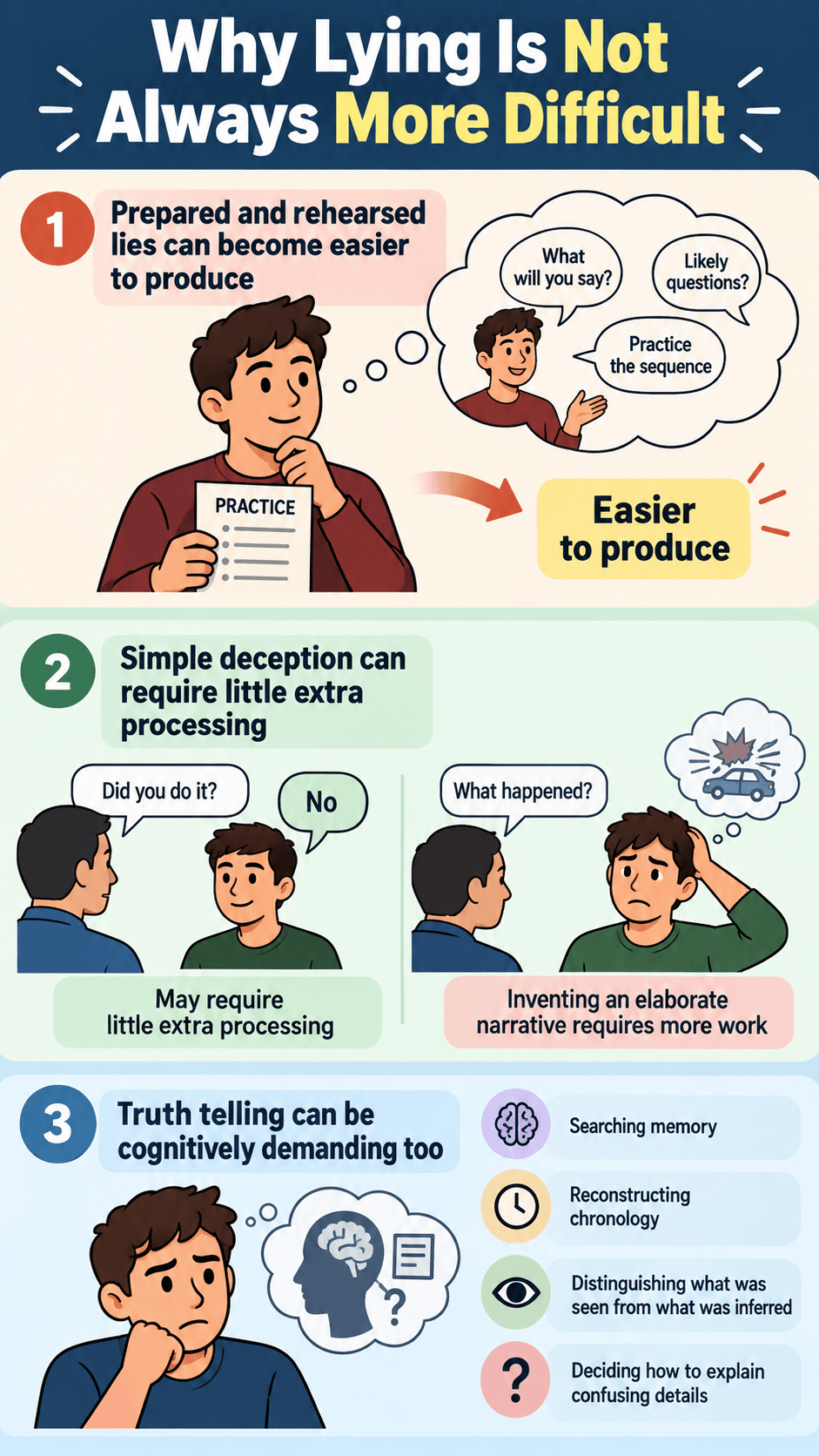
Preparation changes the task. A person who has already decided what to say, practiced the sequence, and anticipated likely questions does not have to construct everything in the moment.
Practice can also make retrieval more fluent. What once required active construction may later feel more like recalling a prepared script. That does not make the statement truthful, but it can reduce the difference in mental effort between deceptive and truthful responding.
Simple deception can require little extra processing
Some lies are cognitively small. Saying “no” instead of “yes” to a simple question may require less work than inventing an elaborate narrative. If the relevant alternative response is obvious, the construction demand may be minimal.
This is why “lie equals high load” should not be treated as a fixed psychological law. The structure of the deceptive act matters.
Truth telling can be cognitively demanding too
Truthful recall can require searching memory, reconstructing chronology, distinguishing what was seen from what was inferred, and deciding how to explain confusing details. Stress, fatigue, divided attention, time pressure, and complex events can increase those demands.
A person may also have truthful information that is difficult to verbalize. They may know what happened but struggle to organize the sequence. Visible effort in that situation reflects cognitive demand, not deception.
Prepared Lie vs Complex Truth
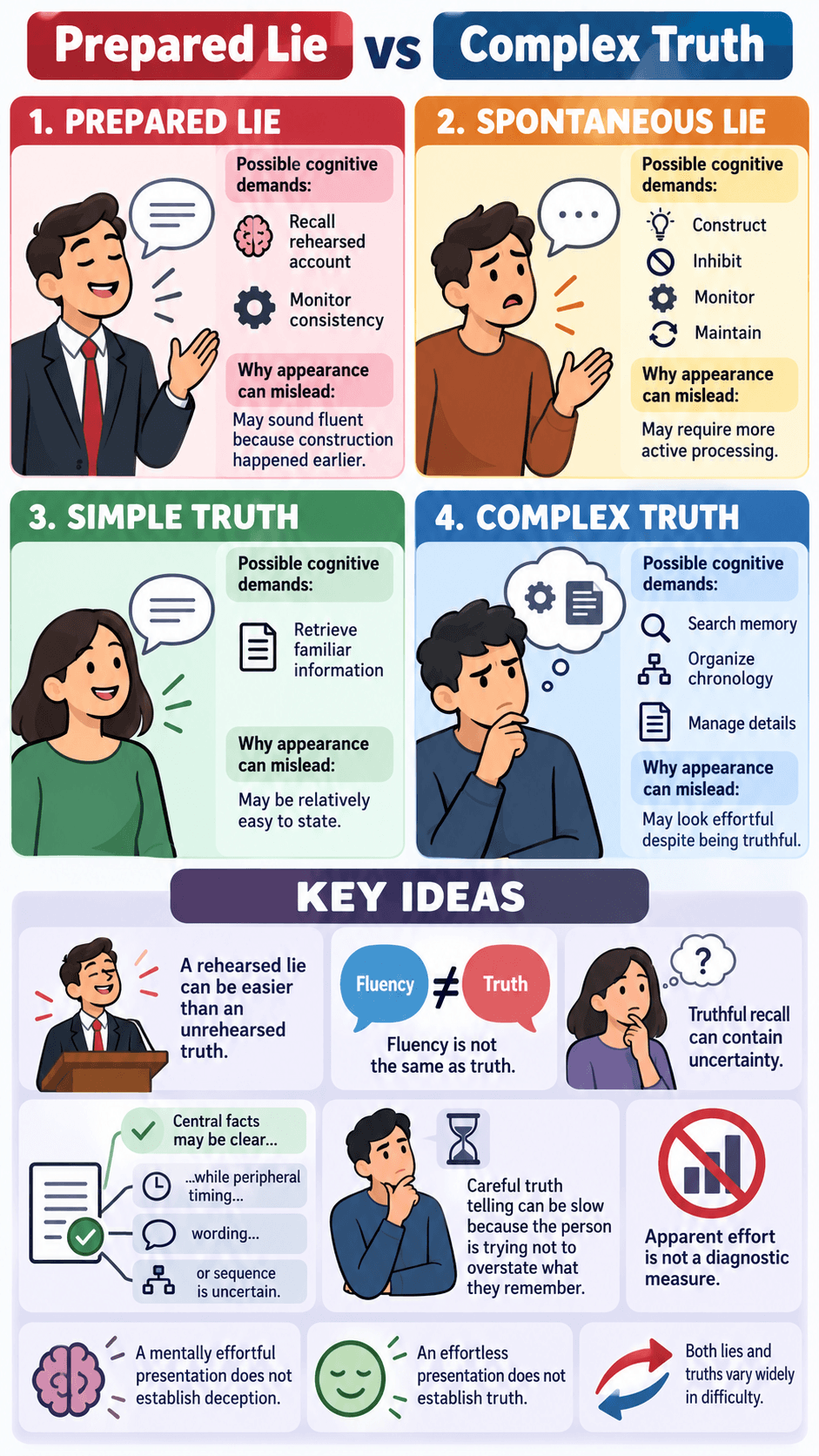
| Situation | Possible cognitive demands | Why appearance can mislead |
|---|---|---|
| Prepared lie | Recall rehearsed account, monitor consistency | May sound fluent because construction happened earlier |
| Spontaneous lie | Construct, inhibit, monitor, maintain | May require more active processing |
| Simple truth | Retrieve familiar information | May be relatively easy to state |
| Complex truth | Search memory, organize chronology, manage details | May look effortful despite being truthful |
A rehearsed lie can be easier than an unrehearsed truth
Suppose one person has repeated the same deceptive explanation several times, while another is truthfully trying to reconstruct an unfamiliar timeline from months ago. The deceptive account may sound smoother even though it is false.
This reversal is important because observers often treat fluency as credibility. Cognitive effort is shaped by preparation and memory access, not only by veracity.
Truthful recall can contain uncertainty
Truthful speakers do not necessarily remember every detail with equal strength. Central facts may be clear while peripheral timing, wording, or sequence is uncertain. Trying to separate strong memory from weak memory can slow a truthful response.
That kind of uncertainty should not be collapsed into the idea that “a truthful person would answer easily.” Sometimes careful truth telling is cognitively responsible precisely because the person is trying not to overstate what they remember.
Apparent effort is not a diagnostic measure
The practical conclusion is straightforward: a mentally effortful presentation does not establish deception, and an effortless presentation does not establish truth. Both lies and truths vary widely in difficulty.
What Changes Cognitive Load?
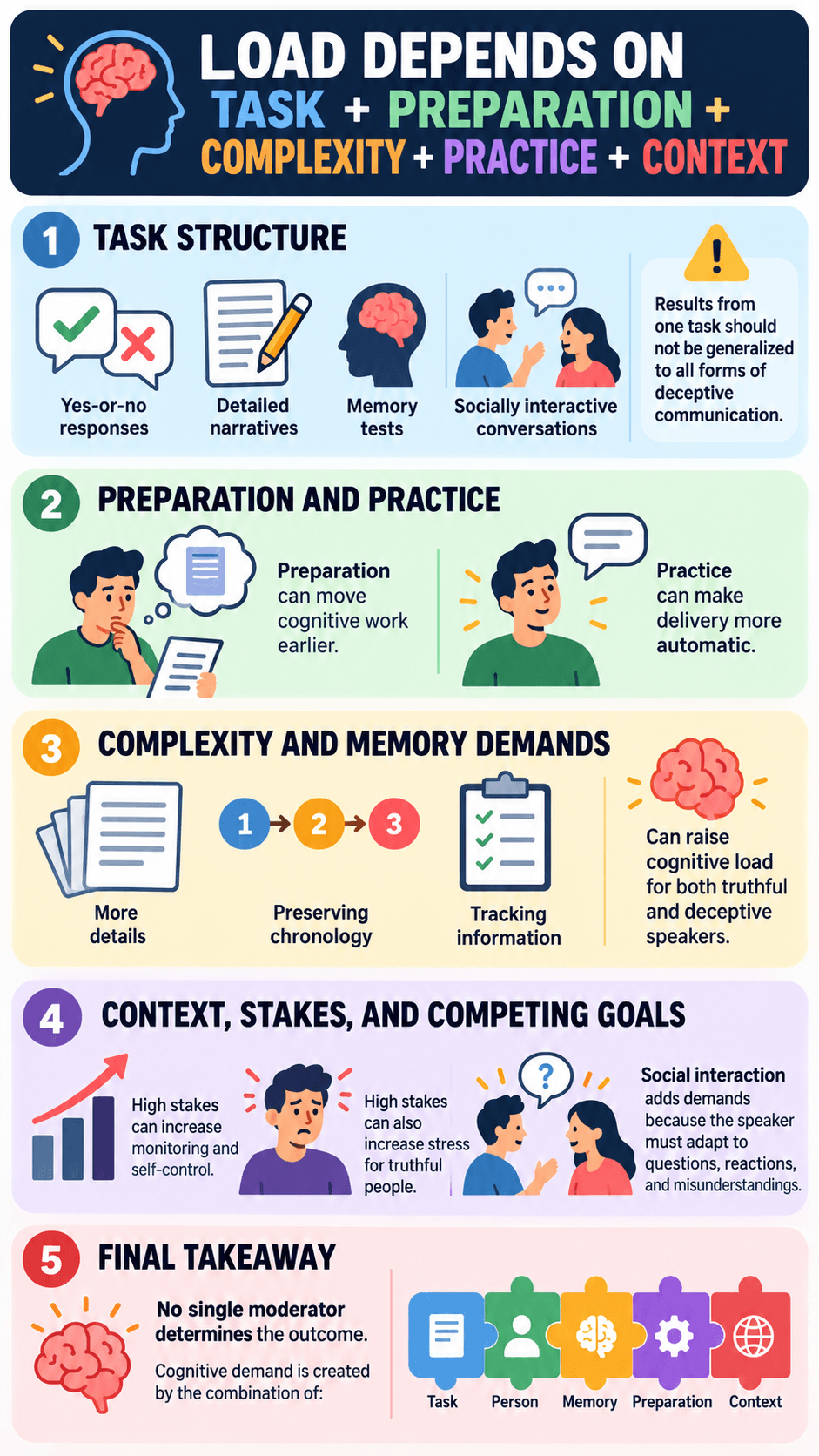
A better model than “lies are harder” is:
LOAD DEPENDS ON TASK + PREPARATION + COMPLEXITY + PRACTICE + CONTEXT
Task structure
A yes-or-no response, a detailed narrative, a memory test, and a socially interactive conversation place different demands on cognition. Results from one task should not automatically be generalized to all forms of deceptive communication.
Preparation and practice
Preparation can move cognitive work earlier in time. The person may construct the account before the conversation rather than during it. Practice can then make delivery more automatic.
Complexity and memory demands
The number of details, the need to preserve chronology, and the amount of information that must be tracked can raise load for both truthful and deceptive speakers.
Context, stakes, and competing goals
High stakes may increase monitoring and self-control, but they can also increase stress for truthful people. Social interaction adds further demands because the speaker must adapt to questions, reactions, and misunderstandings.
No single moderator determines the outcome. Cognitive demand is created by the combination of task, person, memory, preparation, and context.
What Research on Added Cognitive Load Actually Shows
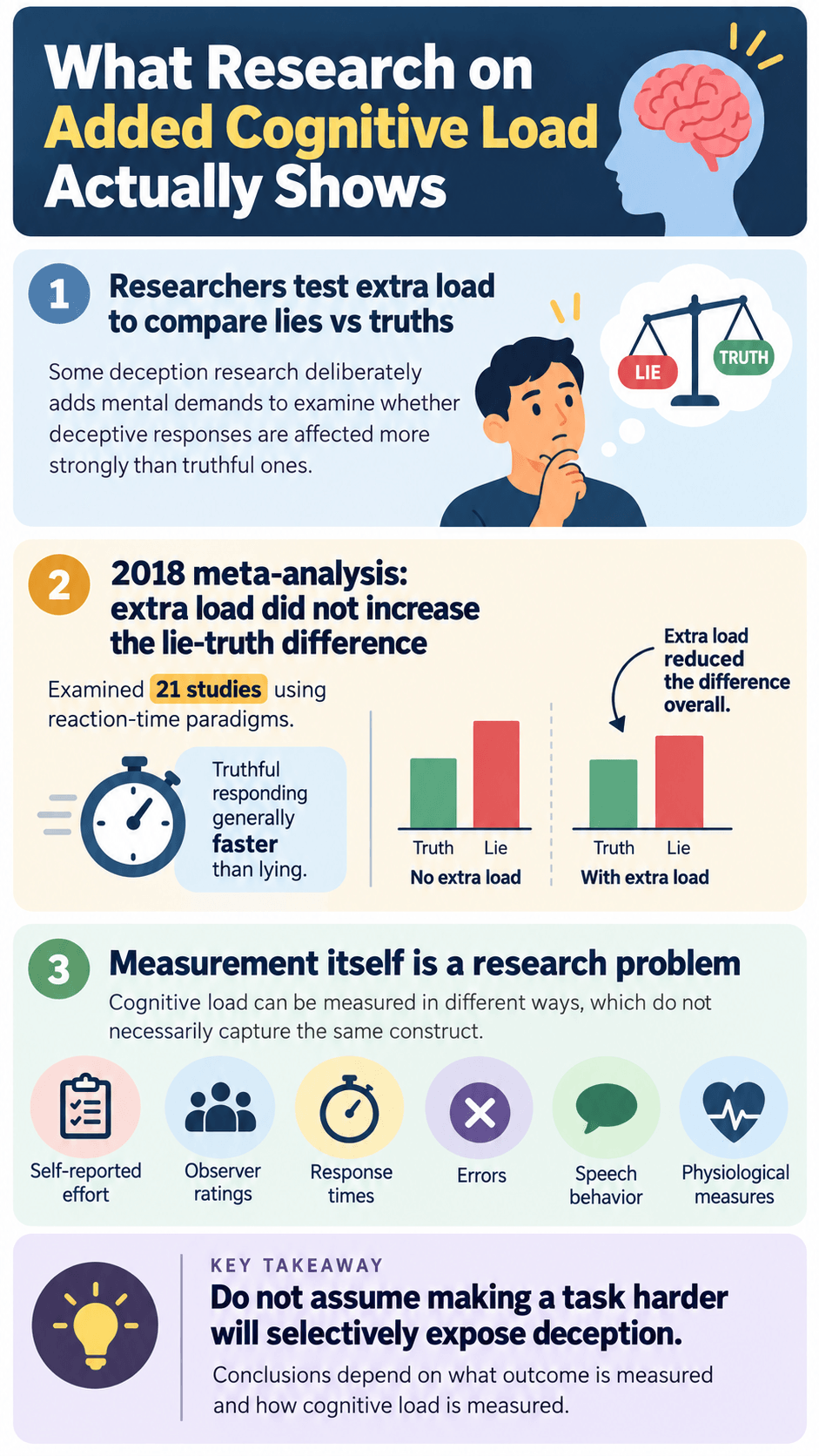
Researchers have tested whether extra load changes lie-truth differences
Some deception research deliberately adds mental demands to examine whether deceptive responses are affected more strongly than truthful ones. This work helped popularize the idea that cognitive load could create larger differences between lies and truths.
For readers, the important point is not how to reproduce those procedures. It is what the results tell us about the underlying theory.
Added load does not always help separate lies from truths
A 2018 meta-analysis examined 21 studies using reaction-time paradigms. Truthful responding was generally faster than lying, but imposing additional cognitive load did not increase that lie-truth difference. In fact, the added load reduced the difference overall because truthful responses also slowed. The meta-analysis of cognitive load and lie-truth reaction times is a strong caution against assuming that making a task mentally harder will selectively expose deception.
This finding does not prove that cognitive demand is irrelevant to lying. It shows that adding more load to a task can affect truth telling too, and that theoretical predictions depend on the specific outcome being measured.
Measurement itself is a research problem
Another complication is deciding how cognitive load should be measured. Self-reported effort, observer ratings, response times, errors, speech behavior, and physiological measures do not necessarily capture the same construct.
A 2025 open-access study evaluated common measures of cognitive load and arousal across deception datasets. Measures of cognitive load showed some convergent validity but problems with discriminant validity, while the authors found no empirical support for the construct validity of the arousal measures they tested. The study on measuring cognitive load in deception research shows why conclusions depend partly on whether the underlying construct is being measured well.
Why the Theory Still Needs Careful Testing
A useful idea can still be underspecified
Cognitive-load explanations are attractive because they provide a plausible mechanism: deception sometimes requires extra operations, so those operations should create measurable costs.
But a theory becomes stronger when it specifies which type of deception, which cognitive process, which measurement, and which conditions should produce the effect. Without those details, almost any difficult response can be interpreted after the fact as “cognitive load.”
Metascientific review has identified weaknesses in the research chain
A 2022 metascientific review examined how cognitive-load lie-detection studies justified the core hypothesis. It concluded that the literature often recycled a limited set of rationales and that ambiguities made the hypothesis difficult to test severely. The metascientific review of cognitive-load lie detection argues for clearer theoretical derivation rather than treating the premise as settled.
This is a healthy scientific limitation, not a reason to dismiss the field. It means readers should distinguish a promising mechanism from a universal diagnostic rule.
Different forms of deception may use different processes
Fabrication, false denial, omission, partial truth, rehearsed deception, and spontaneous deception do not necessarily create the same cognitive demands. Memory effects can differ too.
That diversity makes broad statements such as “the brain always works harder when lying” too simple for the evidence.
Laboratory Findings and Real-World Deception
Controlled experiments make comparison possible
Laboratory studies have an important advantage: researchers can establish who is telling the truth, who is instructed to lie, what information is known, and what task participants complete. That control allows lie-truth differences to be measured.
Without known ground truth, it is difficult to decide whether an observed sign of effort was actually associated with deception.
Real-world lies vary more than laboratory lies
Everyday and high-stakes deception can involve preparation, repeated storytelling, mixed truth and falsehood, uncertain memories, long time intervals, multiple audiences, and changing consequences. Those features may not be fully reproduced in a controlled experiment.
Real truthful accounts are also more varied than simple laboratory truth conditions. A witness describing a stressful event from memory may face much higher cognitive demands than a participant answering a familiar factual question.
Ecological validity limits universal claims
Laboratory research can reveal mechanisms without guaranteeing that the same effect will be strong enough to diagnose a particular real-world case. The more a practical claim moves away from the original task, the more cautious interpretation should become.
This is especially important when someone’s job, relationship, safety, legal status, or reputation could be affected by the conclusion.
Cognitive Load and Lying vs Working Memory Psychology
Working memory is a general cognitive system
Working memory supports temporary maintenance and manipulation of information across many ordinary activities: mental arithmetic, following instructions, reading, reasoning, planning, and conversation.
It is not a deception-specific system.
Cognitive load in lying is a domain-specific application
Deception research asks how general cognitive resources are recruited when someone intentionally communicates misleading information. The same working-memory system may be involved, but the research question is narrower.
This distinction prevents a common conceptual mistake. Saying deception sometimes taxes working memory does not mean working-memory difficulty is evidence of deception.
The mechanism should not be confused with the judgment outcome
Even if deception creates additional cognitive demand in a study, another question remains: can observers use that difference accurately? A production mechanism and detection accuracy are not the same thing.
A measurable average difference between lies and truths can still overlap too much to classify individuals reliably. That is why cognitive-load theory should not be treated as an automatic shortcut to accurate lie detection.
Why This Is Not an Interrogation Guide
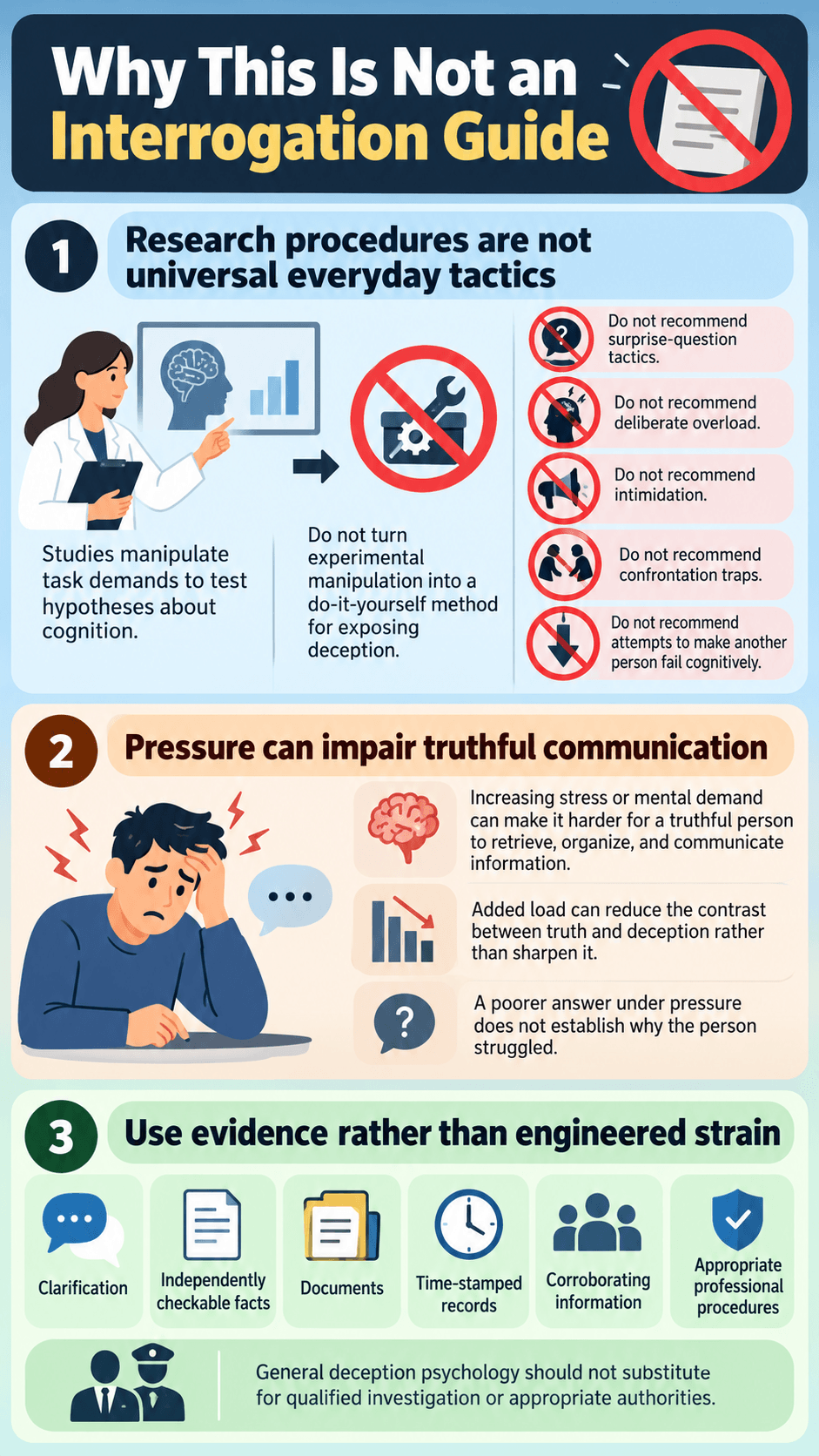
Research procedures are not universal everyday tactics
Studies sometimes manipulate task demands to test hypotheses about cognition. Turning an experimental manipulation into a do-it-yourself method for exposing deception ignores training, ethics, context, validity, and the possibility that truthful people are affected too.
This article therefore does not recommend surprise-question tactics, deliberate overload, intimidation, confrontation traps, or attempts to make another person fail cognitively.
Pressure can impair truthful communication
Increasing stress or mental demand can make it harder for a truthful person to retrieve, organize, and communicate information. The 2018 reaction-time meta-analysis is a useful reminder that added load can reduce the contrast between truth and deception rather than sharpen it.
A poorer answer under pressure does not establish why the person struggled.
Use evidence rather than engineered strain
When a claim matters, stronger foundations include clarification, independently checkable facts, documents, time-stamped records, corroborating information, and appropriate professional procedures.
In criminal allegations, abuse concerns, workplace misconduct, fraud, child-safety cases, or legal disputes, general deception psychology should not substitute for qualified investigation or appropriate authorities.
FAQ
Does lying always require more brainpower than telling the truth?
No. Some lies require extra construction, inhibition, monitoring, and consistency management, but the difference depends on the task. Prepared or simple lies may be relatively easy to produce, while a complex truthful account can place heavy demands on memory and attention. “Lying is always harder” is too absolute for the research.
Can a practiced lie become cognitively easier?
Yes. Preparation and repetition can reduce the amount of active construction needed during delivery. A rehearsed account may become more fluent and easier to retrieve. That does not make it truthful, but it can reduce the observable difference in effort between that lie and a truthful response.
Can telling the truth also be mentally demanding?
Yes. Truthful people may need to reconstruct chronology, search memory, distinguish remembered details from assumptions, manage stress, and explain complicated events. Mental effort therefore cannot be interpreted as a deception marker by itself.
Does cognitive load automatically improve lie-detection accuracy?
No. Research findings depend on the manipulation and outcome being measured. A reaction-time meta-analysis found that added cognitive load did not increase the lie-truth reaction-time difference and instead reduced it overall by slowing truthful responses too. Cognitive load should not be treated as a universal way to make deception easy to detect.
Is working memory the same as cognitive load in deception?
No. Working memory is a general cognitive system for temporarily holding and manipulating information. Cognitive load describes the demands placed on limited cognitive resources. Deception may place demands on working memory, but the concepts are not identical, and neither is specific to lying.
Key Takeaways
- Deception can create extra cognitive demand when a person must construct an alternative account, suppress truthful information, monitor the listener, and maintain consistency.
- The amount of load depends on task structure, preparation, complexity, practice, memory demands, and context.
- A prepared lie can sometimes be easier to deliver than a complicated truthful account, so apparent mental effort is not proof of deception.
- Research on adding cognitive load has produced mixed results, including evidence that extra load can impair truthful responding and reduce lie-truth differences on some measures.
- Working memory is a general cognitive system; cognitive load in lying is one domain-specific application, not a deception-specific mental process.
- The responsible use of this research is explanatory, not tactical: verification and independent evidence are stronger foundations than trying to make someone cognitively struggle.
If a person’s answer seems mentally effortful, treat that observation as incomplete information. Ask what the task itself demands, how complex the memory is, whether the account was prepared, and what independent evidence exists. Cognitive load can help explain why some forms of deception are difficult, but it cannot tell you by itself whether a particular person is lying.

Michael Reed is the Founder and Lead Writer at Psychology Exposed. He writes about human behavior, relationships, emotional patterns, self-awareness, and practical psychology topics using research-informed, easy-to-understand content.
Read More About Michael Reed: https://psychologyexposed.com/michael-reed/