
Someone pauses before answering, looks uncomfortable, changes one detail, or sounds unusually confident. It is easy to feel that the behavior itself tells you whether the person is lying. In reality, deciding whether communication is truthful or deceptive is a much harder judgment problem. Behavior can be ambiguous, context can be incomplete, and confidence can grow faster than the evidence justifies.
Deception judgment psychology looks at how people move from hearing a claim to deciding whether it is probably true or deceptive. That process can involve a default tendency to accept communication, a shift into suspicion, attention to cues, comparison with known facts, and a final judgment that may feel more or less certain. None of those steps turns a single behavior into proof.
This matters because the cost of a mistake can run in both directions. Believing a deceptive claim can expose someone to harm, but wrongly labeling a truthful person as deceptive can damage trust, relationships, reputations, and important decisions. A more responsible approach is to separate impressions from evidence and to match certainty to what is actually known.
Quick Answer
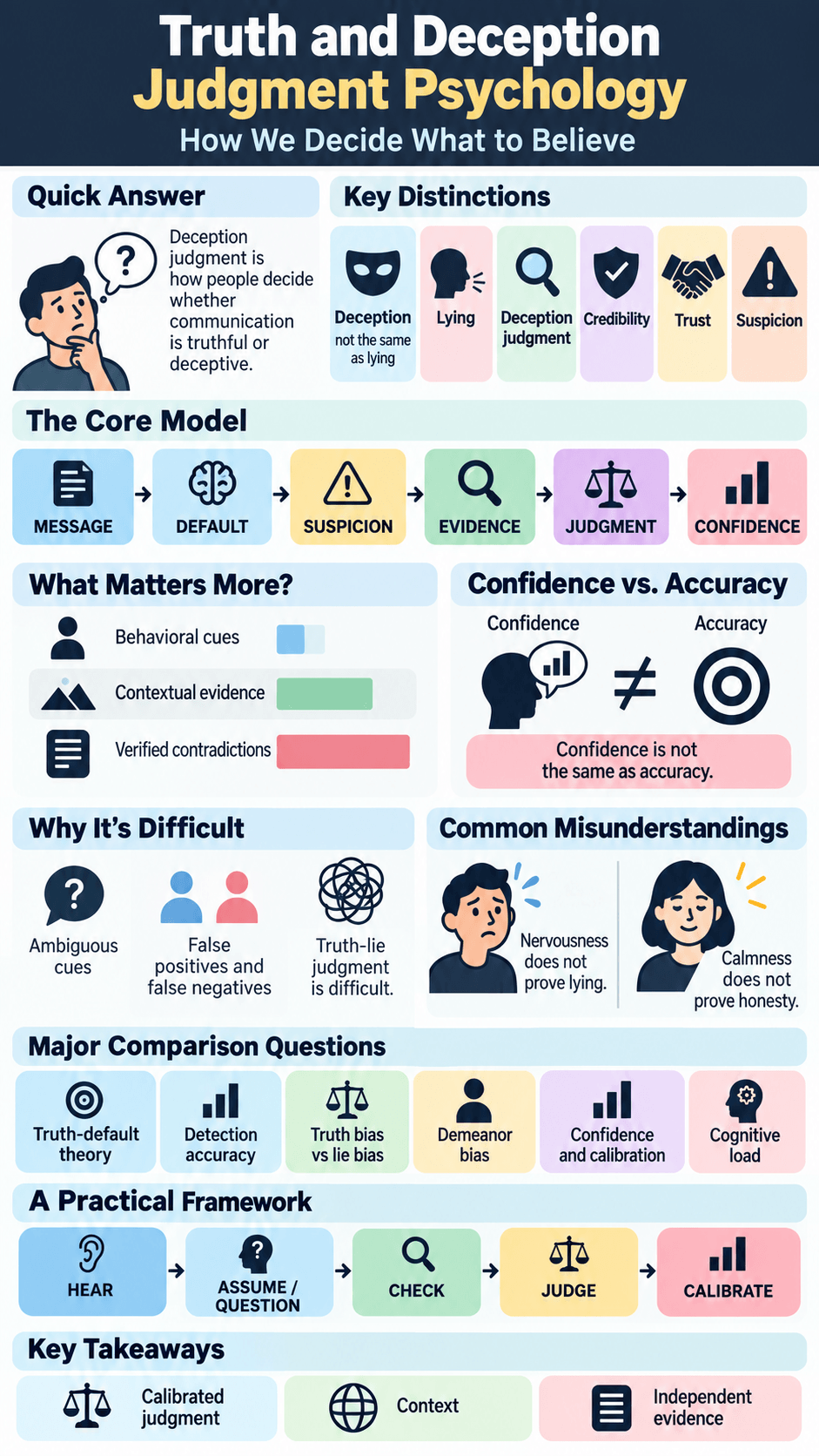
Deception judgment psychology studies how people decide whether communication is truthful or deceptive. We often begin from a position of relative belief, then become more skeptical when context, contradictions, or other information raises suspicion. Human judgments are imperfect because many familiar “lying cues” are ambiguous. The safest approach is to treat behavior as information to examine, not proof, and to calibrate confidence to evidence quality.
What Deception Judgment Means
Deception, lying, and deception judgment are related but not identical
Deception is broader than simply saying a sentence that is factually false. In psychological and communication research, deception generally involves an attempt to create or maintain a belief that the communicator regards as false or misleading. Lying is one form of deception, but deceptive communication can also involve omission, selective presentation, or other ways of shaping what another person believes.
Deception judgment is different again. It refers to the observer’s decision about whether a particular message or communicator is truthful or deceptive. The question is not “Why would this person lie?” but “How am I deciding whether this communication is true?” That distinction keeps motive, personality, and moral evaluation from being confused with the evidence for a specific truth-lie judgment.
Veracity judgment vs credibility vs interpersonal trust
A veracity judgment asks whether a specific communication is true or deceptive. Credibility is broader. A person, account, or claim may seem more or less believable or reliable without the observer concluding that an intentional lie occurred. Someone may tell a confused or mistaken story that seems unreliable but is not deliberately deceptive.
Interpersonal trust is broader still. Trust concerns whether you are willing to rely on someone under uncertainty or vulnerability. You can generally trust a person while questioning one statement, or distrust someone while recognizing that a particular statement may still be true. Keeping these concepts separate helps prevent a single disputed claim from becoming a sweeping judgment about someone’s entire character.
Suspicion is a trigger for evaluation, not the final judgment
Suspicion means that deception has become plausible enough to consider. It may arise because a claim conflicts with known facts, an explanation changes, the situation creates a clear incentive to mislead, or independent information does not fit what was said. Suspicion can be useful because it prompts closer checking.
But suspicion is not the same as proof. Once suspicious, people may begin interpreting ambiguous behavior through that lens. A pause that previously looked like ordinary thinking may suddenly feel evasive. The responsible move is to use suspicion as a reason to investigate the claim more carefully, not as permission to treat every ambiguous cue as confirmation.
The Core Model of Truth-Lie Judgment
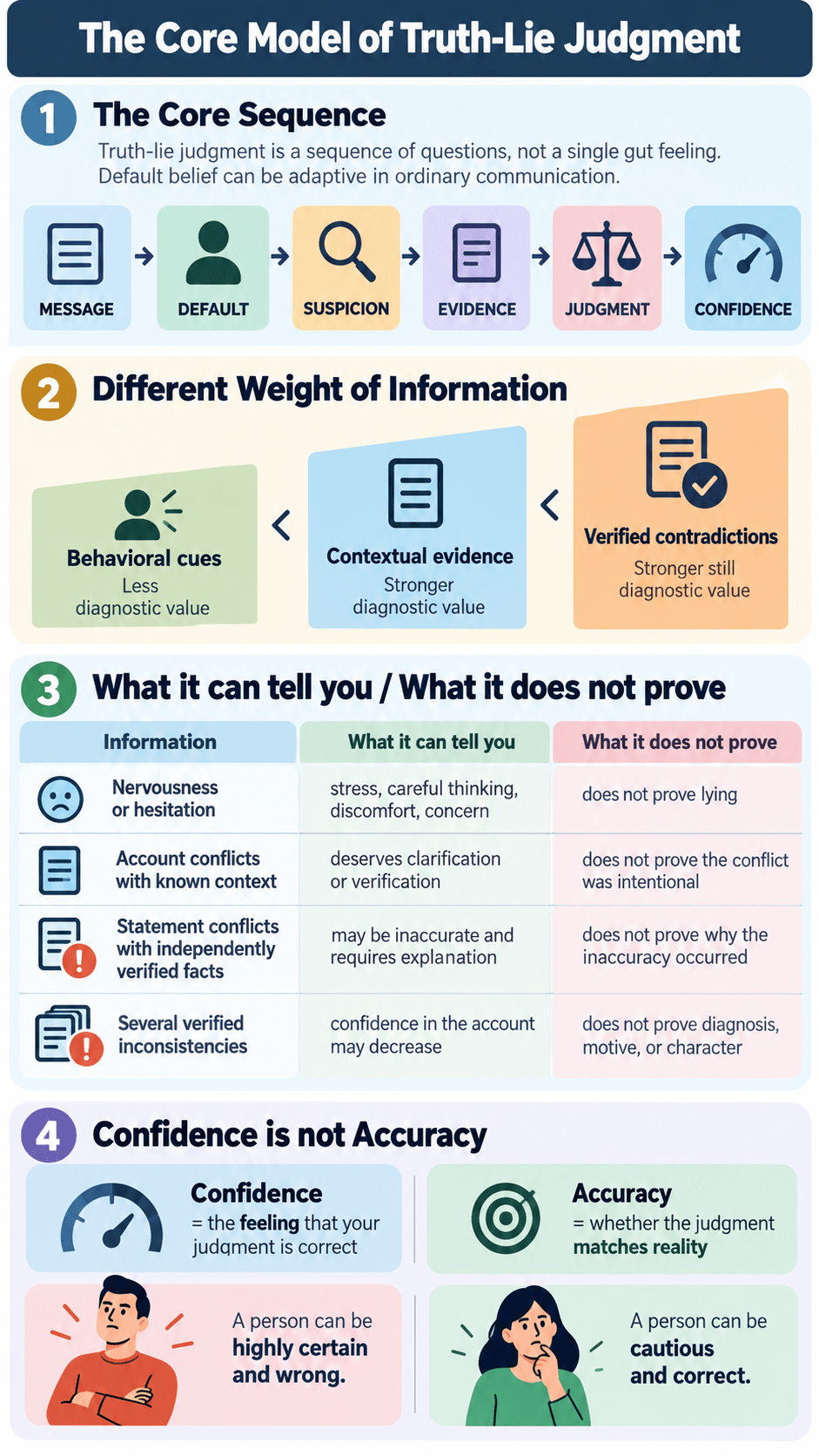
MESSAGE → DEFAULT → SUSPICION → EVIDENCE → JUDGMENT → CONFIDENCE
A useful way to think about truth-lie judgment is as a sequence of questions rather than a single “gut feeling.” First, you receive a message. In many ordinary interactions, you do not examine every sentence as if it were testimony in an investigation. Communication would become extremely inefficient if every routine statement required active verification.
Next comes the possibility of suspicion. Something may make the message worth examining more closely. You then evaluate whatever evidence is available, make a provisional judgment, and experience some level of confidence in that judgment. The important point is that the final feeling of certainty comes after several psychological steps, and errors can enter at any of them.
Timothy R. Levine’s Truth-Default Theory emphasizes that people tend to believe others in ordinary communication and that this default can be adaptive. The theory also places substantial importance on context and communication content rather than assuming that deception is reliably visible through a small set of nonverbal behaviors.
Why behavioral cues, contextual evidence, and verified contradictions carry different weight
Not all information has the same diagnostic value. A behavior such as looking away, hesitating, fidgeting, or speaking with unusual confidence is open to many explanations. Stress, social discomfort, fatigue, memory search, cultural norms, personality, and the stakes of being evaluated can all change behavior in truthful people.
Contextual evidence is usually stronger when it directly bears on the claim. If someone says they were in one place at a certain time, independently confirmed records may tell you more than whether they looked nervous while explaining it. A verified contradiction is stronger still when the conflicting facts are clear and the person had access to the relevant information.
| What you notice | What it can tell you | What it does not prove |
|---|---|---|
| Nervousness or hesitation | The person may be under stress, thinking carefully, uncomfortable, or concerned about the situation | That the person is lying |
| An account conflicts with known context | The claim deserves clarification or verification | That the conflict was intentional |
| A statement conflicts with independently verified facts | The statement may be inaccurate and requires explanation | Why the inaccuracy occurred without further evidence |
| Several verified inconsistencies accumulate | Confidence in the account may reasonably decrease | A diagnosis, motive, or character judgment |
A large meta-analysis of behavioral differences between truthful and deceptive communication found that some cues differ on average, but the effects are generally not simple enough to support a reliable “one sign means lying” rule. The review of 158 proposed deception cues is a useful reminder that observable behavior is probabilistic and context dependent.
Why confidence belongs after judgment but is not the same as accuracy
Confidence is the feeling that your judgment is correct. Accuracy is whether the judgment actually matches reality. Those are different variables. A person can be highly certain and wrong, or cautious and correct.
This difference matters because vivid cues often feel more informative than they really are. A dramatic pause, a confident denial, or a sudden change in expression may make a conclusion feel obvious. Yet a classic meta-analysis of deception judgments found a very small overall relationship between confidence and accuracy. The confidence-accuracy review reported an average weighted correlation close to zero across the samples it analyzed, while also showing that the relationship can vary with how judgments are made.
Why Truth-Lie Judgment Is Difficult
Ambiguous behavior and weak diagnostic cues
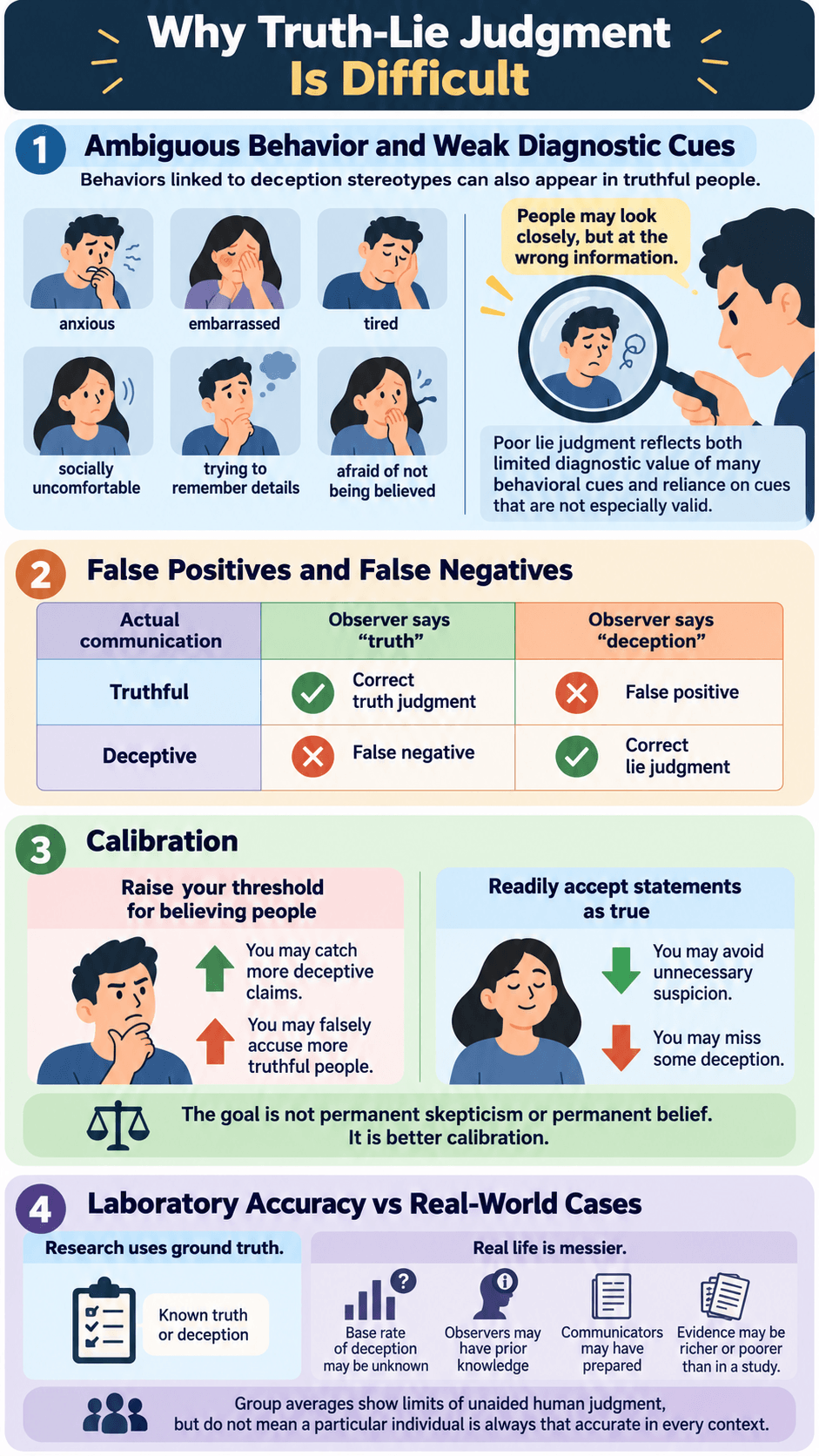
People often expect lying to “leak” through the body. The problem is that many behaviors associated with deception stereotypes also appear when truthful people are anxious, embarrassed, tired, socially uncomfortable, trying to remember details, or afraid of not being believed.
Researchers have also examined why observers fail. A lens model meta-analysis by Hartwig and Bond concluded that poor lie judgment reflects both the limited diagnostic value of many behavioral cues and the tendency of observers to rely on cues that are not especially valid. In practical terms, people can be looking closely and still be looking at the wrong information.
False positives and false negatives
Any truth-lie decision can be correct or incorrect in two different directions. A false positive occurs when a truthful communication is judged deceptive. A false negative occurs when a deceptive communication is accepted as truthful. Both matter.
| Actual communication | Observer says “truth” | Observer says “deception” |
|---|---|---|
| Truthful | Correct truth judgment | False positive |
| Deceptive | False negative | Correct lie judgment |
Thinking in terms of error type is useful because it slows down all-or-nothing reasoning. If you raise your threshold for believing people, you may catch more deceptive claims, but you may also falsely accuse more truthful people. If you readily accept statements as true, you may avoid unnecessary suspicion but miss some deception. The goal is not permanent skepticism or permanent belief. It is better calibration.
Why laboratory accuracy does not map perfectly onto every real-world case
Researchers need situations in which they know which statements are true and which are deceptive. That gives them a ground truth against which judgments can be scored. Real life is often messier. You may not know the true base rate of deception, the observer may have prior knowledge, the communicator may have prepared extensively, and the available evidence may be much richer or much poorer than in a study.
This does not make laboratory research useless. It means its findings should be applied at the right level. Group averages tell us something important about the limits of unaided human judgment, but they do not tell us that a particular individual is always exactly that accurate in every context.
Default Belief, Suspicion, and Response Tendencies
Truth-Default Theory at overview level
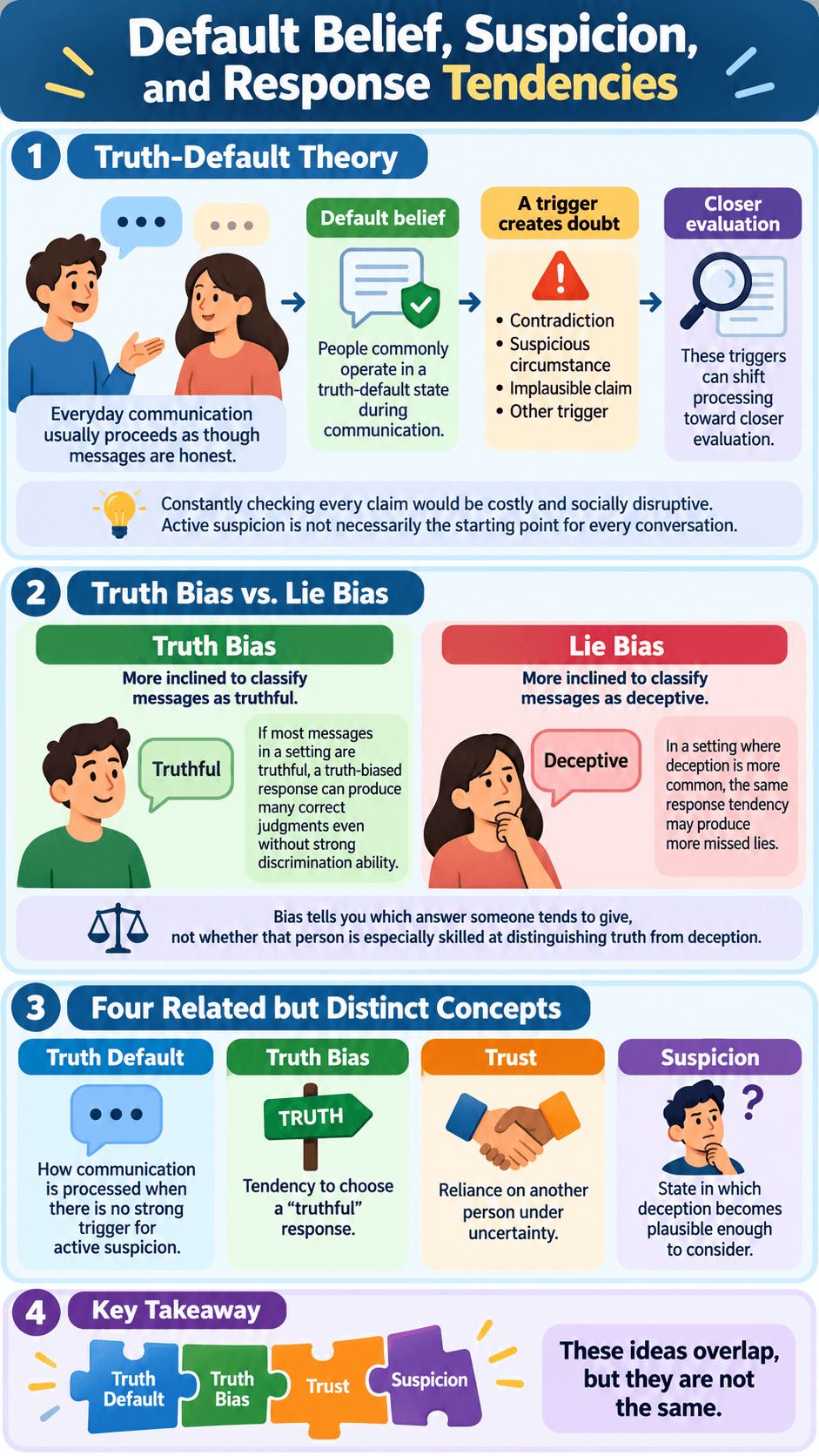
Truth-Default Theory proposes that people commonly operate in a truth-default state during communication. In simple terms, everyday communication usually proceeds as though messages are honest unless something activates sufficient doubt. Constantly checking every claim would be costly and socially disruptive.
This is not the same as saying people believe everything. A contradiction, suspicious circumstance, implausible claim, or other trigger can shift processing toward closer evaluation. The key idea is that active suspicion is not necessarily the starting point for every conversation.
Truth bias and lie bias at overview level
Truth bias and lie bias describe response tendencies. A truth-biased observer is more inclined to classify messages as truthful. A lie-biased observer is more inclined to classify them as deceptive. These tendencies can change how overall performance looks.
For example, if most messages in a setting are actually truthful, a truth-biased response can produce many correct judgments even without strong discrimination ability. In a setting where deception is more common, the same response tendency may produce more missed lies. Bias tells you which answer someone tends to give, not whether that person is especially skilled at distinguishing truth from deception.
Why truth default, truth bias, trust, and suspicion must stay conceptually separate
These ideas overlap, but they answer different questions. Truth default concerns how communication is processed when there is no strong trigger for active suspicion. Truth bias concerns the tendency to choose a “truthful” response. Trust concerns reliance on another person under uncertainty. Suspicion is the state in which deception becomes plausible enough to consider.
Confusing them can lead to poor conclusions. Someone can trust a friend but still question one claim. Someone can be suspicious in a particular situation without having a general lie bias. And someone can show truth-biased responses without being unusually trusting in every part of life.
How Accurate Are Truth-Lie Judgments?
Accuracy, chance benchmarks, and group-level findings
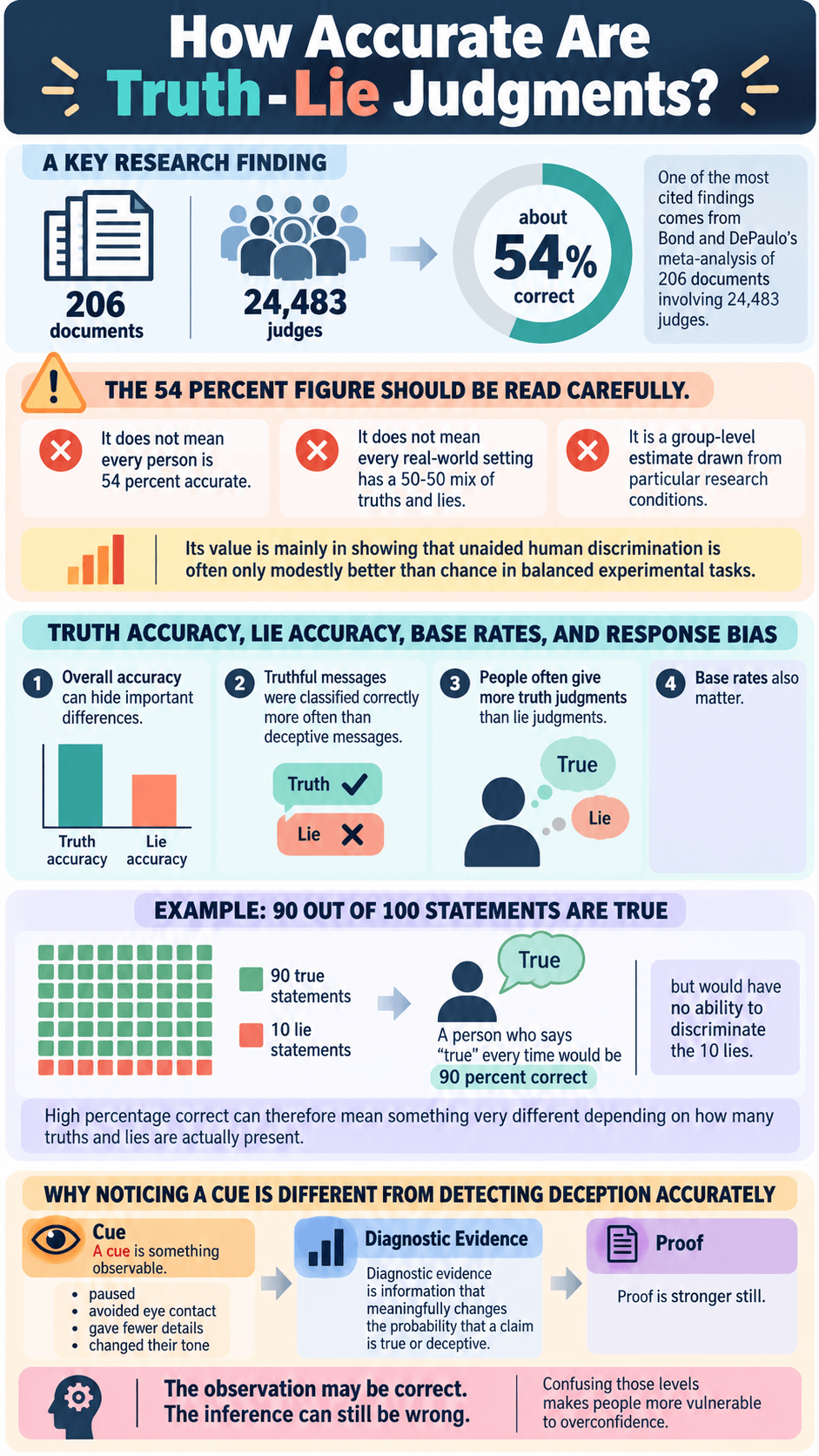
One of the most cited findings in this field comes from Bond and DePaulo’s meta-analysis of 206 documents involving 24,483 judges. Under the conditions included in that review, people averaged about 54 percent correct truth-lie judgments, with truths classified more accurately than lies. The meta-analysis on deception judgment accuracy is important because it summarizes a very large body of research rather than a single experiment.
The 54 percent figure should be read carefully. It does not mean every person is “54 percent accurate,” and it does not mean every real-world setting has a 50-50 mix of truths and lies. It is a group-level estimate drawn from particular research conditions. Its value is mainly in showing that unaided human discrimination is often only modestly better than chance in balanced experimental tasks.
Truth accuracy, lie accuracy, base rates, and response bias
Overall accuracy can hide important differences. In the Bond and DePaulo review, truthful messages were classified correctly more often than deceptive messages. One reason is response tendency: people often give more truth judgments than lie judgments.
Base rates also matter. Imagine a setting where 90 out of 100 statements are true. A person who says “true” every time would be 90 percent correct but would have no ability to discriminate the 10 lies. High percentage correct can therefore mean something very different depending on how many truths and lies are actually present.
That is why accuracy should be interpreted together with truth accuracy, lie accuracy, false positives, false negatives, and the context in which the judgment occurred.
Why noticing a cue is different from detecting deception accurately
You can accurately notice that someone paused, avoided eye contact, gave fewer details, or changed their tone. The observation may be correct. The inference can still be wrong.
This distinction is essential. A cue is something observable. Diagnostic evidence is information that meaningfully changes the probability that a claim is true or deceptive. Proof is stronger still. Confusing those levels makes people more vulnerable to overconfidence, especially when a familiar behavior feels intuitively suspicious.
Conditions That Shape Deception Judgments
Demeanor bias and the nervous truth-teller problem
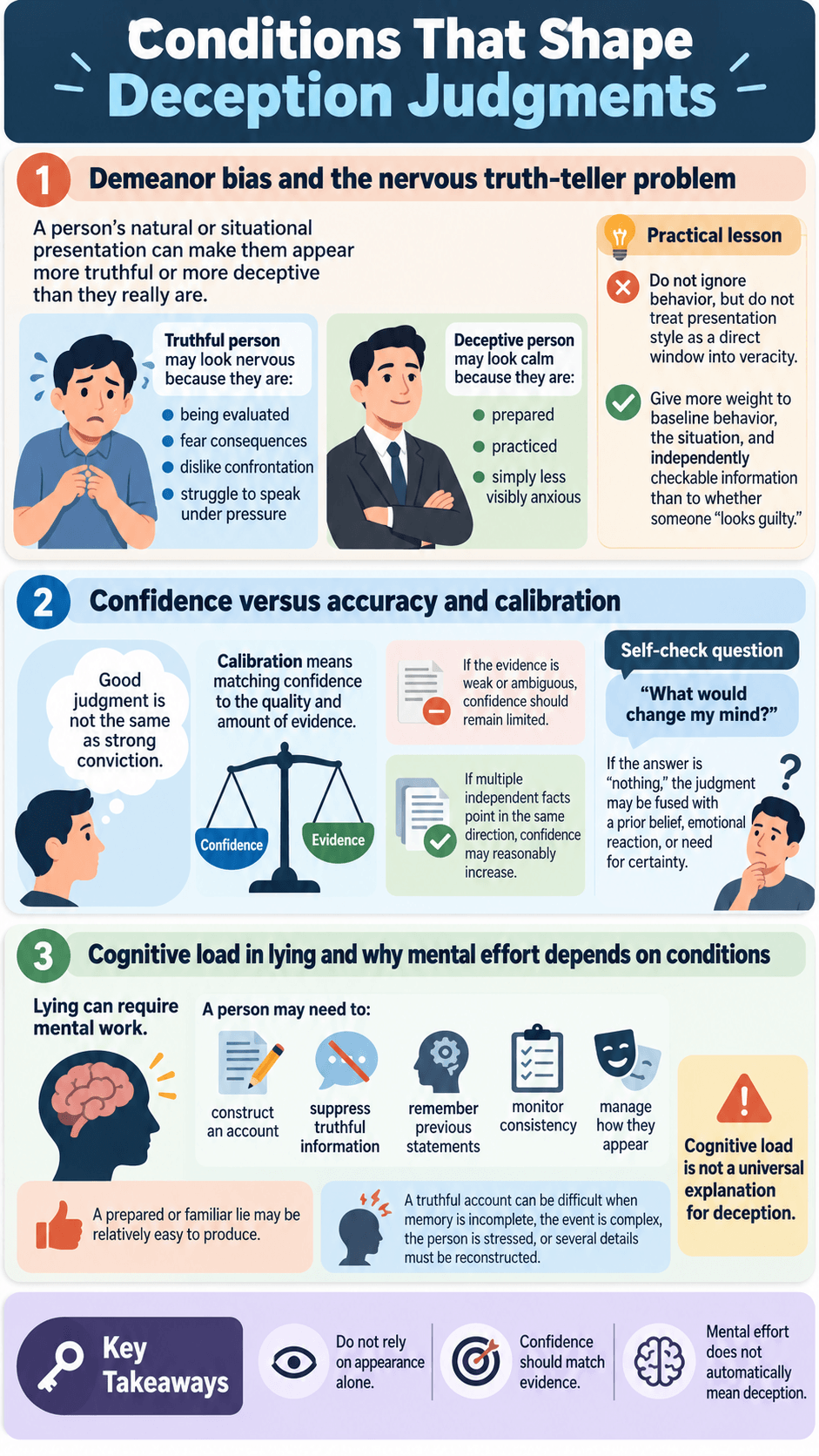
Demeanor bias occurs when a person’s natural or situational presentation makes them appear more truthful or more deceptive than they really are. A truthful person may look nervous because they are being evaluated, fear consequences, dislike confrontation, or struggle to speak under pressure. A deceptive person may look calm because they are prepared, practiced, or simply less visibly anxious.
The practical lesson is not to ignore behavior. It is to avoid treating presentation style as a direct window into veracity. Baseline behavior, the situation, and independently checkable information often deserve more weight than whether someone “looks guilty.”
Confidence versus accuracy and calibration
Good judgment is not the same as strong conviction. Calibration means matching confidence to the quality and amount of evidence. If the evidence is weak or ambiguous, confidence should remain limited. If multiple independent facts point in the same direction, confidence may reasonably increase.
A simple self-check is to ask, “What would change my mind?” If the answer is “nothing,” the problem may no longer be evidence evaluation. The judgment may have become fused with a prior belief, emotional reaction, or need for certainty.
Cognitive load in lying and why mental effort depends on conditions
Lying can require mental work. A person may need to construct an account, suppress truthful information, remember previous statements, monitor consistency, and manage how they appear. But the claim that lying is always harder than telling the truth is too simple.
A prepared or familiar lie may be relatively easy to produce. A truthful account can be difficult when memory is incomplete, the event is complex, the person is stressed, or several details must be reconstructed. An open-access review of deception and cognitive load argues for a broader working-memory perspective and cautions against treating cognitive load as a universal explanation for deception.
Which Question Best Matches What You Want to Understand?
Why do we often believe people until something triggers suspicion?
Focus on Truth-Default Theory. The central issue is how ordinary communication can begin from relative acceptance and then shift toward closer evaluation when context creates a reason for doubt.
How accurate are people at detecting lies overall?
Focus on deception detection accuracy. The important questions are how often judgments match actual veracity, how results compare with chance in balanced tasks, and why truth accuracy and lie accuracy can differ.
Why do some observers lean toward truth or toward deception?
Focus on truth bias versus lie bias. This is about response tendency, not whether the observer possesses a special ability to detect lies.
Why can honest people look deceptive?
Focus on demeanor bias. The key problem is that nervousness, hesitation, confidence, eye contact, and emotional style can shape impressions without reliably revealing whether the message is true.
Does certainty mean a deception judgment is probably correct?
Focus on confidence and calibration. Strong confidence can feel like evidence, but the safer question is whether certainty rises and falls with the actual quality of information supporting the judgment.
Is lying always more mentally demanding than telling the truth?
Focus on cognitive load. Deception may create additional demands under some conditions, but preparation, familiarity, complexity, practice, and the difficulty of truthful recall all matter.
Common Misunderstandings About Detecting Deception
Nervousness does not prove lying and calmness does not prove honesty
Nervousness is a response to pressure, uncertainty, evaluation, fear, social discomfort, and many other conditions. Truthful people can be visibly tense. Deceptive people can be composed. Treating nervousness as guilt creates an especially serious risk of false positives.
The reverse shortcut is also unsafe. Calmness may reflect temperament, preparation, confidence, or emotional style. It is not a certificate of honesty.
A single inconsistency can justify checking, not accusation
Memory is reconstructive, and honest accounts can contain errors. People can misunderstand questions, remember timing incorrectly, omit details, or update their account after remembering something later. One inconsistency may matter, but its meaning depends on the detail, the surrounding evidence, and whether the conflict can be independently verified.
Repeated contradictions involving important facts are more concerning than a minor mismatch in wording. Even then, the next step is clarification and evidence gathering, not an automatic conclusion about motive or character.
Confidence, credibility, suspicion, and proof are different concepts
Confidence is how sure you feel. Credibility is how believable or reliable a person or claim seems. Suspicion means deception is plausible enough to consider. Proof requires evidence strong enough to establish a conclusion under the standard relevant to the situation.
Keeping these concepts separate prevents a common mental shortcut: “I feel suspicious, therefore the person is not credible, therefore they are lying, therefore I am certain.” Each step needs its own support.
A Safer Reader Framework: HEAR → ASSUME / QUESTION → CHECK → JUDGE → CALIBRATE
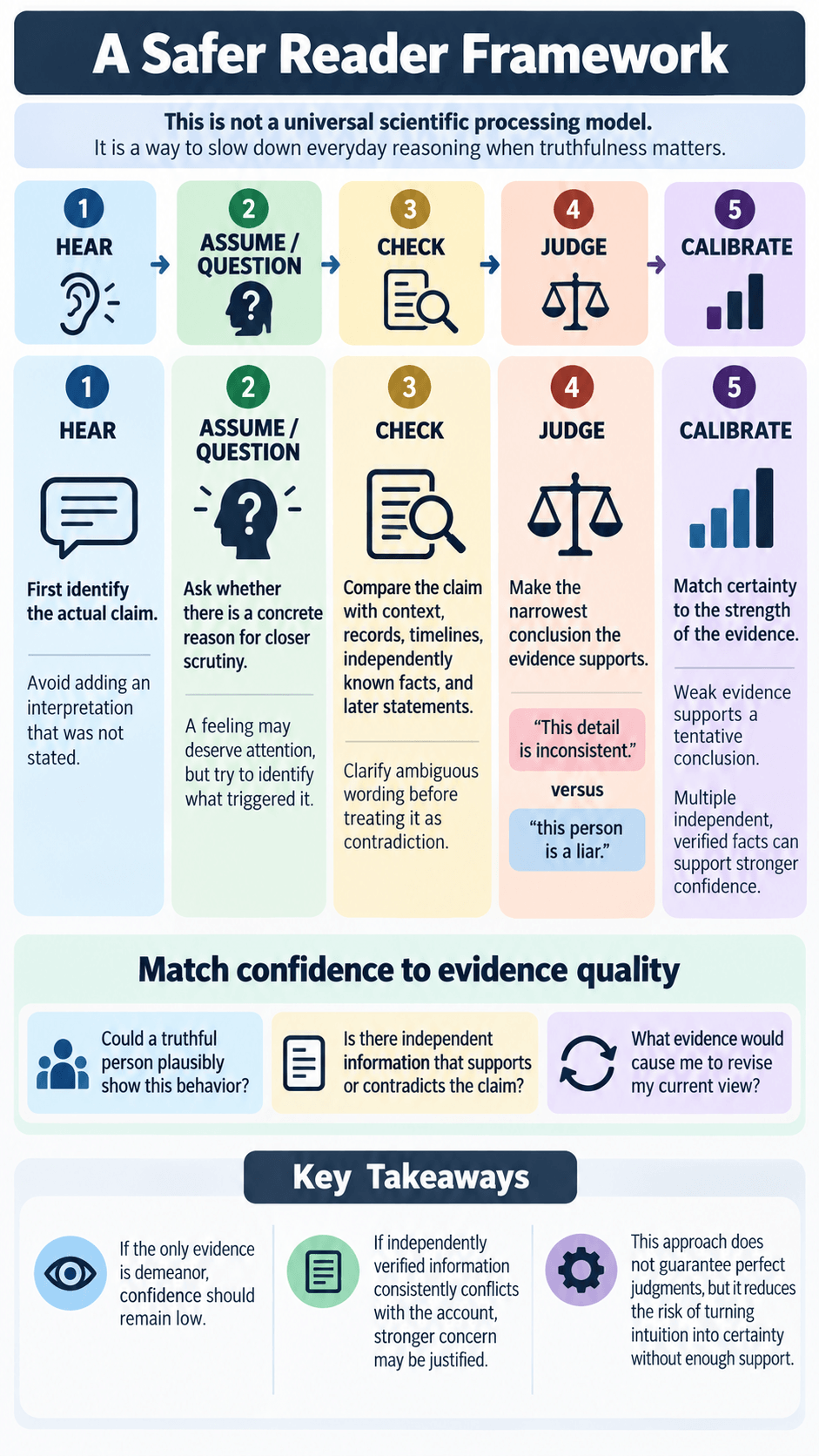
This practical sequence is not a universal scientific processing model. It is a way to slow down everyday reasoning when truthfulness matters.
Compare claims with context, known facts, consistency, and independent information
HEAR: First identify the actual claim. Avoid adding an interpretation that was not stated.
ASSUME / QUESTION: Ask whether there is a concrete reason for closer scrutiny. A feeling may deserve attention, but try to identify what triggered it.
CHECK: Compare the claim with context, records, timelines, independently known facts, and later statements. Clarify ambiguous wording before treating it as contradiction.
JUDGE: Make the narrowest conclusion the evidence supports. “This detail is inconsistent” is often more accurate than “this person is a liar.”
CALIBRATE: Match certainty to the strength of the evidence. Weak evidence supports a tentative conclusion. Multiple independent, verified facts can support stronger confidence.
Match confidence to evidence quality rather than to how vivid a cue feels
When a cue feels emotionally powerful, ask three questions:
- Could a truthful person plausibly show this behavior?
- Is there independent information that supports or contradicts the claim?
- What evidence would cause me to revise my current view?
If the only evidence is demeanor, confidence should remain low. If independently verified information consistently conflicts with the account, stronger concern may be justified. This approach does not guarantee perfect judgments, but it reduces the risk of turning intuition into certainty without enough support.
When the Stakes Are High
Serious decisions require more than behavioral lie detection
General deception psychology should not substitute for professional investigation or formal evidence standards in criminal accusations, abuse allegations, workplace misconduct, legal disputes, financial fraud, child-safety concerns, or medical decision making. The consequences of both false positives and false negatives are too serious.
When stakes are high, rely on documentation, independently verifiable information, appropriate reporting procedures, qualified professionals, and relevant authorities. If you feel unsafe, prioritize safety and outside support rather than trying to test, trap, or interrogate another person. Psychological research can improve how you think about uncertainty, but it cannot turn ordinary observation into proof.
FAQ
Is nervousness a reliable sign that someone is lying?
No. Nervousness can occur for many reasons, including being evaluated, fearing disbelief, social discomfort, high stakes, or difficulty remembering details. It may justify curiosity about what is happening, but it does not establish deception. Look for stronger contextual and independently verifiable information before drawing a conclusion.
Are people naturally gullible because they often default toward believing communication?
That is too simplistic. A truth default can make everyday communication more efficient because constant verification would be costly. It can also be disrupted when context gives people a reason for suspicion. Default belief is not the same thing as low intelligence, blind trust, or an inability to detect deception.
Does feeling certain make a truth-lie judgment more accurate?
Not necessarily. Confidence and accuracy are distinct. Strong certainty may come from valid evidence, but it can also come from familiar stereotypes, vivid behavior, prior beliefs, or repeated attention to the same weak cue. A better question is whether your confidence is proportional to the quality of the evidence.
Can training turn someone into a reliable human lie detector?
Training can change what people attend to, but there is no simple course that makes behavioral lie detection reliably accurate across situations. Performance depends on the information available, the type of task, the communicator, the observer, and the way accuracy is measured. Claims of near-certain lie detection from body language alone deserve strong skepticism.
What is the difference between credibility and deception judgment?
Credibility concerns how believable or reliable a person or claim appears. Deception judgment is the narrower decision about whether a specific communication is truthful or deceptive. A statement can seem weak, confused, or poorly supported without being an intentional lie, so the two judgments should not be treated as interchangeable.
Key Takeaways
- Truth-lie judgment is a process of evaluating communication, not a single ability to “read” a person.
- Behavioral cues such as nervousness, hesitation, eye contact, or confidence are ambiguous and should not be treated as proof.
- Human deception judgments are imperfect, and research often finds only modest discrimination accuracy under controlled conditions.
- Truth default, truth bias, interpersonal trust, suspicion, credibility, confidence, and accuracy describe different psychological ideas.
- False accusations and missed deception are both possible, so the best practical goal is calibrated judgment based on context and independent evidence.
- For high-stakes decisions, documentation and qualified processes matter more than informal behavioral lie detection.
Educational note: Psychology can help explain how people form judgments under uncertainty, but it cannot determine whether a specific person is lying from behavior alone. Use these ideas to improve evidence evaluation, not to diagnose, label, or accuse someone.

Michael Reed is the Founder and Lead Writer at Psychology Exposed. He writes about human behavior, relationships, emotional patterns, self-awareness, and practical psychology topics using research-informed, easy-to-understand content.
Read More About Michael Reed: https://psychologyexposed.com/michael-reed/