

Most conversations would become exhausting if every sentence triggered an internal investigation. When a coworker says a meeting starts at three, a friend says they already sent the message, or a cashier says a machine is temporarily offline, people usually do not stop to ask, “Is this person deceiving me?” Communication normally moves forward because statements are often accepted without a deliberate truth-versus-lie analysis.
Truth-Default Theory, developed by communication researcher Timothy R. Levine, offers a framework for understanding this everyday tendency. The theory does not say that people believe everything, that people are gullible, or that suspicion never occurs. Instead, it proposes that ordinary communication often begins from a truth-default state, and that active doubt usually needs something to trigger it.
That distinction matters because many popular ideas about deception start in the wrong place. They assume people are constantly scanning faces, voices, and body language for hidden signs. Truth-Default Theory shifts attention toward context, message content, prior knowledge, and the conditions that make a person begin questioning veracity in the first place.
Quick Answer
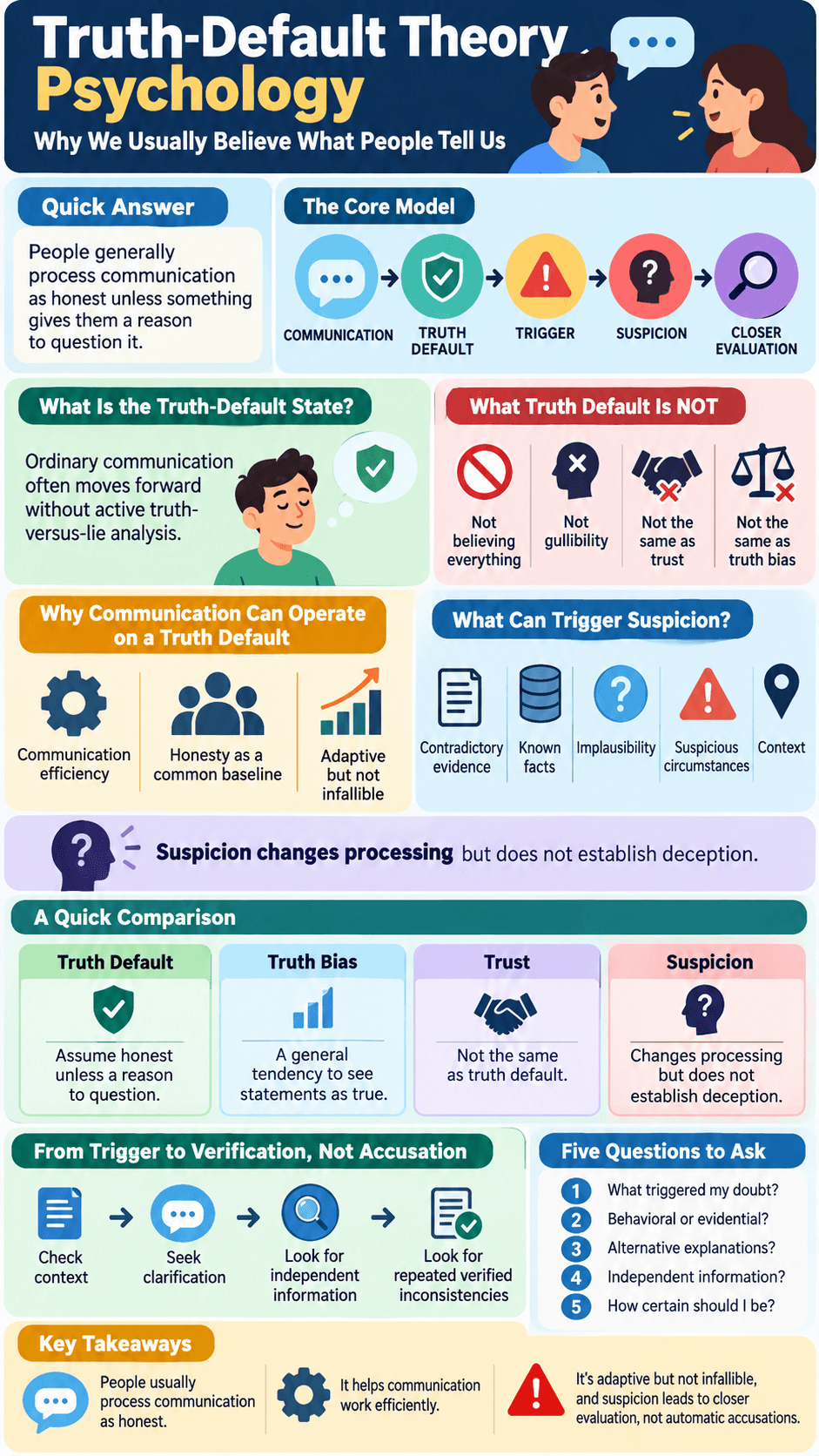
Truth-Default Theory proposes that people generally process communication as honest unless something gives them a reason to question it. This default is not the same as trust, gullibility, or a permanent truth bias. A contradiction, implausible claim, suspicious circumstance, or other contextual trigger may shift someone from passive acceptance toward active suspicion and closer evaluation.
What Truth-Default Theory Proposes
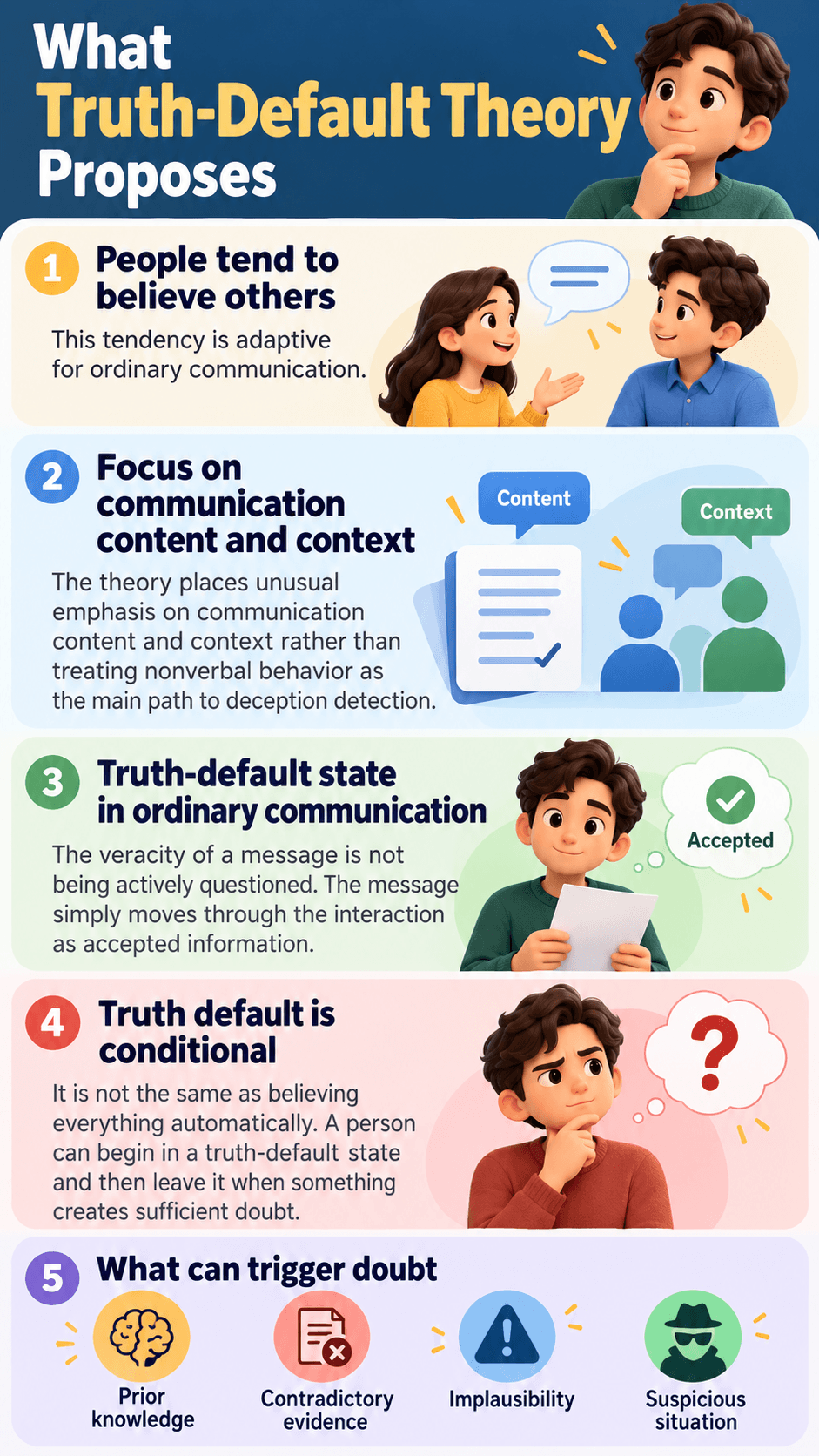
In Levine’s 2014 Truth-Default Theory paper, the central claim is that people tend to believe others and that this tendency is adaptive for ordinary communication. The theory places unusual emphasis on communication content and context rather than treating nonverbal behavior as the main path to deception detection.
Truth-default state in ordinary communication
A truth-default state means that the veracity of a message is not being actively questioned. The listener may understand, remember, react to, or use the message without consciously deciding, “I classify this as true.” The message simply moves through the interaction as accepted information.
Imagine asking a colleague where the printer paper is stored. If they say, “Second cabinet on the left,” you will probably check the cabinet rather than analyze their gaze, vocal pitch, or hand movements. Your mind has many possible tasks in the moment, and determining whether the answer is a lie may not be one of them.
Why truth default is not the same as believing everything automatically
The word “default” can sound absolute, but the theory is more conditional than that. A person can begin in a truth-default state and then leave it when something creates sufficient doubt. Prior knowledge, contradictory evidence, implausibility, or a suspicious situation can make veracity suddenly relevant.
This also means that truth default should not be translated into “humans accept every claim without thinking.” People reject statements, challenge one another, notice contradictions, and sometimes anticipate deception. The point is that active veracity assessment is not necessarily the normal starting state for every message.
The role of Timothy R. Levine and the communication-focused theory
Levine developed Truth-Default Theory within the study of communication and deception. The framework was designed partly to explain findings that are difficult to understand if deception detection is imagined as a constant search for behavioral leakage.
A later review by Levine describes honesty as the starting point for both sending and receiving communication, while suspicion, skepticism, and disbelief require triggers. The 2022 review of Truth-Default Theory also emphasizes that vulnerability to deception can vary dramatically across situations, which is one reason simple claims about a universal human lie-detection ability are misleading.
Why Communication Can Operate on a Truth Default
Communication efficiency and the cost of constant suspicion
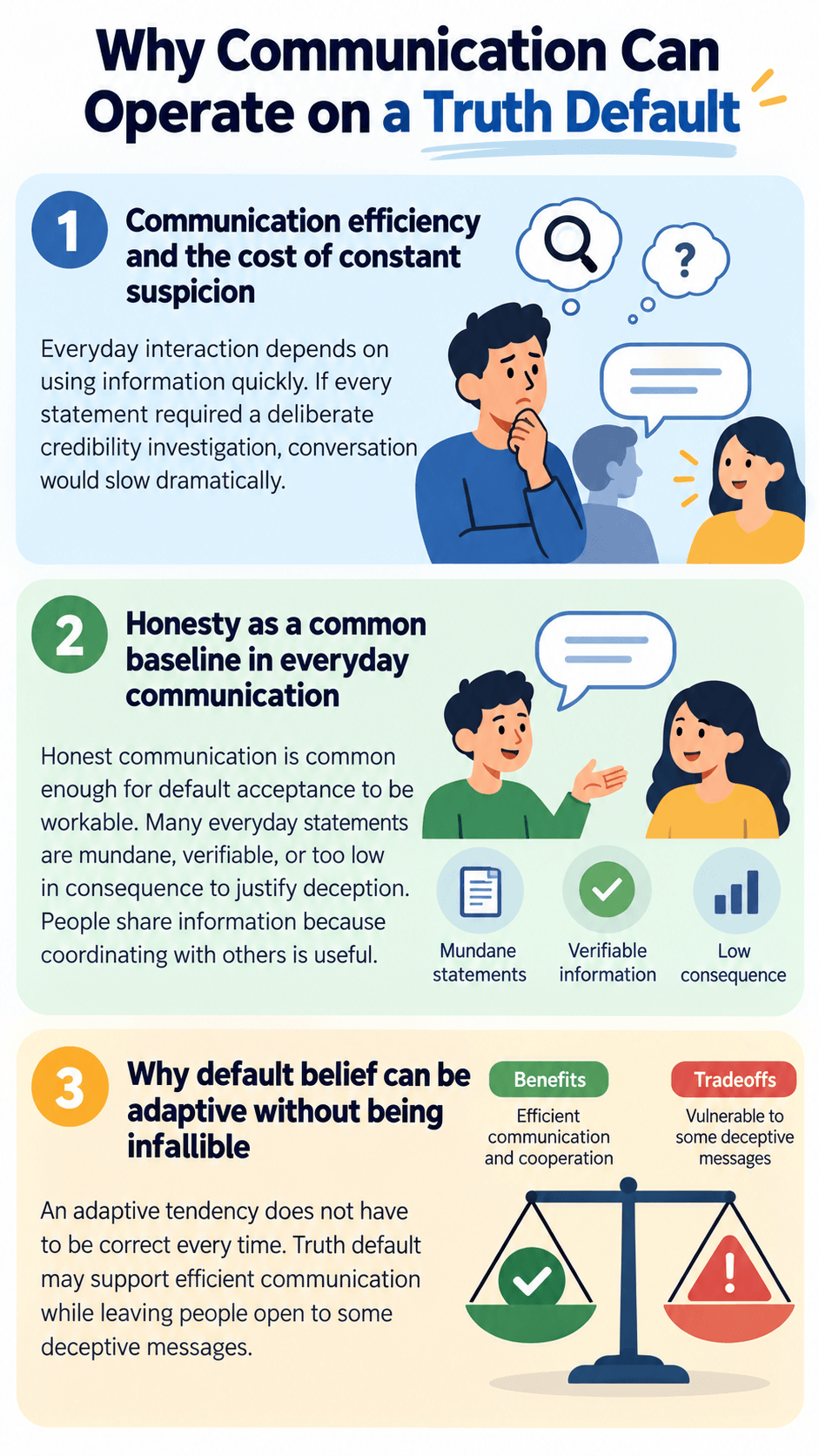
Everyday interaction depends on being able to use information quickly. If every direction, explanation, denial, request, or factual statement demanded a deliberate credibility investigation, conversation would slow dramatically. People would need to spend mental effort evaluating countless low-stakes claims that are usually not deceptive.
Truth default can therefore be understood as part of an efficient communication system. It does not guarantee accuracy in every case. It reduces the cost of treating ordinary communication as a continuous adversarial test.
Honesty as a common baseline in everyday communication
The theory also rests on the idea that honest communication is common enough for default acceptance to be workable. Many everyday statements are mundane, verifiable, or too low in consequence to justify deception. People frequently share information because coordinating with others is useful.
This matters because a default only makes sense relative to an environment. If nearly every ordinary message were deceptive, routinely accepting communication would be disastrous. Truth-Default Theory instead treats honesty as sufficiently common that accepting messages can usually keep social coordination moving.
Why default belief can be adaptive without being infallible
An adaptive tendency does not have to produce the correct answer every time. It can be useful overall while still creating predictable vulnerabilities. Wearing a seat belt is adaptive even though it cannot prevent every injury. In a similar way, truth default may support efficient communication while leaving people open to some deceptive messages.
The tradeoff is important. A person who never accepts anything without proof might avoid some false beliefs, but they could also become slow, suspicious, and unable to cooperate efficiently. Truth-Default Theory focuses on how communication functions under ordinary conditions, not on creating a perfect detector of dishonesty.
The Core Model: Communication, Default, Trigger, Suspicion, Evaluation
A useful way to visualize the theory is:
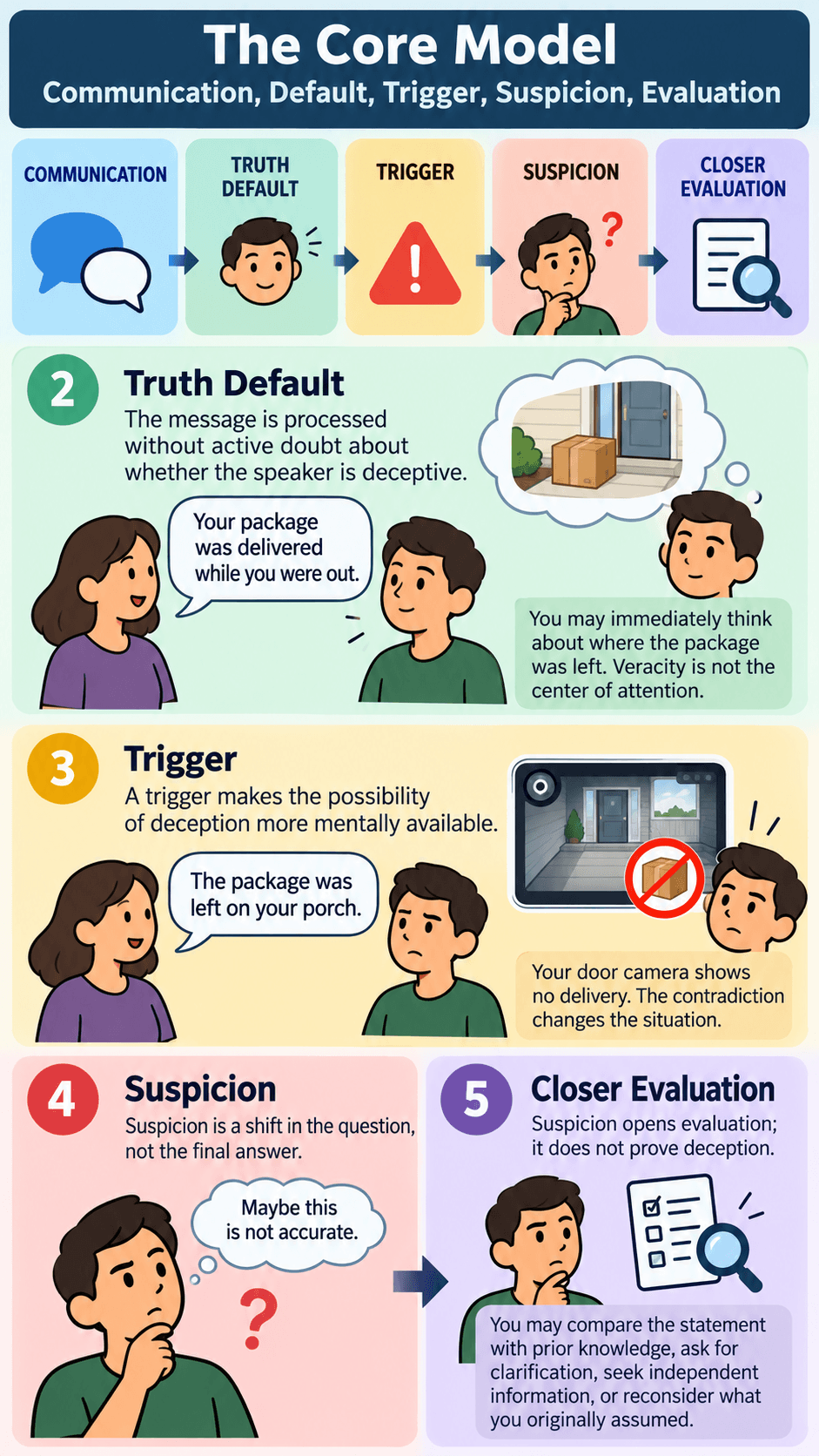
COMMUNICATION → TRUTH DEFAULT → TRIGGER → SUSPICION → CLOSER EVALUATION
This is a reader-friendly map rather than a claim that every brain follows five rigid stages. It helps separate the ordinary acceptance of communication from the point at which veracity becomes an active question.
What the default stage means
At the default stage, the message is being processed without active doubt about whether the speaker is deceptive. A person may still evaluate whether the message is relevant, clear, useful, polite, or surprising. Truth default is specifically about veracity not becoming the center of attention.
For example, if a neighbor says a package was delivered while you were out, you may immediately think about where the package was left. You do not necessarily perform a truth-lie judgment first. The practical meaning of the message takes priority.
What changes when a trigger appears
A trigger makes the possibility of deception more mentally available. Suppose the neighbor says the package was left on your porch, but your door camera shows no delivery. The contradiction changes the situation. Now the claim may receive more deliberate scrutiny because there is a concrete reason to question it.
Notice that the trigger is not “the neighbor looked nervous.” A contextual inconsistency may be more informative than an ambiguous behavior. This focus on content and circumstances is one of the theory’s most useful corrections to popular lie-detection folklore.
Why suspicion changes processing but does not establish deception
Suspicion is a shift in the question, not the final answer. Once a person thinks, “Maybe this is not accurate,” they may compare the statement with prior knowledge, ask for clarification, seek independent information, or reconsider what they originally assumed.
That process can still end with the conclusion that the statement was truthful. The contradiction may have another explanation, memory may be incomplete, or the available information may simply remain uncertain. Suspicion opens evaluation; it does not prove deception.
What Can Trigger Suspicion?
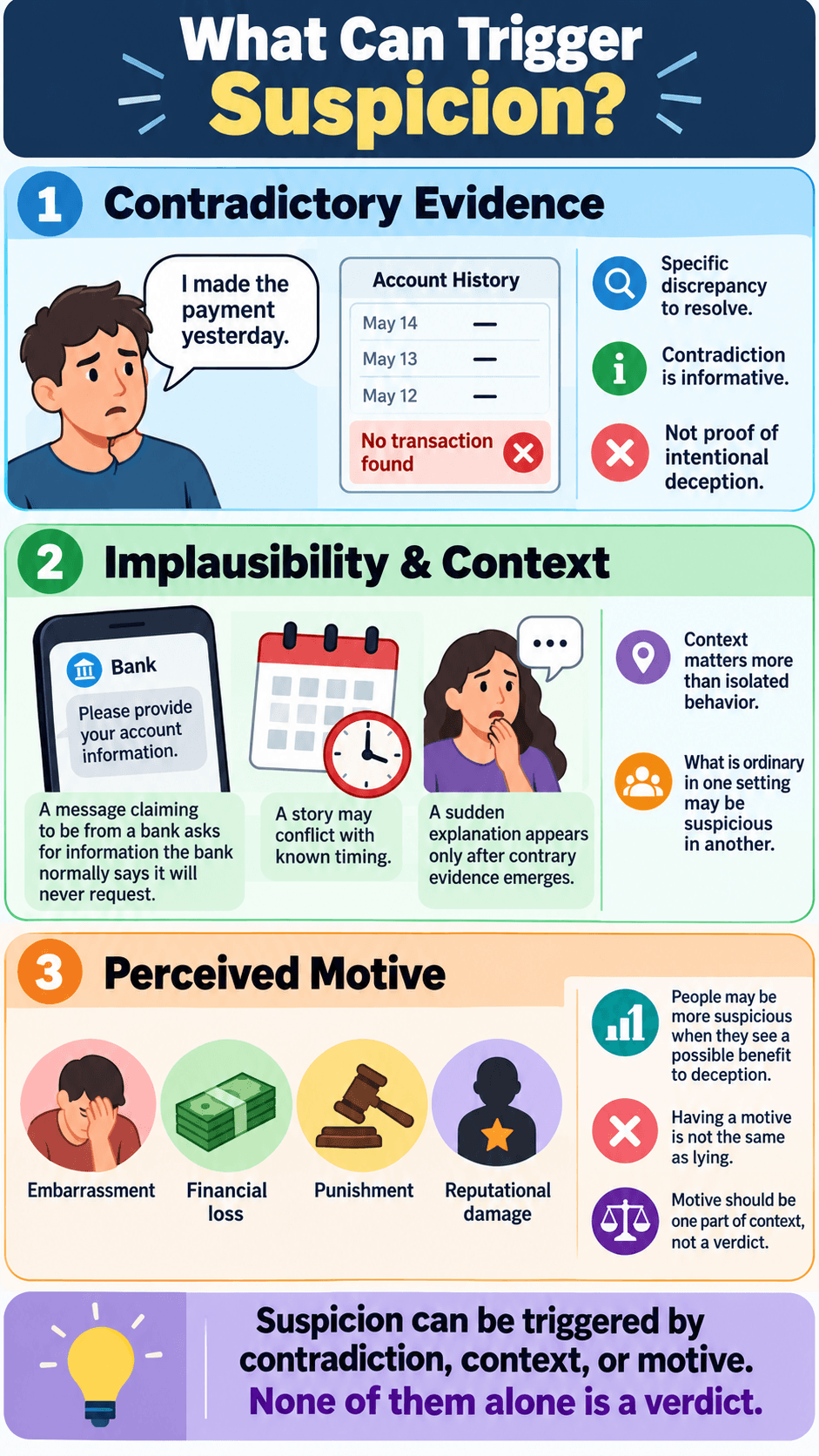
Contradictory evidence and known facts
One of the clearest reasons to question a message is conflict with information that has stronger support. If someone says a payment was made yesterday but the account history shows no transaction, there is a specific discrepancy to resolve. The discrepancy does not automatically show intentional deception, because delays, errors, or misunderstandings remain possible, but it gives the listener a concrete reason to check.
This distinction between contradiction and proof helps reduce premature accusation. A contradiction is informative because it changes what needs explanation. It is not a shortcut around explanation.
Implausibility, context, and suspicious circumstances
Some claims are questioned because they do not fit the surrounding context. A message claiming to be from a bank may ask for information the bank normally says it will never request. A story may contain a sequence that conflicts with known timing. A sudden explanation may appear only after contrary evidence emerges.
Context can therefore matter more than isolated behavior. What is ordinary in one setting may be suspicious in another. A long pause before answering a difficult emotional question, for example, can have many explanations; a claim contradicted by documented facts presents a different kind of reason for doubt.
Perceived motive to deceive and why motive alone is not proof
People may become more suspicious when they can see a possible benefit to deception. Someone facing embarrassment, financial loss, punishment, or reputational damage may appear to have a reason to mislead. Research on projected motive has shown that perceived motives can influence veracity judgments.
However, having a motive is not the same as lying. A person can have something to gain and still tell the truth. Motive is best treated as one part of context, not as a verdict.
How Processing Changes After Suspicion Is Activated
Closer comparison with context and independent information
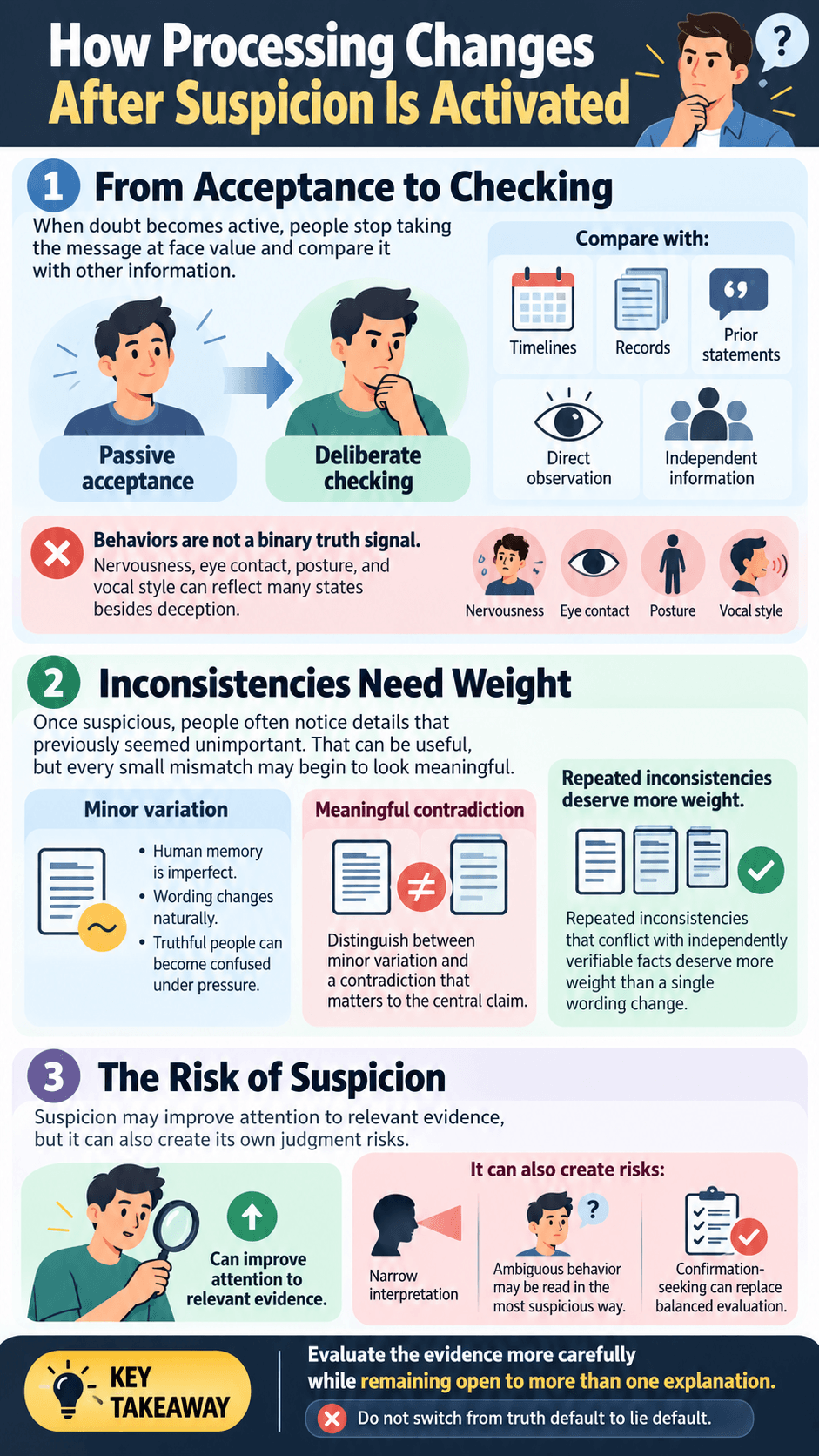
When doubt becomes active, people may stop taking the message at face value and compare it with other information. That may include timelines, records, prior statements, direct observation, or information from an independent party. The practical shift is from passive acceptance to deliberate checking.
This is a better basis for evaluation than trying to convert nervousness, eye contact, posture, or vocal style into a binary truth signal. Those behaviors can reflect many states besides deception.
Greater attention to inconsistencies without turning each inconsistency into proof
Once suspicious, people often notice details that previously seemed unimportant. That can be useful, but it also creates a risk: every small mismatch may begin to look meaningful. Human memory is imperfect, wording changes naturally, and truthful people can become confused under pressure.
A stronger approach is to distinguish between minor variation and a contradiction that matters to the central claim. Repeated inconsistencies that conflict with independently verifiable facts deserve more weight than a single wording change.
Why active suspicion can also create its own judgment risks
Suspicion may improve attention to relevant evidence, but it can also narrow interpretation. Once a person expects deception, ambiguous behavior may be read in the most suspicious way. Confirmation-seeking can replace balanced evaluation.
This is why leaving the truth default should not mean switching to “lie default.” The goal is not to replace automatic belief with automatic disbelief. It is to evaluate the available evidence more carefully while remaining open to more than one explanation.
Truth Default vs Nearby Concepts
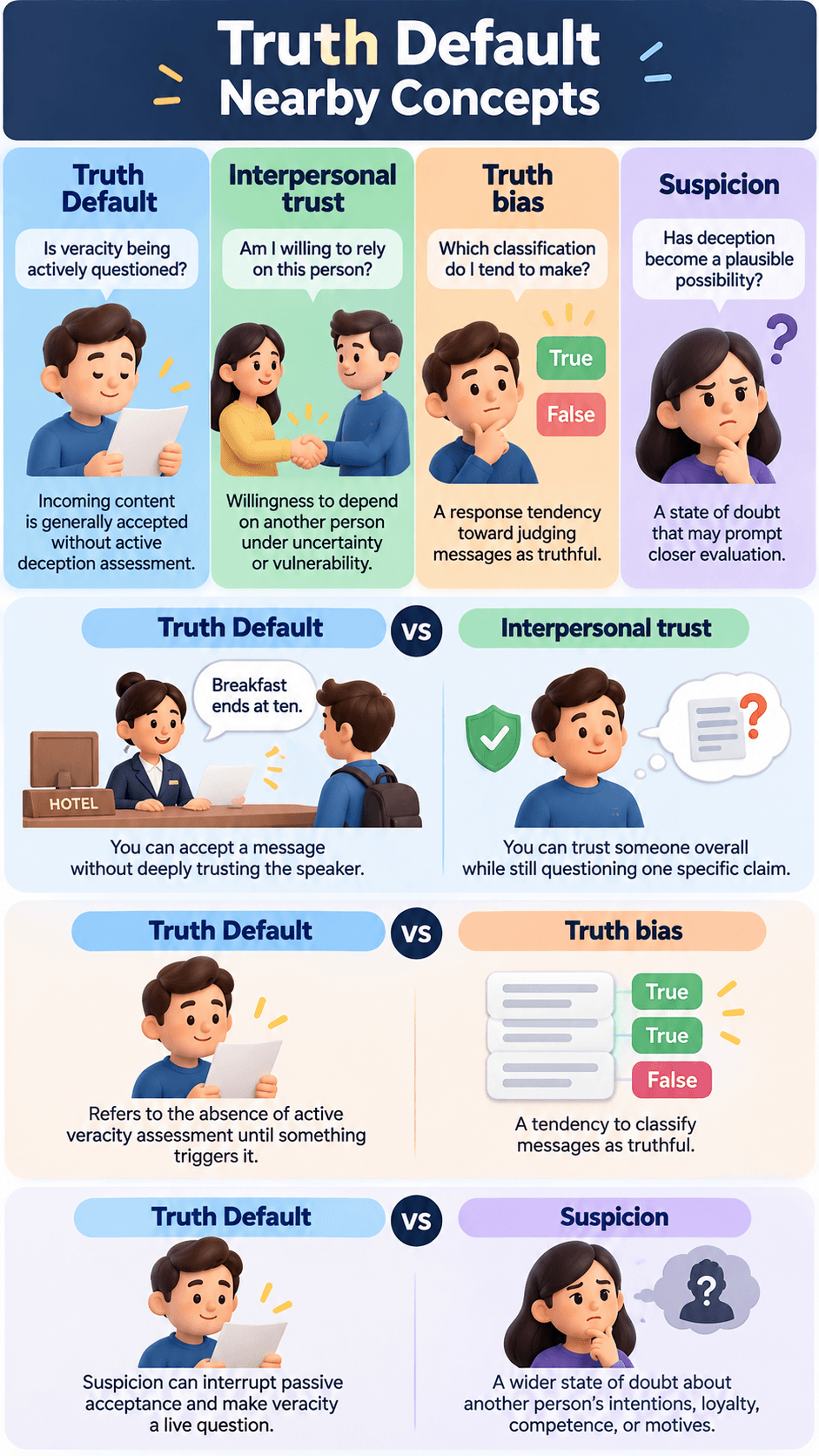
Several concepts sound similar but answer different psychological questions. Keeping them separate prevents a useful theory from turning into a vague synonym for trust or belief.
| Concept | Main question | What it describes |
|---|---|---|
| Truth default | Is veracity being actively questioned? | A communication state in which incoming content is generally accepted without active deception assessment. |
| Interpersonal trust | Am I willing to rely on this person? | Willingness to depend on another person under uncertainty or vulnerability. |
| Truth bias | Which classification do I tend to make? | A response tendency toward judging messages as truthful. |
| Suspicion | Has deception become a plausible possibility? | A state of doubt that may prompt closer evaluation. |
Truth Default vs interpersonal trust
You can accept a particular message without deeply trusting the speaker. A hotel guest may believe the receptionist when told breakfast ends at ten even though no personal relationship exists. Conversely, you can trust someone overall while still questioning one specific claim if strong contradictory information appears.
Trust concerns reliance on a person across uncertainty. Truth default concerns how communication is processed before active veracity questioning begins. The two often interact, but they are not interchangeable.
Truth Default vs truth bias
Truth bias describes a tendency to classify messages as truthful. Truth default refers more specifically to the absence of active veracity assessment until something triggers it. The distinction may seem subtle, but it changes what is being explained.
A person can show more truth judgments in an experiment because of response tendencies, base rates, or task conditions. Truth-Default Theory asks a more basic question: was truth versus deception even being consciously evaluated before the person was prompted to judge?
Truth Default vs broad suspicion
Suspicion is a wider psychological state of doubt. Someone can be suspicious about another person’s intentions, loyalty, competence, or motives without making a specific truth-lie judgment. In Truth-Default Theory, suspicion matters because it can interrupt passive acceptance and make veracity a live question.
The theory therefore does not try to explain every form of suspicion. It uses suspicion in a narrower role within deceptive communication.
Can People Detect Lies If They Usually Default Toward Truth?
Why a truth default does not eliminate deception detection
A truth default does not mean people are incapable of detecting deception. It means detection is often conditional on triggers and useful information. Some situations provide obvious contradictions, strong contextual clues, or knowledge that makes a false claim easier to identify.
This helps explain why deception detection can vary so much from one situation to another. The 2022 review argues that truth-default processes can help make sense of the wide difference between laboratory judgments and some real-world contexts where diagnostic information is more available.
What direct research says about spontaneous veracity assessment
A particularly relevant test asked whether people spontaneously think about truth and deception when not explicitly prompted to do so. In two experiments involving videotaped communication and live face-to-face interaction, Clare and Levine’s 2019 study found that unprompted thought listings mentioned veracity less than 10 percent of the time.
That finding should not be interpreted as a universal percentage for all conversations. The value lies in what the experiments demonstrate: asking people directly, “Was this true or a lie?” can create a veracity task that may not have existed spontaneously. Research procedures themselves can change what participants pay attention to.
How overall detection accuracy fits into the picture
Truth-default processes also interact with the fact that truths and lies do not always occur at equal rates. In controlled experiments, researchers often balance truthful and deceptive messages so performance can be compared. Everyday communication does not necessarily have that balance.
Research on truth-lie base rates in interactive deception detection found that changing the proportion of honest messages changed overall discrimination accuracy in predictable ways. That is one reason accuracy cannot be understood solely as a stable personal skill.
Limits and Critiques of Truth-Default Explanations
Conditional rather than universal claims
Truth-Default Theory is most useful when its claims remain conditional. People do not always accept incoming information. Some environments are adversarial, some messages arrive with warnings attached, and some listeners begin with strong reasons for doubt.
Prior experience also matters. A person who has repeatedly encountered fraud attempts in a particular channel may approach the next message with immediate skepticism. In that situation, a truth-default state may be weaker, shorter, or absent.
Different theories can explain similar judgment patterns
Truth-Default Theory is not the only account of how people make truth-lie judgments. A 2024 paper in Communication Theory comparing TDT with the Adaptive Lie Detector account notes that the two approaches propose different mechanisms while sometimes predicting similar behavior.
This is a useful scientific caution. Observing that people often judge messages as truthful does not, by itself, prove exactly which internal process produced that pattern. Competing explanations can overlap in prediction even when they disagree about mechanism.
Why research context affects what conclusions are reasonable
Many deception studies create tasks in which participants know they must judge truth versus lie. Everyday conversation often does not announce itself as a deception-detection task. That difference matters because prompting suspicion can change attention, decision criteria, and the relevance of veracity.
Laboratory work is valuable because actual truth status can be controlled. At the same time, real-life deception varies in stakes, preparation, familiarity, emotional meaning, and available evidence. A careful interpretation keeps both strengths and limitations in view.
Why the theory should not be translated into “humans are naive”
Naivety is a judgment about a person. Truth default is a proposed feature of communication processing. Treating the two as synonyms turns a theoretical idea into a character label.
A person can be intelligent, experienced, and cautious while still accepting most ordinary statements because doing so is efficient. The important question is not whether default belief makes someone foolish. It is whether the situation provides a strong enough reason to leave default acceptance and evaluate veracity more deliberately.
From Trigger to Verification, Not Accusation
Check context, clarification, independent information, and repeated verified inconsistencies
When something triggers suspicion, a proportionate next step is usually to gather better information. That may mean asking a neutral clarifying question, checking a record, comparing timelines, or looking for evidence that does not depend on the same person’s account.
For example, “I may be missing something. Can you walk me through when that happened?” invites clarification without treating suspicion as a verdict. In a financial or workplace setting, documentation may be more informative than trying to read demeanor.
Treat suspicious cues as prompts for evaluation rather than verdicts
Nervousness, pauses, changes in eye contact, fidgeting, and speech errors are ambiguous. They can occur when people are anxious, embarrassed, cognitively overloaded, socially uncomfortable, intimidated, tired, or simply aware that they are being judged. Calmness is equally poor as proof of honesty.
A more responsible rule is simple: a cue may justify curiosity, but it does not establish deception. The stronger the consequence of being wrong, the stronger the evidence should be before moving from uncertainty to accusation.
A five-question check before deciding what you believe
- What exactly triggered my doubt? Identify the contradiction, context, or information that changed your judgment.
- Is the trigger behavioral or evidential? A nervous presentation and a documented contradiction should not be treated as equivalent.
- What alternative explanations remain possible? Memory error, misunderstanding, timing, stress, or incomplete information may matter.
- What independent information could clarify the claim? Prefer evidence that does not rely only on your impression of the speaker.
- How certain should I be right now? Match confidence to the quality of the evidence rather than to the intensity of your suspicion.
This check does not guarantee a correct judgment. Its purpose is to prevent the move from “something feels off” to “I know this person is lying” from happening faster than the evidence supports.
FAQ
Does Truth-Default Theory say people believe every statement automatically?
No. The theory proposes that communication often begins with passive acceptance rather than active veracity assessment, but contextual triggers can interrupt that state. People may question a message when it conflicts with prior knowledge, appears implausible, or arrives in suspicious circumstances. The theory is conditional, not a claim of universal automatic belief.
Is truth default the same as trusting a person?
No. Trust concerns willingness to rely on another person under uncertainty or vulnerability. Truth default concerns whether the truthfulness of a particular communication is being actively questioned. You can accept a low-stakes statement from a stranger without trusting them broadly, and you can question one statement from someone you generally trust.
Is truth default the same as truth bias?
They are related but distinct. Truth bias is a tendency to classify messages as truthful. Truth default refers to a communication state in which veracity may not be actively assessed at all until a trigger creates doubt. One describes a response tendency; the other describes how veracity can remain outside active consideration.
What kinds of information can shift someone out of a truth-default state?
Contradictory evidence, implausibility, suspicious circumstances, knowledge of a possible motive to deceive, or conflict with known facts can all make veracity more salient. The strength of a trigger depends on context. No single behavior, including nervousness or gaze direction, should be treated as a universal trigger that proves deception.
Can suspicion make deception judgments more accurate?
Sometimes suspicion can prompt closer evaluation, especially when it directs attention toward genuinely diagnostic information. But suspicion can also produce confirmation-seeking and overinterpretation of ambiguous behavior. Accuracy depends on the quality of the information available, not simply on how skeptical a person feels.
Key Takeaways
- Truth-Default Theory proposes that ordinary communication often begins without active questioning of whether a message is deceptive.
- A truth-default state is not the same as gullibility, interpersonal trust, truth bias, or a broad tendency to be unsuspicious.
- Contradictions, context, prior knowledge, implausibility, and suspicious circumstances can trigger closer veracity evaluation.
- Suspicion changes the question but does not prove deception; evaluation can still end with uncertainty or a truthful judgment.
- Behavioral cues such as nervousness or eye contact are ambiguous and should not be treated as standalone evidence of lying.
- When consequences are serious, documented facts and independent evidence deserve more weight than impressions of demeanor.
About the author: Michael Reed is the Founder & Lead Writer at Psychology Exposed. He writes about human behavior, relationships, emotional patterns, self-awareness, and everyday decision-making in a clear, research-aware way.

Michael Reed is the Founder and Lead Writer at Psychology Exposed. He writes about human behavior, relationships, emotional patterns, self-awareness, and practical psychology topics using research-informed, easy-to-understand content.
Read More About Michael Reed: https://psychologyexposed.com/michael-reed/