
It is easy to feel that you would know a lie when you heard one. A pause seems suspicious. A story changes slightly. Someone looks uncomfortable, answers too quickly, or appears almost too calm. In everyday life, those impressions can feel meaningful because the consequences of being misled may matter.
But deception detection accuracy asks a stricter question than “Did something seem off?” It asks whether a person’s final truth-or-lie judgment actually matches reality. That distinction matters because many behaviors associated with suspicion can occur when someone is truthful, anxious, embarrassed, distracted, under pressure, or simply communicating in an unfamiliar way.
Research on human deception judgments has repeatedly found that unaided observers are not highly accurate lie detectors. The point is not that people are incapable of ever noticing deception. It is that human judgment is limited by weak cues, response tendencies, missing context, and the difficulty of knowing the true answer outside controlled research. A behavioral clue may justify curiosity or verification, but it does not prove deception.
Quick Answer
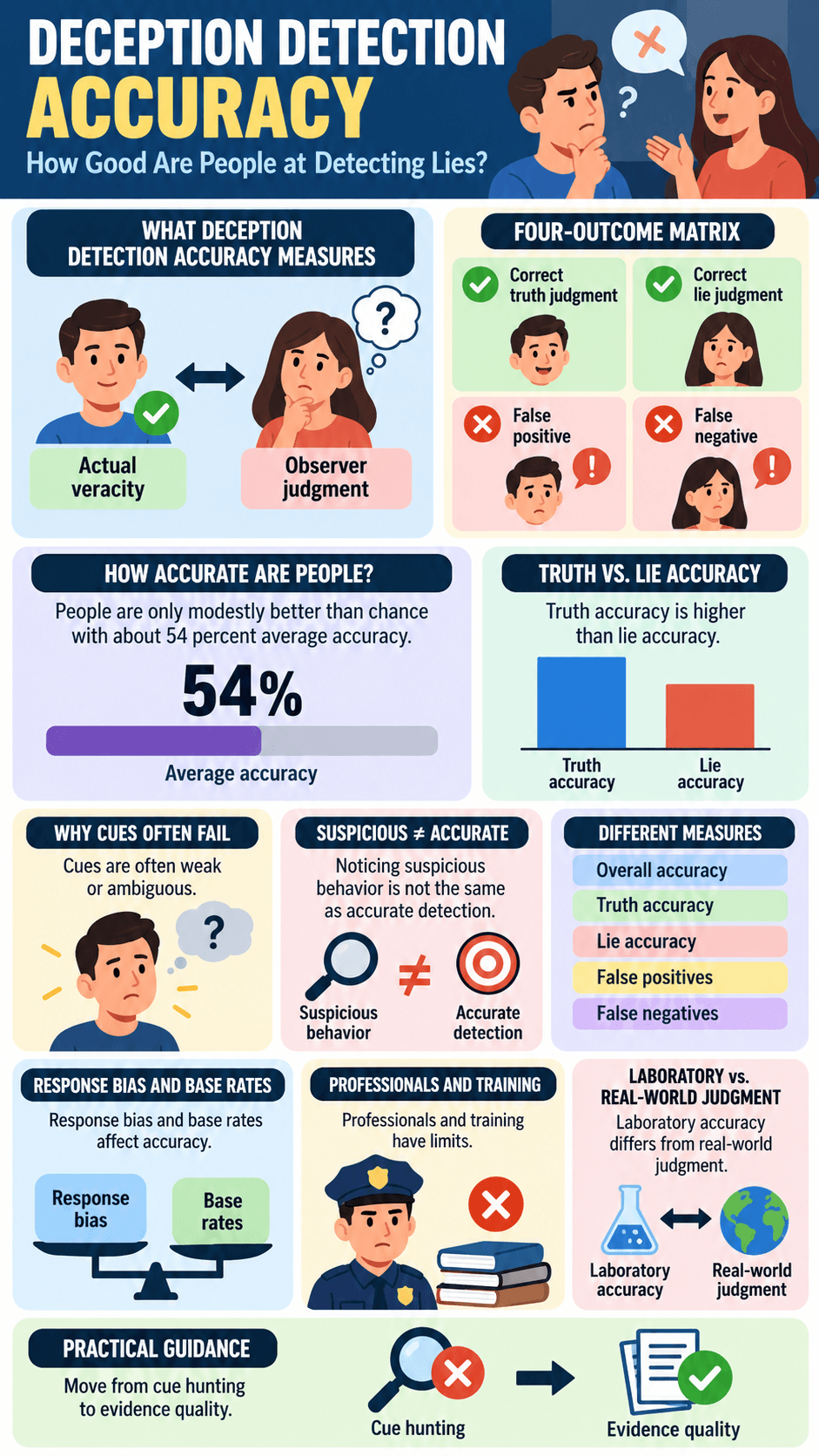
People are generally only modestly better than chance at distinguishing truths from lies under controlled research conditions. A major meta-analysis found about 54 percent overall accuracy, with truth judgments more accurate than lie judgments. That number is a group average, not a personal score or universal constant. Accuracy changes with the task, available information, response bias, base rates, and research design.
What Deception Detection Accuracy Measures
Deception detection accuracy is about correspondence between two things: what was actually true or deceptive, and what an observer decided. In a typical experiment, researchers know which statements were truthful and which were deceptive. Participants then classify messages, speakers, or accounts as truth or lie. Because the researchers know the ground truth, they can compare judgment with reality.
Actual veracity versus observer judgment
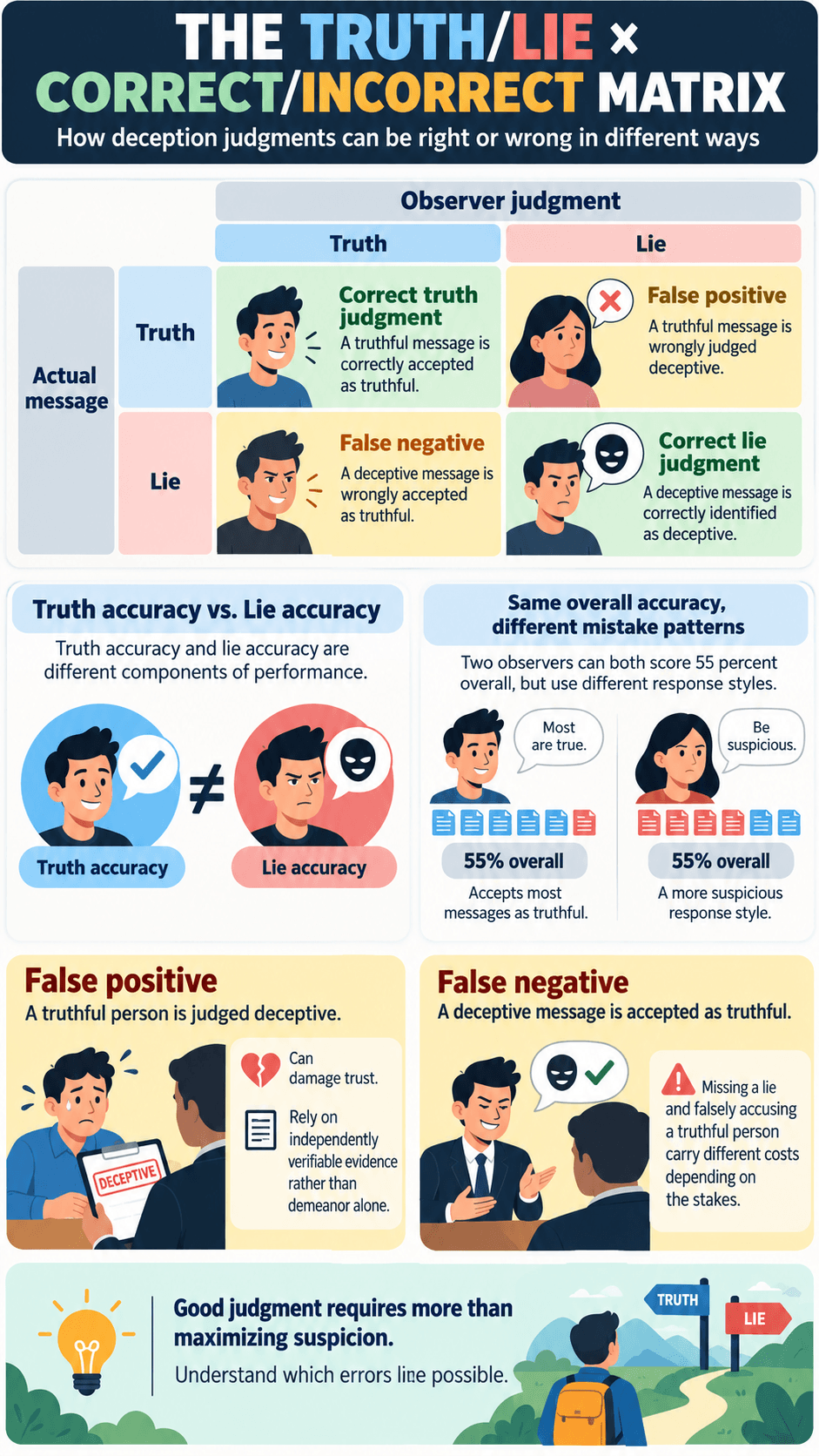
Suppose a participant watches 20 short interviews, 10 truthful and 10 deceptive. The participant labels each one “truth” or “lie.” Every response falls into one of four outcomes: a truth correctly accepted as truth, a lie correctly identified as a lie, a truthful message incorrectly called a lie, or a deceptive message incorrectly accepted as truth.
This sounds simple, but it immediately reveals why raw confidence is not enough. Two people can both feel highly certain while making different numbers and different types of errors. One may be reluctant to accuse anyone and therefore miss lies. Another may be highly suspicious and therefore call many truthful messages deceptive.
Accuracy is not the same as noticing suspicious behavior
Noticing hesitation, inconsistency, nervousness, gaze changes, or an unusual tone is not itself a correct deception judgment. Those observations may be real, but their cause may be ambiguous. A truthful person can hesitate while recalling a complicated event. A deceptive person can appear composed because the story is simple, rehearsed, or familiar.
This is why deception research separates behavioral observation from veracity accuracy. A cue can be noticeable without being diagnostic. A cue can also be associated with deception in some research conditions without being reliable enough to decide whether a particular person is lying.
Why balanced laboratory tasks often use chance as a benchmark
When an experiment contains an equal number of truthful and deceptive messages and participants must choose between two options, random guessing would average about 50 percent correct over many trials. That makes 50 percent a useful comparison point for balanced tasks.
However, real life rarely provides a perfectly balanced set of truths and lies. If nine out of ten messages in a setting are truthful, someone who calls nearly everything truthful could look highly accurate overall while being very poor at recognizing deception. This is one reason overall percentage correct must be interpreted alongside truth accuracy, lie accuracy, and response tendencies.
The Truth/Lie × Correct/Incorrect Matrix
| Actual message | Observer judgment | Outcome | What it means |
|---|---|---|---|
| Truth | Truth | Correct truth judgment | A truthful message is correctly accepted as truthful. |
| Lie | Lie | Correct lie judgment | A deceptive message is correctly identified as deceptive. |
| Truth | Lie | False positive | A truthful message is wrongly judged deceptive. |
| Lie | Truth | False negative | A deceptive message is wrongly accepted as truthful. |
Correct truth judgment and correct lie judgment
Truth accuracy and lie accuracy are different components of performance. A person can be fairly good at accepting truthful messages while being poor at identifying lies. Another person can be more willing to call messages deceptive, which may increase the number of lies caught while also increasing false accusations.
This matters because “accuracy” can hide the shape of the mistakes. If two observers both score 55 percent overall, one could reach that number by accepting most messages as truthful while the other reaches it through a more suspicious response style.
False positive: judging truth as deception
A false positive occurs when someone is truthful but is judged to be lying. In everyday life, this can be especially damaging because the observer may believe the mistake is evidence of insight. A nervous employee answering questions about an error, for example, may appear evasive simply because being evaluated is stressful.
False positives are a reminder that suspicion has costs. Calling a truthful person deceptive can damage trust, escalate conflict, influence workplace decisions, or distort how later information is interpreted. The more serious the accusation, the more important it is to rely on independently verifiable evidence rather than demeanor alone.
False negative: judging deception as truth
A false negative occurs when a deceptive message is accepted as truthful. This is the error people often imagine when thinking about lie detection: “I believed them, but the claim was false.” It can happen because deceptive behavior is subtle, because the observer expects honesty, or because the liar’s presentation does not match familiar stereotypes.
Neither error is automatically more important in every situation. Missing a lie and falsely accusing a truthful person carry different costs depending on the stakes. Good judgment therefore requires more than maximizing suspicion. It requires understanding which errors are possible and what evidence would justify a stronger conclusion.
What Major Research Says About Human Accuracy
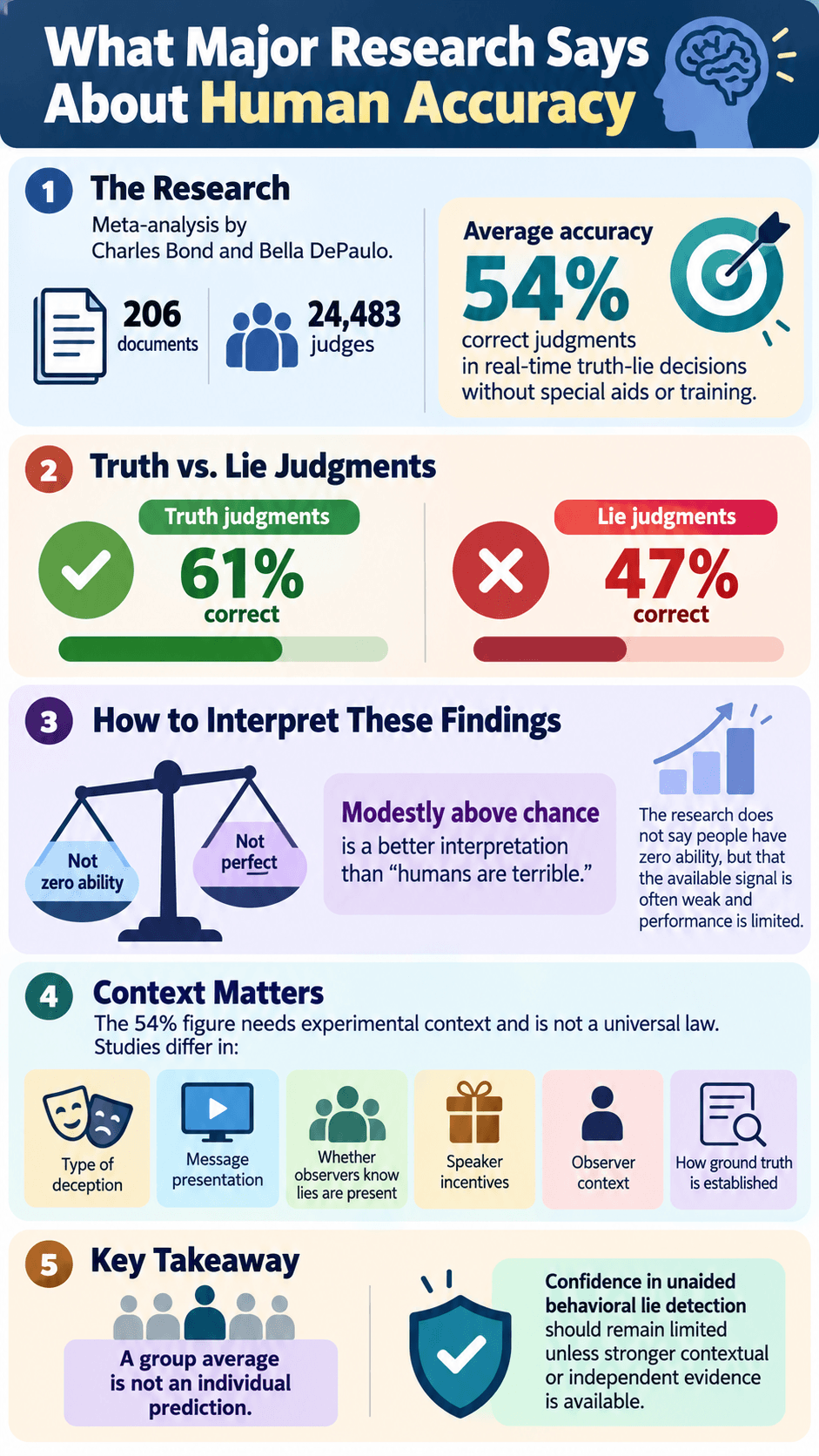
One of the most frequently cited quantitative summaries is the meta-analysis by Charles Bond and Bella DePaulo. Synthesizing 206 documents involving 24,483 judges, they reported an average of about 54 percent correct judgments under conditions in which people made real-time truth-lie decisions without special aids or training. The same analysis reported higher accuracy for truths than for lies, approximately 61 percent versus 47 percent. The details are available in the PubMed record for the Bond and DePaulo meta-analysis.
Why “modestly above chance” is more useful than “humans are terrible”
A 54 percent average in balanced experiments is only modestly above a 50 percent guessing benchmark, but describing it as pure chance would be inaccurate. The research does not say people have zero ability. It says the signal available to unaided observers is often weak enough that performance remains limited.
That distinction is important for responsible interpretation. “People are perfect lie detectors” is unsupported, but “people can never detect lies” also goes too far. Human performance is better described as constrained, variable, and highly dependent on what information is available.
Exact estimates need experimental context
The 54 percent figure is memorable, but it should not be turned into a universal law. It does not mean every person is exactly 54 percent accurate, every lie has a 46 percent chance of being missed, or every real-world situation behaves like a laboratory classification task.
Studies differ in the kind of deception used, how messages are presented, whether participants know lies are present, what incentives speakers have, whether observers receive context, and how ground truth is established. The estimate is most useful as a broad benchmark for unaided judgment across many controlled studies.
A group average is not an individual prediction
Meta-analysis summarizes patterns across many samples. It cannot tell you that one particular person will perform at the average or that a specific judgment has a 54 percent probability of being correct. Individual performance can vary, and any single case may contain information that was absent from the experiments behind the average.
So the responsible takeaway is not “your instincts are 54 percent accurate.” It is that confidence in unaided behavioral lie detection should be limited unless stronger contextual or independent evidence is available.
Truth Accuracy and Lie Accuracy Can Diverge
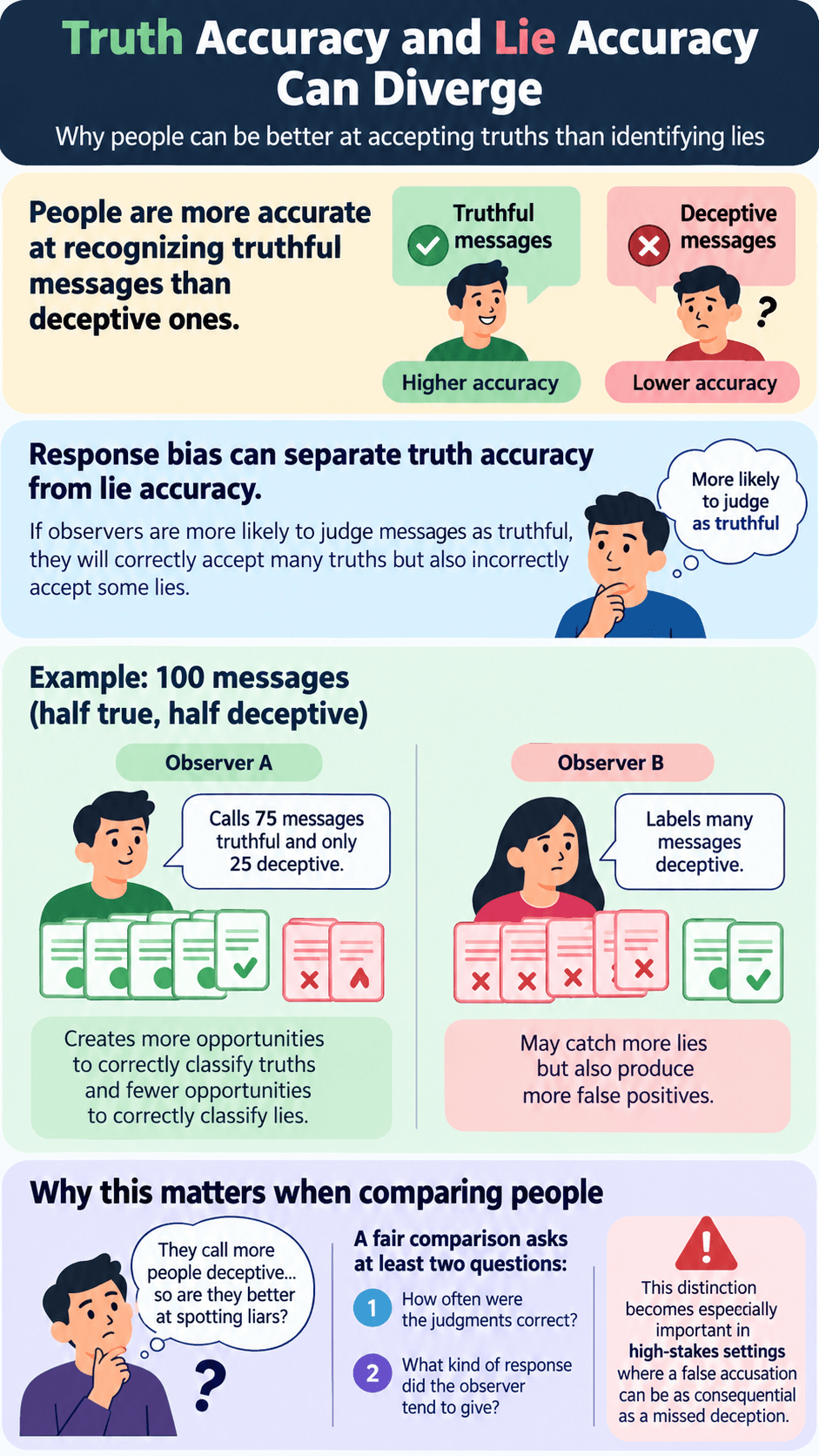
Why people can be better at accepting truths than identifying lies
The Bond and DePaulo findings illustrate an important asymmetry: participants were more accurate at recognizing truthful messages than deceptive ones. One explanation is response bias. If observers are more likely to judge messages as truthful, they will correctly accept many truths but also incorrectly accept some lies.
This is not the same as saying people are naive. Ordinary communication often contains much more truth than deception, and treating every statement as suspicious would make everyday interaction inefficient. The difficulty appears when a general tendency to accept communication as truthful is applied to a task where lies are deliberately mixed in.
Response bias can separate truth accuracy from lie accuracy
Imagine 100 messages, half true and half deceptive. Observer A calls 75 messages truthful and only 25 deceptive. Even without superior discrimination ability, that response pattern creates more opportunities to correctly classify truths and fewer opportunities to correctly classify lies.
Observer B does the reverse and labels many messages deceptive. That person may catch more lies but also produce more false positives. This is why the frequency of “truth” and “lie” responses must be separated from the ability to discriminate between them.
Why this matters when comparing people
Suppose one person appears “better at spotting liars” because they call more people deceptive. That conclusion may be wrong. Their higher lie accuracy could partly reflect a more suspicious response threshold rather than greater sensitivity to valid information.
A fair comparison asks at least two questions: How often were the judgments correct, and what kind of response did the observer tend to give? This distinction becomes especially important in high-stakes settings where a false accusation can be as consequential as a missed deception.
Why Deception Detection Is So Difficult
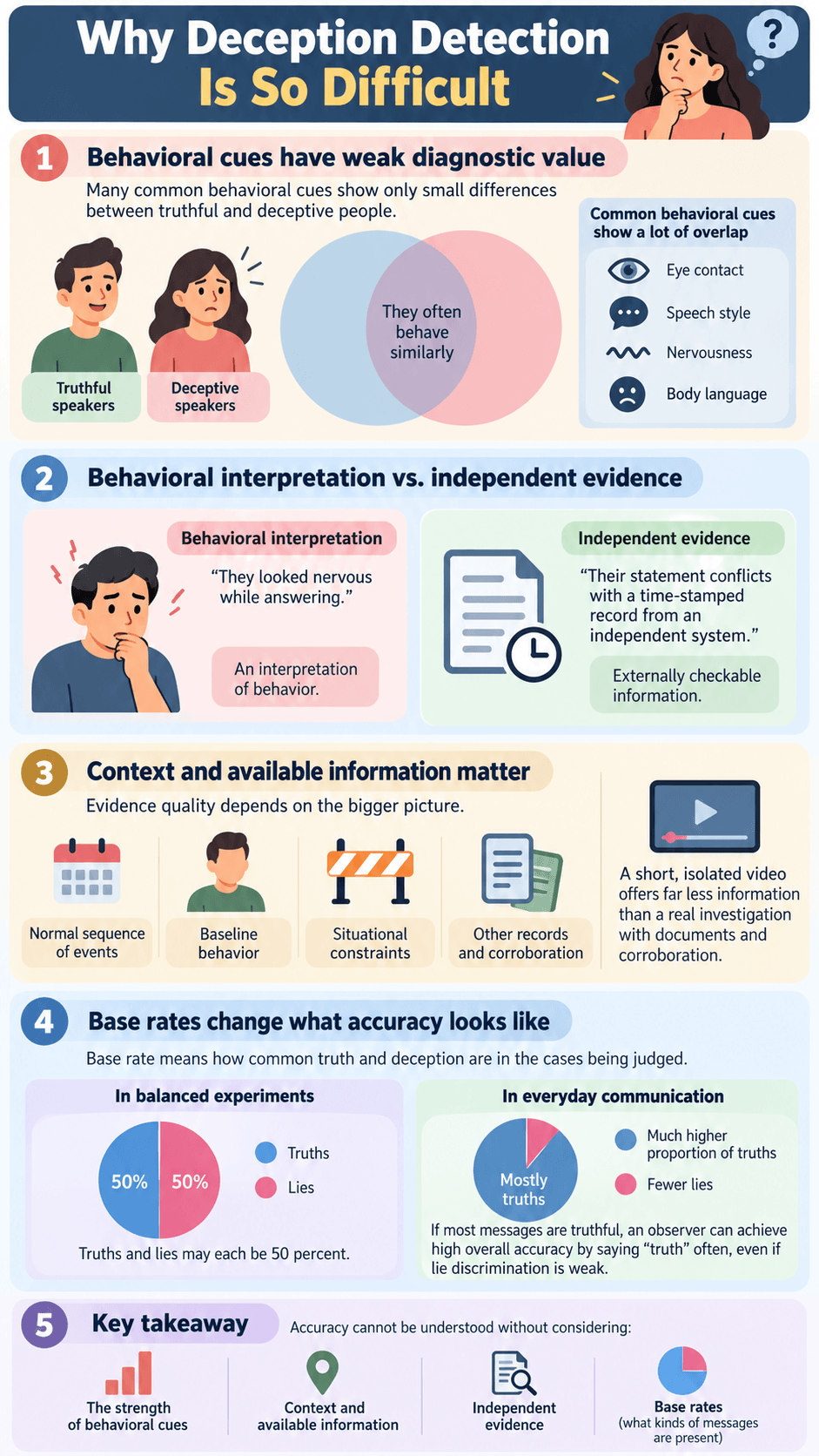
Many familiar behavioral cues have weak diagnostic value
People often look for visible or audible signs that supposedly reveal deception. Yet research suggests a more basic problem than simply choosing the “wrong” cue. A meta-analytic lens-model analysis by Maria Hartwig and Charles Bond concluded that the behavioral differences available to observers are often weak, which limits how accurately those behaviors can support truth-lie judgments. Their review is summarized in the PubMed record on why lie-catchers fail.
This helps explain why simply learning a longer list of behaviors does not solve the problem. If truthful and deceptive speakers overlap heavily in how they behave, even a careful observer may receive an ambiguous signal.
Information availability, context, and independent evidence
Accuracy can improve when judgment is based on information that is more directly connected to the claim. Consider the difference between “They looked nervous while answering” and “Their statement conflicts with a time-stamped record from an independent system.” The first is an interpretation of behavior. The second is externally checkable information.
Context also matters. Knowing the normal sequence of events, the person’s baseline behavior, the constraints of the situation, or what other records show can change the quality of the evidence. A lie-detection task based on a short isolated video may offer far less information than a real investigation with documents and corroboration.
Base rates change what overall accuracy means
Base rate means how common truth and deception are in the set of cases being judged. In a balanced experiment, truths and lies may each make up 50 percent of the messages. In everyday communication, the proportion can be very different.
If most messages in a setting are truthful, a truth-biased observer can achieve high overall accuracy by saying “truth” often, even if their ability to discriminate lies is weak. If a setting contains an unusually high proportion of deception, the same response strategy will perform worse. Accuracy therefore cannot be understood without considering what kinds of messages are present.
Professionals, Training, and the Myth of the Human Lie Detector
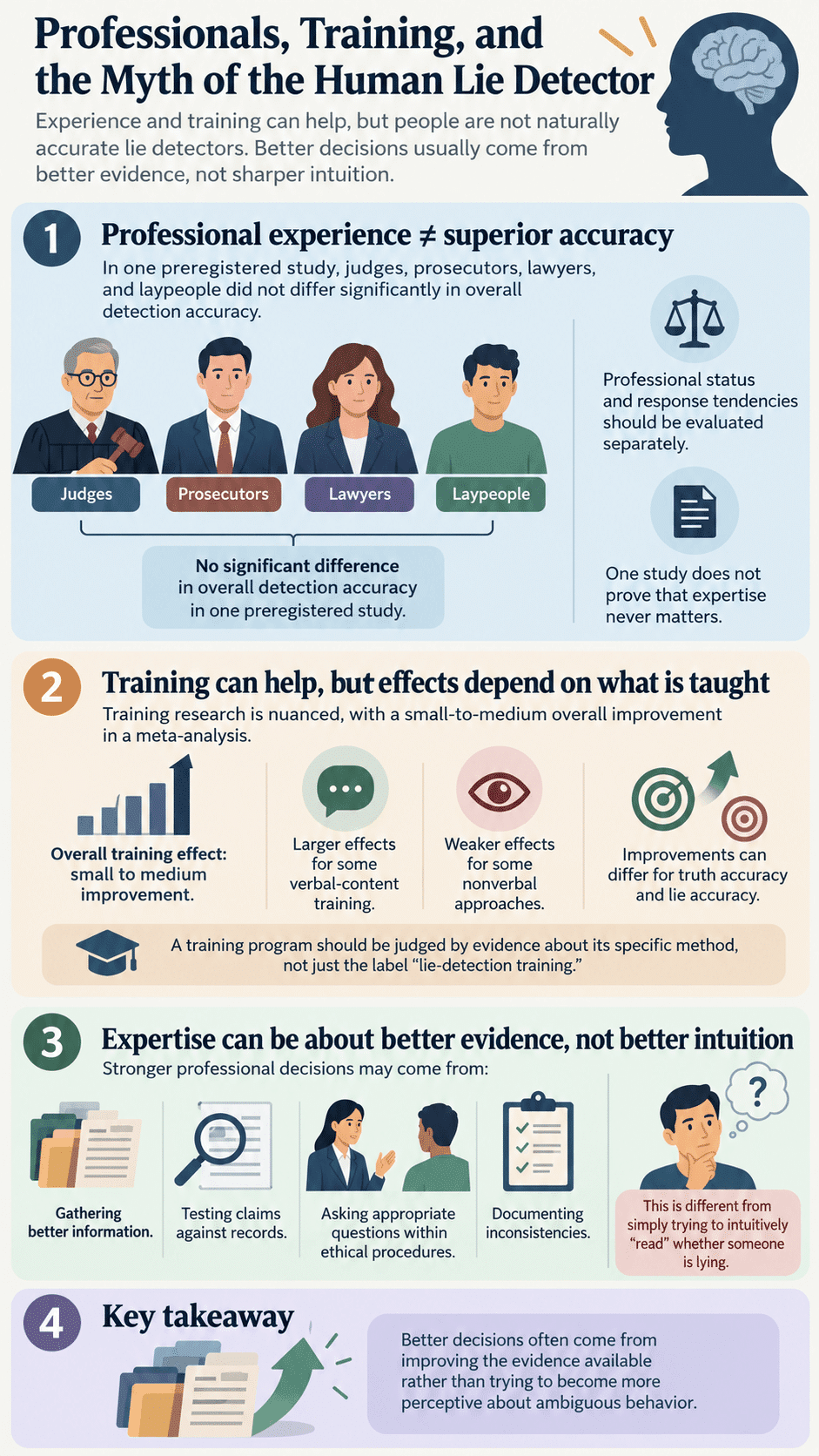
Professional experience does not guarantee superior accuracy
Jobs that involve interviewing, judging credibility, or investigating claims may create an understandable expectation of expertise. However, experience alone does not guarantee consistently high truth-lie discrimination. A recent preregistered study comparing judges, prosecutors, and lawyers with laypeople found no significant difference in overall detection accuracy in its task. The open-access report on expertise and lie-truth detection in the legal system also illustrates why professional status and response tendencies should be evaluated separately.
One study should not be used to claim that expertise never matters. Professional groups differ in training, tasks, feedback, and access to contextual evidence. The stronger point is that occupational experience should not be treated as proof of exceptional unaided lie-detection ability.
Training can help, but effects depend on what is taught
Training research is more nuanced than “training does not work.” A meta-analysis of controlled training studies found a small-to-medium overall improvement, with larger effects in some forms of verbal-content training and weaker effects for some nonverbal approaches. The meta-analysis on deception-detection training also reported that improvements differed for truth accuracy and lie accuracy.
That means a training program should be judged by evidence about its specific method, not by the label “lie-detection training.” Teaching people to rely more strongly on stereotypical nonverbal cues can create confidence without necessarily producing large accuracy gains.
Expertise can be about better evidence, not better intuition
In real practice, skilled professionals may improve decisions by gathering better information, testing claims against records, asking appropriate questions within ethical procedures, and documenting inconsistencies. Those are different abilities from watching a person and intuitively “reading” whether they are lying.
This distinction is useful outside professional settings too. Better decisions often come from improving the evidence available rather than trying to become more perceptive about ambiguous behavior.
Detection Accuracy vs Signs Someone Is Lying
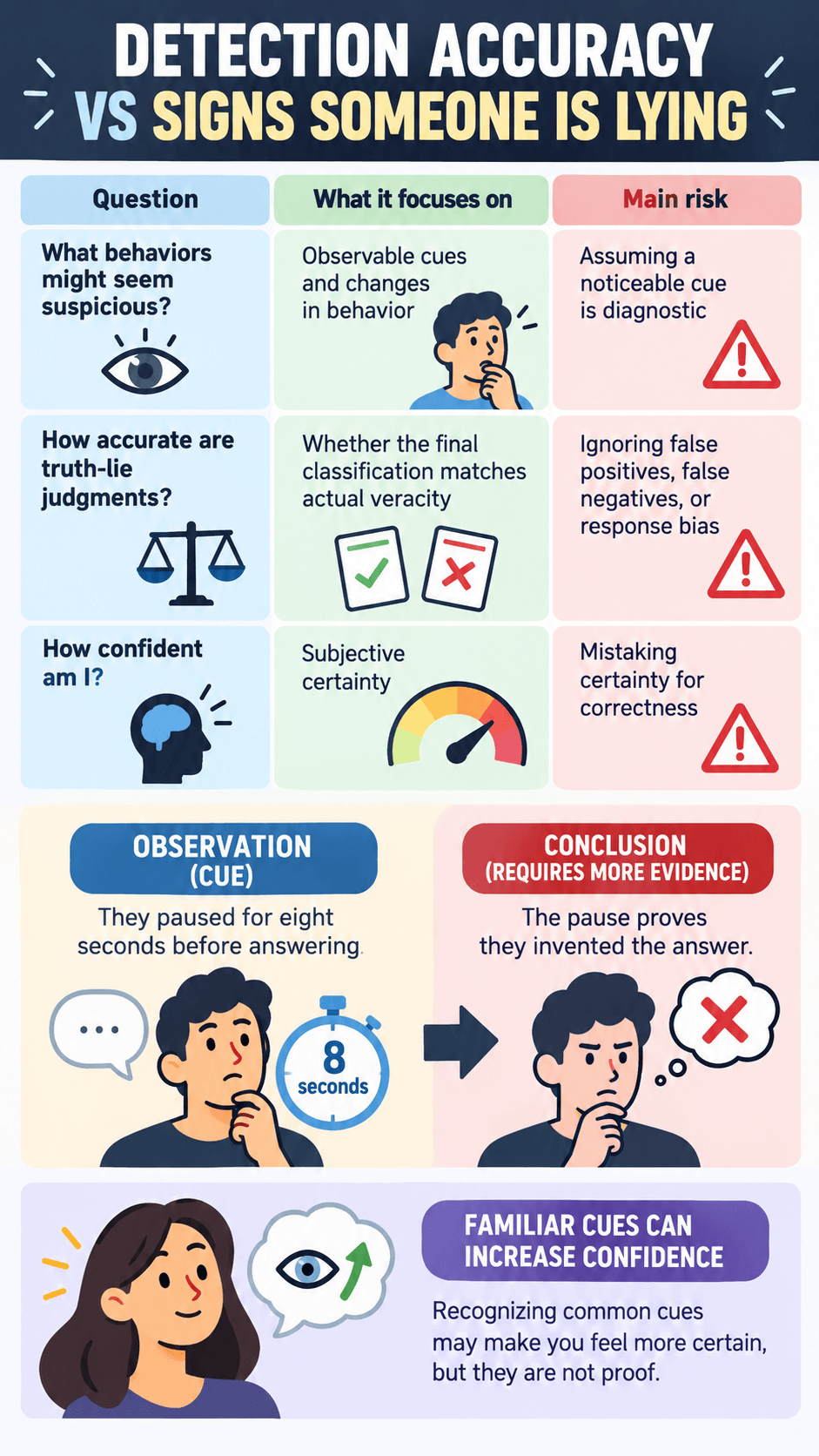
| Question | What it focuses on | Main risk |
|---|---|---|
| What behaviors might seem suspicious? | Observable cues and changes in behavior | Assuming a noticeable cue is diagnostic |
| How accurate are truth-lie judgments? | Whether the final classification matches actual veracity | Ignoring false positives, false negatives, or response bias |
| How confident am I? | Subjective certainty | Mistaking certainty for correctness |
Noticing cues and making correct classifications are different tasks
You can accurately notice that someone paused before answering and still draw the wrong conclusion about why. You can notice reduced eye contact and correctly describe the behavior while incorrectly deciding that it proves deception. Observation may be accurate while inference is not.
For readers interested in practical behavioral interpretation, the site’s existing discussion of signs someone may be lying addresses a different question. Deception detection accuracy asks whether any final classification is correct when checked against actual truth or deception.
Familiar cues can increase confidence without becoming proof
Once a behavior has been mentally labeled “a sign of lying,” seeing it can make a judgment feel easier. That feeling of fluency may increase certainty. But certainty does not upgrade an ambiguous cue into diagnostic evidence.
A useful discipline is to describe the observation before interpreting it. “They paused for eight seconds before answering” is an observation. “The pause proves they invented the answer” is a conclusion that requires additional evidence.
Laboratory Accuracy vs Real-World Judgment
Controlled ground truth is a major advantage of experiments
Researchers studying detection accuracy need to know whether each message is truly honest or deceptive. Laboratory designs provide that ground truth by instructing participants, arranging mock events, or otherwise controlling the truth status of statements. Without ground truth, accuracy cannot be calculated reliably.
Real life is harder because the observer often does not know the answer. If two people disagree about whether someone lied, neither confidence nor consensus establishes what actually happened. This is one reason everyday anecdotes about being “good at reading people” are difficult to evaluate scientifically.
Laboratory control can also reduce realism
The same controls that make accuracy measurable can create distance from real-world deception. Experimental lies may involve different motivations, consequences, preparation, emotional involvement, or complexity than deception in relationships, workplaces, legal cases, or fraud.
A broad review of modern deception-detection research notes both advances and continuing challenges across methods and applied settings. The review of the state of deception-detection research is useful for understanding why results depend on the procedure used rather than on one universal “lie signal.”
Ecological validity changes how far a finding should travel
Ecological validity concerns how well a research task represents the conditions to which someone wants to apply the finding. A result from brief laboratory interviews may be informative about human judgment, but it may not transfer perfectly to a months-long fraud investigation with records, multiple witnesses, and documented transactions.
The responsible approach is neither to dismiss laboratory research nor to overextend it. Controlled studies show important limits of unaided human judgment. Real-world cases may contain richer evidence, but they may also contain biases, missing information, memory problems, pressure, and uncertain ground truth.
How to Use Accuracy Research Without Overclaiming
Move from cue hunting to evidence quality
When something feels suspicious, ask what kind of information you actually have. Is it a behavior that could have several explanations? Is it a contradiction with a verified record? Is it a secondhand report? Is there independent corroboration? Does the conclusion depend on interpreting someone’s emotional presentation?
This shifts attention from “Do they look like they are lying?” to “How strong is the evidence for this specific claim?” That is usually a safer and more useful question.
Separate observation, inference, and verification
- Observation: What did you directly see, hear, or document?
- Inference: What explanation are you giving that observation?
- Verification: What independent information could confirm or challenge that explanation?
For example, “The story changed” is still incomplete. Did a minor peripheral detail change, or did a central fact conflict with a reliable record? Memory, wording, perspective, and normal uncertainty can produce some inconsistency. Repeated contradictions involving independently verifiable facts deserve more weight than one ambiguous behavioral change.
Match the response to the stakes
Low-stakes uncertainty may call for a clarifying question. Higher-stakes situations may require documentation, professional review, or formal procedures. Serious allegations involving crime, abuse, workplace misconduct, financial fraud, child safety, or legal disputes should not be decided through amateur behavioral lie detection.
The general research lesson is modest but useful: when consequences are serious, improve the quality of the evidence rather than increasing the intensity of the accusation.
FAQ
Are people better than chance at detecting lies?
Across many controlled studies, average unaided performance has been modestly above chance rather than dramatically above it. The widely cited Bond and DePaulo meta-analysis reported about 54 percent overall accuracy in the studies they synthesized. That does not mean every person, lie, or real-world situation has the same accuracy rate. It is a benchmark describing group performance under particular research conditions.
Does professional experience make someone a reliable lie detector?
Professional experience does not automatically produce high unaided truth-lie discrimination. Some studies and reviews find limited differences between professional and lay observers, while performance also depends on task design, information access, training, and response bias. A professional may make better real-world decisions through structured evidence gathering without possessing unusually accurate intuition about demeanor.
Why can truth accuracy be higher than lie accuracy?
If observers tend to classify messages as truthful, they create more opportunities to correctly accept truths and more opportunities to miss lies. This response tendency can produce higher truth accuracy than lie accuracy even without a large difference in underlying discrimination ability. Base rates also matter because a truth-favoring strategy performs differently when most messages are actually truthful than when truths and lies are evenly balanced.
What do false positives and false negatives mean in deception detection?
A false positive means a truthful message is incorrectly judged deceptive. A false negative means a deceptive message is incorrectly judged truthful. Looking at both error types is important because overall percentage correct can hide whether an observer is mainly missing lies or mainly accusing truthful people.
Does a 54 percent group average mean every person is 54 percent accurate?
No. A meta-analytic average summarizes results across many participants and studies. It is not a personal diagnostic score and should not be used to estimate the probability that one particular judgment is correct. Individual performance, message type, context, base rates, and available evidence can all differ from the studies included in the average.
Key Takeaways
- Deception detection accuracy measures whether a truth-lie judgment matches actual veracity, not whether a behavior merely looks suspicious.
- A major meta-analysis found average unaided accuracy of about 54 percent, with higher truth accuracy than lie accuracy in the studies analyzed.
- False positives and false negatives matter because a suspicious response style can catch more lies while also misclassifying more truthful messages.
- Weak and ambiguous behavioral differences are a major reason unaided lie detection remains difficult.
- Professional status and training do not automatically create a highly accurate human lie detector, although some evidence-based training methods can produce limited improvements.
- When a judgment matters, context, documentation, independently verifiable information, and proportionate procedures are stronger foundations than demeanor alone.
A practical next step is to separate what you observed from what you inferred. If the conclusion is stronger than the evidence, lower the certainty before raising the accusation. Human deception judgment is most useful when it is treated as a reason to check, not as a substitute for verification.

Michael Reed is the Founder and Lead Writer at Psychology Exposed. He writes about human behavior, relationships, emotional patterns, self-awareness, and practical psychology topics using research-informed, easy-to-understand content.
Read More About Michael Reed: https://psychologyexposed.com/michael-reed/