
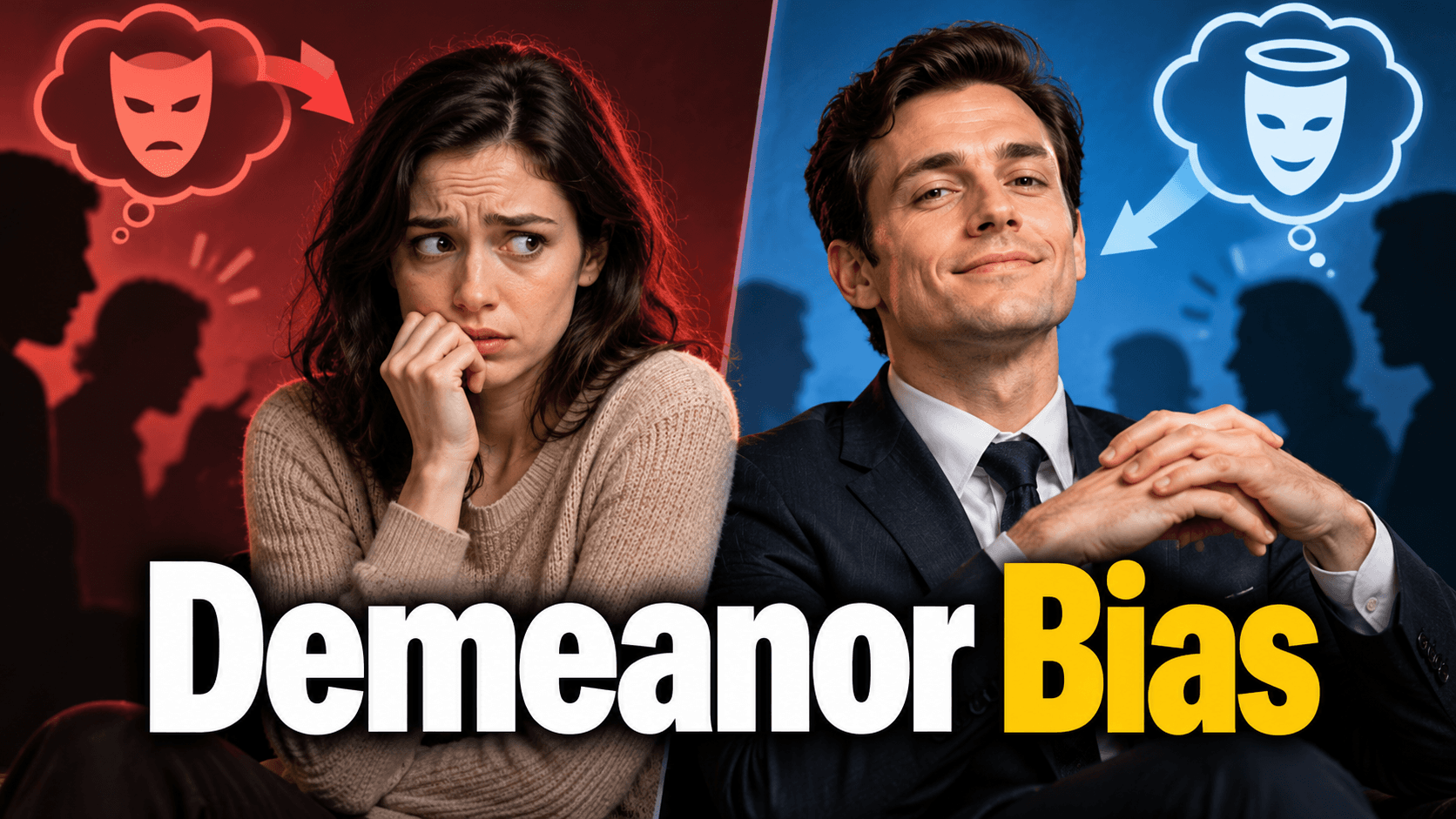
Someone looks tense, avoids eye contact, pauses before answering, or seems unusually flat. It is tempting to treat that presentation as evidence that something is being hidden. The problem is that demeanor tells you how a person appears, not whether the statement they are making is actually true.
A truthful person may look uncomfortable because they are being evaluated, fear being misunderstood, dislike conflict, struggle to recall details under pressure, or simply have a communication style that others read as unusual. A deceptive person may look calm because the story is familiar, rehearsed, simple, or delivered by someone who naturally appears confident.
Demeanor bias describes the judgment error that happens when an observer gives too much weight to this appearance. The result can go in either direction: an honest person looks deceptive, or a deceptive person looks credible. That is why nervousness, confidence, hesitation, gaze, and emotional expressiveness should be treated as context, not proof.
Quick Answer
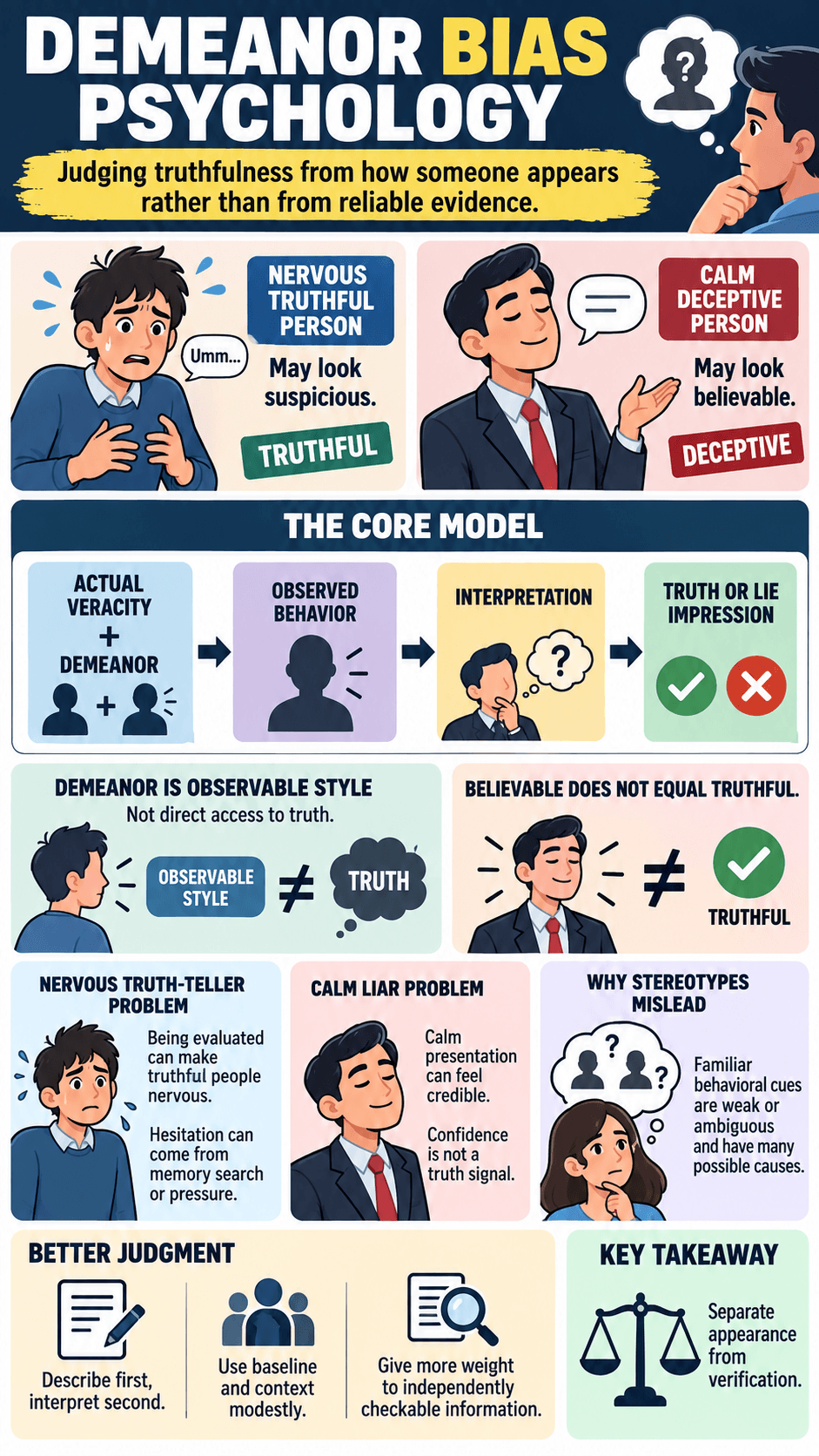
Demeanor bias is the tendency to judge truthfulness from how someone appears rather than from evidence that reliably distinguishes truth from deception. A nervous truthful person may look suspicious, while a calm deceptive person may look believable. Research shows that many familiar behavioral cues are weak or ambiguous, so demeanor is safer treated as a reason to ask or verify, not as a verdict.
What Demeanor Bias Means
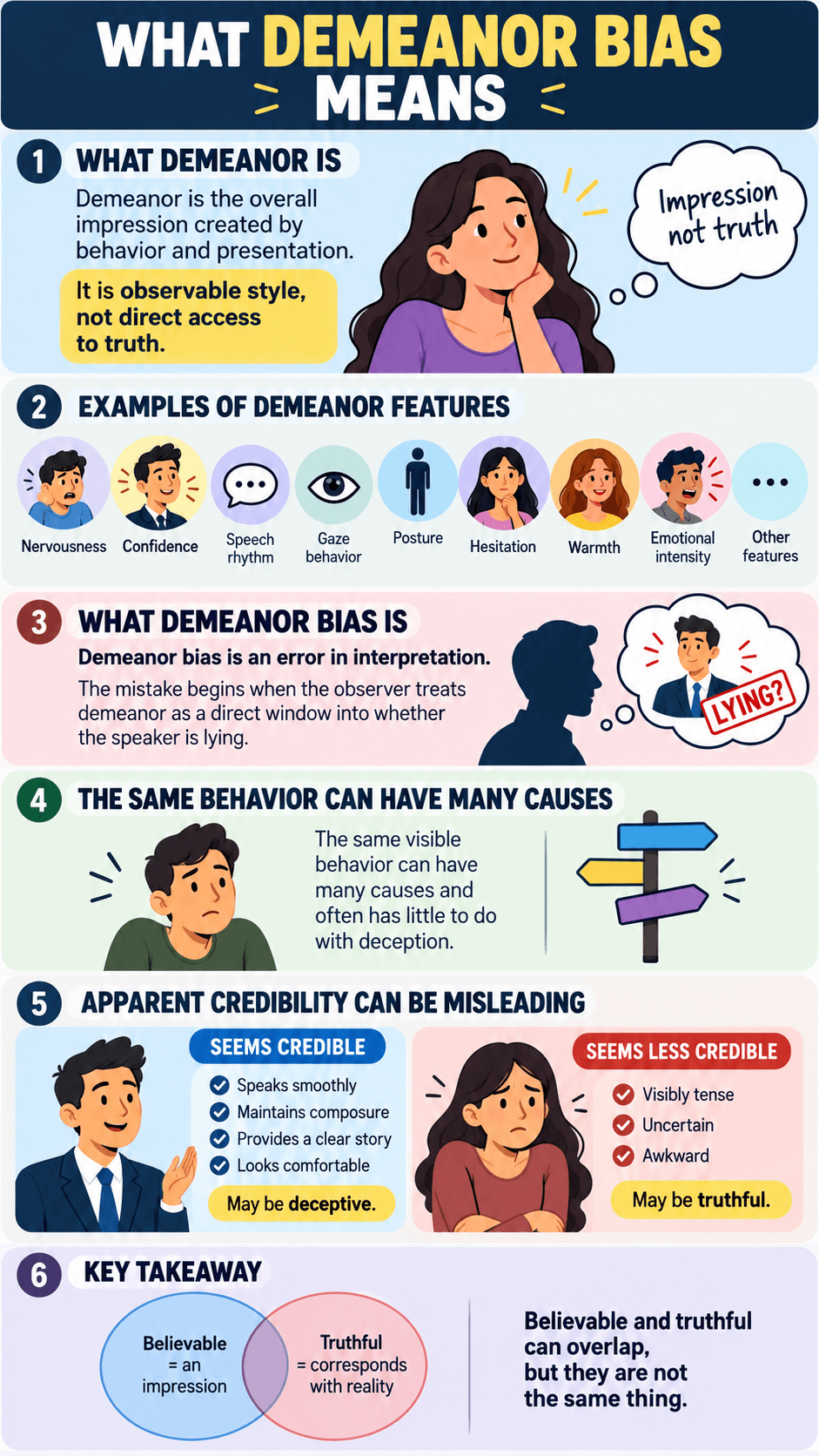
Demeanor is observable style, not direct access to truth
Demeanor is the overall impression created by behavior and presentation. It can include apparent nervousness, confidence, hesitation, warmth, emotional intensity, speech rhythm, gaze behavior, posture, and other features that influence how a person comes across.
Those observations may be real. The mistake begins when the observer treats them as a direct window into whether the speaker is lying. The same visible behavior can have many causes, and those causes often have little to do with deception.
Demeanor bias is an error in interpretation
In classic research on deception, some people appeared more honest across situations while others appeared more deceptive even when their actual truthfulness changed. This was described as a “demeanor bias”: apparent honesty or dishonesty could shape observers’ judgments independently of actual veracity. The early study on the miscommunication of deception and demeanor bias showed how strongly perceived style could influence judgments.
The important point is not that demeanor never contains information. It is that presentation and veracity do not line up cleanly enough to justify treating appearance as proof.
Perceived credibility and actual veracity can separate
A person may seem credible because they speak smoothly, maintain composure, provide a clear story, and look comfortable. Another person may seem less credible because they are visibly tense, uncertain, or awkward. Yet the first may be deceptive and the second truthful.
This separation is central to understanding demeanor bias. “Believable” describes an impression. “Truthful” describes whether the communication corresponds with reality. Those two can overlap, but they are not the same thing.
The Core Model: Veracity, Demeanor, Interpretation, Judgment
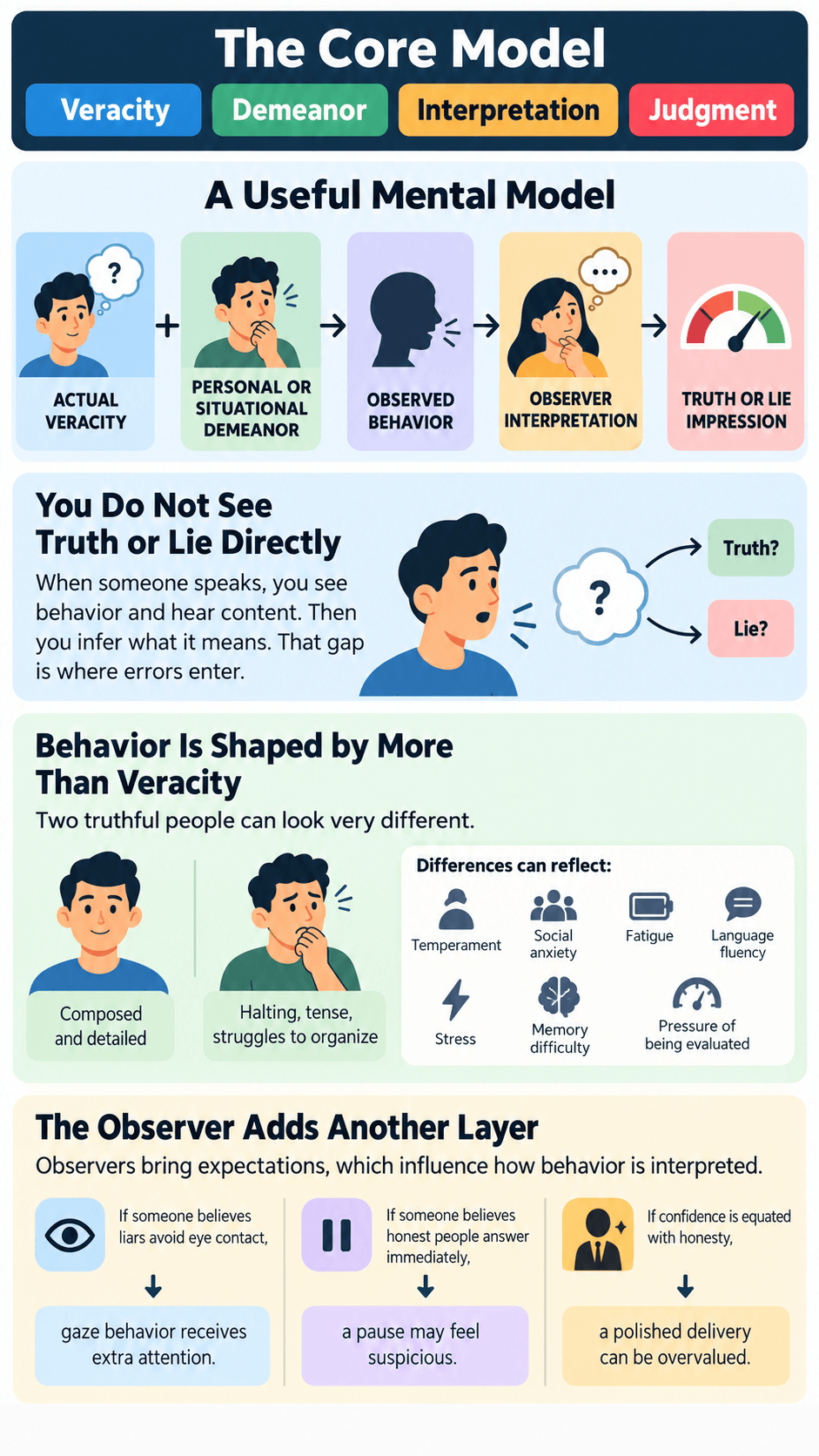
A useful mental model is:
ACTUAL VERACITY + PERSONAL OR SITUATIONAL DEMEANOR → OBSERVED BEHAVIOR → OBSERVER INTERPRETATION → TRUTH OR LIE IMPRESSION
Actual truthfulness is only one influence on what the observer sees. Personality, communication style, social comfort, stakes, memory demands, fear of being judged, cultural norms, and the immediate setting can all affect behavior before the observer begins interpreting it.
Actual truth or deception is not directly visible
When someone speaks, you do not see “truth” or “lie” in raw form. You see behavior and hear content. Then you infer what that behavior means.
That gap between behavior and conclusion is where errors enter. An observer may correctly notice that a speaker looked away, but the claim “looking away means the statement is false” requires evidence that the behavior reliably distinguishes deception from truth. In many cases, it does not.
Behavior is shaped by more than veracity
Two truthful people can look very different while describing the same kind of event. One may be composed and detailed. Another may speak haltingly, look tense, or struggle to organize the account. Those differences can reflect temperament, social anxiety, fatigue, language fluency, stress, memory difficulty, or the pressure of being evaluated.
Likewise, two deceptive people can present very differently. One may appear uncomfortable. Another may seem calm and spontaneous. Individual style changes the signal long before an observer tries to interpret it.
The observer adds another layer of variability
Observers bring expectations too. If someone believes that liars avoid eye contact, gaze behavior receives extra attention. If someone believes honest people answer immediately, a pause may feel suspicious. If confidence is equated with honesty, a polished delivery can be overvalued.
Demeanor bias therefore involves both the speaker’s presentation and the observer’s assumptions about what that presentation means.
The Nervous Truth-Teller Problem
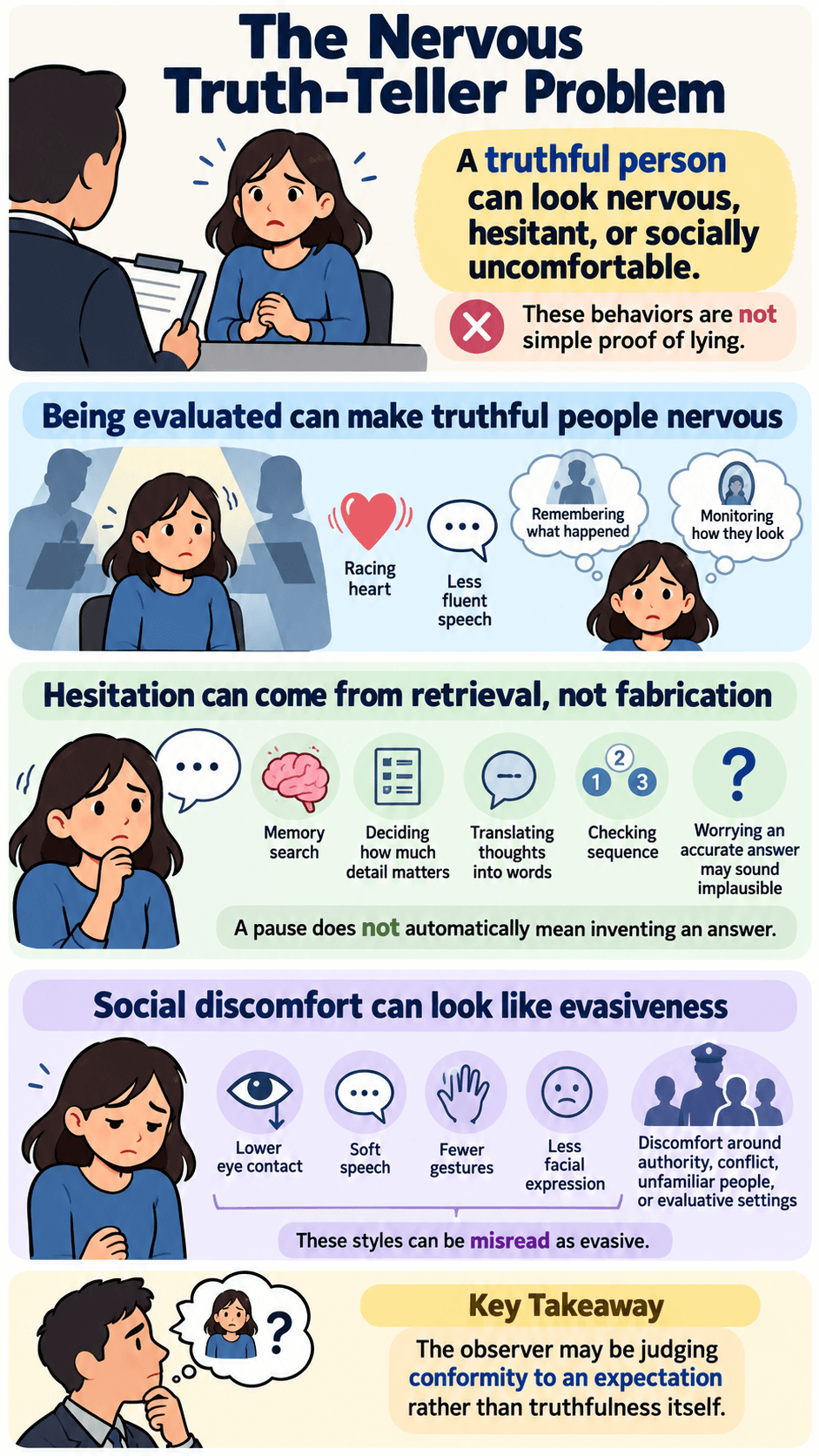
Being evaluated can make truthful people nervous
Imagine being questioned about something important while knowing that the other person may not believe you. Even when you are telling the truth, your heart may race, your speech may become less fluent, and your attention may split between remembering what happened and monitoring how you look.
Nervousness is therefore not specific to deception. A review focused on the common assumption that nervous behavior signals lying concluded that people often associate nervousness with deception even though the behaviors they watch are not reliable enough for that purpose. The open-access discussion of nervous behavior and deception judgments explains why feeling or appearing nervous cannot be converted into a simple lie indicator.
Hesitation can come from retrieval, not fabrication
A pause before answering may mean someone is constructing a false story, but it may also mean they are searching memory, deciding how much detail matters, translating thoughts into words, checking the sequence of events, or worrying that an accurate answer will sound implausible.
This is especially relevant when questions involve dates, timelines, peripheral details, or emotionally charged experiences. Memory is reconstructive rather than a perfect recording. A person who takes time to answer is not automatically inventing an answer.
Social discomfort can look like evasiveness
Some people naturally make less eye contact, speak softly, use fewer gestures, or show less facial expression. Others become visibly uncomfortable around authority, conflict, unfamiliar people, or evaluative settings.
If an observer expects a truthful person to look relaxed and socially fluent, these styles can be misread as evasive. The observer is then judging conformity to an expectation rather than truthfulness itself.
The Calm Liar Problem
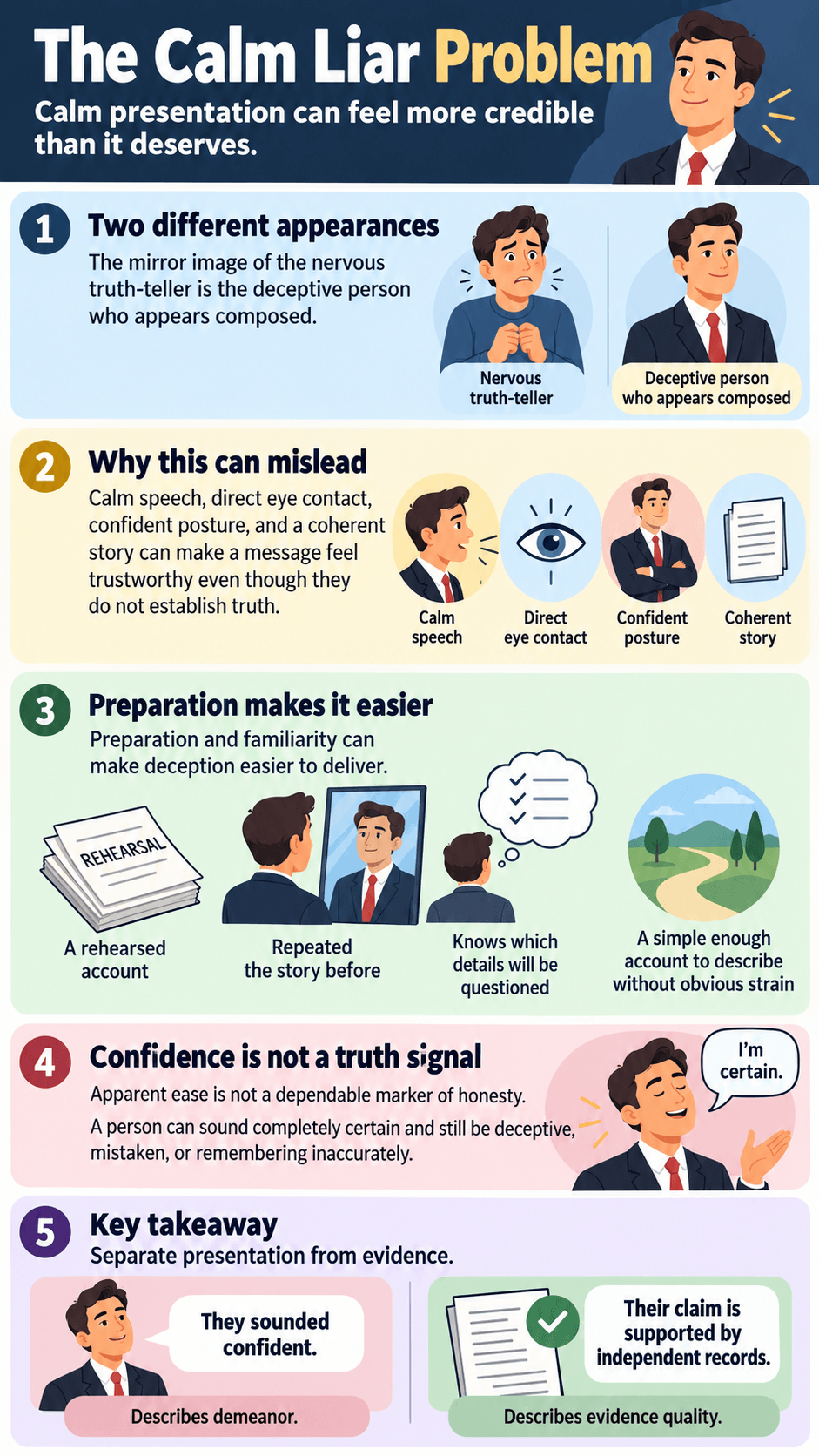
Calm presentation can feel more credible than it deserves
The mirror image of the nervous truth-teller is the deceptive person who appears composed. Calm speech, direct eye contact, confident posture, and a coherent story can make a message feel trustworthy even when those qualities do not establish truth.
Research on nonverbal cue availability illustrates the problem. In one Human Communication Research experiment, deceivers could be judged as more credible as observers gained access to more visual and vocal information, and the best discrimination in that study did not occur in the richest audiovisual condition. The study of demeanor bias and nonverbal cue availability shows that seeing more behavior does not automatically mean judging veracity more accurately.
Preparation and familiarity can make deception easier to deliver
A deceptive account may be rehearsed. The speaker may know which details will be questioned, may have repeated the story before, or may be describing something simple enough to manage without obvious strain.
That does not mean preparation proves deception either. Truthful people also prepare for important conversations. The point is narrower: apparent ease is not a dependable marker of honesty.
Confidence is not a truth signal
Confidence influences social judgment because people often use it as a shortcut for competence or certainty. In deception judgments, that shortcut can be misleading. A person can sound completely certain and still be deceptive, mistaken, or remembering inaccurately.
The safest interpretation is to separate presentation from evidence. “They sounded confident” describes demeanor. “Their claim is supported by independent records” describes evidence quality.
Why Familiar Deception Stereotypes Are So Persuasive
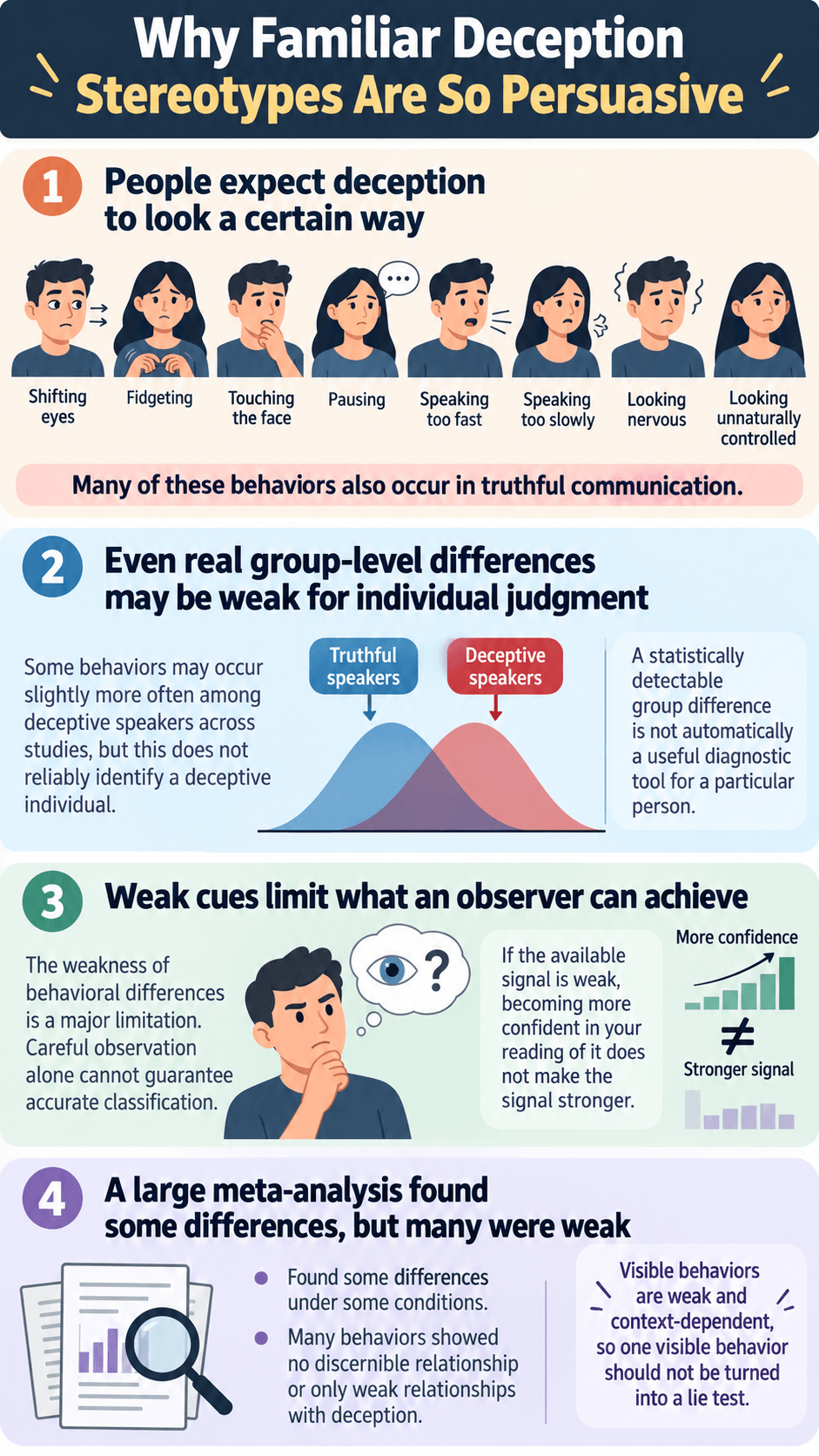
People expect deception to look a certain way
Popular culture often presents lying as visibly leaky: shifting eyes, fidgeting, touching the face, pausing, speaking too fast, speaking too slowly, looking nervous, or looking unnaturally controlled. The problem is that many of these behaviors occur in truthful communication too.
A large meta-analysis by Bella DePaulo and colleagues combined more than a thousand estimates across many possible deception cues. It found that some differences existed under some conditions, but many behaviors showed no discernible relationship or only weak relationships with deception. The meta-analysis of behavioral cues to deception is a strong reason to avoid turning one visible behavior into a lie test.
Even real group-level differences may be weak for individual judgment
Suppose a behavior occurs slightly more often among deceptive speakers across many studies. That does not mean the behavior reliably identifies a deceptive individual. The distributions can overlap heavily: many truthful people show the behavior, and many deceptive people do not.
This is one of the hardest ideas in applied psychology. A statistically detectable group difference is not automatically a useful diagnostic tool for a particular person.
Weak cues limit what an observer can achieve
Maria Hartwig and Charles Bond used a lens-model meta-analysis to examine why lie detection is so difficult. Their work concluded that a major limitation comes from the weakness of behavioral differences themselves, not simply from observers consistently choosing the completely wrong cues. The lens-model meta-analysis of human lie judgments helps explain why careful observation alone cannot guarantee accurate classification.
If the available signal is weak, becoming more confident in your reading of it does not make the signal stronger.
Baseline Behavior and Individual Differences
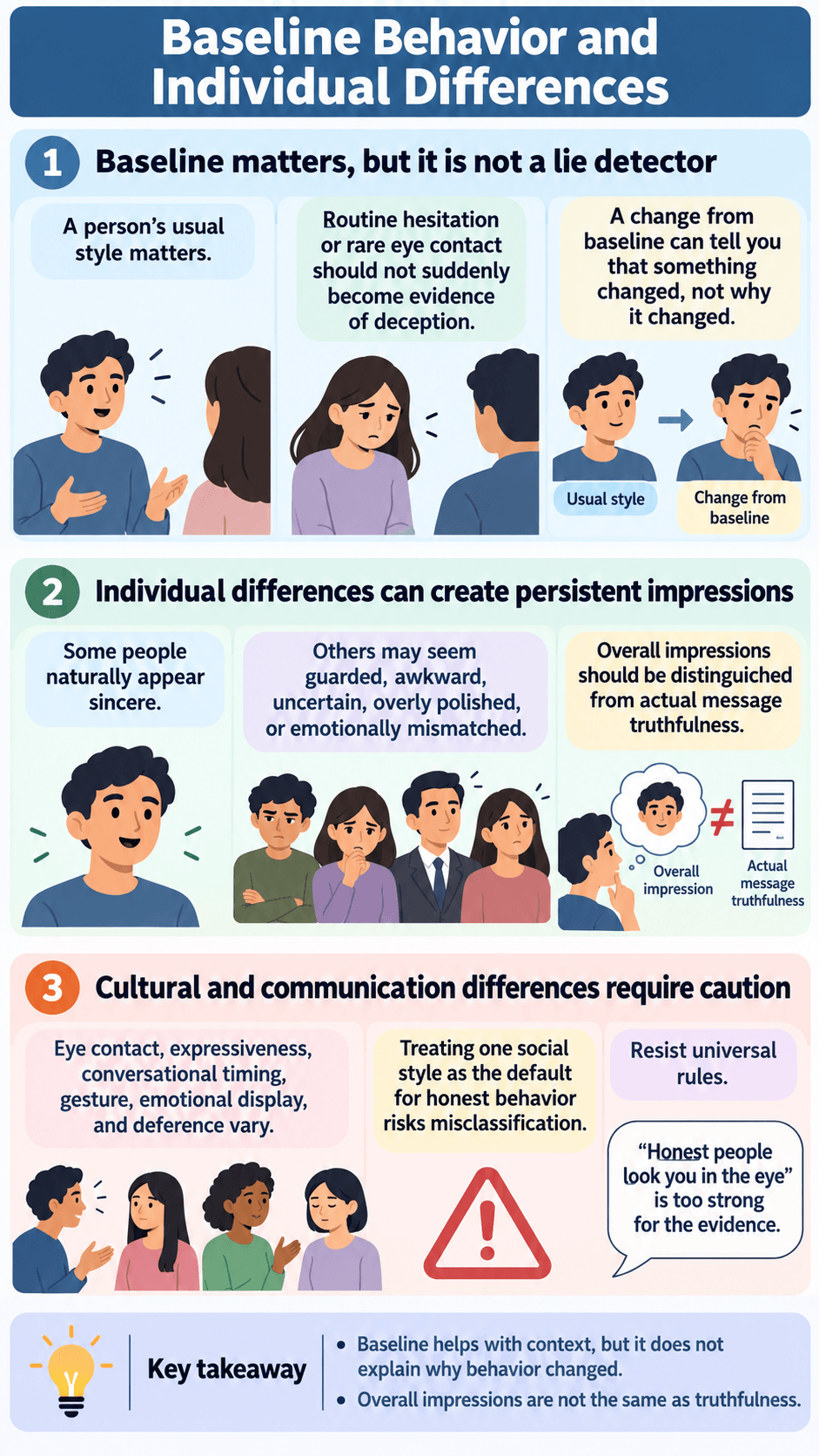
A person’s usual style matters, but baseline is not a lie detector
Comparing behavior with someone’s usual style can sometimes prevent obvious misreadings. If a person routinely speaks hesitantly or rarely makes eye contact, those behaviors should not suddenly become evidence of deception simply because the conversation is important.
However, baseline comparison has limits. People behave differently across topics and situations. Someone may look different when discussing money, conflict, embarrassment, or a serious accusation even while being truthful. A change from baseline can tell you that something changed, not why it changed.
Individual differences can create persistent impressions
Some people naturally appear sincere to observers. Others may seem guarded, awkward, uncertain, overly polished, or emotionally mismatched. These impressions can follow them across truthful and deceptive communication.
A modern review of content, context, cues, and demeanor argues that mismatches between a communicator’s presentation and internal state can produce predictable errors in veracity judgment. The review of demeanor and deception detection emphasizes that overall impressions such as confidence, authenticity, or nervousness should be distinguished from actual message truthfulness.
Cultural and communication differences require caution
Eye contact, expressiveness, conversational timing, gesture, emotional display, and deference vary across communities and communication contexts. Treating one social style as the default for honest behavior risks misclassifying people whose style differs from the observer’s expectations.
This does not mean culture explains every unusual behavior. It means observers should resist universal rules such as “honest people look you in the eye” or “a truthful person would answer immediately.” Those statements are too strong for the evidence.
Demeanor Bias vs Body Language Psychology
| Question | Body language focus | Demeanor bias focus |
|---|---|---|
| What is observed? | Posture, gaze, gestures, movement, facial and vocal behavior | The overall impression created by those behaviors |
| What is being explained? | How nonverbal behavior functions or is perceived | Why observers may misread presentation as evidence of truth or deception |
| Main caution | Behavior has multiple meanings | Credible-looking does not equal truthful, and suspicious-looking does not equal deceptive |
Body language describes behavior
Body language concerns observable nonverbal communication. You might describe crossed arms, gaze direction, movement, posture, facial expression, or interpersonal distance without making a claim about deception.
Demeanor bias starts when those observations are combined into an impression of honesty or dishonesty and the impression receives more evidential weight than it deserves.
Demeanor bias explains the observer’s error
The key question is not “What does fidgeting mean?” but “Why am I treating fidgeting as evidence that this statement is false?” That change in question redirects attention from decoding a person’s body toward evaluating the observer’s own inference.
It also reduces the temptation to build a checklist in which enough behaviors supposedly add up to proof.
Demeanor Bias vs Signs Someone Is Lying
Detection cues and judgment error are different questions
A practical signs discussion asks what behaviors or communication changes people commonly notice when they suspect deception. A demeanor-bias discussion asks why those observations may create a mistaken truth-lie impression.
That distinction keeps the science responsible. A cue may be worth noticing, especially when it marks a meaningful change, but noticing it is not the same as knowing why it occurred.
A familiar “sign” may feel diagnostic when it is not
Imagine someone suddenly becomes less fluent while discussing a sensitive topic. That change can legitimately raise a question. But several explanations remain possible: deception, embarrassment, fear of consequences, uncertainty about memory, concern about privacy, or discomfort with the accusation itself.
The useful response is not to mentally convert the behavior into a guilty verdict. It is to clarify the claim and look for information that could distinguish among explanations.
Accuracy depends on what evidence is available
Demeanor bias helps explain one reason deception detection is difficult. When observers rely heavily on presentation, truthful people with suspicious-looking styles may be falsely accused and deceptive people with credible-looking styles may be believed.
Improving judgment therefore often means improving evidence rather than becoming more intense about observing behavior.
How to Reduce Demeanor-Based Judgment Error
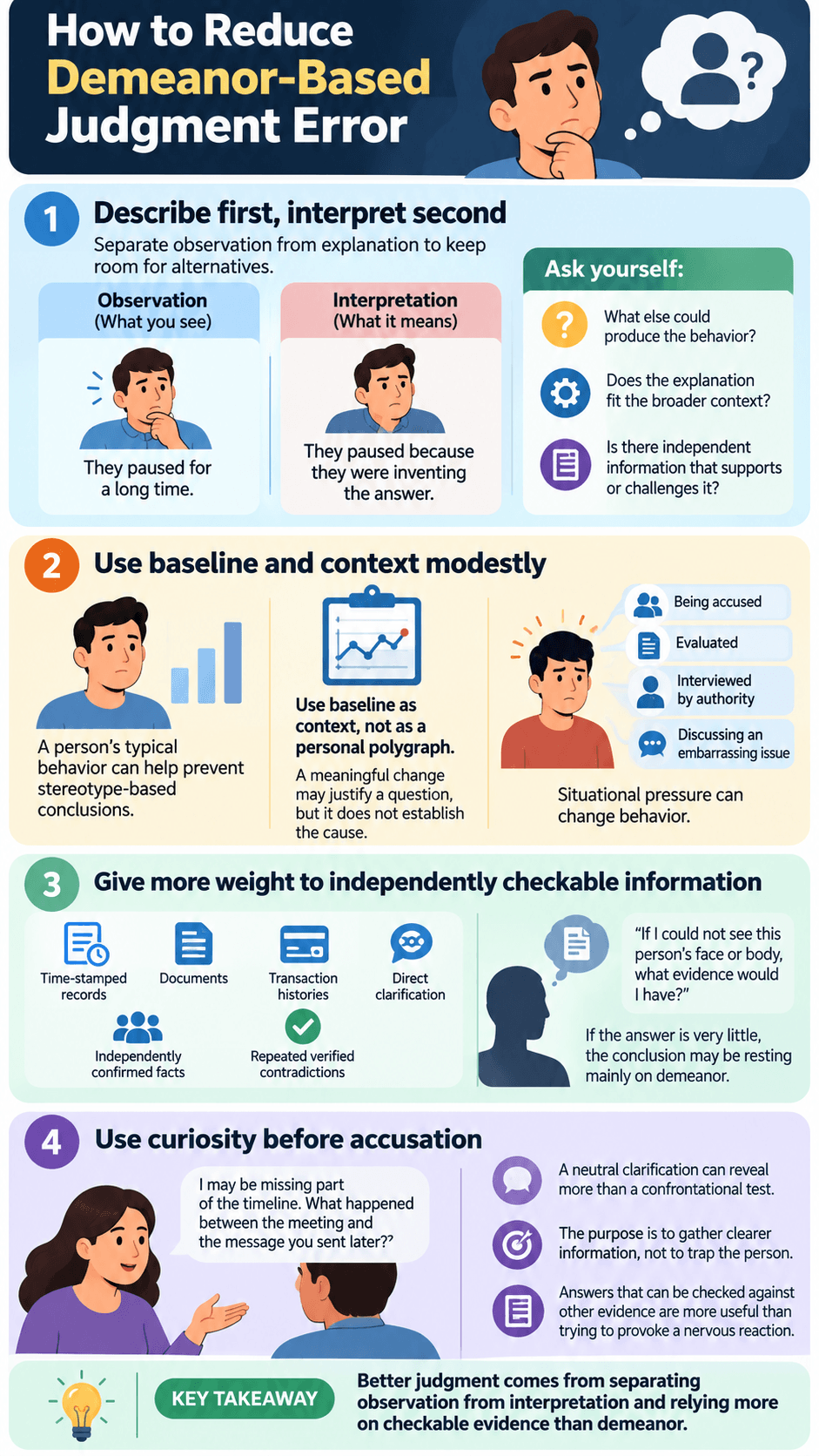
Describe first, interpret second
Separate the observation from the explanation. “They paused for a long time” is an observation. “They paused because they were inventing the answer” is an interpretation.
Putting the two into separate sentences creates room for alternatives. What else could produce the behavior? Does the explanation fit the broader context? Is there independent information that supports or challenges it?
Use baseline and context modestly
Knowing a person’s typical behavior can help prevent obvious stereotype-based conclusions. Still, a baseline should be used as context, not as a personal polygraph. A meaningful change may justify a question, but it does not establish the cause.
Pay particular attention to situational pressure. Someone being accused, evaluated, interviewed by authority, or discussing an embarrassing issue may behave differently from how they act during ordinary conversation.
Give more weight to independently checkable information
When the truth of a claim matters, look for evidence that does not depend on reading someone’s presentation. Time-stamped records, documents, transaction histories, direct clarification, independently confirmed facts, and repeated verified contradictions usually offer a stronger basis than perceived nervousness or confidence.
A useful question is: “If I could not see this person’s face or body, what evidence would I have?” If the answer is very little, your conclusion may be resting mainly on demeanor.
Use curiosity before accusation
When stakes are low and it is appropriate to ask, a neutral clarification can reveal more than a confrontational test. For example: “I may be missing part of the timeline. What happened between the meeting and the message you sent later?”
The purpose is not to trap the person. It is to gather clearer information. An answer that can be checked against other evidence is more useful than trying to provoke a nervous reaction.
When the Stakes Are High
Demeanor is especially risky when the consequences of a mistake are serious. Criminal allegations, workplace misconduct, abuse concerns, fraud, child-safety questions, and legal disputes should not be resolved by deciding who “looks guilty,” “sounds honest,” or appears sufficiently emotional.
High-stakes situations call for documented evidence, established procedures, qualified professionals, and appropriate authorities. A person’s nervousness may reflect the gravity of the situation itself. Their calmness may reflect temperament or preparation. Neither presentation is a substitute for investigation.
FAQ
Can an honest person look nervous or guilty?
Yes. Truthful people may look nervous when they are being evaluated, accused, questioned by authority, discussing embarrassing information, or struggling to recall details. Nervousness is not specific enough to deception to function as proof. The more useful question is what independent evidence supports or contradicts the person’s account.
Does strong eye contact make someone more likely to be truthful?
No simple rule supports that conclusion. Eye contact varies with personality, culture, social comfort, relationship, and situation. People may deliberately maintain eye contact because they believe it makes them look credible, while truthful people may look away when thinking or feeling uncomfortable. Eye contact should not be used as a standalone truth test.
Can a liar appear calm and convincing?
Yes. A deceptive person may appear composed because the account is prepared, familiar, low in complexity, or easy for that individual to deliver. Some people also naturally project confidence. Calmness can influence perceived credibility, but it does not establish whether the statement is true.
What is the difference between demeanor bias and body-language interpretation?
Body-language interpretation focuses on the possible meanings of observable nonverbal behavior. Demeanor bias focuses on the error that occurs when the overall presentation is overused as evidence of veracity. The important boundary is that describing behavior and deciding whether a statement is true are different tasks.
Should I compare behavior with a person’s usual baseline?
Baseline can provide context, especially if a behavior is completely normal for that person. But deviation from baseline does not reveal the cause. Topic sensitivity, stress, fatigue, social pressure, or memory demand may all change behavior. Treat a change as information to explore, not as a lie indicator.
Key Takeaways
- Demeanor bias occurs when an observer overweights how truthful or deceptive someone appears.
- Truthful people can look nervous, hesitant, awkward, or emotionally mismatched for many reasons unrelated to lying.
- Deceptive people can appear calm and credible, especially when a story is familiar, prepared, or easy to deliver.
- Many familiar behavioral cues show weak or ambiguous relationships with actual deception, which limits their diagnostic value for individuals.
- Baseline behavior and context can improve interpretation, but neither converts demeanor into proof.
- Better judgment usually comes from separating observation from inference and giving more weight to independently verifiable evidence.
The next time someone’s presentation feels suspicious, try naming the behavior without naming the cause. Then ask what evidence would still matter if the demeanor disappeared from view. That small separation between appearance and verification is one of the most practical ways to reduce demeanor bias.

Michael Reed is the Founder and Lead Writer at Psychology Exposed. He writes about human behavior, relationships, emotional patterns, self-awareness, and practical psychology topics using research-informed, easy-to-understand content.
Read More About Michael Reed: https://psychologyexposed.com/michael-reed/