
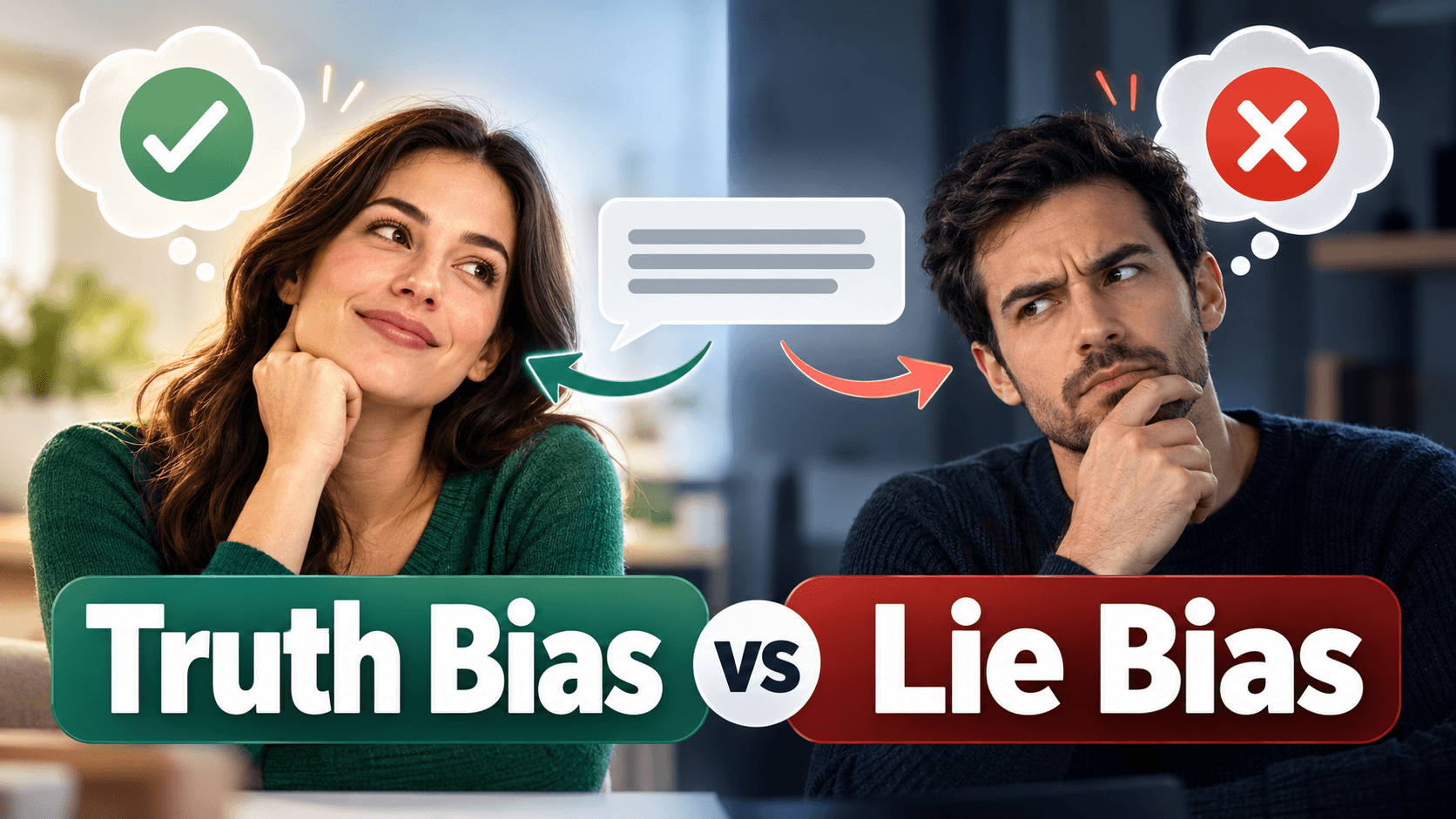
Two people can hear the same statement and reach opposite conclusions. One thinks, “That sounds believable.” The other thinks, “I do not buy it.” The difference may come partly from the evidence, but it can also come from a judgment tendency: how readily each person labels communication as truthful or deceptive.
That is where truth bias and lie bias become useful concepts. Truth bias means a greater tendency to classify messages as truthful. Lie bias means a greater tendency to classify messages as deceptive. Neither tendency automatically tells you whether the person is good at distinguishing truth from deception.
This distinction matters because skepticism can feel like accuracy even when it produces false accusations, while a tendency to believe can look naive even when most messages in a setting are actually honest. Good judgment depends on separating the answer someone tends to give from whether that answer is correct.
Quick Answer
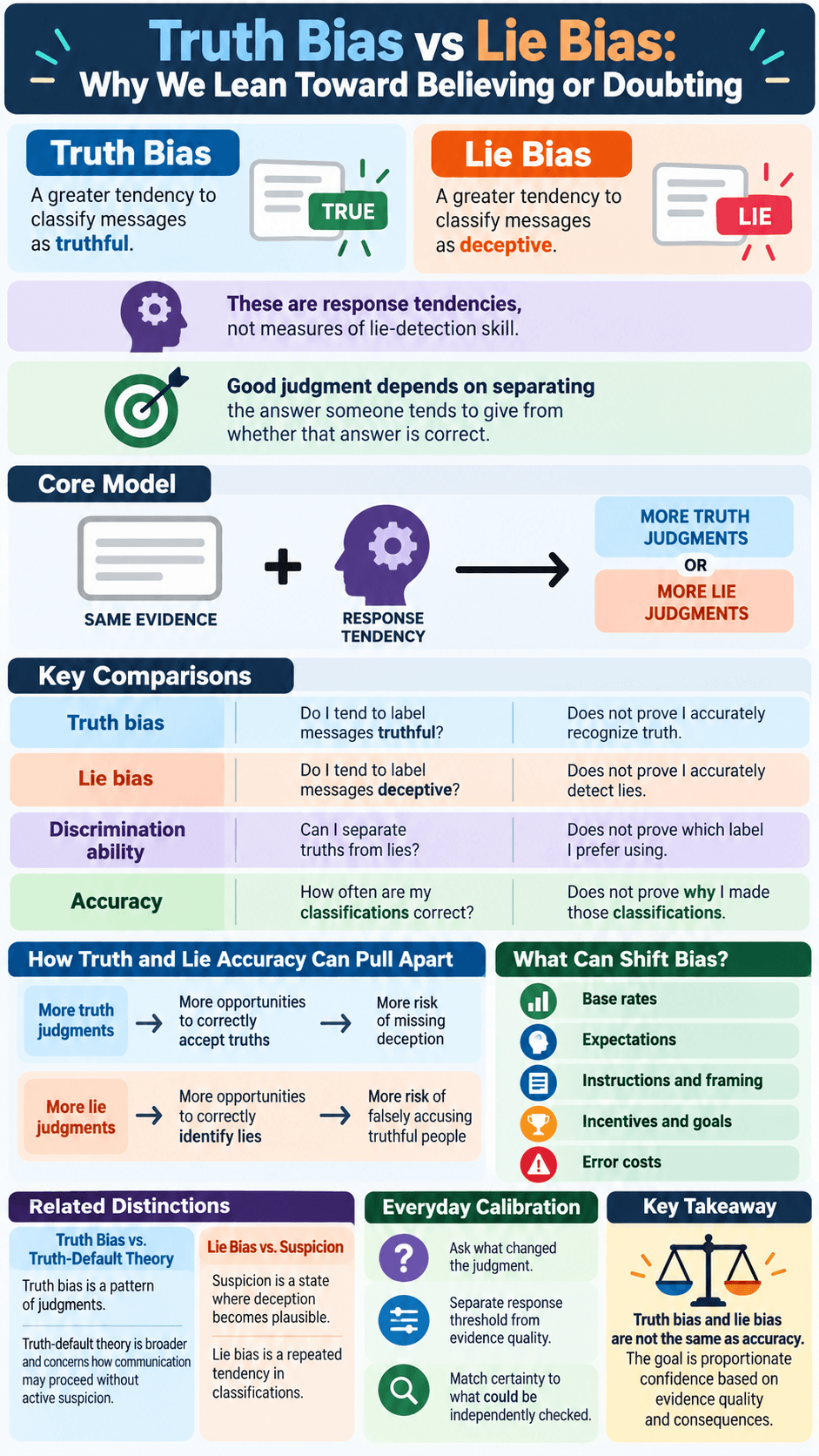
Truth bias is a tendency to judge messages as truthful more often, while lie bias is a tendency to judge messages as deceptive more often. These are response tendencies, not measures of lie-detection skill. A person can show either bias and still have high or low accuracy. Context, expectations, base rates, task framing, and incentives can all shift how often people choose “truth” or “lie.”
Truth Bias and Lie Bias Are Response Tendencies
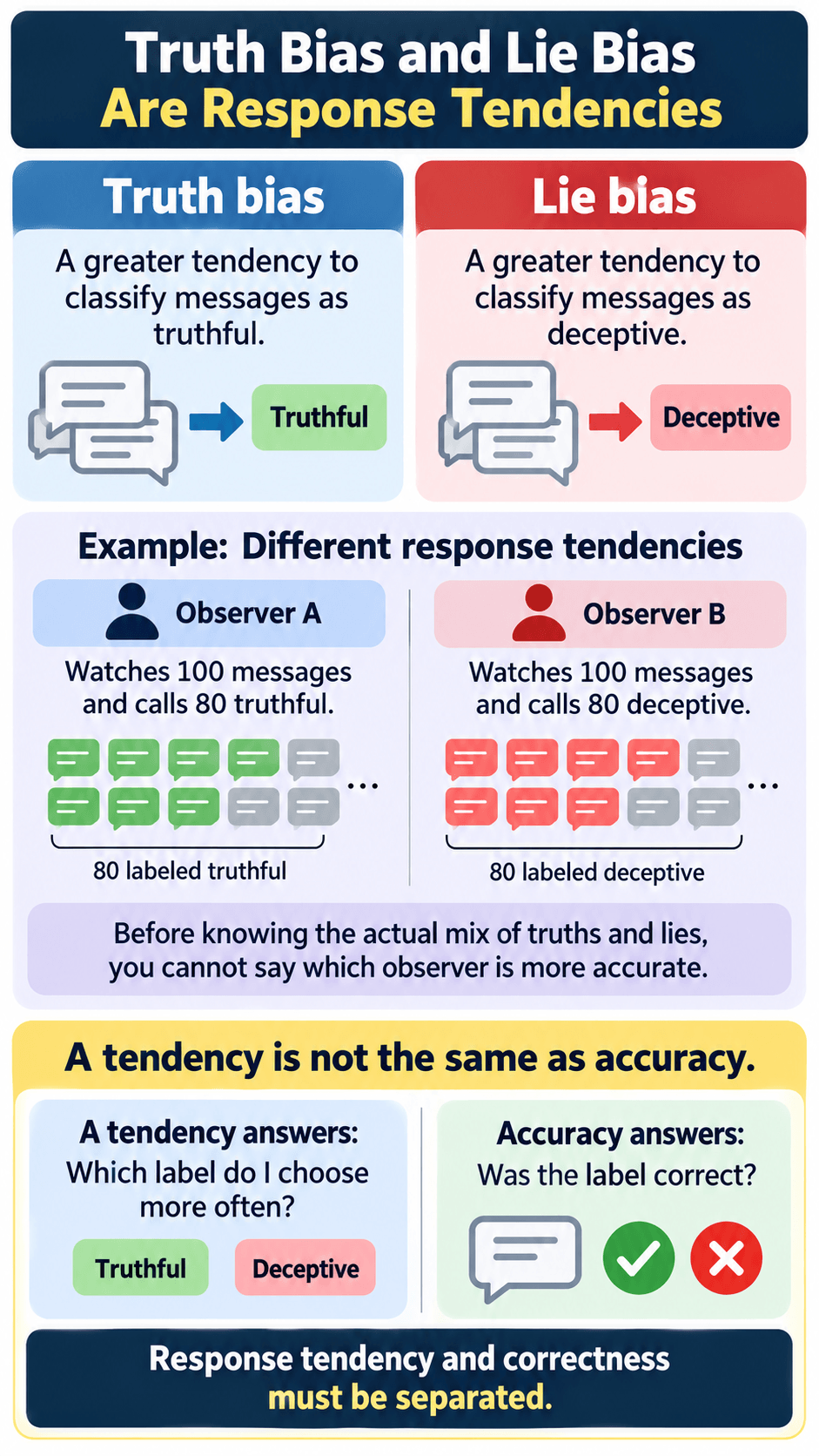
Truth bias: a greater tendency to classify messages as truthful
Truth bias describes a pattern in which an observer gives more truth judgments than lie judgments. If you watched 20 statements and called 15 of them truthful, you would be showing a truth-leaning response pattern in that task. That does not tell us whether the 15 statements were actually true.
This tendency appears often in deception research. A recent reanalysis by Timothy Levine and Kim Serota examined truth bias alongside the well-known difference between truth accuracy and lie accuracy. Their analysis emphasized that truth bias can strongly shape how separate truth and lie accuracy rates look, even when overall discrimination is not especially strong. The 2025 reanalysis of truth bias and the veracity effect is especially useful for understanding why response tendency and correctness must be separated.
Lie bias: a greater tendency to classify messages as deceptive
Lie bias is the opposite response tendency. An observer with a lie-leaning pattern labels a larger share of messages as deceptive. In a setting where many messages really are lies, that can increase the number of lies correctly identified. In a setting where most messages are truthful, the same tendency may produce many false positives.
Lie bias should not be treated as a synonym for healthy skepticism. Skepticism can mean withholding judgment until evidence improves. Lie bias is narrower: it describes the direction in which a person’s classifications tend to lean.
Why neither tendency automatically equals accuracy
Imagine two observers evaluating the same 100 messages. Observer A calls 80 truthful. Observer B calls 80 deceptive. Before you know the actual mix of truths and lies, you cannot say which observer is more accurate. Their response tendencies are obvious, but their discrimination ability is still unknown.
This is one of the most important distinctions in veracity judgment. A tendency answers, “Which label do I choose more often?” Accuracy answers, “Was the label correct?” Those questions are related, but they are not interchangeable.
The Core Model: Same Evidence, Different Response Tendencies
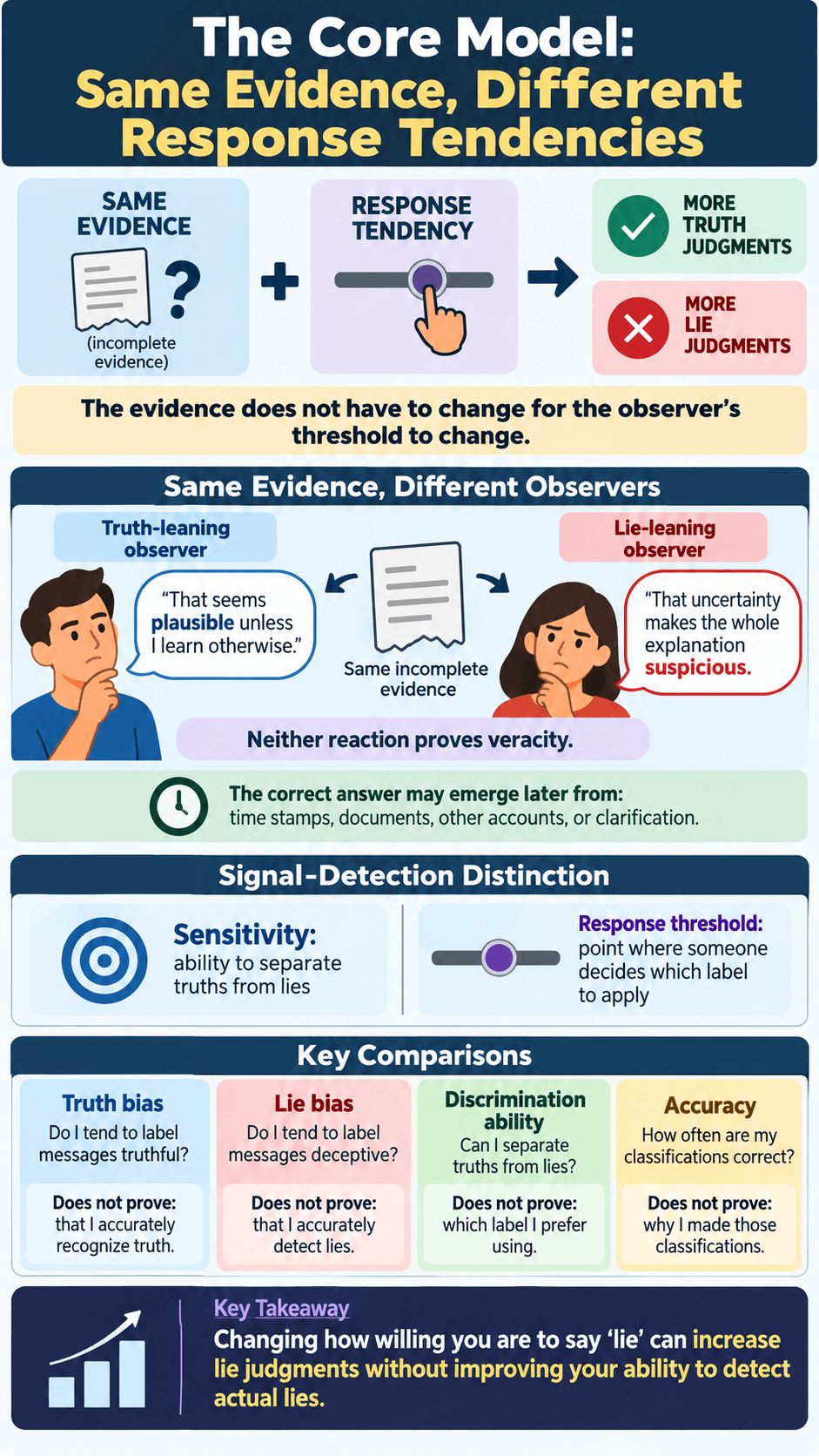
A simple way to picture the issue is:
SAME EVIDENCE + RESPONSE TENDENCY → MORE TRUTH JUDGMENTS OR MORE LIE JUDGMENTS
The evidence does not have to change for the observer’s threshold to change. One person may require substantial contradictory evidence before calling a statement deceptive. Another may call a statement deceptive as soon as several details feel unusual. Their decision rules differ even before we ask which person is better at separating actual truths from actual lies.
Classification tendency before correctness is known
Suppose a coworker explains why a report was submitted late. The explanation contains one uncertain detail, but there is no independent evidence yet. A truth-leaning observer may think, “That seems plausible unless I learn otherwise.” A lie-leaning observer may think, “That uncertainty makes the whole explanation suspicious.”
At this stage, neither reaction proves anything about veracity. Both are classifications under incomplete information. The correct answer may emerge later from time stamps, documents, other accounts, or clarification.
A decision threshold can shift judgments
Signal-detection approaches provide a useful way to think about this. They distinguish sensitivity, the ability to separate two kinds of signals, from response threshold, the point at which someone decides which label to apply. A 2026 review of truth judgments using signal-detection theory makes this distinction explicit by separating truth sensitivity from the general tendency to judge information as true or false. The 2026 review of truth judgments as a signal-detection problem shows why a more skeptical threshold is not the same thing as better discrimination.
For a general reader, the practical idea is simple: changing how willing you are to say “lie” can change your number of lie judgments without improving your ability to tell which messages are actually deceptive.
Bias and sensitivity answer different questions
| Concept | Main question | What it does not prove |
|---|---|---|
| Truth bias | Do I tend to label messages truthful? | That I accurately recognize truth |
| Lie bias | Do I tend to label messages deceptive? | That I accurately detect lies |
| Discrimination ability | Can I separate truths from lies? | Which label I prefer using |
| Accuracy | How often are my classifications correct? | Why I made those classifications |
Response Bias vs Discrimination Ability
You can favor truth judgments without being especially good at discrimination
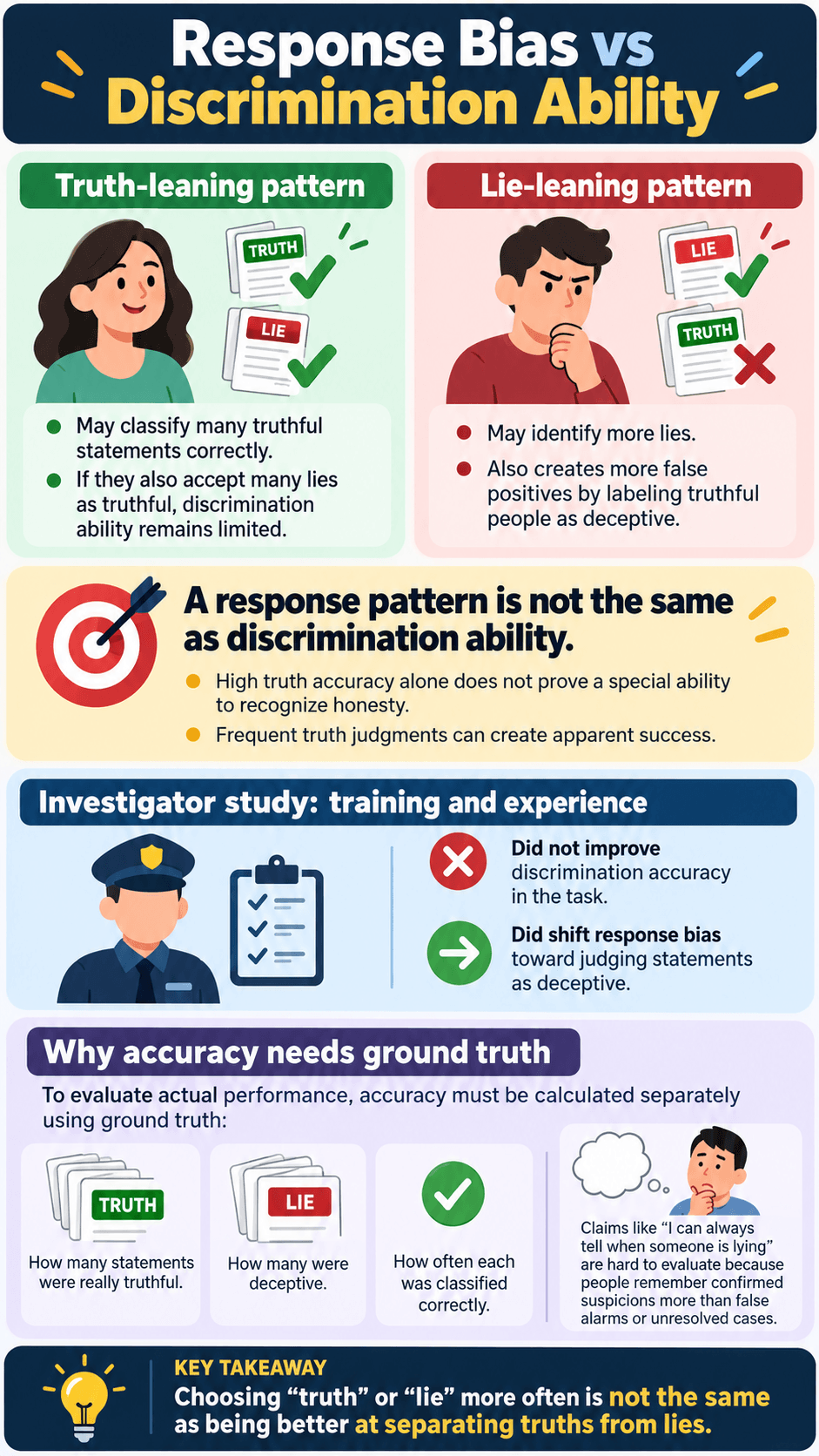
A person who labels most messages truthful may correctly classify many truthful statements. If they also accept many lies as truthful, however, their ability to distinguish the two remains limited. High truth accuracy alone does not show strong discrimination.
This is why a truth-leaning pattern should not be interpreted as evidence that someone has a special ability to recognize honesty. Some of the apparent success may simply come from choosing “truth” frequently.
You can favor lie judgments and create many false positives
The same logic applies to lie bias. If someone calls many messages deceptive, they may correctly identify more lies. But they also create more opportunities to label truthful people as deceptive.
A classic study of investigator judgments helps illustrate the difference. Christian Meissner and Saul Kassin found that training and prior investigative experience did not improve discrimination accuracy in their task, but they did shift response bias toward judging statements as deceptive. The study of investigator bias in truth and deception judgments is a useful reminder that becoming more willing to answer “lie” is not the same as becoming better at separating lies from truths.
Why accuracy belongs in a separate calculation
To evaluate actual performance, you need ground truth. How many statements really were truthful? How many were deceptive? How often did the observer classify each correctly? Without that information, a response pattern may look impressive while remaining impossible to verify.
This is why everyday claims such as “I can always tell when someone is lying” are difficult to evaluate. People usually remember the cases in which later evidence confirmed their suspicion, while the false alarms and unresolved cases may receive less attention.
Why Truth Accuracy and Lie Accuracy Can Pull Apart
Truth bias can raise correct truth judgments while missing lies
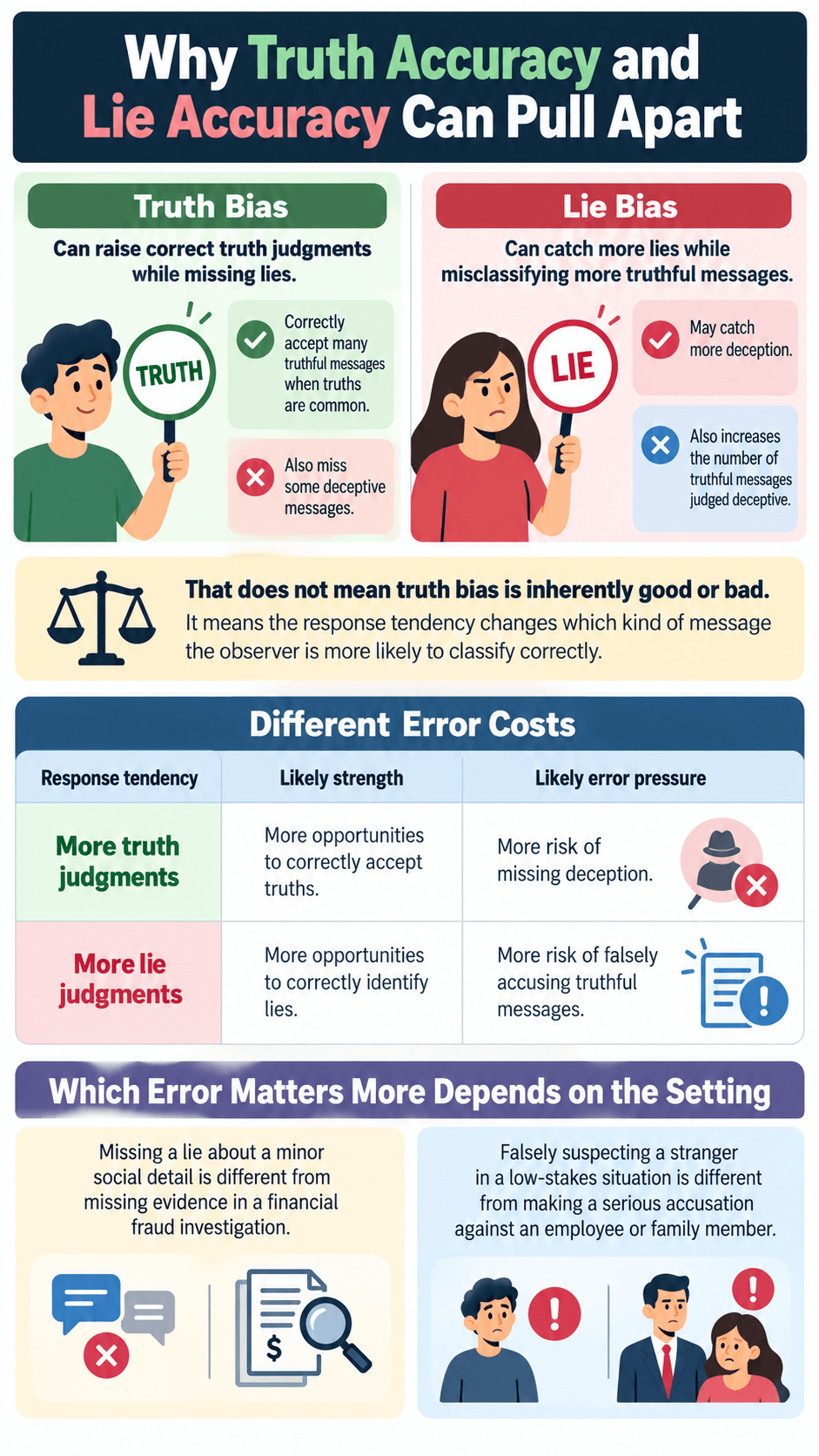
If you say “truth” often, you will correctly accept many truthful messages when truths are common. But you will also miss some deceptive messages. This produces a pattern of higher truth accuracy and lower lie accuracy.
The 2025 Levine and Serota reanalysis reported a strong positive association between truth bias and accuracy for truths, and a strong negative association between truth bias and accuracy for lies. That does not mean truth bias is inherently good or bad. It means the response tendency changes which kind of message the observer is more likely to classify correctly.
Lie bias can catch more lies while misclassifying more truthful messages
A lie-leaning observer faces the reverse tradeoff. Saying “lie” more often may catch more deception, but it also increases the number of truthful messages judged deceptive. If the observer sees skepticism itself as evidence of skill, these false positives can be overlooked.
This is especially important in interpersonal situations. A person who frequently suspects deception may interpret each new doubt as another example of being perceptive, even when the underlying evidence is weak. The practical cost can be repeated accusation rather than improved judgment.
False negatives and false positives are different error costs
| Response tendency | Likely strength | Likely error pressure |
|---|---|---|
| More truth judgments | More opportunities to correctly accept truths | More risk of missing deception |
| More lie judgments | More opportunities to correctly identify lies | More risk of falsely accusing truthful messages |
Which error matters more depends on the setting. Missing a lie about a minor social detail is different from missing evidence in a financial fraud investigation. Falsely suspecting a stranger in a low-stakes situation is different from making a serious accusation against an employee or family member. Response tendency should therefore be considered alongside consequences, evidence quality, and the true base rate of deception.
What Can Shift Truth or Lie Bias?
Base-rate expectations
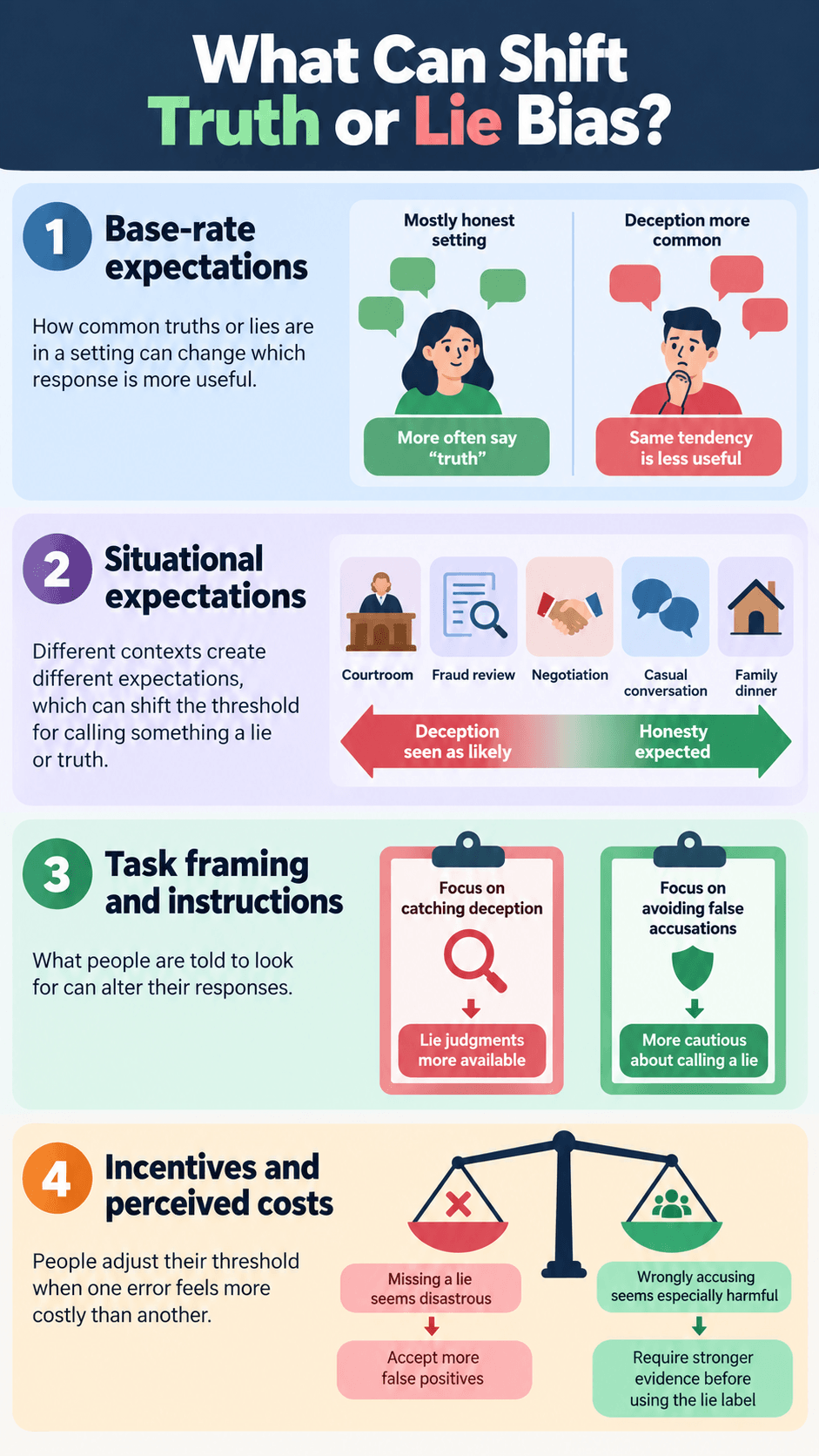
Base rate means the proportion of truths and lies in the environment being judged. If nearly all communication in a setting is honest, frequently choosing “truth” may produce high overall accuracy even without exceptional discrimination ability. If deception becomes much more common, the same tendency becomes less useful.
Human Communication Research has published an extended debate about how base rates affect deception judgments. Park and Levine argued that truth bias and message base rates are central for interpreting accuracy, particularly because many laboratory studies use an artificial 50-50 mix of truths and lies. Their discussion of base rates and deception detection shows why results from balanced experiments should not automatically be treated as a direct model of ordinary communication.
Situational expectations
A courtroom, fraud review, competitive negotiation, casual conversation, and family dinner create different expectations. When a context is framed as one in which deception is likely, observers may lower the threshold for making a lie judgment. When honesty is expected, the threshold may move in the other direction.
That shift may be reasonable when it reflects genuine base-rate information. It becomes a problem when the expectation substitutes for evidence about the specific message. “People sometimes lie in this setting” is not the same claim as “this person is lying now.”
Task framing and instructions
What people are told to look for can alter their responses. Instructions that emphasize catching deception can make lie judgments more mentally available. Instructions that emphasize avoiding false accusations may make observers more cautious about using the lie label.
This is one reason comparisons across studies require care. Two tasks can use similar messages but produce different response patterns because participants were given different goals or assumptions.
Incentives and perceived costs
People also adjust their threshold when one error feels more costly than another. If missing a lie seems disastrous, an observer may accept more false positives. If wrongly accusing someone seems especially harmful, the observer may require stronger evidence before using the deception label.
The shift may be rational from a decision-cost perspective without reflecting better discrimination. A cautious doctor ordering an additional test and a security screener flagging an ambiguous case may intentionally tolerate more false alarms because of the consequences of a miss. The same logic can apply to truth-lie judgments, although the correct threshold depends on the actual stakes and available evidence.
Truth Bias vs Truth-Default Theory
Truth default is a communication-processing theory or state
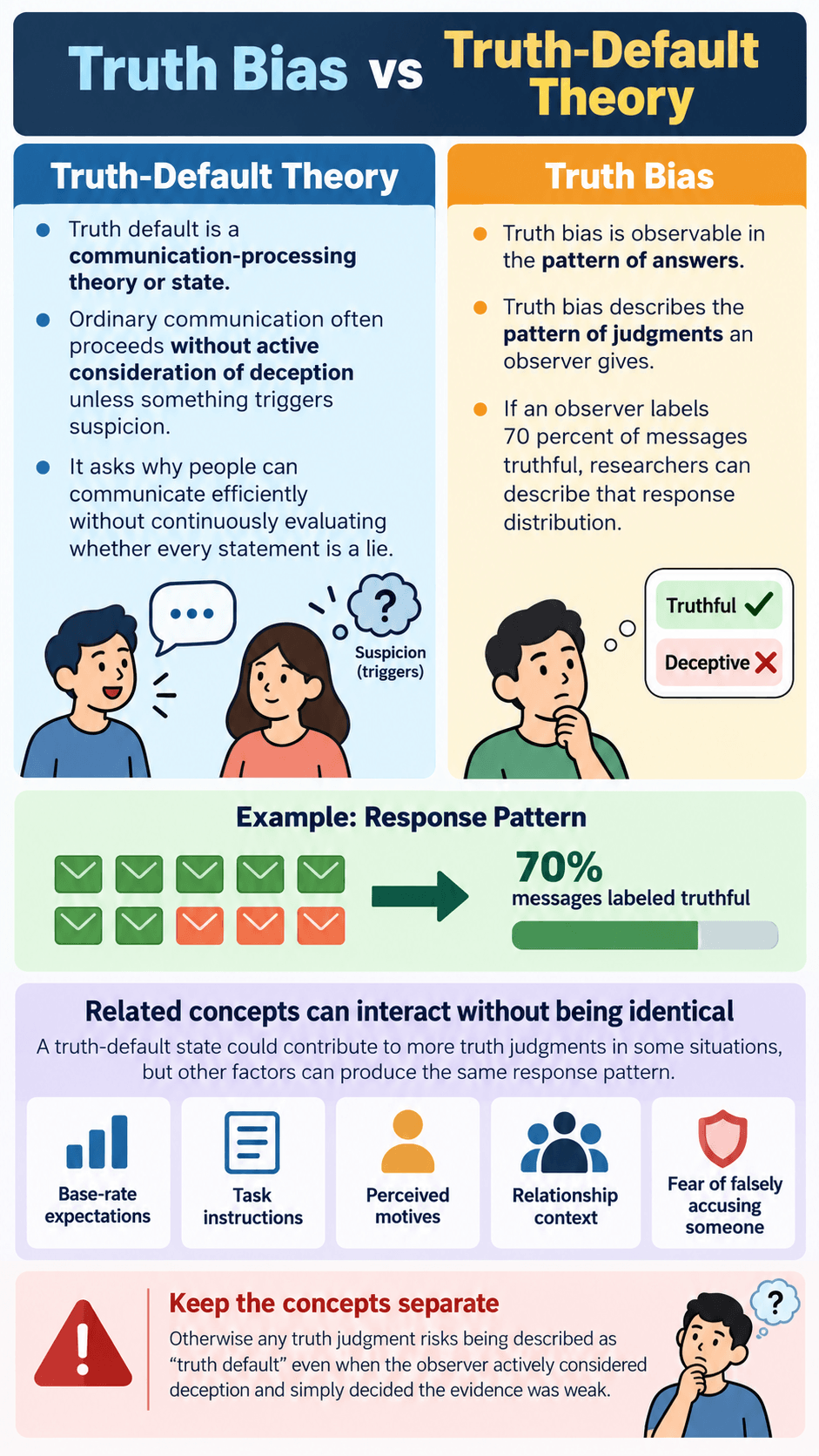
Truth-Default Theory concerns the broader idea that ordinary communication often proceeds without active consideration of deception unless something triggers suspicion. It asks why people can communicate efficiently without continuously evaluating whether every statement is a lie.
Truth bias is narrower. It describes the pattern of judgments an observer gives. Someone can produce many truth judgments, but that response pattern alone does not tell you whether they were in a truth-default state, consciously weighed deception, or simply used a high threshold for calling something a lie.
Truth bias is observable in the pattern of answers
If an observer labels 70 percent of messages truthful, researchers can describe that response distribution. The explanation for why the person produced that distribution is a separate question.
This is why truth bias should not be used as a synonym for the whole theory of default belief. One describes a tendency in responses. The other explains how communication and suspicion may be processed.
Related concepts can interact without being identical
A truth-default state could contribute to more truth judgments in some situations, but other factors can produce the same response pattern. Base-rate expectations, task instructions, perceived motives, relationship context, or fear of falsely accusing someone may all influence the threshold.
Keeping the concepts separate makes later evidence easier to interpret. Otherwise, any truth judgment risks being described as “truth default” even when the observer actively considered deception and simply decided the evidence was weak.
Lie Bias vs Suspicion
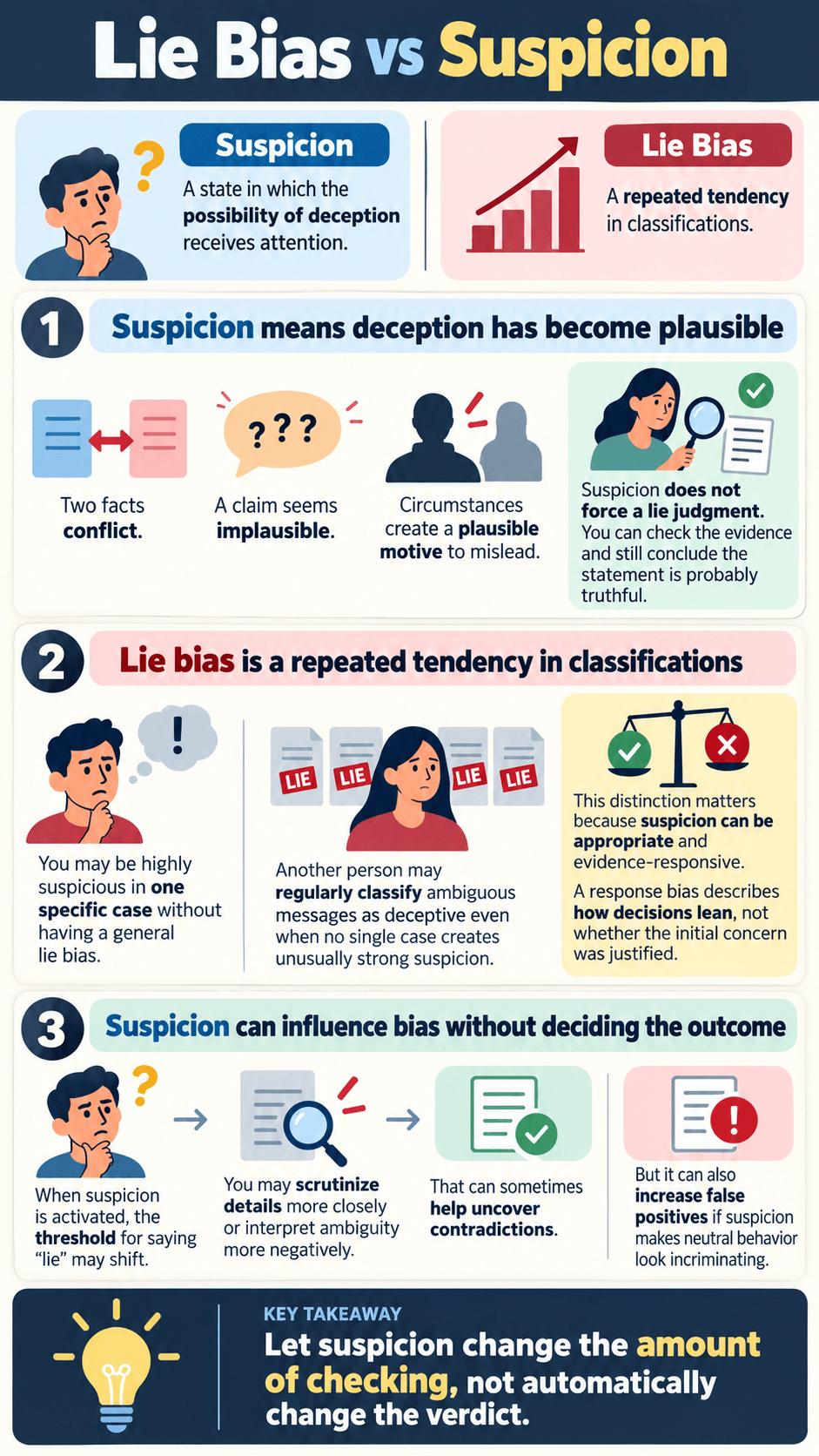
Suspicion means deception has become plausible
Suspicion is a state in which the possibility of deception receives attention. You may become suspicious because two facts conflict, because a claim seems implausible, or because the circumstances create a plausible motive to mislead.
Suspicion does not force a lie judgment. A person can become suspicious, check the evidence, and conclude that the statement is probably truthful.
Lie bias is a repeated tendency in classifications
Lie bias refers to the direction of the observer’s responses across judgments. Someone may be highly suspicious in one specific case without having a general lie bias. Another person may regularly classify ambiguous messages as deceptive even when no single case creates unusually strong suspicion.
This distinction matters because suspicion can be appropriate and evidence-responsive. A response bias describes how decisions lean, not whether the initial concern was justified.
Suspicion can influence bias without deciding the outcome
When suspicion is activated, the threshold for saying “lie” may shift. The observer may scrutinize details more closely or interpret ambiguity more negatively. That can sometimes help uncover contradictions, but it can also increase false positives if suspicion makes neutral behavior look incriminating.
A useful discipline is to let suspicion change the amount of checking, not automatically change the verdict.
When Can a Bias Be Useful or Costly?
Truth bias can sometimes fit a mostly honest environment
If most everyday communication is truthful, a tendency to accept messages can be efficient and often correct. Constant verification would make ordinary conversation slow and socially expensive.
This helps explain why labeling truth bias as irrational is too simplistic. A response strategy that works reasonably well in one environment can perform poorly in another. Its value depends partly on what the environment actually contains.
Lie bias can be costly when truthful messages are common
In a mostly honest setting, frequent lie judgments generate false positives. The observer may become convinced that vigilance is protecting them while repeatedly misclassifying ordinary uncertainty, nervousness, incomplete memory, or awkward communication as deception.
Research on nonverbal cue availability illustrates how behavioral impressions can interact with such judgments. In one Human Communication Research experiment, adding visual and vocal information did not simply make observers better at detecting deception, and some cue conditions increased biased credibility judgments. The study of cognitive biases and nonverbal cue availability helps show why more observable behavior does not automatically produce more accurate veracity decisions.
Context and consequences determine the better threshold
There is no universal instruction to “believe more” or “doubt more.” A better principle is to match the strength of the judgment to the quality of the evidence and the cost of being wrong.
In low-stakes conversation, provisional belief may be reasonable. In a financial decision, documented verification may be appropriate. In a serious allegation, neither automatic belief nor automatic disbelief should substitute for qualified investigation and independently verifiable information.
A Calibration Check for Everyday Judgments
Ask what changed the judgment
Before deciding that someone is truthful or deceptive, identify what moved you. Was it a verified contradiction? A change in demeanor? Prior knowledge? A stereotype about how liars behave? A context in which deception is genuinely more likely?
This does not remove bias, but it makes the decision rule more visible. “I think they are lying because they looked nervous” is a very different evidence statement from “their claim conflicts with two independent records.”
Separate response threshold from evidence quality
Try asking two questions separately:
- How willing am I to use the label “deceptive” here?
- How diagnostic is the information I actually have?
If the first answer is strong and the second is weak, your certainty may be coming more from response tendency than from evidence.
Match certainty to what could be independently checked
When possible, move toward information that can confirm or challenge the claim: dates, records, direct clarification, documented sequences, independent witnesses, or other verifiable facts. Behavioral impressions can be included as context, but they should not carry the same weight as direct contradictory evidence.
For high-stakes allegations involving crime, abuse, workplace misconduct, fraud, child safety, or legal disputes, general deception psychology should not replace professional investigation or appropriate authorities.
FAQ
Is truth bias the same as trusting someone?
No. Trust is broader and concerns willingness to rely on a person under uncertainty or vulnerability. Truth bias describes a tendency to classify messages as truthful. You can trust someone generally while doubting one specific statement, and you can judge a particular statement truthful without having deep interpersonal trust in the speaker.
Is lie bias the same as healthy skepticism?
No. Healthy skepticism can involve delaying judgment, seeking stronger evidence, and remaining open to being wrong. Lie bias means the observer tends to choose the deceptive label more often. A person can be skeptical without automatically deciding that ambiguous communication is a lie.
Can someone have a truth bias and still detect some lies accurately?
Yes. Truth bias describes a tendency, not total inability. A truth-leaning observer can correctly detect deception when strong information is available. The tendency mainly affects how readily the person moves toward a lie judgment, especially when evidence is ambiguous.
Why can lie bias increase false positives?
Every additional lie judgment creates another opportunity to correctly identify deception, but also another opportunity to misclassify a truthful message. If truths are common, frequently choosing “lie” can generate many false positives. Whether the tradeoff is acceptable depends on the setting, the evidence, and the cost of each type of error.
How do base rates change the value of truth or lie judgments?
Base rates tell you how common truth and deception are in the environment being judged. When most messages are truthful, a truth-leaning response can produce high overall accuracy even if discrimination is weak. When deception is unusually common, the same response strategy becomes less effective. This is why balanced laboratory tasks and everyday communication should not be treated as identical environments.
Key Takeaways
- Truth bias means giving more truth judgments; lie bias means giving more deception judgments.
- Neither bias is the same as accuracy or discrimination ability.
- A stronger lie bias may catch more lies while also creating more false accusations.
- Base rates, expectations, instructions, incentives, and perceived costs can shift the threshold for saying “truth” or “lie.”
- Truth bias is not the same concept as Truth-Default Theory, and lie bias is not the same as suspicion.
- A better everyday goal is not maximum belief or maximum doubt, but confidence that is proportionate to evidence quality and consequences.
When you notice yourself leaning strongly toward belief or doubt, do not assume the direction of the judgment proves its quality. Identify the evidence that moved you, consider which error you may be making easier to commit, and look for information that could genuinely change your mind.
Michael Reed is the Founder and Lead Writer at Psychology Exposed. He writes about human behavior, relationships, emotional patterns, self-awareness, and practical psychology topics using research-informed, easy-to-understand content.
Read More About Michael Reed: https://psychologyexposed.com/michael-reed/