
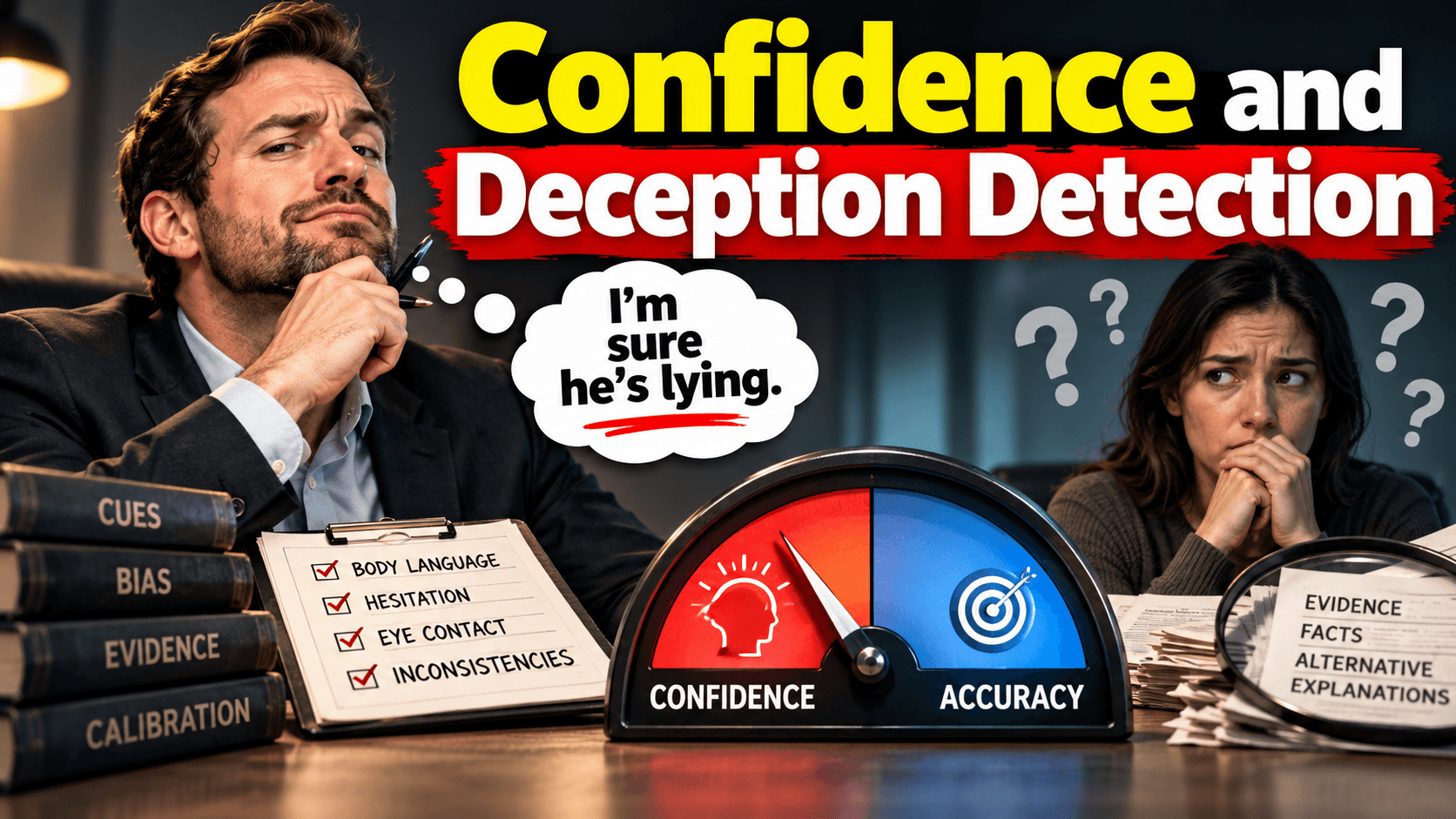
Sometimes a truth-lie judgment does not feel uncertain at all. Someone gives an answer, you notice a detail that seems wrong, and your mind settles quickly: “I am sure they are lying.” That certainty can feel like evidence in its own right.
But confidence and accuracy are different things. Confidence is how certain you feel about a judgment. Accuracy is whether that judgment actually matches reality. The two can be related under some conditions, but one does not automatically guarantee the other.
This matters because deception judgments are often built from ambiguous information. Nervousness, hesitation, eye contact, fluency, confidence, and a vivid inconsistency may strongly influence how sure an observer feels even when those cues are weak or open to several explanations. The safer goal is not to eliminate confidence. It is to calibrate confidence so that certainty rises only when the quality of the evidence justifies it.
Quick Answer
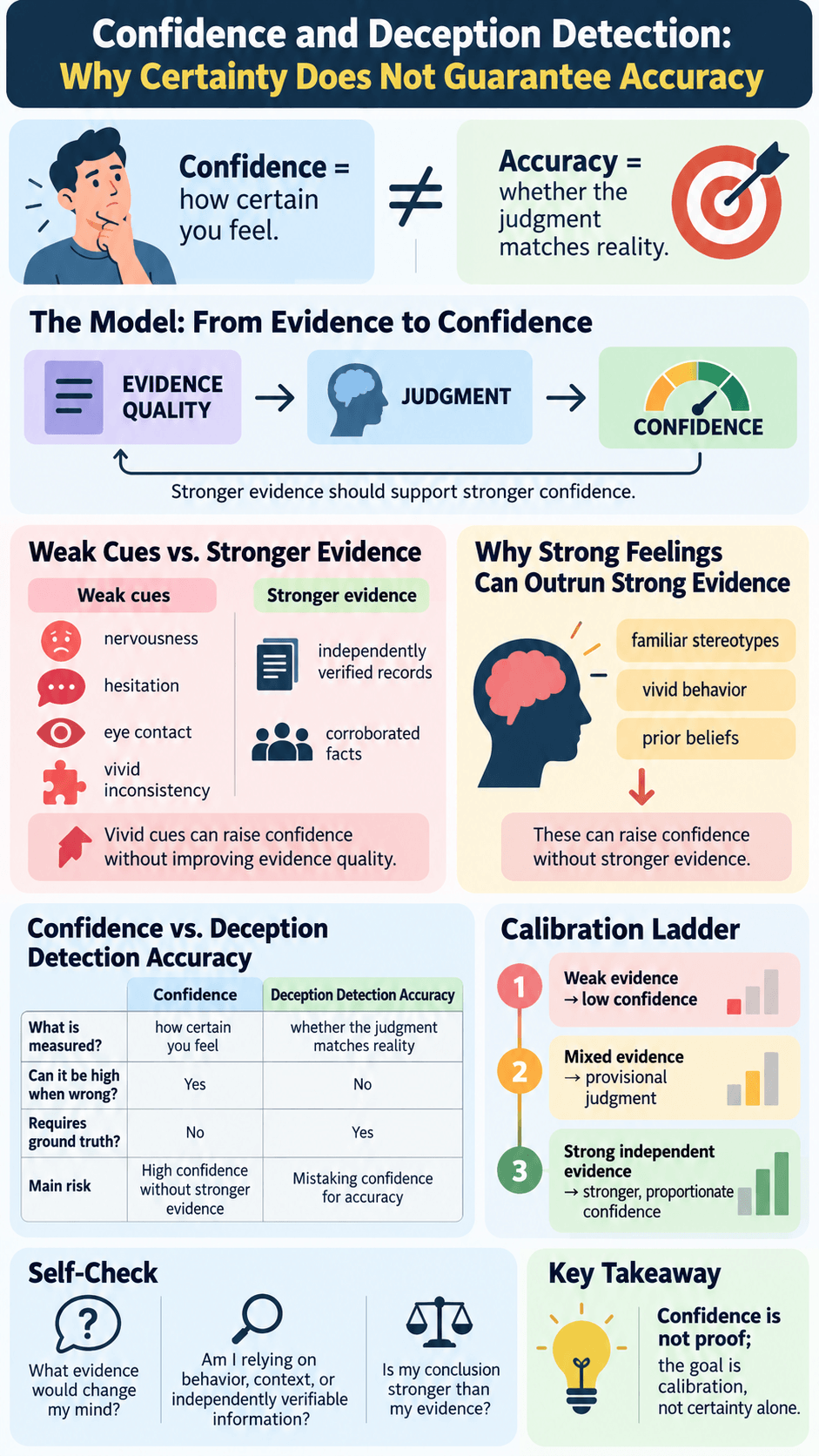
Feeling certain that someone is lying does not prove that the judgment is correct. Classic deception research found very little relationship between how confident different judges felt and how accurate they were overall. Newer work shows a more nuanced picture: under some conditions, higher-confidence individual decisions can be more accurate than lower-confidence decisions. The key is calibration, not certainty alone.
Confidence and Accuracy Are Different Variables
Confidence is subjective certainty
Confidence answers a personal question: “How sure am I that my judgment is right?” It can be expressed informally as low, moderate, or high certainty, or measured on a rating scale after a truth-lie decision.
Confidence can be influenced by evidence, but it can also be influenced by familiarity, expectations, prior beliefs, the clarity of a story, the speaker’s demeanor, and the observer’s own decision style. Two people can make the same judgment while feeling very different levels of certainty. Perceived mental effort can also be misleading because cognitive load in lying varies with preparation, complexity, memory demands, and context.
Accuracy asks whether the judgment matches reality
Accuracy requires ground truth. If a person says “lie,” that judgment can only be called correct if the message is actually deceptive. If the speaker was truthful, the confident judgment is still inaccurate.
This is why everyday confidence is difficult to evaluate. In many real situations, the observer never receives reliable feedback about what actually happened. A judgment can feel confirmed simply because nothing later contradicts it.
Confidence is not proof, but it is not always meaningless
The classic meta-analysis by Bella DePaulo and colleagues examined 18 independent samples and found an average weighted correlation of only .04 between judges’ deception-detection accuracy and their confidence. That relationship was not significantly different from zero. The meta-analysis of confidence and deception-detection accuracy is one reason researchers have long warned against equating certainty with correctness.
However, that finding does not justify the opposite extreme, “confidence never contains useful information.” Later research has shown that the answer depends partly on what kind of confidence-accuracy relationship is being measured.
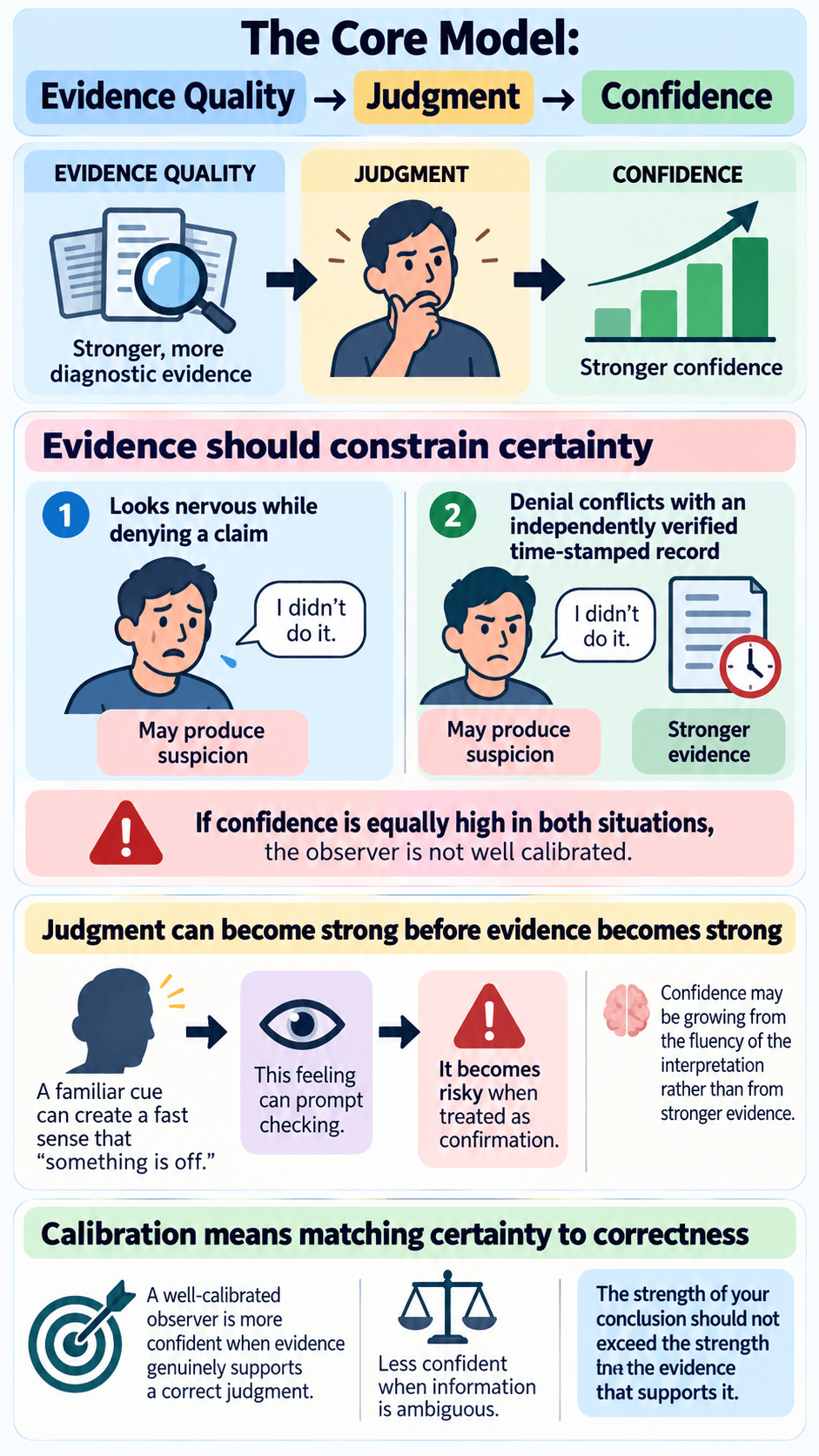
The Core Model: Evidence Quality → Judgment → Confidence
A useful model is:
EVIDENCE QUALITY → JUDGMENT → CONFIDENCE
The ideal is that stronger, more diagnostic evidence produces a stronger judgment and appropriately higher confidence. The problem is that confidence can also rise for reasons that do not improve evidence quality.
Evidence should constrain certainty
Imagine two situations. In the first, someone looks nervous while denying a claim. In the second, their denial conflicts with an independently verified time-stamped record. Both situations may produce suspicion, but the second contains stronger evidence about the claim itself.
If confidence is equally high in both situations, the observer is not well calibrated. The certainty is failing to reflect the difference in evidence quality.
Judgment can become strong before evidence becomes strong
People often experience a conclusion before they consciously evaluate all the reasons for it. A familiar cue can create a fast sense that “something is off,” especially when the situation is emotionally important.
That feeling can be useful as a prompt to check further. It becomes risky when the feeling is treated as confirmation. Confidence may be growing from the fluency of the interpretation rather than from stronger evidence.
Calibration means matching certainty to correctness
Calibration is the degree to which confidence tracks actual accuracy. A well-calibrated observer is more confident when the available evidence genuinely supports a correct judgment and less confident when information is ambiguous.
Perfect calibration is unrealistic in everyday life because ground truth is often unavailable. Still, the principle is practical: the strength of your conclusion should not exceed the strength of the evidence that supports it.
Why Strong Feelings Can Outrun Strong Evidence
Familiar stereotypes can make a judgment feel obvious
If you have learned that liars avoid eye contact, a person looking away may make the answer feel easy. If you believe truthful people answer immediately, hesitation may create instant certainty. The confidence comes partly from having a ready-made explanation.
The problem is that familiar does not mean diagnostic. Looking away, pausing, speaking nervously, or appearing unusually controlled can occur for many reasons. A cue can be easy to interpret and still be weak evidence of deception.
Vivid behavior is psychologically persuasive
A dramatic change in tone or expression may feel more informative than a quiet piece of contradictory evidence. Human attention naturally gives weight to salient events, especially when they seem socially meaningful.
Yet vividness and evidential value are different properties. A nervous laugh may be memorable. A boring time stamp may be much more useful for deciding whether a specific claim is possible.
Prior beliefs can shape certainty before the message is evaluated
If you already distrust someone, ambiguous details may fit an existing story about them. If you strongly trust someone, the same ambiguity may be discounted. In both directions, the prior belief can change how convincing later evidence feels.
This is one reason confidence should be accompanied by a second question: “What evidence would make me change my mind?” If the answer is “nothing,” certainty may be functioning more like commitment than calibration.
High Confidence With Low Evidence
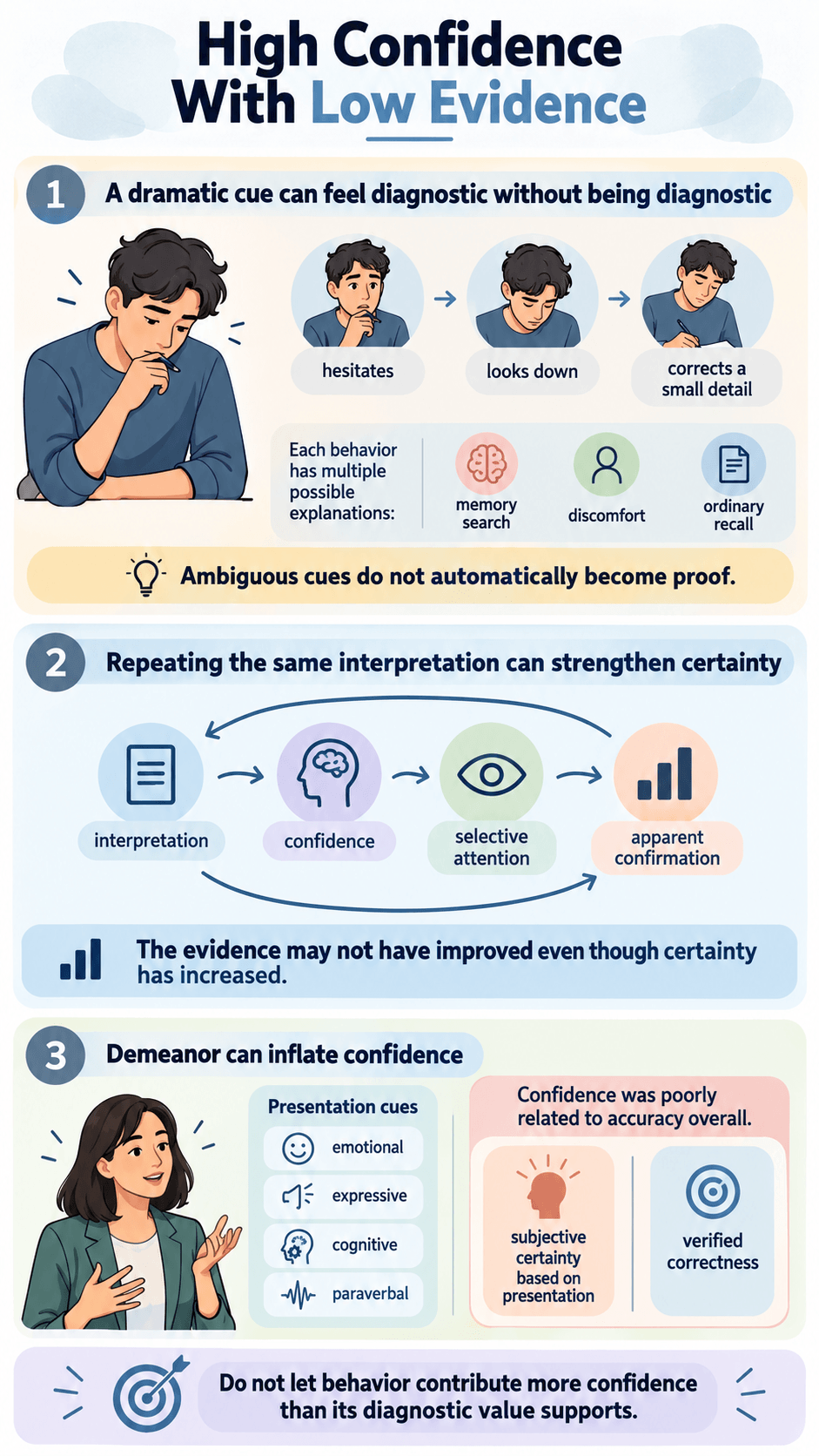
A dramatic cue can feel diagnostic without being diagnostic
Consider a person who hesitates before answering a sensitive question, looks down, then corrects a small detail. An observer may experience all three behaviors as one coherent package of deception and become highly confident.
But each behavior has multiple possible explanations. The hesitation may reflect memory search. Looking down may reflect discomfort. The corrected detail may reflect ordinary recall. Combining ambiguous cues does not automatically convert them into proof.
Repeating the same interpretation can strengthen certainty
Once an observer decides that a behavior signals deception, later attention may become selective. Every new pause or inconsistency appears to confirm the original conclusion, while ordinary or contradictory information receives less weight.
The result is a feedback loop: interpretation produces confidence, confidence narrows attention, and narrowed attention produces more apparent confirmation. The evidence may not have improved even though certainty has increased.
Demeanor can inflate confidence
One open-access study of videotaped interviews found that participants’ deception judgments were only modestly accurate and that confidence was poorly related to accuracy overall. The researchers also examined experiential criteria such as emotional, expressive, cognitive, and paraverbal features. Their study of confidence and experiential criteria in lie detection illustrates why subjective certainty based on presentation should not be confused with verified correctness.
The practical lesson is not to ignore behavior. It is to avoid letting behavior contribute more confidence than its diagnostic value supports.
What Classic Research Found About Confidence
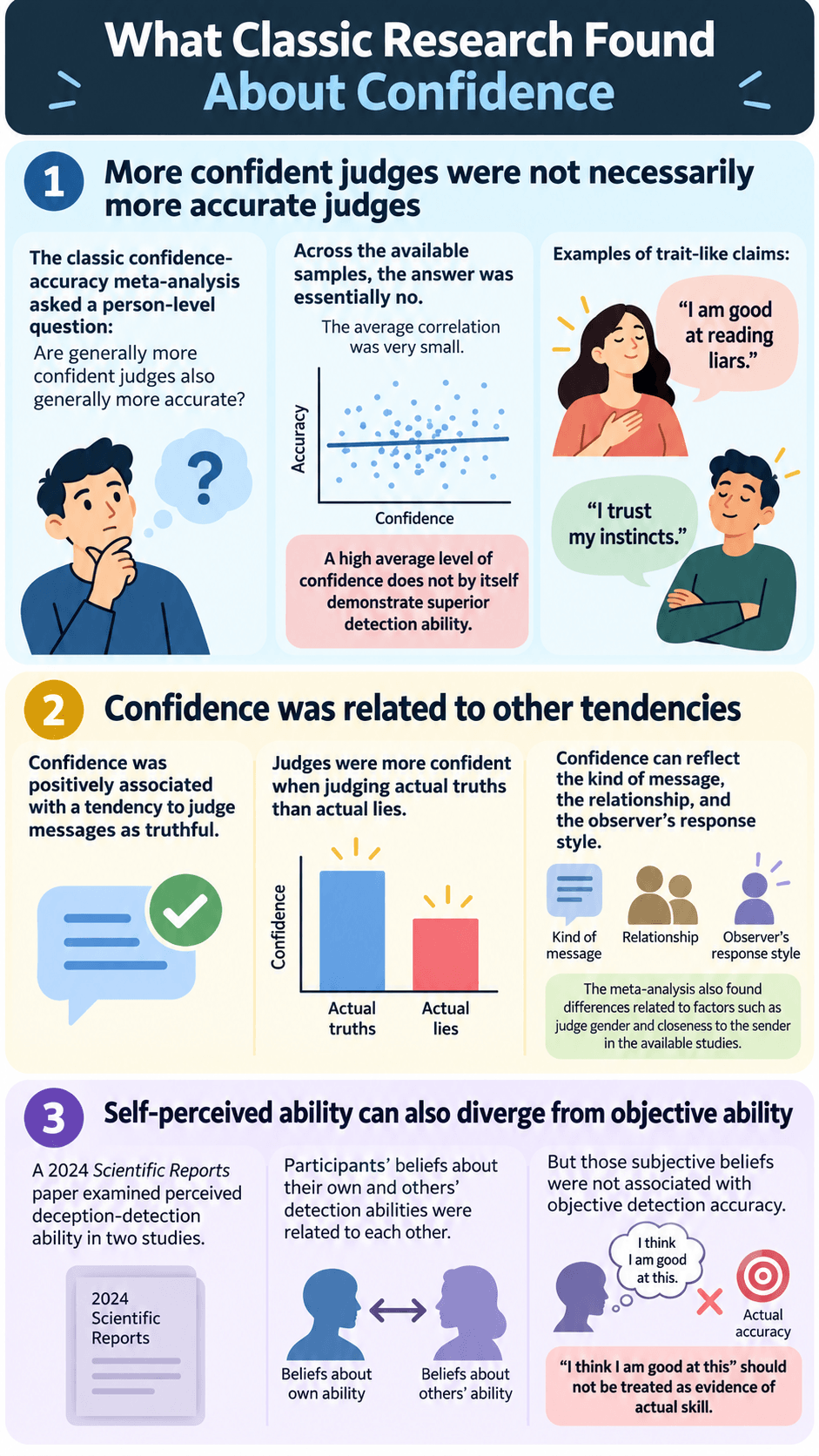
More confident judges were not necessarily more accurate judges
The classic confidence-accuracy meta-analysis asked a person-level question: are judges who are generally more confident also generally more accurate? Across the available samples, the answer was essentially no. The average correlation was very small.
This matters because people often make trait-like claims such as “I am good at reading liars” or “I trust my instincts.” A high average level of confidence does not by itself demonstrate superior detection ability.
Confidence was related to other tendencies
The same meta-analysis reported that confidence was positively associated with a tendency to judge messages as truthful, and that judges were more confident when they were judging actual truths than actual lies. It also found differences related to factors such as judge gender and closeness to the sender in the studies available at the time.
These findings show why confidence is not a pure readout of accuracy. It can reflect the kind of message, the relationship, and the observer’s response style.
Self-perceived ability can also diverge from objective ability
A 2024 Scientific Reports paper examined perceived deception-detection ability in two studies. Participants’ beliefs about their own and others’ detection abilities were related to each other, but those subjective beliefs were not associated with objective detection accuracy. The 2024 study of perceived versus objective deception-detection ability provides a useful modern example of why “I think I am good at this” should not be treated as evidence of actual skill.
Why Newer Research Adds an Important Qualification
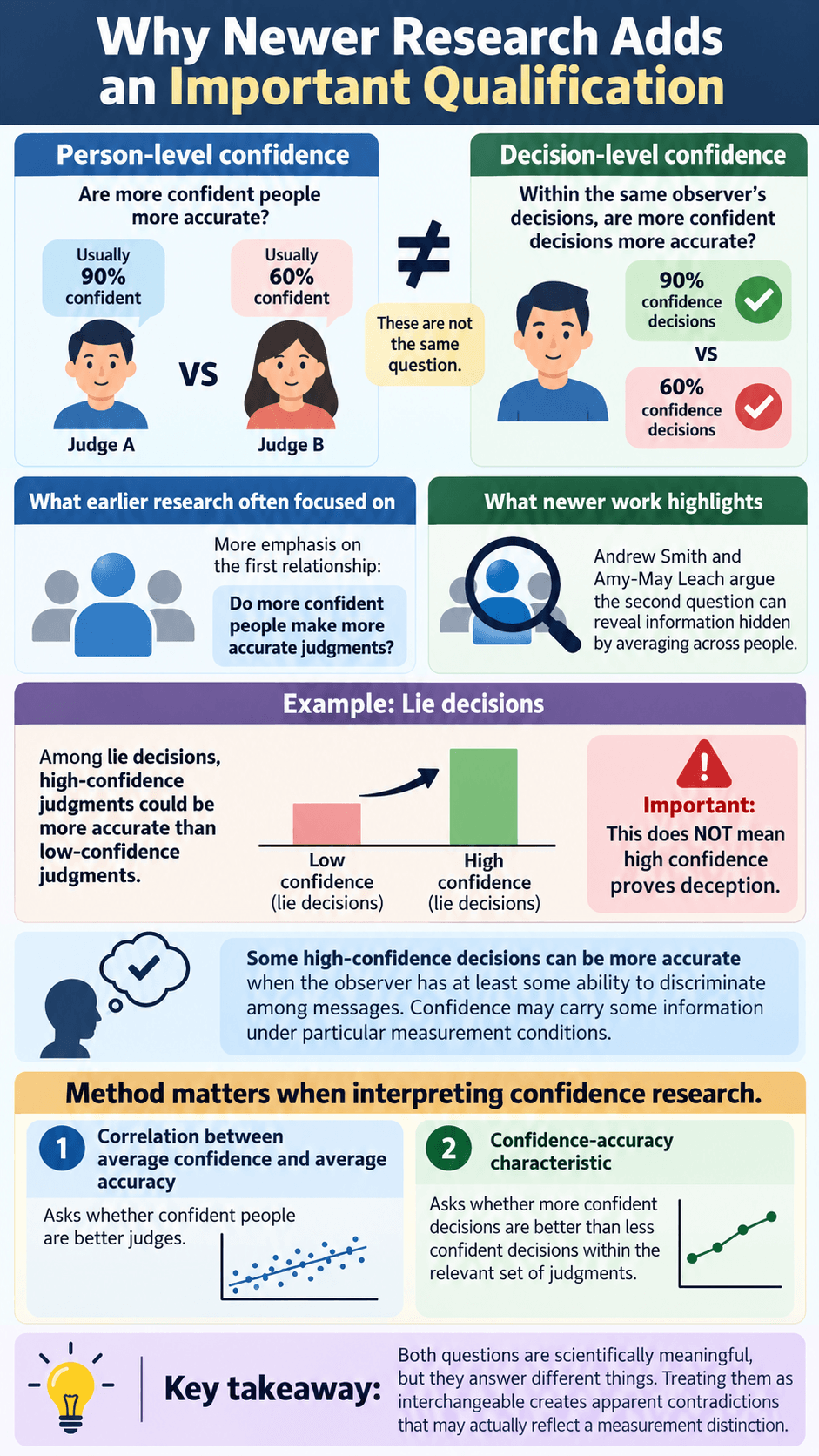
Person-level confidence and decision-level confidence are not the same question
Suppose Judge A is usually 90 percent confident and Judge B is usually 60 percent confident. Asking whether Judge A is more accurate than Judge B is one question.
Now ask a different question: within the same observer’s decisions, are judgments made with 90 percent confidence more accurate than judgments made with 60 percent confidence? That is a different analysis.
Older research often focused heavily on the first kind of relationship. Newer work has argued that the second can reveal information hidden by averaging confidence and accuracy across people.
Some high-confidence decisions can be more accurate
Andrew Smith and Amy-May Leach argued that signal-detection-based confidence-accuracy analyses are better suited to asking whether higher-confidence individual lie decisions are more accurate than lower-confidence ones. Their work reported that, among lie decisions, high-confidence judgments could be more accurate than low-confidence judgments. The 2019 analysis of confidence in accurate and inaccurate lie decisions is an important correction to the blanket statement that confidence is always useless.
But this does not mean “high confidence proves deception.” It means confidence may carry some information under particular measurement conditions when the observer has at least some ability to discriminate among the messages being judged.
Method matters when interpreting confidence research
A correlation between average confidence and average accuracy asks whether confident people are better judges. A confidence-accuracy characteristic asks whether more confident decisions are better than less confident decisions within the relevant set of judgments.
Both questions can be scientifically meaningful. They simply answer different things. Treating them as interchangeable creates apparently contradictory conclusions where there may instead be a measurement distinction.
Judges, Messages, and Why Confidence Varies So Much
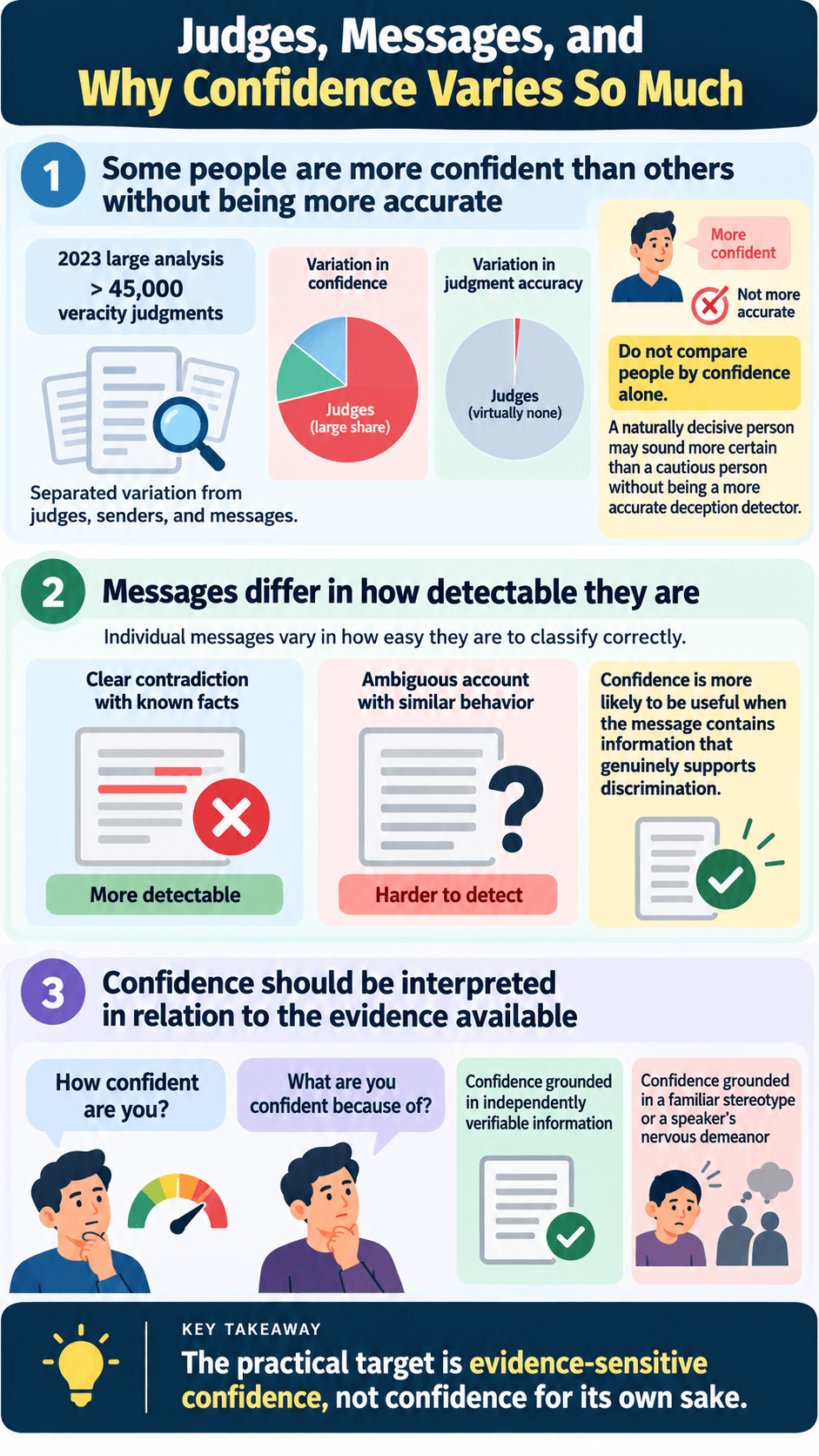
Some people are more confident than others without being more accurate
A large analysis published in 2023 used more than 45,000 veracity judgments and separated variation attributable to judges, senders, and individual messages. Judges accounted for a large share of the variation in confidence, but virtually none of the variation in judgment accuracy. The study separating judge, sender, and message effects found that some judges were consistently more confident even though that higher confidence was not supported by greater overall accuracy.
This is a useful warning against comparing people by confidence alone. A naturally decisive person may sound more certain than a cautious person without being a more accurate deception detector.
Messages differ in how detectable they are
The same 2023 research found meaningful variation associated with individual messages. Some messages were easier to classify correctly than others.
That makes intuitive sense. A message containing a clear contradiction with known facts is different from an ambiguous account in which truth and deception produce similar behavior. Confidence is more likely to be useful when the message contains information that genuinely supports discrimination.
Confidence should be interpreted in relation to the evidence available
This is why “How confident are you?” is incomplete without “What are you confident because of?” Confidence grounded in independently verifiable information deserves different weight from confidence grounded in a familiar stereotype or a speaker’s nervous demeanor.
The practical target is evidence-sensitive confidence, not confidence for its own sake.
Confidence vs Deception Detection Accuracy
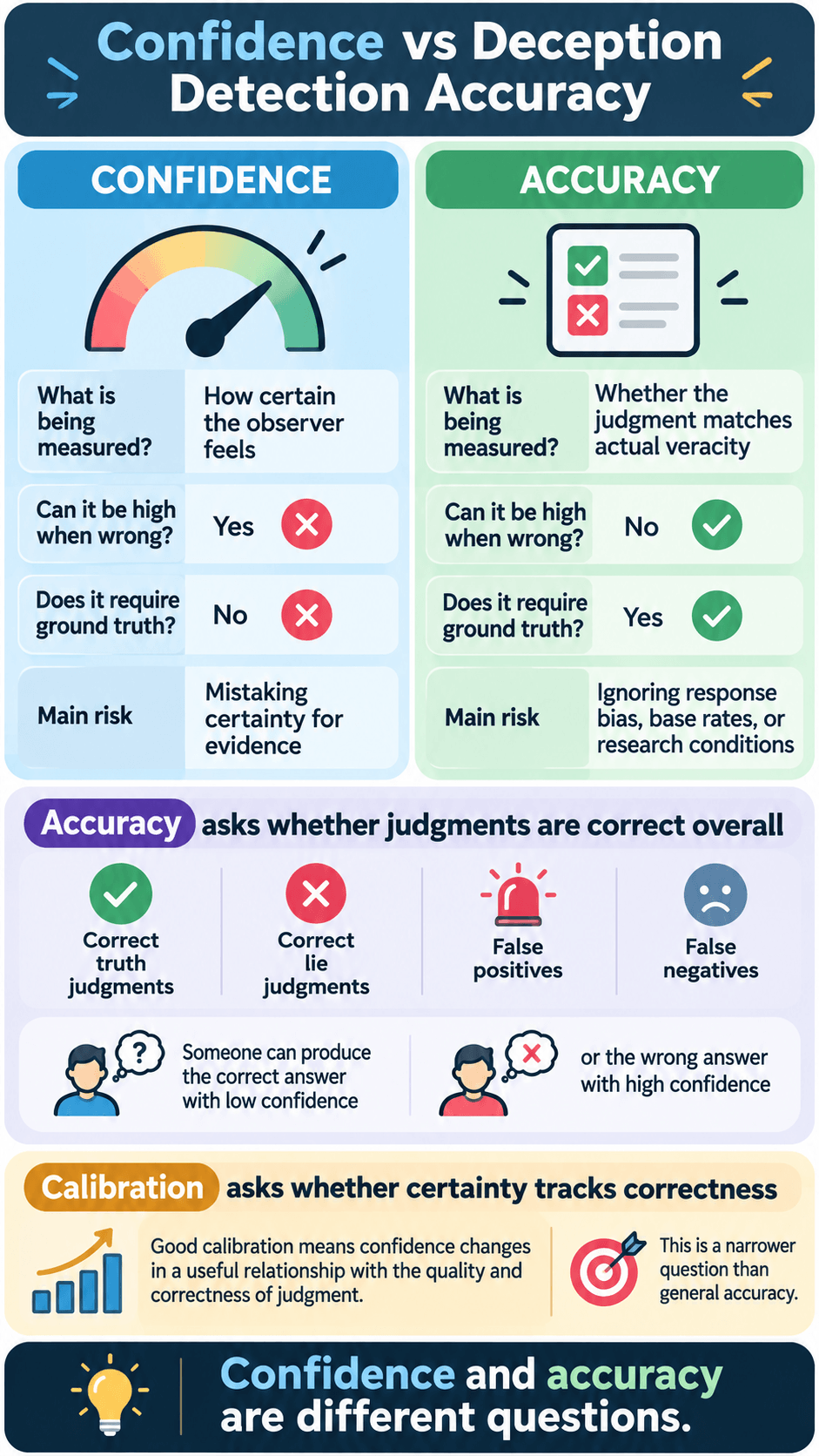
| Question | Confidence focus | Accuracy focus |
|---|---|---|
| What is being measured? | How certain the observer feels | Whether the judgment matches actual veracity |
| Can it be high when wrong? | Yes | No, a wrong judgment is inaccurate by definition |
| Does it require ground truth? | No | Yes |
| Main risk | Mistaking certainty for evidence | Ignoring response bias, base rates, or research conditions |
Accuracy asks whether judgments are correct overall
Deception detection accuracy examines how often truth-lie classifications match reality. It includes correct truth judgments, correct lie judgments, false positives, and false negatives.
That question can be answered without asking how sure the observer felt. Someone can produce the correct answer with low confidence or the wrong answer with high confidence.
Calibration asks whether certainty tracks correctness
Confidence calibration adds another layer. It asks whether stronger certainty tends to accompany more accurate decisions. Good calibration means confidence changes in a useful relationship with the quality and correctness of judgment.
This is a narrower question than general accuracy, which is why the two topics should not be collapsed.
Confidence in Deception Judgments vs Metacognitive Confidence Generally
This is a domain-specific problem
People make confidence judgments in memory, perception, reasoning, eyewitness identification, and many other tasks. Those domains do not all behave the same way.
Here the issue is specifically confidence in veracity judgments: “How sure am I that this particular message is truthful or deceptive?” The evidence base, cue quality, and error structure are specific to deception detection.
General self-confidence is not the same thing
A socially confident person may feel comfortable expressing a judgment but still have weak evidence. A cautious person may phrase a correct judgment tentatively. Personality-level decisiveness should not be confused with calibrated confidence about a particular claim.
Similarly, this topic is not about self-esteem or general belief in one’s cognitive abilities. It concerns certainty attached to a specific truth-lie decision.
Domain-specific feedback matters
Calibration improves only when people receive reliable feedback about whether judgments were correct. In everyday deception judgments, that feedback is often missing, delayed, or ambiguous.
If you accuse someone and they continue denying it, that is not ground truth. If later evidence never appears, that is not proof that the suspicion was correct. Without dependable feedback, confidence can become stable without becoming calibrated.
The Calibration Ladder
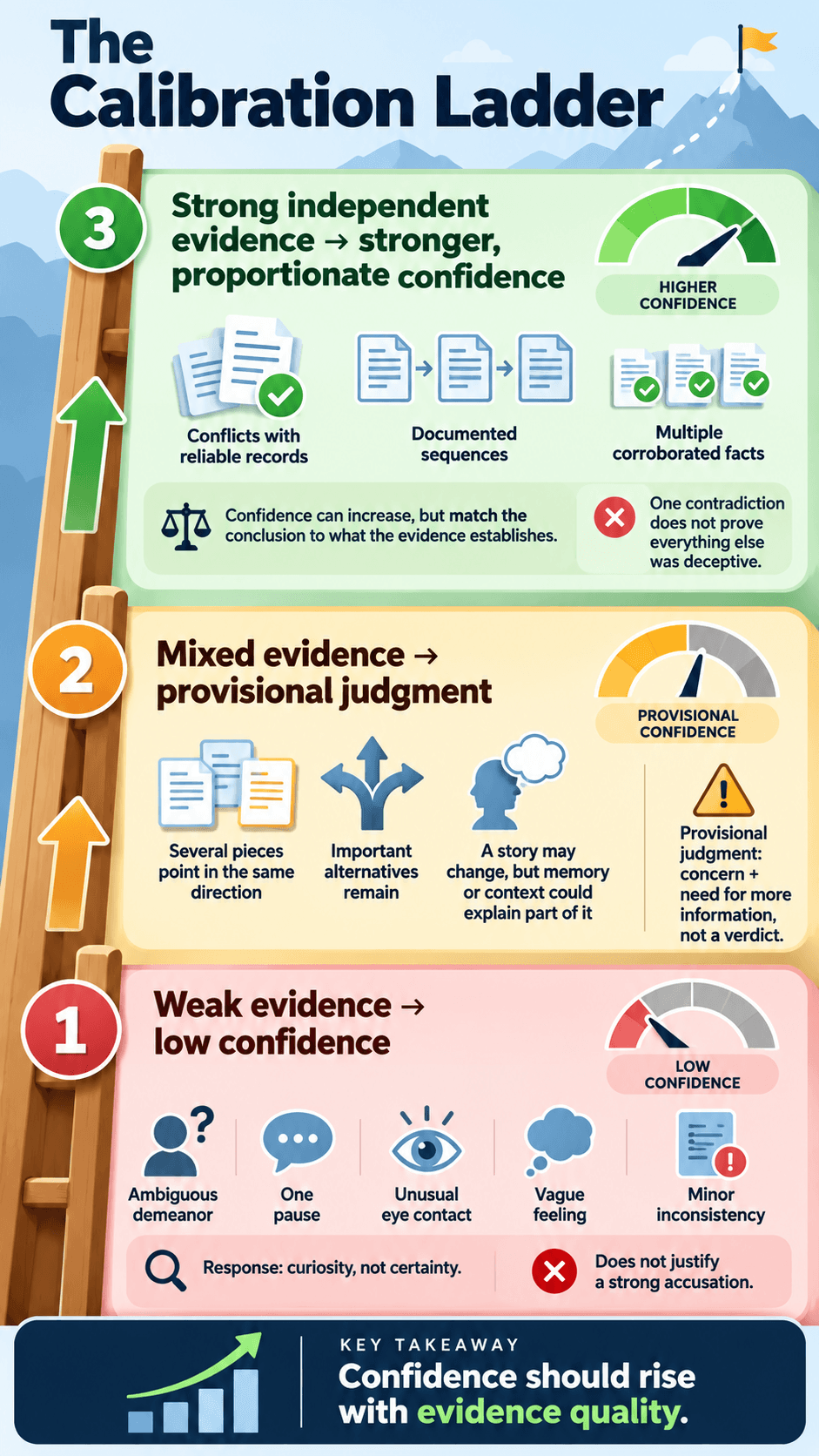
Weak evidence → low confidence
Weak evidence includes ambiguous demeanor, one pause, unusual eye contact, a vague feeling that something is off, or a minor inconsistency with several plausible explanations.
The appropriate response is curiosity rather than certainty. You may want clarification, but the evidence does not justify a strong accusation.
Mixed evidence → provisional judgment
Mixed evidence means several pieces point in the same direction, but important alternatives remain. Perhaps a story changed in a meaningful way, yet memory or context could explain part of the difference.
A provisional judgment sounds like: “I am concerned this may not be accurate, but I need more information.” That wording protects against turning uncertainty into a verdict.
Strong independent evidence → stronger, proportionate confidence
Confidence can reasonably increase when the claim conflicts with reliable independent records, documented sequences, or multiple corroborated facts. Even then, the conclusion should match what the evidence establishes.
A record showing that a person was elsewhere at a specific time may contradict one statement. It does not automatically prove every other statement was deceptive or reveal why the inaccurate statement was made.
Questions to Ask Before Becoming Certain
What evidence would change my mind?
If no possible evidence could reduce your certainty, the judgment may be closed rather than calibrated. A useful conclusion should have conditions under which it could be revised.
Try naming one piece of information that would strengthen the deception hypothesis and one that would weaken it. This makes your standard of evidence more visible.
Am I relying on behavior, context, or independently verifiable information?
Behavior can be informative context, but it is usually more ambiguous than documentation or corroborated facts. Ask yourself how much of your confidence would remain if you could not see the person’s facial expression, posture, or gaze.
If certainty drops sharply once demeanor is removed, appearance may be carrying more of the judgment than you realized.
Is my conclusion stronger than my evidence?
There is a meaningful difference between “I noticed something worth checking,” “I think this account may be inaccurate,” and “I know this person is lying.” Each step requires stronger evidence.
High-stakes accusations involving crime, abuse, workplace misconduct, fraud, child safety, or legal disputes should rely on documented evidence, qualified investigation, and appropriate procedures rather than subjective confidence.
FAQ
If I feel very sure someone is lying, am I more likely to be right?
Not necessarily. Classic research found that people who were generally more confident were not reliably more accurate overall. Newer work suggests that within some sets of decisions, higher-confidence judgments can be more accurate than lower-confidence ones. The safest interpretation is that confidence may sometimes carry information, but certainty alone is never proof and should be evaluated alongside evidence quality.
Can overconfidence make deception judgments worse?
Yes, especially when strong certainty discourages checking alternatives. Overconfidence can make an observer stop looking for disconfirming evidence, interpret ambiguous behavior as confirmation, or escalate an accusation before the facts are established. The problem is not confidence itself. It is confidence that exceeds what the evidence supports.
Does experience improve confidence calibration?
Experience can help when it provides accurate, repeated feedback about which judgments were correct. But experience without dependable feedback can reinforce mistaken rules. A person may become increasingly confident in a cue simply because they have used it for years, even if they rarely learn the true outcome.
Why can a vivid behavioral cue raise confidence without raising accuracy?
Vivid cues are easy to notice and easy to remember, which can make an explanation feel coherent. But psychological salience is not the same as diagnostic value. Nervousness, hesitation, gaze changes, and emotional presentation can have many causes, so a compelling impression may increase certainty without adding reliable evidence about deception.
What does well-calibrated confidence look like?
Well-calibrated confidence changes with evidence quality. Ambiguous cues produce low certainty, mixed information produces a provisional conclusion, and strong independent evidence supports stronger confidence. It also remains revisable. A calibrated observer can say what would change the judgment rather than treating certainty as self-validating.
Key Takeaways
- Confidence is subjective certainty; accuracy is whether a truth-lie judgment matches reality.
- Classic meta-analytic research found almost no relationship between judges’ average confidence and their overall deception-detection accuracy.
- Newer analyses show that some high-confidence individual decisions can be more accurate than lower-confidence decisions, so “confidence is always useless” is too broad.
- Behavioral stereotypes, vivid cues, prior beliefs, and demeanor can increase certainty without increasing evidence quality.
- Some people are consistently more confident than others without being consistently more accurate, which makes person-level confidence a poor substitute for verified skill.
- The practical goal is calibration: weak evidence should produce low confidence, mixed evidence a provisional judgment, and stronger independent evidence proportionately stronger certainty.
Before treating certainty as a reason to act, identify what the certainty is built on. If it rests mainly on demeanor, familiarity, or a strong feeling, lower the conclusion to the level the evidence can support. Confidence becomes more useful when it follows evidence rather than trying to replace it.

Michael Reed is the Founder and Lead Writer at Psychology Exposed. He writes about human behavior, relationships, emotional patterns, self-awareness, and practical psychology topics using research-informed, easy-to-understand content.
Read More About Michael Reed: https://psychologyexposed.com/michael-reed/