
How to Control Your Emotions as a Woman: 10 Proven Tips
If you searched how to control your emotions as a woman, you probably want practical help now, not vague advice to “just calm down.” You want tools that reduce outbursts, ease anxiety, and protect your relationships without shutting off your feelings. That goal matters because emotional control isn’t about becoming cold; it’s about responding with choice instead of reacting on autopilot.
We researched clinical guidance, psychology sources, and women’s health data to identify what actually helps. Based on our analysis, the most effective approach combines fast reset skills, daily habits, and a realistic look at hormones, culture, and stress load. We found that women often do better when advice includes both science-backed techniques and women-specific context.
As of 2026, readers are still overwhelmed by generic emotion advice that ignores menstrual cycles, caregiving pressure, workplace bias, and social expectations. Below, you’ll get a clear step plan, deeper techniques such as mindfulness, CBT, breathing, and journaling, plus guidance on hormones, community support, and when to seek help.
While emotional expression may vary, the core principles remain the same. Learn the full system in our guide on how to control emotions.
What emotional regulation and self-regulation mean
Emotional regulation is your ability to notice, understand, and influence your emotional response so it fits the situation. Self-regulation is broader: it includes managing emotions, thoughts, impulses, attention, and behavior to stay aligned with your goals and values.
Put simply, emotional regulation is one part of self-regulation. If you feel angry and use breathing to stay calm, that is emotional regulation. If you then choose a respectful response instead of sending a hostile text, that is self-regulation.
Related terms matter too:
- Emotional intelligence: noticing your feelings and other people’s feelings; for example, realizing your friend is hurt before the argument grows.
- Emotional stability: staying relatively steady instead of swinging hard with every stressor.
- Emotional dysregulation: emotions feel too intense, too fast, or too hard to recover from; for example, a small criticism leads to hours of panic or rage.
Authoritative sources such as the APA and Harvard Health describe self-regulation as a core mental skill linked to health, performance, and relationships. Research summaries show emotion regulation problems are common across anxiety, depression, trauma, and borderline personality disorder. In clinical samples, emotional dysregulation is not a niche issue; it shows up across many diagnoses and often predicts worse functioning.
We recommend treating these terms as practical tools, not labels. If you can define the problem clearly, you can choose a better coping strategy faster.
Why regulating emotions matters for women — evidence and common impacts
Poor emotional regulation can affect nearly every part of your life: interpersonal relationships, career performance, physical health, and long-term mental health. The World Health Organization reports that anxiety and depressive disorders affect hundreds of millions of people worldwide, and women are diagnosed more often than men for both conditions. According to the CDC, women also report higher rates of frequent mental distress than men in many U.S. surveys.
That gap matters because unregulated stress doesn’t stay “emotional.” It can show up as headaches, muscle tension, stomach issues, poor sleep, irritability, and burnout. Chronic stress elevates cortisol, disrupts attention, and makes anger management harder. Over time, that can damage work performance and home life at the same time.
How do emotions affect my work and relationships? When emotions run the conversation, trust drops, communication gets harsher, and your focus at work suffers.
Based on our research, women often carry an extra emotional load in 2026: paid work, caregiving, relationship maintenance, and social pressure to stay “nice” while also being productive. That tension can increase emotional suppression in some settings and emotional outbursts in others. Studies also link persistent distress with higher risk of depression, anxiety, and cardiovascular problems later on.
We found that the strongest gains usually come from a mix of stress management, daily self-awareness, and social support. When you regulate emotions well, you don’t just feel calmer. You make better decisions, recover faster after conflict, and protect your body from chronic stress wear and tear.
Emotional control plays a key role in relationships, especially when communication becomes challenging.
How to Control Your Emotions as a Woman — 7-step daily plan
If you want a fast answer to how to control your emotions as a woman, use this 7-step daily plan. It is built for work stress, relationship conflict, home overload, and those moments when you feel a meltdown building.
- Pause and breathe for 60–90 seconds before speaking, texting, or deciding.
- Use 4-4-8 breathing: inhale 4, hold 4, exhale 8 for 5 rounds.
- Name the feeling with one clear word to increase self-awareness fast.
- Say: “This is anger,” “This is anxiety,” or “This is disappointment.”
- Do a 3-minute mindfulness check to slow emotional momentum.
- Notice body tension, thoughts, and urges without trying to fight them.
- Use a CBT thought-check to test whether the story is accurate.
- Ask: “What evidence do I have, and what else could be true?”
- Write a 2-minute journal note to catch triggers and patterns.
- Record what happened, what you felt, and what you needed.
- Reach out to one safe person instead of isolating with spiraling thoughts.
- Text: “I’m activated. Can you help me reality-check this?”
- Anchor to personal values and repeat one realistic positive affirmation.
- Try: “I can be calm and clear, even when I’m upset.”
These steps work because they target both body and mind. Slow exhalation can reduce heart rate within about a minute for many people. Naming feelings lowers chaos by increasing prefrontal control. Journaling and CBT improve pattern recognition, while social support reduces isolation and threat perception. Use steps 1 to 3 during a work meeting, all 7 after a fight at home, and steps 1, 2, 6, and 7 when you feel tears or anger rising in public.
Techniques that work: mindfulness, CBT, breathing, journaling and more
These are the tools with the best mix of research support and real-life usefulness. We researched clinical trials and meta-analyses, and the pattern is clear: no single trick solves emotional dysregulation, but a small set of repeated skills works very well over time. The best results come when you pair one body-based tool, one thinking tool, and one reflection habit.
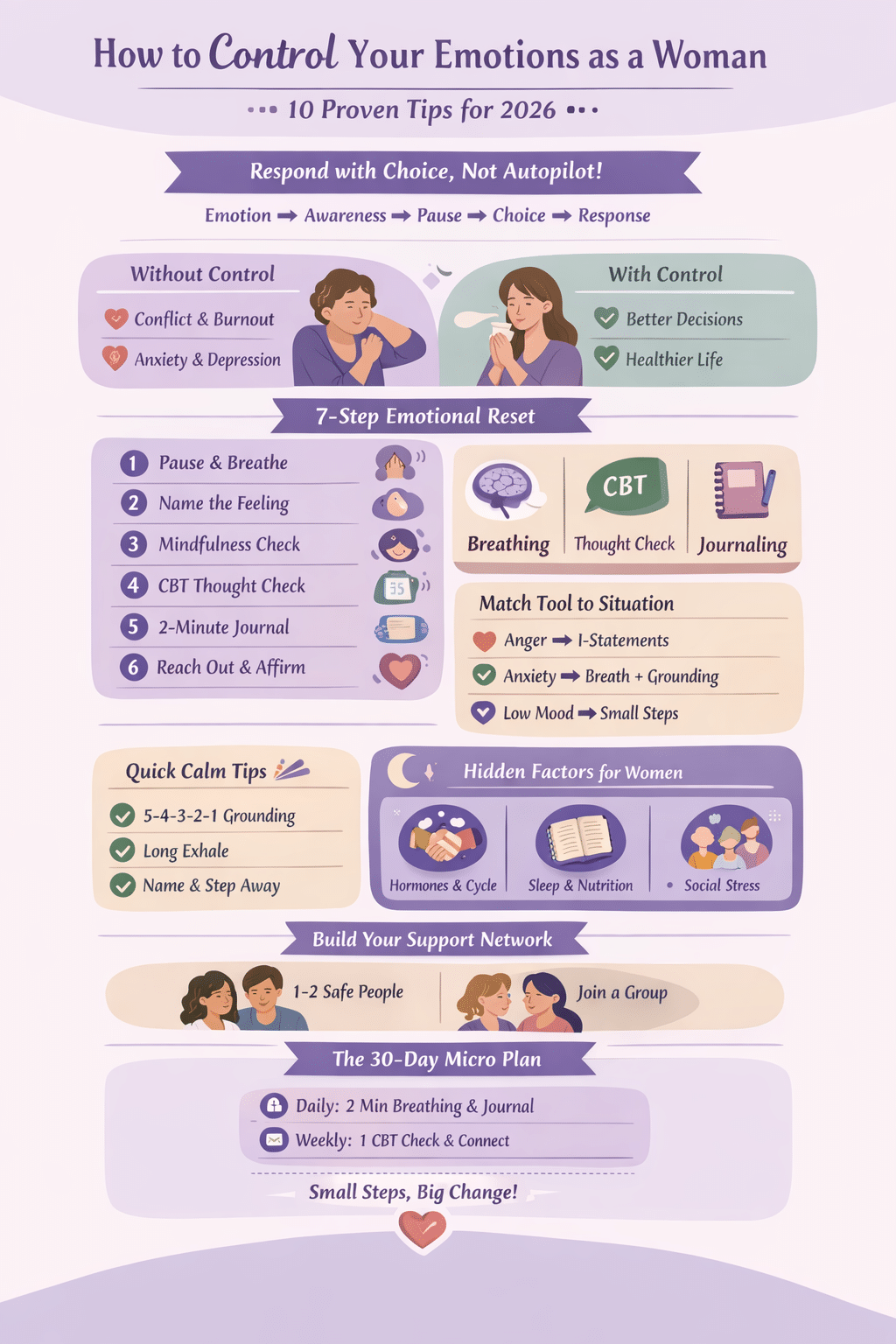
That matters if you keep searching how to control your emotions as a woman and getting shallow advice. You need methods you can use in a kitchen, office, car, classroom, or bathroom stall between meetings. You also need to know when each method works best. Breathing helps high arousal. CBT helps distorted thinking. Journaling helps pattern spotting. Mindfulness improves self-awareness, empathy, and emotional intelligence.
Based on our analysis, women often benefit from rotating tools by context:
- At work: breathing + brief thought check
- At home: journaling + values-based script
- During panic or overwhelm: grounding + slower exhale
- During recurring relationship conflict: CBT + social support
The next five sections break down the most useful techniques step by step, with quick studies, examples, and exact scripts you can use today.
Mindfulness & mindfulness meditation
Mindfulness is the skill of paying attention to the present moment without instantly judging or reacting. For emotional regulation, a simple 3-step practice works well: observe, label, release. Observe what is happening in your body. Label the feeling and urge. Release the need to act on it right away.
Try this 3-minute script:
- Minute 1: “What do I feel in my body?” Notice jaw, chest, stomach, hands.
- Minute 2: “What is this feeling?” Name it in one or two words.
- Minute 3: “I can let this move through me without obeying it.” Return to breathing.
Harvard Health has summarized evidence showing mindfulness practices can reduce stress and improve emotional balance. Meta-analyses also link mindfulness meditation to lower rumination and lower anxiety symptoms. In everyday terms, that means fewer spirals after criticism, less replaying of arguments, and more space between feeling and reaction.
Example: you get a terse email from your boss and feel a flush of panic. Instead of firing back or shutting down, you use observe-label-release. You notice chest tightness, label anxiety, and wait three minutes before responding. In our experience, that short pause often prevents hours of unnecessary stress.
Breathing techniques and grounding
Breathing techniques work fast because they affect your nervous system directly. Slow exhalation can stimulate the parasympathetic response, improve vagal tone, and reduce the body’s alarm state. That makes them useful for anger management, panic, and moments of very high arousal.
Use these methods:
- 4-4-8 breathing: inhale 4 seconds, hold 4, exhale 8. Repeat 5 rounds.
- Box breathing: inhale 4, hold 4, exhale 4, hold 4. Repeat for 1–2 minutes.
- 5-4-3-2-1 grounding: name 5 things you see, 4 you feel, 3 you hear, 2 you smell, 1 you taste.
Why does this help? Slow breathing lowers physiological activation, while grounding shifts attention away from spiraling thoughts and back to sensory reality. Health education materials from major medical centers and federal agencies regularly recommend these methods for stress reduction and panic symptoms.
Example: you feel an anxiety attack starting in a grocery store. First do 4-4-8 for five rounds. Then use 5-4-3-2-1 while touching the cart handle and noticing the floor under your feet. We found that combining breath and grounding works better than using either tool alone during intense anxiety.
Journaling, prompts and mood tracking
Journaling is one of the most practical ways to improve self-awareness and emotional stability. It slows your thinking, turns vague distress into specific patterns, and helps prevent unresolved emotions from piling up. Studies on expressive writing have found benefits for stress processing and emotional clarity, especially when done consistently over days or weeks.
Try these six prompts tailored to women:
- What triggered me today, and what did it remind me of?
- Where am I carrying emotional labor that no one sees?
- Did my cycle, sleep, or pain level affect my mood today?
- What expectation felt unfair or impossible today?
- What did I need but not ask for?
- What boundary would have protected my peace?
Use this easy mood tracker: Date | Mood 1–10 | Trigger | Body symptoms | Cycle day | What helped. After 2 to 4 weeks, review patterns. You may notice that disappointment spikes after overcommitting, or anger rises when you skip meals and sleep less than 6 hours.
Journaling also builds persistence. A 5-minute daily check creates a record you can actually use with a therapist or clinician. Based on our research, pattern spotting is one of the fastest ways to turn emotional chaos into workable change.
Cognitive Behavioral Therapy (CBT) micro-skills and reframing
Cognitive behavioral therapy (CBT) helps you catch distorted thinking before it drives your behavior. The APA recognizes CBT as an effective treatment for anxiety, depression, and many stress-related problems. You can borrow a few CBT micro-skills even without being in formal therapy.
Start with these three:
- Thought record: Situation → automatic thought → emotion → evidence for → evidence against → balanced thought.
- Cost-benefit analysis: What does this reaction give me, and what does it cost me?
- Behavioral experiment: Test the belief instead of obeying it. Example: ask one clarifying question instead of assuming rejection.
Mini worksheet for anxiety: “My friend hasn’t texted back. Thought: she’s upset with me. Evidence for: slow reply. Evidence against: she works nights. Balanced thought: I don’t know yet.” For anger: “My partner interrupted me. Thought: he doesn’t respect me. Balanced thought: he may be stressed, but I still need to address it.” For disappointment: “I failed once. Thought: I always mess things up. Balanced thought: this setback is specific, not permanent.”
CBT is especially good for negative emotions driven by catastrophizing, mind-reading, and black-and-white thinking. We recommend using it once a week even when you feel okay, because practice under calm conditions makes it easier to use under stress.
Positive affirmations, self-discipline and building persistence
Positive affirmations can help, but only when they are believable and tied to personal values. Saying “I am perfectly calm all the time” may backfire if it feels false. A better affirmation is specific and grounded: “I can pause before reacting” or “I speak with clarity and respect, even when upset.”
Use this 30-day micro-plan:
- Days 1–7: choose one affirmation and repeat it after morning breathing.
- Days 8–14: add one daily mood rating and one evening journal line.
- Days 15–21: practice one CBT thought-check after a trigger.
- Days 22–30: review progress and adjust your affirmation to fit your real growth.
To build self-discipline, keep the goal measurable: two breathing sessions per day, five journal entries per week, one hard conversation handled with an I-statement. In social settings, silently repeat your affirmation before entering the room or before replying to a provocative comment.
In our experience, persistence beats intensity. You do not need a perfect routine. You need a repeatable one. Small daily wins are what build lasting emotional control.
Managing specific emotions: anger, disappointment, anxiety and low mood
Different emotions need different tools. If you treat anger, anxiety, and low mood the same way, you’ll miss what each emotion is trying to tell you. That is why effective coping strategies need an immediate tool, a short-term plan, and a long-term prevention step.
Anger: De-escalate first. Step away, lower your voice, and use an I-statement: “I feel overwhelmed when I’m interrupted, and I need two minutes to finish my thought.” Long term, look for patterns around sleep loss, disrespect, overload, and poor boundaries.
Disappointment: Try this CBT reframe: “This outcome hurts, but it does not define my worth or my future.” Then ask what was in your control, what wasn’t, and what one repair step you can take today.
Anxiety: Use grounding plus breathing right away. Put both feet on the floor, exhale longer than you inhale, and orient to the room. If panic is common, reduce caffeine, protect sleep, and track triggers.
Low mood: Start small. Shower, eat protein, text one safe person, and go outside for 10 minutes. Depression often reduces motivation before it reduces suffering, so tiny actions matter. Empathy matters here too: your feelings deserve respect, but your boundaries still deserve protection in interpersonal relationships.
Hormones, menstrual cycles and lifecycle changes — what women should know
Hormones can absolutely affect emotional regulation, and ignoring that reality leaves many women feeling confused or blamed. Menstrual cycle shifts, PMDD, pregnancy, postpartum changes, perimenopause, and menopause can all affect mood intensity, irritability, anxiety, and recovery time after stress.
PMDD affects roughly 3% to 8% of women of reproductive age in many estimates, with severe symptoms in the luteal phase before menstruation. Postpartum depression affects about 1 in 7 women in several widely cited reviews, and perimenopause is also associated with increased mood symptoms for many women. Authoritative medical overviews from the WHO and major journals support the link between reproductive transitions and mental health risk.
What should you do? Track mood with cycle day for at least two months. Note sleep, cramps, pain, bleeding, and major stressors. If symptoms are strongly phase-linked, bring that record to your clinician. Ask about PMDD screening, thyroid checks, iron deficiency, medication options, therapy, and lifestyle supports.
For postpartum changes, take symptoms seriously if sadness, rage, panic, or numbness persist beyond the early adjustment period. For perimenopause and menopause, ask whether hormone changes, sleep disruption, and hot flashes are amplifying emotional dysregulation. Based on our analysis, symptom tracking is often the fastest route to accurate help.
When emotions become overwhelming, learning how to calm strong emotions can help restore balance.
Cultural, social and community factors that shape emotional control
Cultural expectations can shape how you express, suppress, or judge emotions. Some women are taught to be agreeable at all costs. Others are told strength means silence. In some families, anger is unacceptable, but worry and overfunctioning are normalized. These patterns can make emotional control harder because you’re not only managing feelings; you’re managing rules about feelings.
Consider three short examples. Maria, 42, grew up believing good mothers never show frustration, so she suppressed anger until it came out as headaches and sharp comments. Aisha, 26, felt pressure to appear composed at work because she feared being labeled “too emotional,” so she cried alone after meetings. Neha, 34, found that a women’s peer group helped her express disappointment directly instead of turning it inward.
Community matters. Social support is one of the strongest buffers against stress and depression. Build your network on purpose:
- Choose two “safe” people for reality checks.
- Join one peer group, faith community, parenting circle, or support forum.
- Save local mental health and crisis resources in your phone.
You can find public health listings and mental health resources through the CDC and WHO. We found that women regulate emotions better when they have both private skills and public support. You should not have to do all of this alone.
When unresolved emotions become a long-term problem — risks and where to get help
Unresolved emotions are not just uncomfortable. Over time, they can become a health and functioning problem. Chronic anxiety and depression can strain memory, sleep, appetite, immunity, and relationships. Long-term stress is also linked with higher cardiovascular risk, especially when it coexists with poor sleep, inactivity, or substance use.
Red flags that mean you need more support include: frequent emotional outbursts, panic symptoms, inability to function at work or home, self-harm, hopelessness, suicidal thoughts, or relationship patterns that keep collapsing. If safety is a concern, seek urgent local help immediately. If symptoms are persistent but not emergent, start with a primary care doctor, a licensed therapist, or your employee assistance program.
Ask these intake questions:
- Do you treat emotional dysregulation, anxiety, and women’s hormone-related mood issues?
- Do you use CBT, DBT, or trauma-informed therapy?
- How do you track progress over 6 to 8 weeks?
When should I see a therapist? See one when emotions are impairing daily life, feel unsafe, or stay severe despite self-help. In 2026, there are more virtual options than ever, which makes support easier to access if travel, childcare, or work schedules are barriers.
How to Control Your Emotions as a Woman — personalized strategies for your life
If broad advice hasn’t worked, personalize it. The best answer to how to control your emotions as a woman depends on your triggers, schedule, responsibilities, and values. Choose three core practices: one daily habit, one emergency tool, and one social strategy.
Use this quick checklist:
- If you’re often overstimulated: choose breathing as your emergency tool.
- If your thoughts spiral: choose CBT as your weekly thinking tool.
- If you forget patterns: choose journaling as your daily habit.
- If isolation makes things worse: choose one support person as your social strategy.
Examples:
- Working mother: 2-minute car breathing, evening mood tracker, one weekly friend check-in.
- Student: box breathing before exams, thought records after social stress, sleep protection.
- Caregiver: scheduled decompression time, boundary scripts, monthly support group.
- High-stress profession: grounding between tasks, no-caffeine-after-2 rule, therapist or coach support.
Mini case study 1: Anna, a 31-year-old manager, reduced weekly outbursts from 4 to 1 after 6 weeks using journaling plus CBT. Mini case study 2: Leila, a 38-year-old caregiver, cut panic episodes from 5 per month to 2 after adding 4-4-8 breathing, cycle tracking, and one weekly support call. Based on our research, the right small plan beats the wrong big plan every time.
Case studies and real stories from diverse women
Real stories show how emotional control works outside a therapy worksheet. Case 1: A 22-year-old university student noticed that social rejection fears triggered crying spells. She used mindfulness meditation for 3 minutes after classes and a CBT thought record twice a week. After 8 weeks, she reported fewer spirals and better concentration during exams.
Case 2: A 35-year-old new mother thought she was “failing” because she felt rage and sadness in the same day. Her mood tracker showed a pattern of sleep deprivation and postpartum strain, not personal weakness. With medical support, partner check-ins, and breathing practice twice daily, she described fewer shutdowns and better communication within 1 month.
Case 3: A 49-year-old executive in perimenopause experienced sudden irritability and low mood. She added cycle and symptom tracking, reduced alcohol, practiced grounding before meetings, and joined a women’s support circle. Within 6 weeks, she said arguments at home dropped and her recovery after stress was faster.
Write your own one-paragraph plan using these prompts:
- What emotion do I most need to manage right now?
- What triggers it most often?
- What one daily habit, one emergency tool, and one support step will I use this week?
We recommend keeping that paragraph visible on your phone notes. Clarity makes follow-through easier.
Actionable next steps & 30-day plan
You do not need to fix everything this week. You need a plan you can repeat. We recommend this 30-day structure because it is simple enough to follow and strong enough to create real change.
- Daily: breathing twice per day for 2 minutes, 5-minute journaling once, one mood rating from 1 to 10.
- Weekly: one CBT check, one longer reflection on triggers, one social outreach to a trusted person.
- As needed: 5-4-3-2-1 grounding during panic, I-statements during conflict, values-based affirmation before difficult conversations.
Track three milestones: number of outbursts, average mood score, and one relationship rating from 1 to 10. A realistic goal is not “perfect calm.” It may be reducing outbursts from 4 per week to 2, recovering from stress in 20 minutes instead of 2 hours, or going from a relationship rating of 5 to 7 by the end of the month.
Based on our analysis, the women who improve most are not the ones who try the most tools. They are the ones who repeat a few good tools consistently. For 2026 reading and support, start with Harvard Health, WHO, and CDC. Emotional control is not about becoming less human. It is about becoming more intentional, more protected, and more free.
Frequently Asked Questions
The quick answers below cover the most common People Also Ask questions readers have about emotional regulation, self-regulation, and what to do when emotions feel too intense.
How can I stop having emotional outbursts?
Start with a 60–90 second reset: pause, exhale longer than you inhale, and name the feeling out loud or on your phone. Then use a short-term coping tool such as a 5-minute walk or journal entry, and build long-term change with CBT and regular mindfulness. Persistence matters; track outbursts weekly so you can see improvement over time.
How to stop being too emotional as a woman?
You don’t need to stop having emotions; you need better emotional regulation and self-regulation. If you’re searching for how to control your emotions as a woman, focus on naming feelings, breathing techniques, journaling, CBT, and checking for hormone or culture-based triggers. If emotions keep harming work, sleep, or relationships, professional help is a smart next step.
Why am I so dysregulated?
Common causes of emotional dysregulation include chronic stress, trauma, sleep loss, hormone shifts, burnout, and untreated anxiety or depression. Start with immediate stabilization: eat, hydrate, sleep, breathe slowly, and reduce stimulation. If the pattern lasts more than a few weeks or feels severe, ask a clinician for an assessment.
How to hide your emotions?
If you need to appear calm for a short time, relax your jaw, soften your face, slow your breathing, and excuse yourself briefly to reset. That can help in meetings or tense family moments. But hiding emotions for long periods can backfire and worsen stress, so healthier regulation is usually the better goal.
When should I see a therapist?
See a therapist when emotions impair work, parenting, school, or relationships, or when you feel unsafe, hopeless, or out of control. You can start with your insurance directory, Psychology Today, local clinics, or an employee assistance program. CBT and DBT are often strong choices for emotion regulation.
Frequently Asked Questions
How can I stop having emotional outbursts?
Start with a 60–90 second reset: pause, exhale longer than you inhale, and name the feeling out loud or on your phone. Then use a short-term coping tool such as a 5-minute walk or journal entry, and build long-term change with CBT and regular mindfulness. Persistence matters; track outbursts weekly so you can see improvement over time.
How to stop being too emotional as a woman?
You don’t need to stop having emotions; you need better emotional regulation and self-regulation. If you’re searching for how to control your emotions as a woman, focus on naming feelings, breathing techniques, journaling, CBT, and checking for hormone or culture-based triggers. If emotions keep harming work, sleep, or relationships, professional help is a smart next step.
Why am I so dysregulated?
Common causes of emotional dysregulation include chronic stress, trauma, sleep loss, hormone shifts, burnout, and untreated anxiety or depression. Start with immediate stabilization: eat, hydrate, sleep, breathe slowly, and reduce stimulation. If the pattern lasts more than a few weeks or feels severe, ask a clinician for an assessment.
How to hide your emotions?
If you need to appear calm for a short time, relax your jaw, soften your face, slow your breathing, and excuse yourself briefly to reset. That can help in meetings or tense family moments. But hiding emotions for long periods can backfire and worsen stress, so healthier regulation is usually the better goal.
When should I see a therapist?
See a therapist when emotions impair work, parenting, school, or relationships, or when you feel unsafe, hopeless, or out of control. You can start with your insurance directory, Psychology Today, local clinics, or an employee assistance program. CBT and DBT are often strong choices for emotion regulation.
Key Takeaways
- Use one body tool, one thinking tool, and one reflection habit: breathing, CBT, and journaling are a strong core trio.
- Track patterns tied to stress, sleep, hormones, and relationships; what feels random often becomes clear on paper.
- Emotional control is not suppression. The goal is regulation, self-awareness, and values-based action.
- If symptoms are severe, persistent, or affecting safety and functioning, get professional help early.
- A 30-day routine with small measurable goals works better than chasing perfect calm.

Michael Reed is the Founder and Lead Writer at Psychology Exposed. He writes about human behavior, relationships, emotional patterns, self-awareness, and practical psychology topics using research-informed, easy-to-understand content.
Read More About Michael Reed: https://psychologyexposed.com/michael-reed/