
How to Calm Down When Overwhelmed is not about forcing yourself to become calm on command. It is about understanding what your body and mind are doing under pressure, then giving yourself a practical path back to choice. When emotion rises fast, the problem is usually not a lack of intelligence or character. The problem is that attention, body arousal, memory, interpretation, and communication all start competing at once.
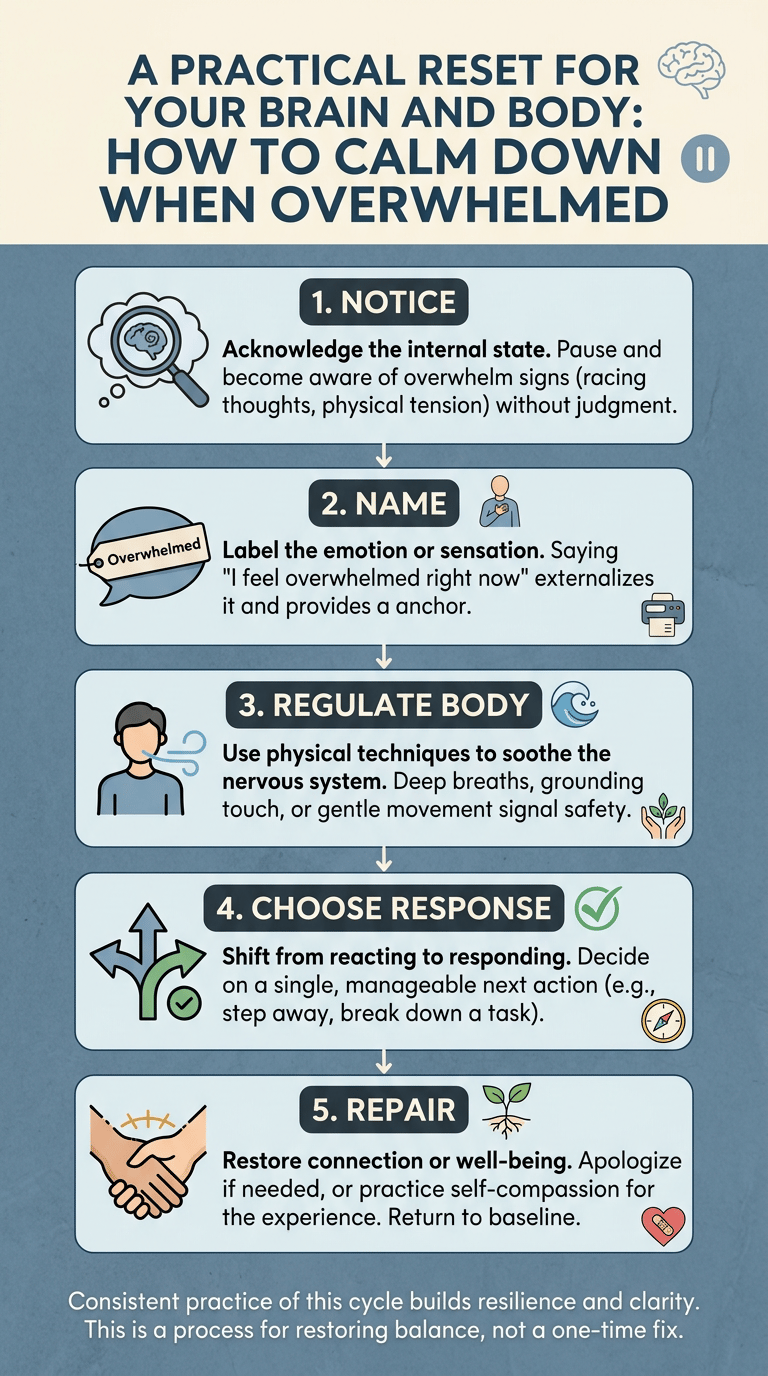
When you are overwhelmed, the useful first step is not to solve everything. It is to reduce input, calm the body, empty working memory, and choose one next action small enough to begin.
This guide stays focused on how to calm down when overwhelmed. It does not try to replace broad emotional-control advice. Instead, it gives you a detailed, situation-specific framework you can use before, during, and after the emotional moment.
The Psychology Behind how to calm down when overwhelmed
Emotion is information, not an instruction
Why feelings need interpretation
An emotion tells you that something matters. It does not always tell you the full truth about what is happening. Fear can point to danger, but it can also point to uncertainty. Anger can point to a violated boundary, but it can also point to exhaustion. Sadness can point to loss, but it can also appear after chronic stress. The first skill is to treat emotion as data that needs checking, not as a command that must be obeyed immediately.
Why the body often reacts first
Stress and emotional arousal involve the body as well as the mind. The American Psychological Association explains in its overview of stress and health that stress can affect thoughts, emotions, and physical functioning. That is why purely logical advice often fails in the middle of a strong emotional moment. The body needs a cue of safety before the mind can use complex reasoning well.
Regulation is different from suppression
Suppression hides emotion, regulation changes your relationship to it
Suppression says, “Do not feel this.” Regulation says, “Feel this without letting it decide everything.” Suppression can make you look composed while tension builds underneath. Regulation creates enough space to notice the feeling, reduce the intensity when possible, and choose a response that fits your values.
The goal is response flexibility
Response flexibility means you have more than one possible move. You can pause instead of attack, ask instead of assume, leave safely instead of explode, or return to a conversation instead of disappearing. Flexibility is a better target than perfect calm because real life is not emotionally tidy.
What Feeling Overwhelmed Actually Means
A simple definition
Too much demand for current capacity
Overwhelm happens when the demands on your attention, emotion, time, body, or relationships exceed your current capacity to organize them. It is not always about weakness. Sometimes there are simply too many open loops and not enough recovery.
Overwhelm vs stress vs anxiety
Stress usually points to pressure. Anxiety points to perceived threat or uncertainty. Overwhelm feels like too much input at once, with no clear order for what should happen next.
The Five-Minute Overwhelm Reset
Step 1: Stop adding input
Reduce noise before making plans
Put down the phone, close extra tabs, pause nonessential conversations, or step into a quieter place. When the system is overloaded, more input usually makes thinking worse.
Step 2: Slow the exhale
Use the body to create a little space
Inhale normally and exhale slightly longer. Do not force perfect breathing. The goal is to give the body a small signal that urgency can soften.
Step 3: Ground through the senses
Return to the room you are actually in
Name five things you see, press your feet into the floor, or hold something cool. Grounding is useful because overwhelm often pulls attention into every possible future problem at once.
Step 4: Brain dump everything
Empty working memory
Write every task, worry, decision, and emotion without sorting. The page can hold more than your working memory can. Once the thoughts are outside your head, organization becomes easier.
Step 5: Choose the next smallest action
Do not choose the perfect action
Choose one action under five minutes: drink water, send one reply, open one document, put one item away, or write one question. Starting small interrupts paralysis.
Why You Get Overwhelmed
Cognitive overload
Too many open loops
The mind struggles when it has to remember, prioritize, decide, and emotionally process at the same time. Overwhelm often improves when the tasks are made visible and sorted.
Emotional overload
Feelings make priorities blur
When emotion is intense, everything can feel urgent. This is why the first step is regulation, not a perfect productivity system.
Stress depletion
A stressed body has less capacity
Cleveland Clinic’s overview of stress and stress management describes how stress can affect mood, body, and behavior. When stress is chronic, overwhelm may appear faster because recovery has not caught up with demand.
What Not to Do When Overwhelmed
Do not solve your whole life at once
Global thinking increases panic
Questions like “What is wrong with my life?” are too large during acute overwhelm. Ask: “What is the next stabilizing action?”
Do not shame yourself into action
Shame drains regulation
Shame may create a brief push, but it usually increases avoidance later. A calmer approach is more sustainable: name the overload, reduce input, choose one action.
Do not keep refreshing information
Scrolling often adds more loops
Scrolling can feel like rest, but it may add comparison, news, tasks, messages, and stimulation. Choose low-input recovery when overwhelmed.
How to Prevent Overwhelm Tomorrow
Use three lists
Must do, should do, could do
Put every item into one of three categories. Must-do items are urgent and important. Should-do items matter but can wait. Could-do items are optional. This prevents the brain from treating every item as equally urgent.
Create decision rules
Pre-decide repeat choices
Use defaults for repeated decisions: when to check email, what to eat on busy days, when to clean, how to start work, and when to stop. Fewer repeated decisions mean less overload.
Build recovery blocks
Rest before collapse
MedlinePlus provides an accessible overview of stress symptoms and coping, including the importance of healthy coping and support. Recovery should not wait until everything is finished, because everything may never be finished.
How to Calm the Body First
Start with the fastest physical levers
Breathing, posture, temperature, and movement
When emotion is high, begin with the body. Slow the exhale, put both feet on the floor, release the jaw, drop the shoulders, or change temperature with cold water on the hands or face. These actions are simple, but they matter because they interrupt the physical escalation loop.
Why small actions work better than dramatic promises
People often promise themselves they will never react that way again. That promise is too broad to use in the moment. A small action is more reliable: one breath, one step back, one sentence, one glass of water, one pause. Regulation is built from repeatable actions, not dramatic declarations.
Name the emotion precisely
Labels reduce confusion
Cleveland Clinic’s guidance on emotional triggers and coping describes labeling emotions and noticing body sensations as useful steps for responding to triggers. A precise label turns a vague storm into something workable. “I am angry” is useful. “I am angry because I feel dismissed” is even more useful.
Use a two-part label
Try this structure: “I feel [emotion] because I am interpreting this as [meaning].” For example, “I feel afraid because I am interpreting your silence as rejection.” The wording matters because it separates the feeling from the conclusion.
Scripts for how to calm down when overwhelmed
When you need a pause
A pause should protect the conversation
A good pause is not a disappearing act. It tells the other person what is happening, gives a return time, and protects the topic from getting worse. Use language such as: “I want to handle this well. I need 20 minutes to calm down, and I will come back at a specific time.”
When you want to keep talking
Slow the pace without surrendering your point
“I want to keep talking, but I need us to slow down and stay with one point.” This protects the conversation from becoming too large to solve.
When the other person misunderstands your reaction
Clarify the state and return to the issue
“My reaction is strong, but I am not trying to avoid the issue. I am trying to stay regulated enough to discuss it clearly.”
When respect is slipping
Set a behavioral boundary
“I can continue if we speak respectfully. If the tone stays harsh, I am going to pause and return later.”
When Self-Help Is Not Enough
Use support when emotions affect safety or daily life
Strong emotions deserve care, not shame
Self-regulation skills are useful, but they are not a substitute for qualified care when emotions feel unmanageable, unsafe, or tied to major changes in sleep, appetite, work, relationships, or daily functioning. If you are worried that you may hurt yourself or someone else, or if someone else is threatening or harming you, seek immediate local emergency support or a qualified crisis resource.
Professional help can make skills easier to use
A therapist or qualified mental health professional can help you understand patterns, practice skills safely, and decide whether a structured approach is appropriate. The World Health Organization describes mental health as part of overall health and wellbeing, and its public health information on mental health and support is a useful reminder that emotional struggles are not personal failures.
FAQ
What should I do first when everything feels urgent?
Stop adding input and write everything down. Then choose one action under five minutes.
Why do I get overwhelmed so easily?
It may be stress, lack of recovery, too many responsibilities, uncertainty, sensory input, anxiety, ADHD, depression, or another factor. If it interferes with daily life, consider professional support.
Is overwhelm the same as anxiety?
Not always. Anxiety can include overwhelm, but overwhelm can also come from workload, grief, burnout, caregiving, decision fatigue, or sensory overload.
Key Takeaways
- Overwhelm means demand has exceeded current capacity.
- Reduce input, regulate the body, empty working memory, and choose one tiny action.
- Prevention depends on fewer open loops, clearer lists, and recovery before collapse.
Practice Block 1: Apply This to how to calm down when overwhelmed
Write the situation in neutral language
Remove blame before choosing a response
Describe the situation as if a camera recorded it. This matters for how to calm down when overwhelmed because emotional language can make the body more reactive before you have chosen what to do. Replace “They attacked me” with the observable facts: what was said, when it happened, who was present, and what behavior needs a response.
Name the feeling and the urge
Separate emotion from behavior
Write one emotion and one urge. For example: angry and wanting to send a harsh message, scared and wanting to disappear, ashamed and wanting to over-apologize. This separation creates a choice point. You are allowed to feel the emotion without obeying the first urge.
Choose a regulated next step
Small, specific, and reversible
Pick a next step that is small enough to do while emotional and specific enough to matter. A regulated step might be a pause, a clarifying question, a boundary sentence, a written note, a walk, a glass of water, or returning to the conversation at an agreed time.
Review without attacking yourself
Skill building needs feedback, not shame
After the moment passes, review what helped and what made things harder. The goal is not to prove that you failed. The goal is to find the earliest point where a different action would have been possible, then practice that point next time.
Practice Block 2: Apply This to how to calm down when overwhelmed
Write the situation in neutral language
Remove blame before choosing a response
Describe the situation as if a camera recorded it. This matters for how to calm down when overwhelmed because emotional language can make the body more reactive before you have chosen what to do. Replace “They attacked me” with the observable facts: what was said, when it happened, who was present, and what behavior needs a response.
Name the feeling and the urge
Separate emotion from behavior
Write one emotion and one urge. For example: angry and wanting to send a harsh message, scared and wanting to disappear, ashamed and wanting to over-apologize. This separation creates a choice point. You are allowed to feel the emotion without obeying the first urge.
Choose a regulated next step
Small, specific, and reversible
Pick a next step that is small enough to do while emotional and specific enough to matter. A regulated step might be a pause, a clarifying question, a boundary sentence, a written note, a walk, a glass of water, or returning to the conversation at an agreed time.
Review without attacking yourself
Skill building needs feedback, not shame
After the moment passes, review what helped and what made things harder. The goal is not to prove that you failed. The goal is to find the earliest point where a different action would have been possible, then practice that point next time.
Practice Block 3: Apply This to how to calm down when overwhelmed
Write the situation in neutral language
Remove blame before choosing a response
Describe the situation as if a camera recorded it. This matters for how to calm down when overwhelmed because emotional language can make the body more reactive before you have chosen what to do. Replace “They attacked me” with the observable facts: what was said, when it happened, who was present, and what behavior needs a response.
Name the feeling and the urge
Separate emotion from behavior
Write one emotion and one urge. For example: angry and wanting to send a harsh message, scared and wanting to disappear, ashamed and wanting to over-apologize. This separation creates a choice point. You are allowed to feel the emotion without obeying the first urge.
Choose a regulated next step
Small, specific, and reversible
Pick a next step that is small enough to do while emotional and specific enough to matter. A regulated step might be a pause, a clarifying question, a boundary sentence, a written note, a walk, a glass of water, or returning to the conversation at an agreed time.
Review without attacking yourself
Skill building needs feedback, not shame
After the moment passes, review what helped and what made things harder. The goal is not to prove that you failed. The goal is to find the earliest point where a different action would have been possible, then practice that point next time.
Practice Block 4: Apply This to how to calm down when overwhelmed
Write the situation in neutral language
Remove blame before choosing a response
Describe the situation as if a camera recorded it. This matters for how to calm down when overwhelmed because emotional language can make the body more reactive before you have chosen what to do. Replace “They attacked me” with the observable facts: what was said, when it happened, who was present, and what behavior needs a response.
Name the feeling and the urge
Separate emotion from behavior
Write one emotion and one urge. For example: angry and wanting to send a harsh message, scared and wanting to disappear, ashamed and wanting to over-apologize. This separation creates a choice point. You are allowed to feel the emotion without obeying the first urge.
Choose a regulated next step
Small, specific, and reversible
Pick a next step that is small enough to do while emotional and specific enough to matter. A regulated step might be a pause, a clarifying question, a boundary sentence, a written note, a walk, a glass of water, or returning to the conversation at an agreed time.
Review without attacking yourself
Skill building needs feedback, not shame
After the moment passes, review what helped and what made things harder. The goal is not to prove that you failed. The goal is to find the earliest point where a different action would have been possible, then practice that point next time.
Practice Block 5: Apply This to how to calm down when overwhelmed
Write the situation in neutral language
Remove blame before choosing a response
Describe the situation as if a camera recorded it. This matters for how to calm down when overwhelmed because emotional language can make the body more reactive before you have chosen what to do. Replace “They attacked me” with the observable facts: what was said, when it happened, who was present, and what behavior needs a response.
Name the feeling and the urge
Separate emotion from behavior
Write one emotion and one urge. For example: angry and wanting to send a harsh message, scared and wanting to disappear, ashamed and wanting to over-apologize. This separation creates a choice point. You are allowed to feel the emotion without obeying the first urge.
Choose a regulated next step
Small, specific, and reversible
Pick a next step that is small enough to do while emotional and specific enough to matter. A regulated step might be a pause, a clarifying question, a boundary sentence, a written note, a walk, a glass of water, or returning to the conversation at an agreed time.
Review without attacking yourself
Skill building needs feedback, not shame
After the moment passes, review what helped and what made things harder. The goal is not to prove that you failed. The goal is to find the earliest point where a different action would have been possible, then practice that point next time.
Practice Block 6: Apply This to how to calm down when overwhelmed
Write the situation in neutral language
Remove blame before choosing a response
Describe the situation as if a camera recorded it. This matters for how to calm down when overwhelmed because emotional language can make the body more reactive before you have chosen what to do. Replace “They attacked me” with the observable facts: what was said, when it happened, who was present, and what behavior needs a response.
Name the feeling and the urge
Separate emotion from behavior
Write one emotion and one urge. For example: angry and wanting to send a harsh message, scared and wanting to disappear, ashamed and wanting to over-apologize. This separation creates a choice point. You are allowed to feel the emotion without obeying the first urge.
Choose a regulated next step
Small, specific, and reversible
Pick a next step that is small enough to do while emotional and specific enough to matter. A regulated step might be a pause, a clarifying question, a boundary sentence, a written note, a walk, a glass of water, or returning to the conversation at an agreed time.
Review without attacking yourself
Skill building needs feedback, not shame
After the moment passes, review what helped and what made things harder. The goal is not to prove that you failed. The goal is to find the earliest point where a different action would have been possible, then practice that point next time.

Michael Reed is the Founder and Lead Writer at Psychology Exposed. He writes about human behavior, relationships, emotional patterns, self-awareness, and practical psychology topics using research-informed, easy-to-understand content.
Read More About Michael Reed: https://psychologyexposed.com/michael-reed/