
Stress vs Anxiety: How to Tell What You Are Feeling is not just a wording problem. For someone who feels activated, tense, or worried and wants a clear next step, the difficult part is that the mind and body can feel urgent before the situation is fully understood. The goal is to name the pattern accurately, because the right label changes the next move.
This guide keeps the focus narrow. It explains how stress and anxiety works, what problem it is trying to solve, and how to respond without turning the article into a generic list of signs or tips. The practical thread is simple: understand the loop, reduce the fuel, and choose one next action that fits the real problem.
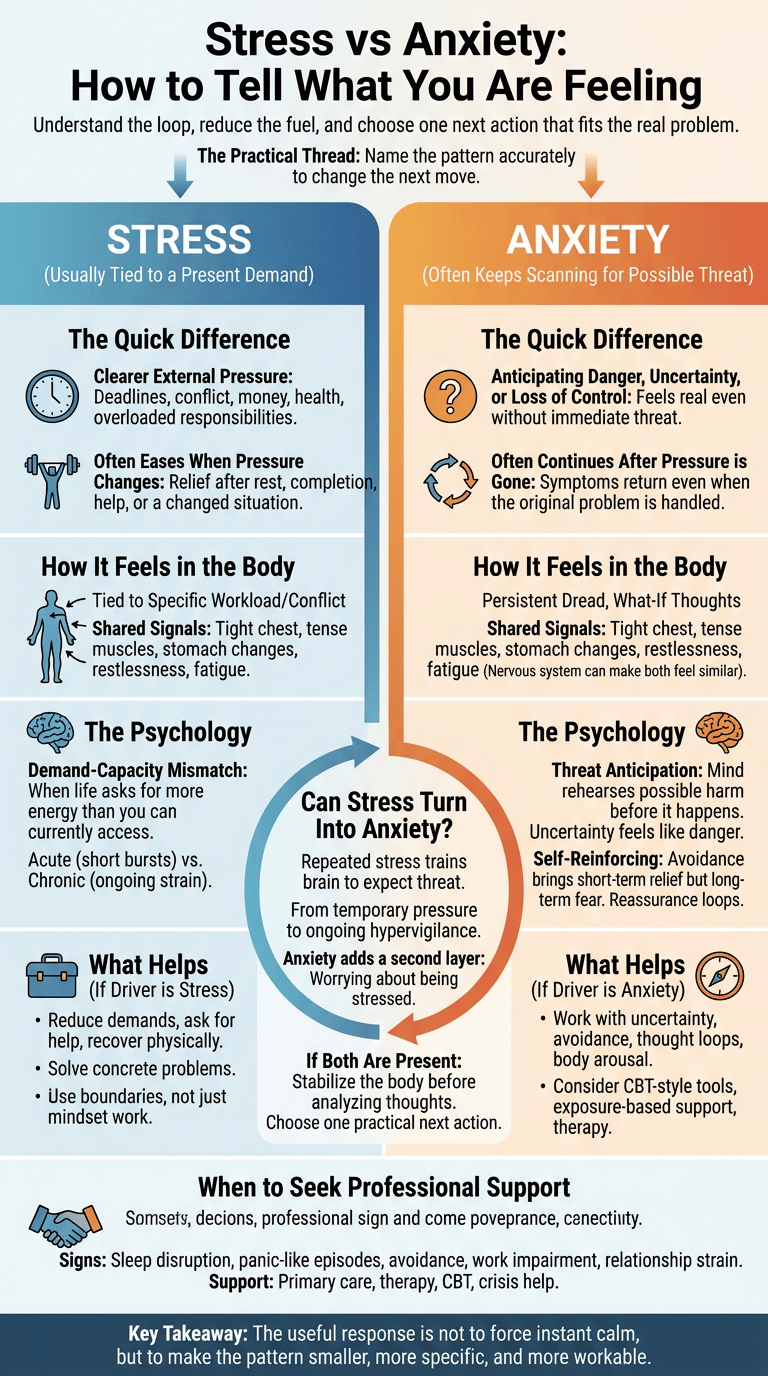
The Quick Difference Between Stress and Anxiety
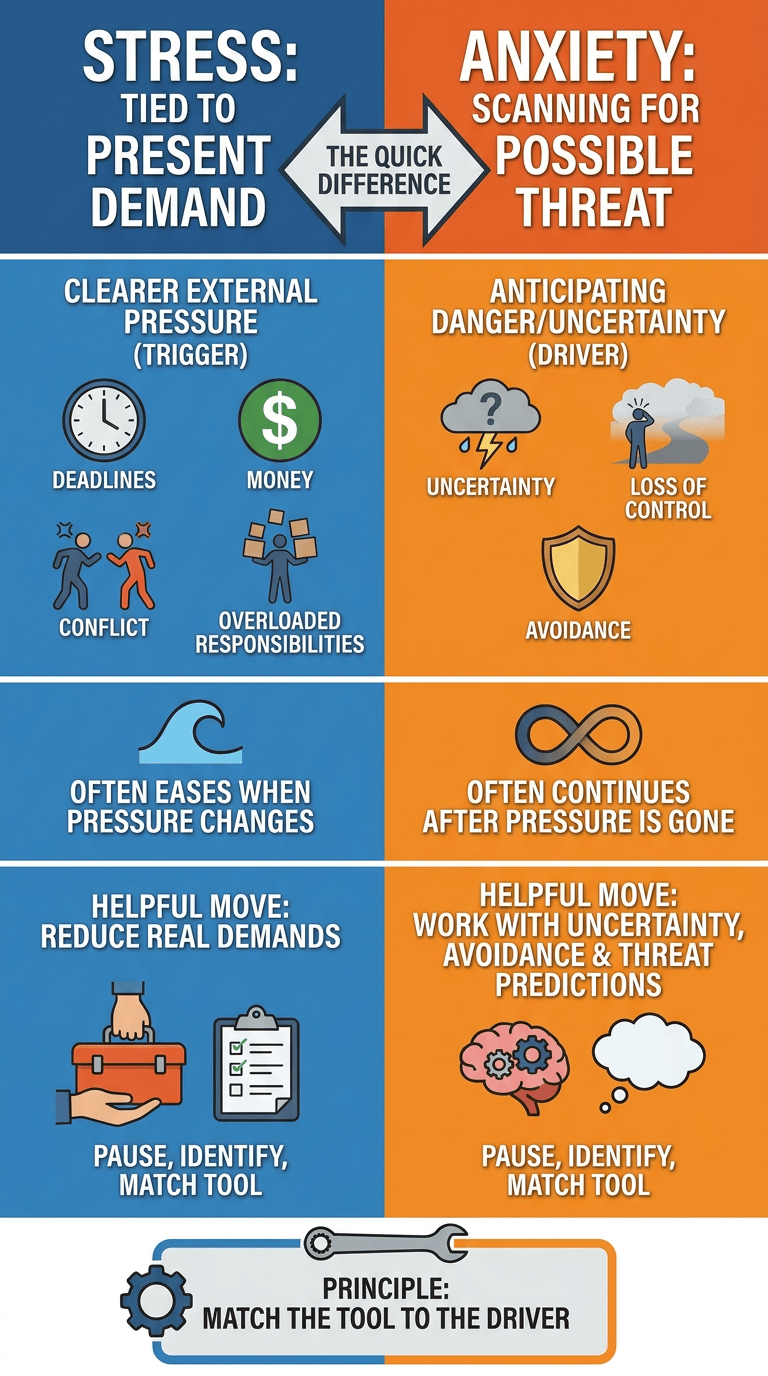
This section focuses on the quick difference between stress and anxiety because it is where many readers lose the thread. In practice, stress is usually tied to a present demand, while anxiety often keeps scanning for possible threat even after the demand changes. When you can see the mechanism clearly, the experience becomes less mysterious and the next step becomes less dramatic. For a broader clinical or psychology context, Stress is a useful reference point for this part of the pattern.
Stress usually has a clearer external pressure
Stress usually has a clearer external pressure matters because it narrows the problem from a vague emotional cloud into something you can work with. For someone who feels activated, tense, or worried and wants a clear next step, this distinction prevents the mind from treating every discomfort as the same emergency.
Deadlines, conflict, money, health, and overloaded responsibilities
Deadlines, conflict, money, health, and overloaded responsibilities is the practical detail that makes the concept usable. Notice what is happening, name it in plain language, and look for the smallest response that changes the loop. In this topic, the common body pattern is muscle tension, stomach changes, faster breathing, sleep disruption, and a sense that the body is bracing for something. The helpful move is to pause long enough to ask what the situation is actually asking for, then apply this principle: match the tool to the driver: reduce real demands when stress is primary, and work with uncertainty, avoidance, and threat predictions when anxiety is primary.
For a related next step, see this guide to the psychology of the Sunday scaries.
Why stress often eases when the pressure changes
Why stress often eases when the pressure changes is the practical detail that makes the concept usable. Notice what is happening, name it in plain language, and look for the smallest response that changes the loop. In this topic, the common body pattern is muscle tension, stomach changes, faster breathing, sleep disruption, and a sense that the body is bracing for something. The helpful move is to pause long enough to ask what the situation is actually asking for, then apply this principle: match the tool to the driver: reduce real demands when stress is primary, and work with uncertainty, avoidance, and threat predictions when anxiety is primary.
Anxiety often continues after the pressure is gone
Anxiety often continues after the pressure is gone matters because it narrows the problem from a vague emotional cloud into something you can work with. For someone who feels activated, tense, or worried and wants a clear next step, this distinction prevents the mind from treating every discomfort as the same emergency.
Anticipating danger, uncertainty, or loss of control
Anticipating danger, uncertainty, or loss of control is the practical detail that makes the concept usable. Notice what is happening, name it in plain language, and look for the smallest response that changes the loop. In this topic, the common body pattern is muscle tension, stomach changes, faster breathing, sleep disruption, and a sense that the body is bracing for something. The helpful move is to pause long enough to ask what the situation is actually asking for, then apply this principle: match the tool to the driver: reduce real demands when stress is primary, and work with uncertainty, avoidance, and threat predictions when anxiety is primary.
Why anxiety can feel real even without an immediate threat
Why anxiety can feel real even without an immediate threat is the practical detail that makes the concept usable. Notice what is happening, name it in plain language, and look for the smallest response that changes the loop. In this topic, the common body pattern is muscle tension, stomach changes, faster breathing, sleep disruption, and a sense that the body is bracing for something. The helpful move is to pause long enough to ask what the situation is actually asking for, then apply this principle: match the tool to the driver: reduce real demands when stress is primary, and work with uncertainty, avoidance, and threat predictions when anxiety is primary.
How Stress and Anxiety Feel in the Body
This section focuses on how stress and anxiety feel in the body because it is where many readers lose the thread. In practice, stress is usually tied to a present demand, while anxiety often keeps scanning for possible threat even after the demand changes. When you can see the mechanism clearly, the experience becomes less mysterious and the next step becomes less dramatic. For a broader clinical or psychology context, Anxiety Disorders is a useful reference point for this part of the pattern.
When the body reads pressure as threat, the fight, flight, and freeze response can make stress feel immediate and physical.
Shared body signals
Shared body signals matters because it narrows the problem from a vague emotional cloud into something you can work with. For someone who feels activated, tense, or worried and wants a clear next step, this distinction prevents the mind from treating every discomfort as the same emergency.
Tight chest, tense muscles, stomach changes, restlessness, and fatigue
Tight chest, tense muscles, stomach changes, restlessness, and fatigue is the practical detail that makes the concept usable. Notice what is happening, name it in plain language, and look for the smallest response that changes the loop. In this topic, the common body pattern is muscle tension, stomach changes, faster breathing, sleep disruption, and a sense that the body is bracing for something. The helpful move is to pause long enough to ask what the situation is actually asking for, then apply this principle: match the tool to the driver: reduce real demands when stress is primary, and work with uncertainty, avoidance, and threat predictions when anxiety is primary.
Why the nervous system can make both feel similar
Why the nervous system can make both feel similar is the practical detail that makes the concept usable. Notice what is happening, name it in plain language, and look for the smallest response that changes the loop. In this topic, the common body pattern is muscle tension, stomach changes, faster breathing, sleep disruption, and a sense that the body is bracing for something. The helpful move is to pause long enough to ask what the situation is actually asking for, then apply this principle: match the tool to the driver: reduce real demands when stress is primary, and work with uncertainty, avoidance, and threat predictions when anxiety is primary.
Clues that point more toward stress
Clues that point more toward stress matters because it narrows the problem from a vague emotional cloud into something you can work with. For someone who feels activated, tense, or worried and wants a clear next step, this distinction prevents the mind from treating every discomfort as the same emergency.
Symptoms tied to a specific workload, conflict, or demand
Symptoms tied to a specific workload, conflict, or demand is the practical detail that makes the concept usable. Notice what is happening, name it in plain language, and look for the smallest response that changes the loop. In this topic, the common body pattern is muscle tension, stomach changes, faster breathing, sleep disruption, and a sense that the body is bracing for something. The helpful move is to pause long enough to ask what the situation is actually asking for, then apply this principle: match the tool to the driver: reduce real demands when stress is primary, and work with uncertainty, avoidance, and threat predictions when anxiety is primary.
Relief after rest, completion, help, or a changed situation
Relief after rest, completion, help, or a changed situation is the practical detail that makes the concept usable. Notice what is happening, name it in plain language, and look for the smallest response that changes the loop. In this topic, the common body pattern is muscle tension, stomach changes, faster breathing, sleep disruption, and a sense that the body is bracing for something. The helpful move is to pause long enough to ask what the situation is actually asking for, then apply this principle: match the tool to the driver: reduce real demands when stress is primary, and work with uncertainty, avoidance, and threat predictions when anxiety is primary. Severe, persistent, or impairing symptoms deserve support from a qualified clinician or primary care professional.
Clues that point more toward anxiety
Clues that point more toward anxiety matters because it narrows the problem from a vague emotional cloud into something you can work with. For someone who feels activated, tense, or worried and wants a clear next step, this distinction prevents the mind from treating every discomfort as the same emergency.
Persistent dread, what-if thoughts, avoidance, and reassurance seeking
Persistent dread, what-if thoughts, avoidance, and reassurance seeking is the practical detail that makes the concept usable. Notice what is happening, name it in plain language, and look for the smallest response that changes the loop. In this topic, the common body pattern is muscle tension, stomach changes, faster breathing, sleep disruption, and a sense that the body is bracing for something. The helpful move is to pause long enough to ask what the situation is actually asking for, then apply this principle: match the tool to the driver: reduce real demands when stress is primary, and work with uncertainty, avoidance, and threat predictions when anxiety is primary. The mistake is treating more pressure as the solution. Pressure may create movement, but it often increases fear, shame, or checking.
Symptoms that return even when the original problem is handled
Symptoms that return even when the original problem is handled is the practical detail that makes the concept usable. Notice what is happening, name it in plain language, and look for the smallest response that changes the loop. In this topic, the common body pattern is muscle tension, stomach changes, faster breathing, sleep disruption, and a sense that the body is bracing for something. The helpful move is to pause long enough to ask what the situation is actually asking for, then apply this principle: match the tool to the driver: reduce real demands when stress is primary, and work with uncertainty, avoidance, and threat predictions when anxiety is primary.
The Psychology Behind Stress
This section focuses on the psychology behind stress because it is where many readers lose the thread. In practice, stress is usually tied to a present demand, while anxiety often keeps scanning for possible threat even after the demand changes. When you can see the mechanism clearly, the experience becomes less mysterious and the next step becomes less dramatic. For a broader clinical or psychology context, Mayo Clinic Stress Symptoms is a useful reference point for this part of the pattern.
Stress as a demand-capacity mismatch
Stress as a demand-capacity mismatch matters because it narrows the problem from a vague emotional cloud into something you can work with. For someone who feels activated, tense, or worried and wants a clear next step, this distinction prevents the mind from treating every discomfort as the same emergency.
When life asks for more energy than you can currently access
When life asks for more energy than you can currently access is the practical detail that makes the concept usable. Notice what is happening, name it in plain language, and look for the smallest response that changes the loop. In this topic, the common body pattern is muscle tension, stomach changes, faster breathing, sleep disruption, and a sense that the body is bracing for something. The helpful move is to pause long enough to ask what the situation is actually asking for, then apply this principle: match the tool to the driver: reduce real demands when stress is primary, and work with uncertainty, avoidance, and threat predictions when anxiety is primary.
Why stress is not always a sign of weakness or pathology
Why stress is not always a sign of weakness or pathology is the practical detail that makes the concept usable. Notice what is happening, name it in plain language, and look for the smallest response that changes the loop. In this topic, the common body pattern is muscle tension, stomach changes, faster breathing, sleep disruption, and a sense that the body is bracing for something. The helpful move is to pause long enough to ask what the situation is actually asking for, then apply this principle: match the tool to the driver: reduce real demands when stress is primary, and work with uncertainty, avoidance, and threat predictions when anxiety is primary.
Acute stress vs chronic stress
Acute stress vs chronic stress matters because it narrows the problem from a vague emotional cloud into something you can work with. For someone who feels activated, tense, or worried and wants a clear next step, this distinction prevents the mind from treating every discomfort as the same emergency.
Short bursts that help performance
Short bursts that help performance is the practical detail that makes the concept usable. Notice what is happening, name it in plain language, and look for the smallest response that changes the loop. In this topic, the common body pattern is muscle tension, stomach changes, faster breathing, sleep disruption, and a sense that the body is bracing for something. The helpful move is to pause long enough to ask what the situation is actually asking for, then apply this principle: match the tool to the driver: reduce real demands when stress is primary, and work with uncertainty, avoidance, and threat predictions when anxiety is primary. Severe, persistent, or impairing symptoms deserve support from a qualified clinician or primary care professional.
Ongoing strain that wears down recovery
Ongoing strain that wears down recovery is the practical detail that makes the concept usable. Notice what is happening, name it in plain language, and look for the smallest response that changes the loop. In this topic, the common body pattern is muscle tension, stomach changes, faster breathing, sleep disruption, and a sense that the body is bracing for something. The helpful move is to pause long enough to ask what the situation is actually asking for, then apply this principle: match the tool to the driver: reduce real demands when stress is primary, and work with uncertainty, avoidance, and threat predictions when anxiety is primary.
The Psychology Behind Anxiety
This section focuses on the psychology behind anxiety because it is where many readers lose the thread. In practice, stress is usually tied to a present demand, while anxiety often keeps scanning for possible threat even after the demand changes. When you can see the mechanism clearly, the experience becomes less mysterious and the next step becomes less dramatic. For a broader clinical or psychology context, Cleveland Clinic Anxiety Disorders is a useful reference point for this part of the pattern.
Anxiety as threat anticipation
Anxiety as threat anticipation matters because it narrows the problem from a vague emotional cloud into something you can work with. For someone who feels activated, tense, or worried and wants a clear next step, this distinction prevents the mind from treating every discomfort as the same emergency.
The mind rehearses possible harm before it happens
The mind rehearses possible harm before it happens is the practical detail that makes the concept usable. Notice what is happening, name it in plain language, and look for the smallest response that changes the loop. In this topic, the common body pattern is muscle tension, stomach changes, faster breathing, sleep disruption, and a sense that the body is bracing for something. The helpful move is to pause long enough to ask what the situation is actually asking for, then apply this principle: match the tool to the driver: reduce real demands when stress is primary, and work with uncertainty, avoidance, and threat predictions when anxiety is primary.
Why uncertainty can feel like danger
Why uncertainty can feel like danger is the practical detail that makes the concept usable. Notice what is happening, name it in plain language, and look for the smallest response that changes the loop. In this topic, the common body pattern is muscle tension, stomach changes, faster breathing, sleep disruption, and a sense that the body is bracing for something. The helpful move is to pause long enough to ask what the situation is actually asking for, then apply this principle: match the tool to the driver: reduce real demands when stress is primary, and work with uncertainty, avoidance, and threat predictions when anxiety is primary.
When anxiety becomes self-reinforcing
When anxiety becomes self-reinforcing matters because it narrows the problem from a vague emotional cloud into something you can work with. For someone who feels activated, tense, or worried and wants a clear next step, this distinction prevents the mind from treating every discomfort as the same emergency.
Avoidance brings short-term relief but long-term fear
Avoidance brings short-term relief but long-term fear is the practical detail that makes the concept usable. Notice what is happening, name it in plain language, and look for the smallest response that changes the loop. In this topic, the common body pattern is muscle tension, stomach changes, faster breathing, sleep disruption, and a sense that the body is bracing for something. The helpful move is to pause long enough to ask what the situation is actually asking for, then apply this principle: match the tool to the driver: reduce real demands when stress is primary, and work with uncertainty, avoidance, and threat predictions when anxiety is primary. The mistake is treating more pressure as the solution. Pressure may create movement, but it often increases fear, shame, or checking.
Reassurance loops and checking behaviors
Reassurance loops and checking behaviors is the practical detail that makes the concept usable. Notice what is happening, name it in plain language, and look for the smallest response that changes the loop. In this topic, the common body pattern is muscle tension, stomach changes, faster breathing, sleep disruption, and a sense that the body is bracing for something. The helpful move is to pause long enough to ask what the situation is actually asking for, then apply this principle: match the tool to the driver: reduce real demands when stress is primary, and work with uncertainty, avoidance, and threat predictions when anxiety is primary.
Can Stress Turn Into Anxiety?
This section focuses on can stress turn into anxiety? because it is where many readers lose the thread. In practice, stress is usually tied to a present demand, while anxiety often keeps scanning for possible threat even after the demand changes. When you can see the mechanism clearly, the experience becomes less mysterious and the next step becomes less dramatic.
When stress continues after the original pressure should have passed, chronic stress may become the more useful concept than short-term stress.
How repeated stress trains the brain to expect threat
From temporary pressure to ongoing hypervigilance
Why burnout, poor sleep, and conflict can lower emotional bandwidth
When anxiety adds a second layer to stress
Worrying about being stressed
Fear of symptoms, mistakes, or future collapse
What Helps Depends on Which One Is Driving the Problem
If the main driver is stress
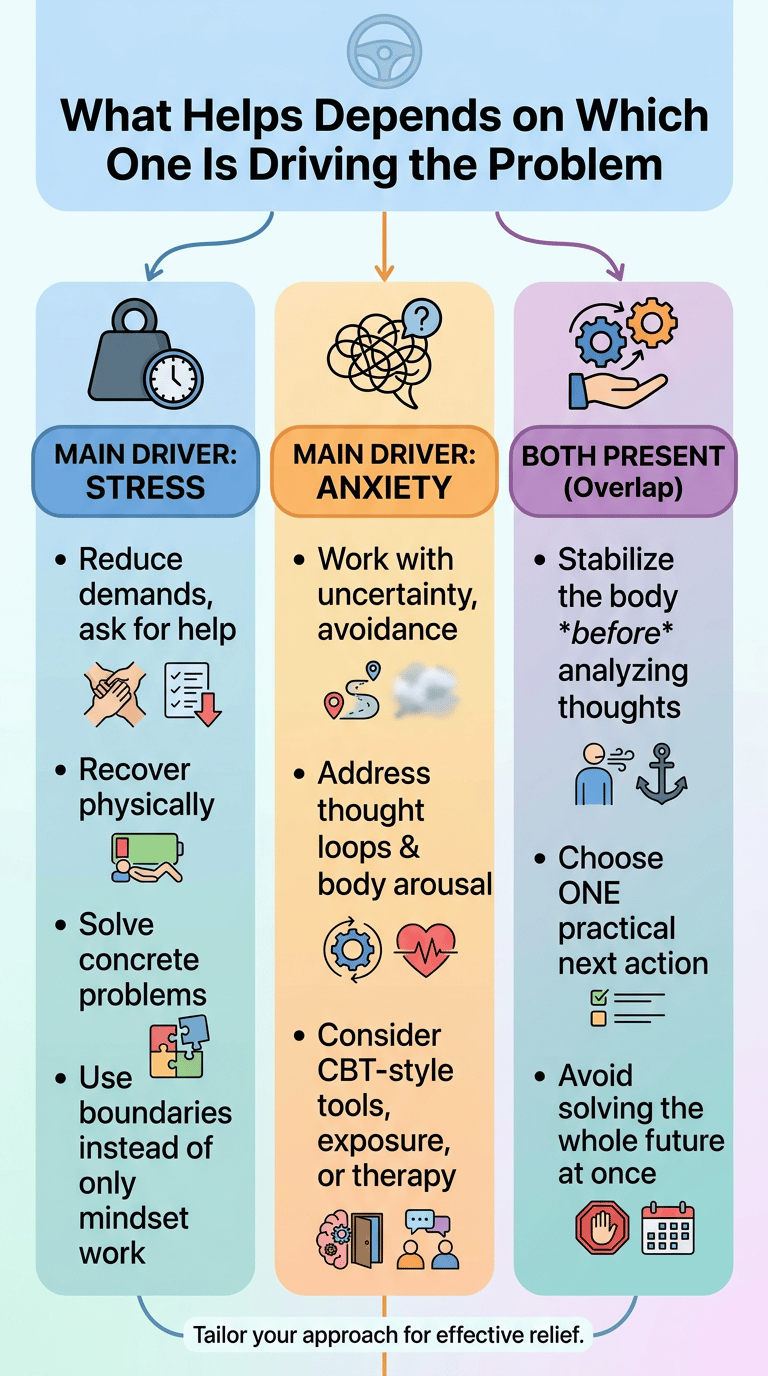
Reduce demands, ask for help, recover physically, and solve concrete problems
Use boundaries instead of only mindset work
If the main driver is anxiety
Work with uncertainty, avoidance, thought loops, and body arousal
Consider CBT-style tools, exposure-based support, or therapy when needed
If both are present
Stabilize the body before analyzing the thoughts
Choose one practical next action instead of solving the whole future
When to Seek Professional Support
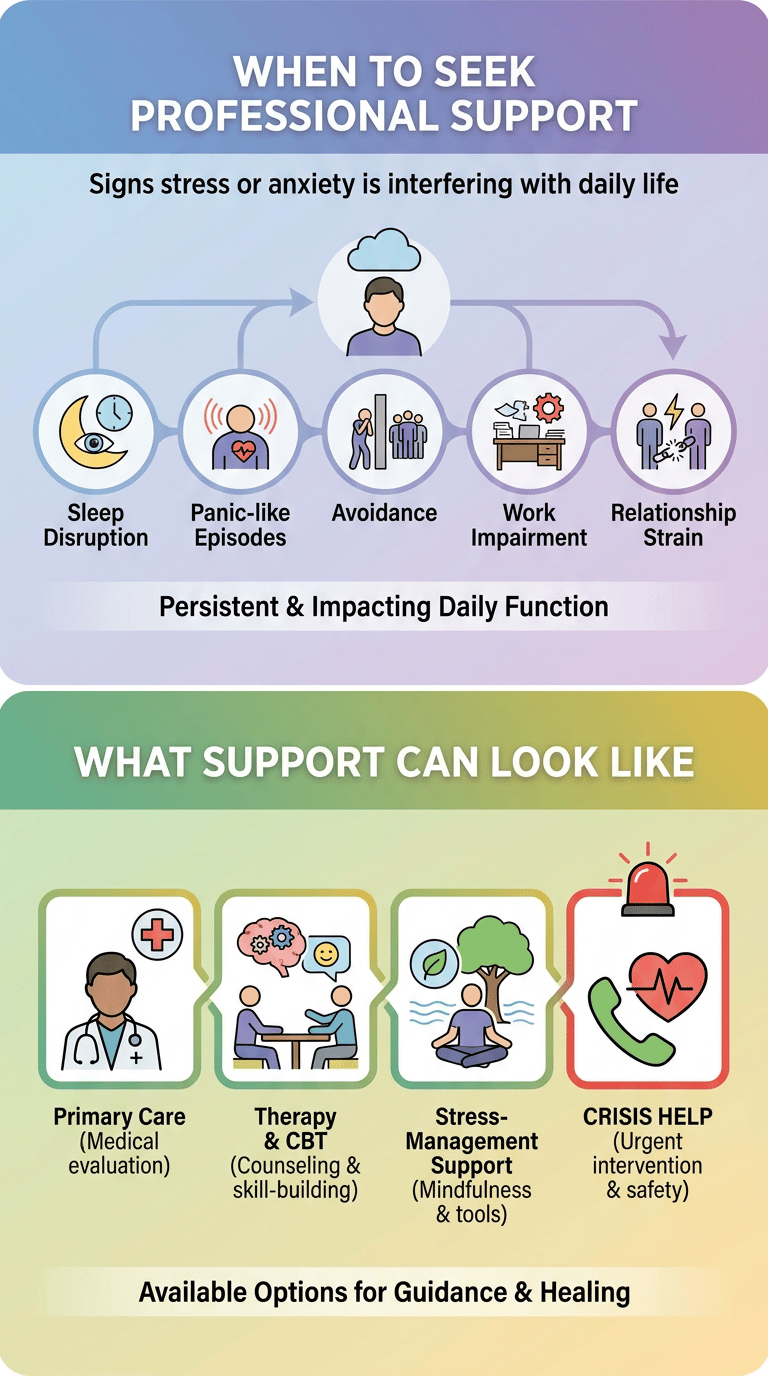
Signs that stress or anxiety is interfering with daily life
Sleep disruption, panic-like episodes, avoidance, work impairment, or relationship strain
What support can look like
Primary care, therapy, CBT, stress-management support, and crisis help when urgent
FAQ
How do I know if I have stress or anxiety?
Look at the trigger and the recovery pattern. Stress usually tracks a specific demand, such as a deadline, conflict, bill, or responsibility. Anxiety is more likely when the worry keeps going after the demand changes, or when your mind keeps scanning for what could go wrong even without a clear immediate problem.
Can anxiety happen without stress?
Yes. Anxiety can appear even when life looks manageable from the outside because the brain is responding to uncertainty, remembered threat, body sensations, or imagined future risk. That does not mean the feeling is fake. It means the threat system may be active before there is a concrete problem to solve.
Is stress always easier to fix than anxiety?
Not always. A small stressor may ease quickly when the task is done, but stress psychology can be very hard to change if the demands are ongoing. Anxiety can also improve, but it often needs a different approach, especially when avoidance, reassurance seeking, or fear of uncertainty keeps the loop alive.
Can chronic stress cause anxiety symptoms?
Chronic stress can make anxiety-like symptoms more likely because the body has less recovery time. Poor sleep, constant pressure, conflict, and overload can leave the nervous system more reactive. If the symptoms are intense, persistent, or interfering with daily life, it is worth getting qualified support.
Key Takeaways
The main takeaway is that stress is usually tied to a present demand, while anxiety often keeps scanning for possible threat even after the demand changes. The useful response is not to force instant calm, but to make the pattern smaller, more specific, and more workable. When the pattern is frequent or impairing, support is part of responsible care, not a personal failure.

Michael Reed is the Founder and Lead Writer at Psychology Exposed. He writes about human behavior, relationships, emotional patterns, self-awareness, and practical psychology topics using research-informed, easy-to-understand content.
Read More About Michael Reed: https://psychologyexposed.com/michael-reed/