

You may know the moment: your heart speeds up, your muscles tighten, your voice gets sharp, your legs want to leave, or your mind suddenly goes blank. Later, when the pressure has passed, you may wonder why you reacted so strongly or why you could not simply think your way through it.
The fight, flight, and freeze response is not a sign that you are weak, dramatic, or broken. It is the body’s fast protection system. It can help you respond to danger, but it can also show up during conflict, criticism, deadlines, public speaking, medical appointments, family tension, or memories of past threat. When it happens, your body may move faster than your deliberate thinking.
This is why understanding the response matters. You do not have to excuse every action that comes from stress, and you do not have to shame yourself for having a body. The useful middle ground is learning to recognize the state, reduce immediate risk, and choose a first step once your thinking comes back online.
Quick Answer

The response in one simple sentence
The fight flight freeze response is an automatic stress reaction that prepares you to confront a threat, escape it, or pause long enough to scan for safety. The APA Dictionary of Psychology describes fight-or-flight as physiological changes linked with sympathetic nervous system activity in threatening or stressful situations. Freeze is often discussed alongside it because pausing or immobilizing can also be protective when action feels risky.
This response is one part of stress psychology, because stress can change physiology and behavior before a person has time to think through the situation.
Why it can feel automatic
This response can feel automatic because the body is trying to prioritize speed over careful analysis. Your nervous system does not wait for a perfect debate about whether the threat is physical, social, emotional, or imagined. It asks a faster question: do I need to defend, get away, or stop and assess?
What the Fight, Flight, and Freeze Response Means

Fight as mobilizing against threat
Fight does not always mean physical aggression. In everyday stress, it may show up as arguing, interrupting, correcting, tightening your jaw, raising your voice, becoming controlling, or feeling a sudden need to prove your point. The body is mobilizing toward the challenge.
Sometimes this is useful. If someone crosses a boundary, a fight response may help you say no, protect another person, or act quickly in an emergency. The problem begins when the same defensive energy takes over during situations that require listening, patience, or careful judgment.
Flight as mobilizing away from threat
Flight is the urge to get distance. It may look like leaving the room, avoiding a message, quitting a task, changing the subject, driving away, scrolling to escape, or mentally rehearsing how to disappear from the situation. The body is trying to reduce contact with what feels unsafe or overwhelming.
Flight can also be practical. Leaving a dangerous place, stepping away from an escalating argument, or ending a conversation that has become cruel can be protective. But when flight becomes the only move, you may avoid conversations, decisions, or responsibilities that would be better handled after a pause.
Freeze as pausing, scanning, or immobilizing
Freeze can be confusing because it may look like doing nothing. Inside, however, it can feel very active: your attention sharpens, your body holds still, your words disappear, and you may wait for a sign of what is safe to do next. Research reviews on defensive behavior describe freezing as part of a shift between pausing and action preparation, not simply a lack of response.
In daily life, freeze may appear during a tense meeting, a sudden confrontation, a medical scare, a loud conflict, or a moment when someone asks you a question you are not ready to answer. You might stare, go quiet, forget your point, or feel as if your body will not cooperate.
Why These Responses Happen in the Body

The role of the autonomic nervous system
The autonomic nervous system helps control body functions that do not require conscious instruction, such as heart rate, breathing patterns, digestion, sweating, and blood vessel changes. Cleveland Clinic explains that the sympathetic branch helps activate body processes during stress or danger, while the parasympathetic branch helps with rest-and-digest functions through a balancing effect of the autonomic nervous system.
They can feel so fast because how stress affects the brain changes attention, threat detection, memory, and decision-making.
These reactions can become harder to settle when nervous system dysregulation keeps the body in stress mode.
That balance is one reason stress is felt in the body, not only in thoughts. Your pulse, stomach, hands, chest, face, muscles, and breath may all become part of the response before you have a neat explanation for what is happening.
Adrenaline, attention, and muscle readiness
During an acute response, the body shifts resources toward immediate survival. You may breathe faster, feel your heart pound, clench muscles, sweat, tremble, scan the room, or notice details that normally fade into the background. These changes are not random. They are part of preparing for action or protection.
This can make a small situation feel huge. A critical email might not be dangerous in the physical sense, but if your body reads it as a threat to belonging, job security, dignity, or control, the same mobilizing system may still switch on.
Why the thinking brain may feel slower
When your body is in protection mode, reflective thinking can feel harder to access. You may know, intellectually, that you should stay calm, but knowing is not the same as being in a state where calm choices feel available. Under acute pressure, attention narrows and the body favors fast reactions.
This does not remove accountability. If you yell, leave without warning, or shut down during an important conversation, the impact still matters. But it does change the first step. Instead of asking, “Why am I like this?” try asking, “Which response took over, and what helps me return enough to choose?”
Common Signs of Each Response
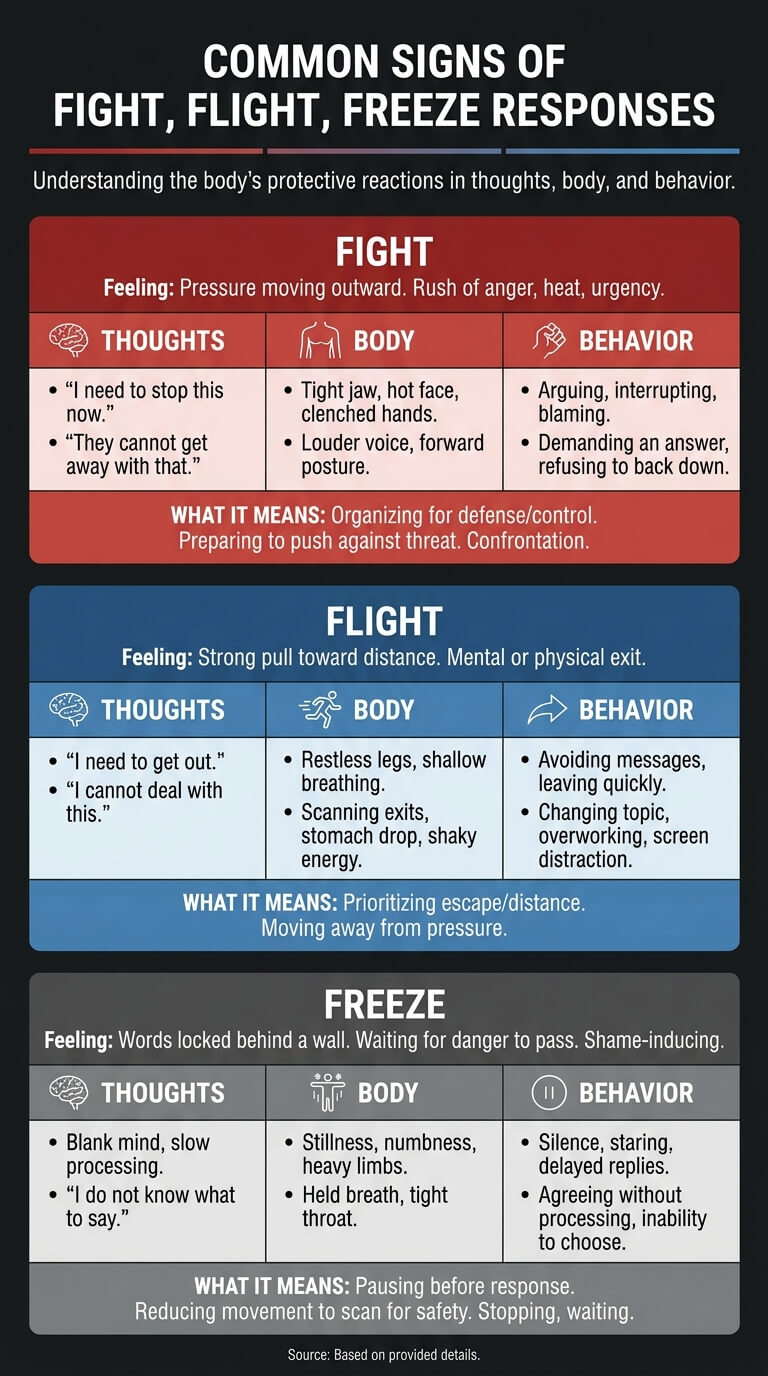
Fight signs in thoughts, body, and behavior
Fight often carries the feeling of pressure moving outward. You may feel a rush of certainty, anger, heat, or urgency. Your body may lean forward, your hands may tense, and your words may become sharper than you intended.
| Area | Fight may look like | What it may mean |
|---|---|---|
| Thoughts | “I need to stop this now.” “They cannot get away with that.” | Your mind is organizing around defense, correction, or control. |
| Body | Tight jaw, hot face, clenched hands, louder voice, forward posture. | Your body is preparing to push against the threat. |
| Behavior | Arguing, interrupting, blaming, demanding an answer, refusing to back down. | The protective move is confrontation, even if the situation needs nuance. |
Flight signs in thoughts, body, and behavior
Flight often feels like a strong pull toward distance. You may not always physically leave. Sometimes the body chooses mental exit, distraction, avoidance, or a sudden need to finish the conversation later without making a plan.
| Area | Flight may look like | What it may mean |
|---|---|---|
| Thoughts | “I need to get out.” “I cannot deal with this.” | Your mind is prioritizing escape or distance. |
| Body | Restless legs, shallow breathing, scanning exits, stomach drop, shaky energy. | Your body is preparing to move away from pressure. |
| Behavior | Avoiding messages, leaving quickly, changing the topic, overworking, disappearing into a screen. | The protective move is distance, whether physical, emotional, or mental. |
Freeze signs in thoughts, body, and behavior
Freeze can feel especially shame-inducing because other people may misread it as indifference, stubbornness, or laziness. From the inside, it may feel like the words are locked behind a wall or the body is waiting for danger to pass.
| Area | Freeze may look like | What it may mean |
|---|---|---|
| Thoughts | Blank mind, slow processing, “I do not know what to say.” | Your mind may be pausing before choosing a response. |
| Body | Stillness, numbness, heavy limbs, held breath, tight throat. | Your system may be reducing movement while scanning for safety. |
| Behavior | Silence, staring, delayed replies, agreeing without processing, inability to make a simple choice. | The protective move is stopping, waiting, or staying unreadable. |
A Simple Four-Part Map: Signal, Surge, Selection, Settle
Signal: something is read as threat
The first part is the signal. It may be obvious, like someone yelling, a car swerving, or a stranger following too closely. It may also be subtle, like a look of disappointment, a tone of voice, an unread message, or a deadline that reminds you of past failure.
The body does not only react to objective danger. It reacts to perceived danger, learned danger, social danger, and uncertainty. That is why two people can face the same event and have very different responses.
Surge: the body prepares before you choose
The second part is the surge. Energy moves through the body. Your breathing, muscles, eyes, attention, and pulse may change quickly. This stage is often where people judge themselves: “Why am I overreacting?” “Why can’t I just speak?” “Why do I want to leave?”
A better question is: “What is my body preparing me to do?” If the energy is pushing outward, fight may be present. If it is pulling away, flight may be present. If it is holding still, freeze may be present.
Selection: the response becomes action or inaction
The third part is selection. This does not always feel like a choice, but it becomes visible as behavior. You may defend, leave, go silent, comply, laugh nervously, over-explain, or try to appear calm while your body is not calm.
This is the point where a small interruption can help. Even a sentence such as “I need a minute before I answer” can create enough space to keep the response from becoming harmful. The sentence does not have to be perfect. It only has to slow the automatic chain.
Settle: the system returns or stays activated
The fourth part is settling. After the moment passes, the body may come down within minutes, or it may stay activated for much longer. NIMH notes that stress is a physical or mental response to an external cause and that stress and anxiety can affect both mind and body, including tension, sleep, and focus changes. Their stress and anxiety fact sheet also encourages seeking help when stress or anxiety interferes with daily life.
Settling does not mean pretending nothing happened. It means your body has enough safety and capacity to think, repair, decide, or take the next step with more control.
Fight, Flight, Freeze, and Fawn: How They Differ

Why fawn is related but not the same
Fawn is often discussed as another stress response, but it deserves a separate explanation because the movement is different. Fight moves against. Flight moves away. Freeze stops. Fawn moves toward the perceived source of threat by pleasing, appeasing, agreeing, or smoothing tension to reduce risk.
Fight, flight, and freeze are not the only protective patterns; the fawn response describes appeasing, agreeing, or keeping another person calm under stress.
A person may fawn during family conflict, workplace pressure, or unsafe relationship dynamics. They may smile, apologize, flatter, or give up preferences before they know what they actually feel. That response can look cooperative from the outside, but it may come from fear rather than choice.
What to notice without labeling yourself
You do not need to turn every reaction into an identity. Most people have more than one response depending on the setting, history, power difference, fatigue level, and perceived consequences. You might fight at work, freeze with a parent, and flee from medical appointments.
Use the labels as a map, not a box. The point is not to decide what kind of person you are. The point is to notice which protective move appears in which situation, then ask what kind of support or boundary makes a more deliberate response possible.
When the Response Is Helpful, and When It Creates Problems
Helpful in real danger or urgent action
These responses can be lifesaving. Fighting back, escaping, or freezing long enough to stay unnoticed may protect a person in real danger. Even in non-life-threatening situations, a short surge of stress can help you perform, speak up, move quickly, or protect a boundary.
That is why the response should not be treated as an enemy. It is better understood as an alarm system. Sometimes the alarm is accurate. Sometimes it is too loud, too sensitive, or shaped by past experiences that are not fully present now.
Harder when the threat is social, emotional, or remembered
Modern stress often involves social evaluation, rejection, conflict, money, health uncertainty, performance pressure, or old fear being reactivated. These are real forms of stress, but they do not always require the same level of emergency response.
For example, your manager asking for a revision may trigger fight energy if criticism has often meant humiliation. A partner saying “Can we talk?” may trigger flight if past conversations became overwhelming. A family member raising their voice may trigger freeze if silence once felt safer than speaking.
Problems when it becomes frequent, intense, or disproportionate
The response becomes harder when it appears often, lasts too long, or creates consequences that do not match the situation. If you keep snapping at people, disappearing from responsibility, or freezing during ordinary choices, your body may need more recovery, predictability, or support than you are getting.
Mayo Clinic lists common stress effects across the body, mood, and behavior, including muscle tension, anxiety, restlessness, anger, sleep problems, and changes in eating or social behavior. Those stress symptoms are one reason it helps to notice the response early rather than waiting until the body is overloaded.
What To Do in the First 10 Minutes

Step 1: name the response without attacking yourself
Start with a quiet label: “Fight is here,” “Flight is here,” or “Freeze is here.” This is different from saying, “I am irrational,” “I am a coward,” or “I am out of control.” A neutral label gives your brain a handle without adding shame.
If you are with someone safe enough, you can say it simply: “I am getting flooded and need a minute.” “My mind went blank, but I do want to come back to this.” “I am too activated to answer well right now.”
Step 2: reduce immediate risk
If there is real danger, prioritize safety over calming techniques. Leave if you can, call emergency services if needed, contact a trusted person, or move toward a safer public space. Do not try to breathe through a situation where someone is threatening, trapping, stalking, or intimidating you.
If the situation is stressful but not dangerous, reduce the next preventable harm. Lower your voice, stop typing the angry reply, sit down if pacing is escalating you, or ask for a pause before the conversation gets worse.
Step 3: give the body one clear signal
Choose one signal that tells the body the immediate emergency is shifting. Put both feet on the floor. Exhale longer than you inhale for a few rounds. Drink water. Look around and name five neutral objects. Step outside and feel the temperature on your skin.
The purpose is not to erase the response. The first goal is to reduce intensity by a few degrees. A small reduction may be enough to prevent the next sentence, message, or decision from being driven entirely by threat energy.
Step 4: choose the smallest safe next action
Do not demand a complete solution while your body is still surging. Choose the smallest safe next action. That may be sending one calm sentence, waiting 20 minutes before replying, writing notes before a meeting, asking a support person to stay nearby, or deciding not to continue a conversation that has become unsafe.
After the body settles, review what happened. Which signal started it? Which response appeared? What did it protect you from? What did it cost? What would make the next moment safer or clearer?
Scripts for Naming the Response Without Blame
When fight energy is rising
Try a sentence that slows the push without denying your concern:
- “I am getting defensive, and I do not want to turn this into an attack.”
- “I need a minute so I can respond instead of just react.”
- “I care about this, but my tone is getting sharper than I want.”
When flight energy wants to leave
Flight needs distance, but distance works better with a return plan when the situation is safe enough to revisit:
- “I need to step away for 20 minutes, and I will come back at 7:30.”
- “I cannot answer well while I feel cornered. I am going to pause and return.”
- “I am not ignoring you. I need space so I do not shut down or say something careless.”
When freeze makes words disappear
Freeze often needs permission to go slowly:
- “My mind went blank. I need a moment to think.”
- “I heard you, but I cannot answer immediately.”
- “Please give me the question in writing so I can respond more clearly.”
How This Connects to Longer Stress Patterns
Acute response vs prolonged activation
Fight, flight, and freeze describe immediate protective moves. Nervous system dysregulation is different because it describes getting stuck in high alert, shutdown, or mixed states over time. Chronic stress is also different because it focuses on stress that keeps returning or never fully resolves.
This distinction matters because the first step is different. An acute response may need a pause, safety check, and settling signal. A prolonged pattern may need routines, environmental changes, medical support, therapy, workload changes, relational boundaries, or recovery time that cannot be solved in one moment.
Stress response vs overthinking
Overthinking is a repetitive mental loop. The fight, flight, and freeze response is a body-state reaction. They can interact, but they are not the same. You might freeze first, then spend hours replaying the conversation. Or you might overthink for days until a small trigger finally activates fight or flight.
If you treat every stress response as a thinking problem, you may try to reason with a body that first needs safety cues. If you treat every thought loop as a body emergency, you may miss the practical question that needs to be answered. Naming the difference helps you choose a better tool.
When To Get Support
When stress reactions interfere with daily life
Consider support if your stress responses are frequent, intense, hard to recover from, or affecting work, school, relationships, sleep, eating, health, or daily decisions. This does not mean something is wrong with you as a person. It means your system may be carrying more demand than it can process alone.
A primary care clinician can help rule out medical contributors when symptoms include chest pain, fainting, severe shortness of breath, new neurological symptoms, or other concerning physical changes. A mental health professional can help when fear, panic, trauma reminders, anger, avoidance, or shutdown are becoming difficult to manage.
When safety is the real issue
If your fight, flight, or freeze response is happening around someone who threatens, controls, humiliates, stalks, traps, or retaliates against you, the priority is safety rather than better communication. In that situation, private support and planning may be safer than confronting the person directly. The National Domestic Violence Hotline offers a personal safety planning tool for people experiencing abuse or preparing to leave an unsafe situation.
If you are in immediate danger, contact local emergency services. If you are in emotional crisis or thinking about harming yourself, use local crisis support or emergency resources right away. A stress response can be understandable, but you still deserve help that matches the level of risk.
FAQ
Is freeze the same as being passive?
No. Freeze can look passive from the outside, but inside it may involve intense scanning, fear, confusion, or effort to stay safe. A person who freezes may care deeply and still be unable to speak or move in that moment. The helpful question is not “Why didn’t I just act?” but “What did my body believe action might cost?”
Can I have more than one response at the same time?
Yes. Responses can blend or shift quickly. You might freeze first, then fight when words return. You might feel flight energy but stay because leaving would create more risk. You might appear calm while your body is preparing for escape. Mixed responses are common, especially in complex social stress.
Does a fight response mean I am an angry person?
Not necessarily. A fight response means your body is mobilizing against perceived threat. That may include anger, urgency, protectiveness, or a need to regain control. You are still responsible for what you do with that energy, but the response itself does not define your character.
Why do small situations trigger such strong reactions?
Small situations can carry large meanings. A short text, raised eyebrow, mistake, or critical comment may remind the body of earlier experiences, power differences, rejection, shame, or uncertainty. The body may respond to the meaning it detects, not only to the size of the current event.
What is the fastest helpful thing to do when I notice it?
Name the response, reduce immediate risk, and choose one body-based settling cue. For example: “Flight is here. I am not in danger right now. I will step outside for five minutes and come back before replying.” The exact words matter less than interrupting the automatic chain.
Key Takeaways
- Fight, flight, and freeze are fast protective responses, not proof that you are weak or irrational.
- Fight moves against pressure, flight moves away from pressure, and freeze pauses or immobilizes while the body scans for safety.
- The response can be useful in real danger, but it can create problems when it is frequent, intense, or mismatched to the situation.
- A first step after activation is to name the response, check safety, signal the body, and choose the smallest safe next action.
- Fawn is related but different because it moves toward the perceived threat through appeasing or pleasing.
- If stress reactions are tied to threats, coercion, stalking, humiliation, or fear of retaliation, prioritize safety support over conversation strategies.
Final Thoughts
The fight flight freeze response is your body’s attempt to protect you quickly. Sometimes it is accurate. Sometimes it is too sensitive for the moment you are actually in. Either way, shame usually makes it harder to work with.
Start with one recent moment. Ask which response appeared, what signal seemed to trigger it, what it helped you avoid, and what it cost. Then choose one small practice for next time: a pause sentence, a grounding cue, a safer exit plan, or a repair after the body settles. Understanding the response is not about excusing harm. It is about giving yourself a better chance to respond with awareness when your body moves first.

Michael Reed is the Founder and Lead Writer at Psychology Exposed. He writes about human behavior, relationships, emotional patterns, self-awareness, and practical psychology topics using research-informed, easy-to-understand content.
Read More About Michael Reed: https://psychologyexposed.com/michael-reed/