

You may know the moment before you say yes. Your body tightens, your mind starts scanning the other person’s face, and the easiest answer seems to be whatever will keep the room calm. You agree before you know what you want. You apologize before you know what you did wrong. You smooth over tension even when a part of you feels unseen, crowded, or resentful.
In fawn response psychology, this kind of pleasing is understood as more than ordinary kindness. It can be a stress-related appeasement pattern, where the body moves toward a perceived threat by becoming agreeable, useful, harmless, or easy to approve of. From the outside, it may look generous. From the inside, it may feel like safety depends on staying liked, needed, or non-disruptive.
This does not mean every compromise is unhealthy. Caring about others, adjusting plans, apologizing when you have caused harm, and cooperating in close relationships are normal. The question is whether you still have choice. When pleasing happens automatically because saying no feels dangerous, selfish, or unbearable, it may be worth looking at fawn as a stress response rather than a personality flaw.
Quick Answer

Fawn response in plain English
The fawn response is a stress pattern where a person tries to reduce tension by pleasing, agreeing, apologizing, flattering, helping, or adapting to another person. It is often described as appeasement: moving toward the perceived threat in a way that lowers the chance of conflict, rejection, anger, or retaliation. It is not a formal diagnosis, and it should not be used to label every kind or accommodating person.
The fawn response belongs inside stress psychology because it shows how pressure can change social behavior, not just heart rate, breathing, or muscle tension.
Why it can look like kindness from the outside
Fawning can be hard to notice because the behavior may look socially positive. You might be polite, warm, helpful, flexible, and emotionally tuned in. The difference is the internal driver. Healthy kindness comes with choice. Fawning often comes with fear, urgency, self-erasure, or a body sense that someone else’s comfort must be protected before your own needs can exist.
What the Fawn Response Means

Appeasing as a way to reduce perceived threat
Stress is not only an emotion. The American Psychological Association explains that stress affects nearly every system of the body, shaping how people feel and behave under demand or pressure. In a fawn response, the body may read another person’s disappointment, anger, silence, criticism, or power as a possible threat and then look for the fastest way to reduce risk.
For some people, fawn feels automatic because nervous system dysregulation can make safety-seeking behavior feel urgent.
The protective move is not to fight back, run away, or go still. It is to become pleasing. You may soften your voice, agree quickly, over-explain, take blame, offer help, compliment the other person, or make yourself smaller. The hidden message is often, “If I keep you comfortable, I may be safer.”
Why fawn is not a formal personality label
Fawn is a useful everyday term, but it is not a diagnosis and it is not a fixed identity. It describes a response pattern that may appear in certain contexts. You might fawn with a critical boss but not with close friends. You might fawn with a parent but not with coworkers. You might fawn when someone is angry, but not when someone is simply asking for support.
This matters because labels can become traps. Saying “I always fawn” can make the pattern feel permanent. A more accurate sentence is, “In some situations, my body tries to stay safe by pleasing.” That wording leaves room for context, learning, safety planning, and choice.
How context shapes the response
Fawning is more likely when the situation carries a real or perceived power difference. That may include a workplace hierarchy, financial dependence, family pressure, cultural expectations, caregiving responsibilities, or a relationship where anger has consequences. It may also be shaped by earlier experiences where disagreeing, needing, or saying no led to rejection, punishment, humiliation, or withdrawal.
Context does not mean fawning is always caused by trauma. It means the nervous system learns from experience. If pleasing has reduced danger before, the body may repeat it before you have time to decide whether it still fits the present moment.
Signs You May Fawn Under Stress

Automatic agreement before checking your own view
One sign is a yes that arrives too quickly. You agree to plans, requests, opinions, deadlines, or emotional expectations before you know what you actually think. Later, when the pressure has passed, you may realize you did not have the time, energy, money, interest, or consent you seemed to offer.
When someone is outside their window of tolerance, pleasing or appeasing may happen faster than clear self-expression.
A helpful clue is the delay. If your real preference appears only after the interaction ends, your body may have prioritized safety over self-awareness in the moment.
Over-apologizing to reduce tension
Apologizing is healthy when you have caused harm. In fawning, apology becomes a tension-reducing reflex. You may say sorry because someone is irritated, because there is silence, because another person is disappointed, or because you feel responsible for making everyone feel better.
The apology may not match the event. You might apologize for having a need, asking a question, taking time to reply, needing rest, or not being able to solve someone else’s mood. The purpose is less about repair and more about lowering the emotional temperature.
Reading the room for danger signals
Many people read social cues. In fawning, scanning can feel urgent and exhausting. You may track tone, facial expression, pauses, message timing, body language, and small changes in warmth. You may adjust your behavior before the other person has even asked for anything.
This can make you seem emotionally intelligent, but inside it may feel like surveillance. You are not simply noticing others. You are trying to prevent tension before it becomes unsafe or unbearable.
Feeling responsible for another person’s mood
Another sign is the belief that another person’s disappointment, anger, sadness, boredom, or stress is your assignment to fix. You may feel guilty when someone is upset, even when you did not cause the problem. You may offer solutions, comfort, favors, or agreement just to stop the discomfort of their emotion.
This can quietly drain relationships. The other person may receive care, but you may lose track of whether you wanted to give it freely or felt forced by anxiety.
Losing access to preferences or boundaries
Fawning can make your own preferences disappear under pressure. When asked what you want, you may say, “Whatever you want,” not because you are relaxed, but because choosing feels risky. When asked whether something is okay, you may say yes while your body says no.
| Possible sign | What it may look like | Question to ask yourself |
|---|---|---|
| Fast agreement | You say yes before checking your time, energy, or preference. | Did I choose, or did I rush to reduce tension? |
| Reflex apology | You apologize for needs, delays, questions, or someone else’s mood. | Did I do harm, or am I trying to make discomfort stop? |
| Hyper-attunement | You monitor tone, silence, facial cues, and approval closely. | Am I being considerate, or am I scanning for danger? |
| Self-erasure | You cannot find your preference until later. | What did I want before I adapted? |
Fawn vs Kindness, Empathy, and Cooperation
Choice vs fear
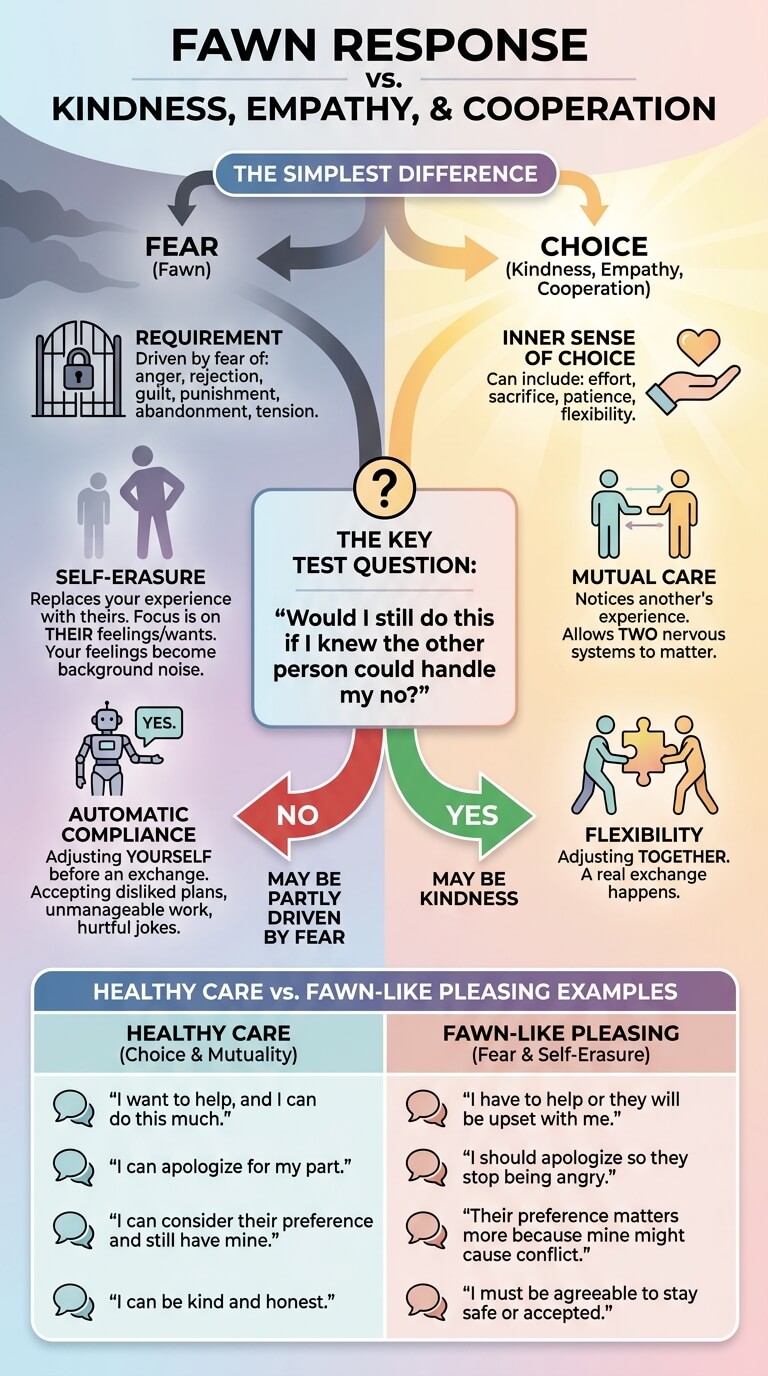
The simplest difference is choice. Kindness can include effort, sacrifice, patience, and flexibility. But it usually leaves you with an inner sense that you are allowed to choose. Fawning feels more like a requirement. You may feel that not pleasing will lead to anger, rejection, guilt, punishment, abandonment, or unbearable tension.
Try asking, “Would I still do this if I knew the other person could handle my no?” If the answer is yes, it may be kindness. If the answer is no, the behavior may be partly driven by fear.
Mutual care vs self-erasure
Empathy notices another person’s experience. Fawning often replaces your experience with theirs. You may become so focused on what they feel, want, expect, or might do that your own feelings become background noise.
Mutual care allows two nervous systems to matter. Self-erasure makes one person responsible for protecting the emotional climate while the other person’s preferences take up most of the space.
Flexibility vs automatic compliance
Cooperation means adjusting together. Automatic compliance means adjusting yourself before there has been a real exchange. You may accept plans you dislike, take on work you cannot manage, laugh at jokes that hurt, or agree with a version of events that does not feel true.
| Healthy care | Fawn-like pleasing |
|---|---|
| “I want to help, and I can do this much.” | “I have to help or they will be upset with me.” |
| “I can apologize for my part.” | “I should apologize so they stop being angry.” |
| “I can consider their preference and still have mine.” | “Their preference matters more because mine might cause conflict.” |
| “I can be kind and honest.” | “I must be agreeable to stay safe or accepted.” |
Fawn vs Conflict Avoidance and Freeze

Avoiding the issue
Conflict avoidance is usually about staying away from a difficult conversation, delaying it, changing the subject, or hoping the issue fades. Fawning may include avoidance, but it often goes further: you actively manage the other person’s comfort so the conflict does not grow.
Fawn is often discussed alongside the fight, flight, and freeze response because all of these patterns can appear when the body is trying to reduce threat.
For example, conflict avoidance might sound like, “Let’s not talk about this.” Fawning might sound like, “You are right, it was my fault, I will fix it,” even when you do not believe that is fair.
Going blank or numb
Freeze is different because the body pauses or immobilizes. You may go blank, quiet, numb, or unable to act. In fawn, you may look very active: smiling, explaining, agreeing, soothing, helping, or trying to predict what will make the other person less upset.
The two can blend. You might freeze internally while fawning externally. Your face smiles, your mouth says yes, but inside you feel absent or unable to access your own view.
Pleasing to keep the peace
Fawn is most recognizable when pleasing becomes the peacekeeping strategy. You are not just avoiding a fight. You are trying to make yourself easy to approve of. This may include praising the other person, taking responsibility for their feelings, minimizing your own pain, or acting like something is fine before you have checked whether it is.
| Response | Main move | Everyday example |
|---|---|---|
| Conflict avoidance | Move away from the issue. | You delay the conversation for days because tension feels too hard. |
| Freeze | Stop, go still, or lose words. | You cannot answer when someone suddenly confronts you. |
| Fawn | Move toward the person through appeasement. | You agree, apologize, or over-help to prevent anger or disappointment. |
Why Fawning Can Become Exhausting
Short-term safety and long-term resentment
Fawning often works in the short term. The room calms down. The other person softens. The conflict ends faster. You avoid the risk of being seen as difficult. That short-term relief teaches the body, “This kept me safe.”
The long-term cost may appear later as resentment, fatigue, confusion, or a sense that people do not really know you. You may feel angry that others keep asking for too much, while also noticing that you rarely gave them accurate information about your limits.
Hidden stress after the interaction ends
After fawning, the body may still carry stress. Cleveland Clinic notes that stress can involve physical, emotional, and behavioral responses, including changes in mood, sleep, energy, appetite, memory, and focus in its overview of stress symptoms and management. A person who fawns may look calm in the moment but feel shaky, drained, ashamed, or irritated afterward.
This delayed reaction can be confusing. You may ask, “Why am I upset? I agreed to this.” But agreement under pressure does not always mean genuine consent, preference, or capacity.
How it can feed burnout or chronic stress
Fawning can quietly add demand to an already overloaded life. If you keep accepting tasks, emotional labor, family expectations, favors, and relationship responsibilities out of fear, your body may never get the recovery it needs. This can contribute to chronic stress, especially when there is no safe space to be honest.
The issue is not that you care too much. It is that care becomes fused with compliance. Over time, the body may learn that rest, honesty, and boundaries are risky, while overfunctioning feels safer.
A Gentle Self-Check for Fawn Patterns
What did I want before I answered?
After a stressful interaction, ask what you wanted before you adapted. Did you want time to think? Did you want to say no? Did you want clarification? Did you want the other person to lower their tone? Did you want to admit that you were hurt?
You may not know immediately. That is normal. Fawning often disconnects you from preference in real time. The practice is not to judge yourself for missing it. The practice is to recover the information afterward so it becomes easier to notice earlier next time.
What did I fear would happen if I said no?
This question reveals the threat your body was trying to prevent. Maybe you feared anger, disappointment, withdrawal, conflict, gossip, job consequences, guilt, rejection, or being seen as selfish. Sometimes the fear is realistic. Sometimes it is old learning showing up in a new moment.
If the feared consequence is mild discomfort, you may be able to practice small boundaries. If the feared consequence is retaliation, threats, violence, stalking, humiliation, or loss of basic safety, the next step is not simple assertiveness. It is support and safety planning.
Did my body feel safe or tense?
Notice body cues. Did your chest tighten? Did you smile while your stomach dropped? Did your shoulders rise? Did your voice become unusually soft? Did you feel a rush to fix the other person’s mood?
The body often gives information before the mind has words. You do not need to analyze every sensation perfectly. You only need enough awareness to ask, “Am I choosing freely, or am I trying to survive this moment?”
| Self-check question | What it can reveal | Possible next step |
|---|---|---|
| What did I want before I answered? | Your original preference or limit. | Write it down after the interaction. |
| What did I fear would happen? | The threat your body was trying to reduce. | Separate realistic risk from old fear when safe to do so. |
| What happened in my body? | Whether the yes came with safety or tension. | Use body cues as an early warning sign. |
| What did it cost me afterward? | Resentment, fatigue, confusion, or lost trust in yourself. | Choose one smaller, clearer response next time. |
First Steps to Interrupt the Pattern Safely
Use a delay phrase before agreeing
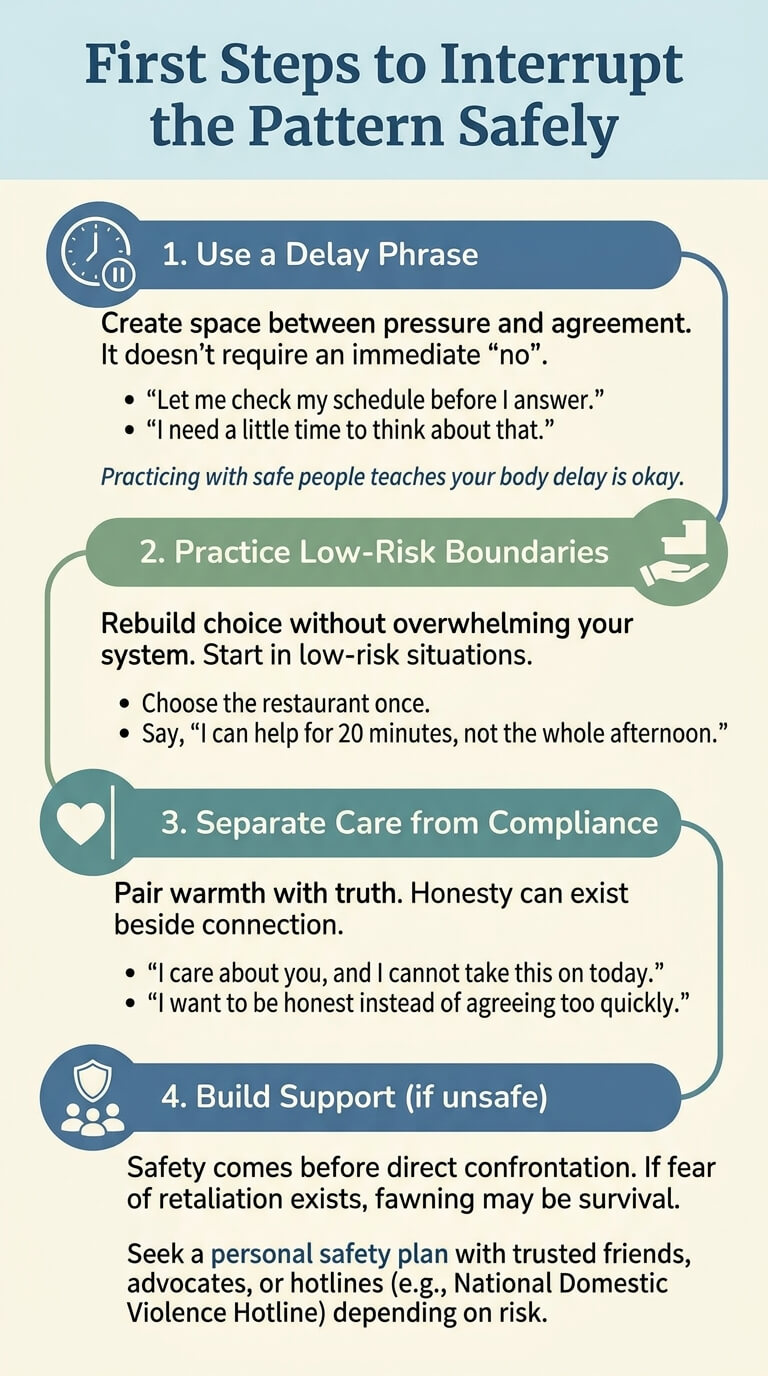
A delay phrase is one of the safest starting points because it does not require an immediate no. It creates a small space between pressure and agreement. That space helps your preference return.
- “Let me check my schedule before I answer.”
- “I need a little time to think about that.”
- “I am not sure yet. I will get back to you.”
- “I heard you. I need a moment before I respond.”
Use these in low-risk situations first. Practicing with safe people teaches your body that delay does not always lead to rejection or punishment.
Practice low-risk boundaries
Low-risk boundaries help rebuild choice without overwhelming your system. You might choose the restaurant once, decline a minor favor, ask for a different meeting time, or say, “I can help for 20 minutes, not the whole afternoon.”
The goal is not to become hard or uncaring. The goal is to teach your body that honesty can exist beside connection. A boundary is not a punishment. It is information about what is possible, acceptable, or sustainable.
Separate care from compliance
Try pairing warmth with truth. This helps the body learn that you can remain kind without disappearing.
- “I care about you, and I cannot take this on today.”
- “I understand why this matters, and I need more time.”
- “I want to be honest instead of agreeing too quickly.”
- “I am willing to talk, but I am not okay being spoken to that way.”
These sentences are not magic. They work best with people who have enough respect and safety to receive them. With unsafe people, a different plan may be needed.
Build support if the relationship is unsafe
If pleasing is happening because you fear someone’s retaliation, control, threats, stalking, or humiliation, do not treat it as a simple confidence issue. In unsafe dynamics, fawning may be a realistic survival strategy. The National Domestic Violence Hotline explains that a personal safety plan can help people think through safer options while experiencing abuse, preparing to leave, or after leaving.
Support may include a trusted friend, advocate, therapist, local service, workplace resource, or emergency help depending on the level of risk. Safety comes before practicing direct confrontation.
How Fawn Fits Beside Fight, Flight, and Freeze
Why appeasement belongs beside other protective reactions
Fight moves against the threat. Flight moves away from the threat. Freeze pauses or immobilizes. Fawn moves toward the threat through pleasing, softening, agreement, or self-adjustment. All of these can be understood as ways the body tries to reduce danger or regain a sense of control.
Some writing and research now uses fawn or appeasement language alongside other protective reactions, although the term is not used as consistently as fight or flight. A peer-reviewed open-access discussion of stress-related responses describes strategic assimilation or appeasement as a “fawn” pattern in contexts where reducing perceived threat may feel important for safety or acceptance.
Why capacity matters for boundaries
It is difficult to set a clear boundary when your body believes safety depends on pleasing. This is where capacity matters. When you are within a manageable stress range, you can usually pause, think, feel your preference, and choose words. When you are outside that range, agreement may happen before reflection.
That is why the first step is often not a dramatic confrontation. It may be noticing body cues, delaying your answer, practicing with safer people, and building enough support that honesty feels less dangerous.
When to Get Support
Fear, retaliation, coercion, threats, or humiliation
Get support if you please someone because you fear what they might do if you do not. That includes fear of being threatened, monitored, isolated, humiliated, punished, stalked, financially controlled, or physically harmed. In these situations, communication tips may increase risk if used without a safety plan.
Private support can help you think more clearly about options. If internet use is monitored, use a safer device or contact a trusted local resource. If you are in immediate danger, contact local emergency services.
Trauma history or severe distress
NIMH notes that traumatic events can affect people emotionally and physically, and that professional help is important when symptoms continue over time or interfere with daily life in its guidance on coping with traumatic events. If fawning is connected to past harm, panic, flashbacks, nightmares, isolation, substance misuse, or overwhelming shame, support from a qualified mental health professional may be helpful.
Seeking help does not mean you failed. It means the pattern may be connected to experiences that deserve care, pacing, and support beyond self-help.
When saying no does not feel safe
If saying no creates real danger, the goal is not to force yourself to be assertive. The goal is to increase safety, choices, privacy, and support. Sometimes the safest response in the moment is not the most emotionally honest response. That does not make you weak. It means your nervous system may be accurately reading risk.
When there is no immediate danger but saying no still feels impossible, start smaller. Delay your answer. Practice with someone safe. Write the honest sentence privately before saying a softer version out loud. Your body may need repeated evidence that disagreement can be survivable.
FAQ About the Fawn Response
Is fawning the same as being a people pleaser?
Not exactly. People-pleasing is a broader behavior pattern, while fawning describes pleasing as a stress-related attempt to reduce threat, tension, rejection, or retaliation. A person can people-please for many reasons, including habit, social approval, guilt, values, or anxiety. Fawn is most relevant when the pleasing feels automatic, fear-based, and difficult to stop in the moment.
Can fawn happen at work?
Yes. Fawning can happen at work when someone feels that safety, approval, job security, or reputation depends on staying agreeable. It may look like accepting too much work, apologizing for reasonable questions, laughing off disrespect, or saying yes to unrealistic demands. Work fawning is especially likely when there is a power difference and the person does not feel safe being honest.
Is it still fawn if I care about the person?
It can be. Caring about someone does not remove the possibility of fear-based pleasing. You may genuinely love, respect, or value a person and still lose access to your own limits around them. The key question is whether your care includes choice, honesty, and mutual respect, or whether it requires you to disappear.
How do I stop fawning without becoming rude?
Start by adding pause and accuracy, not harshness. You can be warm and still say, “I need to think,” “I cannot commit to that,” or “I want to answer honestly instead of too quickly.” The aim is not to swing from compliance to aggression. It is to let kindness include truth.
What if saying no is actually unsafe?
If saying no could lead to harm, retaliation, threats, stalking, humiliation, or serious consequences, do not pressure yourself to use ordinary boundary advice. Prioritize safety planning, private support, and practical risk reduction. In unsafe situations, pleasing may be something your body uses to get through the moment, and you deserve support that takes that risk seriously.
Key Takeaways
- The fawn response is a stress-related appeasement pattern where pleasing is used to reduce perceived danger, conflict, rejection, or retaliation.
- Fawning is different from healthy kindness because it often feels automatic, fear-based, and disconnected from your real preferences.
- Common signs include fast agreement, reflex apologizing, scanning for mood changes, feeling responsible for others’ emotions, and losing access to your own boundaries.
- Fawn can overlap with freeze or conflict avoidance, but its main move is active appeasement rather than leaving, confronting, or going still.
- Small delay phrases and low-risk boundaries can help rebuild choice when the situation is safe enough for practice.
- If pleasing is tied to fear, coercion, threats, humiliation, stalking, or retaliation, safety support matters more than trying to be more assertive.
Final Thoughts
Fawning is often misunderstood because it can look like being easygoing, loyal, thoughtful, or mature. Sometimes it is. But when pleasing becomes automatic under pressure, it may be your body’s way of trying to stay safe.
Start with one recent yes that did not feel fully true. Ask what you wanted before you answered, what you feared would happen, and what your body felt in the moment. Then choose one small next step: a delay phrase, a low-risk no, a warmer but more honest sentence, or support if the situation is unsafe. The point is not to stop caring. The point is to let your care include you too.

Michael Reed is the Founder and Lead Writer at Psychology Exposed. He writes about human behavior, relationships, emotional patterns, self-awareness, and practical psychology topics using research-informed, easy-to-understand content.
Read More About Michael Reed: https://psychologyexposed.com/michael-reed/