
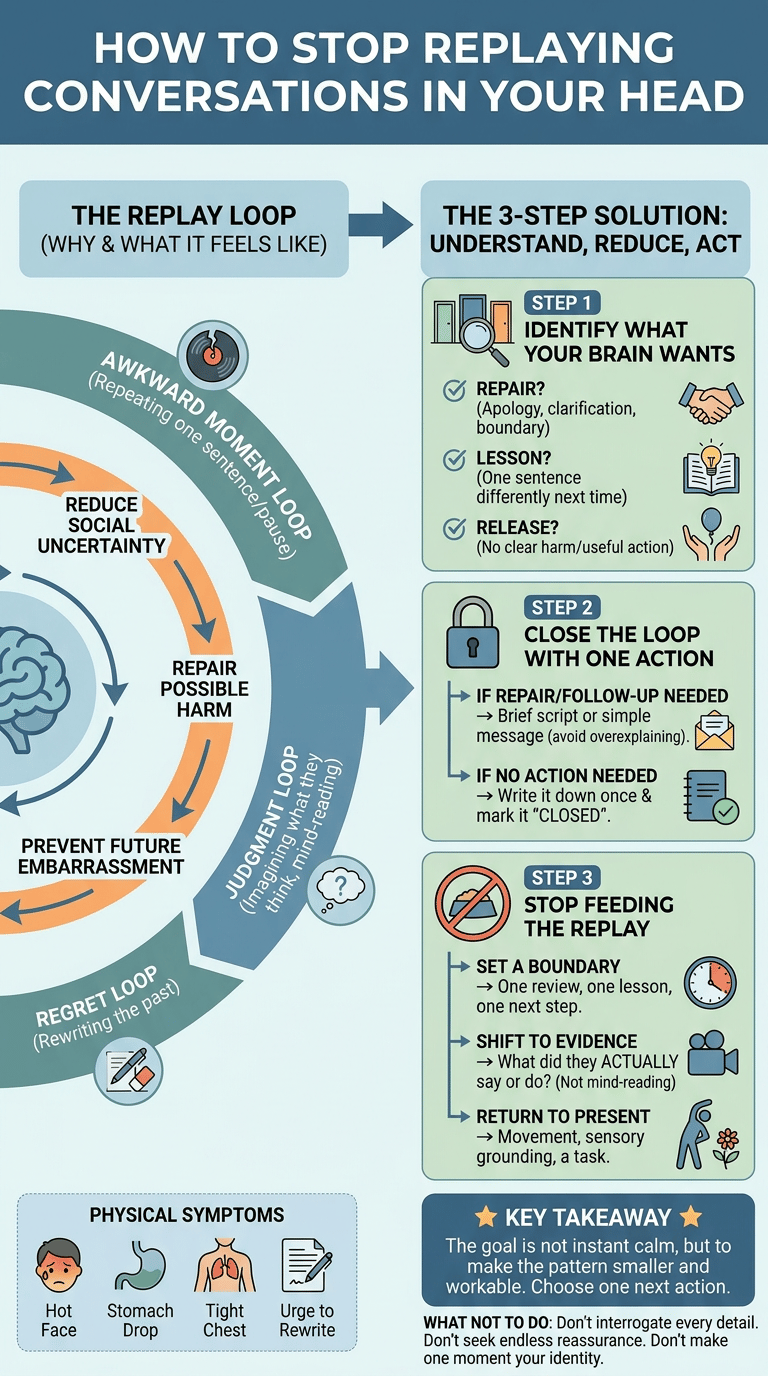
How to Stop Replaying Conversations in Your Head is not just a wording problem. For someone who replays awkward, tense, or important interactions after they are over, the difficult part is that the mind and body can feel urgent before the situation is fully understood. The goal is to name the pattern accurately, because the right label changes the next move.

This guide keeps the focus narrow. It explains how conversation replay works, what problem it is trying to solve, and how to respond without turning the article into a generic list of signs or tips. The practical thread is simple: understand the loop, reduce the fuel, and choose one next action that fits the real problem.
Why You Replay Conversations
This section focuses on why you replay conversations because it is where many readers lose the thread. In practice, the mind is trying to reduce social uncertainty, repair possible harm, or prevent future embarrassment, but replay becomes painful when it turns into mind-reading or self-attack. When you can see the mechanism clearly, the experience becomes less mysterious and the next step becomes less dramatic. For a broader clinical or psychology context, Stress is a useful reference point for this part of the pattern.
Your brain is trying to reduce social uncertainty
Your brain is trying to reduce social uncertainty matters because it narrows the problem from a vague emotional cloud into something you can work with. For someone who replays awkward, tense, or important interactions after they are over, this distinction prevents the mind from treating every discomfort as the same emergency.
Why belonging, rejection, and impression management matter
Why belonging, rejection, and impression management matter is the practical detail that makes the concept usable. Notice what is happening, name it in plain language, and look for the smallest response that changes the loop. In this topic, the common body pattern is a hot face, stomach drop, tight chest, restless urge to check, and a strong pull to rewrite what was already said. The helpful move is to pause long enough to ask what the situation is actually asking for, then apply this principle: decide whether the conversation needs repair, a lesson, or release, then close the loop with one small action.
How the mind treats unclear reactions as unfinished business
How the mind treats unclear reactions as unfinished business is the practical detail that makes the concept usable. Notice what is happening, name it in plain language, and look for the smallest response that changes the loop. In this topic, the common body pattern is a hot face, stomach drop, tight chest, restless urge to check, and a strong pull to rewrite what was already said. The helpful move is to pause long enough to ask what the situation is actually asking for, then apply this principle: decide whether the conversation needs repair, a lesson, or release, then close the loop with one small action.
Replay often starts as repair
Replay often starts as repair matters because it narrows the problem from a vague emotional cloud into something you can work with. For someone who replays awkward, tense, or important interactions after they are over, this distinction prevents the mind from treating every discomfort as the same emergency.
Finding what went wrong, what you meant, or what to say next time
Finding what went wrong, what you meant, or what to say next time is the practical detail that makes the concept usable. Notice what is happening, name it in plain language, and look for the smallest response that changes the loop. In this topic, the common body pattern is a hot face, stomach drop, tight chest, restless urge to check, and a strong pull to rewrite what was already said. The helpful move is to pause long enough to ask what the situation is actually asking for, then apply this principle: decide whether the conversation needs repair, a lesson, or release, then close the loop with one small action.
When review turns into punishment
When review turns into punishment is the practical detail that makes the concept usable. Notice what is happening, name it in plain language, and look for the smallest response that changes the loop. In this topic, the common body pattern is a hot face, stomach drop, tight chest, restless urge to check, and a strong pull to rewrite what was already said. The helpful move is to pause long enough to ask what the situation is actually asking for, then apply this principle: decide whether the conversation needs repair, a lesson, or release, then close the loop with one small action.
What Conversation Replay Usually Sounds Like
This section focuses on what conversation replay usually sounds like because it is where many readers lose the thread. In practice, the mind is trying to reduce social uncertainty, repair possible harm, or prevent future embarrassment, but replay becomes painful when it turns into mind-reading or self-attack. When you can see the mechanism clearly, the experience becomes less mysterious and the next step becomes less dramatic. For a broader clinical or psychology context, Anxiety Disorders is a useful reference point for this part of the pattern.
The awkward moment loop
The awkward moment loop matters because it narrows the problem from a vague emotional cloud into something you can work with. For someone who replays awkward, tense, or important interactions after they are over, this distinction prevents the mind from treating every discomfort as the same emergency.
Repeating one sentence, facial expression, pause, or joke
Repeating one sentence, facial expression, pause, or joke is the practical detail that makes the concept usable. Notice what is happening, name it in plain language, and look for the smallest response that changes the loop. In this topic, the common body pattern is a hot face, stomach drop, tight chest, restless urge to check, and a strong pull to rewrite what was already said. The helpful move is to pause long enough to ask what the situation is actually asking for, then apply this principle: decide whether the conversation needs repair, a lesson, or release, then close the loop with one small action. A simple script is: I want to respond carefully, so I am going to slow this down and come back with one clear point.
For a related next step, see this guide to the psychology of decision paralysis.
For a related next step, see this guide to rumination vs overthinking.
For broader context, see this guide to signs you overthink everything.
The judgment loop
The judgment loop matters because it narrows the problem from a vague emotional cloud into something you can work with. For someone who replays awkward, tense, or important interactions after they are over, this distinction prevents the mind from treating every discomfort as the same emergency.
Imagining what they think of you without evidence
Imagining what they think of you without evidence is the practical detail that makes the concept usable. Notice what is happening, name it in plain language, and look for the smallest response that changes the loop. In this topic, the common body pattern is a hot face, stomach drop, tight chest, restless urge to check, and a strong pull to rewrite what was already said. The helpful move is to pause long enough to ask what the situation is actually asking for, then apply this principle: decide whether the conversation needs repair, a lesson, or release, then close the loop with one small action.
The regret loop
The regret loop matters because it narrows the problem from a vague emotional cloud into something you can work with. For someone who replays awkward, tense, or important interactions after they are over, this distinction prevents the mind from treating every discomfort as the same emergency.
Rewriting the conversation after it is already over
Rewriting the conversation after it is already over is the practical detail that makes the concept usable. Notice what is happening, name it in plain language, and look for the smallest response that changes the loop. In this topic, the common body pattern is a hot face, stomach drop, tight chest, restless urge to check, and a strong pull to rewrite what was already said. The helpful move is to pause long enough to ask what the situation is actually asking for, then apply this principle: decide whether the conversation needs repair, a lesson, or release, then close the loop with one small action.
The safety loop
The safety loop matters because it narrows the problem from a vague emotional cloud into something you can work with. For someone who replays awkward, tense, or important interactions after they are over, this distinction prevents the mind from treating every discomfort as the same emergency.
Planning how to prevent embarrassment next time
Planning how to prevent embarrassment next time is the practical detail that makes the concept usable. Notice what is happening, name it in plain language, and look for the smallest response that changes the loop. In this topic, the common body pattern is a hot face, stomach drop, tight chest, restless urge to check, and a strong pull to rewrite what was already said. The helpful move is to pause long enough to ask what the situation is actually asking for, then apply this principle: decide whether the conversation needs repair, a lesson, or release, then close the loop with one small action.
Why Replaying Makes You Feel Worse
This section focuses on why replaying makes you feel worse because it is where many readers lose the thread. In practice, the mind is trying to reduce social uncertainty, repair possible harm, or prevent future embarrassment, but replay becomes painful when it turns into mind-reading or self-attack. When you can see the mechanism clearly, the experience becomes less mysterious and the next step becomes less dramatic. For a broader clinical or psychology context, ADAA Social Anxiety Disorder is a useful reference point for this part of the pattern.
Memory is not a perfect recording
Memory is not a perfect recording matters because it narrows the problem from a vague emotional cloud into something you can work with. For someone who replays awkward, tense, or important interactions after they are over, this distinction prevents the mind from treating every discomfort as the same emergency.
Stress narrows attention and highlights threat
Stress narrows attention and highlights threat is the practical detail that makes the concept usable. Notice what is happening, name it in plain language, and look for the smallest response that changes the loop. In this topic, the common body pattern is a hot face, stomach drop, tight chest, restless urge to check, and a strong pull to rewrite what was already said. The helpful move is to pause long enough to ask what the situation is actually asking for, then apply this principle: decide whether the conversation needs repair, a lesson, or release, then close the loop with one small action.
Why the replay may become harsher than the real event
Why the replay may become harsher than the real event is the practical detail that makes the concept usable. Notice what is happening, name it in plain language, and look for the smallest response that changes the loop. In this topic, the common body pattern is a hot face, stomach drop, tight chest, restless urge to check, and a strong pull to rewrite what was already said. The helpful move is to pause long enough to ask what the situation is actually asking for, then apply this principle: decide whether the conversation needs repair, a lesson, or release, then close the loop with one small action.
Shame makes small moments feel defining
Shame makes small moments feel defining matters because it narrows the problem from a vague emotional cloud into something you can work with. For someone who replays awkward, tense, or important interactions after they are over, this distinction prevents the mind from treating every discomfort as the same emergency.
The difference between I said something awkward and I am awkward
The difference between I said something awkward and I am awkward is the practical detail that makes the concept usable. Notice what is happening, name it in plain language, and look for the smallest response that changes the loop. In this topic, the common body pattern is a hot face, stomach drop, tight chest, restless urge to check, and a strong pull to rewrite what was already said. The helpful move is to pause long enough to ask what the situation is actually asking for, then apply this principle: decide whether the conversation needs repair, a lesson, or release, then close the loop with one small action.
Mental rehearsal can become avoidance
Mental rehearsal can become avoidance matters because it narrows the problem from a vague emotional cloud into something you can work with. For someone who replays awkward, tense, or important interactions after they are over, this distinction prevents the mind from treating every discomfort as the same emergency.
Thinking about repair instead of sending the message, resting, or moving on
Thinking about repair instead of sending the message, resting, or moving on is the practical detail that makes the concept usable. Notice what is happening, name it in plain language, and look for the smallest response that changes the loop. In this topic, the common body pattern is a hot face, stomach drop, tight chest, restless urge to check, and a strong pull to rewrite what was already said. The helpful move is to pause long enough to ask what the situation is actually asking for, then apply this principle: decide whether the conversation needs repair, a lesson, or release, then close the loop with one small action. A simple script is: I want to respond carefully, so I am going to slow this down and come back with one clear point.
Step 1: Identify What Your Brain Wants
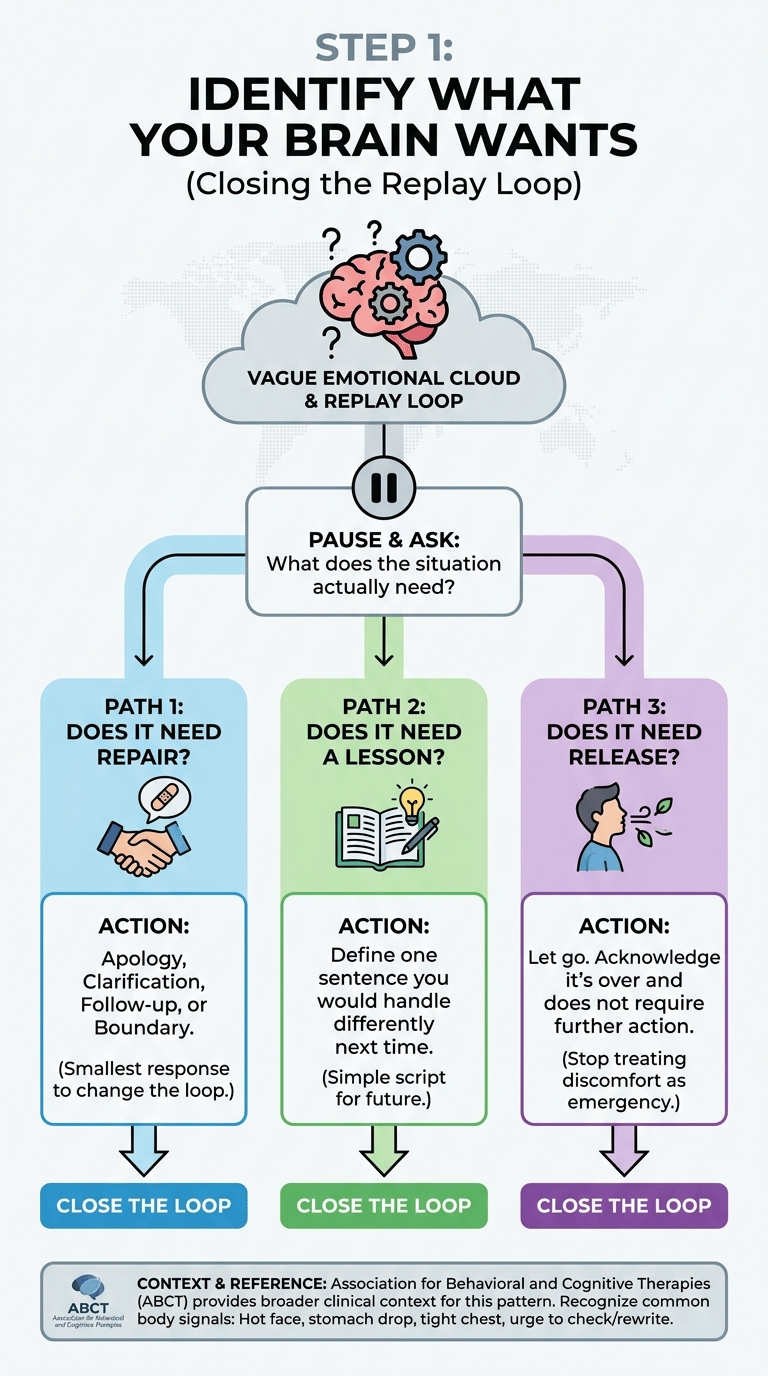
This section focuses on step 1: identify what your brain wants because it is where many readers lose the thread. In practice, the mind is trying to reduce social uncertainty, repair possible harm, or prevent future embarrassment, but replay becomes painful when it turns into mind-reading or self-attack. When you can see the mechanism clearly, the experience becomes less mysterious and the next step becomes less dramatic. For a broader clinical or psychology context, Association for Behavioral and Cognitive Therapies is a useful reference point for this part of the pattern.
Does the conversation need repair?
Does the conversation need repair? matters because it narrows the problem from a vague emotional cloud into something you can work with. For someone who replays awkward, tense, or important interactions after they are over, this distinction prevents the mind from treating every discomfort as the same emergency.
Apology, clarification, follow-up, or boundary
Apology, clarification, follow-up, or boundary is the practical detail that makes the concept usable. Notice what is happening, name it in plain language, and look for the smallest response that changes the loop. In this topic, the common body pattern is a hot face, stomach drop, tight chest, restless urge to check, and a strong pull to rewrite what was already said. The helpful move is to pause long enough to ask what the situation is actually asking for, then apply this principle: decide whether the conversation needs repair, a lesson, or release, then close the loop with one small action.
Does it need a lesson?
Does it need a lesson? matters because it narrows the problem from a vague emotional cloud into something you can work with. For someone who replays awkward, tense, or important interactions after they are over, this distinction prevents the mind from treating every discomfort as the same emergency.
One sentence you would handle differently next time
One sentence you would handle differently next time is the practical detail that makes the concept usable. Notice what is happening, name it in plain language, and look for the smallest response that changes the loop. In this topic, the common body pattern is a hot face, stomach drop, tight chest, restless urge to check, and a strong pull to rewrite what was already said. The helpful move is to pause long enough to ask what the situation is actually asking for, then apply this principle: decide whether the conversation needs repair, a lesson, or release, then close the loop with one small action. A simple script is: I want to respond carefully, so I am going to slow this down and come back with one clear point.
Does it need release?
Does it need release? matters because it narrows the problem from a vague emotional cloud into something you can work with. For someone who replays awkward, tense, or important interactions after they are over, this distinction prevents the mind from treating every discomfort as the same emergency.
No clear harm, no useful action, and no new information
No clear harm, no useful action, and no new information is the practical detail that makes the concept usable. Notice what is happening, name it in plain language, and look for the smallest response that changes the loop. In this topic, the common body pattern is a hot face, stomach drop, tight chest, restless urge to check, and a strong pull to rewrite what was already said. The helpful move is to pause long enough to ask what the situation is actually asking for, then apply this principle: decide whether the conversation needs repair, a lesson, or release, then close the loop with one small action.
Step 2: Close the Loop With One Action
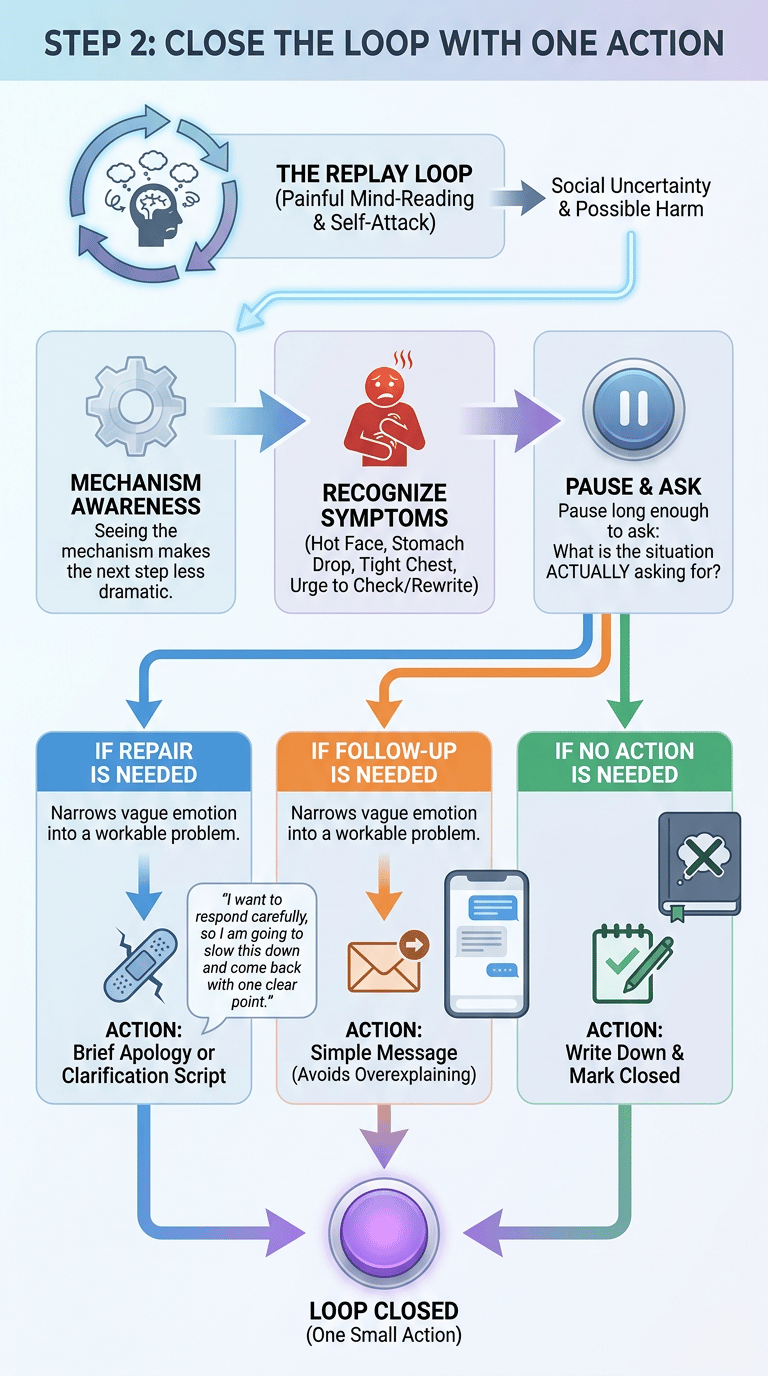
This section focuses on step 2: close the loop with one action because it is where many readers lose the thread. In practice, the mind is trying to reduce social uncertainty, repair possible harm, or prevent future embarrassment, but replay becomes painful when it turns into mind-reading or self-attack. When you can see the mechanism clearly, the experience becomes less mysterious and the next step becomes less dramatic.
If repair is needed
If repair is needed matters because it narrows the problem from a vague emotional cloud into something you can work with. For someone who replays awkward, tense, or important interactions after they are over, this distinction prevents the mind from treating every discomfort as the same emergency.
A brief apology or clarification script
A brief apology or clarification script is the practical detail that makes the concept usable. Notice what is happening, name it in plain language, and look for the smallest response that changes the loop. In this topic, the common body pattern is a hot face, stomach drop, tight chest, restless urge to check, and a strong pull to rewrite what was already said. The helpful move is to pause long enough to ask what the situation is actually asking for, then apply this principle: decide whether the conversation needs repair, a lesson, or release, then close the loop with one small action. A simple script is: I want to respond carefully, so I am going to slow this down and come back with one clear point.
If follow-up is needed
If follow-up is needed matters because it narrows the problem from a vague emotional cloud into something you can work with. For someone who replays awkward, tense, or important interactions after they are over, this distinction prevents the mind from treating every discomfort as the same emergency.
A simple message that avoids overexplaining
If no action is needed
Write the loop down once and mark it closed
Step 3: Stop Feeding the Replay
Use a replay boundary
One review, one lesson, one next step
Shift from mind-reading to evidence
What did they actually say or do?
Return to the present through behavior
Movement, sensory grounding, a task, or social reconnection
What Not to Do
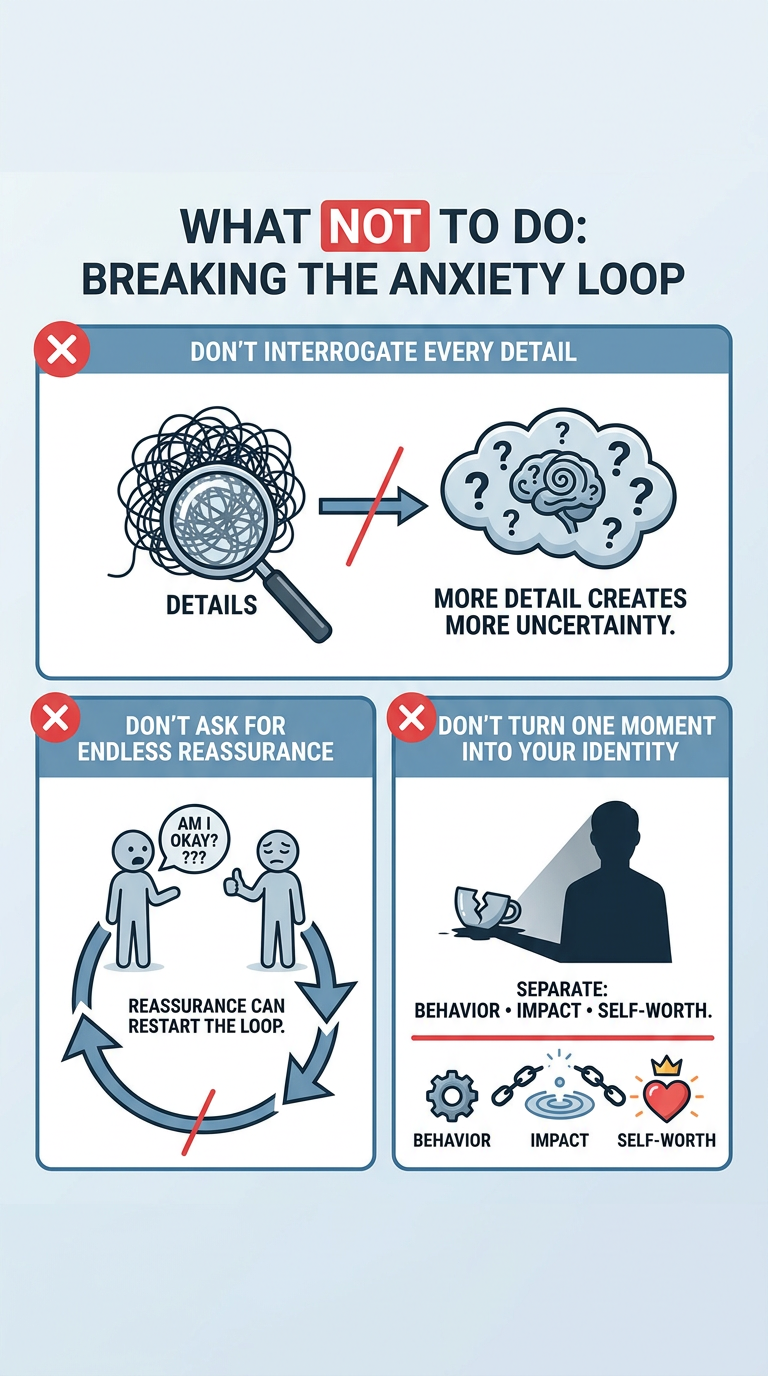
Do not interrogate every detail
More detail can create more uncertainty
Do not ask for endless reassurance
Why reassurance can restart the loop
Do not turn one moment into your identity
Separate behavior, impact, and self-worth
When Conversation Replay Is Part of a Bigger Pattern
Social anxiety, perfectionism, trauma, or rejection sensitivity
When after-social rumination becomes daily impairment
Getting support
CBT, exposure-based therapy, self-compassion work, and professional help
FAQ
Why do I replay conversations after social events?
You may replay conversations because social situations leave room for uncertainty. Your mind tries to check whether you sounded awkward, offended someone, missed a cue, or should have said something differently. A short review can help you learn, but repeated replay usually means your brain is trying to get certainty that is not available.
How do I stop thinking about something embarrassing I said?
Start by deciding whether the moment caused real harm or just discomfort. If repair is needed, send one brief clarification or apology. If no action is needed, write down one lesson, label the rest as replay, and redirect your attention to something physical or present rather than arguing with the memory.
Should I apologize after replaying a conversation?
Apologize when you can name a real impact, not just because you feel anxious. A useful apology is specific, brief, and does not demand reassurance from the other person. If the replay is based mostly on imagined judgment, reassurance seeking may keep the loop going.
Is replaying conversations a sign of anxiety?
It can be connected to anxiety, especially when it happens often, leads to avoidance, or makes ordinary social contact feel unsafe. It can also happen after conflict, embarrassment, stress, or perfectionism. The important question is whether replay is occasional reflection or a pattern that interferes with your life.
Key Takeaways
The main takeaway is that the mind is trying to reduce social uncertainty, repair possible harm, or prevent future embarrassment, but replay becomes painful when it turns into mind-reading or self-attack. The useful response is not to force instant calm, but to make the pattern smaller, more specific, and more workable. When the pattern is frequent or impairing, support is part of responsible care, not a personal failure.

Michael Reed is the Founder and Lead Writer at Psychology Exposed. He writes about human behavior, relationships, emotional patterns, self-awareness, and practical psychology topics using research-informed, easy-to-understand content.
Read More About Michael Reed: https://psychologyexposed.com/michael-reed/