

A face can change the emotional temperature of a conversation before anyone says a full sentence. A quick smile may soften a tense moment. A tightened jaw may make a room feel less open. A blank look may leave someone wondering whether they are being judged, ignored, or simply not understood.
Facial expressions psychology looks at how the face communicates emotion, attention, social feedback, and self-control. It also reminds us that faces are not perfect windows into another person’s private mind. A smile is not always happiness. A frown is not always anger. A neutral face is not always rejection. The safest interpretation usually comes from the face, the situation, the person’s usual style, and what happens next.
This matters because people often react to the face they think they see. A coworker’s flat expression may feel like criticism. A partner’s forced smile may feel confusing. A friend’s raised eyebrows may look like judgment when they are actually surprised. Careful face-reading reduces unnecessary conflict without pretending that one look reveals someone’s feelings.
Quick Answer
Facial expressions can show emotion, attention, social feedback, or regulation
Facial expressions are visible movements of the face that may communicate feeling, focus, discomfort, politeness, confusion, or social response. The APA Dictionary of Psychology describes facial expression as part of communication and emotion display, which is a helpful starting point. In real life, though, one expression rarely proves one exact feeling.
Why facial cues need context before interpretation
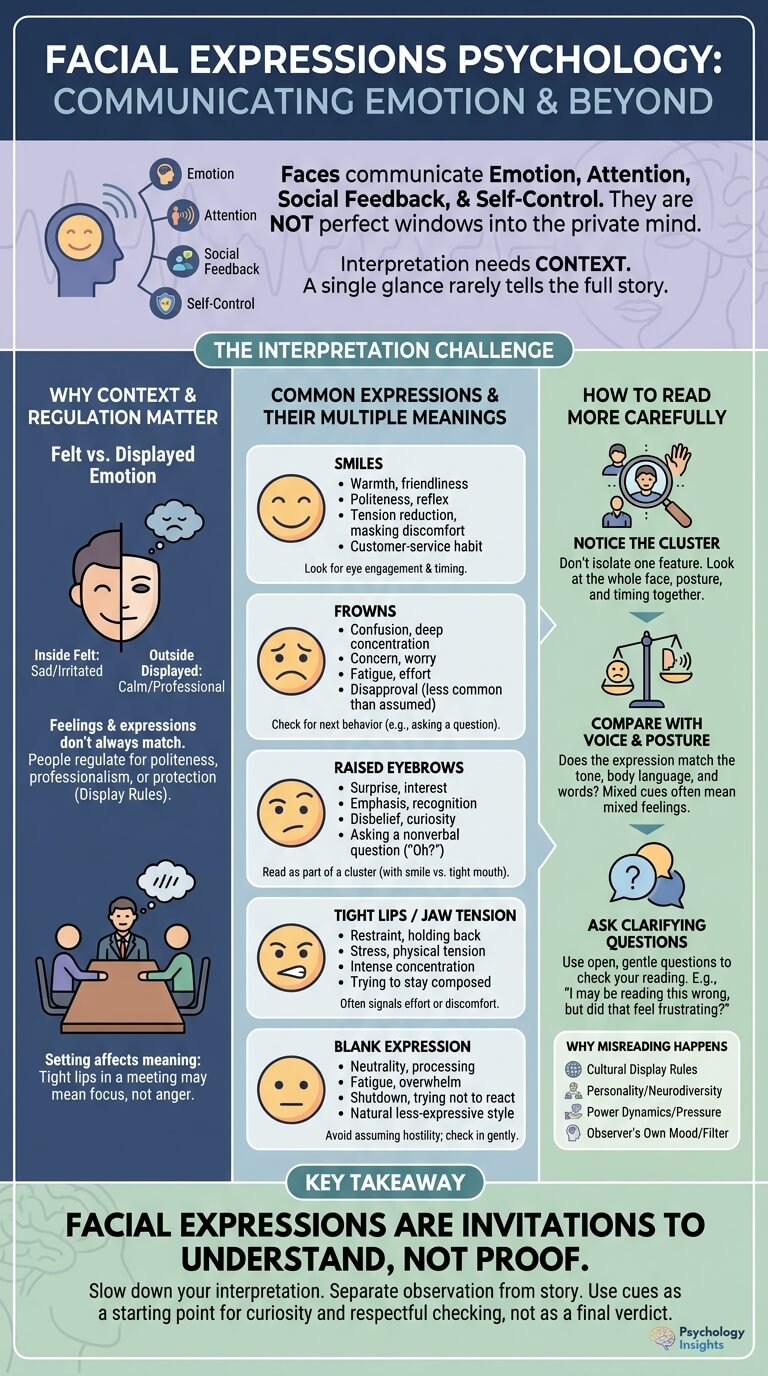
The same facial cue can mean different things depending on the setting. Tight lips during a meeting may mean concentration, restraint, or stress. A smile during an awkward moment may mean kindness, discomfort, habit, or an attempt to keep peace. A careful reader does not ask, “What does this face always mean?” A better question is, “What might this face mean here, with this person, in this moment?”
What Facial Expressions Mean in Psychology
Facial expressions are one of the clearest parts of nonverbal communication, but they still need to be placed inside body language psychology as a broader topic.
Expressions as emotional signals and social messages
Facial expressions are often treated as emotion signals, but they also function as social messages. A person may smile to welcome someone, nod with raised eyebrows to show recognition, narrow their eyes to concentrate, or press their lips together to avoid interrupting. The expression communicates something to others, even when the person is not trying to send a formal message.
That is why faces carry so much weight in conversation. They provide feedback while another person is speaking. They help people know whether to continue, slow down, clarify, apologize, or ask a question. A listener’s face can encourage a speaker, discourage them, or leave them uncertain.
Research on facial expressions and social interaction describes facial expressions as one form of nonverbal communication that influences how people respond to each other emotionally and socially. For example, a review in PubMed Central on facial expressions in social interaction discusses how facial expressions affect others’ feelings, thoughts, and behavior in interpersonal situations.

The difference between felt emotion and displayed emotion
A felt emotion is what someone experiences inside. A displayed emotion is what appears on the outside. These may match, but they do not always match perfectly. Someone may feel irritated but display calm because they are at work. Someone may feel sad but smile because they do not want attention. Someone may feel nervous but keep their face controlled because the situation requires professionalism.
This difference matters because many misunderstandings begin when we assume the displayed face equals the full internal story. A person who smiles may still be uncomfortable. A person who looks serious may still feel friendly. A person who looks blank may be processing more than they can show in the moment.
Why people regulate their faces in public
People learn early that not every feeling is welcome in every setting. A child may learn not to show disappointment at a gift. An employee may learn to keep a calm face while receiving criticism. A family member may smile during a tense gathering to avoid making the conflict worse. These adjustments are sometimes called display rules, which are social and cultural expectations about when and how emotions should be shown.
A study on emotion expression and regulation across cultures explains that emotion expressions are shaped by display rules. This is one reason facial expressions should not be read as universal code. Culture, family history, workplace norms, gender expectations, and power dynamics can all shape how much feeling appears on the face.
Common Facial Expressions and What They May Signal
Smiles: warmth, politeness, tension, or masking
A smile is one of the most easily noticed facial expressions, but it is also one of the easiest to overread. A smile may signal warmth, friendliness, amusement, reassurance, or pleasure. It may also be a polite reflex, a way to reduce tension, a habit from customer-facing work, or a mask for discomfort.
For example, someone may smile while saying, “It’s fine,” even when it is not fine. That smile might not mean they are being dishonest. It may mean they are trying not to escalate the moment, unsure how much to reveal, or used to managing other people’s reactions. A careful interpretation watches what comes with the smile: relaxed eyes, open voice, natural timing, and behavior that fits the words.

Frowns: confusion, concern, concentration, or disapproval
A frown often gets interpreted as anger or dislike, but it may simply mean that someone is thinking hard. People frown when they are confused, worried, focused, tired, or trying to follow a complicated point. In a work meeting, a frown may mean, “I do not understand the numbers yet,” not “I reject your idea.”
Before reacting to a frown as criticism, look for the next behavior. Do they ask a clarifying question? Do they soften when the issue is explained? Do they keep listening? If yes, the frown may be cognitive effort rather than emotional rejection.
Raised eyebrows: surprise, emphasis, recognition, or question
Raised eyebrows can appear during surprise, recognition, emphasis, disbelief, or curiosity. A quick eyebrow raise may function almost like a nonverbal “Oh?” It can invite more information, show that something stood out, or signal that the person is trying to process new input.
Raised eyebrows become easier to read when paired with the rest of the face. Raised eyebrows with a smile may feel welcoming. Raised eyebrows with a tight mouth may feel skeptical. Raised eyebrows with a tilted head may show a question. The cue becomes clearer when it is read as part of a cluster.
Tight lips and jaw tension: restraint, stress, or concentration
Tight lips, a clenched jaw, or a fixed mouth can signal restraint. Someone may be stopping themselves from speaking too quickly, holding back frustration, concentrating intensely, or trying to keep a professional face during stress. These cues may also appear when a person is physically tired or uncomfortable.
In conflict, tight lips may mean, “I am trying not to say the wrong thing.” In a public setting, they may mean, “I need to stay composed.” In a technical task, they may mean, “I am focused.” The meaning depends on what is happening and whether the person later engages, withdraws, or clarifies.
Blank expression: neutrality, shutdown, fatigue, or processing
A blank expression is often misread because people tend to fill silence with their own fears. Someone may see a neutral face and think, “They are angry with me,” “They think I am stupid,” or “They do not care.” Sometimes that interpretation is accurate, but often it is not.
A blank face may mean the person is tired, overstimulated, trying not to react, listening without showing much feedback, or processing what was said. Some people naturally have less expressive faces. Others become less expressive when overwhelmed. If the relationship is safe enough, a simple check works better than a silent conclusion: “I can’t tell how that landed. Are you still with me?”
| Facial cue | Common first impression | Other possible meanings | Better next question |
|---|---|---|---|
| Smile | They are happy | Politeness, tension, masking, reassurance | Does the smile match their words and behavior? |
| Frown | They are angry | Confusion, concentration, concern, fatigue | Are they asking questions or shutting down? |
| Raised eyebrows | They are judging me | Surprise, interest, emphasis, curiosity | Did they follow with curiosity or criticism? |
| Tight jaw | They are hostile | Stress, restraint, focus, physical tension | Did something in the conversation create pressure? |
| Blank face | They do not care | Processing, fatigue, overwhelm, neutral style | Can I ask instead of guessing? |
Why Facial Expressions Are Easy to Misread
Cultural display rules and learned politeness
In some families and cultures, direct emotional display is encouraged. In others, restraint is seen as respectful. One person may learn to smile when uncomfortable because politeness matters. Another may learn to keep a serious face when listening because seriousness shows respect. If these people interpret each other without context, both may feel misunderstood.
This is especially important in workplaces, schools, public service settings, and cross-cultural relationships. What looks cold in one setting may be respectful in another. What looks warm in one setting may feel overly familiar somewhere else.
Personality, neurodiversity, fatigue, and stress
Some people are naturally expressive. Others show less emotion on their faces even when they feel strongly. Some people use animated facial feedback while listening. Others listen quietly and respond later with words. Neurodiversity, sensory processing, stress, tiredness, pain, and cognitive load can all affect how facial expressions appear.
A person who is exhausted may look irritated even when they are not upset with you. A person who is concentrating may look stern. A person who finds eye contact uncomfortable may also show facial tension because the social demand feels intense. None of this means facial cues should be ignored. It means they should be treated as clues, not verdicts.

Power dynamics and pressure to look fine
Facial expressions change when people feel watched, evaluated, or dependent on someone else’s reaction. An employee may smile at a manager’s joke because the power difference makes honesty costly. A student may look calm while feeling embarrassed. A partner may keep a neutral face because showing hurt has led to criticism in the past.
In power-heavy situations, the face often becomes a form of protection. People may manage their expressions to avoid punishment, rejection, embarrassment, or conflict. This is one reason “they smiled, so they must be fine” can be a harmful assumption.
Why your own mood changes what you think you see
Facial expression reading is not only about the other person’s face. It is also about the observer’s state. If you feel anxious, rejected, guilty, or defensive, you may read neutral faces as negative. If you are excited, you may read polite smiles as agreement. If you are tired, you may have less patience for ambiguous expressions.
Before deciding what someone’s face means, it helps to pause and notice your own body. Are you already expecting criticism? Are you looking for proof that someone is upset? Are you trying to protect yourself from embarrassment? Your interpretation may contain useful information, but it may also contain your current emotional filter.
A major review on inferring emotion from facial movements argues for caution when treating facial movements as direct evidence of specific emotions. In everyday terms, that means a face can give you information, but it rarely gives you the whole story by itself.
Facial Expressions vs Microexpressions
Not every facial cue lasts long enough to read easily, and brief facial cues should not be treated as certain proof of hidden emotion.
Everyday expressions are visible and socially shaped
Everyday facial expressions are the visible expressions people notice in normal conversations: smiles, frowns, eyebrow movements, lip tension, eye narrowing, and neutral faces. They may last long enough to be seen clearly. They may be intentional, partly intentional, or automatic. They are shaped by the situation and by what the person wants to show.
Everyday expressions deserve attention because they are what most people encounter at work, at home, and in casual conversation. They affect how safe, welcomed, dismissed, encouraged, or judged people feel.

Microexpressions are brief and easy to overclaim
Microexpressions are often described as very brief facial movements that may appear before someone fully regulates their face. They have become popular in pop psychology, especially in content about lie detection. That popularity creates a problem: people may start treating tiny facial changes as proof of hidden truth.
The safer approach is modest. A quick expression may be worth noticing, but it should not become an accusation. A flicker of surprise, discomfort, or irritation may mean many things. It could be emotion. It could be concentration. It could be fatigue, confusion, or a response to something unrelated.
When a small expression should simply invite curiosity
If you notice a small expression during a conversation, use it as an invitation to check in, not as evidence to prosecute the person. Instead of saying, “You looked angry, so I know you hated that,” try something more open: “I noticed that seemed to land in a complicated way. Did I read that right?”
This protects the relationship and your accuracy. The other person may say, “No, I was just thinking,” or “Actually, yes, that bothered me.” Either answer is more useful than a private story that grows without confirmation.
| Everyday facial expressions | Microexpressions |
|---|---|
| Usually visible long enough to notice in normal conversation | Very brief and easy to miss or misinterpret |
| Often shaped by social context, politeness, and display rules | Often discussed as quick emotional leakage, but claims should stay cautious |
| Useful for understanding social feedback and emotional tone | Not reliable as a stand-alone lie detector |
| Best read with voice, posture, eye contact, and words | Best treated as a reason to slow down and ask, not assume |
How to Read Facial Expressions More Carefully
A tense jaw, polite smile, or raised eyebrow may mean different things depending on the person and the setting, so it is safer to read facial cues in context.
Notice the expression cluster, not one feature
A useful face-reading habit is to look for a cluster instead of one isolated feature. A smile with relaxed shoulders, warm voice, and steady engagement feels different from a smile with stiff posture, short answers, and a tense jaw. A frown with curious questions feels different from a frown with contemptuous tone and repeated dismissal.
Try this simple four-part check: face, setting, sequence, response. First, what did the face do? Second, what is happening around the person? Third, when did the expression appear or change? Fourth, what did the person do afterward? This keeps you from turning a single feature into a final conclusion.
Compare the face with voice tone, posture, and eye contact
The face rarely works alone. Eye contact, voice tone, posture, timing, and personal space can shift the meaning of a facial expression. A neutral face with a gentle voice may feel calm. A neutral face with cold silence and turned-away posture may feel distant. A smile with bright eye contact may feel warm. A smile with tense shoulders and quick withdrawal may feel uncomfortable.
When cues match, interpretation becomes easier. When cues conflict, slow down. Mixed cues do not always mean deception. They often mean mixed feelings. Someone may agree with your point and still feel uncomfortable with the tone.

Ask clarifying questions instead of silently deciding
The strongest correction for overreading is direct but gentle clarification. Not every relationship allows the same level of directness, and safety matters. But when the situation is ordinary and safe enough, a small question can prevent a large misunderstanding.
- “I may be reading this wrong, but did that feel frustrating?”
- “You look thoughtful. Do you want a minute, or should I explain another way?”
- “I noticed you went quiet. Is this a bad time to talk?”
- “I can’t tell if you’re upset or just concentrating.”
- “I don’t want to assume. How did that land for you?”
These questions work because they name uncertainty. They do not force the other person to accept your interpretation. They leave room for correction, which is essential when reading faces.
Facial Expressions in Conflict and Discomfort
A tight smile, still expression, or tense jaw may reflect anxiety, pressure, or effort to stay controlled, and those cues can overlap with nervous body language.
When someone smiles while uncomfortable
Smiling during discomfort is common. Some people smile when they feel embarrassed. Some smile when they are trying to calm the room. Some smile because they were taught that appearing pleasant is safer than showing anger, hurt, or fear. This kind of smile can confuse others because the face looks friendly while the rest of the person feels tense.
If someone smiles while saying something difficult, listen to the words and the situation. “It’s okay” with a strained smile may not mean it is fully okay. “I’m fine” after repeated criticism may not mean the person is fine. A better response is not to challenge the smile, but to make honesty easier: “You don’t have to make this comfortable for me. I want to understand what you actually think.”

When a neutral face is read as hostile
Neutral expressions often become emotional mirrors. If you already fear judgment, a neutral face may look disapproving. If you feel guilty, it may look accusatory. If you are used to being criticized, a quiet face may feel like a warning sign. The face may be neutral, but your nervous system may not experience it that way.
It helps to separate observation from story. Observation: “Their face did not change much.” Story: “They hate what I said.” Observation gives you something to check. Story may be true, but it needs more evidence. Try asking, “I’m not sure how you’re feeling about this. Are you still open to talking?”
How to reduce misinterpretation in tense conversations
When a conversation is already tense, people read faces more quickly and often more defensively. The best move is to reduce pressure before trying to interpret every expression. Slow your pace. Lower your volume. Ask one question at a time. Give the other person room to think.
You can also make your own face easier to read. If you are concentrating but not angry, say so. If you need a pause, say it before going blank. If you are smiling because you feel awkward, name it lightly. Clear words reduce the burden on facial interpretation.
Bridge to Other Body Language Cues
How eye contact changes the meaning of facial expression
Eye contact can intensify or soften facial expressions. A frown with direct eye contact may feel confrontational in one setting and attentive in another. A smile without eye contact may feel polite or distracted. A blank face with steady eye contact may feel intense, while a blank face with lowered gaze may feel tired or overwhelmed.
This is why facial expressions and eye contact should be read together. The face may show emotion, but gaze often shapes how that emotion is received.
How nervous body language can show up in the face
Nervousness often appears in the face: lip biting, forced smiling, blinking changes, jaw tension, swallowing, or a face that becomes less expressive. These signs do not prove fear or guilt. They may show arousal, stress, social pressure, or the effort of self-control.
When facial tension appears with fidgeting, shallow breathing, quiet voice, or avoidance, it may be kinder to reduce pressure rather than push for immediate answers. A face under stress needs patience, not interrogation.
Why facial cues fit inside Body Language Psychology
Facial expressions are one channel in the wider system of body language. They work alongside posture, movement, gaze, space, gesture, and voice. A good reading of the face is never separated from the person’s baseline, the relationship, the setting, and the conversation itself.
That broader view prevents two common mistakes: ignoring faces completely, or treating faces as magical truth machines. The useful middle ground is attentive, humble, and willing to check.
When to Get Support
If reading facial expressions becomes compulsive, fear-based, or tied to social anxiety
Some people do not just notice facial expressions. They scan them constantly. They replay them after conversations, search for signs of rejection, or feel unable to relax unless every face looks approving. When face-reading becomes compulsive or fear-based, the issue may no longer be facial expressions themselves. It may be anxiety, social fear, past criticism, or hypervigilance.

The National Institute of Mental Health notes that social anxiety can involve fear of negative judgment and difficulty in social situations. If reading faces makes daily life feel smaller, frightening, or exhausting, support from a qualified mental health professional may help. Educational information cannot diagnose you or replace professional care.
If facial intimidation, contempt, or humiliation is part of unsafe interactions
A harsh look by itself does not automatically mean abuse. But facial intimidation can be part of a larger unsafe pattern when it comes with threats, humiliation, control, stalking, blocking exits, retaliation, or fear of what will happen if you speak honestly. In those situations, communication tips may not be enough, and trying to interpret the face perfectly is not the main priority.
If someone uses expressions, silence, contempt, or intimidation to control or frighten you, consider reaching out to a trusted person or a safety-focused organization. The National Domestic Violence Hotline offers information on emotional abuse, including non-physical behaviors that control, isolate, or scare someone. Safety matters more than reading the other person correctly.
FAQ About Facial Expressions Psychology
Are facial expressions universal?
Some facial movements are widely recognized across many contexts, but that does not mean every expression has one fixed meaning everywhere. Culture, display rules, personality, power dynamics, and the situation shape what people show and how others interpret it. It is safer to think of facial expressions as meaningful signals that need context, not as a universal dictionary.
Can a smile hide discomfort?
Yes. A smile can express warmth or happiness, but it can also reduce tension, cover embarrassment, maintain politeness, or protect someone in a stressful interaction. To understand a smile more accurately, compare it with the person’s words, voice, posture, timing, and later behavior. A smile that appears during pressure deserves curiosity, not automatic certainty.
Why do people look blank during emotional conversations?
A blank face may mean many things: processing, fatigue, overwhelm, neutrality, shutdown, or a habit of showing less expression. Some people become less expressive when emotion rises because they are trying to stay controlled. If the relationship is safe enough, ask gently rather than assuming the blank face means indifference or hostility.
How do I avoid misreading someone’s face?
Start by separating what you observed from what you imagined it meant. Then look for cue clusters, timing, context, and behavior after the expression. If you still feel unsure, use a clarifying question such as, “I may be reading this wrong. How did that feel to you?” This approach reduces mind-reading and gives the other person room to correct your interpretation.
Are facial expressions reliable by themselves?
Not enough to be used as proof. Facial expressions are useful clues, especially when they match words, voice, posture, and behavior. But a single facial expression can be shaped by fatigue, culture, stress, politeness, concentration, or personal style. The most reliable reading comes from patterns, context, and respectful checking.
Key Takeaways
Facial expressions are meaningful, but they work best as invitations to understand, not proof
- Facial expressions can communicate emotion, attention, feedback, politeness, discomfort, or self-control.
- A displayed expression does not always match the full felt emotion underneath it.
- Smiles, frowns, raised eyebrows, tight jaws, and blank faces all have multiple possible meanings.
- Culture, stress, power dynamics, neurodiversity, fatigue, and your own mood can all affect interpretation.
- Facial expressions should be read with eye contact, voice tone, posture, timing, and context.
- When you are unsure, a gentle question is usually safer than a silent conclusion.
One practical next step is to slow down your first interpretation. The next time you notice a facial expression that triggers a strong reaction in you, name only the observation first: “Their mouth tightened,” “They smiled quickly,” or “Their face went still.” Then ask what else you know from the setting, the person’s baseline, and their words. That pause can turn face-reading from a source of anxiety into a more careful way of understanding people.

Michael Reed is the Founder and Lead Writer at Psychology Exposed. He writes about human behavior, relationships, emotional patterns, self-awareness, and practical psychology topics using research-informed, easy-to-understand content.
Read More About Michael Reed: https://psychologyexposed.com/michael-reed/