
Microexpressions get a lot of attention because they sound like a secret window into the mind. A tiny flash of fear, contempt, sadness, or surprise seems to promise a hidden truth: what someone really feels before they cover it. That idea is fascinating, but it is also easy to misuse.
In microexpressions psychology, the safer starting point is this: a brief facial cue may tell you that something emotional happened, but it does not automatically tell you why it happened, whether the person is lying, or what they intend to do next. A face can change quickly because of discomfort, surprise, memory, social pressure, fatigue, embarrassment, confusion, or an emotion the person is still trying to understand.
This article explains what microexpressions are, why they may happen, where they can be useful, and where popular body-language advice becomes too confident. It is written for everyday readers, not interrogators. The goal is not to turn you into a human lie detector. The goal is to help you slow down, notice context, and use nonverbal cues with more humility.
Quick Answer
Microexpressions may offer clues about emotion, but they are not proof of lying or intent
Microexpressions are very brief facial movements that may appear when a person feels something and quickly regulates, masks, or interrupts that reaction. They can be clues, but they are not reliable proof of deception, attraction, guilt, contempt, or hidden motives. Responsible interpretation requires context, a person’s baseline, other cues, and direct communication when possible.
Why most people overestimate their ability to read them
People often overestimate microexpression reading because the cue feels dramatic after someone points it out. A slow-motion clip, a freeze-frame, or a confident online explanation can make a tiny facial movement seem obvious. Real life is different. Faces move quickly, lighting changes, people talk, emotions mix, and your own expectations can shape what you think you saw.
What Microexpressions Are
Microexpressions make more sense as a narrow part of facial expression, so it helps to understand facial expressions in general before focusing on very brief cues.
Brief facial movements and fast emotional regulation
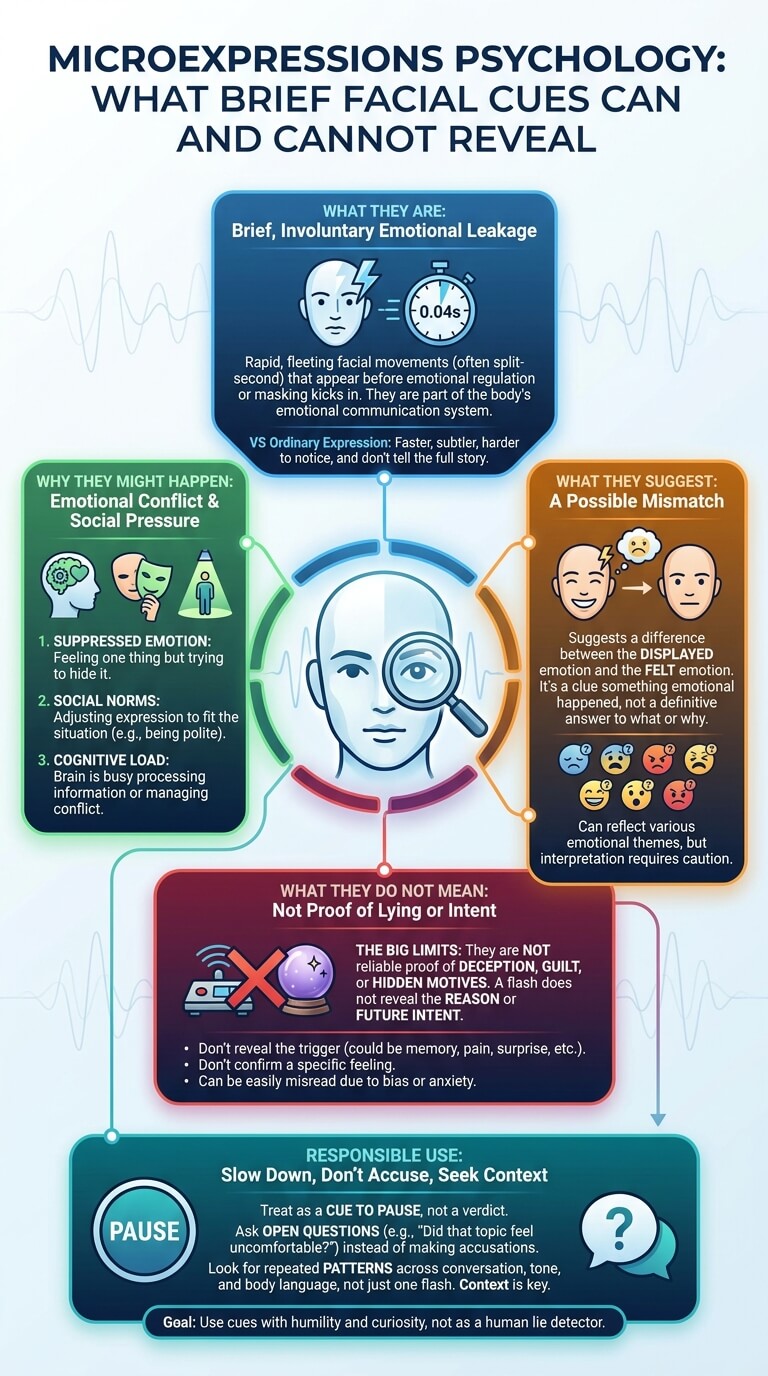
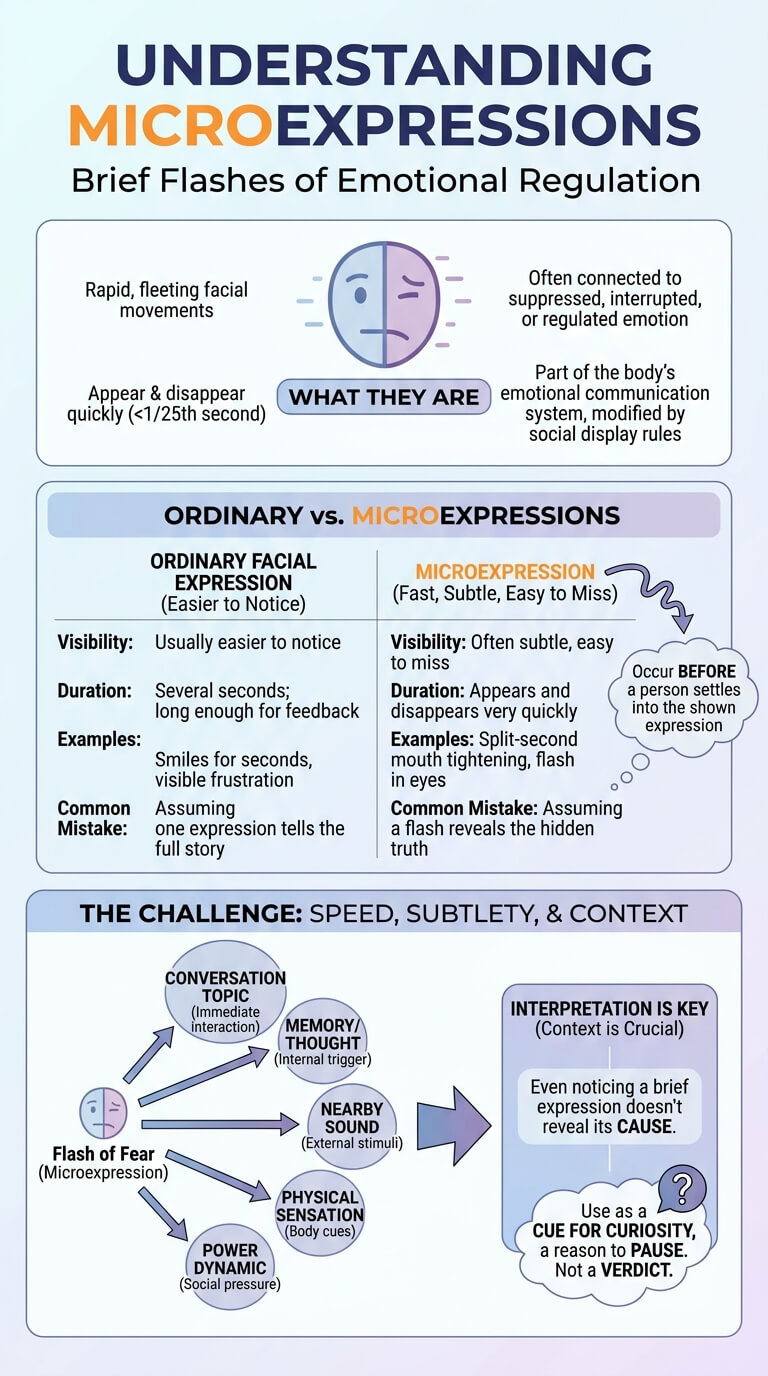
A microexpression is usually described as a rapid, fleeting facial movement that appears and disappears quickly. In everyday terms, it is the kind of expression you might almost miss: a split-second tightening around the mouth, a flash in the eyes, a brief nose wrinkle, a quick brow lift, or a fast downturn before the person returns to a more controlled face.
Researchers and educators often connect microexpressions with emotion that is being suppressed, interrupted, or regulated. That does not mean every tiny facial movement reveals a hidden truth. It means the face is part of the body’s emotional communication system. The APA Dictionary of Psychology describes facial expression as facial movement associated with emotion, while also noting that social display rules and physical conditions can modify what appears on the face.
That point matters. A face is not a perfect screen. People learn when to smile, when to soften anger, when to hide fear, when to look polite, and when to keep a neutral expression because the situation demands it. Microexpressions sit inside that larger system of emotion, social pressure, and self-control.
How microexpressions differ from ordinary facial expressions
Ordinary facial expressions are usually easier to notice. Someone smiles for several seconds, frowns while listening, looks surprised after news, or shows visible frustration during a meeting. These expressions are often long enough for others to register and respond to them.
Microexpressions are different because they are fast, subtle, and easy to miss. They may occur before a person settles into the expression they want to show. For example, a person may briefly look disappointed before saying, “That’s fine.” A colleague may flash irritation before offering a polite answer. A friend may show a tiny look of worry before changing the subject.
| Feature | Ordinary facial expression | Microexpression |
|---|---|---|
| Visibility | Usually easier to notice | Often subtle and easy to miss |
| Duration | May last long enough for conversation feedback | Appears and disappears very quickly |
| Interpretation | Still needs context | Needs even more caution |
| Common mistake | Assuming one expression tells the full story | Assuming a flash reveals the hidden truth |
Why speed, subtlety, and context make them difficult
The main challenge is not only speed. It is meaning. Even when you notice a brief expression, you still do not know what caused it. A flash of fear might relate to the conversation, a memory, a nearby sound, a power dynamic, a physical sensation, or the person’s own anxiety. A flash of contempt might be true contempt, but it could also be confusion, pain, a habitual facial tic, or an expression you misread.
This is why microexpressions are more useful as a reason to pause than as a reason to conclude. The cue can invite curiosity. It should not become a verdict.
Why Microexpressions Happen
A quick facial change may simply show that the person is startled, uncomfortable, anxious, or trying to regulate a reaction, so brief expression changes can overlap with stress cues.
Suppressed, interrupted, or quickly regulated emotion
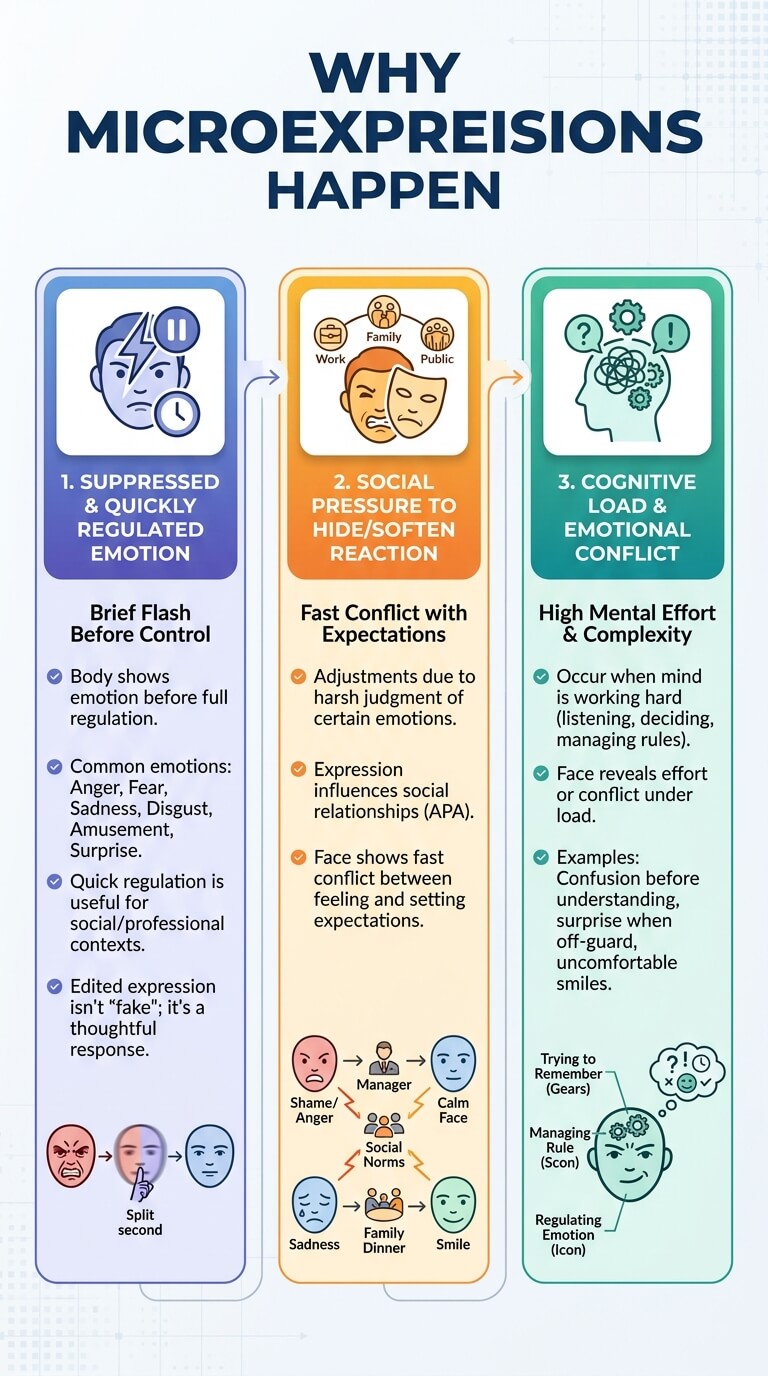
One reason microexpressions may happen is that the body begins to show emotion before the person fully controls their display. Someone might feel anger, fear, sadness, disgust, amusement, or surprise, then quickly change their face because the moment does not feel safe, appropriate, or helpful.
That quick regulation can be useful. Adults often need to manage emotional expression at work, in public, during conflict, around children, or in conversations where a raw reaction would make things worse. The face may briefly start to show something before the person edits it.
This does not make the edited expression fake in a simple way. A person can feel one reaction for half a second and still choose a thoughtful response. A brief flash may show the first reaction, not the person’s final values, intentions, or truth.
Social pressure to hide or soften a reaction
Many people learn to adjust their facial expressions because certain emotions are judged harshly. Anger may be punished in one family. Sadness may be seen as weakness in another. Surprise may be hidden in professional settings. Discomfort may be softened with a smile to avoid awkwardness.
The APA Dictionary’s entry on emotional expression describes expression as part of how people influence their relationship with the social world, not merely a private feeling made visible. This helps explain why a person’s face may show a fast conflict between what they feel and what the setting expects.
For example, someone receiving criticism from a manager may briefly show shame or anger, then quickly put on a calm face. A person at a family dinner may flash sadness when a topic comes up, then smile to avoid questions. A friend may show irritation for a moment, then soften because they still care about the relationship.
Cognitive load, surprise, and emotional conflict
Micro facial expressions are not only about hidden emotion. They can also appear when the mind is working hard. A person may be trying to listen, remember details, choose words carefully, manage a social rule, and regulate emotion all at once.
Under cognitive load, the face may briefly reveal effort or conflict. Someone might look confused before understanding. They might flash surprise when a question catches them off guard. They might smile because they are uncomfortable, not because they are happy. These moments can be meaningful, but they are rarely simple.
What Microexpressions Might Suggest
A possible mismatch between displayed and felt emotion
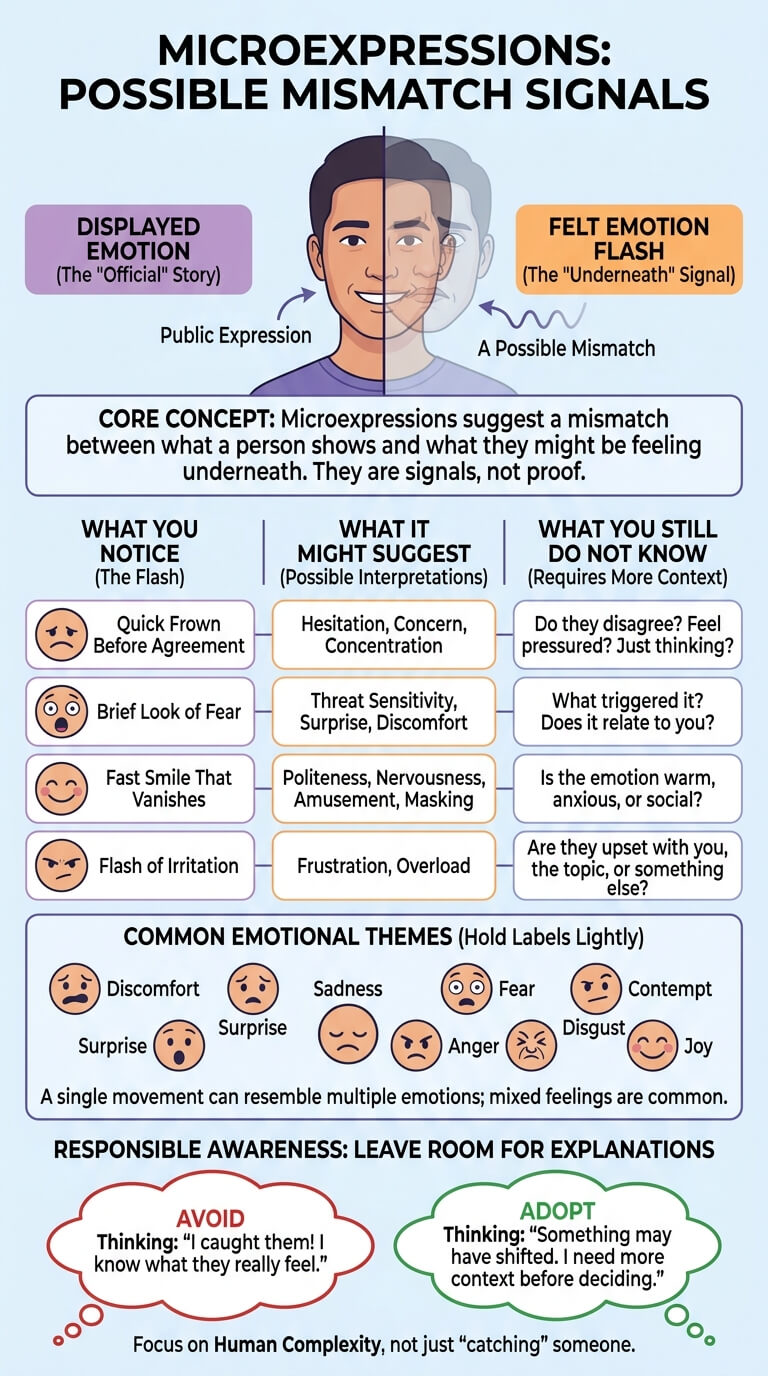
The most useful way to think about microexpressions is as possible mismatch signals. A person’s official expression says one thing, while a fast facial movement suggests something else may be happening underneath.
For instance, a person says, “I’m happy for you,” but a brief flash of sadness crosses their face. That may suggest mixed feelings. They can be happy for you and also grieving something in their own life. If you treat the flash as proof of jealousy or resentment, you may miss the human complexity of the moment.
| What you notice | What it might suggest | What you still do not know |
|---|---|---|
| A quick frown before agreement | Possible hesitation, concern, or concentration | Whether they disagree, feel pressured, or are thinking |
| A brief look of fear | Possible threat sensitivity, surprise, or discomfort | What triggered it or whether it relates to you |
| A fast smile that vanishes | Possible politeness, nervousness, amusement, or masking | Whether the emotion is warm, anxious, or social |
| A flash of irritation | Possible frustration or overload | Whether they are upset with you, the topic, or something else |
A moment of discomfort, surprise, contempt, fear, or sadness
Microexpressions may reflect recognizable emotional themes, such as discomfort, surprise, sadness, fear, contempt, anger, disgust, or joy. Still, labels should be held lightly. A single facial movement can resemble more than one emotion, especially when it is brief.
It is also possible for a person to have mixed emotions. They may be nervous and excited, sad and relieved, angry and ashamed, amused and uncomfortable. A quick expression may represent one layer, not the whole emotional picture.
Why the same flash can have several explanations
Imagine you tell someone good news and see a tiny mouth tightening before they congratulate you. One explanation is envy. Another is surprise. Another is that they just remembered something stressful. Another is that they feel left behind and are trying not to make your good news about them. Another is that you misread the movement completely.
Responsible microexpression awareness means leaving room for several explanations. Instead of thinking, “I caught them,” try thinking, “Something may have shifted. I need more context before I decide what it means.”
The Big Limits of Reading Microexpressions
A brief facial movement may feel meaningful, but it does not prove what someone is thinking, which is why it is better to avoid overreading every cue.
Microexpressions are easy to miss or mislabel
Brief facial cues are difficult to detect in real time. Even trained systems and researchers face challenges with spotting and classifying them. A PubMed Central survey of automatic facial micro-expression analysis describes micro-expression recognition as a field with significant challenges involving detection, databases, methods, and interpretation.
For everyday readers, the practical takeaway is simple: confidence should stay low. If experts and machines still face difficulty, an ordinary conversation is not a courtroom-grade reading environment. You may notice something, but you may also miss it, exaggerate it, or label it incorrectly.
A brief expression does not reveal the reason behind it
A facial flash is not a full explanation. It does not tell you the trigger, the story, the memory, the relationship meaning, or the person’s intention. It may say, “There was a reaction.” It does not say, “Here is the truth.”
This is where many pop-psych claims become risky. They move too quickly from cue to conclusion: contempt means disrespect, fear means guilt, a smile means manipulation, looking away means lying. Real people are not that simple. Real conversations involve mixed motives, social rules, nervous systems, history, and timing.
Training claims can become overconfident
Some training programs suggest that people can become very accurate at reading microexpressions. Training may improve attention to facial movement, but that does not remove the deeper problem of meaning. Recognizing a possible emotion is not the same as knowing why it appeared.
A person may learn to spot a flash of fear, but that does not tell them whether the person fears being caught, fears being misunderstood, fears conflict, fears rejection, or fears the authority of the room. The more important skill is not only sharper eyesight. It is interpretive humility.
Bias can make people see what they expect to see
If you already distrust someone, you may be more likely to interpret neutral or ambiguous facial movement as suspicious. If you admire someone, you may explain away the same cue as stress. If you are anxious, you may scan for danger and find danger in unclear signals.
This is not because you are foolish. Human perception is shaped by expectation, emotion, and past experience. In body-language reading, bias can feel like intuition. That is why the first question should not be, “What did their face prove?” A better question is, “What was I already expecting to see?”
Microexpressions vs Facial Expressions
Duration and visibility
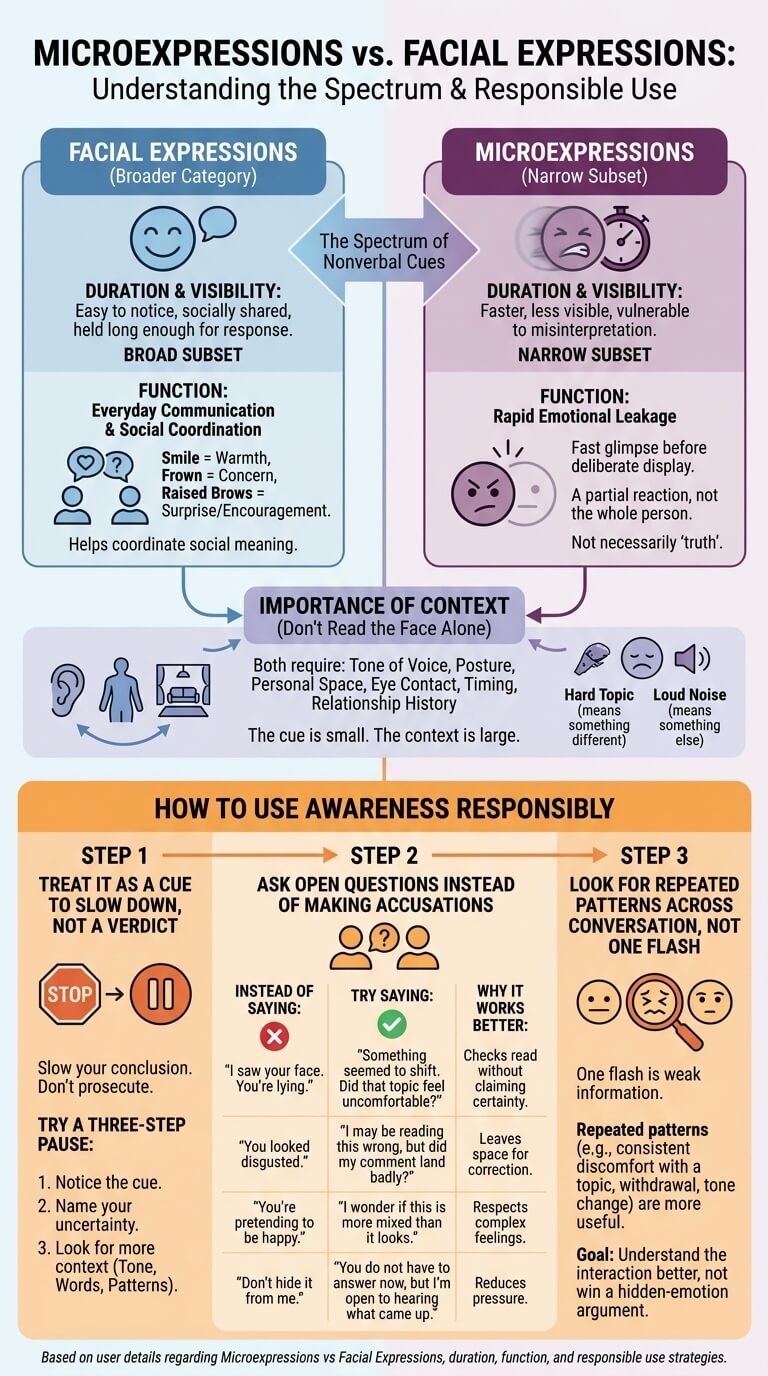
Facial expressions are the broader category. Microexpressions are a narrow and more difficult subset. A facial expression may be easy to notice, socially shared, and held long enough for others to respond. A microexpression is faster, less visible, and more vulnerable to misinterpretation.
Everyday expression vs rapid emotional leakage
An everyday expression often functions as part of conversation. A smile can invite warmth. A frown can signal concern. Raised eyebrows can show surprise or encouragement. These expressions help people coordinate social meaning.
A microexpression may feel more like emotional leakage, a fast glimpse before the person’s more deliberate display returns. But leakage is not the same as truth in the dramatic sense. It may be a partial reaction, not the whole person.
Why both need voice tone, posture, and context
Whether you are reading a normal expression or a microexpression, the face should not stand alone. Tone of voice, posture, personal space, eye contact, timing, and relationship history all change the meaning. A brief frown during a hard topic means something different from the same frown after a loud noise in the room.
This is also why microexpressions fit inside the larger body-language cluster. They connect naturally to facial expressions, nervous body language, eye contact, and practical body-language reading. The cue is small. The context is large.
How to Use Microexpression Awareness Responsibly
Treat it as a cue to slow down, not a verdict
The most responsible use of microexpression awareness is to slow your conclusion. If you notice a quick facial shift, you do not need to ignore it, but you also do not need to prosecute it.
Try a three-step pause: notice the cue, name your uncertainty, then look for more context. For example: “I noticed a quick change in their face. I do not know what it means yet. I will listen for tone, words, and whether this pattern repeats.”
Ask open questions instead of making accusations
If the relationship allows direct communication, use curiosity instead of accusation. A question gives the other person room to clarify. An accusation usually makes them defend themselves, even if your concern was understandable.
| Instead of saying | Try saying | Why it works better |
|---|---|---|
| “I saw your face. You’re lying.” | “Something seemed to shift. Did that topic feel uncomfortable?” | It checks your read without claiming certainty. |
| “You looked disgusted.” | “I may be reading this wrong, but did my comment land badly?” | It leaves space for correction. |
| “You’re pretending to be happy.” | “I wonder if this is more mixed than it looks.” | It respects complex feelings. |
| “Don’t hide it from me.” | “You do not have to answer now, but I’m open to hearing what came up.” | It reduces pressure. |
Look for repeated patterns across conversation, not one flash
One flash is weak information. Repeated patterns are more useful. If someone consistently shows discomfort when a topic arises, withdraws their body, changes tone, and avoids the conversation, you may have a stronger reason to ask what is happening.
Even then, the goal is not to win a hidden-emotion argument. The goal is to understand the interaction better. A pattern can guide a conversation. It should not replace one.
Where Microexpression Reading Can Go Wrong
Conflict, interrogation-style thinking, and false certainty
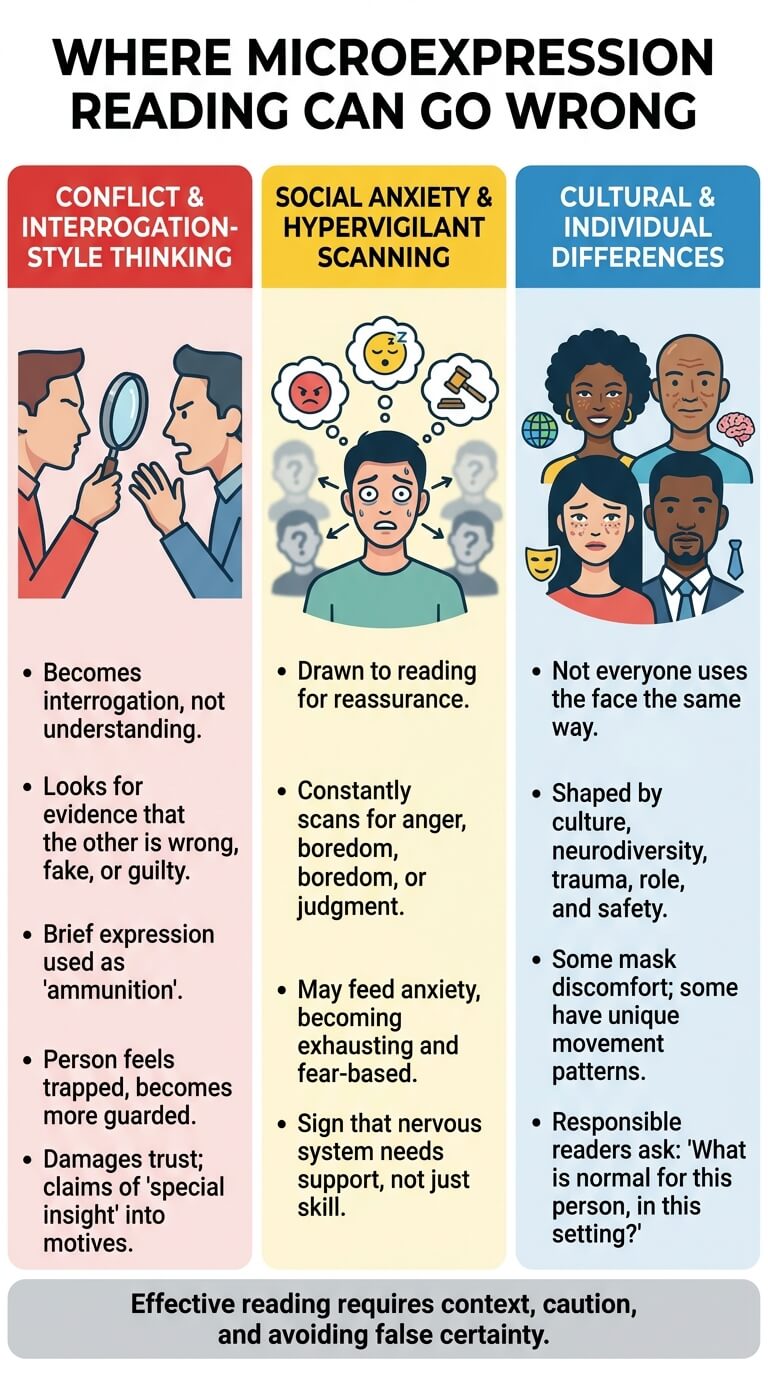
Microexpression reading becomes harmful when it turns into interrogation. In conflict, people often look for evidence that the other person is wrong, fake, guilty, or unsafe. A brief expression can become ammunition.
That is dangerous because the person being watched may feel trapped. They may become more guarded, not more honest. The conversation may shift from the original issue to a debate about facial movement. This can damage trust, especially when one person repeatedly claims special insight into the other person’s hidden motives.
Social anxiety and hypervigilant face scanning
Some readers are drawn to microexpressions because they want reassurance. They scan faces to check whether people are angry, bored, disappointed, judging them, or about to leave. This can feel protective for a while, but it may also feed anxiety.
The National Institute of Mental Health explains anxiety disorders as involving symptoms that can interfere with daily life. If face scanning becomes constant, exhausting, or fear-based, the issue may not be better body-language skill. It may be a sign that your nervous system needs support and steadier ways to tolerate uncertainty.
Cultural and individual expression differences
Not everyone uses the face the same way. Culture, family rules, personality, neurodiversity, disability, trauma history, professional role, and social safety can all shape emotional display. Some people are expressive. Some are reserved. Some mask discomfort with politeness. Some have facial movement patterns that others misread.
A responsible reader does not treat one emotional display style as the default human standard. They ask, “What is normal for this person, in this setting, with this level of safety?”
Bridge to the Full Body Language Framework
Microexpressions are only one small piece of nonverbal communication, and they become more useful when read within body language psychology as a broader framework.
Why micro cues should connect back to facial expressions and eye contact
A microexpression is easier to interpret when you connect it to broader facial behavior and eye contact. Did the person’s gaze drop at the same time? Did their smile become tight? Did their eyes widen with surprise or narrow with concentration? Did the expression match their words or briefly interrupt them?
These questions do not guarantee accuracy, but they prevent you from treating a tiny cue as a complete story. Facial expressions and eye contact give the micro cue a wider frame.
How nervous body language can look like hidden emotion
Nervous body language can be mistaken for concealment. Fidgeting, gaze shifts, swallowed words, lip pressing, shallow breathing, and quick facial changes may reflect stress, not deception. Someone who feels evaluated may look suspicious simply because they feel watched.
This is especially important in work meetings, family conflict, interviews, classrooms, and authority situations. The pressure of being observed can change the body. That change does not automatically reveal guilt.
How practical body-language reading reduces overclaiming
A broader method helps. Start with baseline, then look for clusters, context, timing, and change. A PubMed Central article on misconceptions about nonverbal communication warns against the idea that people communicate through neatly decodable body language. That warning applies strongly to microexpressions.
The more confident a simple cue-reading claim sounds, the more carefully you should examine it. Responsible body-language reading sounds less like “That proves it” and more like “That might matter, but I need context.”
When to Get Support
If you feel driven to scan faces for hidden threat or betrayal
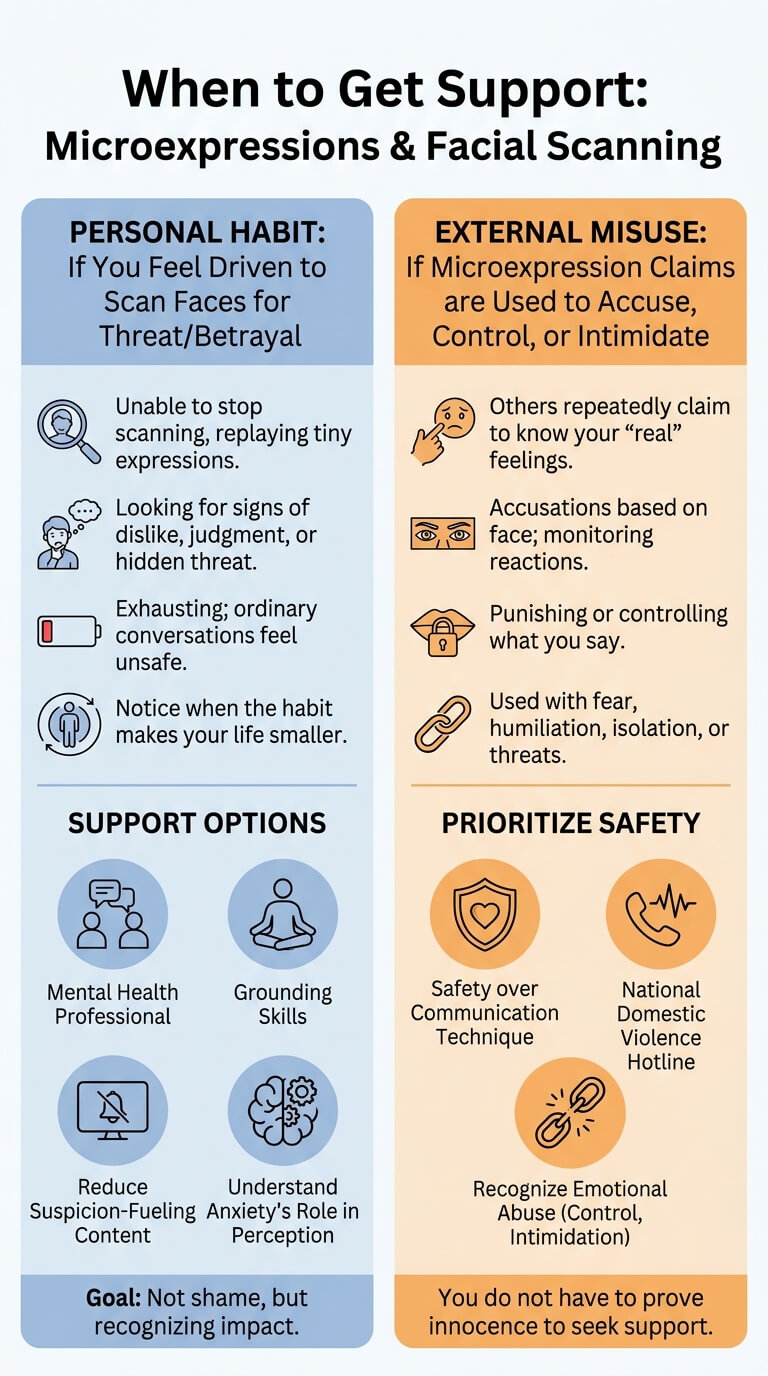
It may be time to seek support if you feel unable to stop scanning faces, replaying tiny expressions, or looking for signs that people secretly dislike, betray, judge, or threaten you. This can be exhausting, and it can make ordinary conversations feel unsafe.
Support may include talking with a mental health professional, practicing grounding skills, reducing online content that fuels suspicion, or learning how anxiety changes perception. The point is not to shame yourself for noticing faces. The point is to notice when the habit is making your life smaller.
If microexpression claims are used to accuse, control, or intimidate
Microexpression language can also be misused by someone else. If a person repeatedly says they know what you “really” feel, accuses you based on your face, monitors your reactions, punishes you for tiny expressions, or uses body-language claims to control what you say, that is not healthy curiosity.
If this happens with fear, humiliation, threats, stalking, isolation, retaliation, or control, prioritize safety over communication technique. The National Domestic Violence Hotline explains emotional abuse as non-physical behavior that can include control, intimidation, and fear. You do not have to prove your facial expressions are innocent before you are allowed to seek support.
FAQ About Microexpressions Psychology
Can microexpressions prove someone is lying?
No. A microexpression cannot prove that someone is lying. It may show that a quick emotional reaction occurred, but it does not reveal the cause. A person may look fearful because they are lying, but they may also look fearful because they are nervous, surprised, ashamed, overwhelmed, remembering something, or worried about being misunderstood.
Can you train yourself to read microexpressions?
You may be able to train your attention to facial movement, but training does not remove the need for context. Noticing a brief expression is only the first step. Interpreting it responsibly requires humility, cultural awareness, baseline comparison, and willingness to be wrong.
Are microexpressions always unconscious?
They are often described as fast and difficult to control, but it is safer not to make absolute claims in everyday life. People vary in awareness, expression habits, emotional regulation, and social masking. A quick expression may feel automatic, but that still does not make your interpretation certain.
What is the difference between a microexpression and a small facial expression?
A microexpression is usually defined by its very brief duration and possible link to rapidly regulated emotion. A small facial expression may simply be low intensity. A tiny smile that lasts several seconds is not the same as a split-second flash. In both cases, context matters more than dramatic labeling.
What should I do if I notice a strange flash on someone’s face?
First, slow down. Do not accuse. Ask yourself what else could explain it, whether you have seen a pattern, and whether the relationship allows a direct question. A gentle check-in is usually better than a claim: “I may be misreading this, but did that topic feel uncomfortable?”
Key Takeaways
- Microexpressions are brief facial cues that may reflect quick emotional regulation, but they do not prove hidden intent.
- The biggest risk is overconfidence: one flash cannot explain why someone reacted.
- Microexpressions differ from ordinary facial expressions because they are faster, subtler, and harder to interpret accurately.
- Use microexpression awareness as a reason to slow down, ask better questions, and look for context.
- Bias, anxiety, cultural differences, and social pressure can all affect what you see and how you interpret it.
- If face scanning becomes compulsive or someone uses it to control you, support and safety matter more than body-language analysis.
Final Thoughts
Microexpressions are interesting because they remind us that people are not always simple, polished, or fully transparent. A face can reveal a fast emotional moment before words catch up. That can make you more attentive and compassionate when you use the information carefully.
The next step is not to hunt for hidden truth in every expression. The next step is to practice a more grounded question: “What else could this mean?” If you can hold that question, microexpressions become less like a weapon and more like a small cue inside a much bigger human conversation.

Michael Reed is the Founder and Lead Writer at Psychology Exposed. He writes about human behavior, relationships, emotional patterns, self-awareness, and practical psychology topics using research-informed, easy-to-understand content.
Read More About Michael Reed: https://psychologyexposed.com/michael-reed/