

Mirroring body language psychology is about the small ways people begin to match each other during interaction: posture, gesture, facial tone, speech rhythm, energy level, and even pauses. Sometimes this happens because two people feel comfortable. Sometimes it happens because one person is trying hard to fit in. Sometimes it is used deliberately, which is why it needs to be understood with care.
The most helpful way to think about mirroring is not, “Does this prove someone likes me?” A better question is, “Does the whole interaction feel mutual, responsive, and respectful?” Mirroring is one piece of nonverbal communication, not a mind-reading tool. The APA Dictionary of Psychology describes nonverbal communication as including facial expressions, gestures, body language, tone of voice, and other physical cues, which is why mirroring should always be read inside a wider context.
This guide explains what mirroring can mean, why it happens, when it is natural, when it feels forced, and how to notice it without turning every movement into a secret message. It avoids dating or flirting claims and focuses on everyday conversations, friendships, teams, supportive listening, and social pressure.

Quick Answer
Mirroring often reflects rapport, comfort, attention, or social synchrony
Mirroring happens when one person subtly matches another person’s posture, gestures, expression, voice pace, or emotional rhythm. In many conversations, it is an ordinary sign of attention and social coordination. It can reflect rapport, empathy, group belonging, or comfort, especially when it is mutual and gradual.
Why mirroring is a clue, not proof of liking or agreement
Mirroring does not prove attraction, agreement, trust, or honesty. A person may mirror because they are nervous, polite, socially skilled, trained to build rapport, or trying to avoid conflict. The meaning becomes clearer only when you look at timing, emotional tone, verbal response, boundaries, and whether both people influence the interaction.

What Mirroring Means in Body Language Psychology
Mirroring is one way people coordinate socially through posture, timing, gesture, and movement, so it belongs inside nonverbal communication as a whole.
Natural mimicry vs deliberate imitation
Natural mimicry is usually subtle. One person leans back and, a little later, the other person relaxes too. Someone lowers their voice during a serious moment and the other person becomes quieter. These shifts often happen without either person consciously planning them.
Deliberate imitation is more obvious. A person copies your hand position immediately, matches your posture in a way that feels staged, or uses your exact tone without real listening. That does not automatically mean bad intent, but it can feel uncomfortable because the behavior draws attention to itself.
The APA Dictionary of Psychology defines mirroring partly as reflecting or emulating another person’s speech, affect, or behavior, including in therapeutic contexts where it may communicate understanding or empathy. In everyday life, the same basic idea can show up in much lighter ways.
Synchrony in posture, gesture, expression, pace, and tone
Mirroring is not limited to copying posture. It can appear as synchrony, which means people fall into a shared rhythm. Two coworkers may start nodding at similar moments during a focused discussion. Friends may laugh with similar timing. A teacher may slow their speech when a student looks confused, and the student may relax as the pace becomes easier to follow.
Because mirroring includes many channels, it is possible for one channel to match while another does not. Someone may copy your posture but avoid your question. A group may share relaxed body language while still disagreeing. This is why mirroring should not be read as a single yes-or-no signal.
Why people mirror without noticing it
Human interaction is coordinated. People often adjust to each other so conversation can feel smoother. Matching can reduce social friction, help people feel “in sync,” and make turn-taking easier. You may notice this most clearly when a conversation feels awkward at first, then slowly settles into a rhythm.
Classic research on the “chameleon effect” described nonconscious mimicry of postures, mannerisms, facial expressions, and other behaviors during interaction, suggesting that people often adapt to one another without deliberate effort. The PubMed abstract for Chartrand and Bargh’s work on the chameleon effect is a useful starting point for this idea.
Why Mirroring Happens
Rapport and social bonding
Mirroring can help people feel connected because it reduces the sense of separation between them. When two people sit at a similar angle, speak at a compatible pace, and respond to each other’s emotional tone, the conversation may feel easier. Neither person has to force the rhythm.
This does not mean that every matched gesture is meaningful. Rapport is usually visible in a cluster: listening, appropriate response, relaxed timing, shared attention, and respect for boundaries. Mirroring without those other elements is weak evidence.

Empathy, attention, and emotional attunement
People may mirror when they are emotionally tuned in. If a friend describes something painful and you soften your face, lower your voice, and sit still, your body is adjusting to the emotional weight of the moment. You are not copying for performance. You are responding to the feeling in the room.
Attunement is different from agreement. You can match someone’s calm tone while still disagreeing with their conclusion. You can lean forward to show attention while also saying, “I see why that upset you, and I have a different view of what happened.” Healthy mirroring supports contact; it does not erase your perspective.
Group norms and social learning
Mirroring also helps people fit into groups. In a quiet meeting, people may speak more softly. In a creative team, people may gesture more freely. In a formal setting, people may sit upright and use less casual expression. Much of this adjustment is social learning rather than deep emotional connection.
This is why mirroring can be common in workplaces, classrooms, families, friend groups, and cultural settings. The person is not necessarily copying one individual. They may be adapting to the shared style of the environment.
Anxiety, people-pleasing, or pressure to fit in
Mirroring can also come from discomfort. A person who worries about being disliked may copy others to avoid standing out. Someone under pressure may agree with the group’s body language before they have processed their own opinion. A person in a power imbalance may match the other person’s tone because disagreement feels risky.
This kind of mirroring may look smooth from the outside but feel tense inside. The clue is not only what the body does. It is whether the person feels free to pause, disagree, change position, ask questions, or leave the interaction without fear.
Signs of Natural Mirroring
Mirroring often appears through posture before it appears through obvious gestures, which makes posture and openness useful context for understanding social rhythm.
Timing feels gradual rather than instant
Natural mirroring usually has a delay. You shift your posture, the conversation continues, and later the other person’s posture changes too. The movement feels like part of the flow, not a copied pose. Instant imitation can still happen accidentally, but repeated instant copying may feel staged.
Cues match the emotional tone of the conversation
Mirroring feels more believable when it fits the mood. During a serious conversation, both people may become quieter. During an excited story, both may smile or lean forward. During problem-solving, both may settle into a focused posture. If the copied behavior does not fit the emotional tone, it can feel performative.
Mirroring appears alongside listening and responsiveness
Real rapport shows up in response, not only posture. The person remembers what you said, answers the actual point, adjusts when you look uncomfortable, and does not push past your “no.” In that setting, mirroring may be one visible sign of attention.
Both people influence each other, not only one person copying
Healthy synchrony is usually mutual. One person shifts, the other adjusts, then the first person responds again. It feels like a shared rhythm. If one person is constantly copying while the other controls the entire pace, the dynamic may be about approval, pressure, or hierarchy rather than relaxed connection.
| What you notice | What it may mean | What to check next |
|---|---|---|
| Both people gradually settle into similar posture | Comfort, focus, or shared rhythm | Do they also listen and respond? |
| Someone copies your gesture immediately | Accident, nervousness, or deliberate imitation | Does it happen repeatedly or feel staged? |
| A person matches your quiet tone | Attunement or respect for the mood | Do they still allow honest disagreement? |
| A group speaks and moves in a similar style | Group norms or social learning | Can members be different without being punished? |
| Mirroring continues after you show discomfort | Poor awareness or boundary pressure | Does the person adjust when you signal no? |
Forced Mirroring vs Real Rapport
Mirroring should not be treated as a guaranteed sign of trust or agreement, because it is better to read body language more carefully and avoid forcing a conclusion.
When imitation feels obvious, performative, or strategic
Forced mirroring often feels too neat. The person matches your posture as soon as you move, repeats your phrasing in a way that sounds rehearsed, or watches your body more than they listen to your words. You may feel studied instead of understood.
Sometimes forced mirroring comes from social awkwardness rather than manipulation. A person may have learned that matching body language builds rapport and may overuse it. The concern rises when imitation is paired with pressure, charm that ignores your discomfort, or attempts to move the conversation faster than you want.
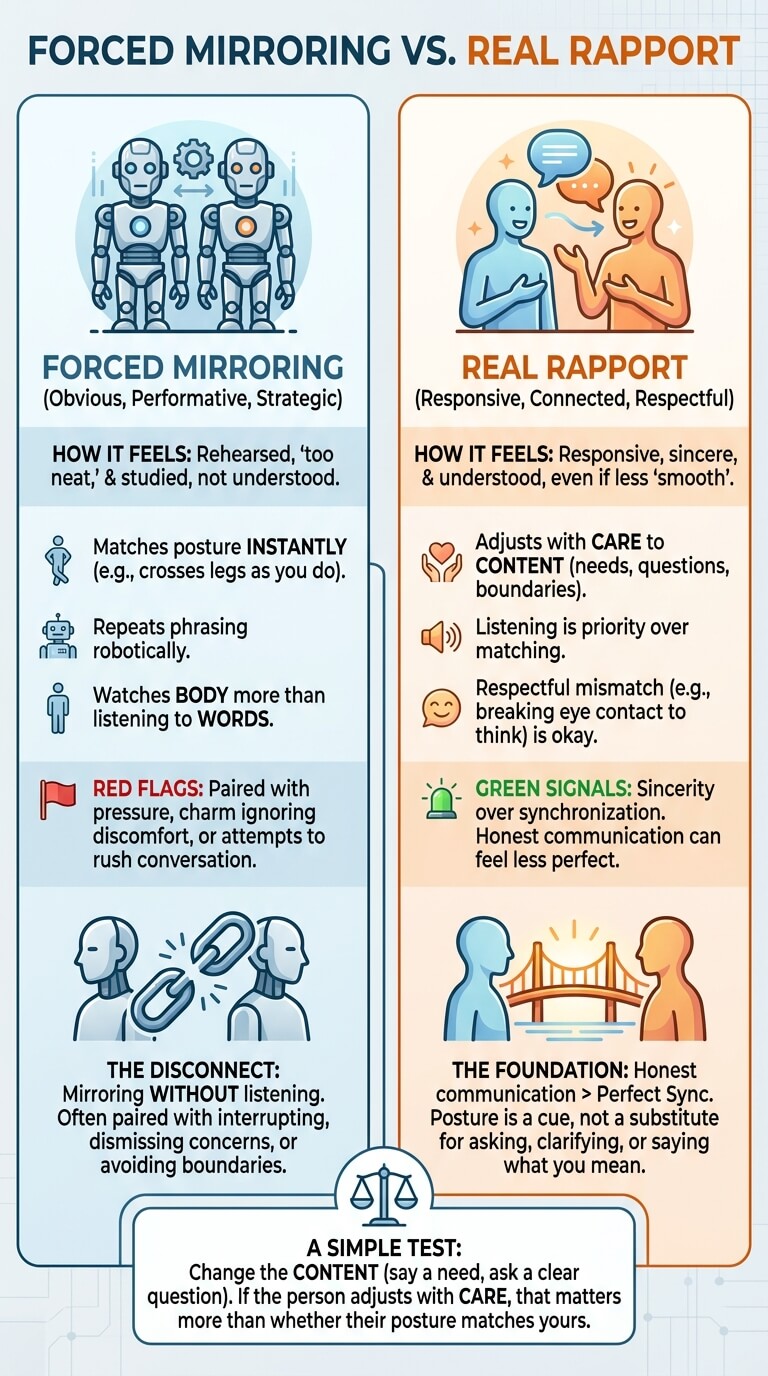
Mirroring without listening is not connection
Real connection includes responsiveness. If someone mirrors your posture but interrupts you, dismisses your concerns, or avoids your boundaries, the matched body language does not carry much weight. The body may appear aligned while the conversation itself is not respectful.
A simple test is to change the content rather than the posture. Say what you actually need. Ask a clear question. Name a boundary. If the person adjusts with care, that matters more than whether their arms or legs match yours.
Why matching posture should not replace honest communication
Mirroring is a cue, not a substitute for asking, clarifying, or saying what you mean. If you rely on body language alone, you may overread friendly coordination as agreement or miss the fact that someone is uncomfortable but polite.
Honest communication can feel less smooth than mirroring. A person may break eye contact to think, sit back to regulate emotion, or use a different posture while still being sincere. Respectful mismatch is often healthier than perfect synchronization with hidden pressure.
Mirroring in Different Contexts
Physical distance changes how copying is received, so personal space matters when reading whether mirroring feels warm, respectful, intrusive, or pressured.
Friends, teams, and familiar groups
Among friends, mirroring often appears as shared timing. People pick up each other’s phrases, laugh in a similar rhythm, or sit in similar relaxed positions. In teams, mirroring can show alignment around a task. People may lean toward the same screen, nod at similar points, or shift into a shared problem-solving pace.
The risk is assuming that sameness always means closeness. Groups can mirror because of habit, culture, shared pressure, or fear of exclusion. A team can look aligned while some members do not feel safe speaking honestly.
Therapy, coaching, teaching, and supportive conversations
In supportive roles, gentle mirroring may communicate attention. A counselor, coach, teacher, or mentor might soften their tone, slow down, or reflect a student’s emotional pace. The point is not to copy for effect. The point is to make the other person feel understood enough to continue.
Good support also respects difference. If someone is overwhelmed, matching their intensity may not help. A calmer rhythm may be more useful. In real care, the other person’s needs matter more than the technique.
Sales, persuasion, and why ethics matter
Mirroring is sometimes discussed in sales, negotiation, and persuasion. The ethical question is simple: are you trying to understand the person, or are you trying to lower their guard? Matching someone’s tone while hiding pressure behind charm can become manipulative.
Research on behavioral mimicry and affiliation suggests that mimicry can be connected with social bonding, but that does not make it a tool to use without consent or judgment. One open-access study on behavioral mimicry as an indicator of affiliation is a reminder that timing, form, and social context matter.
How to Notice Mirroring Without Overthinking It
Look for rhythm and mutual adjustment
Instead of tracking every hand movement, notice the rhythm of the whole exchange. Does the conversation feel like both people are adjusting? Do pauses feel natural? Does one person have room to slow down, disagree, or change direction?
A helpful mini framework is: rhythm, response, respect. Rhythm asks whether the interaction feels coordinated. Response asks whether the person listens to the actual meaning. Respect asks whether boundaries remain intact. Mirroring is only useful when all three are considered together.

Compare mirroring with eye contact and facial expression
Mirroring becomes clearer when you compare it with nearby cues. Warm eye contact can make synchronized posture feel more connected. A tense facial expression can make the same posture feel guarded. A smile that appears at the wrong moment can weaken the impression of attunement.
The key is not to stack clues until you reach a dramatic conclusion. It is to look for consistency. If the body, face, tone, and words mostly point in the same direction, the interpretation is stronger. If they conflict, slow down.
Ask whether the interaction feels respectful, not just synchronized
A synchronized conversation can still be unhealthy if one person feels pressured. Ask yourself: Do I feel free to say no? Do I feel rushed? Does the other person respond when I look uncomfortable? Am I copying because I feel connected, or because it feels safer not to be different?
These questions protect you from treating mirroring as magic. The most important signal is not whether someone matches you. It is whether the interaction gives both people room to be real.
Bridge to Other Nonverbal Cues
How eye contact can strengthen or weaken perceived mirroring
Eye contact changes how mirroring feels. If someone matches your posture while using steady, comfortable eye contact, the interaction may feel attentive. If the eye contact is intense, scanning, or poorly timed, the same mirroring may feel intrusive. The meaning comes from the combination, not the posture alone.
How open or closed posture changes the meaning of synchrony
Two people can mirror closed posture because both feel cold, tired, formal, guarded, or emotionally protected. That does not automatically mean distance. At the same time, shared open posture does not automatically mean trust. Posture needs context: setting, mood, relationship, culture, and what is being discussed.
Why mirroring belongs inside the wider body-language framework
Mirroring is useful because it shows coordination, but body language is larger than coordination. It includes facial expression, personal space, gestures, eye contact, vocal tone, and nervous behaviors. Reviews of nonverbal communication caution against simple myths and overconfident decoding, which is why research on misconceptions about nonverbal communication is helpful for keeping interpretations modest.
When to Get Support
If you mirror others automatically because of fear, fawning, or unsafe power dynamics
If you notice that you copy people because you feel afraid, unsafe, or unable to disagree, the issue may not be mirroring itself. It may be the power dynamic around you. This can happen with a controlling partner, intimidating boss, unpredictable family member, or anyone whose reaction feels threatening.
Start by asking what happens when you do not mirror. Can you speak in your own tone? Can you say no? Can you leave the conversation? If difference leads to punishment, humiliation, threats, stalking, or retaliation, prioritize safety and support over communication techniques.
If someone uses imitation, pressure, or charm to override your boundaries
Mirroring can feel unsettling when someone uses it to seem close while ignoring your discomfort. If imitation is part of a larger pattern of control, isolation, intimidation, or emotional degradation, it is worth taking seriously. The National Domestic Violence Hotline has an educational resource on what emotional abuse can look like, including nonphysical behaviors that are used to control or frighten someone.
You do not need to prove that a person is intentionally mirroring you to trust your discomfort. If an interaction repeatedly leaves you feeling trapped, pressured, or afraid, reach out to a trusted person or a qualified support service. Do not rely on body language analysis when safety is the real concern.

FAQ About Mirroring Body Language Psychology
Does mirroring mean someone likes you?
Not necessarily. Mirroring can happen with liking, comfort, or attraction, but it can also happen through politeness, habit, nervousness, professional training, or group norms. It is safer to read mirroring as a possible sign of rapport, then check whether the person’s words, choices, and respect for boundaries support that impression.
Is mirroring always unconscious?
No. Many forms of mirroring are unconscious or only partly noticed, but people can also mirror deliberately. A teacher may slow their pace to match a student. A counselor may reflect someone’s emotional tone. A salesperson may copy posture to build rapport. Deliberate mirroring is not automatically wrong, but it should be used ethically and respectfully.
Can mirroring be manipulative?
It can be, especially if someone uses matching behavior to create false closeness, rush trust, or soften your boundaries. The red flag is not mirroring by itself. It is mirroring combined with pressure, dishonesty, refusal to accept no, or charm that disappears when you disagree.
Why do I copy people when I feel nervous?
You may be trying to reduce tension or avoid standing out. Copying the other person’s tone, posture, or pace can feel like a quick way to stay socially safe. If this happens often, notice whether you still feel able to express your own preference. Nervous mirroring becomes more concerning when you feel unable to be different.
Should I mirror someone on purpose?
You can adjust to another person in simple, respectful ways, such as slowing down when they seem overwhelmed or softening your voice during a sensitive conversation. Avoid using mirroring as a tactic to control the other person’s response. Focus on listening, consent, clarity, and respect. Real rapport is not created by posture alone.
Key Takeaways
Healthy mirroring is mutual, subtle, and supported by real responsiveness
- Mirroring means subtle matching in posture, gesture, expression, tone, pace, or rhythm.
- It can reflect rapport, attention, empathy, group norms, nervousness, or pressure to fit in.
- Natural mirroring usually feels gradual, mutual, and emotionally appropriate.
- Forced mirroring may feel staged when it is not paired with listening or respect.
- Mirroring does not prove liking, honesty, attraction, agreement, or safety.
- The best next step is to read mirroring with rhythm, response, and respect, not as a standalone signal.
Final Thoughts
Mirroring can make a conversation feel easier, but it should not become a shortcut for judging people. Notice whether the interaction feels mutual, whether the other person responds to what you actually say, and whether both people can keep their own boundaries.
The next time you see mirroring, pause before turning it into a conclusion. Ask what else is happening: eye contact, facial expression, tone, personal space, timing, and respect. When those signals line up, mirroring can be a useful clue. When they do not, trust the full context more than the copied movement.

Michael Reed is the Founder and Lead Writer at Psychology Exposed. He writes about human behavior, relationships, emotional patterns, self-awareness, and practical psychology topics using research-informed, easy-to-understand content.
Read More About Michael Reed: https://psychologyexposed.com/michael-reed/