

Open vs closed body language is one of the easiest body-language ideas to recognize, and one of the easiest to overread. Someone turns their torso toward you, keeps their hands visible, and leans in a little, so they seem available. Someone crosses their arms, angles away, or puts a bag between you, so they may seem guarded. Those impressions can be useful, but they are not proof of what a person feels.
Posture is better understood as a signal of access, protection, comfort, and pressure. Open body language may suggest that a person feels ready to engage, but it can also be performed politely. Closed body language may suggest discomfort, but it can also reflect cold temperature, a sore back, a comfortable habit, concentration, modesty, fatigue, or the shape of the chair. The goal is not to decode people like puzzles. The goal is to notice posture without turning one pose into a verdict.

Quick Answer
Open body language can suggest accessibility, while closed body language can suggest protection, focus, discomfort, or habit
Open body language usually means the front of the body is less protected: the torso faces the other person, arms are relaxed, hands are visible, movement is responsive, and physical barriers are low. Closed body language usually means the body is more protected or less available: arms cross, the torso angles away, objects create barriers, movement reduces, or the person takes up less conversational space. The APA Dictionary of Psychology defines nonverbal communication as communication through cues such as facial expressions, gestures, body language, tone, and other physical indications, which is why posture matters, but not as a stand-alone mind-reading tool.
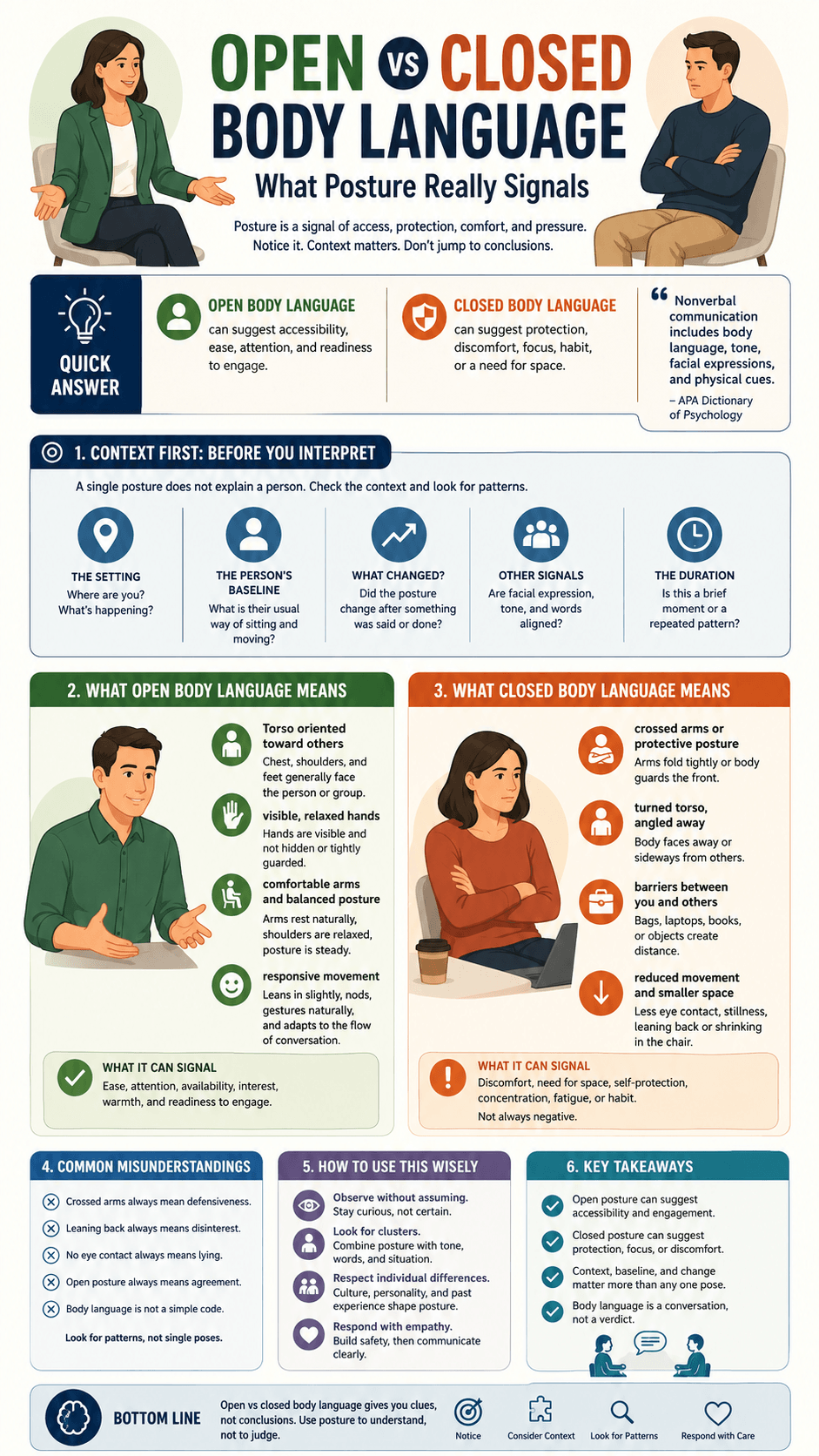
Why posture needs context before interpretation
A single posture does not explain the whole person. Crossed arms may mean defensiveness, but they may also mean warmth, comfort, focus, or habit. Leaning back may mean withdrawal, but it may also mean the person is thinking, adjusting to a chair, or creating space in a crowded room. Researchers have warned against treating body language as a simple code in a review of common nonverbal communication misconceptions. A safer reading starts with the setting, the person’s baseline, what changed, and whether the cue appears with other signals.
What Open Body Language Means
Open and closed posture are useful cues, but they work with gaze, facial expression, distance, and the situation inside body language psychology rather than alone.
Relaxed torso orientation and visible hands
Open body language often begins with orientation. A person’s chest, shoulders, and feet are generally aimed toward the person or group they are engaging with. Their arms are not tightly folded across the torso, and their hands are visible rather than hidden behind a bag, under a table, or deep inside pockets.
Visible hands can make a conversation feel easier because they reduce ambiguity. In many everyday settings, people feel more comfortable when they can see that the other person is not fidgeting aggressively, gripping something tightly, or blocking the interaction. This does not mean hidden hands are suspicious. It only means visible hands often support a sense of openness.

Comfortable arm position, balanced posture, and responsive movement
Open posture does not require a person to sit perfectly straight with their arms wide. In real life, approachable body language is usually more relaxed than dramatic. Arms may rest on the table, hands may fold loosely, shoulders may settle, and the body may shift naturally as the conversation changes.
Responsive movement also matters. A person may lean in slightly when listening, nod when they understand, sit back when thinking, and return to the conversation after a pause. That rhythm often feels more open than a fixed pose because it shows the person is responding to the interaction rather than holding a performance.
How openness can signal ease, attention, or readiness to engage
Open posture can suggest that a person feels available for contact. In a meeting, it may look like turning toward the speaker and keeping notes visible rather than hiding behind a laptop. In a conversation, it may look like facing the person, uncrossing the arms for part of the exchange, and matching the level of formality in the room.
Openness can also contribute to warmth. For example, research on empathic nonverbal behavior discusses how open body posture, eye contact, smiling, and related cues can contribute to perceptions of attention, involvement, warmth, and availability. That does not mean openness guarantees kindness. It means posture can support the message a person is trying to send.
What Closed Body Language Means
Closed posture may show discomfort, but it can also be a stress response, which means it may fit better with nervous body language than rejection.
Crossed arms, turned torso, barriers, and reduced movement
Closed body language usually involves some form of protection, reduction, or distancing. The person may cross their arms, turn their torso away, lean back, place a bag or laptop between themselves and others, hold an object close to the body, or reduce movement. Their posture may make them look less reachable.
These cues become more meaningful when they appear as a change. If someone was open and relaxed for ten minutes, then suddenly folds their arms, turns away, and stops responding after a difficult question, the timing matters. If someone always sits with crossed arms because that feels comfortable, the same cue has a weaker meaning.

Closed posture as comfort, warmth, self-protection, concentration, or discomfort
Closed posture is not automatically negative. People fold their arms when they are cold. They hold themselves when they are tired. They turn sideways when a chair is uncomfortable. They lean away when they need a little breathing room. They may also become still when concentrating, especially in formal or high-stakes settings.
Closed body language may also be self-protective in a neutral way. A person in a new group may keep their arms close until they understand the social atmosphere. Someone receiving feedback may sit back because they need time to process. A reserved person may seem closed to others while feeling perfectly engaged inside.
Why closed body language is not always defensiveness
Defensiveness is only one possible meaning. A defensive posture is more likely when closed body language appears with other cues such as sharp tone, repeated interruptions, eye rolling, dismissive comments, jaw tension, or refusal to answer. Even then, the better conclusion is not “this person is defensive,” but “something may feel threatening, uncomfortable, or unacceptable to them.”
That distinction matters because it changes how you respond. If you assume attack, you may push harder. If you notice possible protection, you can slow down, clarify, or ask a grounded question. For example: “I may have said that too strongly. Do you want a minute, or should I explain what I meant?”
Open vs Closed Body Language: The Core Difference
Accessibility vs protection
The simplest difference is accessibility versus protection. Open body language often makes a person seem easier to approach. Closed body language often makes a person seem more protected, private, or less available. Neither one is always good or bad.
Accessibility can be useful in social introductions, leadership, teaching, interviews, customer service, and conflict repair. Protection can be useful when someone needs privacy, feels overwhelmed, wants to think, or does not want to invite more interaction. The body often balances both needs.

Engagement vs withdrawal
Open posture can suggest engagement when it appears with listening, relevant responses, and relaxed attention. Closed posture can suggest withdrawal when it appears with short answers, turning away, lack of follow-up, or repeated attempts to end the exchange.
Still, engagement is not always physically open. A person can be deeply focused while leaning back with crossed arms. Another person can look open while mentally checked out. This is why posture should be read with speech, timing, expression, and behavior after the conversation.
Comfort vs pressure
Sometimes the difference is not engagement, but comfort. A person may open their posture when they feel safe enough to participate. They may close their posture when the environment feels too loud, too close, too formal, too emotionally loaded, or too unpredictable.
Pressure can also make people perform openness. In a job interview, someone may sit upright, smile, and keep their hands visible because they know that looks professional, even if they feel nervous. In that case, open posture reflects social effort as much as comfort.
Why direction and timing matter more than one pose
Direction and timing are usually more useful than the pose itself. Notice where the torso, feet, and attention go when the topic shifts. Does the person turn toward the speaker when invited in? Do they close off only when a sensitive subject appears? Do they relax after clarification?
A single snapshot can mislead. A sequence tells a better story. If posture changes with the emotional temperature of the conversation, it may point to what feels safe, confusing, frustrating, or welcome in that moment.
| Posture cue | Possible open meaning | Possible closed meaning | Context question |
|---|---|---|---|
| Torso direction | Interest, availability, attention | Distance, discomfort, privacy, habit | Did the person turn away after a topic changed? |
| Arm position | Relaxed, ready to engage | Self-comfort, warmth, focus, guardedness | Is this normal for them, or new? |
| Physical barriers | Low barrier can feel accessible | Objects may create space or protection | Is the barrier practical, accidental, or repeated? |
| Movement | Responsive, involved, relaxed | Still, tense, withdrawn, concentrating | Does stillness come with listening or shutdown? |
Common Closed Body Language Misreads
A crossed arm, turned shoulder, or relaxed posture should not be read in isolation, so the safer approach is to read posture in context.
Crossed arms do not always mean anger
Crossed arms are one of the most famous body posture psychology cues, but they are also one of the most misunderstood. Crossed arms can mean anger, disagreement, or defensiveness in some moments. They can also mean the person is cold, comfortable, tired, waiting, thinking, or simply used to that posture.
The most useful question is not “Are crossed arms bad?” The better question is “What else is happening?” Crossed arms with a relaxed face, soft tone, and normal participation mean something different from crossed arms with a tight jaw, clipped answers, and a sudden turn away.

Leaning back does not always mean rejection
Leaning back may mean a person is pulling away. It may also mean they are considering what was said. Some people lean back when they listen carefully because distance helps them think. Others lean back because sitting upright for a long time is uncomfortable.
Leaning back is more concerning when it combines with repeated avoidance: the person stops answering, points their body toward the exit, checks out of the conversation, or dismisses the speaker. Without that pattern, leaning back is only a clue.
Hands in pockets do not always mean hiding something
Hands in pockets can look closed because the hands are not visible. In some settings, it may signal discomfort, casualness, uncertainty, or a desire to take up less space. It can also be a habit that says very little.
Be careful with deception assumptions. A study on posture and veracity judgments shows that posture can influence how people judge others, which is not the same as proving that a posture reveals truth or lying. A cue that affects impression is not a lie detector.
Stillness does not always mean judgment
Stillness may feel intimidating when you are speaking, especially during feedback, conflict, or a presentation. But stillness can mean many things: listening, concentration, fatigue, social caution, stress, or emotional restraint. Some people move less when they are trying not to interrupt.
Before assuming judgment, look for participation. Does the person ask relevant questions? Do they respond after a pause? Do they remember what you said later? A still body with thoughtful follow-through is different from a still body used to freeze someone out.
How Context Changes the Meaning of Posture
If someone feels crowded, they may lean back, turn away, or create a barrier with their arms or objects, so space and posture work together in real interactions.
Temperature, seating, pain, fatigue, and environment
The physical environment can create closed body language without emotional meaning. Cold rooms make people fold their arms. Crowded spaces make people turn sideways. Hard chairs make people shift or lean back. Pain, fatigue, illness, pregnancy, injury, or sensory overload can also change posture.
Before interpreting posture emotionally, check the obvious conditions. Is the room cold? Is the person carrying something? Are they trying to hear better? Are they avoiding glare from a window? Body language starts in a body, not only in a relationship.
Culture, personality, and personal habits
Culture and personality shape what openness looks like. Some people were taught to keep their body contained in formal settings. Some cultures value less expressive posture in public. Some people naturally use smaller gestures, less eye contact, or more physical reserve.
Personal baseline is especially important. Compare the person to themselves, not to a universal rule. If someone usually sits with relaxed arms but becomes closed during one topic, that change matters. If someone is consistently reserved across settings, the cue may say more about style than emotion.
Power dynamics, conflict, and unfamiliar settings
Posture can carry relational messages, especially when there is status difference, conflict, or uncertainty. A manager standing over a seated employee may feel dominant even if no harm is intended. A person blocking a doorway may feel intimidating even if they claim they are only “standing there.” Research on relational messages in nonverbal behavior notes that nonverbal signals can shape meanings such as dominance, composure, and trust.
In unfamiliar settings, people often close their posture until they feel secure. That does not make them rude. It may mean they are orienting themselves. In conflict, closed posture can be a pause signal, a self-protection signal, or a sign that the conversation is becoming too pressured.
How to Use Open Body Language Yourself
Face the person without crowding them
To look more open, start with orientation, not performance. Turn your torso toward the person enough to show attention, but do not invade their space. A slight angle can feel more natural than facing someone squarely in a way that feels intense.
In a meeting, this might mean turning away from your laptop when someone speaks. In a difficult conversation, it might mean sitting at a diagonal instead of directly across like an interrogation. Openness should make the interaction easier, not more pressured.

Keep hands relaxed and visible when appropriate
Relaxed, visible hands can support trust because they make your posture easier to read. You do not need exaggerated gestures. Resting your hands on the table, holding a pen loosely, or keeping your arms uncrossed for part of the conversation can be enough.
If you naturally fold your arms, you do not have to force yourself to stop forever. You can simply notice moments when your posture may send a stronger message than you intend. During feedback, apologies, or introductions, a more open arm position may reduce unnecessary tension.
Use small nods, soft eye contact, and comfortable distance
Open posture works best when it matches other cues. Small nods can show that you are following. Soft eye contact can signal attention without staring. Comfortable distance helps openness feel safe rather than intrusive.
If you lean in, watch whether the other person also moves closer or slightly pulls away. If they move back, respect that adjustment. Open body language should include sensitivity to the other person’s comfort, not just a display of confidence.
Avoid performing openness in a way that feels unnatural
Overdone openness can feel fake. Wide arms, constant leaning in, intense eye contact, and forced smiling may create pressure instead of warmth. People often sense when nonverbal behavior is being used as a tactic rather than an honest support for the conversation.
A better goal is alignment. Let your posture match your intention. If you want to listen, turn toward the person and reduce distractions. If you need time, say so rather than pretending to be fully open while your body is signaling strain.
Open vs Closed Body Language in Real Situations
When people feel comfortable, they may begin to match each other’s orientation, pace, or sitting position, and this kind of matching posture can reflect shared rhythm.
Meetings and interviews
In meetings and interviews, open body language can make you seem prepared and engaged. Sit in a balanced way, keep your materials organized, face the speaker, and avoid using your laptop or bag as a wall unless you need it for practical reasons.
Closed posture in these settings is not always a problem. A candidate may fold their hands tightly because they are nervous. A manager may lean back to think. The most useful cue is whether the person returns to engagement: answering clearly, asking relevant questions, and showing attention through the full exchange.

Conflict or feedback conversations
During conflict, closed posture often appears because the body is trying to protect itself. A person may cross their arms, look down, or lean back when they feel criticized. Pushing them to “open up” physically can make them feel more exposed.
Try lowering pressure instead. You might say, “This seems tense. I want to talk about the issue without cornering you.” If you are the one receiving feedback, you might say, “I am listening, even if I look guarded. I need a second to take that in.” Those sentences reduce guesswork.
Public spaces and group settings
In public spaces, closed body language can be a boundary. Someone reading with headphones, turned away from the crowd, or holding a bag close may not be upset. They may simply be choosing privacy. Respecting that signal is part of socially aware behavior.
In group settings, open posture can invite participation. Turning your body slightly toward someone who has not spoken, leaving space in the circle, and keeping your gestures relaxed can make the group feel less closed off. The goal is inclusion, not pressure.
Bridge to Nearby Cues
How open posture works with eye contact
Posture and eye contact often change each other’s meaning. A person with open posture and soft eye contact may seem engaged. A person with open posture but intense staring may feel too forceful. A person with less eye contact but an oriented torso may still be listening carefully.
This is why eye contact should not be read alone. Some people look away to think, regulate emotion, or reduce pressure. Torso direction, turn-taking, and verbal responsiveness can provide a more balanced picture.
How nervous body language can make posture look closed
Nervousness can create closed posture even when someone wants to participate. A person may fold their arms to self-soothe, hold an object tightly, shrink their gestures, or angle away because their body feels overstimulated.
This is different from simply rejecting the conversation. If the person still answers, returns attention, or relaxes as the exchange becomes safer, the closed posture may have been more about stress than disinterest. Treat it as a cue to slow down, not as proof of refusal.
How personal space changes whether openness feels safe
Open body language can feel welcoming at a respectful distance and overwhelming at a close distance. Leaning in with relaxed hands may feel friendly across a table. The same lean may feel intrusive in a hallway or elevator.
Personal space also changes by culture, relationship, setting, and personal comfort. If someone steps back, angles away, or places an object between you, the kindest response is often to give more room rather than trying harder to look open.
When to Get Support
If posture is shaped by chronic fear, trauma, or unsafe interactions
If you often feel your body closing before you can think, especially around a specific person or situation, it may be worth paying attention. Chronic fear, past trauma, ongoing criticism, bullying, or unsafe interactions can shape posture over time. You may notice yourself shrinking, freezing, avoiding exits, or trying to make yourself invisible.

That does not mean you need to diagnose yourself. It does mean your body may be giving you useful information about what feels unsafe or overwhelming. Support from a qualified mental health professional, trusted support person, or appropriate workplace or school resource may help if these reactions are frequent or distressing.
If someone uses body position to intimidate, block exits, or control space
Normal posture differences are not abuse. A person crossing their arms or leaning back during conflict is not automatically unsafe. Safety concerns rise when body position is used to intimidate, trap, block movement, crowd someone after they asked for space, stand over them during arguments, or control where they can go.
If that is happening, prioritize safety over communication technique. The National Domestic Violence Hotline explains relationship abuse as a pattern of power and control. If you feel afraid of retaliation, threats, stalking, or being physically blocked, consider reaching out to a trusted local resource or a domestic violence support service before trying to confront the person directly.
FAQ About Open vs Closed Body Language
Do crossed arms always mean someone is defensive?
No. Crossed arms can mean defensiveness, but they can also mean comfort, cold temperature, concentration, fatigue, modesty, or habit. They become more meaningful when they appear suddenly during a tense topic and combine with other cues, such as clipped answers, turning away, a tense face, or refusal to engage.
What is the most approachable body language?
Approachable body language usually includes a relaxed posture, comfortable torso orientation, visible hands, soft eye contact, small responsive nods, and enough distance for the other person to feel safe. The most approachable posture is not exaggerated. It feels natural, attentive, and respectful of the other person’s space.
Can closed body language be a comfort habit?
Yes. Many people use closed posture as a comfort habit. Folding arms, holding a cup, keeping hands in pockets, or sitting slightly turned can help someone feel settled. If the person still listens, answers, and participates, their closed posture may not signal rejection.
How can I look more open without feeling fake?
Start small. Turn your torso slightly toward the person, relax your shoulders, keep your hands visible when appropriate, and reduce obvious barriers such as a phone between you. Do not force a wide smile or intense eye contact. Aim for alignment between your intention and your posture.
How do I know if someone is uncomfortable or just reserved?
Look for change, clustering, and follow-through. A reserved person may use limited gestures but still respond thoughtfully. An uncomfortable person may become more closed after a specific topic, create more distance, give shorter answers, or try to end the exchange. When appropriate, a simple check-in is better than guessing.
Key Takeaways
Open and closed posture are best understood as context-sensitive signals of access, comfort, and protection
- Open body language often signals accessibility, attention, or readiness to engage, but it can also be a polite social performance.
- Closed body language often signals protection, privacy, focus, or discomfort, but it does not automatically mean anger or defensiveness.
- Crossed arms, leaning back, hidden hands, and stillness become more meaningful when they appear as a change and combine with other cues.
- Posture should be read with context, baseline behavior, environment, culture, power dynamics, and what the person says.
- Useful open body language feels natural: oriented torso, relaxed hands, soft eye contact, and respectful distance.
- If body position is used to intimidate, block movement, or control space, treat it as a safety concern rather than a normal posture issue.
Open vs closed body language is most helpful when it makes you more observant, not more certain. The next time you notice a posture cue, pause before naming the meaning. Ask what changed, what the setting might explain, and whether the person’s words and behavior support your first impression. That slower reading is usually more accurate, and it is also more respectful.

Michael Reed is the Founder and Lead Writer at Psychology Exposed. He writes about human behavior, relationships, emotional patterns, self-awareness, and practical psychology topics using research-informed, easy-to-understand content.
Read More About Michael Reed: https://psychologyexposed.com/michael-reed/