

Eye contact can make a conversation feel warmer, sharper, safer, or more uncomfortable in a matter of seconds. A quick look can show attention. A long stare can feel intense. Looking away can mean someone is thinking, embarrassed, overloaded, respectful, distracted, or simply following a different social habit. That is why eye contact psychology is useful, but only when it is handled with care.
The mistake many people make is treating gaze as a secret code. Someone avoids eye contact, so they must be lying. Someone holds eye contact, so they must be confident. Someone looks at you often, so they must be attracted. Real human behavior is rarely that clean. The APA Dictionary of Psychology describes eye contact as a direct look exchanged between people who are interacting, and research around gaze usually looks at patterns, context, and relationship between people, not one isolated glance.
This article explains what gaze can signal in everyday conversations without turning it into a flirting test, lie detector, or character judgment. The better question is: “How does this look fit the person, the moment, the relationship, and the rest of their behavior?”

Quick Answer
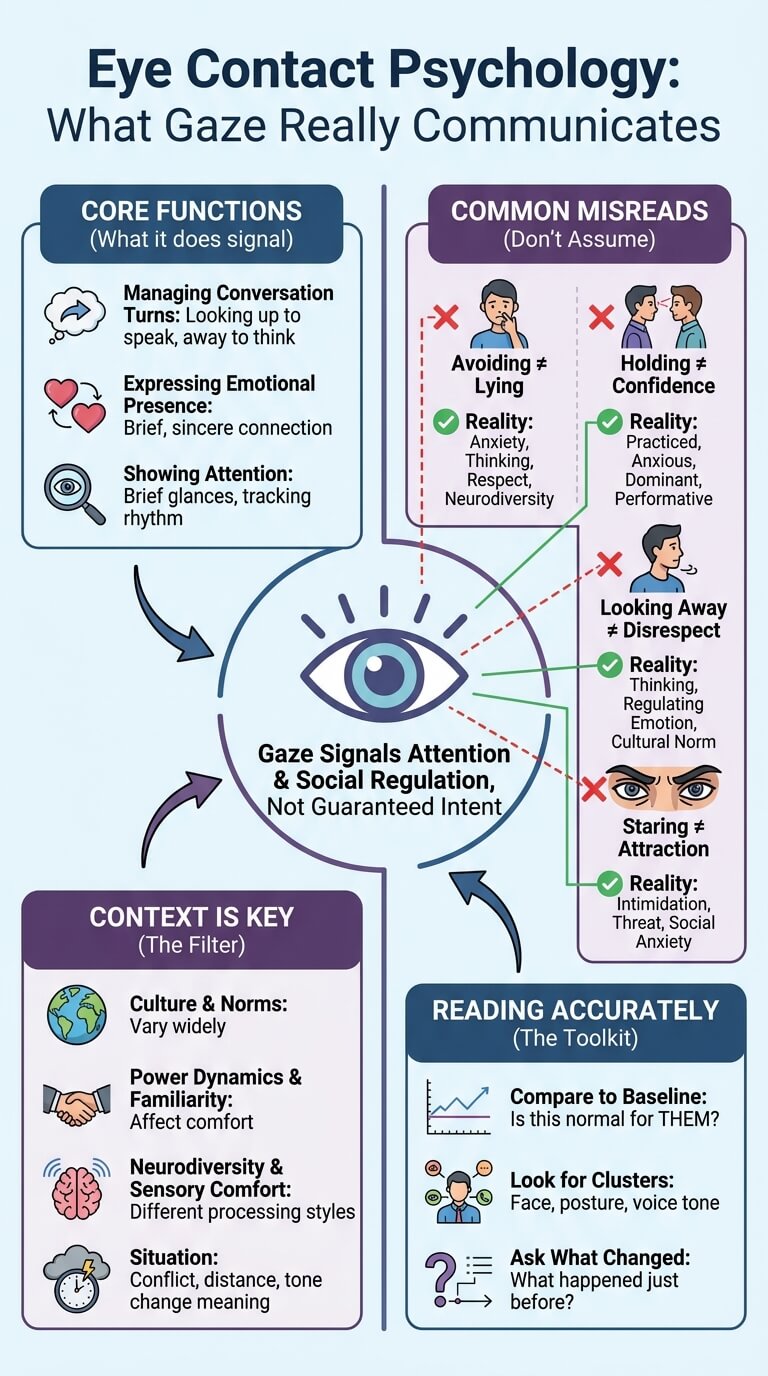
Eye contact signals attention and social regulation, not guaranteed intent
Eye contact usually helps people show attention, manage conversation turns, express emotional presence, and read whether the other person is engaged. It can also feel intense, uncomfortable, respectful, or threatening depending on culture, power, distance, facial expression, and history. One glance rarely proves attraction, honesty, confidence, or disrespect by itself.
Why one moment of gaze is weaker than a pattern
A single gaze shift is easy to misread because people look away for many ordinary reasons. They may be searching for words, regulating embarrassment, remembering details, checking safety, thinking through a complex answer, or trying not to stare. A pattern is stronger than a moment because it shows whether the behavior repeats across situations. Even then, gaze should be compared with tone, facial expression, posture, timing, and what is happening in the conversation.
What Eye Contact Means in Psychology
Eye contact is powerful because it sits inside the wider body language picture, where posture, facial expression, distance, and timing can all change the message.
Eye contact as attention, feedback, and emotional connection
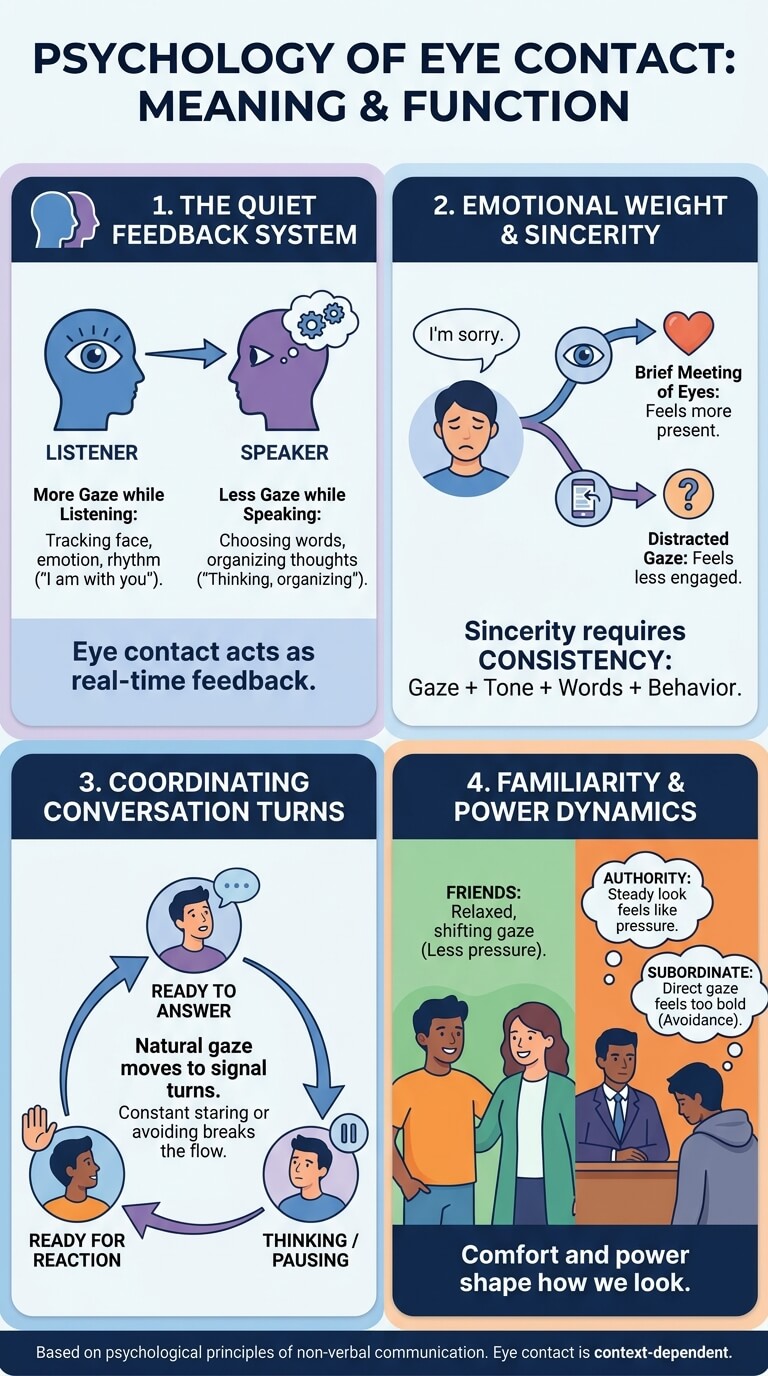
In many conversations, eye contact works like a quiet feedback system. It can tell the speaker, “I am still with you,” or tell the listener, “This part matters.” People often look more when listening than when speaking because listening usually requires tracking the other person’s face, emotion, and conversational rhythm. Speaking may require more looking away because the person is choosing words, organizing memory, or managing self-consciousness.
Eye contact can also add emotional weight. A person who says “I’m sorry” while briefly meeting your eyes may feel more present than someone who says the same words while scrolling. But eye contact does not create sincerity on its own. The stronger signal is consistency between gaze, tone, words, timing, and later behavior.
Why gaze helps people coordinate conversation turns
Conversation is not only verbal. People use small cues to show when they are finished, when they want to respond, when they are confused, and when they need a pause. Gaze is one of those cues. A listener may look up when they are ready to answer. A speaker may glance away while thinking, then return their eyes when they are ready for the other person to react.
Natural gaze moves. It comes and goes. If someone never looks up, the other person may feel unsure whether they are being heard. If someone never looks away, the other person may feel watched rather than listened to.
How eye contact changes with familiarity and power dynamics
Eye contact often changes depending on how safe, familiar, or unequal a situation feels. Friends may use relaxed, shifting gaze because there is less pressure to perform. A job candidate may use more controlled eye contact because they are trying to appear attentive. A student may avoid the teacher’s eyes if they fear being called on. A person speaking to an authority figure may look down because direct gaze feels too bold in that setting.
Power changes how gaze is received. A steady look from a supportive mentor may feel grounding, while the same look from someone who controls your grade, job, money, or safety may feel like pressure.
The Main Types of Eye Contact Cues
Brief eye contact during listening
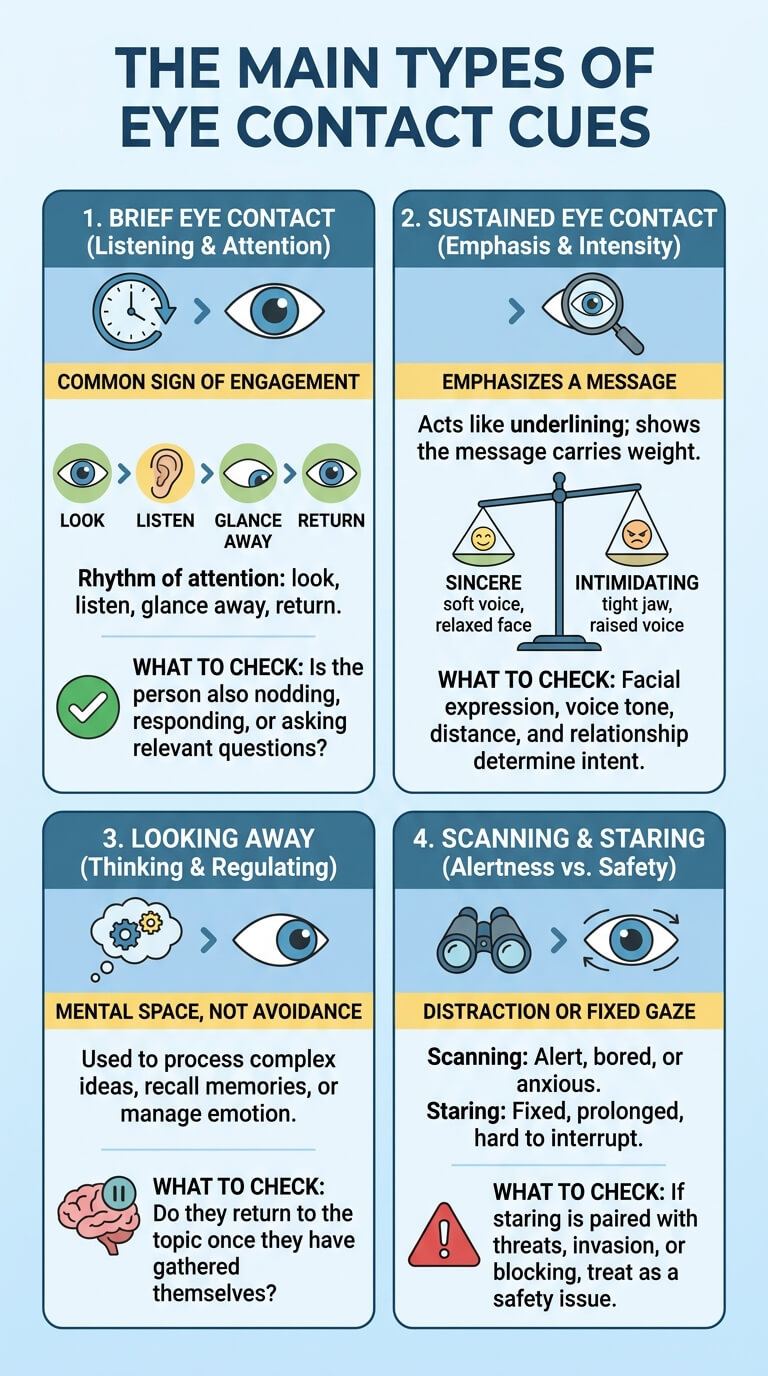
Brief eye contact is one of the most common signs of attention. It often appears as a rhythm: look, listen, glance away, return. In a meeting, someone may look at the speaker while the main point is being made, then glance down to take notes. In a classroom, a student may look up when they understand and look away when they are thinking through the idea.
| Gaze cue | What it may suggest | What to check before deciding |
|---|---|---|
| Short, repeated eye contact | Listening, tracking, polite attention | Is the person also nodding, responding, or asking relevant questions? |
| Eye contact followed by note-taking | Engagement or processing | Are they returning to the conversation or disappearing into another task? |
| Brief eye contact with a neutral face | Basic social coordination | Does the tone sound warm, tense, bored, or rushed? |
Sustained eye contact during emphasis
Sustained eye contact can show emphasis. A manager may hold eye contact while saying, “This deadline matters.” A friend may look directly at you while saying, “I need you to understand this.” In these moments, gaze often works like underlining. It tells the listener that the message carries weight.
But sustained gaze can also feel intense. The difference often comes from facial expression, voice, distance, and relationship. A steady look with a soft voice may feel sincere. A steady look with a tight jaw, close distance, and a raised voice may feel intimidating. The eyes alone are not enough to interpret the whole scene.
Looking away to think or regulate emotion
Looking away is not automatically avoidance. Many people look away when they need mental space. If someone is answering a complex question, recalling a memory, or trying not to react too quickly, breaking eye contact may help them focus. In that case, looking away is part of thinking, not a rejection of the other person.
People also look away when emotion rises. Embarrassment, sadness, shame, anger, or nervousness can make direct gaze feel too exposed. Someone may still care deeply about the conversation, but need less visual intensity to stay regulated. A helpful clue is whether they return to the topic once they have gathered themselves.
Scanning, staring, and checking the room
Not all gaze is directed at the person speaking. Some people scan the room because they are alert, distracted, socially anxious, bored, presenting to a group, watching a child, or checking whether the setting feels safe.
Staring is different from normal scanning. It often feels fixed, prolonged, and hard to interrupt. If it is paired with invasion of space, threats, blocking movement, or repeated monitoring, treat it as a safety issue rather than a communication puzzle.
Why People Avoid Eye Contact
Some people blink more, look down, scan the room, or break eye contact when they are thinking or overwhelmed, and these shifts may be part of nervous body language rather than rudeness.
Social anxiety, shyness, overwhelm, or cognitive load
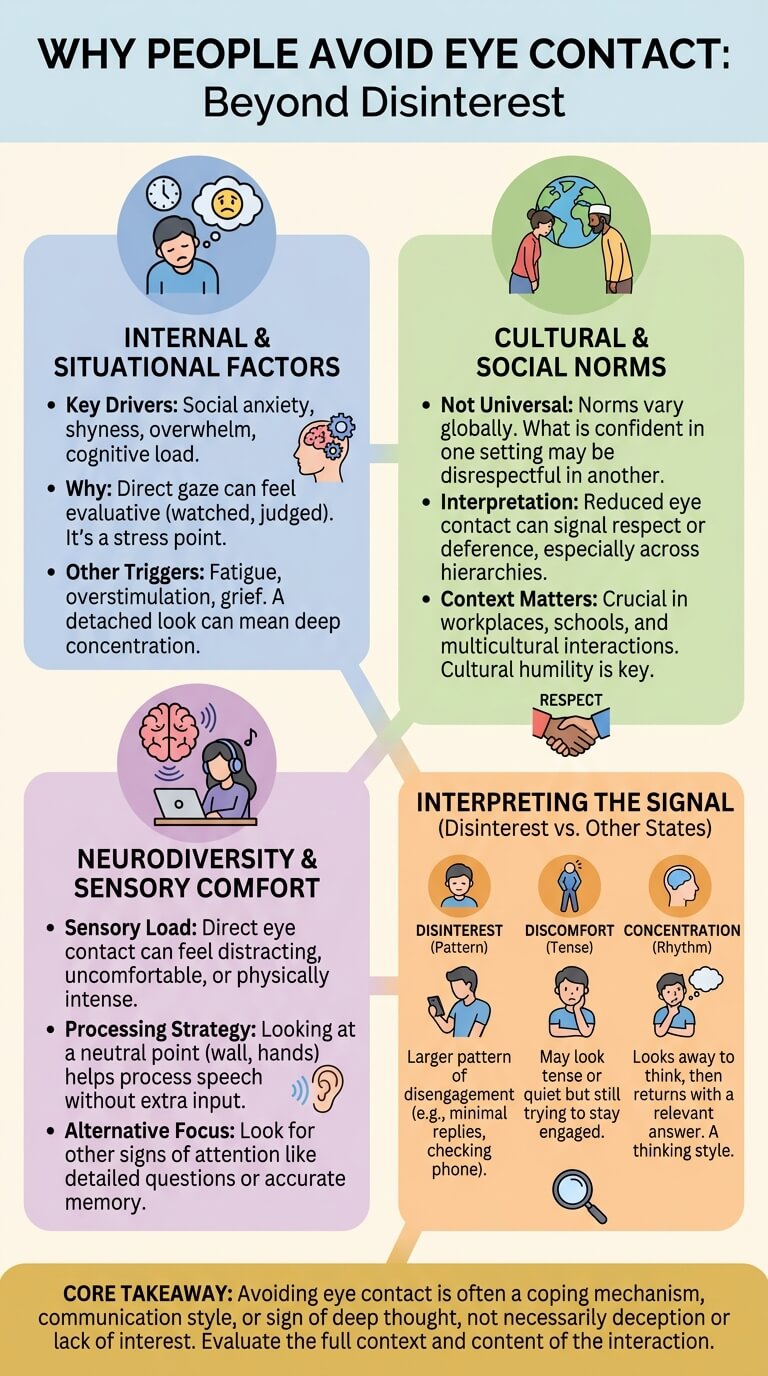
Some people avoid eye contact because direct gaze makes them feel evaluated. The National Institute of Mental Health notes that people with social anxiety disorder may find it difficult to make eye contact and interact in social situations, even when they want to connect with others. That does not mean every person who avoids eye contact has social anxiety. It means eye contact can be a real stress point for some people, especially when they feel watched, judged, or put on the spot through social anxiety symptoms.
Shyness, fatigue, overstimulation, grief, stress, and cognitive load can create similar behavior. A person may appear detached when they are actually concentrating.
Cultural norms and respect-based gaze differences
Eye contact norms are not universal. In some settings, steady eye contact is encouraged as a sign of confidence and honesty. In others, prolonged direct gaze may feel disrespectful, challenging, or too personal, especially across age, status, or authority differences. Cross-cultural research on eye contact perception has found that people from different cultural backgrounds can interpret direct gaze differently, which makes cultural humility important when reading nonverbal cues through cross-cultural gaze research.
This matters in workplaces, schools, healthcare settings, interviews, and multicultural relationships. If someone uses less eye contact than you expect, it may not mean they are hiding something. They may be showing respect, following family norms, or communicating in a style that does not match your expectation.
Neurodiversity, sensory comfort, and communication style
For some neurodivergent people, direct eye contact can feel distracting, uncomfortable, or physically intense. A person may listen better when they are not looking directly into someone’s eyes. They may focus on the wall, hands, desk, or another neutral point because that helps them process speech without extra sensory load.
Someone can be respectful, honest, and engaged while using a different gaze style. A better question is: “How does this person show attention?” They might ask detailed questions, remember what was said, or respond accurately.
Disinterest vs discomfort vs concentration
Avoiding eye contact can sometimes suggest disinterest, but it is only one possibility. Disinterest usually shows up with a larger pattern: minimal replies, no follow-up questions, body angled away, repeated checking of phone or door, and little effort to rejoin the conversation. Discomfort may look similar on the surface, but the person may still try to stay engaged while seeming tense, quiet, or careful.
Concentration has a different rhythm. Someone may look away while thinking, then return with a relevant answer. They may pause, look down, and then give a more precise response. If the content of their response shows they were listening, their lack of eye contact may be a thinking style rather than a relationship signal.
When Eye Contact Feels Too Intense
A glance that feels normal across a room can feel invasive when someone is standing close, which is why gaze and physical distance often need to be understood together.
Prolonged gaze and perceived pressure
Direct gaze is a powerful social signal. A review of direct-gaze research in PubMed Central describes staring eyes as a compelling social cue that can affect attention and behavior, which helps explain why eye contact can feel meaningful so quickly in direct gaze research. The same power that makes eye contact connecting can also make it uncomfortable when it lasts too long.
Too much eye contact can feel like pressure because the listener may feel evaluated. Most people need small gaze breaks to think, breathe, and regulate intensity.
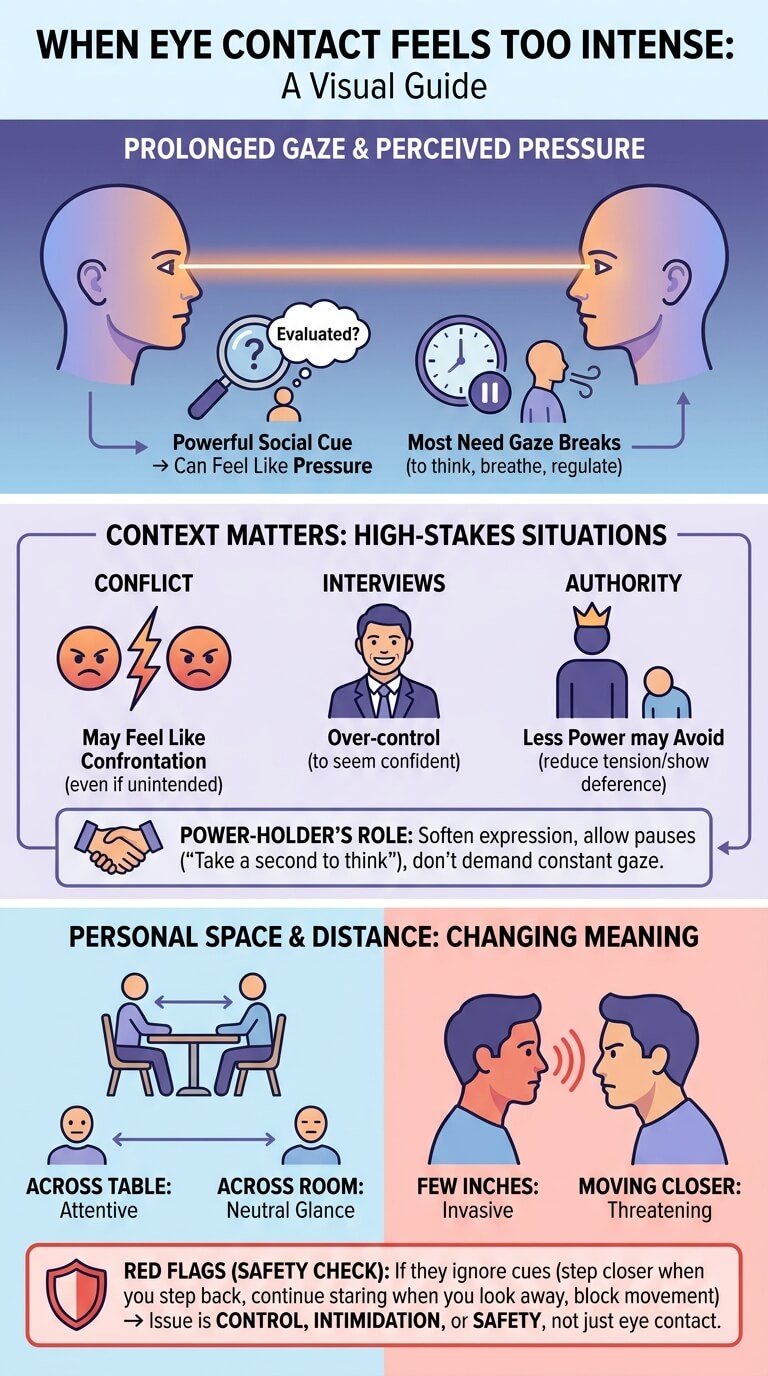
Eye contact in conflict, interviews, and authority situations
Eye contact gets more complicated when the stakes rise. In conflict, direct gaze may feel like confrontation even if the other person only intends seriousness. In interviews, people may over-control their gaze because they want to seem confident. In authority situations, the person with less power may avoid eye contact to reduce tension or show deference.
If you are in the higher-power role, it helps to notice how your gaze lands. A teacher, manager, parent, or interviewer can make eye contact feel safer by softening facial expression, allowing pauses, and not demanding constant direct gaze. “Take a second to think” can reduce the pressure more than telling someone, “Look at me when I’m talking to you.”
How personal space changes the meaning of gaze
Eye contact does not happen in empty space. Distance changes the meaning. A steady look from across a table may feel attentive. The same look from a few inches away may feel invasive. A glance from a stranger across a room may be neutral. Repeated staring from someone who keeps moving closer may feel threatening.
When gaze feels intense, check the distance, exit options, tone, and whether the person respects your cues. If you step back and they step closer, if you look away and they continue staring, or if they block your movement, the issue is not just eye contact. It may be about control, intimidation, or safety.
Common Misreads About Eye Contact
Looking away does not always mean avoidance, and steady eye contact does not always mean confidence, so it is safer to interpret gaze in context instead of relying on one cue.
Avoiding eye contact does not prove lying
One of the most common myths is that liars avoid eye contact. Some people who are lying may avoid gaze, but honest people may do the same when they are nervous, ashamed, overwhelmed, respectful, neurodivergent, tired, or trying to remember details. Some people who are lying may hold strong eye contact because they believe it makes them look believable.
It is safer to avoid turning eye contact into a lie detector. If truth matters, look for evidence, consistency, details, follow-through, and whether the person is willing to clarify. Eye contact may tell you something about comfort, pressure, or social strategy, but it cannot prove honesty by itself.
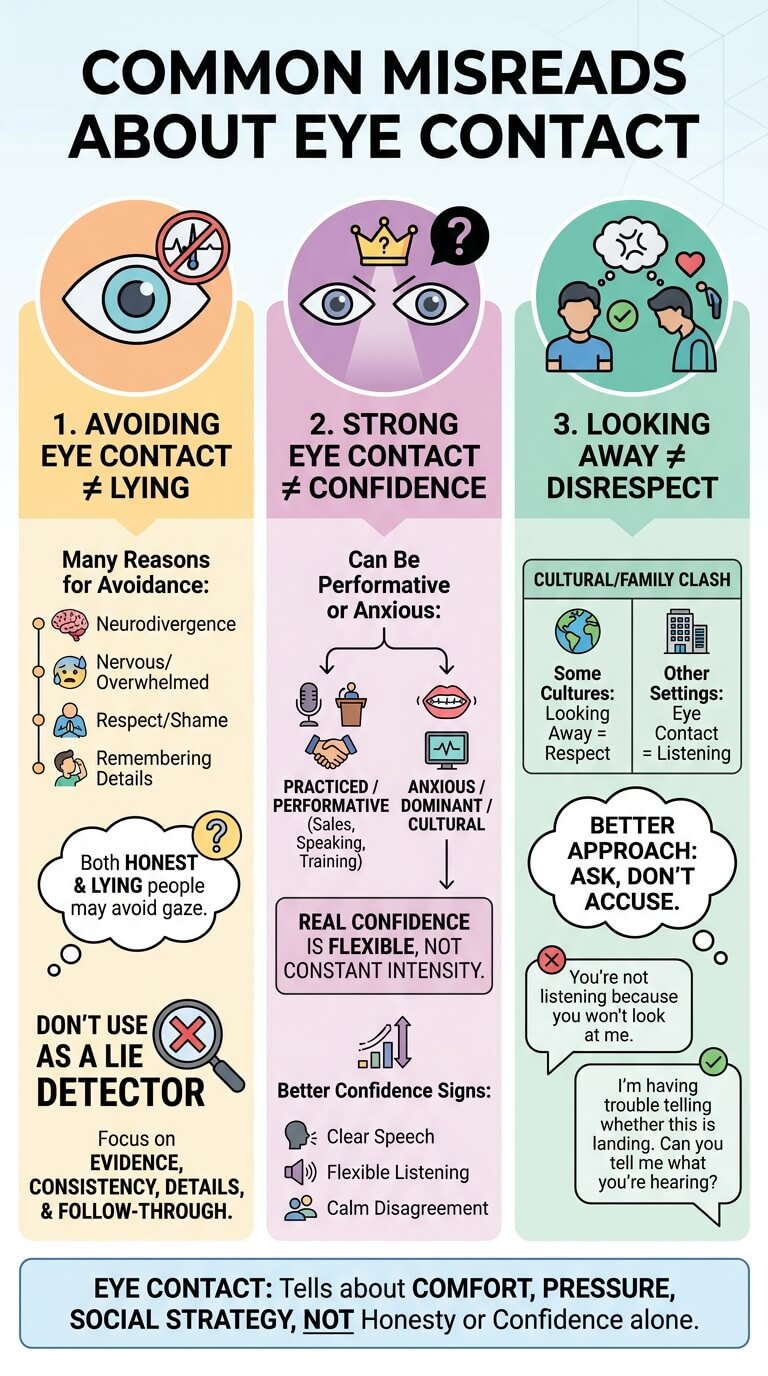
Strong eye contact does not always mean confidence
Strong eye contact can be confident, but it can also be practiced, anxious, performative, flirtatious, dominant, culturally learned, or part of someone’s professional training. A salesperson, public speaker, manager, or performer may use steady gaze because they have learned that it looks assured. That does not always mean they feel calm inside.
Confidence is better read through a broader pattern: clear speech, flexible listening, calm disagreement, and the ability to look away naturally. Real confidence usually has flexibility, not constant intensity.
Looking away is not always disrespect
In some families or cultures, looking away while being corrected is considered respectful. In other settings, adults expect children or employees to maintain eye contact as proof they are listening. These expectations can clash. A person may be trying to show respect in one style while being judged by another style.
If the relationship is safe enough, it is better to ask than accuse. Instead of saying, “You’re not listening because you won’t look at me,” try, “I’m having trouble telling whether this is landing. Can you tell me what you’re hearing?” That checks understanding without forcing one gaze norm as the only acceptable way to communicate.
How to Read Eye Contact More Accurately
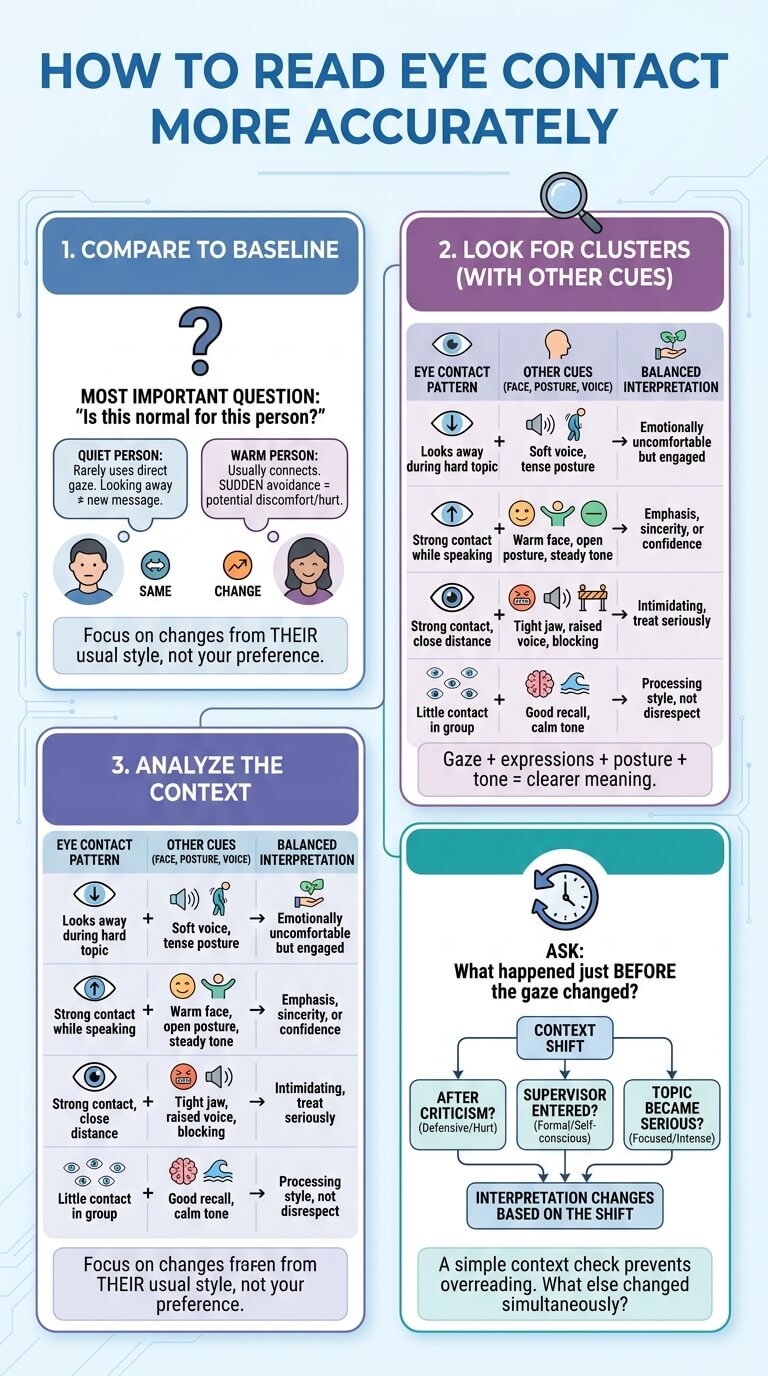
Compare gaze to the person’s baseline
The most useful eye contact question is often: “Is this normal for this person?” A quiet person who rarely uses direct gaze may not be sending a new message by looking away. A usually warm person who suddenly avoids eye contact after a specific comment may be showing discomfort, embarrassment, hurt, or disagreement.
Baseline does not mean you know someone perfectly. It means you avoid comparing every person to your personal preference. Changes from their own usual style are often more meaningful than differences from yours.
Look for clusters with facial expression, posture, and voice tone
Eye contact becomes clearer when it is read with other cues. The APA Dictionary of Psychology definition of nonverbal communication includes facial expressions, gestures, body language, tone of voice, and other physical signals, which is why gaze should not be pulled out of the whole interaction.
| Eye contact pattern | Other cues to compare | More balanced interpretation |
|---|---|---|
| Looks away during a hard topic | Soft voice, still answering, tense posture | May be emotionally uncomfortable but still engaged |
| Strong eye contact while speaking | Warm face, open posture, steady tone | May be emphasis, sincerity, or confident engagement |
| Strong eye contact with close distance | Tight jaw, raised voice, blocking movement | May feel intimidating and should be treated seriously |
| Little eye contact in a group | Good recall, relevant replies, calm tone | May be processing style, not disrespect |
Ask what changed in the context before deciding what it means
Context changes interpretation. Did the person look away after being criticized? Did their gaze change when a supervisor entered the room? Did they become more direct when the conversation turned serious? Did they stop making eye contact after a boundary was crossed? These shifts matter more than a general rule about what eye contact “means.”
A simple context check can prevent overreading. Ask yourself: What happened just before the gaze changed? What else changed at the same time? Is this person trying to think, regulate emotion, show respect, avoid pressure, or control the room? The answer may still be uncertain, but it will be more grounded.
What to Do If Eye Contact Makes You Anxious
Use soft focus instead of forced staring
If eye contact makes you anxious, forcing yourself to stare can make the pressure worse. Soft focus is often easier. You can look near the person’s eyes, at the bridge of the nose, at the upper cheek, or at the face as a whole rather than locking onto the pupils. Most people will experience this as normal attention.
Use a gentle rhythm: look when greeting, when they make an important point, and when you respond. Then allow natural breaks. The aim is enough visual presence that the other person does not feel ignored while you stay regulated.
Practice gaze breaks that still show listening
Gaze breaks feel less awkward when paired with clear listening signals. You can nod, say “That makes sense,” take notes, summarize their point, or ask a relevant follow-up question. These behaviors show attention without requiring constant direct gaze.
| Situation | Anxious impulse | Balanced alternative |
|---|---|---|
| Answering a question in a meeting | Look down the whole time | Glance at the person at the start and end of your answer |
| Listening to feedback | Force intense eye contact | Use brief eye contact, nod, and summarize what you heard |
| Talking to someone new | Avoid looking at their face | Use soft focus near the eyes and take natural breaks |
Choose direct words when nonverbal pressure is confusing
Words can reduce the burden on eye contact. If you need a moment, say, “I’m thinking, but I’m listening.” If you are overwhelmed, say, “I want to answer carefully, so I may look away while I gather my thoughts.” If someone’s gaze feels intense, say, “I can talk about this, but I need a little more space.”
These sentences simply make the invisible part visible. They are useful in workplaces, classrooms, interviews, and personal conversations where quietness or gaze breaks may be misread.
Bridge to Other Body Language Cues
How gaze connects with facial expressions
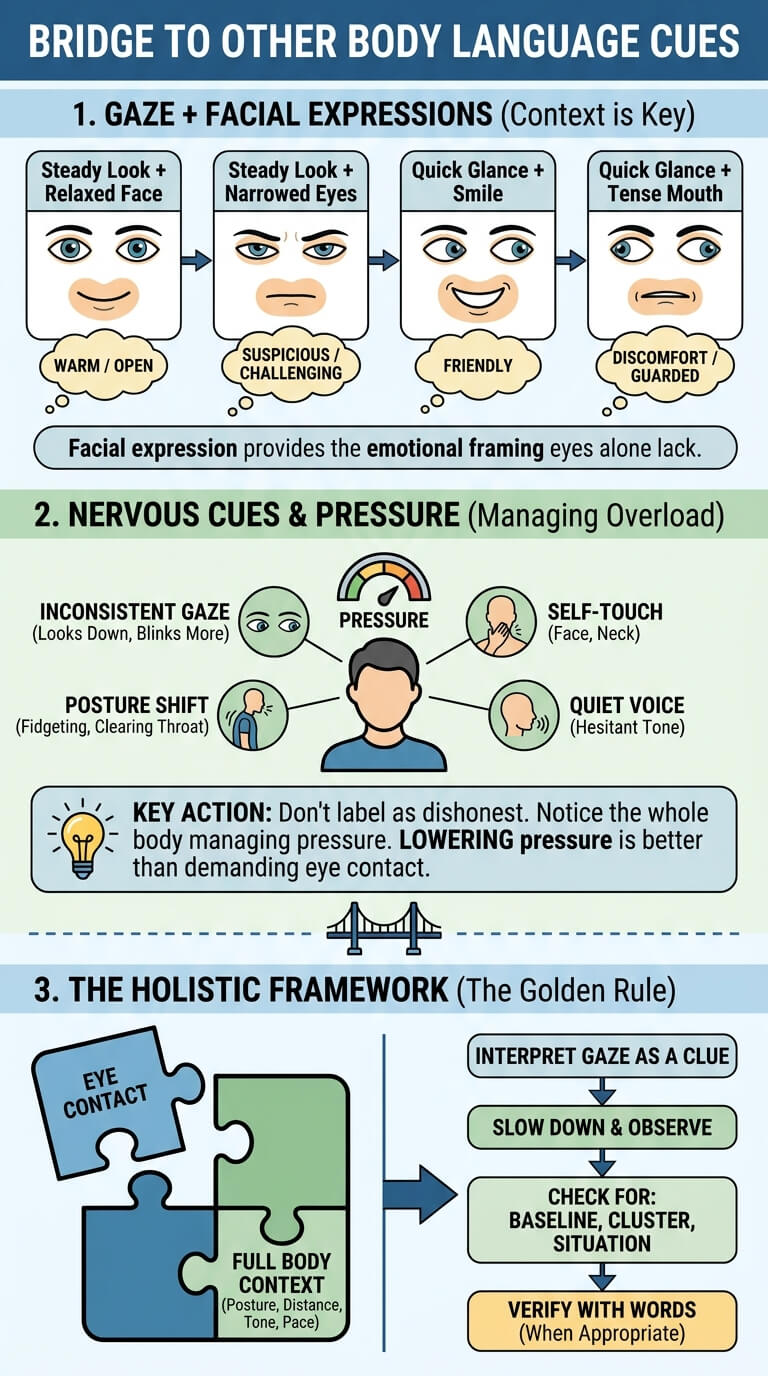
Eye contact changes meaning when paired with facial expression. A steady look with a relaxed face may feel warm. A steady look with narrowed eyes may feel suspicious or challenging. A quick glance with a smile may feel friendly. A quick glance with a tense mouth may signal discomfort.
This is where facial expression adds information that the eyes alone cannot carry. The same gaze pattern may communicate very different things depending on whether the face looks open, strained, amused, sad, guarded, or irritated.
How nervous cues can change eye contact
Nervous body language can make eye contact inconsistent. A person may look down, blink more, touch their face, shift posture, clear their throat, or speak more quietly. These cues may mean anxiety, but they can also come from pressure, fatigue, sensory overload, lack of sleep, or being put on the spot.
The key is not to label the person as nervous or dishonest. Notice whether the whole body seems to be managing pressure. If so, lowering the pressure may create a better conversation than demanding stronger eye contact.
Why eye contact should be read inside the full body-language framework
Eye contact is one piece of a larger nonverbal picture. A person’s posture, distance, hand movement, facial expression, voice tone, pace, and timing all change how gaze is received. This is why a body-language framework should start with context and clusters, not with isolated signs.
If you remember only one rule, make it this: interpret gaze as a clue, then slow down. Look for the baseline. Look for the cluster. Look for the situation. Then, when appropriate, use words to check what you think you are seeing.
When to Get Support
If eye contact anxiety limits work, relationships, or daily life
Eye contact discomfort is common, and it does not automatically mean anything is wrong with you. Support may be worth considering if fear of eye contact causes you to avoid school, work, interviews, friendships, dating, appointments, or daily conversations that matter to you. A mental health professional can help you understand the anxiety pattern without shaming you or forcing unnatural behavior.
Support can be especially useful when eye contact fear is tied to panic symptoms, intense self-consciousness, past humiliation, bullying, trauma, or a strong fear of being judged. The goal is not to become someone else. The goal is to communicate with less distress and more choice.
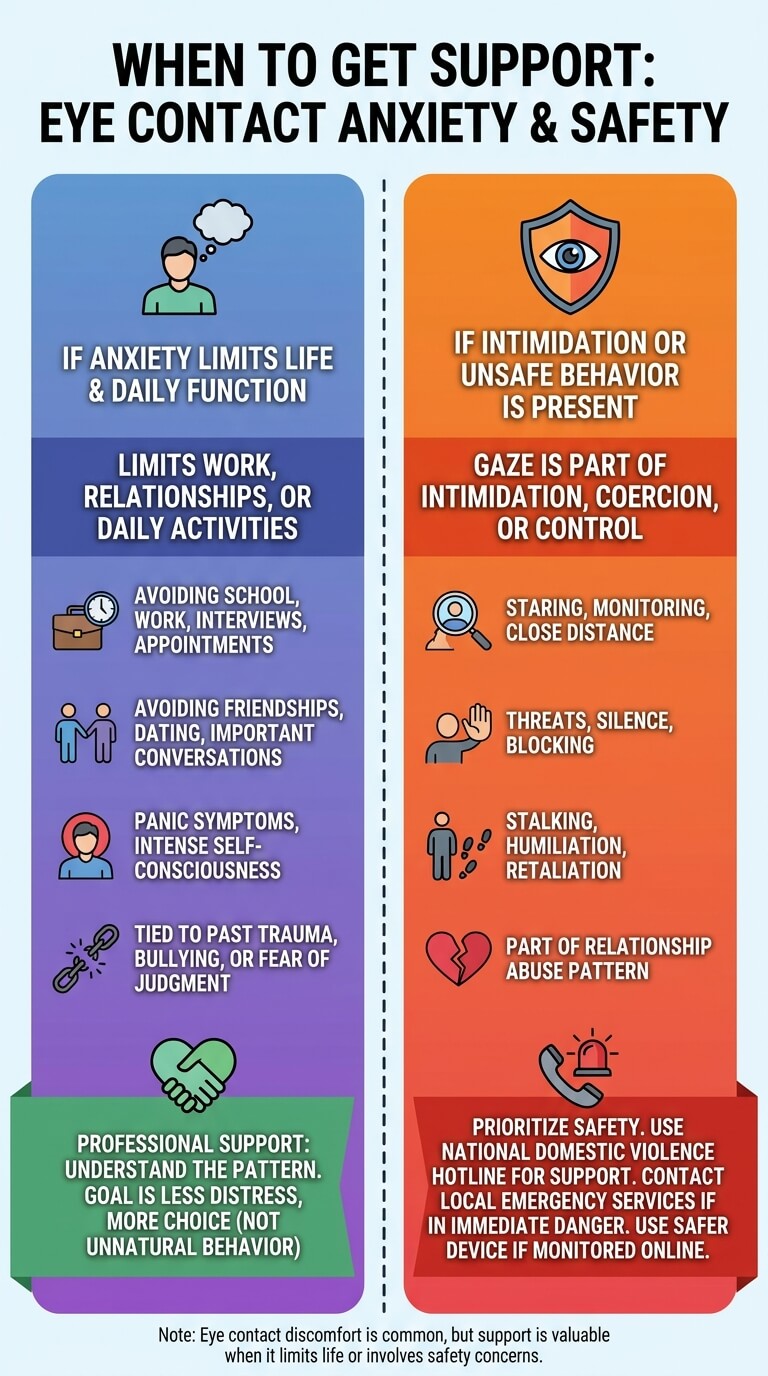
If staring, monitoring, or intimidation is part of unsafe behavior
Sometimes the issue is not your comfort with eye contact. Sometimes another person uses staring, monitoring, silence, threats, blocking, or close distance to make you feel afraid or controlled. If gaze is part of a pattern of intimidation, coercion, stalking, humiliation, or retaliation, prioritize safety rather than trying to communicate better. The National Domestic Violence Hotline explains that relationship abuse can include intimidation and controlling behavior, and its relationship abuse information can help people think through safety and support options.
If you feel in immediate danger, contact local emergency services if it is safe to do so. If you are being monitored online, use a safer device.
FAQ About Eye Contact Psychology
Does avoiding eye contact mean someone is lying?
No. Avoiding eye contact does not prove someone is lying. It may reflect anxiety, embarrassment, concentration, cultural norms, sensory discomfort, respect, fatigue, or emotional overwhelm. If truth matters, focus on consistency, evidence, willingness to clarify, and follow-through rather than treating gaze as proof.
Why do I look away when I am thinking?
Many people look away because direct eye contact takes attention. When you are searching for words, remembering details, or trying to answer carefully, looking away may reduce social pressure and free up mental space. This can be a normal thinking habit, not a sign that you are rude or disconnected.
Can too much eye contact make people uncomfortable?
Yes. Too much eye contact can feel intense, especially when paired with close distance, a serious tone, conflict, authority, or little opportunity to look away. Natural conversation usually includes gaze breaks. Warm eye contact is flexible, not fixed.
Is eye contact interpreted differently across cultures?
Yes. Some cultures and families treat direct eye contact as confidence or honesty. Others may see prolonged eye contact as disrespectful, confrontational, or too bold in certain relationships. This is one reason it is risky to judge politeness, honesty, or interest from gaze alone.
How can I show attention without staring?
You can show attention through brief eye contact, soft focus, nodding, summarizing, asking relevant questions, and turning your body toward the speaker. You do not need to stare to be engaged. Clear words and responsive listening often matter more than constant gaze.
Key Takeaways
Eye contact is strongest when interpreted with context, baseline, and other cues
- Eye contact often signals attention, feedback, emotional presence, or conversational timing, but it does not guarantee attraction, honesty, confidence, or disrespect.
- Looking away can mean thinking, regulating emotion, showing respect, managing sensory comfort, or feeling anxious. It is not automatically avoidance.
- Strong eye contact can feel connecting or intimidating depending on facial expression, voice, distance, power, and whether the person respects your cues.
- The safest way to read gaze is to compare it with the person’s baseline, the context, and nearby cues such as posture, facial expression, and tone.
- If eye contact anxiety limits daily life, support may help. If staring is part of intimidation or control, prioritize safety over communication tips.
Final Thoughts
Eye contact is useful because it gives small signals about attention, pressure, comfort, and connection. It becomes harmful when it is treated like a shortcut to someone’s hidden motives. The next time you notice a gaze shift, pause before deciding what it means. Ask what changed, compare it with the person’s usual style, and look for the wider cluster of cues.
If you are trying to improve your own eye contact, start with one practical step: use brief eye contact at the beginning and end of your point, then allow natural breaks while you think. If you are trying to understand someone else’s gaze, stay curious before you judge. Human eyes communicate a lot, but they communicate best when read with context.

Michael Reed is the Founder and Lead Writer at Psychology Exposed. He writes about human behavior, relationships, emotional patterns, self-awareness, and practical psychology topics using research-informed, easy-to-understand content.
Read More About Michael Reed: https://psychologyexposed.com/michael-reed/