
Creative block can feel strangely personal. You may sit down to write, design, plan, record, sketch, or solve a problem, and the mind that usually makes connections seems to go quiet. Sometimes the block appears as a blank page. Sometimes it looks like endless research, constant revision, sudden fatigue, or the feeling that every idea is wrong before it has a chance to become anything.
In psychology, creative block is better understood as friction in the creative process, not as proof that you have lost your creativity. The friction may come from fear of judgment, early self-criticism, perfectionism, cognitive fatigue, unclear goals, or a mismatch between the kind of thinking you need and the kind of pressure you are putting on yourself. Creativity itself involves producing or developing original work, thoughts, techniques, or ideas, a definition reflected in the APA Dictionary of Psychology definition of creativity.
The useful question is not, “Why am I not creative anymore?” A better question is, “Where is the process getting stuck?” Once you can name the type of block, the next step becomes smaller, kinder, and more practical.

Quick Answer
Creative block is usually friction, not proof you are not creative
Creative block means your ability to start, generate, develop, finish, or share creative work is being interrupted. The interruption may come from pressure, fatigue, fear, uncertainty, perfectionism, or a lack of useful input. It is not a reliable measure of your talent. It is a signal that some part of the creative process needs a different condition.
The first step is identifying the type of block
Most advice about creative block fails because it treats every block the same way. A person with no ideas needs a different first step from a person with too many ideas, a person afraid to show work, or a person too depleted to think clearly. Naming the block makes the solution less vague.
What Creative Block Means Psychologically
Creative block makes more sense when it is viewed inside the broader creativity psychology process, not as a simple sign that someone lacks ideas.
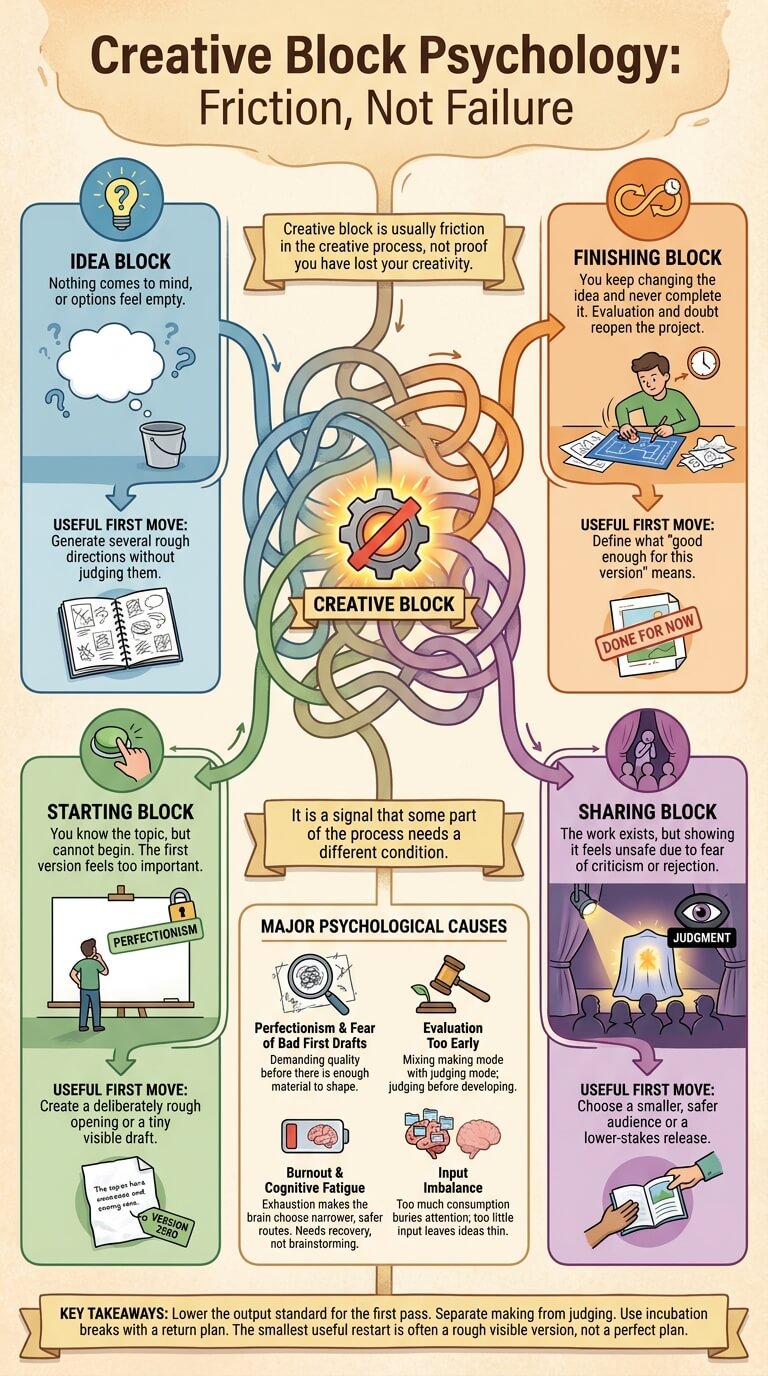
Idea block, starting block, finishing block, and sharing block
Creative block is not one single experience. It is a family of stuck points. The mind can get stuck before an idea appears, after an idea appears, while shaping the idea, or right before showing it to others.
| Type of block | What it feels like | What may be happening | Useful first move |
|---|---|---|---|
| Idea block | Nothing comes to mind, or every option feels empty | The mind lacks input, flexibility, rest, or permission to explore weak ideas | Generate several rough directions before judging any one of them |
| Starting block | You know the topic, but you cannot begin | The first version feels too important, too visible, or too tied to identity | Create a deliberately rough opening or tiny visible draft |
| Finishing block | You keep changing the idea and never complete it | Evaluation, doubt, and new possibilities keep reopening the project | Define what “good enough for this version” means |
| Sharing block | The work exists, but showing it feels unsafe | Fear of criticism, exposure, comparison, or rejection is protecting you from risk | Choose a smaller, safer audience or a lower-stakes release |
These blocks can overlap. A writer may call it writer’s block, but the real issue may be fear of publishing. A designer may call it lack of inspiration, but the real issue may be exhaustion. A student may say they are lazy, when the assignment is actually too unclear to begin.
Why block can feel personal even when it is situational
Creative work often carries identity. When you make something, you are not only performing a task. You may feel as if you are revealing taste, intelligence, originality, competence, or emotional truth. That is why a stuck moment can quickly turn into a harsh story: “I am not talented,” “I used to be creative,” or “Other people would have solved this already.”
The mind often mistakes discomfort for evidence. If a draft feels awkward, you may assume the idea is bad. If you feel anxious before beginning, you may assume you should wait for confidence. If you cannot finish, you may assume you lack discipline. Sometimes those interpretations are too broad. The problem may be local: too much judgment too soon, not enough rest, an unclear goal, or a task that needs exploration before execution.
The Main Psychological Causes of Creative Block

Perfectionism and the fear of bad first drafts
Perfectionism often turns a first draft into a final exam. Instead of allowing early work to be messy, the mind tries to protect you from embarrassment by demanding quality before there is enough material to shape. That demand sounds responsible, but it can freeze the process.
Recent open-access research has examined how perfectionism can interfere with original idea generation, especially when concerns about mistakes and doubts about actions become strong during creative tasks. One study in PubMed Central on perfectionism and divergent thinking found that perfectionistic concerns were negatively linked with originality in divergent thinking, while striving for excellence was not the same as fear-driven perfectionism.
This distinction matters. Caring about quality can help creativity. Fear of mistakes can shut it down before the work has a chance to improve.
Evaluation too early in the process
Creative work usually needs two different mental modes: making possibilities and evaluating possibilities. A block often appears when evaluation interrupts generation too soon. You write one sentence and judge it. You sketch one rough shape and reject it. You record one take and decide your whole idea is embarrassing.
Early judgment can feel like high standards, but it often removes the raw material needed for a strong final version. The first idea may not be the answer. It may be the doorway to the answer. When you judge the doorway as if it should already be the room, the process stops.
Fear of judgment or exposure
Creativity can feel exposing because it reveals choices. Even ordinary creative work involves taste: what you noticed, what you chose, what you left out, what you cared about. If you have been mocked, dismissed, compared, or harshly criticized, your mind may treat creative output as a social risk.
Fear of judgment does not always appear as fear. It may appear as “I need one more course,” “I should research a little longer,” “I am not in the right mood,” or “This idea is not unique enough.” The surface reason may sound practical, while the deeper concern is being seen and evaluated.
Burnout and cognitive fatigue
Creative thinking requires mental energy. It asks the mind to notice, associate, hold uncertainty, make choices, and revise. When you are exhausted, the brain often chooses narrower, safer, more familiar routes. That can make creativity feel unavailable.
Burnout can involve fatigue, detachment, reduced effectiveness, and a loss of motivation. The Cleveland Clinic overview of burnout signs describes exhaustion and dissatisfaction as common parts of burnout. If your creative block comes with ongoing depletion, sleep disruption, cynicism, or difficulty functioning, the first need may be recovery, not a better brainstorming technique.
Lack of input or overconsumption of input
Creative ideas rarely come from nothing. They often come from recombining what you have seen, felt, studied, practiced, or questioned. If your mind has too little meaningful input, ideas can feel thin. You may be asking your brain to make connections without giving it material.
The opposite problem is also common. Too much input can bury your own attention. You may scroll, save examples, watch tutorials, compare styles, read comments, and consume so much that your mind becomes full but not active. You are surrounded by material, yet no single direction has room to breathe.
Ambiguous goals and too many constraints
Some creative blocks are not emotional at first. They are structural. A task may be too vague to begin or too restricted to explore. “Make something amazing” is vague. “Write a perfect article that is original, useful, fast, short, deep, viral, and impossible to criticize” is overloaded.
Constraints can help creativity when they guide attention. They hurt creativity when they compete with each other or make every move feel wrong. A useful constraint narrows the playground. A confusing constraint removes the playground entirely.
Creative Block vs Lack of Discipline vs Burnout
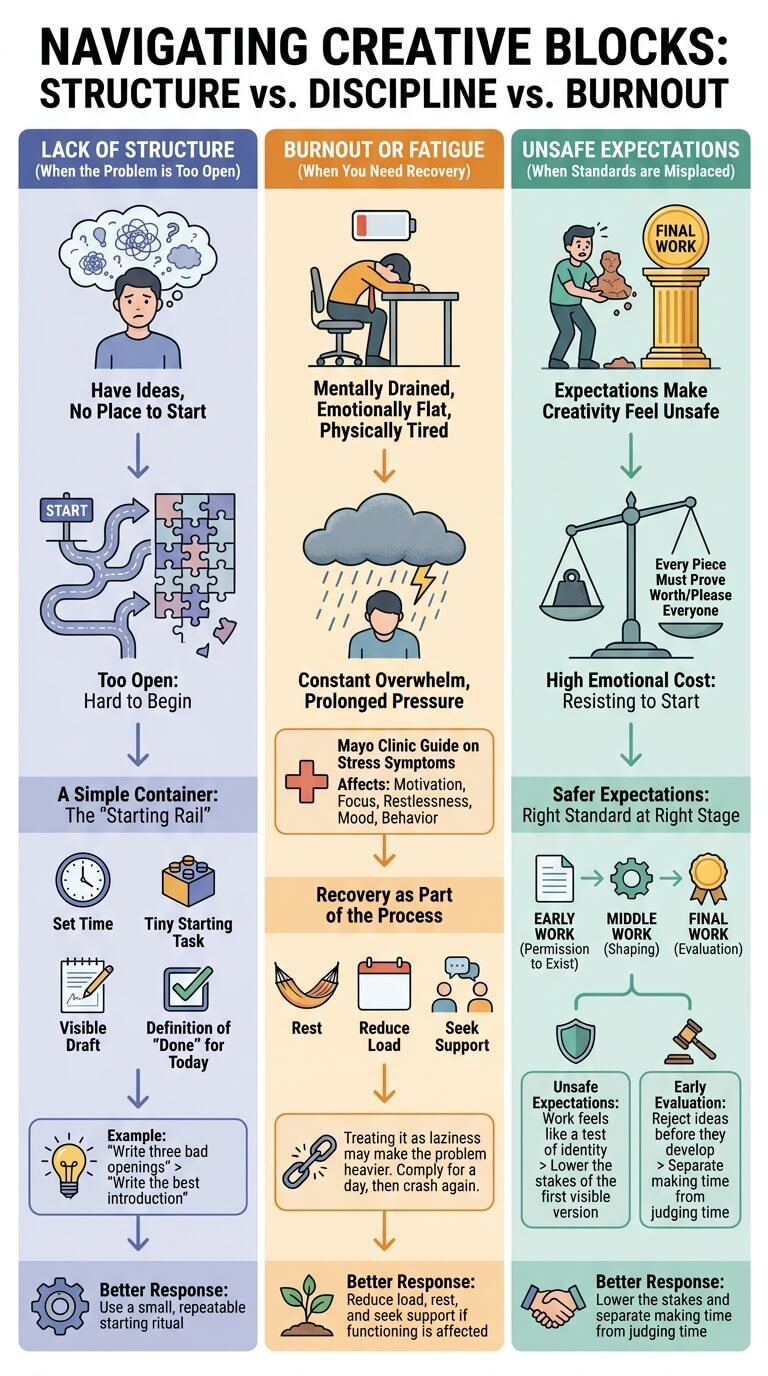
When you need structure
Sometimes the block is partly a structure problem. You may have enough energy and enough ideas, but no repeatable way to begin. In that case, a simple container can help: a set time, a tiny starting task, a visible draft, or a definition of what counts as done for today.
This is not about forcing yourself through everything. Structure helps when the creative problem is too open. It gives the mind a starting rail. For example, “write three bad openings” is easier to begin than “write the best introduction.” “Make five thumbnail shapes” is easier than “design the final visual identity.”
When you need recovery
If you are mentally drained, emotionally flat, physically tired, or constantly overwhelmed, more structure may not fix the block. You may comply for a day and crash again. Recovery becomes part of the creative process because attention, memory, and flexible thinking are affected by stress and fatigue.
The Mayo Clinic guide to stress symptoms notes that stress can affect motivation, focus, restlessness, mood, and behavior. If your creative block arrived after prolonged pressure, conflict, overwork, or major life stress, treating it as laziness may make the problem heavier.
When you need safer expectations
A third possibility is that your expectations are making creativity feel unsafe. You may be asking every piece of work to prove your worth, protect your reputation, please everyone, or become the best thing you have ever made. The mind may resist starting because the emotional cost feels too high.
Safer expectations do not mean low standards. They mean placing the right standard at the right stage. Early work needs permission to exist. Middle work needs shaping. Final work needs evaluation. When final-stage standards are applied at the beginning, the beginning becomes frightening.
| If the main issue is… | You may notice… | A better response is… |
|---|---|---|
| Lack of structure | You have ideas but no place to start | Use a small repeatable starting ritual |
| Burnout or fatigue | Everything feels heavy, not just the project | Reduce load, rest, and seek support if functioning is affected |
| Unsafe expectations | The work feels like a test of your identity | Lower the stakes of the first visible version |
| Early evaluation | You reject ideas before they develop | Separate making time from judging time |
How Creative Block Shows Up

Blank-page avoidance
Blank-page avoidance is not always a lack of ideas. Sometimes the blank page is too clean. It feels like it demands something worthy immediately. The longer it stays empty, the more pressure it gathers.
A practical response is to make the page less sacred. Write a messy title, a bad first line, a list of rejected ideas, or the sentence, “What I am trying to say is…” The point is not quality. The point is to create something the mind can respond to.
Endless research without making
Research can be part of preparation, but it can also become a hiding place. You may feel productive because you are collecting information, examples, references, and inspiration. Yet the project itself remains untouched.
One sign that research has become avoidance is that each new piece of information raises the standard instead of clarifying the next move. You feel more informed, but less willing to create. A useful boundary is to pair input with output: after 20 minutes of research, produce one rough note, sketch, paragraph, question, or decision.
Constantly changing the idea
Changing the idea can be creative exploration. It becomes a block when the change prevents contact with difficulty. Every time the project becomes uncomfortable, a new idea appears to rescue you from finishing the old one.
This often happens to people with strong divergent thinking. They can generate many possibilities, but completion requires choosing a direction and tolerating the loss of other options. Finishing is not proof that the other possibilities were bad. It is the act of giving one possibility enough time to become real.
Needing the mood to be perfect
Inspiration is pleasant, but it is not always available on schedule. Waiting for the perfect mood can train the brain to associate creativity with rare conditions: quiet, confidence, time, energy, certainty, and emotional ease. Real creative work often begins in more ordinary conditions.
A smaller entry point helps. Instead of asking, “Do I feel inspired enough to create?” ask, “What is the smallest part I can touch for ten minutes?” You may not enter flow. You may simply reduce distance from the work, which is often enough to restart momentum.
Hating everything before it develops
Many early ideas look weaker than the image in your head. That gap can feel discouraging. The mind compares a rough external version with a polished internal possibility and concludes that the work is failing.
Early dislike is not always accurate feedback. It may simply mean the idea has moved from imagination into a form that can now be improved. A rough draft gives you something to shape. An imagined perfect version gives you nothing to edit.
What To Do First When You Feel Blocked

Lower the output standard for the first pass
The first pass should have a smaller job. It does not need to impress, explain everything, or survive public judgment. It only needs to make the idea visible enough that you can work with it.
Try naming the first pass honestly: rough map, ugly draft, test version, scratch take, private sketch, or version zero. This language matters because it tells the brain what kind of performance is required. “Final draft” creates pressure. “Version zero” creates permission.
Separate making from judging
Creative block often softens when you stop asking one moment to do two jobs. During making time, your task is to produce material. During judging time, your task is to choose, edit, cut, and improve. Both matter, but mixing them too early can create a mental traffic jam.
| Making mode | Judging mode |
|---|---|
| Write rough lines, sketch shapes, list options, record drafts | Choose what fits the purpose |
| Allows awkward, incomplete, or strange ideas | Uses standards, audience, constraints, and taste |
| Asks, “What else could this become?” | Asks, “What is worth developing?” |
| Needs looseness and tolerance | Needs clarity and decision-making |
If you are blocked, you may not need less judgment forever. You may need judgment to arrive later.
Make one tiny visible version
A creative idea becomes less mysterious when it has a visible form. That form can be extremely small: one paragraph, one scene description, one rough logo shape, one melody line, one bullet list, one voice note, one opening sentence, or one bad prototype.
The tiny version should be small enough that failure does not feel dramatic. The purpose is to move the work out of your head. Once it exists outside you, your mind can react, adjust, reject, combine, and improve.
Use a break for incubation, not escape
Breaks can help creativity when the mind keeps working in the background. This is often described as incubation: stepping away from a problem while it remains mentally active enough for new associations to form. Research on creative blocks has also explored how people can become stuck in parts of semantic memory networks, as discussed in a PubMed Central article on creative block and idea generation.
For a break to support incubation, define a return point before you leave. For example: “I will walk for ten minutes, then write three possible endings.” Without a return point, the break may become avoidance. With a return point, the break becomes part of the process.
Ask what the block is protecting you from
Some creative blocks are protective. They try to protect you from embarrassment, disappointment, criticism, wasted effort, comparison, or the grief of making something that does not match your internal standard. Protection is not always irrational. It may be responding to past experiences.
A useful self-check is: “If I started or finished this, what would become possible, and what would become risky?” The answer may reveal the emotional logic of the block. You might discover that the fear is not the work itself, but being seen trying.
When a Break Helps and When It Becomes Avoidance
A break can help when it gives the mind time to loosen its grip on one route through the problem, but it becomes avoidance when there is no return point.
Incubation breaks that keep the problem warm
An incubation break gives the mind space without abandoning the project. You step away, but the problem stays gently available. You might walk, shower, clean, cook, rest, or do a different simple task. The mind is no longer forcing the answer, which can allow quieter associations to surface.
A break is more likely to help when you have already prepared the problem. You know what you are trying to solve. You have gathered some material. You have made at least one attempt. The break then gives the mind something to reorganize.
Avoidance breaks that increase pressure
An avoidance break gives temporary relief but makes returning harder. You may leave the project with no return plan, consume more input than you can use, compare yourself with others, or distract yourself until the deadline becomes more threatening.
The difference is not always the activity. A walk can be incubation or avoidance. Watching examples can be research or avoidance. Rest can be recovery or avoidance. The difference is whether the break reduces useful pressure or quietly increases it.
How to return with a small next step
The return step should be specific enough that you do not have to renegotiate the whole project. Weak return step: “Work on the piece.” Better return step: “Write five possible titles,” “Choose one example,” “Cut one paragraph,” “Sketch three layouts,” or “Record one rough take.”
When you return, avoid asking whether you feel ready. Readiness often arrives after contact with the work, not before it. Begin with the smallest action that puts your attention back inside the project.
Bridge Topics for Deeper Reading
Creative thinking when the idea feels rigid
If your block feels like mental rigidity, the next useful topic is creative thinking. The question shifts from “Why am I blocked?” to “How can I reframe, combine, and reshape what I already have?” This is especially helpful when you have material, but every version feels too obvious or too narrow.
Divergent thinking when you need more options
If the block is caused by having only one possible answer, divergent thinking can help. It trains the mind to produce multiple directions before choosing. This is useful when you are clinging to the first idea because no alternatives are visible yet.
Flow state when you want smoother engagement
Creative block and flow state are near opposites in experience. Block feels effortful, self-conscious, and interrupted. Flow feels absorbed, responsive, and engaged. Still, flow cannot usually be forced directly. Often it becomes more likely after the starting pressure is lowered and the task is made clear enough to enter.
How to become more creative after the block lifts
Once the immediate block softens, the longer question is how to build conditions that make creativity more available. That includes regular input, low-stakes practice, better idea capture, useful constraints, and a healthier relationship with unfinished work. The maintenance plan comes after the stuck point is understood.
When to Get Support
If creative block comes with severe anxiety, depression, burnout, or shame
A creative block by itself is common. It becomes more concerning when it is part of a wider pattern: ongoing anxiety, depressed mood, loss of interest in most activities, inability to function, major sleep disruption, panic, hopelessness, or thoughts of self-harm. In those cases, the issue is no longer just about creativity.
Support may mean talking with a mental health professional, a trusted doctor, a counselor, or a crisis resource if there is immediate danger. Creativity advice should not replace care when distress is severe, persistent, or affecting daily life.
If self-criticism becomes harsh or persistent
Self-criticism can sound like motivation, but harsh criticism often narrows creativity. If your inner language becomes cruel, humiliating, or relentless, it may be worth getting support or changing the environment around your work. You do not need to earn kindness by producing excellent work first.
Try noticing the difference between useful critique and personal attack. Useful critique says, “This section needs clearer examples.” Personal attack says, “You are embarrassing.” Creative work improves through the first kind, not the second.
FAQ About Creative Block Psychology
Why do I suddenly lose creative ideas?
A sudden loss of ideas can happen when pressure rises, input becomes stale, fatigue builds, or early judgment gets too strong. It can also happen after a period of intense output, when your mind needs recovery or fresh material. Instead of assuming your creativity is gone, look at what changed around the block: sleep, stress, expectations, deadlines, criticism, comparison, or the kind of task you are asking yourself to do.
Is creative block the same as burnout?
Not always. Creative block may affect one project or one stage of the process, while burnout tends to feel broader and more draining. If you still have energy for other parts of life and only feel stuck on one task, the block may be about structure, fear, or uncertainty. If you feel exhausted, detached, ineffective, and unable to recover with normal rest, burnout may be part of the picture.
Should I force myself to create through a block?
Forcing can help only when the problem is mild avoidance and the task can be made small. It usually backfires when the block is linked to exhaustion, severe anxiety, or harsh self-criticism. A better first move is to lower the stakes, make a tiny version, and separate making from judging. If your body and mind are clearly depleted, recovery may be the more responsible step.
Why do I avoid work I actually care about?
The more you care, the more the work may feel tied to identity, hope, reputation, or future possibility. Avoidance can be a way to delay the risk of finding out that the work is hard, imperfect, or not received the way you hoped. Caring does not guarantee ease. Sometimes it raises the emotional stakes, which means the first step needs to feel safer and smaller.
Can perfectionism cause creative block?
Yes, perfectionism can contribute to creative block when fear of mistakes takes over before ideas have time to develop. High standards are not the same as perfectionistic fear. Standards help during editing, refining, and finishing. Fear of imperfection can stop generation, prevent experimentation, and make every early attempt feel like evidence against your ability.
Key Takeaways
- Creative block is usually a stuck point in the process, not proof that creativity has disappeared.
- Different blocks need different responses: idea block, starting block, finishing block, and sharing block are not the same problem.
- Perfectionism often blocks creativity by applying final-stage standards to early-stage work.
- Breaks help most when they include a clear return point and keep the problem gently active.
- If the block is tied to burnout, severe anxiety, depression, or harsh self-criticism, support matters more than forcing output.
- The smallest useful restart is often a rough visible version, not a perfect plan.
Final Thoughts
When you feel creatively blocked, do not begin by attacking your character. Begin by locating the stuck point. Are you missing ideas, avoiding the first move, reopening the project endlessly, or afraid to share what already exists? The answer changes the next step.
If creative block keeps returning, it may help to rebuild creativity through smaller inputs, lower-pressure experiments, and repeated practice.
Choose one small action that matches the block: make a rough version, generate more options, take an incubation break with a return plan, reduce the standard for the first pass, or rest if you are depleted. Creativity often returns not through pressure, but through a better condition for the next honest move.

Michael Reed is the Founder and Lead Writer at Psychology Exposed. He writes about human behavior, relationships, emotional patterns, self-awareness, and practical psychology topics using research-informed, easy-to-understand content.
Read More About Michael Reed: https://psychologyexposed.com/michael-reed/