
When people feel stuck, they often assume the problem is a lack of talent. Sometimes the real issue is narrower: the mind has stopped after the first obvious answer. Divergent thinking psychology looks at what happens when the mind opens the field again, generates more options, changes categories, and allows unusual possibilities to appear before judging which one is best.
Practicing divergent thinking is one practical way to become more creative, especially when you usually stop at the first acceptable answer.
This matters in writing, studying, design, work decisions, social problem solving, and everyday life. If you only produce one answer, that answer has to carry too much pressure. If you can produce ten, you can compare, combine, improve, reject, and choose with more freedom. Divergent thinking is not the same as being brilliant on command. It is the skill of making room for more than one path.
This article focuses on that one skill. It does not cover the entire creative process, personality openness, flow state, or productivity systems. The goal is to help you understand option-making, early judgment, and practical ways to generate before you evaluate.

Quick Answer
Divergent thinking in simple language
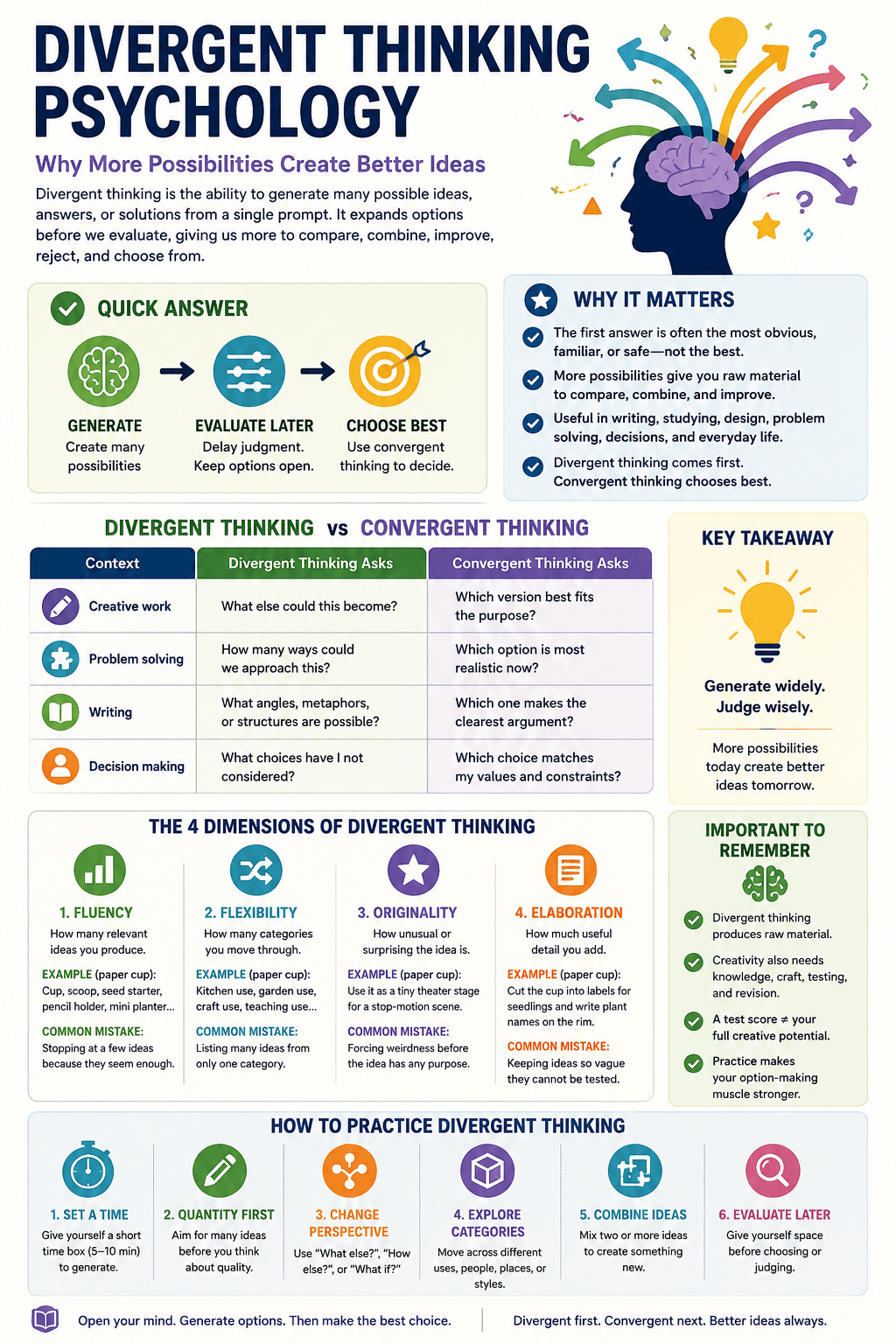
Divergent thinking is the ability to generate many possible ideas, answers, interpretations, or solutions from a single prompt. In psychology, it is often discussed as part of creative cognition because it helps the mind move beyond the first familiar response. It is useful early in problem solving, before you need to evaluate, choose, or refine.
Why it matters before evaluation
Divergent thinking matters because the first answer is not always the best answer. The first answer is often the most available, familiar, safe, or socially expected. Generating more possibilities gives the mind raw material. Later, convergent thinking can narrow the options, test what fits, and choose what is worth developing.
| Question | Divergent thinking asks | Convergent thinking asks |
|---|---|---|
| Creative work | What else could this become? | Which version best fits the purpose? |
| Problem solving | How many ways could we approach this? | Which option is most realistic now? |
| Writing | What angles, metaphors, or structures are possible? | Which one makes the clearest argument? |
| Decision making | What choices have I not considered? | Which choice matches my values and constraints? |
What Divergent Thinking Means
Divergent thinking is one piece of the larger creativity psychology process, where the mind moves between possibility, evaluation, imagination, and refinement.
Generating many possible answers
The APA Dictionary of Psychology defines divergent thinking as creative thinking that solves a problem or reaches a decision through strategies that move away from commonly used or previously taught strategies. In plain English, the mind stops following only the standard route and starts exploring alternatives.
A divergent thinking prompt usually has many possible responses. “What can you do with a brick?” has no single correct answer. It could be a doorstop, bookend, garden border, percussion object, sculpture base, workout weight, emergency wedge, or visual metaphor. Some answers are ordinary. Some are odd. Some are not very useful. That is acceptable during the early stage because the point is range, not immediate quality.
Fluency, flexibility, originality, and elaboration
Researchers often describe divergent thinking through several qualities. Fluency is the number of relevant ideas. Flexibility is the variety of categories those ideas move through. Originality is how uncommon or surprising an idea is within a context. Elaboration is the amount of detail added to an idea so it becomes more developed.
These four qualities show that “more ideas” is not the only goal. Twenty similar ideas may show fluency without much flexibility. Fewer ideas can be more useful if they move across categories and create better openings.
| Component | Simple meaning | Example with “uses for a paper cup” | Common mistake |
|---|---|---|---|
| Fluency | How many relevant ideas you produce | Cup, scoop, seed starter, pencil holder, mini planter | Stopping at three ideas because they seem enough |
| Flexibility | How many categories you move through | Kitchen use, garden use, craft use, teaching use | Listing many ideas from only one category |
| Originality | How unusual the idea is in context | Use it as a tiny theater stage for a stop-motion scene | Forcing weirdness before the idea has any purpose |
| Elaboration | How much useful detail you add | Cut the cup into labels for seedlings and write plant names on the rim | Keeping ideas so vague they cannot be tested |
Why divergent thinking is not the whole of creativity
Divergent thinking produces raw material. Creativity needs more than raw material. After options appear, the mind still has to notice which ideas fit the problem, combine pieces, add craft, test constraints, revise, and sometimes return to the beginning. An idea can be unusual but not useful. It can be useful but not very new. It can be promising but unfinished.
This is why a high score on a divergent thinking task should not be treated as a final judgment of someone’s creative worth. A test can show one kind of creative potential under certain conditions. It cannot measure the full reality of creative life: persistence, taste, domain knowledge, emotional courage, collaboration, timing, or the ability to finish.
Divergent Thinking vs Convergent Thinking

Expanding options vs narrowing answers
Divergent thinking expands. Convergent thinking narrows. The APA Dictionary of Psychology describes convergent thinking as thinking that brings different possibilities together around one correct answer or the best solution to a problem. That narrowing is not the enemy of creativity. It is the partner that helps creative ideas become useful.
A student may use divergent thinking to list arguments, examples, structures, and titles. Then convergent thinking helps choose the strongest thesis and organize the final draft. A designer may sketch many layouts, then narrow to the version that best fits the user, brand, and space.
Why both are needed
Only divergent thinking can become scattered. Only convergent thinking can become rigid. A creative process usually works best when the person knows which mode is needed right now. If the problem is that you have no options, narrowing too soon will not help. If the problem is that you have fifty half-finished ideas, more expansion may create avoidance instead of progress.
A useful question is: “Am I trying to open or close the field?” Opening the field means quantity, variety, and loose exploration. Closing the field means criteria, selection, and refinement. Confusing these two modes is one reason people feel creatively chaotic. They try to judge while generating, or they keep generating when the next step is choosing.
How switching too early can weaken ideas
The most common timing mistake is switching from divergence to evaluation too soon. A person writes three bad opening lines and decides they are not a writer. A team hears one unrealistic suggestion and shuts down the room. A student thinks of one obvious example and never looks for a better one. Early evaluation can protect time, but it can also freeze the process before better ideas have had a chance to appear.
The opposite timing mistake also happens. Someone keeps brainstorming because choosing feels risky. Divergent thinking is strongest with a prompt, time limit, problem, or planned evaluation point.
The Psychology Behind Producing More Options

Looser associations
Divergent thinking often depends on loosening the usual associations around an object, word, problem, or situation. If the prompt is “chair,” the first associations may be sitting, furniture, dining room, office, or wood. A looser association may move toward balance, height, audience, waiting, authority, broken legs, stage props, or childhood classrooms. The mind is not being random. It is traveling farther from the center of the usual meaning.
This distance can be useful because many creative ideas come from connecting remote but relevant material. The danger is drifting so far that the idea no longer fits the task. Good divergent thinking is not endless wandering. It is flexible movement around a prompt while keeping enough contact with the purpose.
Reduced early judgment
Judgment is necessary later, but early judgment can shrink option-making. The mind may reject ideas before they are visible enough to improve. “That is silly,” “someone already did that,” “this will not work,” or “I should have a better idea by now” can stop the flow before flexible thinking has begun.
Reducing early judgment does not mean pretending all ideas are good. It means delaying the verdict. In practice, this might look like writing down an idea you dislike, then asking what part of it could be reused. A bad idea may contain a useful category, image, objection, or question. Divergent thinking treats weak ideas as stepping stones, not identity statements.
Category switching
One of the clearest signs of flexible divergent thinking is category switching. Instead of staying inside one lane, the thinker moves across different kinds of responses. For example, if the prompt is “ways to make a meeting better,” one category is agenda structure. Another is emotional safety. Another is physical setup. Another is decision rules. Another is preparation before the meeting.
Research on flexibility shows why this matters. One open-access paper in PubMed Central on fluency, originality, and flexibility discusses how these dimensions overlap but are not identical. For a general reader, the practical lesson is simple: if all your ideas sound alike, do not only push for more. Change the category.
Playful exploration under constraints
People sometimes imagine divergent thinking as pure freedom, but constraints can make it easier. A blank page is intimidating because the options are too wide. A constraint gives the mind something to push against: only ideas under $10, only ideas using paper, only titles with five words, only solutions that help a beginner, only versions that can be tested in one day.
Play and constraint are not opposites. Play loosens the mind. Constraint gives it direction. A good prompt narrows the start without narrowing responses too early.
Examples of Divergent Thinking
Alternative uses examples
The classic example is the Alternative Uses Task, where someone lists as many unusual uses as possible for a common object. A 2024 paper in Scientific Reports describes the Alternative Uses Task as an established measure in which people generate unconventional uses for familiar items, often under a time limit, with responses evaluated for qualities such as originality, flexibility, fluency, and elaboration.
Try a simple version with the object “newspaper.” Ordinary ideas might include reading it, wrapping something, or lining a pet cage. More flexible categories could include costume material, window cleaning, seedling pots, packing filler, collage texture, emergency shoe drying, table cover for crafts, or a prop in a classroom lesson. Notice that some answers are practical, some visual, some playful, and some situational. That variety is the point.
Content and writing examples
A writer using divergent thinking may list ten openings before choosing one. One opening might start with a question. Another might begin with a scene. Another might use a surprising comparison. Another might start with the reader’s pain point. Another might begin with a common misconception. The writer is not looking for the perfect first sentence yet. They are building a menu of approaches.
For content creators, divergent thinking can also mean producing several angles from the same topic. A topic like “creative block” could become a personal story, a psychology explainer, a mistake list, a self-check guide, a myth-busting article, a visual infographic, or a practical routine. The strongest angle often appears only after the obvious angles are out of the way.
Work and decision-making examples
At work, divergent thinking can prevent false either-or choices. A team may think the only options are “launch now” or “delay everything.” Divergent thinking asks for more possibilities: launch a smaller version, test with one segment, change the promise, split the feature, ask for more user feedback, reduce scope, or build a temporary manual process.
In personal decisions, divergent thinking can soften the pressure of one perfect answer. For a difficult conversation, the options are not only “say everything” or “say nothing.” You might write first, ask for a shorter conversation, name one issue, request time to think, or choose not to engage if the situation is unsafe.
Social and emotional perspective examples
Divergent thinking also helps with perspective. When someone does not reply to a message, the first interpretation may be “they are ignoring me.” Other possibilities might be: they are busy, unsure how to respond, overwhelmed, distracted, not interested, waiting for more information, or dealing with something private. Generating alternatives does not mean denying your feelings. It means not letting the first story become the only story too quickly.
This kind of option-making is especially useful when emotions are strong. A broader set of interpretations can create space before reaction. Still, divergent thinking should not be used to excuse repeated disrespect, threats, coercion, or humiliation. If a situation feels unsafe, safety and support matter more than trying to generate generous explanations.
Why People Struggle With Divergent Thinking

The first-answer trap
The first-answer trap happens when the mind treats the first available response as the final response. This can be efficient in routine life. You do not need divergent thinking to choose a spoon for soup. But in creative work, the first answer is often conventional because it comes from the strongest existing association.
A useful self-check is to notice whether your first idea is simply the idea your environment trained you to produce. If you are writing a headline, the first version may sound like every headline you have recently read. If you are solving a work problem, the first solution may copy the last solution your team used. The first answer is not bad. It is just early.
Fear of silly ideas
Many people do not lack ideas. They censor ideas quickly because they fear looking foolish. This is common in classrooms, meetings, creative teams, and private work. The mind learns that unusual answers can be laughed at, misunderstood, or punished. Over time, it becomes safer to produce predictable answers.
Private practice can help because no one else has to see the first list. You can generate bad, boring, strange, and unfinished ideas without performing. Once early ideas are allowed to be rough, it often becomes easier to reach ideas worth refining.
Overtraining in right-or-wrong answers
Some environments reward speed, accuracy, and obedience to the expected answer. Those skills are valuable, but they can make open-ended thinking uncomfortable. If you were mostly praised for getting the right answer, a task with no answer key may feel uneasy.
Divergent thinking asks for a different relationship with uncertainty. Instead of asking, “What is the correct answer?” it asks, “What are the possible answers, and what changes if I look from another angle?” That shift can feel inefficient at first, especially for people who are used to being rewarded for precision.
Pressure that narrows attention
Pressure can narrow attention toward immediate threat, evaluation, or performance. A deadline can help when it creates focus, but too much pressure can make the mind cling to safe answers. This is one reason people often have more ideas in a shower, on a walk, or after stepping away from a task. Lower pressure can give associations more room to move.
That does not mean you need perfect calm to think creatively. It means your environment should not punish every early attempt. A short protected window, even ten minutes, can help the mind produce options before the editor enters.
Simple Ways to Practice Divergent Thinking

Generate ten options before choosing
Pick a small prompt and require ten responses before judging. Ten is useful because the first three are often predictable, the next few feel strained, and the later ones may force category changes. The prompt can be simple: ten titles, ten metaphors, ten ways to explain an idea, ten possible fixes, ten scene openings, ten uses for an object, or ten questions to ask.
After the list is complete, label each idea quickly: ordinary, strange, promising, useful part, or later. You are not asking which idea proves you are creative. You are asking what the list gives you to work with.
Change categories deliberately
If your ideas start repeating, switch categories on purpose. For a writing topic, categories might be story, question, metaphor, data point, reader mistake, objection, contrast, or example. For a product problem, categories might be price, design, timing, user education, support, onboarding, or removal of friction.
A category switch is powerful because it changes the search space. Instead of demanding “better ideas” from the same mental shelf, you move to another shelf. This is often more useful than trying to force originality directly.
Ask what else could this be
The question “What else could this be?” helps the mind loosen fixed meanings. A mistake could be feedback. A delay could be incubation. A boring draft could be raw material. A conflict could be a values mismatch, a timing issue, a missing boundary, or a misunderstanding. The question does not make every interpretation true. It simply makes more interpretations available.
Use this carefully with emotional situations. Alternative explanations can reduce impulsive reactions, but they should not rationalize repeated harm. If someone belittles, threatens, controls, or retaliates, the issue is not that you failed to think of enough interpretations.
Separate idea generation from idea evaluation
Use two short sessions instead of one blended session. In the first session, generate without editing. In the second session, evaluate with criteria. The criteria might be fit, clarity, effort, risk, usefulness, emotional honesty, audience value, or testability.
This separation protects both stages. Generation gets enough freedom to produce variety. Evaluation gets enough structure to prevent chaos. You do not have to silence your inner critic forever. You only have to ask it to wait until there is something to evaluate.
Divergent Thinking, Creative Thinking, and Originality
Divergence creates raw material
Divergent thinking is the expansion stage. It makes more options available than the first obvious response. This helps with creative block because a person often feels blocked when the mind sees only one route and that route feels impossible, boring, risky, or already taken.
When options disappear, the task becomes emotionally heavier. One idea has to be perfect. One solution has to work. One draft has to prove your ability. Divergent thinking reduces that pressure by multiplying the paths.
Creative thinking develops and combines it
Creative thinking is broader than divergent thinking. It includes noticing, association, reframing, imagination, evaluation, testing, and refinement. Divergent thinking may give you twenty possible ideas. Creative thinking helps combine, remove, expand, test, and shape them.
This distinction keeps the article from becoming too broad. If your question is how the mind generates and develops ideas across the full process, the topic is creative thinking. If your question is how to produce more possibilities before choosing, the topic is divergent thinking.
Originality evaluates how new it feels in context
Originality is not identical to divergence. A long list of ideas can contain many ordinary ideas. An original idea can appear late in a divergent list, but originality depends on context. An idea may be new to you, new to your audience, new in a particular field, or new because it combines familiar pieces in an unexpected way.
This matters because people often judge divergence too harshly. They expect every idea in the list to be impressive. A better approach is to let divergent thinking create the field, then evaluate originality later. Early quantity gives originality more chances to appear, but it does not guarantee it.
Bridge Topics for Deeper Reading
Creative block when options disappear
Creative block often feels like having no ideas, but sometimes it is the experience of having no acceptable ideas. Divergent thinking can help when the block is caused by early judgment, narrow categories, fear of silly attempts, or fixation on one route. It may not be enough when the block is driven by exhaustion, burnout, unclear goals, or severe self-criticism.
Incubation when options improve after breaks
Sometimes options improve after a break because the mind stops repeating the same approach. Incubation is most useful after some engagement with the problem. You give the mind material, step away, then return with a different angle. Divergent thinking and incubation often work together: one opens the field actively, the other allows associations to shift when attention relaxes.
Becoming more creative through repeated option-making
People become more comfortable with creativity when they practice option-making repeatedly. The practice does not need to be dramatic. A daily list of ten angles, ten uses, ten questions, or ten explanations trains the mind to move past the first response. Over time, the person may become less afraid of rough ideas because rough ideas are no longer treated as evidence of failure.
A review of the Torrance Tests of Creative Thinking in Frontiers in Psychology notes that the tests have been used to understand creative strengths and weaknesses. For everyday practice, measurement can be informative, but it should not become a label that limits identity.
FAQ About Divergent Thinking Psychology
Is divergent thinking the same as brainstorming?
Not exactly. Brainstorming is one method people may use to encourage divergent thinking, often in groups. Divergent thinking is the broader mental ability to generate multiple possible responses. You can use divergent thinking alone while writing, planning, problem solving, drawing, studying, or reflecting. Brainstorming can help, but it can also fail if people judge too early, copy each other’s answers, or stay inside the same category.
Can divergent thinking be measured?
Yes, but measurement has limits. Tasks like Alternative Uses, where people list unusual uses for a familiar object, are often used to study divergent thinking. Responses may be scored for fluency, flexibility, originality, and elaboration. These tasks can reveal useful information about one aspect of creative cognition, but they should not be treated as a complete measure of a person’s creativity, potential, or worth.
Why do my ideas get worse before they get better?
Early ideas often come from the most familiar associations. When those run out, the mind may produce awkward or silly ideas before it reaches more flexible categories. That middle stage can feel like decline, but it may actually mean you are moving beyond the obvious. Keep the list going a little longer, then evaluate later. Some weak ideas may contain a useful angle once they are reshaped.
Is convergent thinking bad for creativity?
No. Convergent thinking helps you choose, organize, test, and refine. It becomes a problem only when it enters too early and blocks idea generation before enough options exist. Good creative work usually needs a rhythm: open the field, then narrow it; explore, then select; imagine, then revise. The skill is timing, not choosing one mode forever.
How many ideas should I generate before choosing?
There is no universal number, but ten is a useful practice target for small prompts because it pushes you beyond the first obvious responses. For bigger projects, use several rounds with different categories. The real sign is whether your options include enough variety for comparison, combination, and selection.
Key Takeaways
- Divergent thinking is the ability to generate multiple possible answers, angles, or solutions before choosing one.
- It is a core part of creative cognition, but it is not the entire creative process.
- Fluency, flexibility, originality, and elaboration help explain why a long idea list is not always the same as a useful idea list.
- Convergent thinking is not the enemy of creativity. It helps narrow, test, and refine ideas after enough possibilities exist.
- People often struggle with divergent thinking because of early judgment, fear of silly ideas, right-answer training, or pressure.
- A simple practice is to generate ten options, change categories when ideas repeat, and evaluate only after the list exists.
Final Thoughts
The next time you feel stuck, do not rush to decide that you are not creative. First ask whether you have truly generated options, or whether the first answer became the whole room. Divergent thinking gives the mind permission to open more doors before choosing one. Your next step can be simple: choose one small prompt today, list ten possible responses, change categories at least once, and delay judgment until the page has something to work with.

Michael Reed is the Founder and Lead Writer at Psychology Exposed. He writes about human behavior, relationships, emotional patterns, self-awareness, and practical psychology topics using research-informed, easy-to-understand content.
Read More About Michael Reed: https://psychologyexposed.com/michael-reed/