
Creative thinking psychology is about how the mind notices possibilities, connects ideas, reframes problems, and reshapes early thoughts into something more useful. It is not limited to painters, musicians, writers, or people who seem naturally imaginative. Creative thinking shows up when a student finds a new way to study, a manager changes the framing of a team problem, a parent invents a calmer response to a tense moment, or a person sees a life decision from a fresh angle.
The problem is that creative thinking often feels mysterious from the inside. One day ideas arrive easily, and another day the mind repeats the same safe answer. Many people assume this means they are either creative or not creative. Psychology offers a more helpful view: creative thinking is a set of mental moves. Some moves open possibilities. Others narrow, test, and refine them.
This article explains those mental moves in plain English. It focuses on the thinking process itself, not the whole field of creativity, not openness as a personality trait, and not a productivity system. You will learn why some thinking becomes rigid, how flexible thinking works, how creative thinking differs from divergent thinking, and what small first steps can make ideas easier to generate and develop.

Quick Answer
Creative thinking in one sentence
Creative thinking is the psychological process of forming useful new connections between ideas, experiences, questions, and constraints. It involves more than producing unusual thoughts. It also includes noticing, reframing, testing, editing, and choosing which idea deserves more attention.
Why creative thinking is more than being artistic
Art is one place where creative thinking becomes visible, but it is not the only place. The APA Dictionary definition of creative thinking describes mental processes that lead to new inventions, solutions, or syntheses in any area. That means creative thinking can happen in design, relationships, teaching, business, home routines, scientific work, personal reflection, and ordinary problem solving.
What Creative Thinking Means in Psychology
This article focuses on the thinking moves behind creative ideas. For the wider map of imagination, flow, creative blocks, incubation, and originality, start with the broader creativity psychology guide.

Novel connections between existing knowledge
Creative thinking usually does not appear from nothing. The mind works with what it has already seen, heard, felt, practiced, misunderstood, questioned, or stored. A “new” idea is often a new relationship between old elements.
For example, a writer might combine a childhood memory with a current social issue. A product designer might connect a kitchen tool with a medical need. A teacher might explain a difficult concept through a sports metaphor. The parts are not all new. The connection is new enough to change how the problem is seen.
This is why experience matters, but not in a rigid way. Experience gives the mind more material to combine. Creative thinking uses that material flexibly instead of only repeating the most familiar use.
Flexible attention and reframing
Creative thinking also depends on where attention goes. A rigid thinker may stare at the obvious problem and ask, “What is the correct answer?” A flexible thinker may ask, “What else could this be?” or “What assumption is making this feel impossible?”
The APA Dictionary entry on cognition includes processes such as perceiving, remembering, reasoning, imagining, judging, and problem solving. Creative thinking draws on several of these at once. You notice details, remember related material, imagine alternatives, judge what fits, and revise the idea as new information appears.
Reframing is one of the simplest examples. A problem framed as “I have no good ideas” may become “I have not generated enough weak ideas yet.” A work conflict framed as “They rejected my proposal” may become “The proposal answered the wrong concern.” A personal decision framed as “Which option is perfect?” may become “Which option teaches me the most while staying realistic?”
Why creativity uses both freedom and constraint
Creative thinking needs freedom because the mind must be allowed to wander beyond the first answer. It also needs constraint because a completely open field can feel shapeless. The useful tension is this: freedom creates room for possibility, while constraint gives the mind something to push against.
Consider a blank page. “Write anything” may feel intimidating. “Write a 300-word story that begins in a crowded kitchen and ends with a secret” gives the mind a structure. The constraint does not kill creativity. It gives attention a path.
Constraints can be time, material, audience, format, budget, emotional need, moral value, or practical limit. Creative thinking asks, “What can be done within this?” instead of only asking, “What would I do with no limits?”
| Element | How it helps creative thinking | How it can get in the way |
|---|---|---|
| Freedom | Allows unusual associations, playful testing, and flexible exploration. | Can become scattered if there is no question or direction. |
| Constraint | Gives the mind a target, boundary, or useful pressure. | Can become rigid if treated as a rule that cannot be questioned. |
| Evaluation | Helps refine ideas and choose what works. | Can shut down early ideas if it arrives too soon. |
| Knowledge | Provides raw material and standards for better ideas. | Can narrow thinking if past methods are treated as the only methods. |
The Mental Moves Behind Creative Thinking

Noticing what others overlook
Creative thinking often begins with noticing. Noticing is quieter than brainstorming, but it matters because ideas are shaped by what the mind pays attention to. A creative person may notice an overlooked frustration, a repeated question, a small inconsistency, or an emotional detail others pass by.
In daily life, this might mean noticing that people do not struggle with a task because they are lazy, but because the task has too many hidden steps. It might mean noticing that a conversation keeps failing at the same point, not because people do not care, but because the real concern is never named.
A simple self-check is: “What part of this situation is everyone treating as normal, but is actually worth questioning?” That question can reveal the first crack in a stale answer.
Combining unrelated ideas
Many creative ideas come from combination. The mind takes two things that normally live in separate categories and asks whether they can inform each other. This is why creative ideas often sound strange at first. The connection is not obvious yet.
The APA Dictionary explanation of association of ideas describes how simpler ideas can combine into more complex ones. In creative thinking, association can become practical. A person may connect a customer complaint with a design improvement, a memory with a story concept, or a personal value with a career decision.
To practice this gently, choose two unrelated words connected to your problem. If you are naming a newsletter, combine your topic with a place, object, or feeling. If you are solving a work issue, combine the problem with a process from another field. The goal is not to keep every connection. The goal is to loosen the mind from one predictable path.
Asking a different question
Questions direct thinking. A narrow question usually produces narrow answers. A better question can change the entire problem space.
For example, “How do I make this perfect?” may produce pressure. “What would make this clearer?” produces a more usable next step. “Why am I not creative?” often leads to self-judgment. “What kind of idea am I trying to generate?” gives the mind a task.
Creative thinking improves when the question becomes specific without becoming cramped. Try moving from a judgment question to a design question. Instead of “Is this idea good?” ask, “What would make this idea easier to understand, more useful, or more surprising?”
Switching perspectives
Perspective shifting means looking at the same situation from a different role, scale, time frame, or emotional position. It does not require pretending every viewpoint is equally correct. It simply asks the mind to stop treating its first angle as the only angle.
A creator might ask, “How would a beginner see this?” A manager might ask, “How would this problem look from the customer’s side?” A person making a difficult choice might ask, “What would I advise a friend if they described this exact situation?”
Perspective switching is especially useful when a problem feels emotionally loaded. It creates enough distance to see options without denying the feeling attached to the situation.
Testing and reshaping early ideas
Creative thinking is not finished when an idea appears. Early ideas are often rough. Some are too obvious. Some are too complicated. Some contain one strong piece hidden inside a weak structure.
After an idea is generated, the next question is not only whether it is new, but whether it is useful or meaningful in context.
This is where testing matters. Problem solving can be understood as the attempt to move from a starting situation toward a desired goal. Creative thinking adds flexibility to that movement. You test whether the idea actually helps the goal, then reshape it.
A useful question is, “What is the strongest part of this weak idea?” That keeps evaluation from becoming dismissal. You are not pretending every idea is good. You are learning to extract value before throwing the idea away.
Why Some Thinking Becomes Rigid
Fear of being wrong
Fear can make the mind choose safety over possibility. When being wrong feels humiliating, risky, or tied to identity, the mind may prefer familiar answers. Familiar answers feel safer because they are easier to defend.
This does not mean fear is irrational. In some environments, people are punished for unusual ideas. In other cases, a person may carry memories of being mocked, criticized, or dismissed. The mind learns that being visible with an unfinished idea can feel dangerous.
Creative thinking grows best when early ideas are treated as drafts rather than evidence of intelligence. A draft can be awkward and still useful. A first thought can be incomplete and still point somewhere.
Over-reliance on the first idea
The first idea often has emotional power because it arrives with relief. It ends the discomfort of uncertainty. But the first idea is not always the best idea. It is often the most available idea.
This matters because availability can feel like truth. If the first explanation appears quickly, the mind may stop searching. If the first solution is familiar, it may seem more practical than it really is.
A simple rule is to create more than one version before judging. You do not need twenty options for every decision. Even three versions can reveal whether your first answer was strong, lazy, anxious, or simply incomplete.
Mental habits that reward safe answers
School, work, family systems, and social groups often reward quick correct answers. That can be useful in many situations, but creative thinking requires tolerance for temporary mess. A person who has been trained to look competent at all times may struggle with the awkwardness of half-formed ideas.
Safe answers also receive social approval. They are easier to explain. They do not disrupt expectations. They reduce the chance of criticism. Over time, the mind may confuse approval with usefulness.
One sign of this habit is that you edit before you explore. You hear an idea inside your mind and reject it before it has language. In creative work, that is often too early.
When expertise helps and when it narrows thinking
Expertise gives the mind better material. A skilled designer knows what has already been tried. A teacher knows common points of confusion. A writer understands tone, rhythm, and audience. Expertise can make creative thinking more accurate and more useful.
But expertise can also create grooves. When you know what usually works, you may stop asking what else could work. You may solve the current problem as if it were the last problem.
Research on creative cognition often treats creativity as a set of processes, not a single mysterious location or gift. A review on creative cognition and brain network dynamics describes creativity in terms of mental processes that support generating novel and useful ideas. For everyday readers, the practical lesson is simple: knowledge helps most when it remains available, not when it becomes a cage.
Creative Thinking vs Divergent Thinking

Creative thinking as the broader process
Creative thinking includes the full movement from noticing a problem to shaping a useful idea. It may involve imagination, memory, association, emotional insight, critical judgment, perspective shifting, and revision.
In other words, creative thinking is not only “coming up with lots of ideas.” It also includes deciding which idea fits the context, what needs to be changed, and how to make the idea understandable to someone else.
Divergent thinking as idea multiplication
Divergent thinking is one important part of creative thinking. It helps the mind produce multiple possibilities instead of stopping at one answer. It is especially useful when you feel stuck, repetitive, or trapped in either-or thinking.
The difference is that divergent thinking expands the option field, while creative thinking also includes selecting, combining, reframing, and refining. A person can generate many ideas and still need creative judgment to choose which one deserves development.
When you need one, the other, or both
You need divergent thinking when the problem is too narrow and you need more options. You need broader creative thinking when the problem requires both expansion and refinement. You need evaluation when there are already enough options, but no clear fit.
| Situation | Most useful thinking move | Example |
|---|---|---|
| You keep repeating the same idea. | Divergent thinking. | Generate ten possible openings before choosing one. |
| You have many ideas but no direction. | Evaluation and constraint. | Choose the idea that best fits the audience and goal. |
| The problem feels impossible. | Reframing. | Change “How do I do everything?” to “What is the smallest useful version?” |
| The idea is interesting but weak. | Testing and reshaping. | Keep the core insight and change the format. |
Examples of Creative Thinking in Daily Life
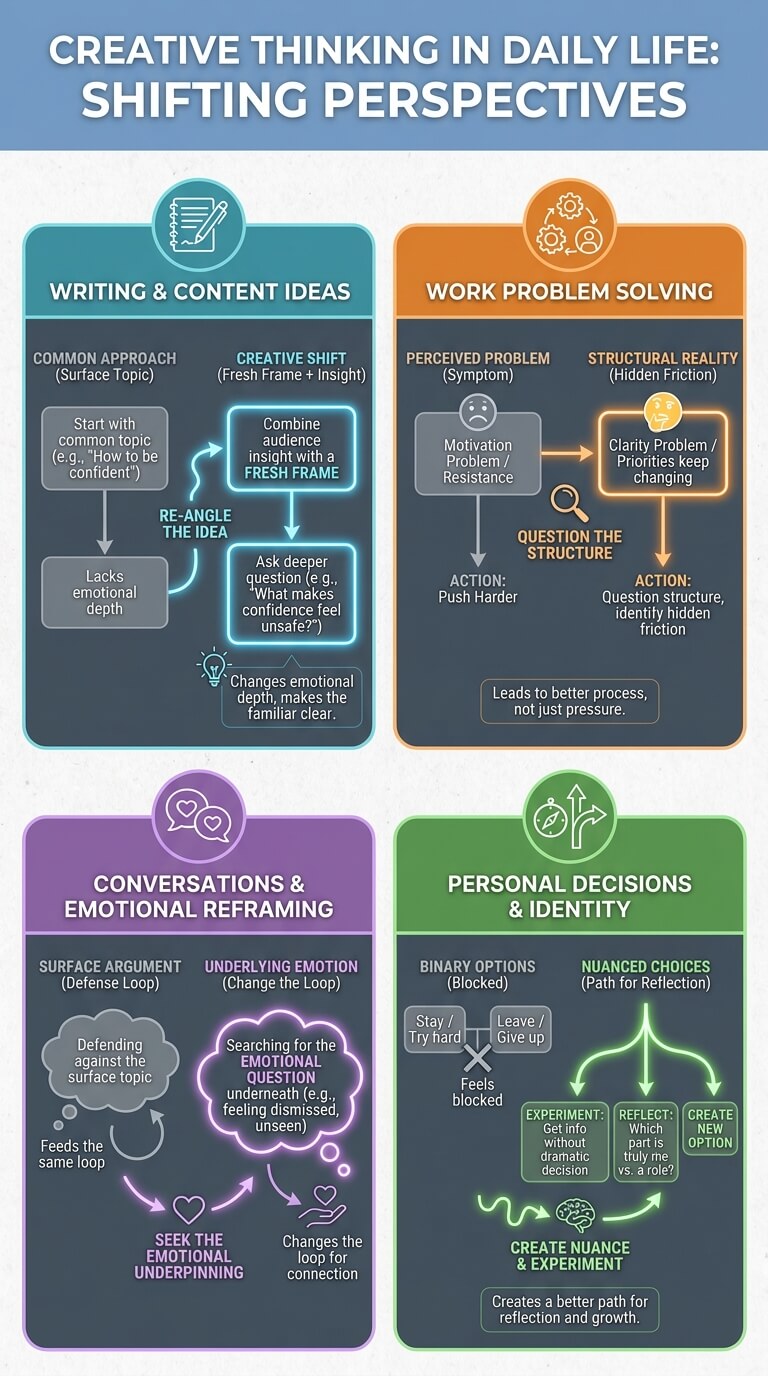
Writing and content ideas
A writer may begin with a common topic and ask what angle has been missed. Instead of writing “how to be more confident,” they might ask, “What makes confidence feel unsafe for people who were criticized for standing out?” That question changes the emotional depth of the idea.
Creative thinking in writing often comes from combining audience insight with a fresh frame. The writer is not trying to sound strange. They are trying to make the reader see something familiar more clearly.
Work problem solving
At work, creative thinking can mean questioning the structure of a problem. A team may think it has a motivation problem when it actually has a clarity problem. People may seem resistant when the real issue is that priorities keep changing.
A creative thinker does not immediately ask, “How do we push harder?” They may ask, “What hidden friction is making the desired behavior difficult?” That shift can lead to a better process, not just more pressure.
Conversations and emotional reframing
Creative thinking also appears in conversations. A person might notice that a recurring argument is not really about the surface topic. It may be about feeling dismissed, rushed, unseen, or overloaded.
Instead of repeating the same defense, creative thinking asks, “What is the emotional question underneath this?” That does not mean accepting unfair blame. It means searching for a response that changes the loop rather than feeding it.
Personal decisions and identity exploration
Personal decisions often feel blocked because the mind offers only two options. Stay or leave. Try hard or give up. Be practical or be creative. Creative thinking creates more nuanced choices.
A person considering a career change might ask, “What experiment would give me information without forcing a dramatic decision?” Someone exploring identity might ask, “Which part of this old self still belongs to me, and which part was only a role I learned to perform?” These questions do not solve everything immediately. They create a better path for reflection.
First Steps to Think More Creatively

Change the question before forcing the answer
When you feel stuck, do not begin by demanding a brilliant answer. Begin by improving the question. A better question changes what your mind searches for.
Try these swaps:
- Instead of “What is the best idea?” ask “What are three possible directions?”
- Instead of “Why am I bad at this?” ask “Which part of the process is blocked?”
- Instead of “How do I avoid criticism?” ask “What would make this idea clearer and more useful?”
- Instead of “What would impress people?” ask “What would genuinely help the person this is for?”
Create three versions before judging one
Three versions are enough to loosen the first idea without overwhelming the mind. Make one safe version, one unusual version, and one simple version. This works for titles, plans, explanations, messages, designs, and decisions.
The point is not to choose the strangest option. The point is to see the shape of the problem from more than one angle. Sometimes the safe version has the clearest structure. Sometimes the unusual version contains the strongest insight. Sometimes the simple version is the one people actually need.
Use constraints as prompts, not walls
When a constraint appears, the mind may treat it as proof that creativity is impossible. A more flexible response is to treat the constraint as a prompt.
If you have only ten minutes, ask what can be clarified in ten minutes. If the budget is small, ask what matters most. If the format is strict, ask where personality can still show up. If the topic is familiar, ask what misconception deserves correction.
Research on cognitive flexibility and creativity highlights flexibility as an important part of creative processes. In everyday terms, flexibility means the mind can change route without giving up the destination.
Capture weak ideas before they disappear
Weak ideas are not useless. They are often early signals. If you reject them instantly, you may lose the stronger idea hidden underneath.
Keep a quick capture system: a note app, a paper notebook, a voice memo, or a simple document. Do not organize too soon. Capture the phrase, image, question, or connection. Later, when evaluation is more useful, return and ask which idea has energy.
This separates two mental jobs: collecting and judging. When those jobs happen at the same time, judgment often wins too early.
Bridge Topics for Deeper Reading
When many options matter: divergent thinking
If your main struggle is producing enough possibilities, divergent thinking deserves its own focus. It helps when your mind stops at the first idea, repeats familiar answers, or treats a problem as if there are only two choices.
Creative thinking is the larger process. Divergent thinking is the expansion skill inside that process. It helps you fill the option field before choosing what to refine.
When nothing comes: creative block
Creative block is not the same as lacking creativity. It can involve pressure, perfectionism, burnout, unclear direction, emotional overload, or fear of judgment. When nothing comes, the problem may not be idea capacity. It may be the conditions around idea generation.
That distinction matters because forcing more effort is not always the answer. Sometimes the first move is reducing threat, changing the task size, resting, or separating drafting from evaluation.
When images and possibilities drive ideas: imagination
Imagination gives creative thinking material to work with. It lets the mind simulate scenes, futures, voices, outcomes, and alternatives before they exist in the world.
Creative thinking then asks what to do with that imagined material. Does it solve a problem? Does it express something meaningful? Does it need testing? Imagination opens the inner space. Creative thinking shapes that space into something usable.
When Creative Thinking Feels Stressful
Normal uncertainty vs distress
Some uncertainty is normal in creative thinking. New ideas are not fully proven yet, so they can feel awkward. You may feel unsure whether an idea is good, whether others will understand it, or whether you have enough skill to develop it.
That discomfort is not automatically a sign that something is wrong. It may simply mean the idea is still forming. However, stress becomes more concerning when it is intense, persistent, or tied to harsh self-criticism. If every creative task becomes a verdict on your worth, the emotional load is too high for a simple thinking technique to solve alone.
When to seek support for anxiety, burnout, or harsh self-criticism
Consider extra support if creative work consistently triggers panic, shame, sleep disruption, avoidance that affects your life, or thoughts of hurting yourself. Support may also help if burnout has made ordinary thinking feel heavy or numb.
For general mental health education, the National Institute of Mental Health information on anxiety can help readers understand when worry becomes more than ordinary stress. This article is educational and cannot diagnose what is happening. A qualified professional can help you sort out whether anxiety, depression, burnout, trauma, or another issue is shaping your relationship with creative work.
FAQ About Creative Thinking Psychology
Is creative thinking a skill?
Creative thinking can be treated as a skill because people can practice the mental moves that support it: noticing, associating, reframing, generating options, testing ideas, and revising. That does not mean everyone will create in the same way or at the same level. It means the process is more flexible than the myth of being “born creative” suggests.
Can logical people be creative?
Yes. Logic and creativity are not enemies. Creative thinking often needs logic after an idea appears, because the idea must be tested, clarified, and adapted to reality. A logical person may be especially strong at refining ideas, identifying constraints, or turning an unusual thought into a workable solution.
Why do I reject my ideas too quickly?
You may reject ideas quickly because evaluation arrives before exploration. This can happen when you fear criticism, expect perfection, compare your draft to someone else’s finished work, or believe a first idea should already be impressive. Try separating idea capture from idea judgment. Let rough ideas exist long enough to reveal whether they contain a useful piece.
Does creative thinking require talent?
Talent can help, but it is not the whole story. Creative thinking also depends on attention, knowledge, curiosity, emotional tolerance, practice, and willingness to revise. A person with modest natural talent but strong process habits may produce better ideas than someone who waits for inspiration and avoids revision.
How is creative thinking different from imagination?
Imagination is the ability to form mental images, possibilities, scenes, or alternatives. Creative thinking uses imagined material, but it also organizes, tests, adapts, and applies it. You can imagine many things without turning them into a useful idea. Creative thinking is what helps shape possibility into something that fits a purpose.
Key Takeaways
- Creative thinking is a cognitive process, not only an artistic identity or a personality trait.
- Better ideas often come from noticing overlooked details, combining existing knowledge, asking different questions, and changing perspective.
- Divergent thinking helps generate many options, while creative thinking includes the wider cycle of reframing, selecting, testing, and refining.
- Rigid thinking often grows from fear of being wrong, over-trusting the first idea, or treating familiar answers as the safest option.
- Constraints can support creativity when they are used as prompts rather than treated as walls.
- If creative work consistently triggers severe anxiety, burnout, or harsh self-criticism, support may be more useful than another technique.
Final Thoughts
The most practical way to begin is to stop asking your mind for a perfect idea on demand. Ask for a better question, a second version, a strange connection, or a smaller test. Creative thinking becomes easier when early ideas are allowed to be rough, flexible, and unfinished before they are judged.
If the reader wants to turn these concepts into practice, the next step is to build simple creative habits that make better thinking more repeatable.
For your next creative problem, try this small sequence: name the real question, create three versions, choose the most promising part of each, and test one small version in the real world. That is often where creative thinking becomes less mysterious and more usable.

Michael Reed is the Founder and Lead Writer at Psychology Exposed. He writes about human behavior, relationships, emotional patterns, self-awareness, and practical psychology topics using research-informed, easy-to-understand content.
Read More About Michael Reed: https://psychologyexposed.com/michael-reed/